
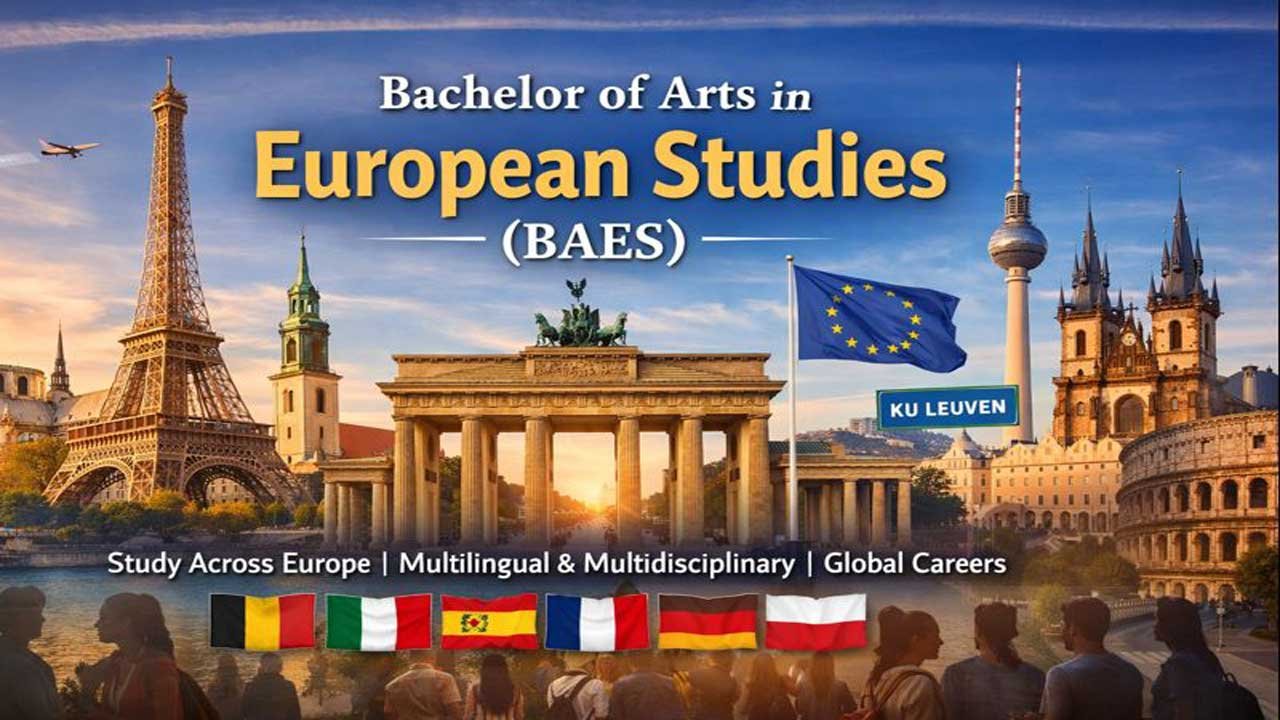
The Bachelor of Arts in European Studies (BAES) is a highly selective, three-year joint degree offered by a consortium of leading European universities through the Una Europa alliance, designed for students seeking a deep, multidisciplinary, multilingual, and lived understanding of Europe.
Combining studies in politics, law, economics, history, philosophy, international relations, and languages with mandatory mobility across two to three European countries (at least 18 months abroad), the program emphasizes personalization through major/minor specializations, strong language immersion, and research and internship opportunities.
Graduates gain exceptional analytical, cross-cultural, and professional skills that lead to strong employment outcomes (around 88% employed within six months) across EU institutions, diplomacy, government, NGOs, international organizations, and multinational corporations, with competitive long-term salary prospects.
While academically demanding and mobility-intensive, BAES offers high return on investment through international recognition, powerful professional networks, and clear pathways to advanced master’s programs, making it an ideal choice for students committed to European-focused, globally oriented careers.
| Category | Information |
|---|---|
| Program Name | Bachelor of Arts in European Studies (BAES) |
| Degree Type | Joint Bachelor’s Degree |
| Duration | 3 years (180 ECTS) |
| Consortium | Una Europa Alliance (9 leading European universities) |
| Coordinating University | KU Leuven (Belgium) |
| Degree-Awarding Universities | KU Leuven (Belgium), University of Bologna (Italy), Universidad Complutense de Madrid (Spain), Jagiellonian University Kraków (Poland) |
| Mobility Requirement | Minimum 18 months studying in 2–3 European countries |
| Language of Instruction | English + mandatory second European language |
| Academic Focus | Multidisciplinary: Politics, Law, Economics, History, Philosophy, IR, Linguistics |
| Specializations | European Law, Economics, Politics & IR, History, Philosophy & Culture, Languages & Linguistics, Society & Interdisciplinary Studies |
| Admission Level | Competitive, assessment-based |
| English Requirement | IELTS 6.5+ / TOEFL 90+ (or equivalent) |
| Application Deadline | April 1 (via KU Leuven) |
| Tuition Fees (EU students) | Approx. €900–€1,500 per year |
| Tuition Fees (Non-EU students) | Approx. €4,500–€8,500 per year |
| Employment Rate | ~88% employed within 6 months of graduation |
| Main Career Paths | EU Institutions, Diplomacy, Public Policy, NGOs, International Business, Compliance |
| Starting Salary (avg.) | €30,000–€35,000 per year |
| Mid-Career Salary (5+ yrs) | €45,000–€65,000+ |
| Further Study Options | Master’s in European Studies, IR, Public Policy, EU Law, Erasmus Mundus |
| Best Study Locations | Belgium, Germany, France, Italy, Spain, Netherlands |
| Ideal For | Students seeking international, multilingual, Europe-focused careers |
Bachelor of Arts in European Studies (BAES): Complete Guide to Program, Career Opportunities & Global Prospects
Understanding the Bachelor of Arts in European Studies: The Bachelor of Arts in European Studies (BAES) is one of Europe’s most innovative joint degree programs, designed for students who want to develop a comprehensive understanding of European societies, cultures, institutions, and global influence. Unlike traditional single-discipline European studies programs, the BAES offers a truly international, multilingual, and multidisciplinary approach to learning about Europe in the 21st century.
Offered through a unique consortium of nine leading European universities via the Una Europa alliance, this three-year bachelor’s degree (180 ECTS) combines academic rigor with extensive international mobility. Students don’t just study about Europe—they experience it firsthand by living and studying across multiple European countries during their degree.
For students aspiring to careers in diplomacy, European policy, international relations, or global business, the BAES provides an unparalleled foundation. This guide explores everything you need to know about the program, from admission requirements to career trajectories and salary expectations.
What Makes the BAES Unique: Program Structure and Features
The Four Pillars of BAES Excellence
The BAES is built on four distinctive characteristics that set it apart from conventional European studies degrees:
1. Truly International
Students complete their degree at two to three different universities across European countries, immersing themselves in different European cultures and educational systems. This extensive mobility—totaling 18 months abroad—creates opportunities to develop transversal skills that employers highly value in both domestic and international work environments. Students gain firsthand experience with Europe’s linguistic, political, and cultural diversity, not through textbooks, but through lived experience.
2. Truly Multidisciplinary
The program combines perspectives from seven disciplinary fields: Philosophy, Law, Economics, History, Politics, International Relations, and Linguistics. Rather than forcing students into rigid specializations, the BAES begins with a common core of multidisciplinary courses (“truncus communis”), followed by major and minor specializations. This flexible structure allows students to tailor their education to their specific interests and career aspirations—whether that’s EU law, economic policy, or international diplomacy.
3. Truly Multilingual
Beyond English, students master a second European language as part of their degree requirements. This dual-language competency provides a significant competitive advantage on the European job market, where multilingual professionals command premium compensation and access to restricted career paths. Language immersion is embedded throughout the curriculum and reinforced during mobility periods.
4. Truly You
The program emphasizes student agency and personalization. Rather than a one-size-fits-all curriculum, students design their own learning pathways, choose their specializations based on interest, and can incorporate internships and research projects aligned with their career goals. This customization ensures graduates enter the workforce with both breadth of knowledge and specific expertise.
Specialization Fields: Choosing Your Pathway
The BAES offers seven major/minor options, allowing students to develop specialized expertise:
- European Law: Study EU legal frameworks, constitutional law, and governance structures
- European Economics: Analyze economic integration, trade policy, and financial systems
- European History: Understand historical contexts shaping contemporary Europe
- European Politics & International Relations: Examine political systems, policy-making, and diplomatic relations
- European Philosophy & Culture: Explore intellectual traditions and cultural heritage
- European Languages & Linguistics: Develop advanced language skills and cross-cultural communication
- European Society & Interdisciplinary Studies: Analyze social issues, migration, and contemporary challenges
Students must complete one major and one minor, creating combinations that reflect their professional interests.
Partner Universities: Where You’ll Study
The BAES is coordinated by KU Leuven (Belgium) and partners with eight leading research universities:
Degree-Awarding Partners (students receive a joint degree):
- Alma Mater Studiorum – Università di Bologna (Italy)
- KU Leuven (Belgium)
- Universidad Complutense de Madrid (Spain)
- Uniwersytet Jagiellóński w Krakowie (Poland)
Mobility Partners (students earn credits and an Una Europa certificate):
- Freie Universität Berlin (Germany)
- Helsingin Yliopisto (Finland)
- University of Edinburgh (United Kingdom)
- Université Paris 1 Panthéon-Sorbonne (France)
This consortium structure ensures you study at top-tier European universities while maintaining curricular coherence. Depending on your enrollment pathway, you’ll spend at least 18 months studying at different partner institutions, gaining exposure to multiple European educational systems and research traditions.
Admission Requirements: Getting Into BAES
Admission to the BAES is competitive and assessment-based, requiring demonstration of both academic capability and personal fit for the program.
Required Documents and Assessments
Academic Requirements:
- Secondary school diploma granting university access in your country of origin
- Strong academic performance (specific GPA requirements vary by partner university)
- Demonstration of academic writing ability through an essay assignment
English Language Proficiency:
All applicants must prove advanced English competency through one of these standardized tests:
- TOEFL: 90+ overall (no subscore below 20)
- IELTS: 6.5+ (no subscore below 5.5)
- Cambridge ESOL CAE/CPE: 176+ overall (no subscore below 169)
- PTE Academic: 59+ (no subscore below 53)
- ITAEC: C1 or C2
Exemption: Students who completed secondary education at English-speaking institutions (USA, UK, Canada, Australia, Ireland, New Zealand) are automatically exempt.
Application Components:
- Academic writing assignment (evaluates critical thinking and communication)
- Motivational video pitch (assesses communication skills and genuine interest in European studies)
- Completion of the standardized application form through KU Leuven
Important Dates and Deadlines
Applications for 2026-2027 are open through April 1st to KU Leuven (the coordinating university). The application process is centralized, meaning students apply once to KU Leuven regardless of which partner university they prefer as their starting institution.
Evaluation focuses on assessing your capacity and suitability to successfully complete the rigorous BAES curriculum, including your readiness for international mobility and cross-cultural engagement.
Program Curriculum: What You’ll Study
Year 1: The Common Core Foundation
First-year courses provide multidisciplinary foundations in European studies:
Semester 1 & 2:
- Foundations of European Studies (interdisciplinary overview)
- European History I & II (from Medieval to Modern Europe)
- European Politics (EU institutions and governance)
- European Law (introduction to EU legal systems)
- European Economy (economics of European integration)
- Philosophy & European Thought (intellectual foundations)
- European Language I (second language studies)
- Research Methods & Critical Analysis
This foundational phase ensures all students, regardless of background, develop shared conceptual frameworks for understanding Europe. The research methods course is particularly important—it equips students with analytical tools used throughout their remaining studies.
Years 2-3: Specialization and Mobility
After completing the common core, students select:
Major Specialization (substantial coursework, typically 60-80 ECTS)
Minor Specialization (complementary coursework, typically 30-40 ECTS)
Advanced coursework becomes increasingly specialized, covering topics such as:
- EU institutional law and policy
- European economic integration and trade
- Contemporary European political movements
- Media, culture, and identity in Europe
- European foreign policy and diplomacy
- Constitutional frameworks and governance
- Advanced language proficiency (achieving C1 level)
Embedded Mobility and Internships
Three mobility semesters are distributed across the degree:
- First mobility semester: Second year at either starting or secondary university
- Second mobility semester: Third year at a second partner institution
- Third opportunity: Optional extended mobility, internship, or capstone research project
A compulsory winter school (offered physically or virtually) provides additional short-term interdisciplinary experiences.
Skills You’ll Develop: Competitive Advantages in the Job Market
BAES graduates develop a sophisticated skill set that employers in international affairs, diplomacy, policy analysis, and global business consistently seek:
Substantive Knowledge:
- Deep understanding of European political systems, institutions, and decision-making processes
- Expertise in EU law, policy-making, and regulatory frameworks
- Comprehensive knowledge of European economic integration and trade
- Historical context for contemporary European challenges
- Cultural and linguistic competency across multiple European societies
Critical Thinking & Analysis:
- Ability to analyze complex multi-faceted European issues from multiple disciplinary perspectives
- Competency in evaluating policy proposals and assessing their implications
- Capacity to conduct primary and secondary research using academic standards
- Understanding of different methodological approaches across disciplines (historical, legal, economic, sociological)
Communication & Presentation:
- Professional-level writing in English and at least one additional European language
- Presentation skills developed through seminars and conferences
- Capacity to communicate complex ideas to both expert and non-expert audiences
- Cross-cultural communication competency through multinational cohorts
Professional & Transferable Skills:
- Problem-solving in multicultural team environments
- Project management through research and internship components
- Adaptability to different educational systems and work cultures
- Networking ability with peers and professionals across Europe
- Digital literacy and research tool proficiency
- Entrepreneurial thinking and innovation mindset
Career Opportunities: Where BAES Graduates Work
Employment Statistics and Outcomes
Research from European universities offering similar programs shows exceptional employment outcomes:
- 88% of European studies graduates secure employment at their qualification level within six months of graduation
- Unemployment rate among graduates: significantly below national average
- Career satisfaction: Graduates consistently report meaningful, engaging careers aligned with their interests
Primary Career Sectors
Government & Public Service
BAES graduates work across government levels (local, regional, national, international) in roles including:
- European Policy Officers: Developing and implementing policies affecting European integration
- EU Specialists for Municipal/Provincial Authorities: Managing EU-level policy implications for local governance
- International Relations Specialists: Analyzing diplomatic relations and international agreements
- Trade Officers: Managing international trade relationships and regulatory compliance
- Foreign Service Officers/Diplomats: Representing national interests in European and global forums
European & International Institutions
Employment opportunities in supranational organizations:
- European Commission: Policy analysis, program management, external relations
- European Parliament: Legislative advisors, policy analysts, communications specialists
- European Council & Council of the EU: Institutional support, policy coordination
- United Nations (various agencies): UNDP, UNEP, UNESCO, UNHCR
- International Financial Organizations: IMF, World Bank, OECD, European Investment Bank
- NATO & Defense Organizations: Policy analysis, strategic studies
NGOs & International Non-Profits
Careers addressing European social and environmental challenges:
- Amnesty International, Greenpeace, Doctors Without Borders
- European human rights organizations
- Environmental and sustainability advocacy groups
- Development and international aid organizations
- Research institutes and think tanks
Private Sector & Corporate
Business opportunities for European studies graduates:
- International Business Development Managers: Identifying European market opportunities, managing expansion
- Compliance Officers: Ensuring adherence to complex EU regulations (essential in banking, energy, pharmaceuticals, technology)
- Public Affairs & Government Relations: Representing corporate interests with EU institutions and member states
- Lobbying & Strategic Communications: Shaping business-relevant policy outcomes
- European Market Analysts: Researching market entry strategies and regulatory environments
- Multinational corporations in finance, energy, technology, pharmaceuticals, and manufacturing
Academic & Research Pathways
Graduates pursuing advanced studies:
- Master’s programs in European Studies, International Relations, Public Policy, Law, Economics
- PhD research on European governance, politics, economics, or society
- University positions as researchers and academics
Specific Job Titles for BAES Graduates
| Job Title | Primary Employers | Approximate Salary Range (EUR) |
|---|---|---|
| Policy Advisor/Analyst | EU institutions, national governments, NGOs | €35,000-€55,000 |
| Lobbyist | Corporate offices, industry associations, NGOs | €40,000-€70,000+ |
| Compliance Officer | Banks, energy firms, tech companies | €38,000-€60,000 |
| Diplomat/Foreign Service Officer | National governments, EU service | €45,000-€80,000+ |
| International Business Development Manager | Multinational corporations | €42,000-€75,000+ |
| Public Affairs Manager | Corporations, associations | €40,000-€65,000 |
| EU Legal Advisor | Law firms, corporations, EU institutions | €45,000-€80,000+ |
| Communications Specialist | NGOs, EU institutions, media | €32,000-€55,000 |
Salary Expectations: What BAES Graduates Earn
Early Career Earnings
Starting Salary (0-2 years post-graduation):
- European average for recent graduates: €29,852-€35,000 annually
- Varies significantly by country, sector, and employer
- Government and institutional positions: €30,000-€42,000
- NGO positions: €25,000-€38,000
- Private sector entry roles: €32,000-€50,000
Mid-Career Progression (5 years post-graduation)
Average salary after five years: €45,446-€55,000 annually
- Policy and compliance roles: €45,000-€65,000
- Senior positions in corporations: €50,000-€75,000
- Diplomatic service: €50,000-€70,000
- Management positions: €55,000-€80,000
Top Earners (10+ years experience)
High-earning trajectories:
- Top 20% of earners: €60,000-€86,545+ annually
- Senior corporate positions: €70,000-€120,000
- Executive roles in institutions: €80,000-€150,000
- Senior diplomats: €75,000-€140,000
Factors Affecting Your Salary
Geography: Salaries vary significantly across Europe. Switzerland, Germany, Netherlands, and Nordic countries offer 15-30% higher compensation than Southern or Eastern European countries.
Employer Type: International organizations and multinational corporations typically pay 20-40% more than local NGOs or government agencies.
Language Skills: Additional European language proficiency (beyond the required second language) commands 10-20% salary premiums.
Specialization: Legal expertise and economic specialization often command higher salaries than generalist policy positions.
Experience & Advancement: Career progression accelerates for professionals who combine their BAES degree with professional certifications or master’s degrees.
Geographic Context: Europe’s Job Market in 2026
Understanding where jobs are concentrated helps guide your career strategy.
Top Destinations for BAES Graduates
Germany
- Largest job market for international relations professionals
- Strong demand in Berlin (EU policy), Frankfurt (finance), Munich (corporate)
- Tech, finance, and engineering sectors growing rapidly
- Salary range: €35,000-€70,000 starting to experienced
Belgium (Brussels)
- Heart of EU institutions and policy-making
- Highest concentration of BAES-relevant positions
- Diverse employers: European Commission, Parliament, Council, NATO, think tanks, lobbyists
- Salary range: €38,000-€75,000 (EU institutions); €40,000-€80,000+ (private sector)
Netherlands
- Progressive work environment, high quality of life
- Strong corporate sector with international orientation
- Tech and sustainability emerging sectors
- Salary range: €36,000-€65,000
United Kingdom (London)
- Global financial hub with international business emphasis
- Strong NGO and diplomatic presence
- Post-Brexit dynamic creating career opportunities
- Salary range: £32,000-£60,000+ (equivalent EUR)
France (Paris)
- Cultural influence in policy discussions
- Strong governmental and institutional presence
- Growing tech sector
- Salary range: €33,000-€60,000
Poland, Czech Republic, Hungary
- Emerging markets with lower cost of living
- Growing international business presence
- EU policy development roles
- Salary range: €25,000-€45,000
Job Market Trends for 2026
The European employment landscape is shifting in directions favorable to BAES graduates:
- Digital transformation: Demand for professionals who understand digital regulation (GDPR, AI Act), cybersecurity governance, and digital market policy
- Green transition: European Green Deal creating roles in sustainability policy, environmental compliance, renewable energy regulation
- Geopolitical complexity: Russia-Ukraine conflict increasing demand for security analysts, foreign policy specialists
- Healthcare: Telemedicine regulations, pandemic preparedness creating policy roles
- AI governance: Emerging field requiring policy expertise and multidisciplinary understanding
Cost of Study: Tuition Fees and Financial Planning
Annual Tuition Fees
Tuition fees vary based on your citizenship and the degree-awarding partner university:
For EU/EEA Students:
- Belgium (KU Leuven): €906/year
- Spain (Universidad Complutense de Madrid): €750-€2,100/year
- Italy (Università di Bologna): €900-€1,500/year
- Poland (Jagiellóński): €600-€1,200/year
- Average EU student cost: €900-€1,500/year
For Non-EU International Students:
- Belgium: €4,175-€8,500/year
- Spain: €6,000-€8,000/year
- Italy: €5,000-€7,000/year
- Poland: €3,500-€5,000/year
- Average non-EU cost: €4,500-€8,500/year
Total Program Cost (Three Years)
EU Students: €2,700-€4,500 tuition + living costs (€9,000-€15,000 annually depending on country) = Total: €29,700-€49,500
Non-EU Students: €13,500-€25,500 tuition + living costs = Total: €40,500-€70,500
Living Costs by Country
Average annual living expenses (accommodation, food, transport, materials):
- Belgium: €10,200-€11,400
- Spain: €9,600-€12,000
- Italy: €8,500-€11,000
- Poland: €7,000-€9,500
- Germany/France: €9,000-€11,500
Scholarships and Financial Support
Erasmus+ Scholarships
- Partial tuition coverage and living stipends
- Competitive merit-based selection
- Typically €300-€500/month for mobility periods
University-Specific Scholarships
- KU Leuven Excellence Scholarship
- Universidad Complutense de Madrid scholarships
- University of Bologna merit scholarships
- Varying amounts and eligibility criteria
Erasmus Mundus Joint Masters
- Available after BAES completion
- Full tuition + living cost scholarships available
- €1,200+ monthly stipends for selected students
National Government Scholarships
- Many countries offer scholarships for citizens studying abroad
- Research your home country’s education ministry offerings
- Often combined with loan programs
Cost-Benefit Analysis
While program costs are significant, several factors justify the investment:
- High employment rate (88%) ensures return on investment
- Average salary trajectory reaches break-even within 3-5 years
- International credential increases lifetime earning potential
- Multilingual, internationally experienced graduates command 15-30% salary premium
- Access to European professional networks provides long-term career advantages
- Strong job security and meaningful work trajectory
Student Experience: What It’s Really Like to Study BAES
The Mobility Experience
Students consistently cite the mobility component as transformative. Rather than passive study-abroad, students are integrated into local universities’ academic communities for 4-6 month periods. This creates genuine immersion—you’re not a tourist, but a student taking courses, conducting research, and building relationships with peers from diverse backgrounds.
One student reflected: “I’m convinced European Studies provides you with a good background. In combination with being curious and wanting to learn every day, it gives you a great advantage when looking for a job in the field.”
The international cohort—students from across Europe and the world—creates a professional network that often spans decades. Many graduates maintain friendships and professional connections with peers from their BAES cohort.
Academic Rigor
BAES is academically demanding. The common core exposes students to rigorous disciplinary methods (historical analysis, legal reasoning, economic modeling, philosophical argumentation). Research methods coursework teaches academic standards that graduates apply throughout their careers.
The thesis component (typically 30 ECTS, requiring 12+ weeks of research and writing) provides substantial capstone experience. Many graduates describe their thesis as the most intellectually challenging and rewarding academic work of their lives.
Cohort Characteristics
BAES attracts intellectually curious, internationally oriented students. Cohort diversity is intentional—you’ll study alongside peers from Poland, Belgium, Spain, Germany, France, UK, and beyond. This diversity enriches discussions and creates a genuinely European learning environment.
Language immersion occurs naturally. Your study group includes native speakers of multiple languages, and requirements to develop second-language proficiency create peer communities for language practice.
How BAES Compares to Alternative European Studies Programs
BAES vs. Single-University European Studies Degrees
Advantages of BAES:
- Multi-university exposure vs. single institutional perspective
- Mandatory 18-month mobility vs. optional study abroad
- Joint degree recognized across multiple European jurisdictions
- Built-in European network of peers and institutions
- Multidisciplinary requirements vs. variable disciplinary flexibility
Trade-offs:
- Higher coordination complexity (benefits from institutional efficiency)
- Slightly higher costs for non-EU students
- Mandatory mobility (some students prefer stability)
- More specialized program (if you want broader liberal arts, traditional programs offer more flexibility)
BAES vs. Master’s Programs in European Studies
Many students ask whether they should pursue a BAES bachelor or traditional bachelor + master’s pathway.
BAES Advantages:
- Develop European expertise earlier in career
- Access European job market immediately after graduation
- Master’s degree typically requires 2 additional years/significant cost
- BAES graduates can pursue specialized master’s with advanced standing
- Networking and mobility built into undergraduate experience
Master’s Advantages:
- Greater specialization after general undergraduate foundation
- Potentially higher entry-level positions (some EU institutions require master’s)
- More advanced research experience before entering job market
- Ability to work 2-3 years before graduate study
Recommendation: BAES for students certain about European-focused careers; traditional bachelor + master’s for those exploring options.
International Recognition
The BAES carries special recognition as an official “Una Europa” joint European degree. This designation:
- Signals multidisciplinary, multilingual, multicultural education quality
- Recognized by European employers, institutions, and academic bodies
- May enable faster visa processing in certain countries
- Positions graduates favorably for international careers
Master’s Pathways After BAES: Continuing Your Education
BAES degree provides access to diverse master’s programs:
Directly Related Master’s Programs:
- MA European Studies (various universities)
- MA International Relations
- MA European Politics & Governance
- MA EU Law
- MA European Business & Diplomacy
Professional Master’s with European Focus:
- MA Public Policy (European concentration)
- MBA International Business (European emphasis)
- LLM European Law
- MA Diplomatic Studies
Erasmus Mundus Joint Masters
- Full scholarships available: €1,200-€1,500/month
- Programs combine 2-3 universities across Europe
- 2-year intensive programs with internship components
Career-Specific Master’s:
- Civil Service Fast Stream (UK) – designed for future civil servants
- Sciences Po Master’s in Public Affairs
- College of Europe programs in Brussels/Bruges (highly prestigious for EU careers)
Average timeline: BAES bachelor (3 years) + master’s (1-2 years) = 4-5 years total to advanced professional qualification.
Making Your Decision: Is BAES Right for You?
BAES is an excellent fit if you:
✓ Have genuine interest in understanding Europe in depth
✓ Are comfortable with international mobility and adaptation
✓ Seek careers in European policy, diplomacy, or international affairs
✓ Value multilingual education and cross-cultural competency
✓ Want to build professional networks across Europe
✓ Are intellectually curious about complex, multifaceted issues
✓ Can manage the academic rigor and research demands
✓ Are willing to invest in upfront costs for long-term career advantage
Consider alternative programs if you:
✗ Prefer staying in one location for your studies
✗ Are undecided about European-focused career paths
✗ Have limited financial resources (though scholarships help)
✗ Prefer narrower disciplinary focus
✗ Need immediate job entry (three years is substantial time investment)
Getting Started: Application Timeline and Next Steps
Critical Dates
| Timeline | Milestone |
|---|---|
| Now – January | Research programs, prepare application materials |
| January – March | Polish application essays, prepare video pitch, arrange English test |
| March – early April | Final application push, submit through KU Leuven portal |
| April 1 | Application deadline |
| April – June | Application review and interviews |
| June – July | Admission decisions released |
| July – August | Visa application, housing search, enrollment procedures |
| September | Program begins at starting university |
Preparing Your Application
- Research the program thoroughly: Review course offerings, partner universities, specialization paths
- Take the English test early: TOEFL/IELTS preparation requires 2-3 months; test results take weeks
- Craft compelling essays: Address why you’re specifically interested in BAES vs. general European studies
- Prepare your video pitch: Practice explaining your motivation authentically (2-3 minutes)
- Gather supporting documents: Academic transcripts, reference letters, passport copy
- Plan your finances: Research scholarship opportunities early
- Connect with current students: Reach out via LinkedIn, Una Europa website for insights
Resources
- Una Europa official website: www.una-europa.eu/study/baes
- KU Leuven admissions: www.kuleuven.be/programmes/bachelor-european-studies
- Application portal: KU Leuven online application system
- Student testimonials: Search YouTube for “BAES Una Europa student experience”
Conclusion: Your European Future Starts Here
The Bachelor of Arts in European Studies represents a unique educational opportunity—one that combines rigorous multidisciplinary scholarship with genuine international experience. The 18 months you spend studying across European universities isn’t an add-on; it’s central to the program’s educational mission.
Graduates emerge as “truly European professionals”—individuals who understand Europe’s complexities, speak multiple languages fluently, have built networks across the continent, and possess skills that international employers consistently seek.
Whether your aspiration is European policy-making, diplomacy, international business, or NGO leadership, the BAES provides comprehensive preparation. The program’s 88% employment rate and strong salary trajectories reflect employer recognition of these skills.
The investment—both financial and temporal—pays dividends through career opportunities, professional advancement, and the profound personal growth that comes from studying and living across multiple European countries alongside an international cohort of peers.
Your application deadline is approaching. For students committed to understanding Europe deeply and building careers in international affairs, the BAES remains Europe’s premier undergraduate pathway.
FAQs
What is the Bachelor of Arts in European Studies (BAES)?
The Bachelor of Arts in European Studies (BAES) is a three-year joint undergraduate degree offered by a consortium of leading European universities under the Una Europa alliance, focusing on Europe’s politics, law, economy, history, culture, and languages through a multidisciplinary and international approach.
How is BAES different from a traditional European Studies degree?
Unlike traditional single-university programs, BAES requires students to study at multiple European universities, offers a joint degree recognized across Europe, integrates mandatory mobility, and combines several disciplines within one structured curriculum.
How long does the BAES program last?
The BAES program lasts three academic years and comprises 180 ECTS credits.
Which universities offer the BAES degree?
The degree is coordinated by KU Leuven and awarded jointly by KU Leuven, the University of Bologna, Universidad Complutense de Madrid, and Jagiellonian University Kraków, with additional mobility partners including institutions in Germany, France, Finland, and the UK.
Is BAES taught entirely in English?
Yes, the main language of instruction is English, but students must also study and demonstrate proficiency in at least one additional European language.
How many countries will I study in during BAES?
Students study in at least two and usually three different European countries, with a minimum of 18 months spent abroad during the program.
What disciplines are included in the BAES curriculum?
The program integrates philosophy, law, economics, history, politics, international relations, linguistics, and interdisciplinary social studies.
Can I choose a specialization in BAES?
Yes, students choose one major and one minor specialization, allowing them to tailor the program to their academic interests and career goals.
What specialization options are available?
Specializations include European Law, European Economics, European History, European Politics and International Relations, European Philosophy and Culture, European Languages and Linguistics, and European Society and Interdisciplinary Studies.
Is BAES suitable for students interested in diplomacy or EU careers?
Yes, BAES is specifically designed to prepare students for careers in EU institutions, diplomacy, public policy, international organizations, and related fields.
What are the admission requirements for BAES?
Applicants need a secondary school diploma granting university access, strong academic performance, proof of English proficiency, an academic writing assignment, and a motivational video pitch.
What English tests are accepted for BAES?
Accepted tests include IELTS, TOEFL, Cambridge CAE/CPE, PTE Academic, and ITAEC at C1 or C2 level, with exemptions for students educated in English-speaking countries.
Is BAES competitive to get into?
Yes, BAES is a selective program with holistic evaluation focusing on academic ability, motivation, writing skills, and readiness for international mobility.
When is the application deadline for BAES?
The main application deadline is April 1 for entry in the following academic year.
Do I apply to each university separately?
No, applications are centralized and submitted through KU Leuven, regardless of the preferred starting university.
How much does BAES cost for EU students?
Tuition fees for EU students typically range from about €900 to €1,500 per year, depending on the degree-awarding university.
How much does BAES cost for non-EU students?
For non-EU students, tuition fees generally range from approximately €4,500 to €8,500 per year.
What are the living costs during the program?
Living costs vary by country but generally range between €7,000 and €12,000 per year, covering accommodation, food, transport, and study materials.
Are scholarships available for BAES students?
Yes, students may access Erasmus+ mobility grants, university-specific scholarships, national government scholarships, and later Erasmus Mundus funding for master’s studies.
Does BAES include internships?
The curriculum allows and encourages internships, particularly during mobility periods or as part of capstone and research components.
What skills do BAES graduates gain?
Graduates develop strong analytical, research, multilingual communication, cross-cultural, policy analysis, and professional skills valued in international careers.
What is the employment rate after graduating from BAES?
Around 88% of graduates secure employment at their qualification level within six months of graduation.
What jobs do BAES graduates typically pursue?
Common roles include policy analyst, EU affairs officer, diplomat, compliance officer, public affairs manager, lobbyist, NGO project officer, and international business development manager.
Can BAES graduates work in the private sector?
Yes, many graduates work in multinational corporations in areas such as compliance, government relations, market analysis, and international strategy.
What is the average starting salary after BAES?
Starting salaries typically range between €30,000 and €35,000 annually, depending on country, sector, and employer.
How does salary progress over time for BAES graduates?
Mid-career salaries often reach €45,000–€65,000+, with senior professionals earning significantly more, especially in EU institutions or corporate roles.
Is BAES recognized internationally?
Yes, BAES is an official Una Europa joint degree and is widely recognized by European employers, institutions, and universities.
Can I pursue a master’s degree after BAES?
BAES graduates commonly continue to master’s programs in European Studies, International Relations, Public Policy, EU Law, Economics, or Erasmus Mundus joint programs.
Is BAES academically demanding?
Yes, the program is rigorous, with strong emphasis on research, critical thinking, writing, and interdisciplinary analysis.
Who is BAES best suited for?
BAES is ideal for students with strong interest in Europe, international affairs, languages, mobility, and complex policy issues.
Is BAES suitable for students who prefer staying in one country?
No, the program requires mandatory mobility and is not ideal for students seeking a single-location study experience.
Does BAES help with networking?
Yes, students build extensive professional and academic networks across Europe through multinational cohorts, partner universities, and mobility experiences.
What makes BAES valuable in the job market?
Its combination of multilingualism, international experience, joint-degree recognition, and multidisciplinary training gives graduates a strong competitive advantage.
Is BAES worth the investment?
For students committed to European and international careers, BAES offers strong return on investment through high employability, salary growth, and long-term career flexibility.


Leave a Reply
You must be logged in to post a comment.