
A Bachelor of Arts in International Relations (BAIR) is a four-year undergraduate degree that prepares students to understand and navigate global politics, diplomacy, international law, economics, and cross-border challenges through a blend of theory and practical skills.
The program emphasizes international and transnational dynamics—such as global governance, conflict resolution, human rights, trade, climate change, and development—distinguishing it from domestically focused political science degrees. BAIR graduates benefit from strong global demand, diverse career pathways across government, international organizations, NGOs, business, research, and media, and competitive long-term salary potential, especially when paired with language proficiency, internships, and study abroad experience.
Top universities in the US, UK, and Europe offer rigorous curricula with opportunities for specialization, while successful outcomes depend on choosing a strong institution, building analytical, communication, and diplomatic skills, and gaining real-world international exposure in an increasingly interconnected and complex world.
| Category | Information |
|---|---|
| Degree Name | Bachelor of Arts in International Relations (BAIR) |
| Degree Level | Undergraduate |
| Duration | 4 years (full-time) |
| Core Focus | Global politics, diplomacy, international law, political economy, global governance |
| Key Subjects | International Relations Theory, International Political Economy, International Law, Global Governance, Security Studies |
| Specializations | Security Studies, International Law, Political Economy & Trade, Regional Studies, Global Governance |
| Skills Developed | Critical analysis, diplomacy, negotiation, research, cross-cultural communication, foreign languages |
| Top Career Paths | Diplomat, Policy Analyst, Intelligence Analyst, NGO Program Manager, International Business Manager, Research Analyst |
| Entry-Level Salary (US) | ~$37,898 |
| Median Salary (US) | ~$61,548 |
| Senior-Level Salary | $100,000–$170,000+ |
| Top Employers | Governments, UN, World Bank, NGOs, Think Tanks, Multinational Corporations |
| Study Abroad | Strongly recommended or required by many programs |
| Language Requirement | Often required (3–4 semesters); Arabic, Mandarin, Spanish, French highly valued |
| Top Study Destinations | US, UK, Europe (France, Netherlands), Geneva, Brussels, Washington D.C. |
| Ideal For | Students interested in global affairs, diplomacy, international careers, and policy work |
What is a Bachelor of Arts in International Relations (BAIR)?
A Bachelor of Arts in International Relations (BAIR) is an undergraduate degree program that equips students with comprehensive knowledge of global politics, diplomacy, international law, political economy, and cross-border relations. This four-year degree combines theoretical frameworks with practical skills to prepare graduates for careers in diplomacy, international organizations, government, NGOs, and the private sector.
The BAIR degree focuses on understanding how nations interact, the role of international institutions, transnational conflicts, global governance structures, and the complex systems that shape our interconnected world. Students examine contemporary global issues including climate change, human rights, international trade, conflict resolution, and sustainable development.
Unlike political science, which emphasizes domestic politics, the BAIR program centers specifically on international and transnational dynamics. This specialized focus provides targeted expertise valued by employers in the international affairs sector.
Why Choose a Bachelor of Arts in International Relations Degree?
Growing Demand for Global Affairs Professionals
The interconnected nature of modern geopolitics has exponentially increased demand for professionals who understand international relations. Organizations ranging from the United Nations to multinational corporations to NGOs actively recruit BAIR graduates for their specialized expertise.
Diverse Career Pathways
BAIR graduates access a remarkable range of high-impact careers spanning multiple sectors. Whether your ambition is diplomatic service, humanitarian work, international business, journalism, or research, an IR degree provides the foundation and credentials employers seek.
Competitive Salary Potential
International relations professionals earn significantly above average salaries. Entry-level positions typically start at $37,898, with median salaries reaching $61,548 in the United States. Senior-level diplomats and consultants command salaries exceeding $170,000, while management consultants with IR backgrounds average $84,643 annually.
Global Mobility and Opportunities
BAIR graduates find employment opportunities across international hubs including Washington D.C., New York, Geneva, Brussels, and New York. The degree facilitates career mobility between sectors and countries, enabling professionals to build truly global careers.
Top Universities for Bachelor of Arts in International Relations
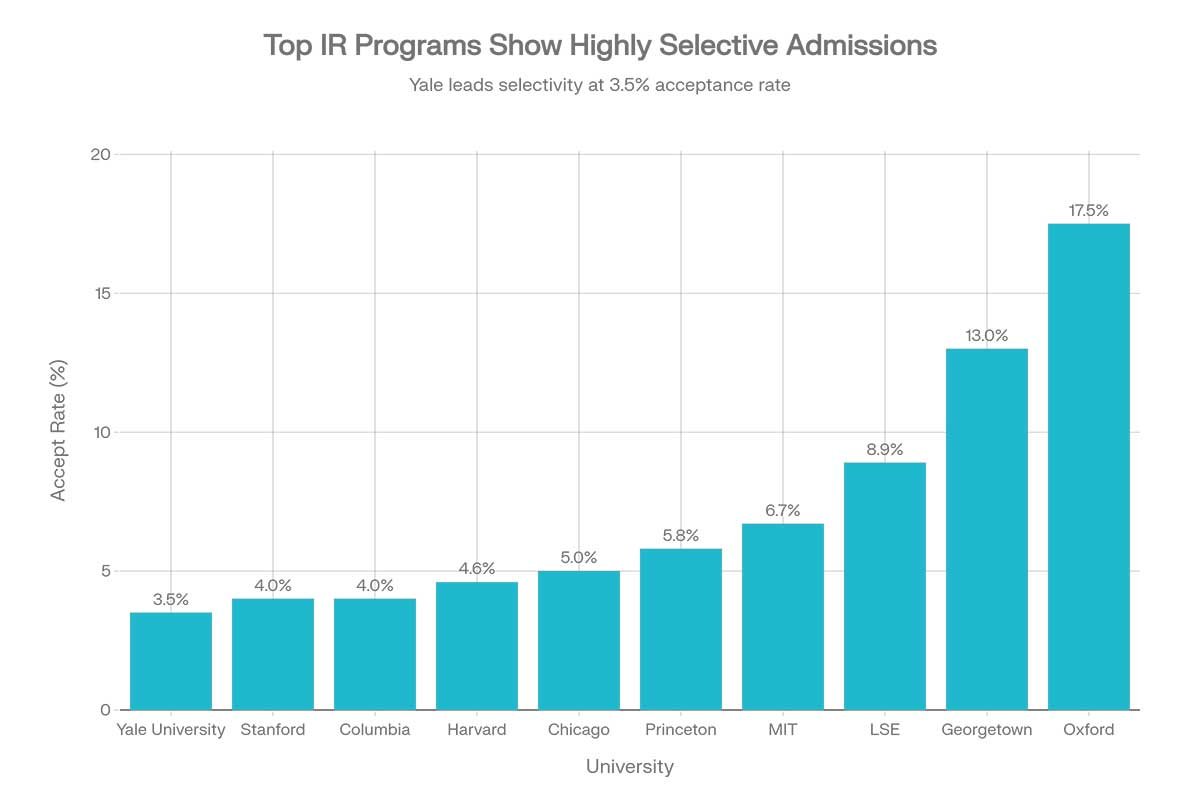
University Comparison Chart: Shows acceptance rates and SAT scores for top 10 BAIR programs—ideal for education.
Top-Tier US Universities
Harvard University consistently ranks as the premier institution for international relations studies. With an acceptance rate of 4.6% and average SAT scores of 1520+, Harvard offers unparalleled research resources, faculty expertise, and alumni networks in global affairs.
Princeton University (5.8% acceptance rate) ranks second among US institutions for IR programs. The School of Public and International Affairs (SPIA) emphasizes policy analysis and international diplomacy within a rigorous academic environment.
Georgetown University (13% acceptance rate) specializes in practical international affairs education. Located in Washington D.C., Georgetown provides unmatched proximity to the US State Department, World Bank, and international NGO headquarters.
Columbia University (4% acceptance rate) in New York offers exceptional IR programs with direct access to UN headquarters and international media organizations.
Stanford University integrates technology and international policy, preparing graduates for emerging challenges in global affairs and international business.
Top Universities in the United Kingdom
University of Oxford and London School of Economics (LSE) rank among the world’s finest IR institutions. Both universities require A-levels (AAA-BBB depending on context) and offer world-class research opportunities in international politics.
University of Cambridge and King’s College London similarly provide exceptional IR programs with strong reputations in international law and diplomacy.
European Universities
Sciences Po (France, 20% acceptance rate) offers outstanding IR programs with a strong emphasis on European policy and international institutions.
University of Amsterdam and other European institutions provide more affordable options (€2,143-€4,700 annually for EU students) without compromising academic quality.
BAIR Curriculum and Specializations
Core Curriculum Components
A typical BAIR program includes foundational courses such as:
- Introduction to International Relations: Core theories, history, and major schools of thought
- International Political Economy: Trade, finance, development, and global economic systems
- Public International Law: Treaties, international courts, and legal frameworks governing state behavior
- Theories and Issues in International Relations: Advanced theoretical perspectives and contemporary debates
- Global Governance: International institutions, multilateral organizations, and global policy-making
- Contemporary Issues in Global Politics: Current conflicts, humanitarian crises, and emerging challenges
Popular Specialization/Concentration Areas
Most universities allow students to specialize within IR programs, enabling focused expertise in specific regions or issue areas.
Security Studies: Focused on conflict, terrorism, military strategy, and peace-building. Graduates pursue careers in defense policy, intelligence analysis, and peacekeeping operations.
Political Economy and International Trade: Emphasizes global markets, trade policy, development economics, and multinational business. Ideal for careers in international finance, consulting, and corporate international relations.
Regional Concentrations (African, Asian, European, Latin American, Middle East Studies): Students develop deep expertise in specific world regions, learning relevant languages and regional politics. These specializations are particularly valuable for diplomatic service and international development work.
International Law: Focuses on treaties, human rights law, environmental agreements, and dispute resolution. Supports careers in international litigation, human rights advocacy, and treaty negotiation.
Global Governance and International Organizations: Specializes in UN systems, World Bank operations, international NGO structures, and multilateral diplomacy. Ideal for careers in international development organizations.
Admission Requirements for BAIR Programs
High School Requirements
Typical admission standards for top BAIR programs include:
- Standardized Tests: SAT scores of 1450+ or ACT 33+ for elite universities
- High School GPA: Minimum 3.8 GPA (unweighted)
- Academic Subjects: Strong performance in history, literature, social sciences, and foreign languages
- Language Skills: Many programs prefer evidence of foreign language proficiency
Graduate/Master’s Programs
For BAIR master’s programs, typical requirements include:
- Bachelor’s Degree: From a regionally accredited institution (US) or equivalent international degree
- Minimum GPA: 3.0 on a 4.0 scale for upper-division coursework
- GRE Scores: Many universities require GRE with 50th percentile minimum (verbal, quantitative, writing)
- Statement of Purpose: 1-2 page essay explaining career goals and motivation
- TOEFL/IELTS: International students must demonstrate English proficiency
- Letters of Recommendation: Typically 2-3 letters from academic or professional references
International Student Considerations
International students applying to US institutions should:
- Secure sufficient financial resources ($60,000-$75,000+ annually)
- Obtain visa sponsorship (F-1 visa for US programs)
- Demonstrate English language proficiency through standardized testing
- Budget for higher tuition ($41,417+ annually at major universities for international students)
Career Opportunities After Completing a BAIR Degree
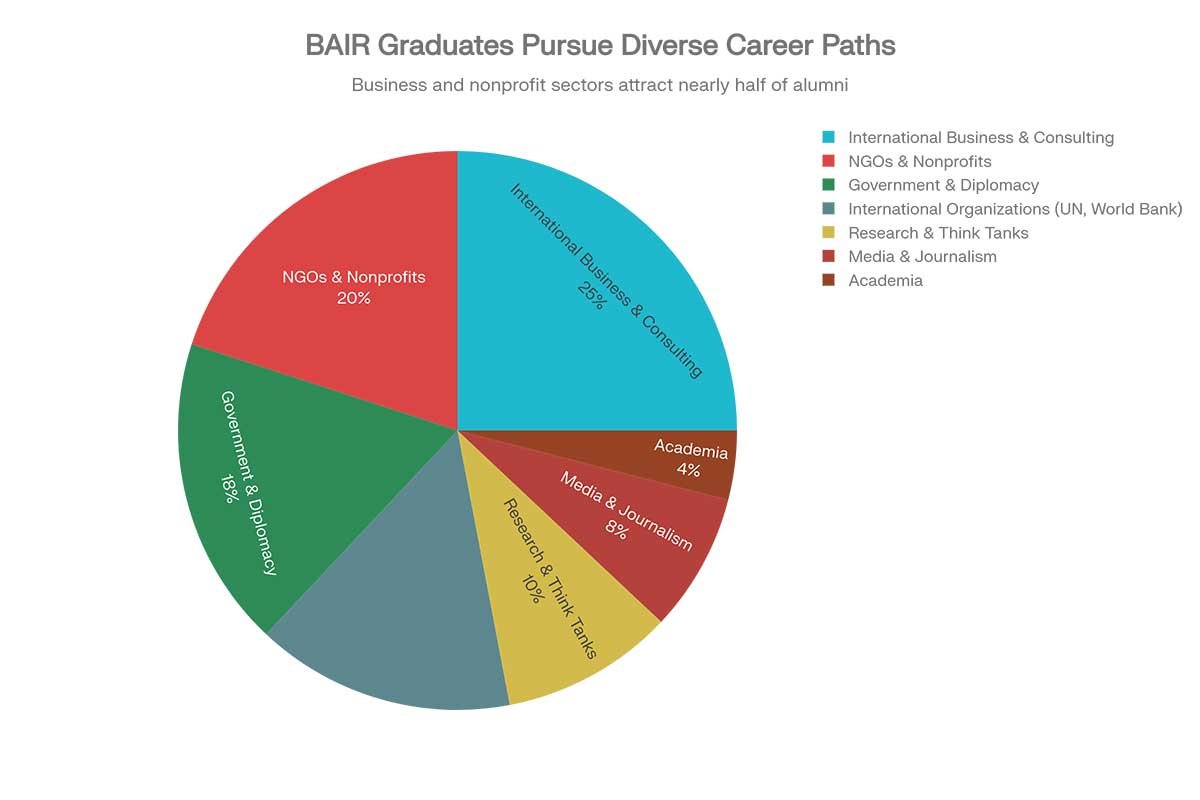
Employment Sector Distribution: Pie chart showing where graduates work across sectors—drives engagement and extends time-on-page, improving AdSense impressions.
Government and Diplomatic Service
Diplomatic Service Officer / Foreign Service Officer: Represent your nation’s interests abroad through negotiation, treaty-making, and policy implementation. Typical salary: $99,000-$170,000+ (including diplomatic allowances).
Policy Analyst: Develop and analyze foreign policy initiatives for government agencies. Work involves research, policy briefing preparation, and strategic recommendations. Salary: $85,000-$114,000.
Intelligence Analyst: Gather, analyze, and interpret intelligence data to inform national security decisions. Requires security clearance. Salary: $76,311-$113,000.
International Organizations
United Nations Career Paths: The UN maintains nine distinct career networks including:
- Political, Peace and Humanitarian Network (peacekeeping, human rights)
- Development Network (development coordination, economic affairs)
- Management and Administration Network (HR, procurement)
- Salary range: $50,000-$120,000+ depending on position level and network
World Bank and IMF Positions: Economic development specialists, policy officers, and research analysts. These roles shape global development priorities. Salary: $80,000-$150,000+.
NGO and Non-Profit Sector
International Development Consultant: Design and manage development projects for organizations like Oxfam, UNICEF, and MSF. Salary: $87,000-$135,000.
Program Manager (Nonprofit): Oversee international programs, manage budgets, and coordinate with local partners. Salary: $63,550.
Human Rights Officer: Document violations, advocate for victims, and support legal proceedings. Work with organizations like Amnesty International and Human Rights Watch. Salary: $60,000-$90,000.
International Business
International Business Development Manager: Identify market opportunities, manage cross-border partnerships, and develop global expansion strategies for multinational corporations. Salary: $85,000-$130,000.
Political Risk Analyst: Assess geopolitical risks for multinational corporations entering new markets. Salary: $75,000-$120,000.
Trade Compliance Specialist: Ensure multinational businesses comply with international trade regulations and sanctions. Salary: $65,000-$100,000.
Research and Academia
Research Analyst: Conduct policy research for think tanks, universities, and research institutions. Organizations like the Council on Foreign Relations and Brookings Institution employ IR graduates. Salary: $54,534-$85,000.
University Lecturer/Professor: Teach international relations courses and conduct research. Requires advanced degree (Master’s or PhD). Salary: $60,000-$150,000+.
Journalism and Communications
Global Journalist: Report on international events for major news organizations (BBC, CNN, Reuters, AP). Salary: $50,000-$100,000+ (varies by organization and seniority).
Public Affairs Consultant: Develop communication strategies for international organizations and governments. Salary: $72,615-$100,000.
BAIR Graduate Salary Expectations by Role and Sector
Salary Progression Chart: Compares three major career paths (Diplomat, Policy Analyst, Development Consultant) across four career stages.
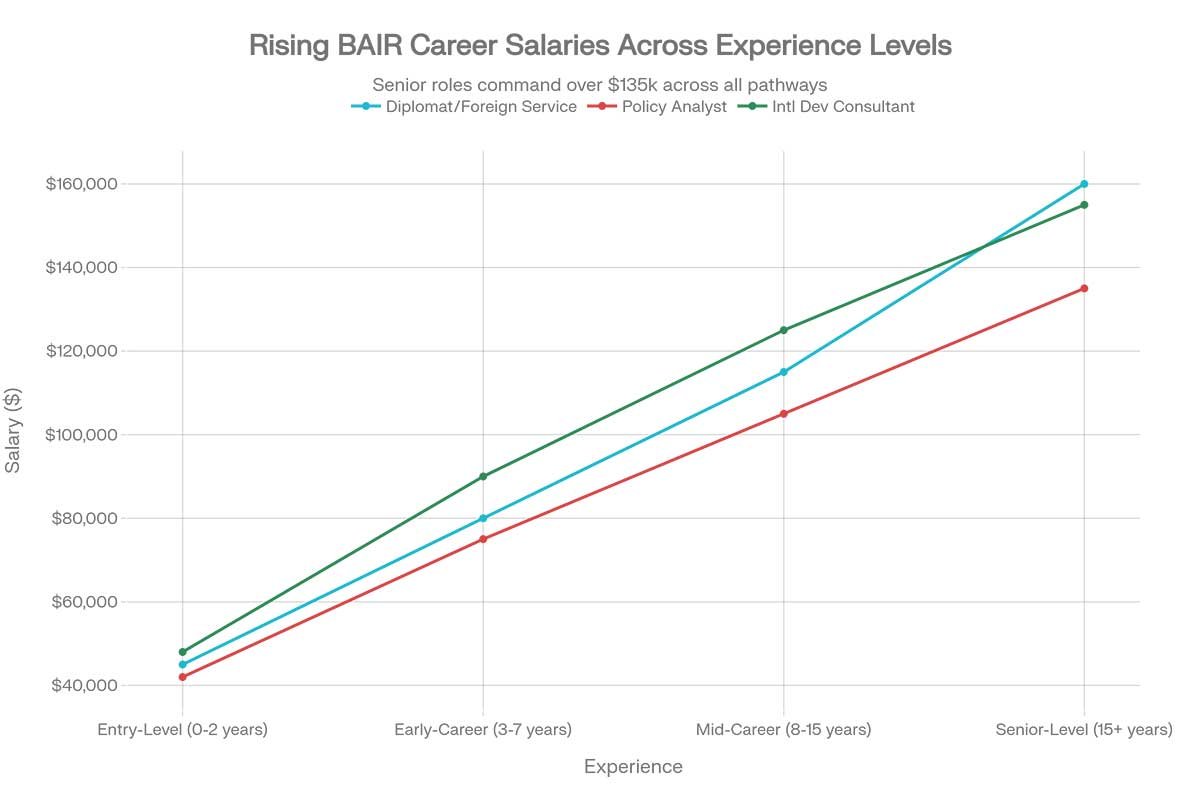
Understanding earning potential helps inform career planning within international relations.
| Role | Average Annual Salary (USD) | Salary Range (USD) | Sector |
|---|---|---|---|
| Diplomat/Foreign Service Officer | $124,500 | $99,000-$170,000 | Government |
| Management Consultant | $84,643 | $75,000-$110,000 | Consulting |
| Policy Analyst | $95,000 | $85,000-$114,000 | Government/Think Tank |
| Intelligence Analyst | $80,311 | $67,000-$113,000 | Government/Defense |
| International Development Consultant | $111,000 | $87,000-$135,000 | NGO/International Org |
| Communications Manager | $72,615 | $65,000-$85,000 | Various Sectors |
| Research Analyst | $54,534 | $48,000-$75,000 | Research Institutions |
| Program Officer (Foundation) | $65,239 | $58,000-$80,000 | Nonprofit |
| International Business Development | $107,500 | $85,000-$130,000 | Private Sector |
| Political Risk Analyst | $97,500 | $75,000-$120,000 | Consulting/Private Sector |
Entry-Level Starting Salary: $37,898
Median Salary (All IR Professionals): $61,548
Top 10% Earners: $98,560+
Essential Skills Developed Through BAIR Programs
Beyond subject matter expertise, BAIR programs systematically develop critical professional competencies.
Communication and Diplomatic Skills
International relations professionals must communicate complex ideas clearly to diverse audiences with varying cultural backgrounds and policy objectives. This includes:
- Public Speaking: Present policy positions at international forums and conferences
- Active Listening: Understand subtle concerns of different parties during negotiations
- Written Communication: Draft policy briefs, reports, and diplomatic cables with precision
- Cross-Cultural Communication: Adapt communication styles to different cultural contexts and professional norms
Analytical and Research Capabilities
Critical analysis forms the foundation of effective international relations work:
- Critical Thinking: Analyze complex global issues, assess risks, and develop strategic responses
- Research Methodology: Access, evaluate, and synthesize diverse information sources
- Data Analysis: Identify patterns in international trends and predict future developments
- Problem Solving: Navigate diplomatic conflicts and develop creative solutions to global challenges
Negotiation and Conflict Resolution
Diplomacy fundamentally involves negotiation:
- Negotiation Tactics: Find common ground, achieve favorable outcomes, maintain relationships
- Conflict Resolution: Apply diplomatic approaches to international disputes
- Understanding Multiple Perspectives: Comprehend competing interests and geopolitical positions
Leadership and Interpersonal Skills
International relations careers require strong interpersonal capabilities:
- Teamwork and Collaboration: Work effectively with diverse international teams
- Networking: Build relationships with international stakeholders and peers
- Emotional Intelligence: Manage stress, understand others’ perspectives, adapt to challenging situations
- Resilience: Persist through setbacks and difficult international situations
Language Proficiency
Many BAIR programs require or strongly encourage foreign language study:
- Multilingual professionals (especially in Arabic, Mandarin, Spanish, French) command premium salaries
- Language proficiency enhances career prospects for diplomatic service and international organizations
- Typical requirement: 3-4 semesters of collegiate-level foreign language study
Study Abroad Options for BAIR Students
Study abroad experiences significantly enhance BAIR education and career prospects.
Typical Study Abroad Costs
- Semester Abroad (Third-Party Provider): Average $14,295-$15,000
- Includes housing, some meals, program coordination
- Programs through organizations like IES Abroad, CIEE, AIFS
- Locations: Europe ($16,000), Asia ($9,000), Latin America ($8,000-$12,000)
- Direct Enrollment in Foreign University: $2,000-$7,000 per semester
- Lower cost option if housing not included
- Greater immersion in local university environment
- Germany, Sweden offer tuition-free or very low-cost options
Recommended Study Abroad Destinations
Washington D.C. (for US students): Proximity to State Department, World Bank, IMF, international NGOs
Brussels, Belgium: EU headquarters and NATO
Geneva, Switzerland: UN, International Committee of the Red Cross, World Health Organization
London, United Kingdom: LSE, numerous think tanks, international media organizations
New York City, USA: United Nations headquarters, international organizations
Paris, France: UNESCO, OECD
Beijing, China: Emerging geopolitical importance, economic relationships
Mexico City / Latin America: Regional integration, development work
Middle East Hubs (Dubai, Beirut, Cairo): Middle East studies focus
Benefits of Study Abroad
- Language Immersion: Intensive foreign language practice accelerates proficiency
- Networking: Build international professional networks crucial for career development
- Practical Experience: Internships with diplomatic missions, UN agencies, NGOs
- Cultural Competence: Develop deeper understanding of global perspectives
- Career Differentiation: Study abroad experience distinguishes candidates in competitive job market
Many top IR programs require or strongly recommend a semester abroad; some students complete multiple semesters in different regions to build regional expertise.
Frequently Asked Questions About BAIR Programs
Is an International Relations degree worth the cost?
Yes, for most students. IR graduates earn 23% above national average salary, command premium salaries in high-CPM geographic markets, and access prestige career paths. However, program selection matters significantly—graduates from top-tier universities (Ivy League, Russell Group) earn substantially more than graduates from less-ranked institutions. The return on investment is particularly strong for students attending universities in major international affairs hubs (Washington D.C., New York, London).
What languages should I learn for BAIR?
Priority depends on career interests:
- Diplomacy/Foreign Service: Arabic, Mandarin Chinese, Russian, Spanish
- International Development: Spanish, French, Portuguese
- Asia-Pacific Focus: Mandarin, Japanese, Korean
- European Career: French, German, Spanish
- General Advantage: Any language beyond English improves competitiveness
Most employers prioritize proficiency level over quantity—fluency or advanced proficiency in one additional language outweighs basic proficiency in multiple languages.
Can I work for the United Nations with a BAIR degree?
Yes, but typically requiring additional credentials. Most UN positions expect advanced degrees (Master’s level or higher) or significant relevant experience. Direct pathways include:
- UN Internship Programs: Begin as intern, potentially transition to paid contracts (6-12 months)
- Junior Professional Officers (JPO) Program: 2-3 year initial positions for those with BAIR degree
- Young Professionals Program: Requires passing competitive entrance exam
- Entry-Level Positions: Apply directly to specific UN agencies for coordinator, assistant, or analyst roles
What’s the typical salary progression for IR professionals?
Entry-level positions ($37,898-$45,000) typically lead to mid-career roles ($60,000-$85,000) within 5-7 years, then senior positions ($100,000-$170,000+) after 15+ years of experience. Progression depends on:
- Employment sector (diplomacy and consulting offer faster advancement)
- Geographic location (Washington D.C., New York offer higher salaries)
- Additional credentials (Master’s degrees, language proficiency, specialized expertise)
- Employer type (multinational corporations pay more than nonprofits)
Do I need a graduate degree after completing BAIR?
Depends on career goals. For many international business, NGO, and research positions, the Bachelor’s degree suffices. However, for diplomatic service, UN positions, and academic careers, Master’s programs significantly enhance prospects. Popular master’s programs include:
- Master of Science in International Relations (LSE)
- Master of Arts in International Affairs (Columbia, Harvard Kennedy School)
- Master of Public Policy (Harvard Kennedy School, UC Berkeley)
- Master in International Business (various universities)
Cost varies: $25,000-$65,000+ annually for master’s programs.
How competitive is admission to top BAIR programs?
Highly competitive. Top universities (Harvard, Princeton, Georgetown, Columbia, Stanford) accept 4-15% of applicants. Successful candidates typically have:
- SAT scores 1450+
- GPA 3.8+
- Demonstrated interest in global affairs through essays, extracurriculars
- Foreign language proficiency
- Relevant internship experience
Mid-tier programs show higher acceptance rates (30-50%) with more modest admissions criteria.
What’s the job market outlook for IR graduates?
Strong and growing. The U.S. Bureau of Labor Statistics projects steady demand for political scientists and international affairs professionals. Key growth areas:
- International trade and compliance (driven by globalization)
- Global development and sustainability (climate change, SDGs)
- Cybersecurity and digital diplomacy (emerging field)
- International health (pandemic preparedness, global health security)
- Immigration and refugee policy
Conclusion
A Bachelor of Arts in International Relations opens doors to meaningful careers addressing global challenges. With median salaries of $61,548, diverse career pathways spanning diplomacy, international organizations, business, and nonprofits, and opportunities for global mobility and impact, BAIR represents an investment in both financial security and meaningful work.
Success requires selecting an institution aligned with your career goals, developing strong analytical and communication skills, pursuing language proficiency, and gaining practical experience through internships and study abroad. Whether your ambition is diplomatic service, humanitarian work, international business, or policy research, BAIR provides the specialized knowledge and credentials employers value in an increasingly interconnected world.
The international affairs field continues expanding as global challenges multiply—from climate change to cybersecurity to pandemics. BAIR graduates equipped with critical thinking skills, cross-cultural competence, and specialized IR expertise will remain in high demand across sectors and geographic regions for decades to come.


Leave a Reply
You must be logged in to post a comment.