
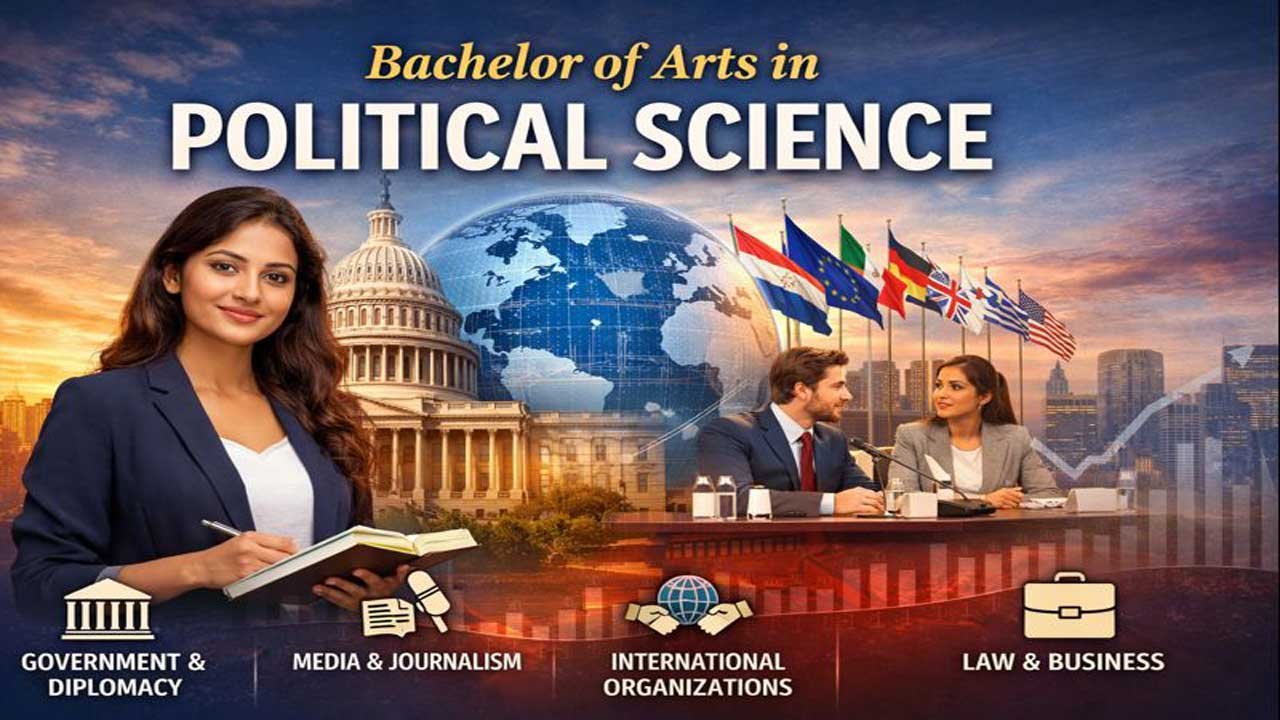
Choosing an undergraduate degree is one of the most consequential decisions a student makes. For those drawn to understanding governance, policy-making, global affairs, and societal change, the Bachelor of Arts in Political Science (BAPS or BA in Political Science) stands as one of the most versatile and future-ready options available in 2026.
Political science is experiencing a resurgence in relevance. As geopolitical tensions intensify, policy reforms accelerate, and democratic institutions face unprecedented challenges, the demand for professionals who can analyze political systems, craft public policy, and engage in informed discourse continues to grow. Unlike purely academic disciplines, a BA in Political Science opens doors to careers spanning government, international organizations, media, law, business, and non-profit sectors.
This comprehensive guide explores every critical dimension of pursuing a BAPS degree: program structure, career pathways, salary expectations, international opportunities, and practical strategies for maximizing your investment in this education.
| Aspect | Information |
|---|---|
| Degree | Bachelor of Arts in Political Science (BA / BAPS) |
| Duration | 3–4 years (full-time) |
| Core Areas | Political Theory, Comparative Politics, International Relations, Public Policy, Research Methods |
| Skills Gained | Critical thinking, policy analysis, research, writing, public speaking |
| Career Paths | Civil services, policy analyst, diplomat, journalist, NGO roles, law, corporate affairs |
| Starting Salary | US: $40k–60k • India: ₹4–7 LPA |
| Mid-Career Salary | US: $80k–120k+ • India: ₹12–20 LPA |
| Higher Studies | MA Political Science, MPA, MBA, Law (JD/LLB), PhD |
| Global Scope | Strong demand in government, think tanks, international organizations |
| Ideal For | Students interested in governance, public policy, global affairs, social change |
What Is a Bachelor of Arts in Political Science?
A Bachelor of Arts in Political Science is a three- to four-year undergraduate degree that provides rigorous academic training in political systems, theory, institutions, and processes at local, national, and global levels. The curriculum combines theoretical frameworks with applied research methods, equipping graduates with analytical rigor and practical skills.
Core Areas of Study in BAPS Programs
Political Science programs typically organize coursework into distinct specializations:
American Politics and Governance – Examines the U.S. political system, constitutional law, electoral processes, congressional dynamics, and institutional behavior.
Comparative Politics – Studies political systems across nations, analyzing democracies, authoritarian regimes, governance structures, and institutional differences between countries.
International Relations – Focuses on diplomacy, foreign policy, international organizations, conflict resolution, trade relations, and geopolitical dynamics.
Political Theory and Philosophy – Explores foundational concepts: power, sovereignty, justice, democracy, liberty, and competing political ideologies from classical to contemporary thinkers.
Public Policy and Administration – Analyzes policy-making processes, bureaucratic structures, public administration, and governance implementation.
Research Methods – Teaches quantitative and qualitative research approaches, data analysis, and research design essential for advanced studies or professional roles in policy analysis and research institutions.
Program Duration and Credits
| Program Type | Duration | Credit Hours | Typical Structure |
|---|---|---|---|
| BA in Political Science (Standard) | 3-4 years | 120-155 credits | Flexible electives, broad foundations |
| BA Honours in Political Science | 3-4 years | 155-170 credits | Specialized coursework, research focus |
| BA with Honours (Research) | 4 years | 170+ credits | Thesis/capstone project required |
| Dual Degree (Pol. Sci. + IR) | 3-4 years | 150-160 credits | Integrates international relations depth |
Most students complete a BA in Political Science within four years of full-time study, though accelerated and part-time options exist at many institutions.
Why Pursue a Bachelor of Arts in Political Science in 2026?
Growing Global Relevance
The world is experiencing unprecedented political, economic, and social complexity. Climate change, geopolitical conflicts, populism, digital governance, artificial intelligence policy, international trade disputes, and human rights crises shape headlines daily. These challenges demand professionals who understand political institutions, policy mechanisms, and international relations.
Political science graduates are uniquely positioned to engage with these issues. According to recent analysis, demand for professionals in policy research, international relations, and political analysis continues to expand, with growth projected at roughly 3% through 2032—a stable outlook reflecting consistent institutional demand.
Skill Development with Broad Applicability
Beyond subject-specific knowledge, a BA in Political Science develops transferable skills highly valued across sectors:
- Critical Thinking and Analysis: Students learn to evaluate complex problems, identify underlying assumptions, and construct evidence-based arguments—skills applicable to law, business, journalism, and research.
- Research and Data Literacy: Coursework in quantitative and qualitative research methods prepares graduates to conduct meaningful investigations, analyze policies, and interpret data.
- Written and Oral Communication: Political science demands clarity in writing and persuasiveness in presentation—essential for careers in law, advocacy, diplomacy, and corporate communications.
- Policy Analysis and Problem-Solving: Students practice translating political theory into practical solutions, a skill sought by governments, NGOs, think tanks, and corporations.
- Global Perspective: Exposure to comparative politics and international relations fosters cultural competence and understanding of diverse governance models.
Competitive Advantage for Advanced Studies
A BAPS degree provides a strong foundation for law school, public policy master’s programs, and specialized postgraduate study in international relations, security studies, or public administration. Many graduates leverage their undergraduate degree as a springboard to competitive graduate programs and professional qualifications.
Bachelor of Arts in Political Science: Career Opportunities
The career versatility of a BAPS degree is one of its strongest selling points. Graduates pursue diverse career paths across public, private, and non-profit sectors.
Government and Public Administration
Civil Service Officer – Graduates are well-positioned to pass competitive civil service examinations (such as UPSC in India, foreign service exams in the US, and equivalent tests in other countries). Civil service careers offer stable employment, pension benefits, and opportunity to shape policy at the highest levels.
Policy Analyst – Organizations increasingly employ political science graduates to research policy trends, analyze the impact of legislation, and recommend evidence-based reforms. Policy analysts work for government agencies, research firms, think tanks, and consulting companies. Median salary in the US: approximately $62,592 annually, with range from $40,000-$90,000 depending on organization and experience.
Public Administration and Management – Political science education prepares graduates for roles managing public agencies, overseeing regulatory compliance, and coordinating government programs. This career path typically offers salary ranges of $50,000-$80,000+ with advancement to director-level positions.
Urban and Regional Planner – Planners use political science knowledge to navigate regulatory frameworks, engage stakeholders, and develop strategic plans for communities. This is among the higher-paying career paths for political science graduates, with median salaries around $119,284 annually in the US (range: $48,098-$261,000).
International Organizations and Diplomacy
Foreign Service Officer / Diplomat – Political science graduates pursue careers with foreign ministries, embassies, and international organizations (UN, World Bank, European Union, ASEAN). These roles involve representing national interests, conducting negotiations, and engaging in international relations. Salary range in India: ₹6.7-27 LPA (lakhs per annum); in the US, comparable roles earn $60,000-$150,000+ depending on level.
International Relations Specialist – Organizations focused on global affairs, trade, development, and multilateral cooperation employ political science graduates to analyze international trends, develop foreign policy strategies, and manage bilateral relationships. These roles are increasingly in demand as globalization intensifies.
International Policy Analyst – The highest-paying roles in international relations belong to policy analysts who evaluate complex global issues affecting trade, security, human rights, and environment. These professionals conduct research, analyze data, and advise governments and organizations on policy decisions. Estimated salary range in India: ₹3-12 LPA.
Media, Journalism, and Communication
Political Analyst / Commentator – Media organizations employ political scientists to provide analysis, forecast election outcomes, and explain complex policy developments. Roles include on-air commentary, written opinion pieces, and research-backed investigations.
Journalist – Political science education prepares graduates for investigative journalism, political reporting, and fact-based storytelling. Journalists with political science backgrounds bring analytical depth to coverage of governance, elections, and policy.
Policy Communications Specialist – Governments, NGOs, and corporations employ professionals to translate complex policy into accessible public communication. This role combines political knowledge with strategic communications skills.
Think Tanks, Research, and Advocacy
Research Associate / Political Researcher – Think tanks, policy research organizations, and academic institutions employ graduates to conduct original research, analyze existing studies, and contribute to policy briefs and reports. Typical salary: $35,000-$55,000 starting, with advancement potential.
Non-Governmental Organizations (NGOs) – Advocacy organizations focused on human rights, environmental policy, development, and governance employ political science graduates in program management, research, and advocacy roles. These careers often combine financial stability with meaningful social impact.
Lobbying and Government Relations – Political science graduates work for corporations, associations, and advocacy groups to influence policy outcomes. These roles require deep understanding of legislative processes, stakeholder interests, and political dynamics.
Business and Corporate Sectors
Management Analyst – Corporations employ analysts to improve organizational efficiency and propose process improvements. Political science graduates bring policy analysis skills to business strategy. Average salary: $41,213-$60,000 annually.
Public Relations Manager – Corporate communications departments employ professionals to manage organizational reputation and communications strategy. Political science education supports career progression from PR associate to director. Average salary: $75,409 annually (range: $47,089-$127,363).
Marketing Research Analyst – Understanding consumer behavior, market dynamics, and political/economic trends attracts organizations to hire political science graduates for research roles.
Law and Legal Practice
A BA in Political Science provides excellent preparation for law school. The legal reasoning, policy analysis, and research skills developed in undergraduate political science coursework directly support law school success and subsequent legal practice.
Salary Expectations and Earning Potential
Salary by Career Path
The earning potential of BAPS graduates varies significantly by career choice, geography, sector (public vs. private), and experience level. The following table provides realistic salary expectations:
| Career Path | Starting Salary (US) | Mid-Career Salary (US) | Starting Salary (India) | Mid-Career (India) | Notes |
|---|---|---|---|---|---|
| Civil Service Officer | $50,000-$60,000 | $80,000-$120,000+ | ₹5.5-7 LPA | ₹12-20 LPA | Includes pension benefits |
| Policy Analyst | $40,000-$50,000 | $62,592-$85,000 | ₹4-6 LPA | ₹10-15 LPA | Think tanks pay more |
| Political Scientist | $50,000-$60,000 | $80,937-$139,380 | ₹5-8 LPA | ₹12-18 LPA | Research-focused roles |
| Urban Planner | $40,000-$50,000 | $119,284 | ₹4-6 LPA | ₹12-20 LPA | High ceiling for growth |
| Journalist / Media | $30,000-$45,000 | $55,000-$80,000 | ₹3-5 LPA | ₹8-15 LPA | Varies by outlet/circulation |
| NGO Program Officer | $35,000-$45,000 | $50,000-$70,000 | ₹3-5 LPA | ₹8-12 LPA | Mission-driven but stable |
| Foreign Service Officer | $55,000-$75,000 | $100,000-$150,000+ | ₹6.7-12 LPA | ₹15-27 LPA | Significant growth potential |
| International Policy Analyst | $50,000-$65,000 | $85,000-$130,000+ | ₹5-8 LPA | ₹12-18 LPA | Highest-paying IR role |
Factors Influencing Salary
Education Level: Master’s degrees (MA Political Science, MPA, MBA) significantly increase earning potential, often resulting in 20-40% salary premiums.
Geographic Location: Urban centers and developed economies offer higher salaries. US government roles, UK diplomacy positions, and international organization postings pay substantially more than entry-level positions in developing markets.
Sector: Private sector consulting and international organizations typically pay more than government or NGO roles at comparable levels.
Specialization: International relations, policy analysis, and strategic roles command higher salaries than general administrative positions.
Experience and Credentials: Competitive examinations (UPSC, Foreign Service Exam) and additional certifications increase advancement speed and compensation.
Admission Requirements and Program Prerequisites
Educational Prerequisites
Most universities offering BA Political Science require:
- High School Diploma or Equivalent (GCE A-Levels, International Baccalaureate, or national equivalent)
- English Language Proficiency – Minimum score on TOEFL (iBT 80+), IELTS (6.5+), or equivalent for international students
- Competitive Academic Record – GPA 3.0+ or equivalent (typically top 50-60% of high school class)
- Relevant High School Coursework – Subjects such as History, Civics, Economics, or Geography strengthen applications, though not always required
Application Components
Universities typically require:
- Completed application form with personal statement or essay
- Academic transcripts and GPA documentation
- Letters of recommendation (usually 2-3 from teachers or counselors)
- Standardized test scores (SAT, ACT, or equivalent)
- English language test scores (for international students)
- Resume or curriculum vitae
- Personal essay addressing motivation for political science study
Special Considerations for International Students
International students applying to study political science abroad face additional considerations:
Visa and Work Authorization: Post-study work permits vary by country. The US offers up to 3 years OPT (Optional Practical Training); UK offers 2 years Graduate Route; Canada provides up to 3 years Post-Graduation Work Permit; Australia allows 2-4 years depending on qualification.
English Language Requirements: International students must typically demonstrate proficiency through TOEFL, IELTS, or equivalent tests with specific minimum scores.
Financial Capacity: Tuition, living expenses, and visa requirements necessitate demonstrated financial resources. Many universities offer scholarships and financial aid to qualified international students.
Top Universities Offering BA Political Science Programs
United States
- University of Southern California (USC) – Strong political science program requiring coursework in American Politics, Comparative Politics, Law and Public Policy, and Political Thought
- University of Michigan – Ranked among top US programs with strengths in political theory and American politics
- University of Wisconsin-Madison – Known for comparative politics and public policy focus
- Harvard University – Prestigious program with research emphasis and extensive alumni network in government
United Kingdom
- University of Manchester – Top 10 UK program in Politics and International Studies, offering Politics and International Relations degree with strong comparative politics focus
- London School of Economics (LSE) – Elite program with research expertise in political theory and international relations
- Oxford University – Highly selective with strength in political philosophy and theory
- Cambridge University – Traditional strength in politics and governance
Canada
- University of Toronto – Strong political science program with Canadian politics focus and international opportunities
- McGill University – Known for comparative politics and multicultural policy research
- University of British Columbia – Offers political science with Asia-Pacific focus
India
- Delhi University – Multiple colleges with established political science programs
- Shoolini University – International collaborations with 250+ institutions in China, South Korea, Taiwan, Italy; faculty from Oxford, Delhi University, ISB
- Jawaharlal Nehru University (JNU) – Renowned for political science research and critical perspectives
- Bennett University, Delhi – Emphasizes practical skills and soft skills development alongside theoretical training
Australia
- University of Melbourne – Strengths in Australian politics, Asia-Pacific relations
- University of Sydney – Known for democratic systems and foreign policy analysis
- Australian National University – Research-focused program with government policy connections
Studying Political Science Abroad: International Opportunities
For ambitious students, studying political science at international universities offers substantial advantages:
Key Benefits of Studying Abroad
Exposure to Diverse Political Systems – Learning politics in different countries provides firsthand understanding of comparative systems, democratization, and governance challenges. A US student studying in India gains insight into world’s largest democracy; an Indian student in the UK understands Westminster systems.
Multicultural Learning Environment – Classrooms with international peers provide varied perspectives on global issues, enriching discussions and broadening worldviews.
Practical Engagement – Many programs offer placements with UN agencies, embassies, international NGOs, policy research organizations, and think tanks, translating classroom learning into professional experience.
Career Mobility – Degree from internationally recognized institution opens doors to global career opportunities. Graduate visa programs in developed countries allow students to gain post-study work experience, often leading to permanent residence pathways.
Language and Cultural Development – Studying abroad improves language skills and cultural competence, significant advantages for careers in diplomacy, international relations, and global organizations.
Popular Destinations and Post-Study Work Opportunities
| Country | Focus Area | Post-Study Work Rights | Typical Cost |
|---|---|---|---|
| USA | Public policy, international affairs, think tank research | 3 years (STEM OPT applicable) | $40,000-$70,000/year |
| UK | Political theory, governance, diplomacy | 2 years (Graduate Route) | £18,000-£30,000/year |
| Canada | Multicultural policy, peace studies, development | 3 years (Post-Graduation Work Permit) | CAD 25,000-40,000/year |
| Netherlands | EU governance, international law, diplomacy | 1 year search visa (extendable) | €8,000-15,000/year |
| Australia | Asia-Pacific politics, democratic systems | 2-4 years based on qualification | AUD 30,000-50,000/year |
How to Prepare for a Career in Political Science
High School Preparation
Students considering a political science degree should:
- Excell in Relevant Subjects – Strong performance in History, Civics, Economics, English, and Social Studies demonstrates readiness for political science coursework.
- Develop Writing and Communication Skills – Political science demands clear, persuasive writing. Participation in debate, Model UN, and writing competitions builds essential skills.
- Engage in Current Events – Regular reading of quality news sources, academic journals, and policy publications builds contextual knowledge and demonstrates genuine interest.
- Pursue Internships and Volunteering – Early exposure to government, advocacy, or policy organizations provides practical perspective and strengthens university applications.
- Develop Research Skills – Familiarity with academic databases, citation styles, and research methodology gives advantage in undergraduate coursework.
During Undergraduate Studies
To maximize career prospects:
- Specialize Strategically – Choose electives and thesis topics aligned with career interests (e.g., international relations students should take courses in diplomacy, foreign policy, and international law).
- Engage in Research – Undergraduate research projects, senior theses, and faculty-mentored investigations build credentials for graduate school or research positions.
- Build Professional Networks – Attend conferences, join professional associations (American Political Science Association, etc.), and connect with professors and practitioners in your area of interest.
- Gain Practical Experience – Internships with government agencies, NGOs, think tanks, media outlets, or law firms translate classroom learning into professional skills and résumé credentials.
- Pursue Advanced Language Skills – Proficiency in foreign languages (Mandarin, Spanish, French, Arabic) significantly enhances career prospects in international relations and diplomacy.
- Consider Graduate School – Master’s degrees (MA Political Science, MPA, MBA, JD) increase earning potential and access to senior-level positions. Plan applications and GRE/GMAT preparation accordingly.
Challenges and Honest Considerations
While political science offers genuine career advantages, prospective students should understand realistic challenges:
Employment Market Realities
Competition for Government Roles – Civil service examinations are highly competitive. In India, UPSC selection rates are below 1%; candidates often attempt exams multiple times. Success requires sustained preparation and potentially professional coaching.
Job Market Saturation in Some Sectors – Media and journalism sectors are experiencing contraction in traditional outlets, making entry-level positions increasingly competitive. However, emerging opportunities in digital media and policy communications partially offset this decline.
Geographic Constraints – The most desirable positions (foreign service, international organizations) are geographically limited and often require language skills, advanced degrees, or specific country connections.
Master’s Degree Nearly Essential for Advancement – While a BA opens initial opportunities, reaching senior positions (analyst, director, senior officer level) increasingly requires specialized master’s degrees. Budget accordingly for graduate education.
Financial Considerations
Student Debt Implications – For international students or those attending expensive private universities, the cost of a political science degree may exceed immediate salary prospects. Evaluate total cost of attendance against probable starting salary and career trajectory.
Varying Earning Potential by Region – Starting salaries vary dramatically by geography. A civil service officer in India may start at ₹5.5 LPA; a comparable US policy analyst might earn $50,000+. Factor geographic preferences into decision-making.
FAQ: Bachelor of Arts in Political Science
Q: What’s the difference between a BA in Political Science and other social science degrees?
A: Political science focuses specifically on political systems, governance, power, and policy. While related to history, economics, and sociology, political science offers more specialized training in political institutions, theory, and analysis. Many students double-major or pursue minors in related fields.
Q: Can I work in law without studying law?
A: Yes. A BAPS degree provides strong preparation for law school, and many law students come from political science backgrounds. The critical thinking, research, and writing skills developed in political science directly support legal education and practice.
Q: How long does it take to see career success after graduation?
A: Timeline varies. Some graduates secure government positions immediately through competitive examinations (1-2 years preparation). Others build careers progressively through internships and entry-level roles (5-10 years to mid-career positions). Those pursuing graduate degrees typically add 2-3 years before entering their intended career.
Q: Is political science degree valuable for international students?
A: Yes, substantially. International students bring diverse perspectives valued by employers. Post-study work permits in developed countries allow 2-4 years of professional experience, often leading to permanent residence. Degree from respected Western university enhances Indian graduate’s prospects in international organizations and multinational corporations.
Q: What’s the job outlook for political science graduates specifically?
A: Overall employment for political scientists is projected to decline 3% through 2034, but about 500 openings occur annually through retirement and job transitions. However, related careers (policy analysis, public administration, law, international relations) show stronger growth. Emphasis should be on developing specialized skills and leveraging the degree’s versatility.
Q: Should I pursue a master’s degree immediately after BA?
A: This depends on career goals and financial circumstances. For government positions, civil service examination preparation may be more immediate priority. For research, academia, international organizations, or advanced consulting, a master’s degree (MA Political Science, MPA, or MBA) strengthens credentials. Many successful professionals work 3-5 years, then pursue graduate degrees while employed.
Q: What languages are most valuable for political science careers?
A: Mandarin Chinese, Spanish, Arabic, and French are most commercially valuable. Choice depends on career interest: Mandarin for Asia-focused IR, Spanish for Latin American policy, Arabic for Middle East studies, French for EU and African affairs.
Q: Can I change careers later with a political science degree?
A: Yes. The analytical, research, and communication skills developed are highly transferable. Graduates successfully transition to law, business, nonprofit management, consulting, and education. The degree’s versatility is one of its key advantages.
Conclusion
The Bachelor of Arts in Political Science in 2026 represents a degree choice aligned with contemporary challenges and career opportunities. Whether aspiring to shape public policy, represent national interests in international forums, investigate governmental accountability through journalism, or advise organizations on political risks, a BAPS degree provides both intellectual foundation and practical preparation.
The growing complexity of global governance, rising demand for policy expertise, and expanding career pathways make political science increasingly relevant. Yet success requires strategic planning: thoughtful choice of university, deliberate specialization within the discipline, proactive engagement in internships and research, and realistic assessment of competitive career markets.
For intellectually curious students motivated by understanding power, governance, and social change, the BA in Political Science offers substantive career pathways and the satisfaction of contributing meaningfully to public discourse and policy outcomes. With proper preparation and strategic career planning, graduates find diverse professional opportunities across sectors and geographies, from government leadership to international diplomacy to policy-driven journalism and corporate strategy.
Key Takeaways
- Versatile Career Pathways: BAPS graduates pursue careers in government (civil service, policy analysis), international organizations (diplomacy, UN agencies), media, law, NGOs, and business.
- Competitive Earning Potential: Starting salaries range from $40,000-$60,000 (US) or ₹4-7 LPA (India), with significant growth potential to $100,000+ or ₹15-27 LPA in senior roles.
- Strategic Specialization Matters: Choose electives, internships, and thesis topics aligned with specific career interests (international relations, public policy, law, etc.).
- Master’s Degree Increasingly Important: Advancing to senior positions typically requires specialized master’s degrees (MA Political Science, MPA, MBA, or JD).
- International Study Opportunities: Degree from respected international university opens global career opportunities and provides post-study work permits in developed countries.
- Skills Transfer Broadly: Critical thinking, research, communication, and policy analysis skills developed in political science are highly transferable across sectors.
- Competitive Preparation Required: Success in competitive government and international organization careers requires sustained preparation, often including additional competitive examinations or language development.


Leave a Reply
You must be logged in to post a comment.