
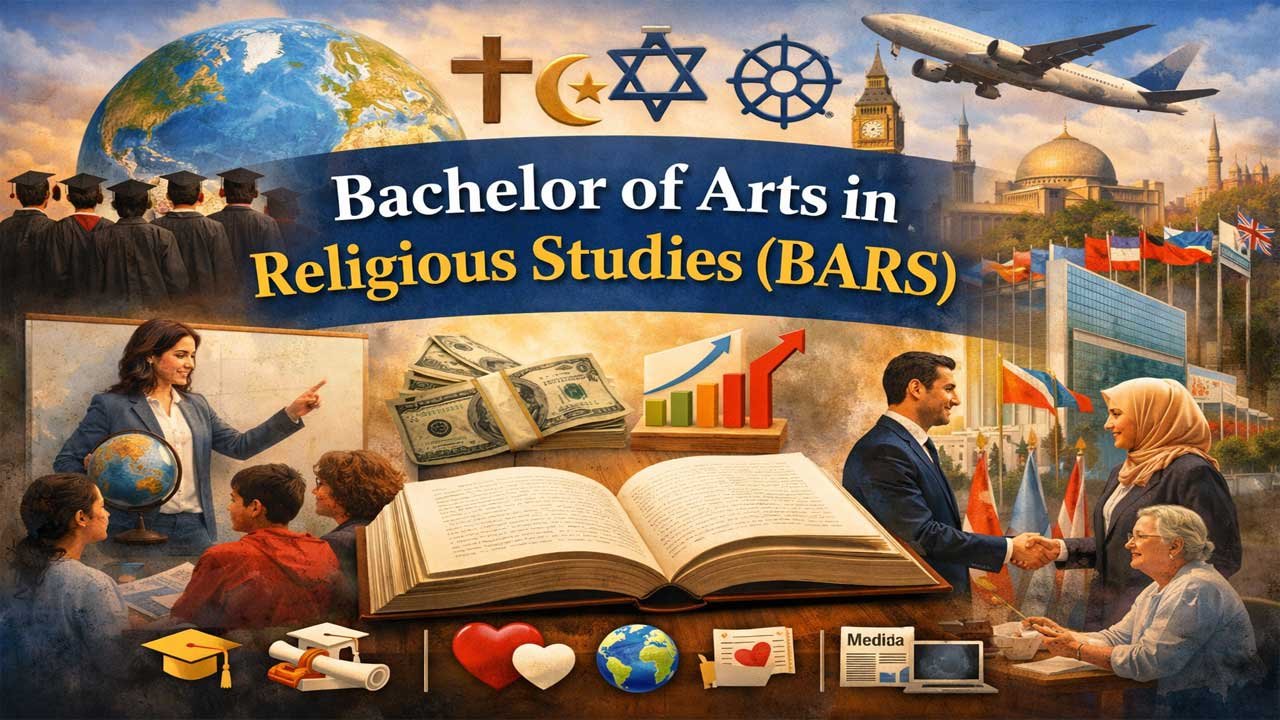
A Bachelor of Arts in Religious Studies (BARS) is an interdisciplinary undergraduate degree that academically and comparatively examines global religious traditions, beliefs, and practices, emphasizing their historical, cultural, political, and social impact rather than devotional training.
Typically completed over four years, the program develops strong analytical, research, writing, and cross-cultural skills that are highly transferable across sectors, contributing to a notably low unemployment rate of about 2.3% and competitive early-career earnings. Graduates pursue diverse careers in education, nonprofit leadership, diplomacy, public policy, law, healthcare, media, and international development, while others use the degree as a foundation for graduate study.
Offered by top universities worldwide—including prestigious U.S. institutions and low-cost or tuition-free options in countries like Germany—BARS programs increasingly incorporate interdisciplinary study, global learning, and online formats. Overall, the degree combines intellectual depth with practical career value, preparing graduates for meaningful work in an increasingly religiously and culturally complex world.
| Category | Information |
|---|---|
| Degree Name | Bachelor of Arts in Religious Studies (BARS) |
| Degree Level | Undergraduate |
| Duration | 4 years (approx. 120 credit hours) |
| Academic Focus | Comparative, analytical study of global religions |
| Approach | Non-sectarian, interdisciplinary, research-based |
| Core Areas | World religions, sacred texts, ethics, culture, politics, society |
| Key Skills Gained | Critical thinking, research, writing, cross-cultural competence |
| Average Unemployment Rate | ~2.3% (below national average) |
| Early-Career Salary | ~$38,000–$50,000 |
| Mid-Career Salary | ~$50,000–$73,000+ |
| Common Career Paths | Education, nonprofits, diplomacy, policy, law, media, healthcare |
| Top Employers | Schools, NGOs, government agencies, faith-based organizations |
| Study Locations | USA, UK, Germany, Canada, Netherlands, Australia |
| Tuition Range | Free–$70,000/year (varies by country & institution) |
| Graduate Pathways | Law, public policy, international relations, theology, PhD |
| Ideal For | Students interested in culture, belief systems, global issues |
Bachelor of Arts in Religious Studies (BARS): A Comprehensive Guide to Career Growth and Global Opportunities
A Bachelor of Arts in Religious Studies (BARS) is an interdisciplinary undergraduate degree that examines religious traditions, beliefs, practices, and their cultural and societal impact across the globe. Unlike theology or divinity programs that may focus on a specific faith tradition from a devotional perspective, religious studies programs adopt an academic, comparative, and analytical approach to understanding how religion shapes human civilization. This degree opens doors to diverse career paths spanning education, nonprofit leadership, international diplomacy, law, and research—with graduates experiencing a remarkably low unemployment rate of just 2.3%, far below the national average.
For students and professionals considering further education, the BARS degree represents not only intellectual fulfillment but also meaningful economic opportunity, particularly in an era where cross-cultural understanding and religious literacy are increasingly valued across industries. This guide provides a complete overview of what a BARS degree entails, career prospects, program structures, global educational options, and strategic considerations for pursuing this degree internationally.
What is a Bachelor of Arts in Religious Studies?
The Bachelor of Arts in Religious Studies is a four-year, undergraduate degree program typically requiring 120 credit hours, with 37-40 of those specifically focused on religious studies coursework. The program takes an academic and analytical approach to examining the world’s major religious traditions—including Christianity, Islam, Judaism, Buddhism, Hinduism, Sikhism, and indigenous belief systems—within their historical, cultural, philosophical, and sociological contexts.
Program Structure and Core Coursework
A typical BARS degree consists of three key components: a general education core (24 credit hours), a major concentration in religious studies (37-40 credit hours), and electives. Within the major, students typically complete:
- Gateway/Introductory Courses: Foundational studies on religion’s role in society, world religions overview, and the study of sacred traditions (6-12 credits)
- Religious Traditions Courses: In-depth study of major world religions, regional traditions, and comparative analysis (9-12 credits)
- Contemporary Issues in Religion: Courses addressing modern challenges such as secularism, interfaith dialogue, religion and politics, gender and religion, and social justice (6-9 credits)
- Methodology and Electives: Research methods, specialized seminars, and topics-based courses (9-12 credits)
Many programs, particularly those emphasizing contemplative studies, include courses on meditation practices, theological reflection, and experiential learning alongside traditional academic coursework. This dual approach—combining rigorous scholarship with experiential understanding—distinguishes leading religious studies programs from purely historical or philosophical approaches.
The Academic Approach
Religious studies differs fundamentally from theology in that it adopts a nonsectarian, scholarly lens. Rather than promoting or defending a specific faith tradition, the discipline examines religion as a human phenomenon worthy of critical academic analysis. Students learn to interpret sacred texts, understand theological concepts, analyze religious institutions, and evaluate the relationship between religion and power, culture, politics, and identity.
This comparative and secular approach makes religious studies valuable not only for those interested in religion itself but also for those pursuing careers in law, public policy, international relations, journalism, or any field requiring nuanced cross-cultural understanding.
Career Opportunities After BARS Graduation
One of the primary concerns for prospective students is employment potential. The good news: religious studies graduates achieve exceptional outcomes. With an unemployment rate of just 2.3%—compared to 6.7% for all bachelor’s degree holders—religious studies is one of the most economically resilient humanities majors.
Career Paths and Salary Expectations
Average Salary Range: Religious studies graduates earn an average of $49,097 to $50,306 annually in early career positions. Entry-level salaries typically range from $38,596 to $44,451, and with five years of experience, average compensation rises to approximately $45,518. The 75th percentile earns around $52,000 annually, while top performers (90th percentile) can earn $73,000 or more.
Specific Career Paths and Earnings:
| Career Path | Average Salary | Requirements |
|---|---|---|
| Religious Educator / Teacher | $43,450 | Teacher certification; typically MA for secondary positions |
| Chaplain (Hospital, Prison, Military) | $50,397 | BA + CPE certification; often requires ordination for certain contexts |
| Clergy Member | $38,736 | Ordination; theological training varies by denomination |
| Long-term Chaplain | $63,587 | Experience + specialized certification |
| UN Diplomat / International Relations | $95,000+ | BA + language skills; experience in diplomacy/NGO work |
| Nonprofit Director / Program Manager | $55,000-$70,000 | BA; often requires 3-5 years experience |
| Policy Analyst / Researcher | $50,000-$65,000 | BA; strong for think tanks and government positions |
Key Employer Types
Graduates work across a wide range of sectors:
- Education: Schools, colleges, universities, and educational nonprofits
- Religious & Faith-based Organizations: Churches, synagogues, mosques, temples, interfaith organizations
- Government & Diplomacy: State Department, international agencies, foreign service, cultural attaché positions
- Nonprofit Sector: Human rights organizations, development agencies, humanitarian NGOs, community organizations
- Media & Communications: Publishing, journalism, media consulting, content strategy
- Law & Public Policy: Law firms, policy think tanks, civil rights organizations
- Healthcare & Counseling: Hospitals, hospice care, counseling centers, rehabilitation programs
- Business & Consulting: Corporate diversity initiatives, organizational development, international business
Transferable Skills That Drive Employability
Employers across industries value the critical competencies that a BARS degree develops:
- Advanced analytical and critical thinking: Interpreting complex texts, evaluating arguments, synthesizing diverse sources
- Research and writing excellence: Conducting original research, writing persuasively, documenting sources
- Cross-cultural competency: Understanding diverse worldviews, cultural sensitivity, interfaith awareness
- Communication and presentation: Clear verbal and written expression, ability to discuss sensitive topics respectfully
- Emotional intelligence and empathy: Understanding human motivation, perspective-taking, compassion
- Objectivity and open-mindedness: Evaluating evidence fairly, recognizing bias, engaging with opposing viewpoints
These skills directly transfer to careers in law, nonprofit management, business, government service, and international development—not just religious or academic roles.
Top Universities for Religious Studies (BARS)
Students considering a BARS degree will find outstanding options in the United States, internationally, and increasingly through online platforms. The following represent leading institutions recognized for academic rigor, faculty expertise, and graduate outcomes.
Top Ranked Programs in the United States
1 Yale University (New Haven, CT)
- Acceptance Rate: 5%
- Average SAT: 1500-1580
- Program Focus: Comparative study of religion with research emphasis
- Reputation: World-leading faculty; strong for doctoral preparation
2 Princeton University (Princeton, NJ)
- Acceptance Rate: 4%
- Average SAT: 1500-1580
- Program Focus: Religion and culture; philosophy of religion
- Network: Strong alumni network in academia and public service
4 University of Chicago (Chicago, IL)
- Acceptance Rate: 5%
- Average SAT: 1510-1570
- Student-Faculty Ratio: 5:1
- Program Focus: Historical theology and comparative religion with analytical rigor
Other Top US Programs:
- Harvard Divinity School (World-class graduate programs; undergraduate available through Committee on Study of Religion)
- Stanford University (Innovative seminar-based approach; strong international focus)
- Northwestern University (Multiple concentrations; strong interdisciplinary approach)
- University of Notre Dame (Catholic intellectual tradition; strong graduate programs)
- Vanderbilt University (Theological studies concentration; excellent graduate programs)
- UCLA (Center for the Study of Religion; flexible major/minor options)
Leading International Programs
United Kingdom
The UK offers some of the world’s most prestigious religious studies and theology programs:
| University | Location | Tuition (International) | Key Features |
|---|---|---|---|
| Oxford University | Oxford | £24,000-40,000/year | Ancient traditions; extensive college libraries |
| Cambridge University | Cambridge | £24,000-40,000/year | Contemplative approach; strong theological tradition |
| Durham University | Durham | £24,000-40,000/year | Theology and religious studies integrated |
Europe
Germany stands out as an exceptional value for international students, with most public universities offering free or near-free tuition even for international students, plus English-taught programs in religious studies:
- University of Bonn: Free tuition; English-taught Masters
- University of Göttingen: Free tuition; strong theological tradition
- Free University Berlin: Minimal fees; multiple concentration options
- Study Period: 3-4 years bachelor’s, 2 years master’s
Netherlands
- Utrecht University: Master’s in Religious Studies (English-taught); €2,694/year for EU students; strong methodology focus; €21,342/year for non-EU
Canada
- McGill University (Montreal): BA Major in Religious Studies; strong comparative approach; CAD $16,000-45,000/year depending on residency
Study Abroad Opportunities
Beyond degree programs, students can pursue religious studies courses in specific contexts:
- Theology in Europe: Especially UK, Germany, and Netherlands
- Islamic Studies: Middle East (Israel, Jordan, Qatar), Morocco, parts of India
- Jewish Studies: Israel (particularly Jerusalem)
- Buddhism: Japan, Thailand, Southeast Asia
- Christianity: Europe (especially Italy, Spain, UK)
- Comparative Religion: Japan, India, Turkey
Many universities offer semester abroad or gap-year intensive programs, allowing students to study religions in their cultural contexts.
Cost of a Bachelor’s Degree in Religious Studies
United States
- Public Universities: $8,000-16,000/year in-state; $25,000-45,000/year out-of-state
- Private Universities: $50,000-70,000/year
- Total 4-Year Cost (Public In-State): ~$32,000-64,000
- Total 4-Year Cost (Private): ~$200,000-280,000
- With Scholarships/Financial Aid: Costs reduced by 20-50% on average
International Markets
United Kingdom
- Tuition: £20,000-40,000/year ($26,000-52,000 USD)
- 4-Year Cost: $104,000-208,000
- Living Expenses: £10,000-15,000/year additional
Germany
- Tuition: Free to €500/semester (minimal fees)
- 4-Year Cost: Approximately $0-8,000 in tuition alone
- Living Expenses: €700-1,000/month (€33,600-48,000 for 4 years)
- Significant cost advantage for international students
Canada
- Tuition: CAD $16,000-45,000/year
- 4-Year Cost: CAD $64,000-180,000 ($48,000-135,000 USD)
Australia
- Tuition: AUD $17,216-35,315/year
- 4-Year Cost: AUD $68,864-141,260 ($45,000-92,000 USD)
Netherlands
- EU Students: €2,694/year (€10,776 for 4 years)
- Non-EU Students: €21,342/year (~$85,000/year)
Financial Aid and Scholarships
- In the US: Federal and state grants, institutional scholarships, work-study programs
- International: Commonwealth Scholarships (UK), Fulbright-Nehru Scholarships (US), DAAD Scholarships (Germany), Endeavour Awards (Australia)
- University-Specific: Many universities offer 20-50% financial aid packages based on merit and need
Admission Requirements and Application Process
Typical Undergraduate Requirements
High School Prerequisites:
- High school diploma or equivalent
- Minimum GPA: 2.3-3.0 (varies by institution)
- Competitive schools: Top 25% class rank OR 3.0+ GPA
- SAT/ACT: Scores of 1100+ SAT or 22+ ACT typically required for competitive schools
Application Materials:
- Completed application form
- Official high school transcripts
- Standardized test scores (SAT/ACT)
- Letter of recommendation (typically 1-2)
- Personal essay or statement of purpose
- Resume or activity list (for competitive programs)
Graduate Program Requirements (Master’s/PhD)
- Bachelor’s degree (any discipline, though religious studies is typical)
- Minimum GPA: 3.0+
- Writing sample (typically 15-20 pages of academic work)
- Letters of recommendation (2-3)
- Statement of purpose
- GRE (increasingly optional)
- TOEFL/IELTS for international students (if English is not native language)
International Student Considerations
- Language Proficiency: TOEFL (79-100 iBT) or IELTS (6.5-7.5) typically required for English-taught programs
- Visa: F-1 (US), Tier 4 (UK), or equivalent required; universities typically support visa sponsorship
- Credential Evaluation: Some institutions require official credential evaluation (WES, NACES) for international degrees
Emerging Trends and Future Outlook
Growing Demand for Religious Literacy
In an increasingly globalized and religiously diverse world, employers and institutions recognize the value of professionals with advanced religious literacy. Key areas of growth include:
- Interfaith Dialogue and Conflict Resolution: Roles in mediation, peacebuilding, and intercommunal understanding
- Cultural Competency in Healthcare and Social Services: Training for professionals working with religiously diverse populations
- International Diplomacy and Development: Religious knowledge increasingly valued in foreign service, USAID, and international NGOs
- Corporate Diversity and Inclusion: Companies hiring for roles addressing religious diversity in the workplace
- Media and Communications: Need for experts explaining religious issues to general audiences
Online and Hybrid Programs
Major universities now offer online Bachelor’s degrees in religious studies, expanding accessibility:
- ASU Online: Offers Bachelor of Arts in Religious Studies with concentration in Religion, Culture, and Public Life
- Liberty University: Fully online religious studies programs
- Naropa University: Combines online and in-person contemplative approach
Online programs offer flexibility for working professionals while maintaining academic rigor.
Interdisciplinary Growth
Religious studies increasingly intersects with:
- Peace and conflict studies
- Gender studies
- Environmental ethics
- Philosophy and ethics
- Media and cultural studies
- International relations
Students increasingly combine a BARS major with minors in related disciplines to enhance career prospects.
Is a BARS Degree Right for You?
Who Should Pursue This Degree
A Bachelor of Arts in Religious Studies is an excellent choice if you:
- Are fascinated by human belief systems, culture, and meaning-making
- Want to develop critical thinking and research skills in a humanistic context
- Are interested in interfaith understanding and cross-cultural dialogue
- Seek a degree that opens multiple career paths (not just clergy or academia)
- Value a major that develops soft skills employers prioritize: writing, communication, analysis, empathy
- Are considering graduate school in religious studies, law, public policy, international relations, or theology
- Want to work in nonprofit, government, education, or faith-based sectors
- Are interested in studying abroad or engaging with global perspectives
Career Prospects
Religious studies graduates have significantly higher employment rates and earning potential than many other humanities majors. The combination of critical skills, cultural awareness, and demonstrable research abilities makes graduates competitive across sectors.
Alternative Pathways
If a full BARS degree doesn’t align with your goals, consider:
- Religious Studies Minor: Combines well with majors in education, international affairs, business, philosophy, or history
- Certificate Programs: Shorter programs in specialized areas (theology, ministry, religious education)
- Graduate Degrees: Master’s or PhD if you seek academic careers or advanced expertise
- Related Majors: Philosophy, history, anthropology, international relations, or sociology (with religious studies coursework)
Conclusion
The Bachelor of Arts in Religious Studies (BARS) is a versatile, rewarding undergraduate degree that prepares graduates for meaningful careers across sectors while deepening understanding of human civilization’s most powerful force: religion. With low unemployment rates, competitive salaries starting at $38,596 and rising to $50,000+ with experience, and opportunities spanning education, nonprofit leadership, diplomacy, law, and business, a BARS degree represents both intellectual and economic value.
For international students, options abound: from prestigious US universities like Yale, Princeton, and University of Chicago, to affordable German programs offering tuition-free education, to specialized programs throughout Europe, Asia, and beyond. Whether pursued as a bachelor’s degree, combined with a minor, or as a foundation for graduate study, religious studies develops critical competencies increasingly valued in our complex, multicultural world.
The future belongs to professionals who understand not just their own culture but the religious traditions, beliefs, and values that shape billions of people worldwide. A BARS degree positions you to meet that demand—and to make meaningful contributions to interfaith understanding, cultural dialogue, and human flourishing.
FAQs
What is a Bachelor of Arts in Religious Studies (BARS)?
A BARS is an undergraduate degree that academically examines global religious traditions, beliefs, texts, and practices using comparative, historical, cultural, and analytical methods rather than devotional instruction.
How is Religious Studies different from Theology or Divinity?
Religious studies is nonsectarian and scholarly, focusing on religion as a human and social phenomenon, while theology or divinity often studies a specific faith from an internal or faith-based perspective.
How long does it take to complete a BARS degree?
The degree typically takes four years to complete and requires around 120 credit hours, including general education, major coursework, and electives.
What subjects are covered in a BARS program?
Programs cover world religions, sacred texts, ethics, philosophy of religion, religion and politics, gender and religion, social justice, and contemporary religious issues.
What skills do students gain from a BARS degree?
Students develop critical thinking, research and writing skills, cross-cultural literacy, communication abilities, empathy, ethical reasoning, and analytical problem-solving.
What careers can you pursue with a BARS degree?
Graduates work in education, nonprofit organizations, government and diplomacy, public policy, media, healthcare, law, international development, and corporate diversity roles.
Is a BARS degree employable?
Yes, religious studies graduates have a low unemployment rate and strong employability due to transferable skills valued across many industries.
What is the average salary after graduating with a BARS degree?
Early-career salaries typically range from $38,000 to $50,000, with mid-career earnings often exceeding $50,000 and reaching higher levels in leadership or specialized roles.
Can a BARS degree lead to graduate school?
Yes, it is a strong foundation for graduate studies in law, public policy, international relations, religious studies, theology, education, and the humanities.
Which countries offer the best BARS programs?
Top programs are available in the United States, United Kingdom, Germany, Canada, the Netherlands, Australia, and other parts of Europe and Asia.
Is studying Religious Studies abroad affordable?
In some countries, especially Germany, public universities offer tuition-free or very low-cost education even for international students, making it highly affordable.
Are online BARS programs available?
Yes, many accredited universities now offer fully online or hybrid BARS programs, providing flexibility for working students and international learners.
Do I need to be religious to study Religious Studies?
No, students of all belief systems—including non-religious backgrounds—pursue religious studies for academic, cultural, and professional reasons.
Is Religious Studies useful outside religious careers?
Absolutely, the degree is highly relevant for careers requiring cultural awareness, ethical reasoning, communication skills, and global perspective.
Who should consider a BARS degree?
This degree is ideal for students interested in culture, belief systems, global affairs, social issues, critical analysis, and careers that involve working with diverse populations.


Leave a Reply
You must be logged in to post a comment.