
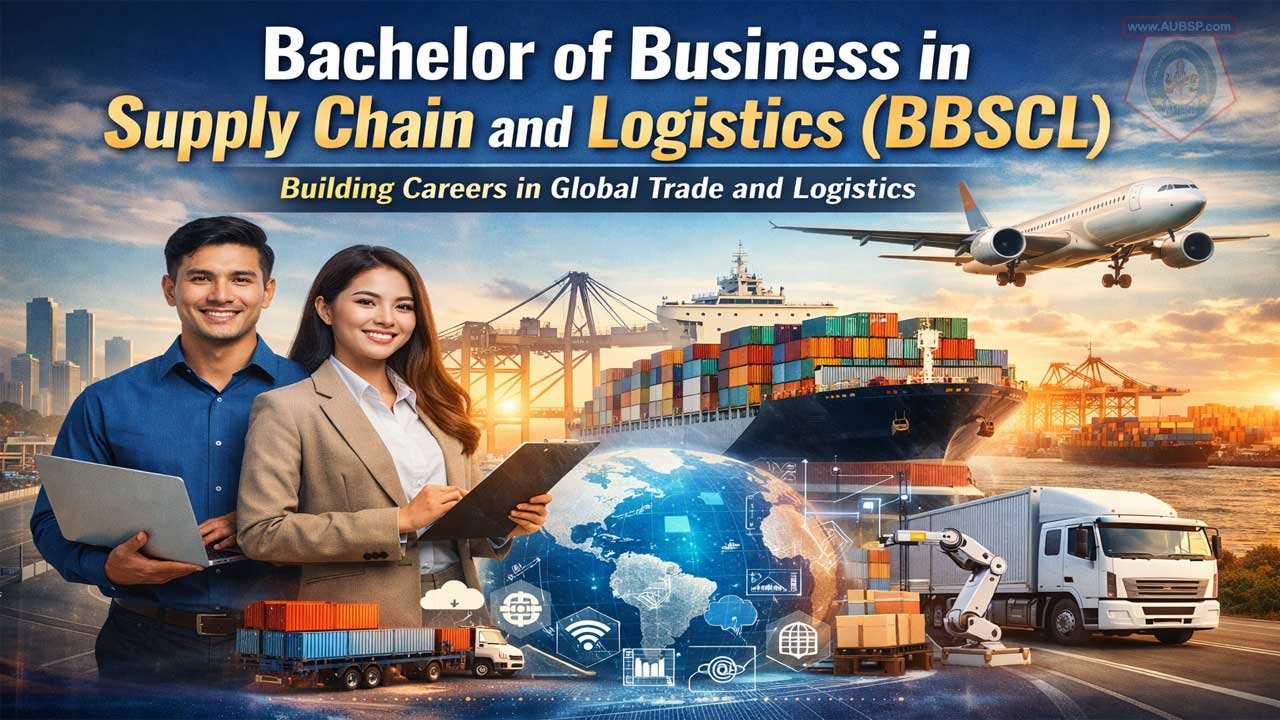
The Bachelor of Business in Supply Chain and Logistics (BBSCL) is a degree that prepares students to manage the movement of goods, information, and operations in the global economy. Supply chain management has changed from simple warehouse and transport work to a strategic role that helps companies stay efficient, profitable, and resilient.
The program combines core business subjects like accounting, finance, marketing, and management with specialized topics such as procurement, logistics, operations, analytics, and digital technologies like AI and ERP systems. Students learn how to manage the entire supply chain—from raw materials to final delivery—across industries like retail, healthcare, and manufacturing. Many universities in countries like Australia, New Zealand, and the UAE offer these programs with industry placements and professional accreditations such as CIPS and CILT.
Graduates have strong career opportunities with good salaries and can work in roles like supply chain manager or logistics analyst. As technology and global trade grow, supply chain professionals play an important role in building efficient, sustainable, and intelligent global supply networks.
| Category | Information |
|---|---|
| Degree Name | Bachelor of Business in Supply Chain and Logistics (BBSCL) |
| Field of Study | Business, Supply Chain Management, Logistics |
| Program Duration | Typically 3–4 years |
| Core Subjects | Accounting, Finance, Marketing, Operations Management, Data Analytics |
| Specialized Courses | Procurement, Global Logistics, Supply Chain Analytics, ERP Systems, Digital Supply Chains |
| Key Skills Developed | Logistics planning, data analysis, vendor management, problem-solving, strategic decision-making |
| Technologies Used | AI, Blockchain, ERP (SAP), IoT, Predictive Analytics |
| Career Roles | Supply Chain Manager, Logistics Manager, Procurement Specialist, Operations Analyst |
| Industries | Retail, Manufacturing, Healthcare, E-commerce, Aviation, Government |
| Top Study Destinations | Australia, New Zealand, UAE, USA |
| Professional Certifications | CIPS, CILT, Six Sigma, CSCP |
| Average Starting Salary | Varies by country; approx. AU$77k (Australia), NZ$96k (New Zealand), AED 20k/month (UAE senior roles) |
| Career Outlook | High global demand due to growth of e-commerce, digital logistics, and global trade |
Bachelor of Business in Supply Chain and Logistics (BBSCL): Course, Career, and Global Opportunities
The contemporary global economy operates through a complex, interdependent architecture of value chains, where the Bachelor of Business in Supply Chain and Logistics (BBSCL) has emerged as the premier academic conduit for future leaders of international commerce. Traditionally relegated to back-office functional roles such as local warehousing and basic transportation, the discipline of supply chain management (SCM) has undergone a fundamental metamorphosis into a strategic cornerstone of corporate resilience and global stability.
The modern BBSCL degree is an integrated program that fuses core business fundamentals—encompassing accounting, finance, marketing, and organizational behavior—with specialized technical proficiency in procurement, operations excellence, and global distribution networks. This report provides an exhaustive analysis of the BBSCL landscape, designed to guide international students through the academic, professional, and regulatory nuances of this critical field.
The Strategic Evolution of Supply Chain and Logistics Education
The definition of a Bachelor of Business in Supply Chain and Logistics centers on the mastery of strategy and execution in moving goods, managing information, and optimizing operations within an increasingly volatile, AI-driven global environment. Professionals in this field are now characterized as “problem-solvers who keep the world running,” tasked with navigating disruptions, driving technological innovation, and delivering results across diverse industries ranging from healthcare and retail to aerospace and government. The curriculum focuses on the international supply chain from the inception of raw material sourcing through the complexities of manufacturing and final consumption.
The definition of a Bachelor of Business in Supply Chain and Logistics centers on the mastery of strategy and execution in moving goods, managing information, and optimizing operations within an increasingly volatile, AI-driven global environment. Professionals in this field are now characterized as “problem-solvers who keep the world running,” tasked with navigating disruptions, driving technological innovation, and delivering results across diverse industries ranging from healthcare and retail to aerospace and government. The curriculum focuses on the international supply chain from the inception of raw material sourcing through the complexities of manufacturing and final consumption.
| Academic Descriptor | Primary Strategic Focus | Industry Application |
|---|---|---|
| BBA/BSc/BCom in SCM | Integration of business principles with logistics technicality | Manufacturing, Retail, Healthcare, Technology |
| Core Focus | End-to-end value chain optimization | Global Trade, E-commerce, Disaster Relief |
| Technical Integration | AI, Blockchain, ERP, and Predictive Analytics | Smart Warehousing, Autonomous Transport |
| Global Perspective | International trade laws, culture, and distance factors | Cross-border Logistics, Export Management |
The shift from a functional to a strategic perspective is driven by the realization that supply chain efficiency directly correlates with organizational profitability and customer satisfaction. Graduates are no longer just managing trucks and warehouses; they are orchestrating complex digital networks that must remain lean and efficient while simultaneously being resilient to geopolitical shifts and climate change.
Comprehensive Curricular Architecture and Pedagogical Frameworks
The structural integrity of a BBSCL program is predicated on a balanced pedagogical framework that bridges theoretical management concepts with rigorous quantitative analytical tools. Most international institutions adopt a tiered approach, beginning with broad business foundations before transitioning into specialized, high-intensity logistics modules.
Foundational Business Core and Pre-requisites
The initial phase of the degree ensures that students develop the necessary “business acumen” to interface effectively with finance, marketing, and executive leadership teams. At institutions like Victoria University (VU) and the University of Texas at Dallas (UT Dallas), the first-year curriculum typically includes modules that provide a robust knowledge base for subsequent specialization.
- Financial and Managerial Accounting: Units such as “Financial Information for Decision Making” (ACC10007) and “Introductory Management Accounting” (ACCT 2302) focus on the financial implications of supply chain decisions, cost management, and the tracking of material flow through financial statements.
- Economic Principles: Courses like “Economic Concepts and Application” (BEO1001) and “Principles of Microeconomics” (ECO 2023) introduce students to market dynamics, supply-demand balancing, and the economic factors influencing global buyer behavior.
- Quantitative Foundations: Because SCM is data-intensive, students must master “Business Data Analytics and Visualisation” (BEO1000) and “Statistical Methods” (STA 2023). Advanced programs often require “Applied Calculus I” (MATH 1325) to support complex optimization modeling.
- Organizational Behavior and Management: “People and Organisations” (BMO1000) and “Principles of Management” (MAN 3025) investigate management theories, focusing on the four primary functions of planning, organizing, leading, and controlling.
Specialized Major Coursework and Technical Mastery
As students progress into the major-specific units, the focus shifts toward the technical and strategic application of logistics principles. This phase is characterized by the use of simulation software, case studies, and real-world projects.
| Unit Category | Representative Course Titles | Key Competencies Developed |
|---|---|---|
| Procurement & Sourcing | Procurement and Supply Management (BMO2012), Strategic Sourcing | Vendor management, contract negotiation, cost reduction |
| Logistics & Distribution | Global Transport and Distribution Management (BMO3007), Global Logistics | Multimodal transport, routing, scheduling, 3PL management |
| Operations Management | Operations Management (BMO2181), Supply Chain Process Analysis | Resource allocation, capacity planning, Lean Six Sigma |
| Digital Technologies | Digital Supply Chain Management (BMO2013), ERP Systems (SAP) | Blockchain, RFID, sensor tech, WMS, and IoT integration |
| Analytical Modeling | Supply Chain Analytics (BMO3419), Optimization Modeling | Predictive simulation, spreadsheet modeling, network design |
| Strategic Integration | Strategic Supply Chain Management (BMO3008), SCM Strategy | Risk management, resilience, sustainability, and ethics |
Advanced coursework at institutions such as the American University in the Emirates and Swinburne University of Technology emphasizes “Omnichannel Distribution” and “Cloud Approaches for Enterprise Systems” (INF20030), reflecting the retail industry’s shift toward complex, multi-platform fulfillment.
Global Institutional Landscapes for International Students
The choice of geography and institution significantly influences the educational experience, industry exposure, and post-graduation career trajectory of an international student.
The Australasian Educational Model: Australia and New Zealand
Australia and New Zealand have established themselves as premier destinations for logistics education, driven by strong academic reputations and deep-rooted industry connections.
Australia: Innovation and Professional Placement
In Australia, universities such as RMIT, Swinburne, and Victoria University offer degrees that are often endorsed by professional bodies like the Supply Chain and Logistics Association of Australia (SCLAA). The “Swinburne Advantage” includes being ranked in the top 5% of global higher education business schools and offering a major in Logistics and Supply Chain Management that focuses on transport optimization and enterprise resource planning.
| Australian University | Degree Option | Unique Program Features |
|---|---|---|
| Victoria University (VU) | Bachelor of Business (Supply Chain Management) | Focus on digital technologies and simulation software; includes “My Professional Brand” unit |
| Swinburne University | Bachelor of Business (Logistics and SCM) | #1 in Melbourne for student support; features “Big Data Management” (INF20016) |
| Curtin University | Bachelor of Commerce (Logistics and SCM Major) | Multi-location study options; offers double majors with Marketing or Finance |
| RMIT University | Bachelor of Business (Logistics and SCM) | Focus on global sourcing, global logistics, and warehousing |
| Univ. of Wollongong | Bachelor of Business (Supply Chain Management) | Concern with the entire lifecycle of products and service operations |
Australian programs are notable for their inclusion of “Workplace Learning” (BSK3001) and professional placements that can last six to twelve months, providing students with critical local work experience before they enter the full-time job market.
New Zealand: Triple Crown Excellence and Sustainability
New Zealand institutions are recognized for their high academic standards, with many holding “Triple Crown” accreditation (EQUIS, AMBA, AACSB). The University of Auckland and the University of Waikato are leaders in this field, offering specialized conjoint degrees that allow students to combine a Bachelor of Commerce in Operations and Supply Chain Management with degrees in Law, Science, or Global Studies.
| New Zealand University | Ranking/Reputation | Specialized Degree Pathways |
|---|---|---|
| University of Auckland | QS #65; NZ #1 | Conjoint BCom/LLB (Hons) and BCom/BSc options |
| University of Waikato | QS #281; NZ #6 | Triple Crown Accredited; focus on computer simulation and SAP software |
| Lincoln University | QS #407; NZ #7 | BCom in Supply Chain Management with focus on production and distribution |
| Univ. of Canterbury | QS #261; NZ #5 | Focus on strategy, entrepreneurship, and operations efficiency |
New Zealand’s educational model encourages students to apply classroom learning to real-world scenarios, such as using computer simulation to coordinate material flows or working with real companies to recommend the adoption of new business technologies.
The Middle Eastern Logistics Hub: UAE, Qatar, and Saudi Arabia
The Middle East, particularly the United Arab Emirates (UAE), has strategically positioned itself as a global logistics nexus, leading to the proliferation of high-quality business programs tailored to the region’s unique maritime and aviation strengths.
UAE: Regional Leadership and Strategic Specialization
Institutions in the UAE, such as Emirates Aviation University (EAU) and the American University of Sharjah (AUS), offer programs that address the dynamic challenges of logistics in a desert and aviation context.
- Emirates Aviation University: Provides a B.Sc. in Logistics and Supply Chain Management that integrates specialized courses like “Retail and Manufacturing Logistics” and “Introduction to Artificial Intelligence”.
- American University in the Emirates: Offers a BBA with a focus on Warehouse Management and Material Handling, emphasizing critical analysis skills relevant to the global economy.
- London American University College: Delivers a 528-credit hour Bachelor of Supply Chain & Logistics Management, designed for students who have completed an Advanced Diploma in Business Administration.
- Abu Dhabi University: Ranked among the top 5% of universities in the UAE for supply chain and logistics studies.
The UAE is an increasingly attractive destination due to its vibrant, culturally diverse environment, with over 216,000 international students currently enrolled in its various educational portals.
Saudi Arabia and Qatar: Vision-Driven Logistics
In Saudi Arabia, the focus is increasingly on “Supply Chain Specialists” and “Supply Chain Analysts” to support the nation’s economic diversification goals. Academic programs emphasize project management, data analysis, and forecasting, often requiring popular certifications like Six Sigma Green Belt or the APICS Certified Supply Chain Professional (CSCP) to supplement the bachelor’s degree.
Professional Accreditation Frameworks: CIPS and CILT
For the international student, a degree is only the first step; professional accreditation acts as a “global passport,” validating competencies across different geographic markets.
The Chartered Institute of Procurement and Supply (CIPS)
CIPS is the premier global authority for procurement and supply chain professionals. An accredited university program reflects the current and future needs of the global management profession, providing students with a direct pathway to the MCIPS (Member of the Chartered Institute of Procurement and Supply) designation.
- MCIPS Advantages: Holding this designation can lead to an average salary increase of 59% compared to non-MCIPS peers. Furthermore, 52% of global employers specifically request MCIPS-qualified candidates for senior roles.
- Pathway to Chartership: Students at accredited universities receive complimentary affiliate membership, allowing access to the CIPS Global Standard (a competency framework), an intelligence hub, and ethics testing. After graduation and three years of relevant work experience, they can upgrade to full MCIPS status.
- Levels of Qualification: For those not pursuing a full degree, CIPS offers a structured ladder from Level 2 (Certificate) to Level 6 (Professional Diploma), allowing professionals to study at their own pace.
The Chartered Institute of Logistics and Transport (CILT)
CILT accreditation focuses on the intricacies of land, air, and maritime transport. Degrees at institutions like RMIT, Victoria University, and Aston University are frequently CILT-accredited, ensuring that students develop skills in air and maritime transport, supply chain simulation modeling, and land transport logistics. CILT-accredited programs often feature close ties to industry trusts, such as the NOVUS Trust, which connects graduates with major logistics firms like DHL, Sainsbury’s, and Wincanton.
International Student Admissions: Strategic Requirements and Benchmarks
The admission process for a BBSCL program is designed to ensure that students possess the linguistic and academic capabilities necessary to thrive in a quantitatively demanding business environment.
Linguistic Proficiency Benchmarks
International students whose first language is not English must provide evidence of proficiency through standardized tests. Requirements vary by institution prestige and regional standards.
| Language Test | Standard University (e.g., Illinois State, Dallas College) | Elite Institution (e.g., UC Berkeley, Vanderbilt) |
|---|---|---|
| IELTS (Overall) | 6.0 – 6.5 (no band below 6.0) | 7.0 – 8.0 |
| TOEFL iBT | 71 – 81 | 100 or higher |
| Duolingo (DET) | 105 – 110 | 125 – 130 |
| PTE Academic | 55 | 70 |
Waivers are sometimes available for students who have completed at least two to three years of study at an institution where English is the primary medium of instruction in countries such as Australia, New Zealand, the UK, or the US.
Academic Prerequisites and Documentation
Applicants must typically provide official transcripts in their original language alongside certified English translations. Academic prerequisites often include:
- Secondary Education: Completion of high school with a certificate allowing university entrance in the home country. Competitive US programs often require the IB Diploma or A-Level program with at least three academic exams.
- Mathematics Mastery: Many programs require “Elementary Calculus” or “Advanced Business Quantitative Methods” as a pre-requisite or first-year core unit, making strong high school performance in math essential.
- Regional Specifics: In Texas, for instance, students must meet TSI (Texas Success Initiative) requirements in reading and writing unless they are otherwise exempted via SAT or ACT scores.
The Statement of Purpose (SOP): Narrative Strategy for Success
The Statement of Purpose is a critical document that allows an international student to present a “formal but personalized essay” to the admissions committee. It should not merely summarize a resume but tell a coherent story about the student’s academic journey and future ambitions.
The SOP Framework and “Toolkit”
Effective SOPs for supply chain programs often utilize a professional tone and follow specific formatting guidelines, such as 12pt Arial or Times New Roman font with 1.5 line spacing.
| SOP Section | Critical Content | Example Action Item |
|---|---|---|
| The Hook | A compelling fact or quote about SCM | “Imagine a world where every component flows seamlessly…” |
| Academic Foundations | Relevant coursework, projects, or research | Mention BBA leadership skills or technical HTML/JS knowledge |
| Professional Context | Internships, projects, or family business experience | Quantify results: “reduced inventory costs by 15%” |
| Why This Program? | Faculty research, specialized courses, industry ties | Cite interest in specific professors (e.g., Colleen Loewen at Univ. of Melbourne) |
| Future Objectives | Short-term and long-term career goals | Goal: “Expand my family business to global markets” |
Admissions committees use the SOP to assess the applicant’s “Aha!” moment—the specific experience that sparked an interest in logistics—and to evaluate how well the program aligns with their future aspirations. For instance, a student might describe the impact of a delayed shipment on a local business as their motivation for pursuing SCM.
Economic Outlook and Compensation Analysis
The demand for logistics professionals is growing rapidly as firms realize that improved efficiency directly enhances profitability. This demand is reflected in competitive salary packages across global logistics hubs.
Regional Salary Landscapes
Salaries in the supply chain sector are highly dependent on experience, specific job titles, and the industry of employment.
| Country/Region | Role | Average Annual/Monthly Salary (2026 Est.) |
|---|---|---|
| Australia | Supply Chain Manager | AU$130,000 – AU$150,000 |
| Australia | Entry-Level Manager | AU$77,293 |
| New Zealand | Supply Chain Manager | NZ$138,361 |
| New Zealand | Entry-Level Manager | NZ$96,922 |
| UAE | Logistics Manager | AED 250,308 (avg. annual) |
| UAE | Senior SCM Manager | AED 20,000 – AED 35,000 (monthly) |
| Saudi Arabia | Supply Chain Specialist | SAR 146,029 (avg. annual) |
| Saudi Arabia | Entry-Level Analyst | SAR 107,106 |
| Qatar | Logistics/SCM Manager | QAR 13,500 – QAR 16,500 (monthly) |
In the UAE, the “Logistics Manager” role can vary significantly by sector. High-margin industries like Oil & Gas and Aviation Logistics typically offer the highest compensation, while Retail and FMCG (Fast Moving Consumer Goods) offer more moderate, steady demand. UAE salaries are also enhanced by tax-free status and comprehensive benefits packages that often include housing allowances (AED 3,000–6,000/month), transport allowances, and annual medical insurance.
Post-Graduation Work Rights and Migration Pathways
For many international students, the primary value of a BBSCL degree is the opportunity to transition from student life to a professional career in the host country.
Australia: The Temporary Graduate Visa (Subclass 485)
The Australian Government offers the Temporary Graduate visa as a bridge to professional employment.
- Eligibility: Students must be aged 35 or under and apply within six months of completing their CRICOS-registered course.
- Visa Streams: The “Post-Higher Education Work stream” allows graduates to stay for 2–3 years depending on their degree level. Those who study and live in “Regional Areas” may be eligible for a second post-higher education work visa, extending their stay further.
- Requirements: Applicants must provide evidence of adequate health insurance (OSHC), an Australian Federal Police check, and the required level of English proficiency.
New Zealand: Post Study Work Visa
New Zealand provides a post-study visa that can lead to permanent residency, particularly for those in high-demand roles.
- Duration: Graduates of a degree level 7 or above can work for any employer for up to 3 years.
- Green List Occupations: If a graduate’s job is on the “Green List,” they may be eligible for residency immediately or after two years of working in New Zealand.
- Financial Proof: Applicants must have at least NZD $5,000 available to pay for living expenses.
UAE: The Green and Golden Visa Initiatives
The UAE has decoupled residency from specific employer sponsorship for top academic performers through the Green and Golden Visa schemes.
- Golden Visa for Students: Exceptional university graduates from the top 100 universities worldwide (based on recognized ranking systems) are eligible for a 10-year residency permit if they apply within two years of graduation. They typically require a GPA of 3.8 or higher.
- Green Visa for Skilled Workers: This 5-year renewable visa targets skilled professionals with a minimum bachelor’s degree and a monthly salary of at least AED 15,000. It allows the holder to sponsor their spouse and children for the duration of the visa.
Strategic Trends and the 2026 Horizon
As global supply chains move toward 2026, the industry is shifting from reacting to crises to building “intelligent resilience” through advanced technology.
Agentic AI and Self-Healing Chains
A transformative development is the rise of “Agentic AI”—systems that do not just provide insights but autonomously execute solutions. By 2026, these “self-healing” supply chains will use AI agents to renegotiate freight rates in real-time or reroute shipments during port closures without human intervention. This marks a significant transition from predictive analytics to proactive, autonomous partnership between human managers and AI systems.
Digital Twins and Predictive Simulation
“Operational Digital Twins” are evolving from basic asset tracking into full network simulations. By linking data from ERP and warehouse systems, these models allow companies to test “what-if” scenarios, such as the impact of port strikes or fuel price increases, and automatically trigger contingency plans.
Verifiable Sustainability and Circular Logistics
Sustainability is no longer a peripheral reporting metric; it is becoming embedded in daily operations through ESG (Environmental, Social, and Governance) goals.
- Digital Product Passports: Blockchain and IoT technologies are being deployed to verify the environmental impact and labor standards of each shipment across the entire supply chain.
- Circular Systems: By 2026, circular logistics—covering reverse logistics, repair, and recycling from the design phase—will be essential for global competitiveness.
- Green Logistics: Optimization of operations, such as reduced “empty miles” through digital route planning, is helping firms meet tightening global carbon emission regulations.
Professional Synthesis and Conclusion
The Bachelor of Business in Supply Chain and Logistics represents a multifaceted academic investment that prepares international students for the complexities of the 21st-century economy. The role of the supply chain professional has transitioned from a back-office support function to a “business critical” leadership position, where the integration of data science, strategic sourcing, and ethical management is paramount.
For the international student, the BBSCL offers a unique value proposition: it provides a versatile business foundation while granting access to a high-demand, high-salary job market. Whether navigating the rigorous accreditation pathways of CIPS and CILT, drafting a compelling Statement of Purpose that captures a personal passion for global trade, or strategically choosing a study destination based on post-graduation work rights, students must approach their education as the first phase of a long-term professional journey.
As we look toward 2026, the discipline will be characterized by the “cognitive orchestration” of human and machine efforts, where professionals must be as comfortable with algorithmic optimization as they are with ethical vendor management. By mastering the technical foundations of procurement, transportation, and analytics today, BBSCL graduates will be the architects of a more resilient, sustainable, and connected global future.
The convergence of tax-free financial incentives in the Middle East, robust residency pathways in Australia and New Zealand, and the relentless advance of “agentic” technology ensures that the field of supply chain and logistics remains one of the most rewarding and strategically significant choices for international scholars worldwide.
FAQs about Bachelor of Business in Supply Chain and Logistics
What is a Bachelor of Business in Supply Chain and Logistics (BBSCL)?
It is an undergraduate degree that trains students to manage and optimize global supply chains, combining business knowledge with logistics and technology skills.
What subjects are covered in a BBSCL program?
Core subjects include accounting, finance, marketing, and management, while specialized courses cover procurement, logistics, operations, data analytics, and digital supply chain technologies.
How long does it take to complete a BBSCL degree?
Most programs take 3 to 4 years of full-time study, depending on the country and university.
Which industries can BBSCL graduates work in?
Graduates can work in retail, manufacturing, healthcare, e-commerce, aviation, government, and other sectors requiring supply chain and logistics expertise.
What skills do BBSCL graduates gain?
Key skills include logistics planning, vendor management, data analysis, strategic decision-making, problem-solving, and technology integration.
Which countries are popular for studying BBSCL?
Australia, New Zealand, the UAE, and the USA are top destinations for international students due to strong academic programs and industry connections.
Are there professional certifications for BBSCL graduates?
Yes, certifications like CIPS, CILT, Six Sigma, and CSCP help validate skills and improve career prospects.
What career opportunities are available after BBSCL?
Roles include supply chain manager, logistics manager, procurement specialist, operations analyst, and other positions in global trade and logistics.
What is the average salary for BBSCL graduates?
Salaries vary by country and role; for example, entry-level in Australia is around AU$77k, New Zealand NZ$96k, and UAE senior roles AED 20k per month.
How does BBSCL prepare students for the future of supply chains?
The degree equips students with knowledge of AI, blockchain, digital twins, and predictive analytics to build resilient, sustainable, and efficient global supply networks.


Leave a Reply
You must be logged in to post a comment.