
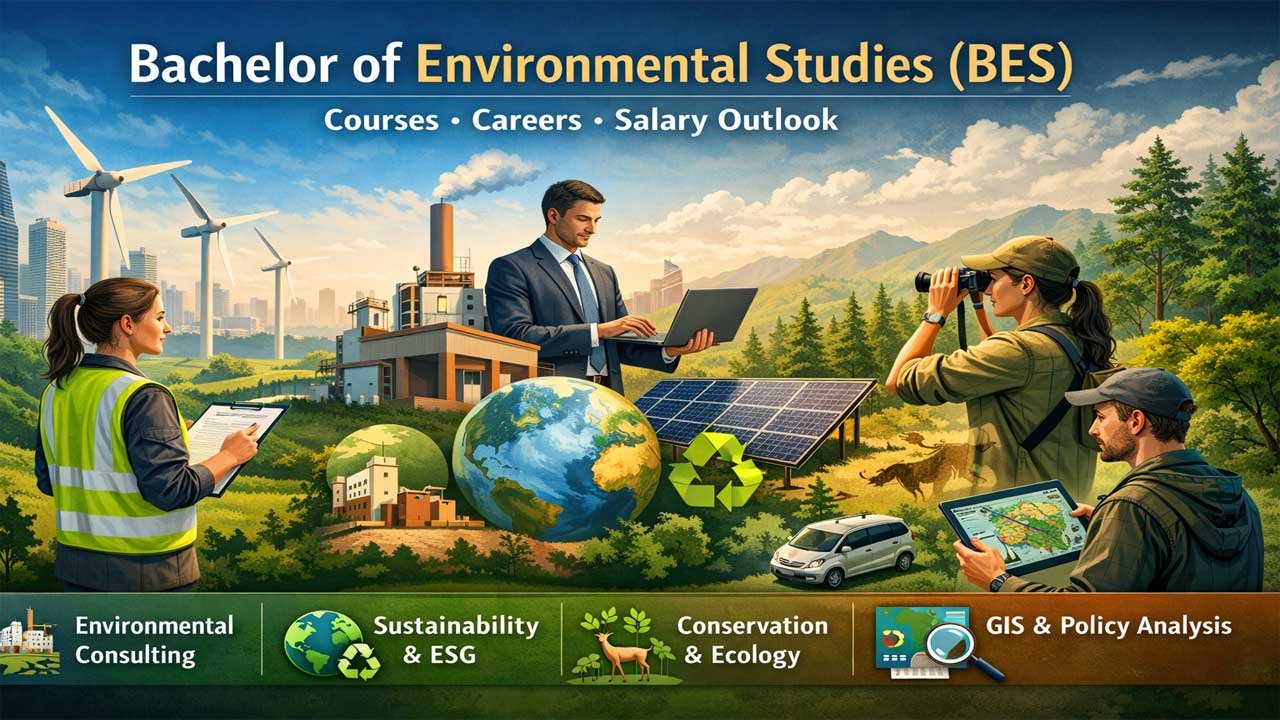
A Bachelor of Environmental Studies (BES) is a four-year undergraduate degree that combines environmental science with social sciences, policy, economics, and management to help students solve real-world environmental problems.
It is ideal for those interested in climate change, sustainability, conservation, renewable energy, and environmental policy, offering careers in government, NGOs, consulting firms, and corporate sustainability roles. Compared to Environmental Science, BES is less math- and lab-heavy and more focused on human–environment relationships, decision-making, and strategy.
Graduates can work as environmental consultants, sustainability or ESG managers, policy analysts, conservation professionals, GIS analysts, and educators, with entry-level salaries around $40,000–$50,000 in developed countries and senior roles reaching $100,000+ with experience and specialization. With strong global demand driven by climate action, green energy, and ESG regulations, a BES degree is a good choice for students who want flexible, meaningful careers that balance environmental impact with long-term growth.
| Aspect | Details |
|---|---|
| Degree Name | Bachelor of Environmental Studies (BES) |
| Level | Undergraduate |
| Duration | 4 years |
| Degree Type | BA or BS (varies by university) |
| Core Focus | Environment, sustainability, policy, society, and management |
| Main Subjects | Environmental science, policy, economics, GIS, law, sustainability |
| Ideal For | Students interested in climate change, ESG, conservation, policy |
| Math Requirement | Moderate (less than Environmental Science) |
| Top Career Roles | Environmental Consultant, Sustainability/ESG Manager, Policy Analyst, GIS Analyst |
| Employment Sectors | Government, NGOs, consulting firms, corporates, energy sector |
| Entry-Level Salary (Global Avg.) | USD 40,000–50,000 per year |
| Mid-Career Salary | USD 65,000–95,000 per year |
| Senior-Level Salary | USD 100,000–150,000+ per year |
| Top Hiring Countries | USA, Canada, UK, Germany, Australia, Singapore |
| Higher Study Options | MSc Environment, MBA, Environmental Law, Data/GIS specialization |
| Job Market Outlook | Strong growth due to climate action & ESG demand |
Bachelor of Environmental Studies (BES): Complete Guide to Programs, Careers & Salary in 2026
The Bachelor of Environmental Studies (BES) has emerged as one of the most sought-after undergraduate degrees for students passionate about addressing global environmental challenges. Whether you’re interested in climate change mitigation, renewable energy development, conservation policy, or corporate sustainability, a BES degree opens doors to a rapidly expanding career landscape.
This comprehensive guide explores everything you need to know about BES programs—from program structure and admission requirements to career prospects and international salary expectations.
What is a Bachelor of Environmental Studies (BES)?
A Bachelor of Environmental Studies is an interdisciplinary undergraduate degree that combines scientific knowledge with social sciences, humanities, policy, and business principles to address complex environmental challenges.
Key Characteristics of BES Programs
Interdisciplinary Focus: Unlike pure science degrees, BES programs integrate multiple disciplines—biology, chemistry, geography, economics, law, public health, and business studies—to provide a holistic understanding of environmental issues.
Duration: Typically 4 years (160 academic credits or units)
Degree Classification: Bachelor of Science (BS) or Bachelor of Arts (BA), depending on the institution
Core Philosophy: BES programs emphasize that environmental problems are not purely scientific; they require understanding of policy, culture, economics, and human behavior.
BES vs. Environmental Science: Key Differences
Many students confuse Bachelor of Environmental Studies with Bachelor of Environmental Science. Here’s the critical distinction:
| Aspect | BES (Environmental Studies) | Environmental Science |
|---|---|---|
| Primary Focus | Human-environment relationships, policy, sustainability | Scientific principles and quantitative analysis |
| Disciplines | Science + social sciences + humanities + policy | Biology, chemistry, physics, geology, ecology |
| Coursework | Mix of science, economics, law, policy, communications | Heavy lab work, fieldwork, advanced mathematics |
| Career Path | Policy, consulting, management, advocacy | Research, technical roles, environmental engineering |
| Quantitative Demand | Moderate | High (advanced math, statistics, data analysis) |
Professional Insight: According to environmental professionals with 20+ years of experience, the distinction matters for employer preference. Government environmental agencies and consulting firms often prefer BS in Environmental Science for technical roles, while NGOs, policy organizations, and corporate sustainability departments favor BES graduates for strategic positions.
BES Program Structure & Curriculum
Year-by-Year Breakdown
Most BES programs follow a structured 4-year framework with progressive learning:
First Year: Foundation courses covering environmental science basics, ecology, chemistry, economics, and an introduction to environmental studies from multiple perspectives.
Second Year: Intermediate courses in environmental policy, GIS (Geographic Information Systems), environmental law, sustainability concepts, and specialized science courses.
Third Year: Advanced coursework in specialized areas (climate change, conservation, renewable energy, environmental management), plus internship placements.
Fourth Year: Capstone projects, research papers, honors theses, and career-focused seminars.
Typical Course Categories
- Natural Sciences: Ecology, biodiversity, environmental chemistry, climate systems, water resources
- Social Sciences: Environmental economics, policy analysis, environmental sociology, sustainable development
- Applied Skills: GIS mapping, environmental impact assessment, data analytics, environmental auditing
- Communications: Environmental writing, scientific communication, policy briefings, media engagement
- Law & Policy: Environmental law, international environmental agreements, regulatory compliance
- Business & Management: Corporate sustainability, ESG (Environmental, Social, Governance) strategy, green business models
Top BES Programs Worldwide (2026)
Leading Universities Offering BES
National University of Singapore (NUS) – Bachelor of Environmental Studies (Honours)
- Offered through College of Humanities and Sciences
- Specializations in Environmental Geography or Environmental Biology
- Strong industry connections with Singapore government agencies
- Median graduate salary: SGD 3,500-5,000/month
- Admission: GCE A-Levels or equivalent
York University (Canada) – Bachelor of Environmental Studies
- Multiple specializations: Environmental Science, Environmental Management, Environmental Arts and Justice
- Experiential learning with field trips to Las Nubes EcoCampus (Costa Rica)
- Strong co-op placement programs
- Admission: Mid-70s to high 70s grade average
- Tuition: CAD 32,772/year for domestic students
Saint Mary’s University (SMU, Canada) – BES Program
- Focus on practical environmental problem-solving
- Maritime region’s first dedicated environmental studies degree
- Flexible program design with creative approaches to environmental challenges
- Strong research opportunities
University of the Fraser Valley (UFV, Canada)
- Integrated interdisciplinary curriculum
- Regional focus: agriculture, food security, climate change, GIS
- Blended learning: online and face-to-face formats
- Four-year bachelor’s degree with practical applications
TERIA (Delhi, India) – BES Honours/Honours with Research
- Four-year FYUP (Four-Year Under-Graduate) Programme
- Flexible entry/exit options (certificate, diploma, degree, honors, honors with research)
- Thematic specializations: climate science, natural resources, geoinformatics, economics
- Mapped with UN Sustainable Development Goals
- Admission: 10+2 with 50% aggregate marks
University of Manchester (UK) – Online Environmental Programs
- Multiple online options for flexible study
- Strong research-backed curriculum
- International cohort of students
- Tuition: Varies by program
BES Admission Requirements: Global Standards
Typical Eligibility Criteria
Educational Qualification
- Completion of 10+2 (Class XII) or equivalent senior secondary examination
- Science stream preferred (Physics, Chemistry, Biology, Mathematics)
- Some programs accept any stream with specific subject prerequisites
Minimum Marks/Grades
- India: 50% aggregate marks in Class 12
- Canada (Ontario): Mid-70s to high 80s average
- US/UK: Variable by institution; typically 60-70% equivalent
- Singapore: Good grades in relevant subjects; specific cutoff varies by cohort
Subject Requirements
- At least one of: Biology, Chemistry, Physics, Mathematics, Geography, Economics
- Advanced mathematics highly advantageous
- English language proficiency (IELTS/TOEFL for international applicants)
Additional Documents
- Statement of Purpose (SOP) explaining motivation for environmental studies
- Letters of Recommendation (typically 2-3)
- Academic transcripts
- For international students: IELTS (6.5+) or TOEFL (90+)
Application Timeline
Most programs have rolling admissions with deadlines typically in:
- Early January (for Fall/September intake)
- June-July (for Winter/January intake)
- March-April (for Spring/May intake)
Recommendation: Apply 6-8 months in advance to secure scholarships and visa approvals.
BES Career Paths & Job Opportunities
High-Demand Environmental Careers for BES Graduates
1. Environmental Consultant
- Advise businesses and governments on environmental compliance and sustainability practices
- Conduct environmental impact assessments
- Salary Range:
- US: $60,000-$85,000 entry; $80,000-$120,000+ senior
- UK: £44,000-£88,000
- India: ₹7.6-12 LPA
- Germany: €50,000-€75,000
2. Sustainability Manager / ESG Manager
- Develop and implement corporate sustainability strategies
- Manage carbon footprint reduction programs
- Coordinate ESG (Environmental, Social, Governance) initiatives
- Salary Range:
- US: $70,000-$130,000
- Germany: €55,000-€85,000
- India: ₹13.2 LPA (experienced)
3. Environmental Policy Analyst
- Research and analyze environmental regulations
- Contribute to policy development at government or NGO level
- Engage with stakeholders on environmental legislation
- Salary Range:
- US: $65,000-$95,000
- UK: £40,000-£70,000
- India: ₹3-6 LPA
4. Conservation Scientist / Ecologist
- Monitor ecosystems and biodiversity
- Design habitat restoration projects
- Conduct field research on species and ecosystems
- Salary Range:
- US: $59,000-$111,000 (Marine Biologist)
- UK: £35,000-£75,000
- India: ₹9.6 LPA
5. Renewable Energy Specialist
- Design and implement renewable energy projects (solar, wind, hydroelectric)
- Analyze energy efficiency opportunities
- Develop clean energy strategies
- Salary Range:
- US: $70,000-$140,000
- Germany: €50,000-€105,000
- UK: £50,000-£100,000+
6. Corporate Environmental Strategist
- Develop long-term environmental and sustainability goals for corporations
- Assess supply chain environmental impact
- Lead net-zero transition initiatives
- Salary Range:
- US: $75,000-$150,000
- UK: £50,000-£90,000+
- Germany: €60,000-€100,000
7. GIS/Data Analyst (Environmental)
- Use Geographic Information Systems for environmental mapping
- Analyze environmental data and trends
- Create spatial visualizations for decision-making
- Salary Range:
- US: $55,000-$90,000
- India: ₹6.5 LPA
- Germany: €45,000-€65,000
8. Environmental Health & Safety Officer
- Ensure workplace environmental compliance
- Conduct health and safety audits
- Develop workplace environmental protocols
- Salary Range:
- US: $54,789-$101,000
- India: ₹4.2 LPA
9. Environmental Educator / Science Communicator
- Develop educational programs on environmental issues
- Create content for public awareness campaigns
- Train professionals and communities on sustainability
- Salary Range:
- US: $40,000-$70,000
- UK: £25,000-£55,000
10. Water Resources Manager
- Manage water quality and availability
- Design water treatment systems
- Plan water conservation strategies
- Salary Range:
- US: $70,000-$120,000
- India: ₹18 LPA (senior roles)
Employment Sectors for BES Graduates
- Government environmental agencies (EPA, Ministry of Environment)
- International NGOs (Greenpeace, WWF, TNC, UNDP)
- Private consulting firms (Deloitte, ERM, Jacobs)
- Energy and utility companies
- Oil & gas companies (transitioning to renewable energy)
- Tech companies (sustainability and ESG reporting)
- Academic research institutions
- International development organizations (World Bank, ADB)
- Municipal governments and urban planning departments
BES Salary & Compensation (2026)
Entry-Level Salaries (0-2 Years Experience)
| Region/Country | Entry-Level Range | Notes |
|---|---|---|
| United States | $40,000-$50,000 | Environmental analyst or junior consultant roles |
| United Kingdom | £30,000-£40,000 | Entry-level consultant or environmental officer |
| Germany | €35,000-€45,000 | Starting salary for environmental specialist |
| Canada | CAD 45,000-55,000 | Government or consulting entry positions |
| Australia | AUD 50,000-65,000 | Junior environmental consultant |
| Singapore | SGD 28,000-35,000 | Entry roles in consulting or government |
| India | ₹1.6-3.5 LPA | Lab, government, or junior consulting roles |
Mid-Career Salaries (5-7 Years Experience)
| Region/Country | Mid-Career Range | Typical Roles |
|---|---|---|
| United States | $65,000-$95,000 | Senior consultant, manager, specialist |
| United Kingdom | £40,000-£70,000 | Senior analyst, project lead |
| Germany | €50,000-€75,000 | Senior environmental specialist |
| Australia | AUD 70,000-110,000 | Project manager, senior consultant |
| Singapore | SGD 45,000-65,000 | Manager or senior specialist |
| India | ₹4-8 LPA | Senior analyst, project lead, coordinator |
Senior-Level Salaries (10+ Years Experience)
| Region/Country | Senior Range | Typical Roles |
|---|---|---|
| United States | $100,000-$140,000+ | Director, senior manager, principal consultant |
| United Kingdom | £60,000-£120,000+ | Senior manager, director |
| Germany | €70,000-€110,000+ | Senior manager, specialized roles |
| Australia | AUD 120,000-180,000+ | Director, principal consultant |
| Singapore | SGD 70,000-120,000+ | Senior manager, director level |
| India | ₹8-15+ LPA | Policy advisor, research director, ESG head |
Highest-Paying Environmental Career Paths
- Environmental Engineer: $75,718-$108,000 (US median: $96,820)
- Environmental Lawyer: $132,377-$149,000 (requires law degree)
- Energy Manager: $92,294-$157,000
- Chief Sustainability Officer: $100,000-$250,000+ (senior executive role)
- Hydrologist: $88,770-$125,000
- Geoscientist/Geologist: $84,030-$110,629
Salary Growth Factors
- Advanced Degrees: MBA or MSc can increase salaries by 20-40%
- Specialized Skills: GIS expertise, data analytics, environmental law background
- Geographic Location: Developed nations offer 2-3x higher salaries than developing countries
- Sector: Private consulting > government > NGO (generally)
- Leadership Roles: Management positions offer 30-50% salary premium
- Certifications: Environmental auditor certifications, ESG credentials enhance earning potential
BES Skills & Competencies Developed
Technical Skills
- GIS & Spatial Analysis: Mapping environmental data, geospatial analysis
- Environmental Modeling: Climate modeling, water quality simulation, ecological prediction
- Data Analytics: Statistical analysis, environmental data interpretation, visualization
- Field Research Methods: Sampling techniques, biodiversity assessment, ecosystem monitoring
- Laboratory Techniques: Water/soil/air quality testing, chemical analysis
- Environmental Auditing: Compliance assessment, environmental management system evaluation
Professional Skills
- Policy Analysis & Writing: Environmental policy assessment, regulatory compliance documentation
- Environmental Impact Assessment (EIA): Assessing project environmental effects, mitigation planning
- Project Management: Sustainability initiative planning and execution
- Stakeholder Engagement: Communication with diverse environmental actors
- Report Writing & Presentation: Complex environmental data communication
- Leadership & Team Management: Project team coordination
Soft Skills
- Critical Thinking: Multi-disciplinary problem analysis
- Communication: Scientific and policy communication to diverse audiences
- Collaboration: Working across disciplines and sectors
- Adaptability: Navigating complex environmental challenges
- Passion & Advocacy: Commitment to environmental solutions
Global Job Market Outlook
Employment Growth Trends
United States
- Environmental Scientists & Specialists: 4% employment growth (2024-2034)
- ~8,500 job openings annually
- Driven by climate change, pollution regulation, renewable energy transition
European Union
- Green jobs sector: 15-20% annual growth
- EU Green Deal driving sustainability career demand
- Strong demand in Germany, Netherlands, UK, Sweden
Asia-Pacific
- Fastest-growing environmental job market
- India: Environmental sector projected to add 100,000+ jobs by 2030
- Singapore, Australia: High demand for ESG and sustainability roles
- China: Renewable energy jobs exceeding 4 million
Developing Nations
- Growing environmental regulatory frameworks increasing consulting demand
- International development funding expanding conservation opportunities
- Youth unemployment partially addressed by green jobs creation
Most In-Demand Environmental Specializations (2026)
- Climate Change & Carbon Management: 25-30% salary premium
- Renewable Energy: High demand, competitive salaries
- ESG & Corporate Sustainability: Fastest-growing sector
- Water Resources & Circular Economy: Critical for development
- Biodiversity & Conservation: NGO and government sector growth
- Environmental Technology: Intersection of tech and environment
Choosing the Right BES Program: Decision Framework
Questions to Consider
- Program Focus: Does it align with your environmental interests (climate, conservation, policy, energy)?
- Geographic Location: Studying near job opportunities in your target sector?
- Experiential Learning: Does the program offer internships, field courses, research opportunities?
- Industry Connections: Are there partnerships with employers in your career path?
- Cost & Financial Aid: Tuition affordability and scholarship availability?
- International Recognition: Will the degree be respected in your target job market?
- Alumni Network: Do graduates work in your desired organizations?
- Specialization Options: Can you tailor courses to your specific interests?
Recommended Timeline for Application
- 16-18 Months Before: Research programs, explore specializations, prepare for entrance exams
- 12 Months Before: Take standardized tests (SAT, ACT, IELTS, TOEFL if applicable)
- 9-12 Months Before: Prepare application materials (SOP, transcripts, recommendations)
- 6-9 Months Before: Submit applications
- 3-6 Months Before: Accept offers, arrange scholarships, plan for accommodations
- 1-3 Months Before: Complete visa applications, arrange travel
Funding BES Education: Scholarships & Financial Options
Scholarships Available
Merit-Based Scholarships
- For exceptional academic performance
- Often: 25-100% tuition coverage
- Examples: NUS Environmental Scholarship, York University Merit Awards
Need-Based Scholarships
- Based on financial need assessment
- Available from universities and government bodies
- Often 30-80% tuition support
Government Scholarships
- National scholarships for citizens
- EU Erasmus+ for European students
- Singapore government scholarships for international students
Environmental Organization Scholarships
- WWF education funding
- Conservation organization grants
- UNDP scholarships for development-focused students
Corporate Scholarships
- Shell, BP, Microsoft sustainability scholarships
- Oil & gas companies transitioning to green energy
- Tech company ESG programs
Average Program Costs
- India: ₹2-4 lakhs for entire degree
- Canada: CAD 80,000-130,000 for 4 years
- UK: £45,000-90,000+ for 3-year degree
- US: $60,000-200,000+ for 4 years (public to private)
- Singapore: SGD 30,000-60,000 for 4 years (citizen-friendly pricing)
International BES Career Opportunities
Best Countries for Environmental Careers (2026)
| Country | Salary Range (USD) | Advantages | Challenges |
|---|---|---|---|
| Germany | $50,000-$105,000 | Strong green job sector, EU support | Language barrier, competitive market |
| Sweden | $43,000-$85,000 | High quality of life, environmental leadership | High cost of living, limited positions |
| Netherlands | $45,000-$90,000 | Renewable energy hub, startup ecosystem | Limited positions, housing costs |
| United Kingdom | $44,000-$88,000 | Net-zero targets, consulting opportunities | Post-Brexit visa complexities |
| United States | $60,000-$140,000 | Highest salaries, diverse opportunities | Visa sponsorship needed |
| Australia | $46,000-$92,000 | Strong environmental sector, quality of life | High cost of living, visa requirements |
| Singapore | $45,000-$90,000 | Rapid growth, regional hub, high salaries | Competitive market, visa tied to employer |
| Canada | $48,000-$100,000 | Work permit post-study, environmental focus | Cold climate, high competition |
Work Visa & Immigration Considerations
Post-Study Work Visas
- Canada: 3-year open work permit for STEM graduates
- UK: 2-3 year visa for international STEM graduates
- Australia: Post-study work visa (typically 2-3 years)
- Singapore: Sponsored visa dependent on employer
Skilled Migration Points Systems
- Canada Express Entry: Environmental scientist (high points)
- Australia Skilled Migration: Environmental scientists eligible
- New Zealand Skilled Migrant Category: Environmental professionals qualify
Conclusion: Is a BES Degree Worth It?
A Bachelor of Environmental Studies represents a strategic investment in a career aligned with global sustainability imperatives. Here’s the verdict:
BES is Worth It If:
- You’re passionate about environmental solutions, not just income
- You want career flexibility across sectors (NGO, corporate, government)
- You value interdisciplinary education and critical thinking
- You’re willing to combine it with complementary skills (data analytics, law, business)
- You seek work that contributes to global sustainability goals
Earning Potential: Entry-level positions start at $40,000-$50,000, but senior specialists earn $100,000-$150,000+. Strategic career moves (MBA, specialized certifications) significantly enhance earning power.
Job Outlook: 4% growth in the US, faster in Asia-Pacific and Europe. Green jobs sector is among the fastest-growing employment categories globally.
Regional Advantage: Studying in developed nations (US, UK, Canada, Australia) provides better immediate salary prospects and international recognition, though living costs are higher.
Final Recommendation: A BES degree opens doors to meaningful, well-compensated careers in an industry addressing humanity’s most pressing challenges. Pair it with specialized skills (GIS, data science, business acumen) and strategic work experience for maximum career impact and earning potential.
FAQs
Q: Is a BES degree different from an Environmental Science degree?
A: Yes. BES combines science with social sciences, policy, and economics. Environmental Science focuses on hard sciences. BES suits policy, consulting, and management careers; Environmental Science suits research and technical roles.
Q: What’s the median salary for a BES graduate?
A: Entry-level: $40,000-$50,000 (US). Mid-career (5 years): $65,000-$95,000. Senior (10+ years): $100,000-$150,000+. Varies significantly by country and sector.
Q: Which countries hire the most BES graduates?
A: Germany, UK, USA, Canada, Australia, and Singapore lead in environmental job creation. India’s sector is rapidly growing.
Q: Can I do a BES if I’m not strong in math?
A: While quantitative skills help, BES programs vary in mathematical demand. Programs emphasizing policy and management require less advanced math than those focusing on environmental engineering.
Q: What’s the job growth outlook for environmental careers?
A: 4% average growth in developed nations (as fast as average). Fastest growth in Asia-Pacific and renewable energy sectors. ESG and corporate sustainability roles growing 15-20% annually.
Q: Should I pursue a BES or Environmental Science degree?
A: BES if interested in policy, consulting, management, advocacy. Environmental Science if interested in research, technical environmental engineering, or academic careers.
Q: What’s the best country to study BES?
A: Depends on career goals. Canada/Australia for post-study work. USA for highest salaries and opportunities. Germany/Netherlands for green job sector. Singapore for Asia-Pacific base.
Q: Can BES graduates work in corporate sustainability roles?
A: Yes—increasingly so. BES graduates are well-suited for ESG manager, sustainability officer, corporate environmental strategist roles (often better than narrow science degrees).


Leave a Reply
You must be logged in to post a comment.