
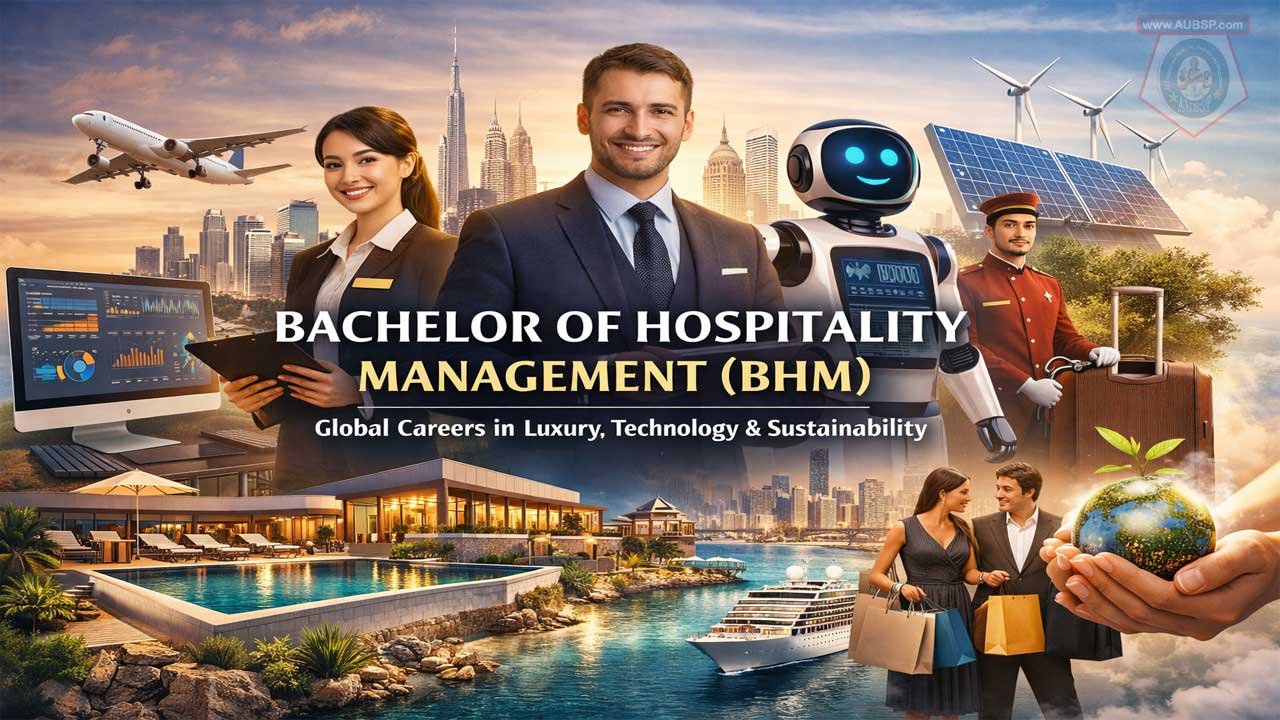
The Bachelor of Hospitality Management (BHM) has evolved into a modern business degree that combines service skills with finance, technology, and leadership training. The hospitality industry is growing fast and is expected to create many global jobs, driven by demand for luxury experiences and personalized service.
Top schools, especially in Switzerland, lead because they combine classroom learning with real industry training. The curriculum progresses from basic operations to management, specialization, and leadership, with focus areas like luxury management, sustainability, and digital transformation. Technology such as AI, robotics, and data analytics is now essential, while sustainability has become a key business priority.
Graduates can work in hotels, aviation, luxury retail, events, and consulting, with strong salary growth and global career opportunities. Although tuition is high, scholarships, internships, and post-study work visas improve return on investment and career mobility.
| Category | Information |
|---|---|
| Degree Name | Bachelor of Hospitality Management (BHM) |
| Duration | 3–4 years (some accelerated options available) |
| Focus Areas | Hotel management, finance, marketing, leadership, AI, sustainability |
| Top Study Destinations | Switzerland, USA, UK, Australia, Netherlands, Hong Kong |
| Curriculum Structure | Operations → Management → Specialization → Internship/Capstone |
| Popular Specializations | Luxury brand management, event management, resort management, sustainable tourism |
| Technology Integration | AI, robotics, data analytics, digital guest experience systems |
| Career Fields | Hotels, airlines, cruise lines, luxury retail, events, consulting |
| Entry Requirements | High school diploma, English test (IELTS/TOEFL), interviews, essays |
| Average Starting Salary | $40,000–$70,000 globally (higher at elite schools) |
| Tuition Range | $17,000–$60,000+ per year depending on country |
| Scholarships | University merit awards, corporate sponsorships, government scholarships |
| Post-Study Work Options | 1–3 years in countries like UK, Australia, Ireland, Germany |
| ROI Potential | High, with fast promotion to management and global mobility |
Bachelor of Hospitality Management (BHM): Career Scope, Top Universities, Fees, and Global Salary Outlook (2026 Guide)
The contemporary global economy characterizes the hospitality sector not merely as a service industry but as a sophisticated, high-stakes management ecosystem that integrates real estate investment, advanced data analytics, and human-centric service design. At the heart of this transformation lies the Bachelor of Hospitality Management (BHM), an academic credential that has evolved from a vocational training path into a rigorous, multi-disciplinary business degree.
In the current landscape, the BHM serves as the primary gateway for international students seeking to navigate a sector that is projected to account for one out of every eight new jobs globally by 2033. The resilience of the industry, which rebounded significantly following the pandemic-era disruptions, is now driven by a fundamental shift in consumer behavior where high-net-worth individuals and emerging middle classes alike prioritize experiential luxury and personalized service over material accumulation.
This shift necessitates a new breed of hospitality leader—one who is as comfortable interpreting dynamic pricing algorithms as they are managing multicultural teams in high-pressure environments. The modern BHM curriculum reflects this, shifting its weight from basic operational tasks toward strategic asset management, digital transformation, and sustainable development. International students for these programs is fueled by the promise of global mobility, competitive salaries that are increasingly matching traditional corporate finance roles, and the opportunity to work at the intersection of technology and human experience.
The Competitive Hierarchy: Global Institutional Rankings and the Swiss Hegemony
The selection of a BHM program is a strategic life decision for international students, governed largely by institutional prestige and industry connections. The QS World University Rankings by Subject 2026 for Hospitality & Leisure Management remains the definitive benchmark, revealing a landscape dominated by the “Swiss Model” of education.
This model is characterized by a “dual-education” approach that seamlessly blends academic theory with intense practical immersion, a tradition that has allowed Switzerland to maintain its status as the pinnacle of hospitality training.
Global Leaders in Hospitality and Leisure Management
The hierarchy of the top twenty-five institutions reflects the global nature of the sector, with elite schools concentrated in Switzerland, the United States, and emerging hubs in Asia and the Middle East.
| Rank | Institution | Location | Overall Score | Key Performance Indicator |
|---|---|---|---|---|
| 1 | EHL Hospitality Business School | Switzerland | 98.8 | Employer & Academic Reputation |
| 2 | Les Roches Global Hospitality Education | Switzerland | 91.0 | International Student Ratio |
| 3 | SHMS – Swiss Hotel Management School | Switzerland | 90.8 | Operational Innovation |
| 4 | University of Nevada – Las Vegas | United States | 89.4 | Research Citations per Paper |
| 5 | César Ritz Colleges Switzerland | Switzerland | 88.8 | Entrepreneurial Research Focus |
| 6 | Glion Institute of Higher Education | Switzerland | 87.2 | Luxury Management Focus |
| 7 | Hotel Institute Montreux | Switzerland | 86.7 | Business Acumen integration |
| 8 | Culinary Arts Academy Switzerland | Switzerland | 86.5 | Culinary-Management Synergy |
| 9 | Hotel School The Hague | Netherlands | 82.9 | Sustainable Business Models |
| 11 | The Hong Kong Polytechnic University | Hong Kong SAR | 73.6 | Asian Market Integration |
| 12 | Vatel Hotel & Tourism Business School | France | 70.8 | Global Network reach |
| 13 | Macao University of Tourism | Macau SAR | 69.5 | Integrated Resort Management |
| 15 | Cornell University | United States | 67.6 | Real Estate & Financial Strategy |
| 16 | University of Surrey | United Kingdom | 66.9 | Academic Research Quality |
| 20 | Taylor’s University | Malaysia | 64.6 | Industry Partnership depth |
The consistency of institutions like EHL and Les Roches at the top of these rankings is not merely a matter of tradition but a reflection of their ability to adapt to modern technological demands. For example, EHL has integrated Big Data and Marketing into its core curriculum to address the “Age of Information,” while SHMS has introduced advanced robotics into its campus environment to demonstrate the synergy between human service and automated efficiency.
Furthermore, the rise of the University of Macau and Hong Kong Polytechnic University highlights the shifting center of gravity toward the Asia-Pacific integrated resort market, which requires a specific set of management skills distinct from traditional European boutique hoteliering.
Academic Architecture: The BHM Curriculum as a Business Degree
A common misconception among prospective international students is that a BHM is primarily concerned with hotel operations. In reality, modern programs are accredited business degrees that utilize hospitality as the primary lens through which to study economics, finance, human resources, and marketing. The curriculum is typically structured over three to four years, designed to move a student from a “service-mindset” to a “leadership-mindset”.
Year-by-Year Pedagogical Progression
The structural flow of a top-tier BHM program—particularly those following the Swiss or British “sandwich” model—is designed to ensure that theoretical knowledge is immediately pressure-tested in real-world environments.
| Phase | Year | Core Modules | Strategic Learning Outcome |
|---|---|---|---|
| Foundations | Year 1 | F&B Operations, Room Division, Space & Revenue Management | Mastery of the “Practical Arts” and base-level service mechanics |
| Management | Year 2 | Human Resources, Financial Accounting, Marketing, Law | Transition from technical skill to departmental oversight and legal compliance |
| Specialization | Year 3 | Asset Management, Luxury Strategy, Sustainable Tourism | Deep dive into high-value niches and strategic problem-solving |
| Integration | Year 4 | Work-Based Research, Capstone Projects, Digital Transformation | Final synthesis of theory and practice for senior leadership readiness |
In the first year, modules such as “Space and Revenue Management” introduce students to the critical relationship between physical inventory and financial yield, a foundation essential for the efficient running of any catering or lodging operation.
As students progress into the management phase, the focus shifts toward “Hospitality Leadership” and “Operational Supervision,” where the emphasis is on effective strategy implementation and ensuring unique guest experiences through team management. The final years of the degree are increasingly tailored toward career outcomes, with tracks in “Hotel Asset Management,” “Consulting,” and “Marketing and Sales” allowing students to refine their expertise in alignment with global market demands.
Specializations and the Rise of Niche Management
The maturity of the hospitality sector has led to a diversification of specializations within the BHM. Rather than a “one-size-fits-all” approach, elite universities now offer pathways that allow students to target specific high-growth sectors.
- Luxury Brand Management: Focusing on the psychology of the high-net-worth individual and the maintenance of exclusivity in a digital age.
- Sustainable Development & ESG: Preparing leaders to implement “Climate-Positive” operations and manage regenerative tourism projects.
- Event and Integrated Resort Management: Covering the complexities of mega-events, conventions, and large-scale entertainment complexes.
- Wellness and Longevity Tourism: A rapidly expanding sector focusing on holistic health, biohacking retreats, and high-end medical spas.
Technological Transformation: AI, Robotics, and the Hyper-Personalized Guest Journey
For the BHM student entering the workforce in 2025 or 2026, technological fluency is as important as interpersonal empathy. The hospitality industry is at the forefront of the Fourth Industrial Revolution, utilizing Artificial Intelligence (AI) and the Internet of Things (IoT) to redefine the guest experience.
The Role of Artificial Intelligence and Machine Learning
AI is no longer a futuristic concept; it is an operational reality. Hotels and resorts are utilizing AI to manage every touchpoint of the guest journey, from pre-booking inquiries to post-stay engagement.
- Conversational AI and Chatbots: Over 89% of properties now utilize AI for customer service, reducing response times by 73% and offering 24/7 multilingual support without the need for additional staffing.
- Predictive Analytics for Revenue Management: Dynamic pricing algorithms are now standard, allowing properties to adjust rates in real-time based on demand, which has been shown to increase RevPAR (Revenue Per Available Room) by 12% to 18%.
- Hyper-Personalization: By analyzing guest data, AI can anticipate individual preferences, such as room temperature, lighting settings, and dining options, creating a “tailor-made” experience that fosters long-term brand loyalty.
- Robotic Integration: The use of service robots for tasks such as housekeeping, luggage delivery, and even food preparation is becoming common in upscale properties. Robot “Lucki” at the SHMS campus exemplifies how robotics can free up human staff to focus on “high-touch” personalized services.
Contactless Solutions and the Digital Ecosystem
The preference for seamless, tech-driven interactions is a hallmark of the modern traveler. Institutions offering a BHM degree now emphasize the management of these digital ecosystems.
| Technology | Operational Impact | Guest Benefit |
|---|---|---|
| Digital Room Keys | 31% faster check-in times | Skipping the front desk; instant access to rooms |
| Smart Room Controls | Optimized energy use through IoT sensors | Voice-activated lighting, temperature, and media |
| AR-Enhanced Menus | 14-minute average reduction in service time | Interactive, visual dining choices; ingredient transparency |
| VR Facility Tours | Engaging guests before they book | Immersive “try before you buy” experiences |
However, this increased digitization brings new challenges that BHM graduates must manage. Cybersecurity is now a primary concern, with 24/7 network support required to counter ransomware and phishing threats directed at guest data. The “Future of Hospitality” curriculum at institutions like the University of Cincinnati and EHL explicitly addresses these technical competencies alongside traditional management.
Sustainability as a Competitive Imperative: The Shift to ESG-Driven Management
In the 2026 landscape, sustainability has moved from being a voluntary corporate social responsibility (CSR) initiative to a non-negotiable competitive imperative. Guests are increasingly booking based on a property’s environmental footprint, and investors are demanding transparent ESG (Environmental, Social, and Governance) reporting.
Green Operational Strategies and Financial Returns
The integration of sustainable practices is not just “good for the planet”; it is demonstrably good for business. BHM graduates are trained to implement and manage complex green systems that impact the bottom line.
- Energy and Water Efficiency: The use of smart thermostats, low-water-consuming kitchen equipment, and LED lighting significantly reduces overhead costs.
- Waste Reduction: Moving beyond the elimination of single-use plastics, properties are now implementing composting programs and sustainable sourcing models. Hotels with local food partnerships report 27% higher F&B revenue due to the “farm-to-table” appeal.
- Renewable Infrastructure: Integrating solar panels, geothermal heating, and wind turbines into resort design is becoming a hallmark of luxury properties.
- LEED Certification: Achieving green certification has a direct financial impact, with LEED-certified properties often achieving a 19% higher ADR (Average Daily Rate) than non-certified competitors.
The curriculum at schools like EHL and Cornell now reflects these realities, producing graduates who can lead “responsible hotels” and “regenerative tourism” initiatives that align with global climate goals. This focus on sustainability is particularly relevant for the “Bleisure” (Business + Leisure) market, where corporate travelers often have strict sustainability mandates for their chosen accommodations.
Global Career Trajectories and the 2034 Salary Outlook
A BHM degree provides one of the most versatile professional foundations in the modern economy. Graduates are no longer limited to hotel management; they are increasingly recruited by luxury retail brands, private equity firms, aviation companies, and healthcare providers who value their unique blend of operational rigor and service excellence.
Salary Projections for Key Hospitality Management Roles
The earning potential for BHM graduates is on a steep upward trajectory, driven by labor shortages and the increasing complexity of management roles.
| Role | 2024 Median Salary | 2034 Projected Salary | Job Growth (2024-34) |
|---|---|---|---|
| Hotel Manager | $118,297 | – | – |
| Lodging Manager | $68,130 | $106,743 | 3% |
| Regional Restaurant Manager | $104,715 | – | – |
| Food Service Manager | $65,310 | $91,028 | 6% |
| Chef and Head Cook | $60,990 | $85,439 | 7% |
| Real Estate Analyst (MMH) | $100,000 – $110,000 | – | – |
| Revenue Analyst | $67,000 – $75,000 | $101,010 (Experienced) | – |
| Restaurant Cook | $37,730 | $69,548 | 15% |
| Event Planner | – | – | 11% |
For those graduating from elite programs like Cornell’s Nolan School, starting salaries in high-impact fields such as “Asset Management” and “Real Estate Acquisitions” can exceed $115,000 immediately upon graduation. This reflects a growing demand for hospitality professionals with “investment savvy” and “strategic foresight” who can manage the financial performance of massive global portfolios.
Niche Career Paths: Beyond the Traditional Hotel
The “Experience Economy” has opened up diverse roles that prioritize the hospitality skill set in specialized environments.
- Cruise Ship Retail Management: This represents a fast-track leadership pathway for high-performing managers. A “Shop Manager” on a world-class cruise ship can earn between $2,700 and $4,200+ gross monthly, with additional performance-based commissions and the benefit of living in a private manager’s cabin.
- Aviation Management: BHM graduates are entering roles as “Aviation Sustainability Managers,” “Airline Schedule Recovery Managers” (with average salaries of $86,378), and “Aviation Insurance Risk Analysts”.
- Luxury Retail: Leading brands such as LVMH and Richemont often recruit BHM graduates for roles in “Visual Merchandising,” “Inventory Management,” and “Bespoke Concierge Services”.
- Wellness and Longevity Clinics: High-end medical spas and “biohacking” retreats require managers who can bridge the gap between healthcare hospitality and luxury service.
Admissions Requirements and the “Hospitality Mindset”
Admissions to top-tier BHM programs is a competitive process that evaluates more than just academic performance. Universities are looking for the “Hotelie” persona—intellectually curious, energetic, collaborative, and passionate about the “business of hospitality”.
Quantitative and Academic Standards
Despite the perception of hospitality as a “soft” field, quantitative aptitude is strictly required.
- Mathematics and Science: Elite schools like EHL and Cornell require a minimum of three to four years of mathematics (including Pre-Calculus) and specific science units (such as Chemistry) at the secondary school level.
- Standardized Testing: While some institutions have moved toward “test-optional” policies, many still require SAT (≥1200) or ACT (≥24) scores for a competitive application.
- GPA and Diploma Requirements: Minimum GPA requirements are typically high (e.g., 3.2/5.0 or 12/20 in the French system), and candidates must hold a certificate qualifying them for university admission in their home country.
English Language Proficiency for International Students
For students whose primary language of instruction was not English, demonstrating proficiency is mandatory.
| Test | Typical Minimum Score Required |
|---|---|
| IELTS Academic | 6.0 – 7.5 |
| TOEFL iBT | 80 – 100 |
| Duolingo English Test | 110 – 120 |
| PTE Academic | 60 – 70 |
| Cambridge C1/C2 | 180 – 191 |
The Portfolio: Essays, Interviews, and Experience
The most critical part of the application is often the portfolio, where candidates must demonstrate their motivation and service mindset.
- Personal Essays: Candidates are asked to reflect on current industry trends, their career objectives, and why they fit the specific culture of the school.
- Relevant Experience: About half of the first-year students at elite programs already have relevant work experience in the hospitality or service-industry sector.
- Interviews: Some schools, like EHL, utilize interviews to assess interpersonal skills, while others, like Cornell, take a holistic view of the written application and extracurricular passions.
The Financial Investment: Tuition, Living Costs, and ROI
The cost of a BHM degree is substantial, making it a “strategic investment” for international families. Tuition varies significantly based on geographic location and the level of practical arts training provided.
Global Tuition Comparison
| Country | Institution Type | Indicative 1st Year Tuition | Total Course Duration |
|---|---|---|---|
| Switzerland | Private Elite (e.g., César Ritz) | High Range | 4 Years |
| United States | Private Ivy (Cornell) | ~ $60,000+ | 4 Years |
| Australia | Public (ECU) | AUD $38,600 | 3 Years |
| Australia | Private (ICMS/ICHM) | AUD $35,200 – $52,800 | 3 Years |
| United Kingdom | Public (Napier/Surrey) | £17,520 – £20,950 | 3-4 Years |
Living Expenses and Mandatory Costs
International students must budget for more than just tuition. In the UK, monthly living costs are estimated at £1,300 to £1,400 in London and £900 to £1,300 in the rest of the country. In Australia, students at schools like ICHM must also factor in the cost of professional business uniforms and textbooks, which can add AUD $400 to $600 annually.
Calculating the ROI: Traditional vs. Accelerated Degrees
The Return on Investment (ROI) for a BHM degree is driven by the speed of entry into managerial positions. Accelerated 2-year degrees are becoming popular, as they allow students to enter the workforce nearly two years earlier, potentially saving $40,000 to $60,000 in tuition and lost income.
Research shows that hospitality graduates often see an ROI boost of 15-25% within the first five years due to the rapid career advancement paths available in luxury resorts and consulting firms. Online and hybrid programs further improve ROI by allowing students to maintain employment while they study, minimizing the “income interruption” that occurs in traditional full-time programs.
Global Scholarship Ecosystem for Hospitality Students
To attract the world’s best talent, institutions and industry giants offer a robust network of scholarships and grants for the 2025/2026 academic cycles.
- Institutional Merit Awards: EHL’s “Excellence Scholarship” provides full tuition waivers and living stipends, while UNLV’s “Harrah College Scholarship” covers full tuition and accommodation.
- Industry Foundations: The National Restaurant Association Educational Foundation offers multiple awards ranging from $2,500 to $10,000 for students pursuing culinary and hospitality degrees.
- Corporate Sponsorships: Marriott’s “Path to Prosperity” and Hilton’s “Lifelong Learning” programs focus on supporting underrepresented groups and fostering long-term career growth.
- Government-Backed Funding: The “Australia Awards” provide full funding for students from participating developing countries, while the “Government of Ireland International Education Scholarship” offers full funding for the 2026 cycle.
- Niche Grants: The “Aga Khan Foundation International Scholarship” supports students from developing countries, emphasizing the industry’s commitment to building global leadership.
Post-Study Work Visas: The Pathway to Permanent Residency
A primary driver for international BHM enrollment is the opportunity to stay and work in the host nation after graduation. In 2026, stay-back policies have become more strategic, targeting skilled graduates to fill management shortages.
2026 Stay-Back Policies by Destination
| Country | Visa Subclass/Route | Stay Duration (Bachelor’s) | Path to PR |
|---|---|---|---|
| Australia | Subclass 485 | 2 Years | Skilled Independent/Regional Pathways |
| UK | Graduate Route | 2 Years | Switch to Skilled Worker Visa |
| Ireland | Stamp 1G | 12 – 24 Months | Link to “Critical Skills” Employment |
| Germany | Job Seeker | 18 Months | Switch to German Work Permit/EU Blue Card |
| France | – | 2 Years | Flexible employment & industry networking |
In Australia, the length of stay is sometimes tailored to the level of qualification and the applicant’s nationality. For example, Indian nationals under the AI-ECTA agreement may receive up to three years for a Master’s by research, while PhD holders from Hong Kong can stay up to five years. These policies offer graduates the chance to build a professional network and potentially secure permanent residency through skilled work pathways.
Conclusions: The Future of the BHM Professional
The Bachelor of Hospitality Management has successfully transitioned from a specialized operational degree into a cornerstone of the global experience economy. For the international student, it offers a pathway to a resilient, high-growth career that is increasingly protected against automation through its focus on human empathy and complex problem-solving. As the industry continues to integrate AI, robotics, and sustainable practices, the value of the BHM will only increase, provided the graduate maintains a commitment to lifelong learning and technological adaptation.
Ultimately, success in the 2025–2034 cycle will be defined by “Hyper-Personalization” and “Sustainable Leadership.” Institutions that produce graduates capable of managing these two pillars while delivering a high financial ROI will continue to dominate the global rankings. For the student, the strategic choice of a program must be balanced between institutional prestige, the quality of practical internships, and the favorability of post-study work policies in their chosen host nation.
FAQs about Bachelor of Hospitality Management
What is a Bachelor of Hospitality Management (BHM)?
It is a 3–4 year undergraduate business degree that teaches hotel operations, finance, marketing, leadership, and technology for careers in hospitality and service industries.
What are the career options after BHM?
Graduates can work as hotel managers, event managers, revenue analysts, airline service managers, cruise managers, luxury retail managers, or hospitality consultants.
Which countries are best for studying BHM?
Switzerland, USA, UK, Australia, Netherlands, and Hong Kong are popular due to strong industry connections and global recognition.
What is the average salary after BHM?
Starting salaries usually range from $40,000 to $70,000 per year globally, with higher salaries possible in luxury hotels and management roles.
Is BHM a good career choice in the future?
Yes, the hospitality industry is growing fast and is expected to create millions of new jobs worldwide, especially in luxury tourism and global travel.
What subjects are taught in BHM?
Students learn food and beverage operations, hotel management, accounting, marketing, human resources, revenue management, and hospitality technology.
Do BHM students get internships?
Yes, most programs include mandatory internships in hotels, resorts, airlines, or event companies to gain real-world experience.
What are the admission requirements for BHM abroad?
Students need a high school diploma, English proficiency test scores like IELTS or TOEFL, and sometimes interviews or personal essays.
Can BHM graduates work abroad?
Yes, hospitality is a global industry, and many countries offer post-study work visas and international career opportunities.
What is the duration of a BHM course?
Most BHM programs take 3 to 4 years to complete, depending on the country and university.


Leave a Reply
You must be logged in to post a comment.