
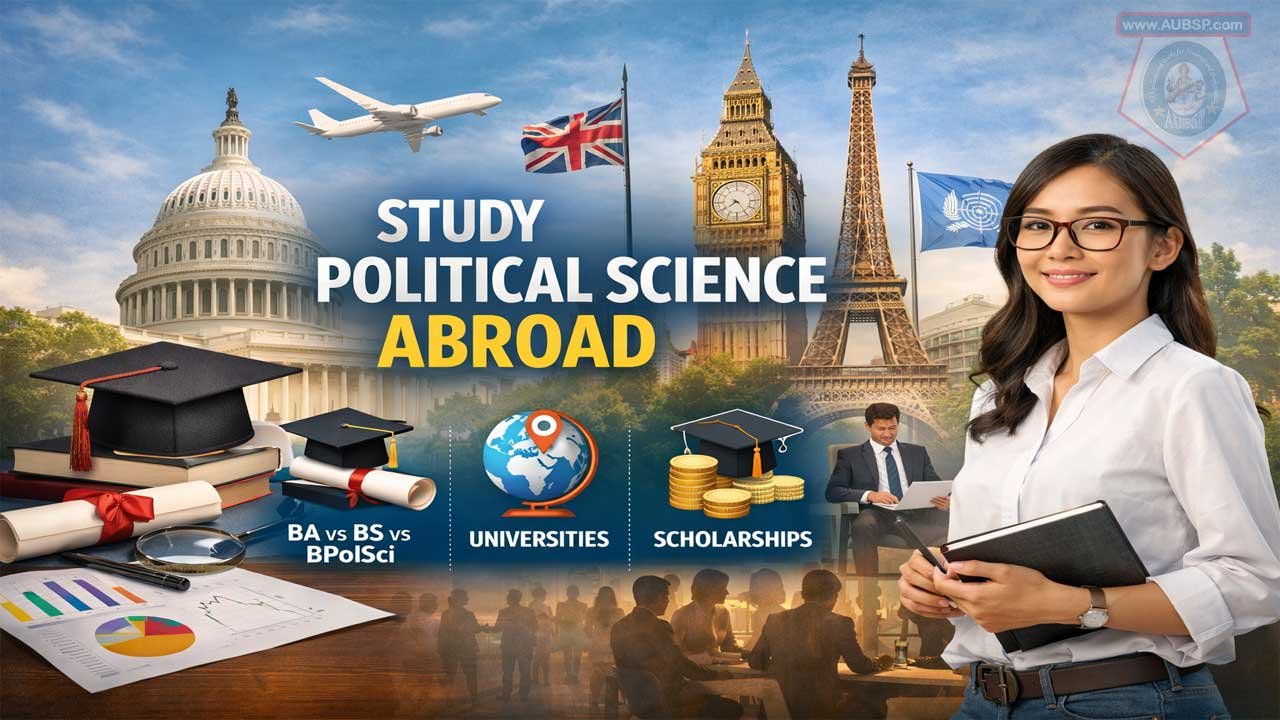
Political science has grown from a field focused mainly on political philosophy and governance into a modern discipline that also uses research, data analysis, and global policy studies. Students choosing an undergraduate degree in this field usually decide between a BA, BS, or BPolSci, which differ mainly in their approach.
A BA focuses on theory, writing, and broad liberal arts learning, while BS/BPolSci programs emphasize statistics, data analysis, and research methods. Regardless of the degree type, students study core areas such as American politics, comparative politics, international relations, and political theory, along with research methodology.
Many top universities in the U.S., U.K., Europe, and Asia offer strong programs, though tuition and admission requirements vary, often including English tests like TOEFL or IELTS and sometimes SAT/ACT scores. Scholarships and internships can help international students manage costs and gain experience. Graduates can pursue careers in government, law, business, public policy, data analysis, international organizations, or NGOs, making political science a flexible degree with many career paths.
| Category | Information |
|---|---|
| Degree Types | BA in Political Science, BS in Political Science, Bachelor of Political Science (BPolSci) |
| Main Difference | BA focuses on theory, humanities, and writing; BS/BPolSci emphasize statistics, data analysis, and research methods |
| Core Study Areas | American Politics, Comparative Politics, International Relations, Political Theory, Research Methodology |
| Program Duration | Typically 3–4 years depending on the country |
| Top Study Destinations | United States, United Kingdom, Netherlands, Singapore, Canada, Australia |
| Leading Universities | Harvard, Stanford, Georgetown, Columbia, LSE, Oxford, Cambridge, NUS, University of Amsterdam |
| English Tests Required | TOEFL, IELTS, or Duolingo for most international students |
| Standardized Tests | SAT/ACT required by some U.S. universities; many remain test-optional |
| Average Tuition | ~$55k–$65k/year (US), £27k–£31k/year (UK), €12k–€15k/year (Netherlands) |
| Major Scholarships | Mastercard Foundation Scholars, DAAD, Leiden Excellence Scholarship, Lester B. Pearson Scholarship |
| Career Paths | Government, policy analysis, law, data science, international relations, public affairs |
| Example Job Roles | Policy Analyst, Political Scientist, Data Analyst, Lawyer, Management Analyst |
| Career Locations | Government agencies, NGOs, think tanks, corporations, international organizations like the UN |
| Internship Hubs | Washington D.C., New York, London, Brussels |
Political Science Degree Guide: BA vs BS vs BPolSci, Top Universities, Scholarships & Careers (2026)
The study of political science has transitioned from its classical roots in political philosophy and statecraft into a sophisticated, multi-dimensional discipline that integrates rigorous empirical research, advanced data analytics, and complex global policy evaluation. For the international student navigating the selection of an undergraduate degree, the choice between a Bachelor of Arts (BA), a Bachelor of Science (BS), or the specialized Bachelor of Political Science (BPolSci) represents a critical decision that dictates the methodological lens through which they will analyze power, authority, and societal organization.
As contemporary global political structures encounter unprecedented challenges—ranging from the digital divide and climate governance to the shifting alliances of multilateralism—the demand for graduates equipped with both theoretical depth and technical proficiency has escalated across the public, private, and non-profit sectors. This article serves as an exhaustive guide to the academic architecture of the BPolSci degree, the competitive landscape of global higher education, and the strategic professional pathways available to graduates in the 2025–2027 academic cycles.
The Disciplinary Architecture: Defining the BA, BS, and BPolSci
The fundamental distinction between undergraduate political science degrees lies in their methodological orientation and the specific technical competencies they prioritize. While all tracks provide a foundational understanding of how citizens interact with governance and how policies are formulated to serve societal needs, the curricular divergence is designed to prepare students for distinct professional and academic environments.
The Bachelor of Arts (BA) in Political Science
The Bachelor of Arts remains the most established pathway, emphasizing a broad liberal arts education that prioritizes critical thinking, historical context, and normative political theory. The BA curriculum typically requires a broader representation of disciplines, incorporating courses in writing, art, history, philosophy, and religion to provide a holistic understanding of human society.
A distinguishing feature of the BA track at many leading institutions, such as Arizona State University and various Ivy League schools, is a rigorous foreign language requirement. This component is intended to cultivate cross-cultural competence, making the BA an ideal choice for students targeting careers in the foreign service, international NGOs, or global journalism where linguistic and cultural nuances are paramount.
The Bachelor of Science (BS) and Bachelor of Political Science (BPolSci)
In contrast, the Bachelor of Science (BS) and the specialized Bachelor of Political Science (BPolSci) are engineered for students who seek rigorous training in social scientific methodology and empirical research production. These programs often eschew the foreign language requirement in favor of intensive coursework in statistics, data comprehension, and mathematical literacy as applied in political contexts.
For instance, the BS program at The Ohio State University distinguishes itself through a core sequence of three methodology courses and a fourth elective in specialized methodology, such as game theory or policy analysis. These degrees are particularly advantageous for students pursuing a second STEM-related major or those intending to enter graduate programs focused on quantitative political analysis or data science.
The following table provides a structural comparison of the core requirements and skill emphases across these degree tracks as observed in major global universities.
| Feature | Bachelor of Arts (BA) | Bachelor of Science (BS / BPolSci) |
|---|---|---|
| Primary Focus | Qualitative analysis, theory, and policy review | Quantitative methodology and empirical research |
| Core Skills | Reasoning, argumentation, and persuasive writing | Statistics, data comprehension, and math literacy |
| Language Requirement | Often required (typically 2-4 semesters) | Typically replaced by advanced quantitative credits |
| Methodology Level | Introductory research methods and qualitative logic | Advanced data analysis, R/Python coding, and modeling |
| Elective Scope | Humanities, history, and broad liberal arts | STEM-aligned social sciences and technical electives |
| Standard Duration | 3-4 years depending on the country | 3-4 years depending on the country |
Foundational Subfields and Curricular Requirements
Regardless of the degree nomenclature, the academic study of politics is organized into four or five substantive subfields that provide a comprehensive framework for understanding political phenomena. International students are typically required to complete introductory sequences in at least three of these areas before specializing.
American Politics and Public Policy
This subfield examines the internal mechanics of the United States political system, including elections, political behavior, the U.S. Constitution, and the development of federal and local laws. At Boston University, for example, students might begin with Introduction to American Politics (PO 111) and Introduction to Public Policy (PO 141) to understand how institutions and interest groups influence government decisions. For international students, this area serves as a primary case study in federalism and interest-group pluralism.
Comparative Politics
Comparative politics focuses on the political systems of other countries, employing a comparative method to understand why states develop different forms of government, such as democracies or autocracies. The curriculum often explores political elites, modern ideologies, and conflict management policies within specific regional contexts, such as Sub-Saharan Africa, East Asia, or Western Europe. This subfield is essential for students interested in democratization, international development, and regional stability.
International Relations (IR)
IR explores the interactions between state and non-state actors on the global stage, covering topics such as international security, global political economy, trade, and human rights. Core courses often include IR theory, conceptually addressing the nature of power and the role of international organizations like the United Nations (UN) and the European Union (EU). The study of IR at institutions like Columbia University or the London School of Economics (LSE) provides a critical lens for analyzing diplomacy and global governance.
Political Theory
Political theory involves the philosophical study of concepts such as equality, liberty, and justice. Students engage with foundational texts from classical and modern thinkers to evaluate how societies organize and govern themselves. At LSE, the Introduction to Political Theory (GV100) serves as a compulsory foundation for all politics students, fostering the analytical skills required to critique contemporary political systems.
Methodology and Empirical Inquiry
A growing priority in the BPolSci curriculum is the mastery of methodology. This includes introductory and advanced statistics, probability, sampling, and hypothesis testing. The Ohio State University requires BS students to take a data analysis sequence (Political Science 3780, 4781, 4782) that fulfills technical literacy requirements, ensuring graduates can produce as well as consume empirical research.
Global Institutional Hierarchy: Leading Destinations for International Students
Selecting an institution requires a balance of academic reputation, geographical advantage, and specific subfield expertise. Recent global rankings and scholar indices highlight a concentration of excellence in the United States, United Kingdom, and Western Europe.
The United States: Research-Intensive Powerhouses
The U.S. remains the global leader in political science education, characterized by substantial research funding and a strong emphasis on quantitative behavioral research.
- Harvard University: Ranked as the world’s leading department, Harvard offers concentrations in government, international relations, and political economy. Its extensive research centers and global programs provide undergraduate students with unmatched involvement in real-world policy application.
- Stanford University: Stanford is noted for an interdisciplinary approach that blends theory with data analysis and real-world application. Its curriculum focuses on American politics, international relations, and methodology, often connecting academic study with the innovative culture of Silicon Valley.
- Georgetown University: Situated in Washington, D.C., Georgetown offers a unique advantage for students interested in government and international affairs. Its location provides unparalleled access to internships at federal agencies, think tanks, and global institutions, emphasizing diplomacy and political leadership.
- Columbia University: Located in New York City, Columbia emphasizes international politics, urban policy, and global governance, benefiting from its proximity to the United Nations.
The United Kingdom: Theoretical Depth and Specialization
The UK model often features a three-year undergraduate structure with a heavy emphasis on disciplinary depth from the first year.
- London School of Economics (LSE): A global focal point for social sciences, LSE offers specialized BSc degrees in Politics, International Relations, and Politics and Economics. The school attracts students from over 140 countries and provides access to world-leading faculty in political theory and IR.
- University of Oxford: Oxford is historically renowned for its strength in political theory and the study of contemporary political systems. Its tutorial system provides rigorous one-on-one analytical training.
- University of Cambridge: Offers the Human, Social, and Political Sciences (HSPS) tripos, allowing students to combine politics with archaeology, social anthropology, or sociology.
Continental Europe and Asia: Emerging Hubs for International Study
- University of Amsterdam (Netherlands): As a top-ranked European institution, Amsterdam offers several English-taught programs, including the interdisciplinary Politics, Psychology, Law, and Economics (PPLE) degree.
- Leiden University (Netherlands): Offers a prominent program in International Relations and Organisations located in Den Haag (The Hague), the world’s capital of international law and justice.
- National University of Singapore (NUS): Asia’s highest-ranked institution for politics, NUS provides a critical perspective on Asian governance and international political economy.
The following table summarizes indicative tuition costs for international students at these top-tier destinations for the 2026 academic entry.
| Institution / Country | Annual Tuition (Indicative USD/Local) | Standard Length |
|---|---|---|
| Harvard / Yale / Princeton (USA) | ~$55,000 – $65,000 USD | 4 Years |
| LSE (UK) | £29,200 – £31,000 GBP | 3 Years |
| Oxford / Cambridge (UK) | £27,000 – £29,000 GBP | 3 Years |
| Univ. of Amsterdam (Netherlands) | ~€12,000 – €15,000 EUR (Indicative) | 3 Years |
| NUS (Singapore) | ~$14,900 USD (S$18,900) | 4 Years |
| Univ. of Toronto (Canada) | ~$36,100 CAD (Average) | 4 Years |
| Univ. of Sydney / ANU (Australia) | AU $20,000 – $56,000 AUD | 3 Years |
International Admissions: Standards and Standardized Testing Trends
For international applicants, navigating the admission process requires a meticulous understanding of language proficiency requirements and the evolving role of standardized tests like the SAT and ACT.
English Proficiency Requirements
Most universities require non-native speakers to demonstrate mastery of English through the TOEFL or IELTS. For the 2026 cycle, significant changes in scoring scales—specifically the introduction of the 1–6 score scale for TOEFL iBT—will be adopted by many institutions.
| University / Program | TOEFL iBT (Min) | IELTS (Min Academic) | Duolingo (Min) |
|---|---|---|---|
| LSE (All Undergrad) | 100+ (Strong profile) | 7.0 (Each component) | N/A |
| University of Chicago | 100 (Avg 5 on new scale) | 7.0 (Each section) | N/A |
| Stanford / Harvard | 100+ | 7.0+ | 115+ |
| MIT | 90 | N/A | 120 |
| Cal Poly (SLO) | 80 | 6.5 | 115 |
| Texas Tech University | 79 (Scale Score 4) | 6.5 | 100 |
Institutions often grant automatic waivers to students from English-speaking countries (e.g., Australia, UK, Canada) or those who have attended English-medium high schools for at least three consecutive years.
The Standardized Testing Landscape (SAT/ACT)
While more than 80% of U.S. four-year colleges remain test-optional or test-blind for Fall 2026 and 2027, a significant number of prestigious institutions have reinstated SAT/ACT requirements.
Universities like MIT, Georgetown, Yale, Dartmouth, Brown, and Harvard have returned to requiring these scores, citing internal studies that suggest they help identify talented students from diverse educational backgrounds who will thrive in rigorous academic environments. In contrast, schools like Columbia and Princeton remain test-optional for the 2026/27 cycle, though strong scores are still valued in holistic review.
Academic Qualifications: A-levels and IB
For international students not following the U.S. curriculum, top-tier schools like LSE typically demand exceptional grades in the International Baccalaureate (IB) or GCE A-levels. Typical offers for a BSc in Politics at LSE include 38 points in the IB (with 766 at Higher Level) or AAA in A-levels. Strong performance in essay-based subjects like History, English, and Philosophy is highly regarded, although the BSc Politics and Economics track also mandates A-level Mathematics.
Strategic Funding and Scholarships for International Students
The financial burden of an international degree can be offset through a variety of merit-based and need-based scholarships. Funding opportunities often prioritize leadership potential, commitment to public service, and academic excellence.
Global and University-Specific Scholarships
- Mastercard Foundation Scholars Program: This fully funded program provides citizens from Sub-Saharan Africa with access to university education at partner institutions like the University of Toronto, UC Berkeley, and Sciences Po. Benefits include tuition, travel, housing, and stipends.
- DAAD (German Academic Exchange Service): Germany’s primary funding organization supports over 140,000 scholars annually. While focused on graduates, some programs exist for undergraduate social science students from developing nations. Recipients typically receive a monthly allowance (approx. €992) and travel grants.
- Heinrich Böll Foundation (Germany): Closely aligned with the Green project’s ideals, this foundation awards scholarships to approximately 1,500 students of all subjects and nationalities. Applicants must demonstrate excellent academic records and strong social and political engagement. Proficiency in German (at least B2 or DSH 2) is a strict requirement.
- Leiden University Excellence Scholarship (LExS): Aimed at excellent non-EEA students, this scholarship offers tuition fee waivers ranging from €10,000 to €19,000.
- Lester B. Pearson Scholarship (University of Toronto): A prestigious award for international students that covers tuition, books, incidental fees, and full residence support for four years.
External and Subject-Specific Grants
- Boren Scholarships: Provide up to $20,000 for U.S. undergraduate students to study abroad in regions critical to national security, emphasizing less commonly taught languages.
- Education Future International Scholarship: Open to Indian nationals for any course except in India, offering partial funding for study at major international destinations.
- Truman Scholarship: Awards $30,000 for graduate study to college juniors committed to public service.
Professional Trajectories: ROI and Career Pathways
The Bachelor of Political Science serves as a versatile foundation for a wide range of careers in both the public and private sectors. The return on investment (ROI) is particularly strong for those who augment their degree with quantitative skills or pursue advanced professional degrees.
Career Fields and Salary Expectations
The U.S. Bureau of Labor Statistics (BLS) indicates that political science graduates can anticipate employment growth across multiple related sectors between 2021 and 2031.
| Career Category | Potential Job Titles | Median Salary | Projected Growth |
|---|---|---|---|
| Data Science / Analysis | Data Scientist, Research Analyst | $100,910 | 36% |
| Legal Services | Attorney, Judge, Paralegal | $127,990 | 10% |
| Government & Policy | Political Scientist, Policy Analyst | $122,510 | 6% |
| Business & Management | Management Analyst, Business Analyst | $93,000+ (Indicative) | 11% |
| Public Affairs | Public Relations Specialist, Lobbyist | Varies by experience | 8% |
The BS track’s emphasis on statistics and coding often qualifies students for higher-paying technical roles in political polling and market research companies. Conversely, the BA track provides the communicative and cultural depth favored by the Foreign Service and international NGOs.
The United Nations Young Professionals Programme (YPP)
For many political science students, a career as an international civil servant is the pinnacle of the profession. The UN YPP is a competitive recruitment initiative for talented graduates under 32 years of age.
- Eligibility: Candidates must be citizens of a participating member state and hold at least a first-level university degree relevant to the exam subject (e.g., Political Affairs, Human Rights, or Global Communications).
- Process: Applicants undergo a rigorous online written examination, consisting of a general paper and a specialized paper, followed by an oral interview for those who pass the written stage.
- Recruitment: Successful candidates are placed on a roster for up to three years and may be recruited into professional roles (P-1 or P-2 levels) across various UN duty stations like Geneva, Nairobi, or New York.
Pathways in Law and Business
A BPolSci degree is widely considered one of the most effective preparations for law school. The curriculum’s focus on constitutional law, institutional design, and analytical writing aligns perfectly with the requirements of top-tier legal education. In the corporate sector, political science majors are increasingly hired for roles in government relations, regulatory risk management, and corporate strategy, where an understanding of the intersection between political environments and economic activity is essential.
The Internship Ecosystem: Strategic Professional Development
Internships are the critical bridge between theoretical study and professional employment. For political science students, proximity to political centers offers a decisive advantage in securing high-impact placements.
Hubs of Political Activity
- Washington, D.C.: Home to federal agencies (CIA, FBI, State Department), Congress, and prestigious think tanks like the Brookings Institution and the American Enterprise Institute (AEI).
- New York City: Provides unique opportunities with the UN Secretariat, major NGOs, and global financial firms focusing on political risk.
- London and Brussels: Centers for international diplomacy, European policy, and global advocacy.
Internship Placement Examples
Organizations like AIFS Abroad and Connect-123 design customized programs that place students in roles such as:
- Legislative Research: Drafting constituent letters or Senate proclamations.
- Communications and Outreach: Managing social media for political campaigns or drafting press releases for international delegations.
- Data and Analysis: Managing CRM databases for political action committees or conducting community research for senators.
The rise of remote internships also allows students to gain experience with global startups and NGOs without geographic constraints, focusing on digital advocacy and political messaging.
Conclusion: Navigating the Future of Political Science Education
The Bachelor of Political Science in the late 2020s is a degree defined by its versatility and its ability to synthesize qualitative insight with quantitative rigor. For the international student, success requires a strategic approach that begins with choosing the correct methodological track—BA for cultural and theoretical depth, or BS/BPolSci for technical and analytical mastery.
As the admissions landscape shifts toward a return to standardized testing at elite institutions and more stringent English proficiency benchmarks, early preparation becomes paramount. Furthermore, by leveraging the extensive network of global scholarships—such as the Mastercard Foundation or DAAD—and securing internships in political capitals, students can maximize the return on their educational investment. Whether aspiring to influence local policy, advocate for international human rights, or manage regulatory risks in the private sector, BPolSci graduates remain at the forefront of managing the most complex societal challenges of our time.
FAQs about Bachelor of Political Science
What is the difference between a BA and a BS in Political Science?
A BA in Political Science focuses on theory, history, writing, and liberal arts subjects, while a BS emphasizes quantitative skills such as statistics, data analysis, and research methods used in political studies.
What is a Bachelor of Political Science (BPolSci)?
A BPolSci is a specialized degree that concentrates entirely on political science. It usually includes advanced training in political research, policy analysis, and data-driven methods.
How long does it take to complete a political science degree?
Most undergraduate political science degrees take 3 to 4 years to complete, depending on the country and the university.
What subjects are studied in political science programs?
Common subjects include American politics, comparative politics, international relations, political theory, public policy, and research methodology.
Which countries are best for studying political science abroad?
Popular destinations include the United States, United Kingdom, Netherlands, Singapore, Canada, and Australia because of their strong universities and global research reputation.
Do international students need English proficiency tests?
Yes, most universities require tests such as TOEFL, IELTS, or Duolingo for students whose first language is not English.
Are SAT or ACT scores required for political science programs?
Some universities, especially in the United States, require SAT or ACT scores, but many institutions currently follow a test-optional policy.
What careers can you pursue with a political science degree?
Graduates can work in government, public policy, law, international organizations, journalism, research, public relations, or business strategy.
Is political science a good degree for law school?
Yes, political science is one of the most common pre-law majors because it develops strong analytical, research, and writing skills needed for legal studies.
Are scholarships available for international students studying political science?
Yes, many universities and organizations offer scholarships such as the Mastercard Foundation Scholars Program, DAAD scholarships, and university-specific awards to support international students.


Leave a Reply
You must be logged in to post a comment.