
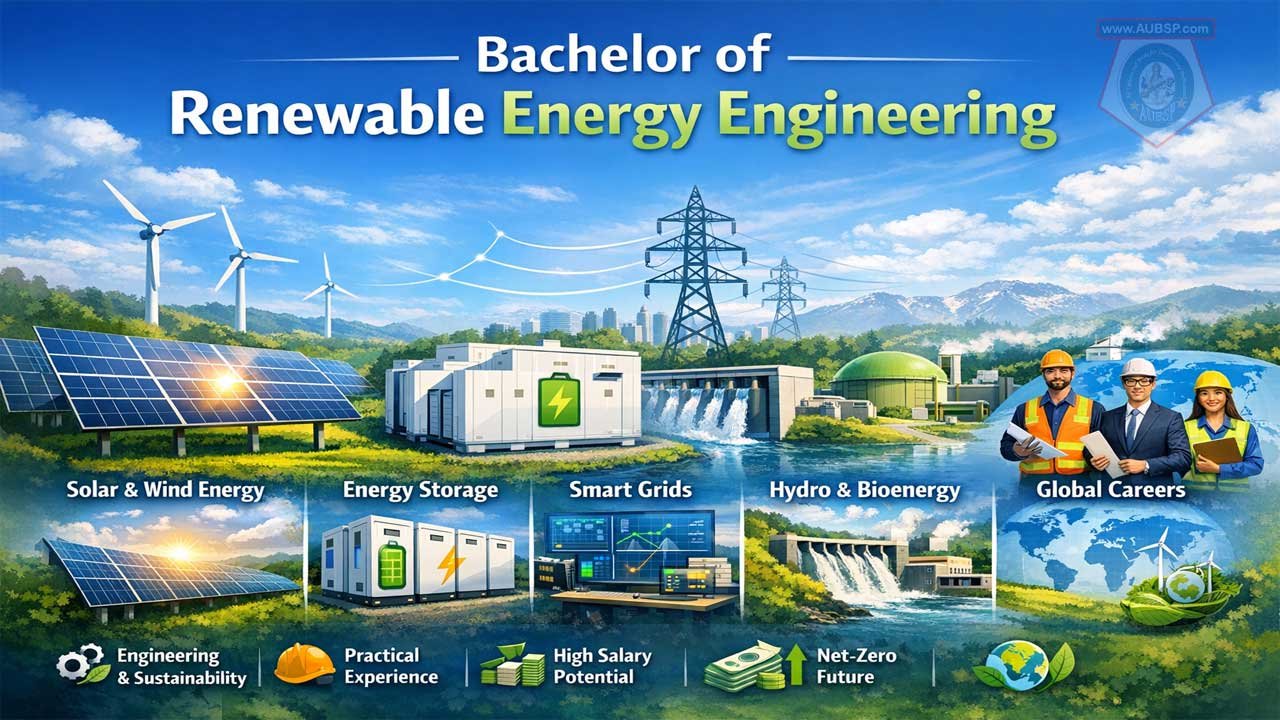
A Bachelor of Renewable Energy Engineering is a 3–4 year specialized undergraduate degree that combines core electrical and mechanical engineering with sustainability to prepare students to design, build, and manage clean energy systems such as solar, wind, hydro, bioenergy, storage, and smart grids.
The program typically covers engineering fundamentals, energy systems, advanced renewable technologies, and includes labs, projects, and sometimes industry placements, equipping graduates with strong technical, digital, and project management skills.
With global investment accelerating in decarbonization and net-zero targets, demand for renewable energy engineers is growing rapidly across Europe, North America, Asia-Pacific, and the Middle East, offering strong salary prospects and international career pathways in utilities, consulting, manufacturing, government, and clean-tech companies.
| Category | Information |
|---|---|
| Degree Name | Bachelor of Renewable Energy Engineering (B.Eng / B.E. / B.Sc) |
| Duration | 3–4 years full-time (some programs ~3.5 years) |
| Study Focus | Design and management of clean energy systems (solar, wind, hydro, bioenergy, storage, smart grids) |
| Core Subjects | Engineering mathematics, physics, thermodynamics, fluid mechanics, electrical systems |
| Advanced Topics | Solar & wind systems, energy storage, smart grids, sustainable transport, CO₂ reduction |
| Practical Components | Labs, fieldwork, capstone project, internships/industry placements |
| Entry Requirements | Strong high school grades in mathematics and physics; English proficiency (IELTS 6.0–6.5 or equivalent for international students) |
| Key Skills Gained | System design, simulation & modeling, grid integration, sustainability analysis, project management |
| Career Roles | Renewable energy engineer, solar/wind engineer, energy systems engineer, storage engineer, project engineer |
| Salary Outlook | Entry-level: ~$65,000–90,000 USD/year; Experienced: ~$130,000–200,000+ USD/year (varies by country) |
| Global Demand | High and growing due to net-zero and decarbonization targets worldwide |
| Further Study Options | Master’s in Energy Systems, Sustainable Engineering, Climate & Energy Policy, or Management |
Bachelor of Renewable Energy Engineering is a specialized undergraduate engineering degree that prepares you to design, build, and manage clean energy systems such as solar, wind, hydro, bioenergy, and smart grids for a low‑carbon future. It combines core engineering with sustainability, making it an attractive option for students who want strong job prospects and the chance to work on climate solutions worldwide.
What is a Bachelor of Renewable Energy Engineering?
A Bachelor of Renewable Energy Engineering (often B.Eng, B.Sc or B.E.) is a 3–4 year undergraduate degree focused on technologies that generate and manage clean power from sources like sun, wind, water, and biomass. Programs are typically built on a foundation of electrical, mechanical, and energy engineering, then add specialized courses in renewable systems, energy policy, and sustainability.
You’ll learn to design power plants and distributed systems, integrate them into the grid, and evaluate their technical, economic, and environmental performance. The degree title can vary—examples include “Renewable Energy Engineering,” “Sustainable and Renewable Energy Engineering,” or “Electrical and Renewable Energy Engineering,” but the focus is similar across institutions.
Why this degree is in high demand
Global renewable energy capacity is expanding quickly as countries pursue net‑zero and decarbonization goals, driving a surge in demand for qualified engineers. Industry analyses show that salaries in renewable energy are growing faster than in traditional oil and gas, supported by large public investments like the UK’s multi‑hundred‑million‑pound renewable support schemes.
Dedicated salary guides and career reports indicate that demand for renewable energy engineers is projected to grow around 12–28% in the coming decade, reflecting rapid deployment of solar, wind, and storage projects worldwide. This growth spans developed and emerging markets, from Europe and North America to the Middle East and Asia‑Pacific.
Course structure and typical curriculum
Most Bachelor of Renewable Energy Engineering programs run for 3–4 years of full‑time study, with some European universities offering 3.5‑year tracks (about 42 months). Degrees generally start with core engineering subjects and progress toward advanced renewable energy topics and design projects.
Typical modules include:
- Year 1: Engineering fundamentals
- Engineering mathematics and scientific computing, mechanics, materials, electronics, and general engineering principles.
- Years 2–3: Energy and systems
- Renewable energy systems, thermodynamics, fluid mechanics, electrical energy conversion, building energy management, and data/signals/systems.
- Advanced/specialist modules (later years):
- Solar energy systems, wind energy, bioenergy, low‑carbon heating systems, energy storage, smart grids, sustainable transport, and CO₂ capture.
Many universities also integrate:
- Field courses and labs in renewable energy plants and test facilities.
- Capstone or dissertation projects where you design or optimize real‑world energy systems.
- Industrial placements or internships of 6 weeks or more between second and third year to gain practical experience.
Admission requirements for international students
Entry criteria vary by country and university, but typical requirements include:
- Academic background:
- High school completion with strong grades in mathematics and physics; chemistry is often recommended.
- English language proficiency (for English‑taught programs):
- Common minimums: IELTS 6.0–6.5, TOEFL iBT around 70–90, or equivalent PTE and Duolingo scores.
- Duration:
- UK and some European programs: usually 3 years; Germany may offer ~3.5‑year B.Eng; Australia, Canada, and many others: 4‑year honours‑style engineering degrees.
Some institutions may also look for a motivation statement, recommendation letters, or evidence of interest in sustainability and engineering projects. International applicants should also budget for tuition plus living costs, which can vary significantly between countries and cities.
Top countries and universities offering this degree
Many universities across Europe, North America, the Middle East, and Asia‑Pacific now offer dedicated renewable energy engineering bachelor’s programs.
| Country | University | Program Title | Approx. Duration |
|---|---|---|---|
| Australia | University of Newcastle | Bachelor of Renewable Energy Engineering (Honours) | 4 years |
| UK | University of Exeter | B.Eng Renewable Energy Engineering | 3 years |
| Canada | Carleton University | B.Eng Sustainable and Renewable Energy Engineering | 4 years |
| Australia | Edith Cowan University | B.Eng Electrical and Renewable Energy Engineering | 4 years |
| Germany | Nordhausen Univ. of Applied Sciences | B.Eng Renewable Energy Engineering | ~42 months |
| UAE (Dubai) | Canadian University Dubai | B.Sc in Power and Renewable Energy Engineering | 4‑year style program |
| USA | Texas Tech University | B.Sc in Renewable Energy (and related variants) | 4 years |
| Europe (multiple) | Various universities | Bachelors in Sustainable or Renewable Energy | 3–4 years, 68+ programs in Europe alone |
In addition to pure “Renewable Energy Engineering,” some universities embed renewable energy as a major within broader electrical, mechanical, or energy engineering degrees, which can be equally valued in the job market.
Key skills you will gain
A Bachelor of Renewable Energy Engineering builds both deep technical skills and broad professional competencies. Typical outcomes include:
- Technical and analytical skills
- Power generation and distribution, solar PV and solar thermal design, wind turbine and farm design, energy storage, and grid integration.
- Strong grounding in thermodynamics, fluid mechanics, electrical machines, and control systems.
- Digital and engineering tools
- Use of simulation and CAD software, data analysis, and system modeling tools for designing and optimizing energy systems.
- Sustainability and policy understanding
- Knowledge of energy markets, climate policy, and environmental impact assessment, often through modules in energy policy, markets, and law.
- Professional skills
- Project management, teamwork, communication, and problem‑solving, developed through group design projects, presentations, and industry placements.
These skills are highly transferable, enabling graduates to work not only in renewable energy companies but also in utilities, consulting firms, manufacturing, and government agencies.
Career opportunities and salary outlook
Graduates of renewable energy engineering programs can enter a wide variety of roles across the clean energy value chain. Common job titles include:
- Renewable energy engineer or energy systems engineer
- Solar PV engineer and designer
- Wind energy engineer (onshore/offshore)
- Energy storage / battery systems engineer
- Grid integration / smart grid engineer
- Building energy and HVAC engineer
- Renewable energy project engineer or project manager
Industry reports suggest that entry‑level renewable energy engineers in major markets often earn around 65,000–90,000 USD per year, with experienced engineers and managers reaching 130,000–200,000+ USD, depending on specialization and region. Specialized roles such as solar, wind, and energy storage engineers are frequently listed with ranges from about 85,000–140,000 USD annually in advanced economies.
Global analyses also show that average salaries for renewable energy professionals are increasing faster than for traditional oil and gas roles, as governments commit more funding to clean energy projects and private investment accelerates. For example, some guides quote approximate averages around 78,000–95,000 USD in markets like the UK, Canada, and Germany, with local currency equivalents in India and other emerging markets scaling to purchasing power and economic conditions.
Global study and work pathways
Because renewable energy is a global industry, this degree can be a powerful pathway to international mobility. Many programs are taught in English and attract diverse cohorts in Europe (including Germany, the Netherlands, the UK, and Ireland), North America, Australia, and the Middle East.
Some countries combine study with post‑study work visas or clear routes to longer‑term residence, especially where governments explicitly target clean‑tech skills shortages. Universities often support internships and career placement with utilities, EPC (engineering, procurement, construction) firms, solar and wind developers, and technology manufacturers, which can lead directly to full‑time employment.
Is Bachelor of Renewable Energy Engineering right for you?
This degree is a strong fit if you:
- Enjoy physics, mathematics, and problem‑solving and want to apply them to real‑world engineering challenges.
- Care about climate change and want a career that contributes to decarbonization and sustainable infrastructure.
- Are interested in a global, high‑growth sector with opportunities to work across countries and technologies.
If you prefer broader engineering but still want exposure to clean energy, you can also consider electrical, mechanical, or energy engineering degrees with a renewable energy major or specialization, which many universities offer.
FAQs about Bachelor of Renewable Energy Engineering
How long does a Bachelor of Renewable Energy Engineering take?
Most programs take 3–4 years of full‑time study, depending on the country and institution. Some European B.Eng programs run for around 3.5 years (about 42 months), while Australian, Canadian, and US programs are typically structured as 4‑year honours‑level degrees.
Do I need prior experience in energy or engineering?
You usually do not need prior industry experience; universities mainly require strong high‑school preparation in mathematics and physics. However, any exposure to robotics clubs, science competitions, or sustainability projects can strengthen your application and help you engage more deeply with the curriculum.
What is the difference between Renewable Energy Engineering and Electrical Engineering?
Renewable Energy Engineering is more specialized: it focuses on generation from solar, wind, hydro, biomass, storage, and grid integration, combined with sustainability and policy topics. Electrical Engineering is broader, covering electronics, communications, control systems, and power systems, with the option in many universities to specialize in renewables in later years.
Can I work outside the energy sector with this degree?
Yes. The analytical, mathematical, and project management skills gained are valuable in consulting, technology, manufacturing, building services, and even finance roles focused on infrastructure and climate‑related investments. Many graduates pursue master’s degrees in energy systems, sustainability, or management to broaden their career options further.


Leave a Reply
You must be logged in to post a comment.