
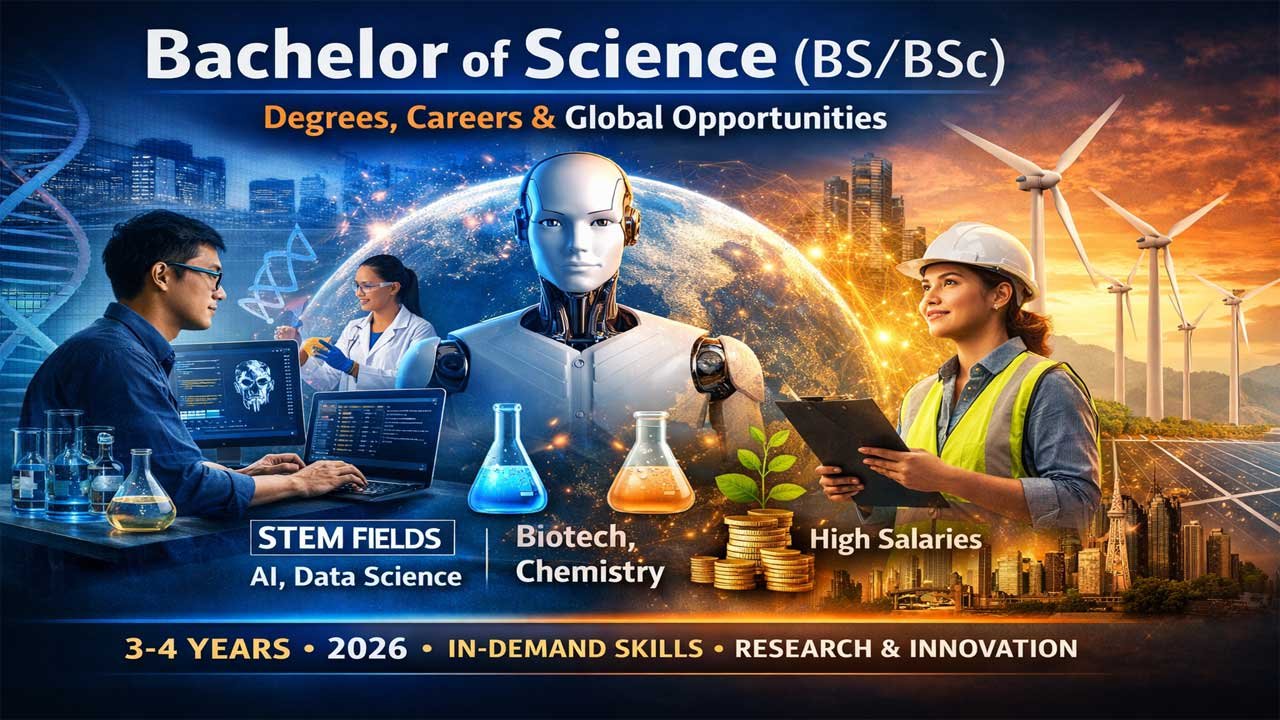
A Bachelor of Science (BS/BSc) is a globally recognized undergraduate degree that blends scientific theory with practical, industry-relevant skills, offering strong career prospects in 2026 amid rapidly growing STEM demand.
Typically completed in 3–4 years depending on country and format, the degree spans diverse specializations such as computer science, AI, data science, biotechnology, environmental science, and more, all of which lead to high employment rates, competitive salaries, and international mobility.
While BS and BSc differ slightly in structure and regional naming conventions, both are equally valued worldwide and serve as solid foundations for careers in industry, research, healthcare, sustainability, or further study at the master’s and doctoral levels. With curricula increasingly focused on AI, data analytics, sustainability, interdisciplinary learning, and Industry 4.0 skills, a Bachelor of Science today represents not just an academic qualification but a strategic investment in long-term career growth, global opportunities, and meaningful impact.
| Aspect | Information |
|---|---|
| Degree Name | Bachelor of Science (BS / BSc) |
| Duration | 3–4 years (4 years in US, 3 years in UK/Commonwealth; 4-year Honours option) |
| Focus | Scientific theory, practical skills, research, and technical expertise |
| Popular Fields | Computer Science, AI/ML, Data Science, Biotechnology, Physics, Chemistry, Environmental Science |
| Eligibility | 10+2 with Science stream (Physics/Chemistry/Maths/Biology) |
| Global Recognition | Fully recognized worldwide from accredited institutions |
| Career Outcomes | STEM roles in tech, healthcare, research, finance, sustainability |
| Job Growth | STEM jobs growing ~8.1% (2024–2034), faster than non-STEM |
| Average Salary | Higher than non-STEM; strong long-term earning potential |
| Further Study | MS/MSc, MBA, PhD, professional certifications |
| International Options | Research programs, internships, global mobility, MNC careers |
Bachelor of Science (BS or BSc): Complete Guide to Degrees, Career Paths, and Global Opportunities 2026
A Bachelor of Science (BS or BSc) represents one of the most valuable undergraduate degrees in the global education landscape, combining theoretical knowledge with practical scientific expertise. Whether you’re a high school student exploring your future, a career changer seeking new opportunities, or a parent guiding your child’s educational journey, understanding what a Bachelor of Science degree offers is essential for informed decision-making.
The demand for science graduates has never been higher. According to the latest employment data, STEM (Science, Technology, Engineering, and Mathematics) occupations are projected to grow by 8.1% from 2024 to 2034—nearly three times faster than non-STEM jobs. With median salaries exceeding $103,000 annually for STEM professionals compared to $48,000 for non-STEM roles, a Bachelor of Science degree represents a significant investment in your future earning potential.
This comprehensive guide explores everything you need to know about Bachelor of Science degrees, from understanding the different formats to navigating career opportunities and maximizing your global prospects.
What is a Bachelor of Science Degree?
A Bachelor of Science is an undergraduate degree that focuses on scientific and technical subjects. The program equips students with both theoretical understanding and practical laboratory skills in disciplines ranging from biology and chemistry to computer science and environmental science.
The Basic Structure
Most Bachelor of Science programs follow a structured curriculum that typically includes:
- Foundation Year: Introduction to core scientific concepts, mathematics, and research methodologies
- Core Courses: Specialized coursework in your chosen field of study
- Practical Components: Laboratory work, experiments, and field studies
- Electives: Additional courses allowing specialization or interdisciplinary learning
- Capstone Project or Thesis: A significant research project demonstrating cumulative learning
The degree provides students with analytical thinking skills, problem-solving abilities, and hands-on technical expertise—all highly valued by employers across industries.
BS vs BSc: Understanding the Differences
One of the most common questions students ask is whether there’s a meaningful difference between a BS and BSc degree. The answer is nuanced, depending on geography and institutional context.
Duration and Format
BS (Bachelor of Science)
- Predominantly offered in North America
- Typically 4 years in duration
- Research-driven curriculum with mandatory capstone projects
- Flexible course selection with interdisciplinary opportunities
- Strong emphasis on practical application and innovation
BSc (Bachelor of Science)
- Primarily offered in the United Kingdom, India, Australia, and Commonwealth countries
- Generally 3 years in duration (standard) or 4 years (Honours)
- Theory-heavy with comprehensive subject specialization
- More structured, less flexible curriculum
- Focus on academic depth in the primary discipline
B.Sc (Hons) – Honours Degree
- Available in India, UK, and Australia
- 3-4 years depending on the institution
- Deeper specialization in core subject
- Research and thesis components (especially in 4-year programs)
- Recognized as a distinction from standard B.Sc degrees
Global Recognition
Here’s the important part: both BS and BSc degrees are globally recognized and respected. The primary difference lies in naming conventions and curriculum design philosophy rather than academic rigor. Employers and universities worldwide accept both qualifications with equal regard when they come from accredited institutions.
Popular Bachelor of Science Specializations in 2026
The field of science offers numerous specialization options, each with distinct career pathways and employment prospects. Here are the most sought-after specializations in 2026:
High-Demand STEM Fields
1. Computer Science and AI/Machine Learning
- Entry salary: ₹6,00,000 – ₹20,00,000 annually (India)
- Global median: $103,580+
- Job growth: 17% for software development roles
- Employers: Google, Microsoft, Amazon, Apple, Meta, Tesla
- Key roles: Software Engineer, AI Engineer, ML Developer, Data Analyst
- Market insight: The AI industry is projected to grow at 37.3% CAGR through 2030, reaching $267 billion by 2027
2. Data Science and Analytics
- Entry salary: ₹6,00,000 – ₹12,00,000 (India)
- Growing sector with 821,300+ job openings in the next decade
- High-demand roles: Data Scientist, Business Analyst, Data Engineer
- Industries: Tech, Finance, Healthcare, E-commerce, Retail
- Skills required: Python, SQL, Statistical analysis, Machine learning
3. Biotechnology and Computational Biology
- Entry salary: ₹3,50,000 – ₹7,00,000 (India)
- Emerging specialization combining biology with computational methods
- Career paths: Biotech Analyst, Research Scientist, Pharmaceutical Developer
- Industries: Pharmaceuticals, Healthcare, Agricultural biotech, Environmental science
- Future potential: Growing demand for bioinformatics professionals and genome researchers
4. Physics and Chemistry
- Entry salary: ₹3,00,000 – ₹7,00,000 (India)
- Career options: Research Scientist, Lab Technician, Teaching, Data Analyst
- Industries: Research institutions, Oil & Gas, Education, Defense
- Research-oriented path ideal for pursuing higher degrees
5. Environmental Science and Sustainability
- Emerging field with increasing global focus
- Career paths: Environmental Scientist, Conservation Specialist, Sustainability Analyst
- Industries: Renewable energy, Environmental protection, Climate research
- Growing opportunities aligned with global sustainability goals
6. Cybersecurity and Digital Forensics
- Entry salary: ₹6,00,000 – ₹11,00,000 (India)
- Critical field as cyber threats escalate
- Employers: Tech companies, Government agencies, Financial institutions
- Roles: Cybersecurity Analyst, Forensic Investigator, Security Engineer
7. Psychology and Behavioral Science
- Entry salary: ₹4,00,000 – ₹8,00,000 (India)
- Growing field combining science with human behavior
- Roles: Psychologist, HR Analyst, Research Analyst, Behavioral Consultant
- Industries: Mental health, HR, Education, Research organizations
Global Job Market and Employment Statistics
The employment landscape for Bachelor of Science graduates is exceptionally favorable, supported by comprehensive labor market data.
STEM Employment Growth
Recent employment projections paint a compelling picture:
- 8.1% growth in STEM occupations (2024-2034) versus 2.7% for non-STEM roles
- 86% employment rate for STEM professionals versus 79% for non-STEM workers
- Over 36 million people currently employed in STEM occupations globally
- More than 60% of science and engineering roles require at least a bachelor’s degree
- Over 821,000 STEM job openings projected in the next decade
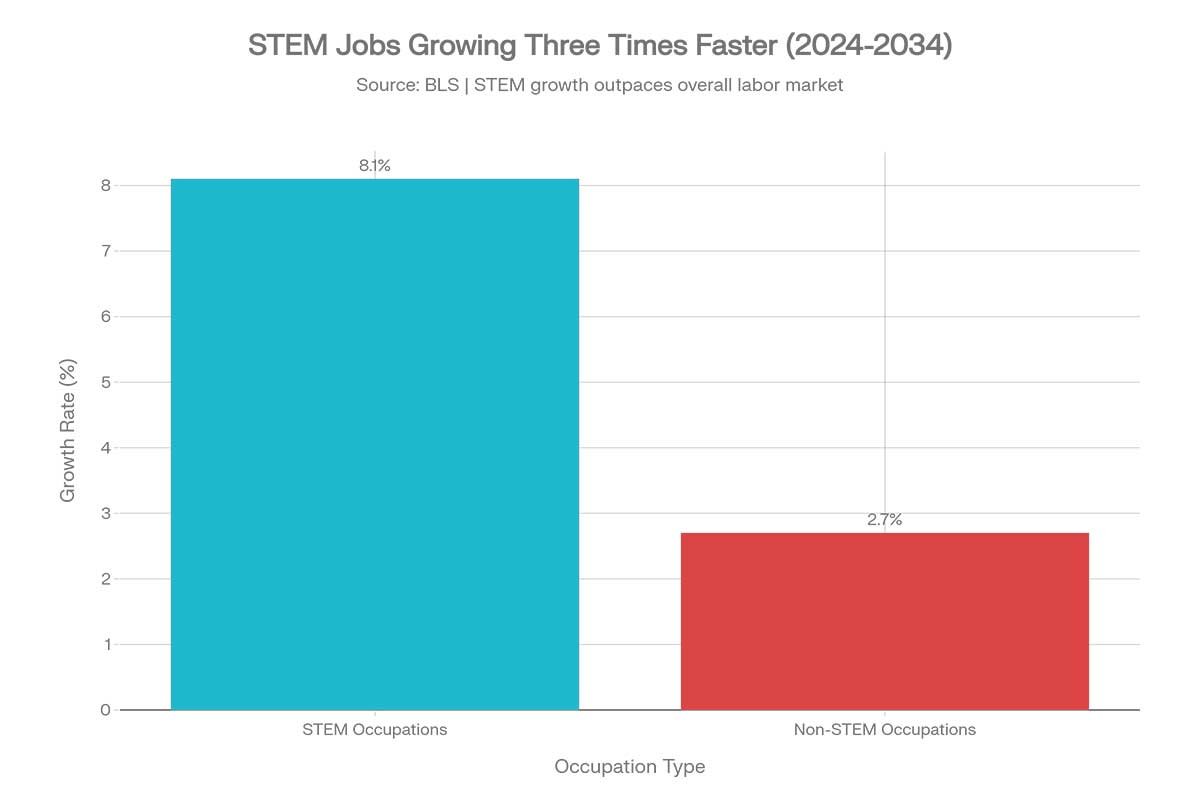
STEM Career Growth and Salary Advantage: Employment projections show STEM occupations growing 8.1% (2024-2034) with median salaries of $103,580, significantly outpacing non-STEM roles.
Salary Prospects by Field
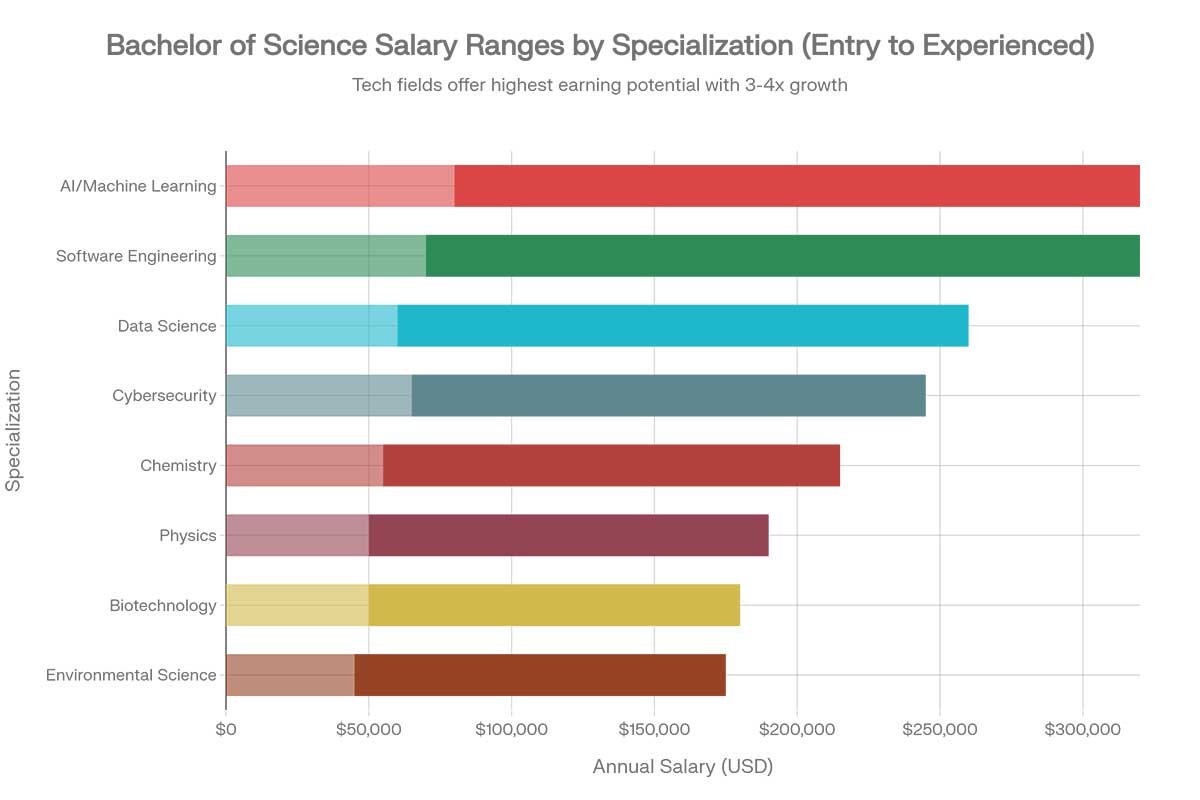
Bachelor of Science graduates enjoy competitive salaries across industries:
| Field | Entry Salary (USD) | Experienced (USD) | Growth Potential |
|---|---|---|---|
| Data Science | $60,000 – $90,000 | $120,000 – $200,000+ | Very High |
| AI/Machine Learning | $80,000 – $130,000 | $150,000 – $300,000+ | Very High |
| Software Engineering | $70,000 – $110,000 | $130,000 – $250,000+ | High |
| Environmental Science | $45,000 – $70,000 | $75,000 – $130,000 | Moderate |
| Biological Sciences | $50,000 – $80,000 | $85,000 – $150,000 | Moderate to High |
| Chemistry | $55,000 – $85,000 | $90,000 – $160,000 | Moderate |
Industry Demand
The strongest demand for Bachelor of Science graduates comes from:
- Technology Sector: Silicon Valley companies, cloud computing providers, AI startups
- Healthcare and Pharmaceuticals: Drug development, medical research, diagnostics
- Finance and Banking: Risk analysis, financial modeling, algorithmic trading
- Government and Defense: Research institutions, NASA, Department of Energy
- Renewable Energy: Solar, wind, and sustainable technology development
- Biotechnology: Gene editing, synthetic biology, personalized medicine
Admission Requirements and Eligibility
Understanding the admission process is crucial for aspiring Bachelor of Science students, whether you’re applying domestically or internationally.
Basic Eligibility Criteria
Minimum Requirements:
- Completion of secondary education (10+2 or equivalent)
- Minimum 50% aggregate marks in the science stream
- Subject requirements: Physics, Chemistry, Biology, or Mathematics (depending on specialization)
- Age: Typically minimum 17 years old
Entrance Examinations
Different institutions and countries require various entrance exams:
- CUET (Common University Entrance Test): Used in Indian universities for undergraduate admission
- NEST (National Entrance Screening Test): Some specialized institutions
- NPAT (National Program Aptitude Test): Specific institutions
- SAT/ACT: Required for admission to US universities
- IELTS/TOEFL: English proficiency for international students
- Institution-specific exams: IITs, IISERs, and other premier institutions conduct their own examinations
Application Process
The typical admission process includes:
- Registration on the university portal
- Document upload (marksheets, certificates, identity proof)
- Entrance exam (if applicable) or merit-based selection
- Merit list release and candidate ranking
- Counseling and choice filling – selecting preferred colleges/specializations
- Seat allotment based on merit and preferences
- Document verification and final enrollment
Bachelor of Science Curriculum and Learning Outcomes
Modern Bachelor of Science programs, particularly those following the National Education Policy (NEP) 2020 in India and similar initiatives globally, have evolved to emphasize practical skills alongside theoretical knowledge.
Key Components
Theory and Laboratory Work
- Classroom lectures covering fundamental concepts
- Hands-on laboratory experiments reinforcing theoretical learning
- Data analysis and interpretation skills
- Research methodology training
Practical Skills Development
- Programming and coding (for technology-focused programs)
- Statistical analysis and data interpretation
- Equipment operation and maintenance
- Field work and fieldtrips (for environmental and biological sciences)
Research and Innovation
- Minor and major research projects
- Capstone projects addressing real-world problems
- Thesis work for honours programs
- Exposure to cutting-edge research facilities
Interdisciplinary Learning
- Integration of mathematics and statistics across all programs
- Environmental and sustainability perspectives
- Ethics in science and research
- Communication and presentation skills
Industry Collaboration
- Internship opportunities in leading companies and research institutions
- Industry-led projects and case studies
- Guest lectures from professionals
- Industrial visits and exposure
International Opportunities for Bachelor of Science Graduates
One of the major advantages of holding a Bachelor of Science degree from an accredited institution is the abundance of international opportunities available.
International Research Programs
1. International Research Opportunities Programme (IROP)
- Offered by universities like Imperial College London
- 8-week research placement at partner institutions worldwide
- Funding and visa assistance provided
- Access to world-renowned research facilities
2. NASA International Internship Program
- Opportunities for students from 11+ participating countries
- Placement in NASA centers for research projects
- Ideal for physics, engineering, and space science students
3. Erasmus+ Programs
- Student mobility across European universities
- Internship and research opportunities
- Cultural exchange benefits
4. Summer Research Programs
- UCLA Summer Programs for Undergraduate Research (SPUR)
- Aalto Science Institute International Summer Research Programme
- Local research institutions and universities
Global Career Prospects
Bachelor of Science graduates from reputable institutions find employment opportunities across:
- Multinational Technology Companies: Google, Microsoft, Apple, IBM, Amazon
- Pharmaceutical Giants: Pfizer, Moderna, Johnson & Johnson
- Financial Institutions: Goldman Sachs, JPMorgan, Bloomberg
- Research Organizations: CERN, Max Planck Institute, NIH
- Government Agencies: NASA, NOAA, EPA, British Council
- International NGOs: Working in environmental conservation and global health
Cost of Bachelor of Science Degrees
Understanding the financial investment required is essential for educational planning.
Cost by Region
India
- Government colleges: ₹20,000 – ₹50,000 annually
- Private universities: ₹2,00,000 – ₹20,00,000 annually
- Top-tier institutions (IITs, IISERs): ₹3,00,000 – ₹8,00,000 for 4-year program
United States
- Public universities: $15,000 – $35,000 annually
- Private universities: $40,000 – $80,000 annually
- International student rates: Often 2-3x domestic rates
United Kingdom
- Tuition: £9,250 – £18,000 annually (post-Brexit changes)
- International students: £20,000 – £40,000 annually
Australia
- Domestic students: AUD $10,000 – $15,000 annually
- International students: AUD $20,000 – $45,000 annually
Financial Aid and Scholarships
Numerous funding options exist:
- Merit-based scholarships
- Need-based financial aid
- Government grants and loans
- International scholarship programs (Fulbright, Erasmus+, DAAD)
- Employer-sponsored education programs
Choosing the Right Bachelor of Science Program
Selecting an appropriate program requires careful consideration of multiple factors.
Key Considerations
1. Career Goals
- Identify your ultimate career aspirations
- Research which degree specializations lead to those careers
- Consider whether you want to pursue further education (Masters, PhD)
2. Institution Quality
- Check university rankings and accreditations
- Review research output and faculty expertise
- Examine industry placement records
- Consider international reputation for global opportunities
3. Specialization Options
- Evaluate available specializations and electives
- Assess internship and research opportunities
- Consider interdisciplinary options for flexibility
4. Location and Student Life
- Campus facilities and infrastructure
- Student community and culture
- Cost of living
- Proximity to major cities and employment hubs
5. Online vs In-Person
- Flexibility considerations
- Hands-on laboratory requirements
- International accessibility
- Cost implications
6. Future Study Options
- Pathways to postgraduate programs
- Recognition for international higher education
- Credit transfer policies
Career Paths After Bachelor of Science
The degree opens doors to diverse career trajectories:
Research and Academia
- University researcher or lecturer
- Government research institutions
- Corporate R&D divisions
- Think tanks and policy organizations
Industry and Technology
- Software development and engineering
- Data science and analytics
- Product management
- Quality assurance and testing
Healthcare and Life Sciences
- Pharmaceutical research
- Medical device development
- Clinical research
- Healthcare analytics
Environmental and Social Impact
- Environmental conservation
- Sustainability consulting
- Climate research
- Public health
Entrepreneurship
- Science-based startups
- Biotechnology ventures
- EdTech and STEM education
- Consulting services
Emerging Trends in Bachelor of Science Education (2026)
The field of science education is evolving rapidly in response to global challenges and technological advancement.
Integration of AI and Data Science
Bachelor of Science programs increasingly incorporate artificial intelligence, machine learning, and data analysis across all disciplines. Even traditional fields like biology and chemistry now feature significant computational components.
Sustainability and Climate Focus
Environmental sustainability is becoming central to science education, with programs addressing climate change, renewable energy, and environmental conservation.
Interdisciplinary Programs
Universities are moving away from siloed disciplines toward integrated programs combining biology with computer science, chemistry with engineering, and environmental science with policy studies.
Global Collaboration
Virtual laboratories, international research partnerships, and global student cohorts are becoming standard, providing genuine international learning experiences.
Industry 4.0 Skills
Programs increasingly emphasize practical skills aligned with Industry 4.0: IoT, automation, cybersecurity, and advanced data analytics.
Conclusion
A Bachelor of Science degree in 2026 represents far more than a credential—it’s a gateway to a fulfilling, well-compensated career in fields addressing humanity’s greatest challenges. Whether you’re drawn to developing artificial intelligence solutions, discovering new medicines, protecting our environment, or advancing human knowledge through research, a Bachelor of Science education provides the foundation and opportunities to make meaningful contributions.
The data is clear: STEM professionals enjoy significantly higher employment rates, superior salary prospects, and greater job security than their non-STEM counterparts. With STEM occupations growing three times faster than other fields and over 800,000 job openings projected in the coming decade, now is an exceptional time to pursue a Bachelor of Science degree.
Your choice of institution, specialization, and commitment to continuous learning will shape your trajectory. Whether you pursue a traditional 3-year BSc, a 4-year BS with research focus, or an honours degree with advanced research components, you’re investing in a future of opportunity, impact, and personal growth.
The Bachelor of Science degree has never been more relevant. Embrace it.
Frequently Asked Questions
Q: How long does a Bachelor of Science degree take to complete?
A: Typically 3-4 years, depending on the country and institution. North American BS programs are usually 4 years, while Commonwealth countries often offer 3-year programs with 4-year honours options.
Q: Is a Bachelor of Science recognized internationally?
A: Yes, Bachelor of Science degrees from accredited institutions are recognized globally. The degree title (BS or BSc) differs by country, but the qualification carries equivalent weight in international job markets and for pursuing further education.
Q: What are the best specializations for employment prospects?
A: As of 2026, Computer Science, AI/Machine Learning, Data Science, and Biotechnology offer the strongest employment prospects and highest salaries. However, all STEM fields show positive growth projections.
Q: Can I pursue a Master’s degree after a Bachelor of Science?
A: Absolutely. A Bachelor of Science is an excellent foundation for postgraduate studies including Masters (M.Sc, MS, MBA), PhDs, and professional certifications.
Q: What’s the average salary for Bachelor of Science graduates?
A: Entry-level STEM graduates earn $50,000-$90,000 in the US and ₹3,00,000-₹12,00,000 in India, depending on specialization and location. Experienced professionals can earn significantly more.
Q: Are online Bachelor of Science programs reputable?
A: Yes, many reputable universities offer online BS programs. Check for accreditation and ensure the institution is recognized by employers in your target industry.
This article is regularly updated to reflect the latest career trends, employment data, and educational opportunities in science degree programs. Information accurate as of January 2026.


Leave a Reply
You must be logged in to post a comment.