
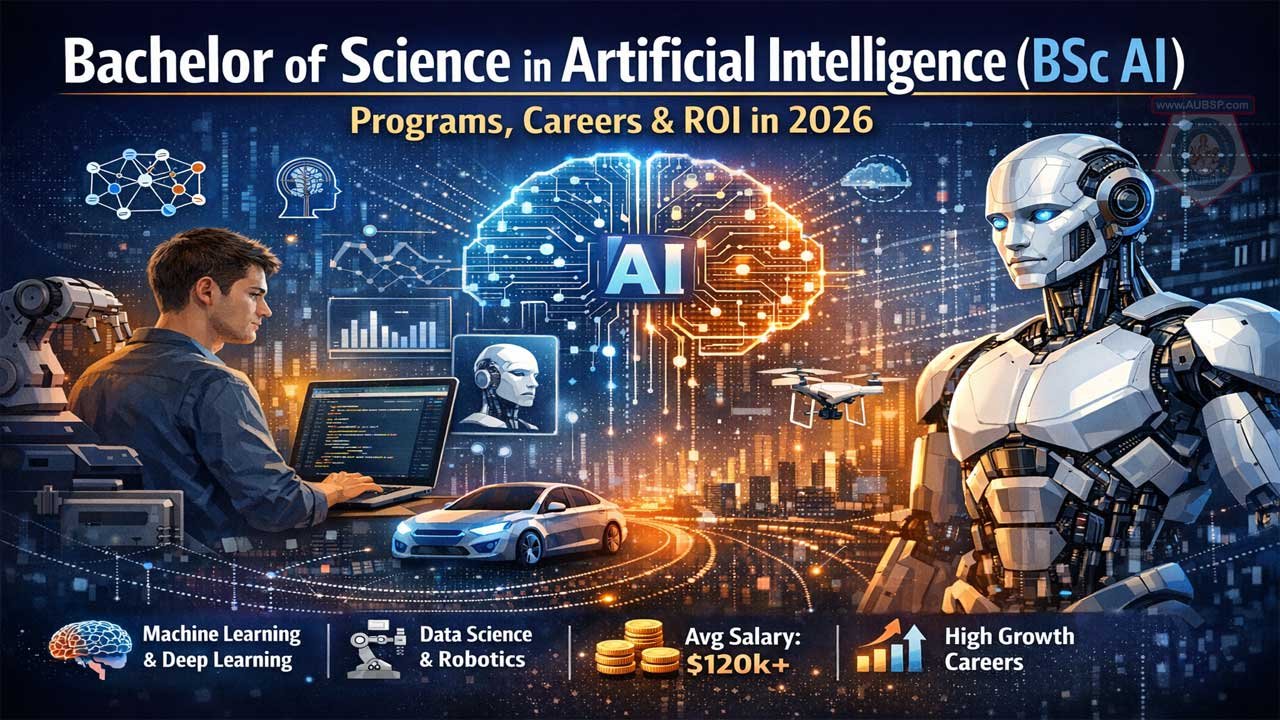
A Bachelor of Science in Artificial Intelligence (BSc AI) is a specialized 3–4 year undergraduate degree that combines rigorous mathematics, computer science, and hands-on programming to train students in building intelligent systems such as machine learning models, deep learning networks, NLP, computer vision, and robotics, with strong emphasis on ethical and real-world applications.
Graduates are highly sought after across tech, finance, healthcare, robotics, and emerging industries, earning average starting salaries around $120,000+ with strong long-term ROI and projected job growth of 20–34%.
The program suits students passionate about cutting-edge technology, problem-solving, and data-driven innovation, offering flexible specializations, global university options, internships, and research pathways, and serving as a solid foundation for direct industry roles or advanced study, making it one of the most future-proof and lucrative degrees heading into 2026.
| Aspect | Details |
|---|---|
| Degree Name | Bachelor of Science in Artificial Intelligence (BSc AI) |
| Duration | 3–4 Years |
| Level | Undergraduate |
| Core Focus | Machine Learning, Deep Learning, Data Science, AI Systems |
| Key Skills Learned | Python, ML Algorithms, Neural Networks, NLP, Computer Vision |
| Eligibility | High School (12th Grade) with Mathematics |
| Average Starting Salary | $120,000+ (₹10–25 LPA in India) |
| Career Roles | ML Engineer, AI Engineer, Data Scientist, AI Researcher |
| Top Industries | Tech, Finance, Healthcare, Robotics, Automotive |
| ROI Potential | 8–15× within 5–10 years |
Bachelor of Science in Artificial Intelligence (BSc AI): Complete 2026 Guide to Programs, Careers & ROI
A Bachelor of Science in Artificial Intelligence (BSc AI) is a specialized 3-4 year undergraduate degree program that provides foundational and applied knowledge in machine learning, deep learning, data science, and AI systems.
Graduates earn an average of $123,000-$134,000 annually as ML engineers or AI specialists, with high-demand roles across tech, finance, healthcare, and robotics sectors globally.
What is a BSc in Artificial Intelligence?
A Bachelor of Science in Artificial Intelligence is an undergraduate degree designed to equip students with both theoretical knowledge and practical skills in building intelligent systems. Unlike general computer science degrees, BSc AI programs focus specifically on the algorithms, mathematics, and engineering principles that power modern AI technologies.
Core Focus Areas:
- Machine learning algorithms and neural networks
- Deep learning and generative AI systems
- Natural language processing (NLP)
- Computer vision and image recognition
- Data science and statistical analysis
- Robotics and autonomous systems
- Ethical AI and responsible AI design
The program combines mathematical rigor (linear algebra, probability, statistics) with hands-on programming experience using Python, TensorFlow, PyTorch, and other industry-standard tools. Most BSc AI programs run for 3 to 4 years, with some universities offering an honors or research track in the final year.
Who Should Pursue This Degree?
- Students passionate about cutting-edge technology and innovation
- Those interested in solving complex real-world problems using data
- Career changers seeking to enter the high-growth AI industry
- Individuals with strong mathematical and analytical abilities
- Learners interested in both academic research and industry applications
Program Structure & Core Curriculum
The typical BSc AI curriculum balances foundational theory with contemporary applications, typically organized into four key areas:
Year 1: Fundamentals (30-35 Credits)
Mathematics & Logic:
- Linear algebra and matrix computations
- Calculus and optimization
- Discrete mathematics and logic
- Probability theory and statistics
Programming Foundations:
- Python programming (primary language)
- Data structures and algorithms
- Introduction to computer science concepts
- Software engineering principles
Year 2: Core AI Concepts (30-35 Credits)
Machine Learning Track:
- Supervised learning (regression, classification)
- Unsupervised learning (clustering, dimensionality reduction)
- Feature engineering and data preprocessing
- Model evaluation and validation techniques
Systems & Infrastructure:
- Database design and management
- Cloud computing basics
- Data pipeline architecture
- Signal processing
Year 3: Specialization & Applied Learning (30-35 Credits)
Elective Specializations (choose 2-3):
- Deep Learning and Neural Networks
- Computer Vision
- Natural Language Processing
- Robotics and Autonomous Systems
- Reinforcement Learning
- Generative AI and Large Language Models
- Quantum Computing and AI
- FinTech Applications
- Healthcare AI and Bioinformatics
- AgriTech and Environmental AI
Practical Project Work:
- Capstone projects with industry partners
- Internship placements (6-12 months)
- Research collaborations
- Real-world problem-solving competitions
Year 4 (Optional): Honours/Research Track
- Advanced research seminar
- Individual research project or thesis
- Advanced specialization courses
- Industry/academic research placement
Learning Methodology:
- Lectures covering theory and concepts
- Lab sessions with hands-on coding
- Project-based group work
- Kaggle competitions and AI challenges
- Industry guest lectures and workshops
- Internships with tech companies
Top Universities Offering BSc AI Globally
United States
| University | Location | Notable Strengths |
|---|---|---|
| Stanford University | Silicon Valley, CA | AI research leadership, industry access, computer vision |
| MIT | Cambridge, MA | Foundational AI research, robotics, reinforcement learning |
| UC Berkeley | Berkeley, CA | Deep RL, computer vision, BAIR Lab research |
| Carnegie Mellon | Pittsburgh, PA | Robotics, autonomous systems, AI ethics |
| Purdue University | West Lafayette, IN | Bachelor of Arts/Science AI, diverse applications |
| University of Pennsylvania | Philadelphia, PA | Ivy League reputation, interdisciplinary approach |
| Illinois Institute of Technology | Chicago, IL | First Midwest BSc AI program |
| UT Austin | Austin, TX | Strong tech ecosystem, industry partnerships |
United Kingdom & Europe
- University of Oxford
- University of Cambridge
- University of Edinburgh
- Imperial College London
- ETH Zurich
India
| University | Program | Highlights |
|---|---|---|
| Bennett University | B.Sc. Artificial Intelligence | Emphasis on theoretical depth, domain specializations (Healthcare, AgriTech, Robotics) |
| Symbiosis AI Institute (SAII) | B.Sc. AI | NEP 2020 compliant, flexible exit options (Certificate/Diploma/Bachelor/Honours) |
| UPES | B.Tech AI | Hands-on labs, industry mentorship |
| IIT Bombay, Delhi | Specialized AI programs | Research-focused, high entry barriers |
Canada
- University of British Columbia
- University of Toronto
- McMaster University
Australia
- University of Sydney
- RMIT University
- Monash University
Middle East
- Mohamed bin Zayed University of AI (MBZUAI) – Abu Dhabi
- Engineering and Research streams available
- Full co-op program with industry placements
Admission Requirements & Eligibility
General Prerequisites
Academic Qualifications:
- Completion of 12th grade (high school diploma equivalent)
- Minimum GPA: 3.0-3.5 (varies by institution)
- Recommended subjects: Mathematics, Physics, Computer Science
- Minimum marks: 50-60% depending on university and country
Entrance Examinations:
- US: SAT/ACT scores (international students)
- India: JEE Main/Advanced for top-tier institutions, some colleges have their own entrance exams
- UK: A-Levels or International Baccalaureate (IB) qualification
- Canada: Provincial exams + university-specific tests
- Other: IELTS/TOEFL for non-native English speakers
Language Proficiency:
- English language proficiency (TOEFL iBT: 90+, IELTS: 7.0+)
- Some universities may waive this for native English speakers
Selection Process
- Academic merit (50-60% weightage)
- Entrance exam scores (20-30% weightage)
- Personal statement/essay (10-15%)
- Personal interview or group discussion (10-15%)
- Extracurricular activities and coding projects (optional)
Application Timeline
- Typical application window: August-January (for fall intake)
- Rolling admissions: Some universities accept applications year-round
- Processing time: 4-8 weeks
- Early decision deadlines: Often in November-December
Career Paths & Salary Prospects
High-Demand AI Career Roles
1. Machine Learning Engineer
Average Salary: $123,117 USD / ₹12.2 lakh (India)
- Design and build ML systems for production environments
- Optimize models for performance and scalability
- Work with data pipelines and infrastructure
- Industries: Tech, Finance, Healthcare, E-commerce
2. AI Research Scientist
Average Salary: $99,578 USD – $140,910+ (senior roles)
- Conduct research on novel AI algorithms
- Publish papers and contribute to open-source projects
- Work for research labs, universities, or tech companies
- Industries: Tech giants (Google, Meta, OpenAI), Universities, Research labs
3. AI Engineer / Software Engineer (AI-specialized)
Average Salary: $134,188 USD
- Implement AI systems at scale
- Develop AI-powered applications
- Collaborate with cross-functional teams
- Industries: All sectors (tech, automotive, healthcare, finance)
4. Data Scientist
Average Salary: $126,927 USD
- Analyze complex datasets and extract insights
- Build predictive models
- Create data visualization dashboards
- Industries: Finance, Healthcare, Retail, E-commerce, Tech
5. Robotics Engineer
Average Salary: $113,270 USD
- Design and program autonomous robots
- Develop control systems and algorithms
- Work on robotics startups or established companies
- Industries: Manufacturing, Automotive, Aerospace, Consumer Robotics
6. NLP Specialist / Computational Linguist
Average Salary: $115,000+ USD
- Develop language models and chatbots
- Work on translation, summarization, and sentiment analysis
- Industries: Tech companies, Content platforms, Healthcare
7. Computer Vision Engineer
Average Salary: $130,000+ USD
- Build image recognition and video analysis systems
- Work on autonomous vehicles, surveillance, medical imaging
- Industries: Automotive, Healthcare, Tech, Security
8. FinTech AI Specialist
Average Salary: $140,000+ USD (with bonuses up to $400,000)
- Build AI models for fraud detection, trading algorithms, risk assessment
- Work for investment banks, hedge funds, fintech startups
- Industries: Finance, Trading, Insurance
9. AI Product Manager
Average Salary: $130,000-$180,000 USD
- Define AI product strategy and roadmap
- Translate business needs into AI solutions
- Industries: All sectors, especially SaaS, E-commerce, Tech
10. Quantum Computing + AI Specialist
Average Salary: $150,000+ USD (emerging field)
- Combine quantum computing with AI algorithms
- Industries: Tech research labs, Startups, Defense
Salary Variations by Geography
| Location | AI Engineer | ML Engineer | Data Scientist |
|---|---|---|---|
| San Francisco, CA | $164,499 | $149,795 | $149,378 |
| New York City, NY | $141,539 | $124,920 | $126,859 |
| Seattle, WA | $140,000+ | $130,000+ | $125,000+ |
| London, UK | £80,000-£120,000 | £75,000-£110,000 | £70,000-£100,000 |
| Singapore | SGD 120,000-180,000 | SGD 110,000-160,000 | SGD 100,000-150,000 |
| India | ₹12.2L-₹25L | ₹10L-₹20L | ₹10L-₹18L |
Job Market Growth
- Data Scientists: 34% projected growth (2024-2034) – much faster than average
- ML Engineers: 20% growth expected
- AI Researchers: Steady demand with increasing salaries
- Top Hiring Companies: Google, Meta, Amazon, Microsoft, Apple, Tesla, OpenAI, DeepMind, IBM, JPMorgan Chase
Specialization Options
Most BSc AI programs offer flexibility to specialize in specific AI applications:
Technical Specializations
1. Deep Learning & Neural Networks
- Convolutional Neural Networks (CNNs)
- Recurrent Neural Networks (RNNs)
- Transformers and attention mechanisms
- Generative models (GANs, VAEs)
- Career path: AI Research, Computer Vision, NLP
2. Computer Vision
- Image classification and object detection
- Semantic segmentation
- 3D reconstruction
- Video analysis
- Career path: Autonomous vehicles, Medical imaging, Robotics, Surveillance
3. Natural Language Processing (NLP)
- Text classification and sentiment analysis
- Machine translation
- Chatbots and conversational AI
- Information extraction
- Career path: Language models, Virtual assistants, Search engines
4. Reinforcement Learning
- Q-learning and policy gradients
- Game playing AI
- Robotics control
- Autonomous systems
- Career path: Robotics, Gaming AI, Autonomous vehicles
5. Data Science & Analytics
- Statistical modeling
- Data mining techniques
- Big data frameworks
- Business intelligence
- Career path: Data analyst, BI developer, Analytics consultant
Domain-Specific Specializations
Healthcare & Biotech AI
- Medical image analysis
- Drug discovery prediction
- Patient outcome prediction
- Genomics AI
- Career path: Hospital IT, Biotech companies, Medical device firms
FinTech & Quantitative Finance
- Algorithmic trading
- Fraud detection
- Risk assessment models
- Portfolio optimization
- Career path: Investment banks, Trading firms, Insurance companies
Autonomous Systems & Robotics
- Robot perception and control
- Path planning and navigation
- Multi-agent systems
- Swarm robotics
- Career path: Robotics companies, Automotive, Aerospace
Environmental & Agricultural AI
- Climate modeling
- Crop yield prediction
- Resource optimization
- Sustainability analytics
- Career path: AgriTech startups, Environmental agencies, Renewable energy
Cybersecurity AI
- Threat detection
- Intrusion prevention
- Malware analysis
- Network security
- Career path: Cybersecurity firms, Defense, Enterprise security
Media & Creative Industries
- Generative AI and content creation
- Video synthesis and editing
- Audio processing
- Recommendation systems
- Career path: Content platforms, Gaming studios, Entertainment tech
BSc AI vs. Other AI Degrees
Bachelor of Science (BSc) AI vs. Bachelor of Technology (BTech) AI vs. Bachelor of Arts (BA) AI
| Feature | BSc AI | BTech AI | BA AI |
|---|---|---|---|
| Duration | 3-4 years | 4 years | 3-4 years |
| Focus | Theory + Applied | Engineering-focused | Philosophy + Computer Science |
| Math Intensity | Very High | High | Moderate |
| Programming | Extensive (Python, C++) | Extensive (C++, Java) | Moderate (Python focus) |
| Thesis/Research | Optional (year 4) | Capstone project | Research-oriented |
| Career Path | AI Research, Academia, Tech | Software engineering, Product roles | AI ethics, Policy, Philosophy |
| Top Jobs | ML Engineer, Researcher | Full-stack Engineer, DevOps | AI ethicist, Policy advisor |
| Salary (Entry) | $95,000-$120,000 | $85,000-$110,000 | $70,000-$95,000 |
BSc AI vs. Master’s in AI
| Aspect | BSc AI | M.Sc. AI |
|---|---|---|
| Duration | 3-4 years | 1-2 years |
| Entry Level | High school | Bachelor’s degree |
| Foundational Knowledge | Comprehensive | Assumes prior knowledge |
| Cost | $30,000-$150,000 (total) | $20,000-$80,000 (total) |
| Time to Employment | 3-4 years | 1-2 years (faster) |
| Starting Salary | $100,000-$130,000 | $110,000-$150,000 |
| Career Path | Entry to mid-level roles | Mid to senior roles faster |
| Research Opportunities | Limited (year 4 only) | Extensive |
When to choose BSc AI:
- You’re a high school graduate interested in foundational AI knowledge
- You prefer broader computer science education before specializing
- You want 3-4 years of diverse learning and exploration
- You’re interested in research or academia
When to choose Master’s:
- You already have a CS or related bachelor’s degree
- You want faster entry into specialized AI roles
- You’re career-switching and need efficient reskilling
- You’re targeting senior-level positions
Cost & Return on Investment
Program Costs by Region
United States
- Public Universities: $25,000-$50,000/year
- 4-year total: $100,000-$200,000
- With scholarships: $50,000-$150,000 net cost
- Private Universities: $50,000-$80,000/year
- 4-year total: $200,000-$320,000
- Merit aid can reduce this by 30-50%
India
- Private Institutions (Bennett, SAII, UPES): ₹8-15 lakh ($10,000-$18,000)
- Top IITs: ₹1-3 lakh ($1,200-$3,600) (highly competitive entry)
- Government Universities: ₹2-5 lakh ($2,400-$6,000)
United Kingdom
- International Students: £20,000-£35,000/year
- 3-year total: £60,000-£105,000 ($75,000-$130,000 USD)
- UK/EU Citizens: £9,000-£15,000/year (government-capped)
Canada
- International Students: CAD $30,000-$60,000/year
- 4-year total: CAD $120,000-$240,000 ($90,000-$180,000 USD)
- Domestic Students: CAD $6,000-$15,000/year
Australia
- International Students: AUD $40,000-$70,000/year
- 4-year total: AUD $160,000-$280,000 ($105,000-$185,000 USD)
Return on Investment (ROI)
5-Year ROI Calculation:
- Average starting salary: $120,000
- Career progression (year 5): $160,000-$180,000
- 5-year cumulative earnings: $700,000-$850,000
- Average total program cost: $120,000 (US average with aid)
- Net gain in 5 years: $580,000-$730,000
10-Year ROI:
- Average mid-career salary (10 years): $200,000-$250,000
- 10-year cumulative earnings: $1.5M-$1.8M
- ROI: 12-15x initial investment
Salary Growth Trajectory:
| Year | Salary Range | Role |
|---|---|---|
| Entry (Year 0-1) | $95,000-$120,000 | ML Engineer, Data Scientist (Junior) |
| Year 2-3 | $130,000-$160,000 | Mid-level Engineer, Specialist |
| Year 5-6 | $160,000-$200,000 | Senior Engineer, Team Lead |
| Year 10+ | $200,000-$300,000+ | Principal Engineer, Manager, Researcher |
Financing Options
Scholarships & Grants:
- Merit-based scholarships: 20-50% tuition
- Need-based grants (US): Federal Pell Grants, state grants
- Industry scholarships: Google, Microsoft, Meta offer programs
- University-specific: Full or partial scholarships for exceptional students
Student Loans:
- US Federal Loans: $5,500-$20,500/year depending on year
- Private loans: Available but higher interest rates
- Income-based repayment plans available
Employer-Sponsored Education:
- Tech companies offer tuition reimbursement ($5,000-$15,000/year)
- Apply after gaining entry-level experience
Work-Study & Part-Time Work:
- Campus jobs: $15-$20/hour (can earn $5,000-$8,000/year)
- Tech internships: $18-$30/hour (summers can earn $10,000-$20,000)
Skills You’ll Develop
Technical Skills
Programming & Software Engineering
- Python (primary language for AI/ML)
- C++ or Java (systems programming)
- SQL and database management
- Git and version control
- Linux/Unix command line
- API development and REST services
Mathematics & Statistics
- Linear algebra and matrix operations
- Calculus and optimization
- Probability theory and distributions
- Statistical hypothesis testing
- Bayesian inference
Machine Learning Frameworks & Tools
- TensorFlow and Keras
- PyTorch and Lightning
- Scikit-learn
- Pandas and NumPy
- Jupyter Notebooks and Google Colab
- MLflow (model versioning)
Data Engineering
- ETL pipelines
- Data warehousing
- Apache Spark and Hadoop
- Cloud platforms (AWS, Google Cloud, Azure)
- Real-time data processing
AI/ML Specialization Tools
- Computer Vision: OpenCV, YOLO, Detectron2
- NLP: NLTK, spaCy, Hugging Face Transformers
- Reinforcement Learning: OpenAI Gym, RLlib
- Visualization: Matplotlib, Seaborn, Plotly
Soft Skills
Problem-Solving & Critical Thinking
- Breaking down complex problems
- Designing experimental approaches
- Debugging and troubleshooting
Communication
- Presenting technical findings to non-technical audiences
- Writing research papers and technical documentation
- Explaining AI concepts in simple terms
Project Management
- Coordinating with team members
- Meeting deadlines and milestones
- Agile and scrum methodologies
Entrepreneurship & Leadership
- Taking initiative on projects
- Mentoring junior team members
- Contributing to open-source communities
Creativity & Innovation
- Designing novel AI solutions
- Thinking beyond conventional approaches
- Prototyping and experimentation
Frequently Asked Questions
Is a BSc AI degree worth it in 2026?
Yes, absolutely. AI is one of the fastest-growing fields with median starting salaries of $120,000+, consistent 20-34% job growth, and diverse career opportunities. The 5-year ROI is typically 8-12x your investment, even accounting for program costs. However, ensure you’re genuinely interested in the field—passion matters as much as earning potential.
Can I get a BSc AI degree if I’m weak in mathematics?
Mathematics is fundamental to AI, but programs are designed to teach it progressively. If you struggle, supplement with Khan Academy, MIT OpenCourseWare, or pre-college prep courses. Many universities offer math bridging programs. With dedication, most students can succeed.
What’s the job market like for BSc AI graduates?
Extremely strong. LinkedIn reported AI-related jobs are growing 3-4x faster than average. Top companies (Google, Meta, Microsoft, Amazon, Tesla) actively recruit BSc AI graduates. Competition exists, but strong fundamentals, projects, and internships make you highly marketable.
Should I choose BSc AI or BTech AI?
Both lead to excellent careers. BSc AI is more theory-focused and suitable for research; BTech AI is more engineering-focused and leads faster to software engineering roles. Choose based on your interests: pure AI research → BSc; practical engineering → BTech.
How important are internships during my BSc AI?
Crucial. Most companies require at least one internship before hiring full-time. Internships help you:
- Apply classroom learning to real-world problems
- Build a professional network
- Gain practical experience with enterprise tools
- Often lead directly to job offers
Aim for at least 2-3 internships during your degree.
Can I study BSc AI online?
Yes, several universities offer online or hybrid BSc AI programs, including:
- Purdue University Online
- University of the People (certificate programs)
- Some European universities
However, hands-on labs and coding experience are essential, so fully online programs typically include in-person capstone or lab weeks.
What’s the difference between AI and Data Science programs?
- AI/ML: Focuses on building intelligent systems, algorithms, neural networks, and automation
- Data Science: Focuses on extracting insights from data, statistics, visualization, and business analytics
- Career overlap: 60-70% similar, but AI roles emphasize model building, data science roles emphasize interpretation
- Both are lucrative; choose based on whether you prefer building systems (AI) or analyzing data (Data Science)
What if I want to work internationally after my BSc AI?
Most AI skills are globally portable. Options:
- Study in an English-speaking country (US, UK, Canada, Australia) for easier international employment
- Build a strong GitHub portfolio (employers worldwide value this more than degree location)
- Target FAANG companies or startups with international offices
- Consider work visa sponsorship (many tech companies offer this)
- Indian graduates are highly sought after in Singapore, Middle East, and Western countries
Can I transition to a Master’s program after BSc AI?
Yes, easily. With a BSc AI, you can:
- Pursue a Master’s in AI, ML, or specialized fields
- Apply to top programs (MIT, Stanford, Cambridge) with strong recommendations
- Many students work 2-3 years, then pursue Master’s part-time or full-time
- Master’s degrees take 1-2 years, so total time is 5-6 years vs. 3-4 for direct Master’s entry
What are the biggest career challenges for BSc AI graduates?
- Staying current: AI evolves rapidly; continuous learning is mandatory
- Competition: Many graduates pursue AI; differentiate yourself with projects and contributions
- Imposter syndrome: Common in AI field; focus on steady skill-building
- Job location: Best AI jobs concentrate in tech hubs (San Francisco, Seattle, NYC, Boston, London, Beijing, Bangalore)
- Ethical considerations: As AI becomes more powerful, responsibility increases—understand the ethical implications
How do I stand out as a BSc AI candidate to employers?
- Build projects: Create 3-5 solid GitHub projects (CV classfier, recommendation system, NLP chatbot)
- Contribute to open-source: Show you can work in collaborative environments
- Compete: Participate in Kaggle, hackathons, and coding competitions
- Internships: Secure internships at recognized companies
- Write: Publish medium articles or blog posts explaining AI concepts
- Network: Attend conferences, join AI communities, connect on LinkedIn
- Research: Consider publishing a paper if pursuing research-oriented roles
Conclusion
BSc AI is a 3–4 year degree focused on machine learning, deep learning, and data science, leading to high-demand global AI careers with strong ROI.
A Bachelor of Science in Artificial Intelligence is an excellent investment for students interested in cutting-edge technology, problem-solving, and strong earning potential. With average starting salaries exceeding $120,000, consistent job market growth, and diverse career paths—from research to entrepreneurship—the degree opens doors across industries.
The key to success lies not just in completing the degree, but in:
- Building real projects and contributing to open-source
- Securing meaningful internships
- Staying curious and continuously learning
- Developing both technical and soft skills
- Building a professional network
Whether you choose a university in the US, India, UK, Canada, or Australia, the fundamentals remain the same: master the mathematics, practice coding daily, and apply learning to real-world problems. The world needs AI talent, and a BSc AI positions you perfectly to lead that future.


Leave a Reply
You must be logged in to post a comment.