
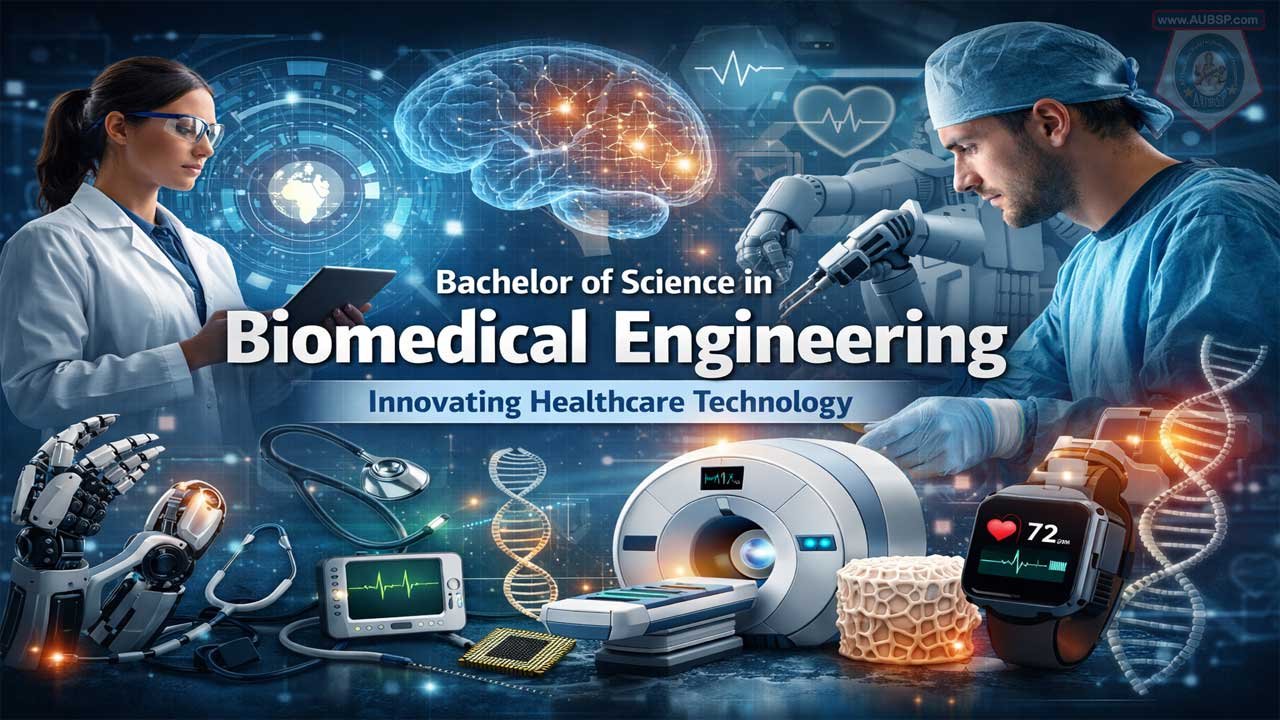
The Bachelor of Science in Biomedical Engineering (BScBME) is a multidisciplinary degree that merges engineering, biology, and medicine to design technologies that improve healthcare, from medical devices and imaging systems to AI-driven diagnostics and regenerative medicine.
The program builds strong foundations in math, physics, electronics, biology, and programming before advancing into specialized areas like biomechanics, biomaterials, biomedical instrumentation, signal processing, and medical imaging, culminating in real-world capstone projects.
Graduates enjoy strong global demand, competitive salaries (with median earnings around $106,000 in the US), diverse career paths across medical device design, clinical engineering, regulatory affairs, research, rehabilitation, and digital health, and opportunities worldwide. Driven by trends such as AI, wearables, robotics, and tissue engineering, biomedical engineering offers job security, intellectual challenge, and the rare chance to directly improve human lives while working at the cutting edge of healthcare innovation.
| Aspect | Information |
|---|---|
| Degree Name | Bachelor of Science in Biomedical Engineering (BSc BME) |
| Field | Engineering + Medicine + Biology |
| Duration | 4 Years (Full-Time) |
| Core Subjects | Biomaterials, Biomechanics, Medical Imaging, Biomedical Instrumentation, Signal Processing |
| Skills Required | Mathematics, Programming, Electronics, Problem-Solving, Biology |
| Top Career Roles | Biomedical Engineer, Clinical Engineer, Medical Device Designer, R&D Engineer |
| Average Salary (US) | $70,000–$85,000 (Entry), $106,950 Median |
| Top Industries | Medical Devices, Healthcare, Biotech, Digital Health, Research |
| Global Demand | High (5–6% growth projected through 2034) |
| Future Scope | AI Healthcare, Wearables, Robotics, Regenerative Medicine |
The Future of Healthcare Innovation
The Bachelor of Science in Biomedical Engineering (BScBME) represents one of the most dynamic and rewarding career paths in modern healthcare and technology. This comprehensive guide explores everything you need to know about this degree, from curriculum structure to global career opportunities, salary expectations, and emerging industry trends shaping the future of medical device innovation.
Biomedical engineering stands at the intersection of healthcare and advanced technology, combining engineering principles with medical sciences to design, develop, and maintain life-saving medical equipment and devices. As healthcare systems worldwide modernize and aging populations drive demand for innovative medical solutions, the field experiences unprecedented growth and opportunity.
What is Biomedical Engineering? Understanding the Field
Biomedical Engineering is the application of engineering principles and design concepts to medicine and biology for healthcare improvement. Unlike traditional engineering disciplines, biomedical engineers must understand both the technical requirements of devices and the biological systems they interact with.
Core Definition and Scope
Biomedical engineering professionals work on developing and maintaining medical equipment spanning from diagnostic systems to therapeutic devices and implantable technologies. Their work directly impacts patient outcomes, making it one of the most socially impactful engineering fields.
Key Characteristics of the Discipline
The field combines several critical elements:
- Engineering expertise: Understanding mechanics, electronics, fluid dynamics, and materials science
- Biological knowledge: Comprehending human anatomy, physiology, and pathophysiology
- Medical device development: From concept through regulatory approval
- Regulatory compliance: Managing FDA, ISO, and international healthcare standards
- Problem-solving orientation: Addressing real clinical challenges with innovative solutions
The field has evolved dramatically over the past two decades, driven by technological advances in artificial intelligence, digital health, tissue engineering, and personalized medicine.
BScBME Curriculum: What You’ll Study
First Year: Engineering Fundamentals
The first year establishes a strong foundation in core engineering sciences:
| Subject | Credits | Focus |
|---|---|---|
| Mathematics I & II | 8 | Calculus, differential equations, linear algebra |
| Physics I & II | 8 | Classical mechanics, electromagnetism, waves |
| Engineering Chemistry | 3-4 | Chemical principles relevant to medical applications |
| Engineering Mechanics | 3-4 | Statics, dynamics, forces in biological systems |
| Basic Electrical Engineering | 3-4 | Circuits, power systems, electrical safety in hospitals |
| Professional Communication | 3 | Technical writing, presentations, professional skills |
Second Year: Biology Meets Engineering
The second year bridges biological and engineering knowledge:
| Subject | Credits | Key Topics |
|---|---|---|
| Anatomy & Physiology | 4 | Human body systems, organ function, medical terminology |
| Engineering Physiology | 3 | How engineering principles apply to biological processes |
| Circuit Theory & Networks | 3 | Analog and digital circuits for medical devices |
| Biomathematics & Biostatistics | 3 | Statistical analysis, probability, mathematical modeling |
| Introduction to Programming | 3-4 | C++, Python, computational problem-solving |
| Analog & Digital Electronics | 4 | Components for medical instrumentation |
Third Year: Specialized Biomedical Topics
The third year introduces specialized biomedical engineering subjects:
| Subject | Credits | Applications |
|---|---|---|
| Biomechanics | 3 | Joint design, prosthetics, gait analysis, rehabilitation |
| Biomedical Transport Phenomena | 3 | Fluid flow in blood vessels, diffusion in tissues |
| Biomaterials | 3 | Biocompatibility, implant materials, tissue scaffolds |
| Biomedical Instrumentation | 3 | Medical device design, sensors, signal conditioning |
| Biomedical Signals & Systems | 3 | ECG, EEG, EMG signal processing and interpretation |
| Embedded Systems | 3 | Microcontroller programming for medical devices |
Fourth Year: Advanced Applications and Projects
The final year focuses on capstone projects and advanced specializations:
| Component | Credits | Description |
|---|---|---|
| Biomedical Signal Processing | 3 | Advanced signal analysis for diagnostic systems |
| Medical Imaging Techniques | 3 | MRI, CT, ultrasound, X-ray physics and engineering |
| Hospital Management & Clinical Engineering | 3 | Healthcare system operations, equipment management |
| Rehabilitation Engineering | 3 | Assistive technologies, prosthetics, accessibility devices |
| Biomedical Ethics | 3 | Regulatory frameworks, ethical considerations in medical devices |
| Senior Capstone Project/Design | 6-8 | Real-world problem-solving in healthcare technology |
Global Salary Prospects: What You Can Earn
United States Market (Highest Paying)
The United States offers the most competitive salaries in biomedical engineering globally:
- Entry-level (0-2 years): $70,000 – $85,000 USD annually
- Mid-career (5-10 years): $95,000 – $120,000 USD
- Senior roles (10+ years): $130,000 – $180,000+ USD
- Median salary: $106,950 USD (Bureau of Labor Statistics, 2025)
- Specialized roles: Regulatory affairs, R&D, medical device design frequently exceed $150,000
Canada
- Entry-level: CAD $50,000 – $70,000
- Mid-career: CAD $70,000 – $90,000
- Senior positions: CAD $100,000+
- Benefits: Typically superior public benefits and work-life balance compared to US
Europe
United Kingdom: £30,000 – £40,000 entry-level; £50,000+ for experienced professionals
Germany: €55,000 – €70,000 average; strong industrial R&D ecosystem supports higher salaries
France: €38,000 – €50,000 average; structured labor market with social benefits
Switzerland: CHF 116,632 average (among highest globally); excellent quality of life
Sweden: SEK 432,000 average; competitive benefits and work conditions
Asia-Pacific Region
Australia: AUD 103,114 average; significant demand in medical device sector
Singapore: SGD 107,592 average; premium hub for medical technology with competitive compensation
India: INR 250,000 – 650,000 annually (entry to mid-career); rapidly growing market with multinational companies expanding presence
Japan: JPY 9,281,518 average; stable but competitive market
Latin America
Brazil: BRL 85,000 average; growing medical device sector
Mexico: MXN 180,000 – 190,000 average; increasing opportunities in medical manufacturing
Job Outlook and Employment Trends
Global Market Growth
The biomedical engineering field is experiencing robust growth worldwide:
- US job growth: 5-6% projected through 2034, faster than average for all occupations
- Annual openings: Approximately 1,300 new positions per year in the United States alone
- Global medical device market: Projected to grow from $680 billion (2025) to $956 billion by 2030
- Driving factors: Aging populations, chronic disease prevalence, technological advancement, emerging markets expansion
Employment Statistics
According to the U.S. Bureau of Labor Statistics:
- Current workforce: 22,200 biomedical engineers in the United States
- Projected workforce by 2034: 23,400+ positions
- Replacement demand: 1,000+ positions annually from retirements
- Competitive advantage: Engineers with specializations in emerging areas command higher salaries and faster advancement
Career Paths and Specializations
Biomedical engineering graduates pursue diverse career trajectories across multiple sectors:
Medical Device Development and Design
- Roles: Design engineer, product engineer, R&D engineer
- Responsibilities: Conceptualizing new devices, CAD modeling, prototyping, testing
- Employers: Medtronic, GE Healthcare, Philips, Siemens, Abbott
- Salary range: $85,000 – $150,000+ depending on experience
Clinical Engineering and Hospital Management
- Roles: Clinical engineer, biomedical technician, equipment specialist
- Responsibilities: Installation, maintenance, troubleshooting medical equipment; staff training
- Employers: Hospitals, healthcare systems, diagnostic centers
- Salary range: $70,000 – $110,000
- Growth: Essential in healthcare facilities as technology increases
Regulatory Affairs and Quality Assurance
- Roles: Regulatory specialist, quality engineer, compliance officer
- Responsibilities: Ensuring FDA/ISO compliance, documentation, risk management
- Employers: Medical device companies, pharmaceutical firms, contract manufacturers
- Salary range: $90,000 – $140,000
- Demand: High; specialized knowledge commands premium compensation
Biomedical Research and Development
- Roles: Research engineer, scientist, innovator
- Responsibilities: Advancing technology, publishing research, grant writing
- Employers: Universities, research hospitals, biotech companies
- Salary range: $75,000 – $130,000+ (with advanced degrees)
- Path: Often requires Master’s or PhD for senior roles
Rehabilitation Engineering
- Roles: Rehabilitation engineer, assistive technology specialist
- Responsibilities: Designing prosthetics, wheelchairs, communication devices
- Employers: Rehabilitation centers, prosthetic companies, healthcare systems
- Salary range: $70,000 – $120,000
- Growth: Expanding field as demand for assistive technologies increases
Tissue Engineering and Regenerative Medicine
- Roles: Tissue engineer, biomaterials specialist
- Responsibilities: Developing biocompatible materials, scaffold design, organ engineering
- Employers: Biotech companies, research institutions, pharmaceutical companies
- Salary range: $80,000 – $150,000+
- Future growth: Among the most innovative and highest-growth specializations
Biomedical Imaging
- Roles: Imaging engineer, medical imaging specialist
- Responsibilities: MRI/CT system development, algorithm optimization, image processing
- Employers: GE Healthcare, Siemens, Philips, imaging startups
- Salary range: $85,000 – $140,000
- Demand: Consistent as imaging remains central to diagnosis
Medical Device Sales and Marketing
- Roles: Sales engineer, product manager, marketing specialist
- Responsibilities: Customer relationships, product knowledge, market development
- Employers: All major medical device companies
- Salary range: $80,000 – $200,000+ (including commissions)
- Growth: High earning potential in technical sales
Essential Skills for Biomedical Engineering Success
Technical Competencies
- Medical Device Knowledge: Understanding working principles of patient monitors, pumps, ventilators, diagnostic systems, imaging equipment
- CAD and Design Software: SolidWorks, AutoCAD, CATIA, FEA software (ANSYS, COMSOL)
- Programming: C++, Python, MATLAB, LabVIEW for control systems and data analysis
- Signal Processing: Understanding biomedical signals (ECG, EEG, EMG) and analysis techniques
- Materials Science: Biomaterial selection, biocompatibility testing, material properties
- Regulatory Knowledge: FDA approval pathways, ISO standards, Quality Systems Regulation (QSR)
- Electronics and Circuits: Analog and digital circuit design for medical instrumentation
- Project Management: Planning, budgeting, timelines in device development
Professional Skills
- Problem-Solving: Structured approaches to complex clinical challenges
- Communication: Technical writing, presentations to clinical and business audiences
- Collaboration: Interdisciplinary teamwork with doctors, nurses, other engineers
- Critical Thinking: Evaluating clinical evidence, risk-benefit analysis
- Continuous Learning: Staying current with rapidly evolving technology
- Documentation: Meticulous record-keeping for regulatory compliance
In-Demand Specializations (2026)
Candidates with expertise in these areas experience higher salaries and faster career advancement:
- AI and Machine Learning: Diagnostic algorithms, predictive analytics
- Wearable Technology: Smart sensors, continuous monitoring devices
- Digital Health: Telemedicine, connected medical devices, IoT integration
- Robotics: Surgical robots, rehabilitation robotics, prosthetic automation
- Regenerative Medicine: Tissue scaffolds, organ-on-chip devices
- Nanotechnology: Nanoparticles for drug delivery, biosensors
Emerging Trends Shaping Biomedical Engineering 2026-2030
1. Artificial Intelligence and Machine Learning in Medical Devices
AI is fundamentally transforming diagnostic and therapeutic devices:
- Medical imaging analysis: AI algorithms now rival radiologist performance in detecting tumors, lesions, and abnormalities
- Predictive diagnostics: Machine learning models analyze patient data to predict disease progression and treatment response
- Personalized medicine: AI enables customized treatment plans based on individual patient profiles
- Smart medical devices: Devices that adapt parameters based on real-time patient data
- Career impact: Engineers combining medical hardware knowledge with AI expertise command 20-40% salary premiums
2. Wearable and Smart Medical Devices
Wearables are shifting healthcare from reactive to preventive:
- Continuous monitoring: Smart watches track heart rate, blood pressure, ECG, oxygen levels, glucose
- Real-time alerts: Devices notify patients and providers of abnormal readings instantly
- Remote patient monitoring: Hospitals manage chronic patients outside clinical settings
- Personal health data: Users gain unprecedented insights into their health patterns
- Market growth: Wearable medical device market growing faster than traditional medical devices
- Career opportunities: Rapid hiring in wearable device companies and digital health platforms
3. Robotic Surgery and Robot-Assisted Procedures
Robotics enhance surgical precision and reduce recovery times:
- Surgical robots: Da Vinci-style systems enabling minimally invasive complex procedures
- Autonomous robots: Surgical assistance with increasing automation capabilities
- Prosthetic advances: AI-enabled prosthetics that respond to neural signals and user intent
- Rehabilitation robotics: Robotic therapy devices helping stroke and spinal cord injury patients regain function
- Employment: Dedicated robotics engineers in demand at major medical device companies
4. Regenerative Medicine and Tissue Engineering
Growing organs and tissues rather than mechanical replacement:
- Tissue scaffolds: Biodegradable materials that guide tissue growth
- Bioprinting: 3D printing of living tissues and organs
- Organ-on-chip technology: Miniature tissue models for drug testing
- Biomaterials innovation: New materials combining synthetic durability with biological functionality
- Clinical impact: First 3D-printed organs entering human trials in 2025-2026
- High-growth field: Companies in this space attract significant venture capital funding
5. Digital Health and Internet of Medical Things (IoMT)
Connected devices transforming healthcare delivery:
- Telemedicine integration: Medical devices connect to remote consultation platforms
- Cloud-based analytics: Device data aggregated in cloud for population health insights
- Cybersecurity challenges: Protecting patient data in connected systems requires specialized engineers
- Interoperability: Different devices and systems communicating seamlessly
- Global expansion: Enabling healthcare access in remote and underserved regions
6. Point-of-Care Testing and Rapid Diagnostics
Decentralizing diagnostics from hospitals to clinics and homes:
- Lab-on-a-chip devices: Microfluidic systems enabling complex testing on portable devices
- Rapid molecular testing: CRISPR-based assays delivering results in minutes
- At-home testing: Patients performing sophisticated diagnostics without clinical support
- Emergency response: Deployable diagnostic systems for pandemic and disaster response
- Market opportunity: Portable diagnostics represent fastest-growing device segment
Best Universities for BScBME Programs
Top Global Universities (2025-2026 Rankings)
United States
- Massachusetts Institute of Technology (MIT)
- Acceptance rate: 5%; Average SAT: 1545
- Net price: $21,519
- Strengths: Biomedical device development, MIT Media Lab, partnerships with Massachusetts General Hospital
- Research focus: Device innovation, translational research
- Harvard University
- Acceptance rate: 3%; Average SAT: 1540
- Net price: $17,900
- Strengths: Medical device design, biomedical sciences, research excellence
- Location advantage: Boston’s medical device cluster
- Stanford University
- Acceptance rate: 4%; Average SAT: 1545
- Net price: $17,998
- Strengths: Innovation focus, entrepreneurship, Silicon Valley medical device companies
- Program: Emphasis on translating research to products
- University of Pennsylvania
- Acceptance rate: 6%; Average SAT: 1535
- Net price: $26,017
- Strengths: Bioengineering excellence, medical connections, research funding
- Specializations: Tissue engineering, rehabilitation engineering
- Johns Hopkins University
- Acceptance rate: 8%
- Strengths: Medical device development, hospital connections, research partnerships
- Focus: Engineering for global health
- University of Michigan – Ann Arbor
- Acceptance rate: 18%; Average SAT: 1440
- Specialties: Biomedical device design, tissue engineering
- Advantages: Strong industry connections, reasonable tuition
International Leaders
- University College London (UK)
- World-class biomedical engineering program
- Strengths: Tissue engineering, rehabilitation engineering
- Location: Access to UK’s thriving medical device sector
- National University of Singapore (NUS)
- Top Asia-Pacific program
- Strengths: Medical device manufacturing, digital health
- Regional opportunities: Gateway to Southeast Asian medical technology market
- University of Toronto (Canada)
- Enrollment: 27,651
- Strengths: Biomedical engineering, medical device design
- Advantages: High graduate employment (94%+), affordable international tuition
- Cambridge University (UK)
- Biomechanics research, clinical partnerships
- Advantages: Research commercialization, industry connections
Regional Considerations
India and South Asia: IITs, NITs offer affordable BTech in Biomedical Engineering programs with strong fundamentals and industry connections. Entry through JEE Main/Advanced examinations.
Europe: German universities offer strong technical programs with lower tuition; Swiss universities rank among highest globally but have highest costs.
Admission Requirements and Prerequisites
Undergraduate (Bachelor’s) Admission
Academic Prerequisites
- High school diploma or equivalent
- Minimum 50% marks in Physics, Chemistry, and Mathematics
- Some universities require 60-70% for competitive programs
- Strong performance in mathematics and science essential
For United States Universities
- SAT score: 1350-1545 range for top universities (varies by institution)
- ACT score: 31-35 range
- GPA: 3.5+ for competitive programs
- Advanced Placement (AP) credit in math/science beneficial
For India (JEE Entrance)
- JEE Main qualification (minimum percentile: 85-95 for biomedical engineering)
- Followed by JEE Advanced for top-tier institutes
- Category-wise cutoffs available for reserved candidates
- Board exam performance in 12th standard
For Other Countries
- Country-specific entrance exams (UK: A-Levels or IB; Australia: ATAR)
- English language proficiency tests for international students (TOEFL, IELTS)
- University-specific entrance examinations in some cases
Application Materials Typically Required
- Academic transcripts
- Standardized test scores
- Statement of purpose/personal essay
- Letters of recommendation from teachers/mentors
- Resume highlighting science/math achievements
- For some universities: portfolio of projects or competitions
Postgraduate (Master’s) Admission
Prerequisites
- Bachelor’s degree in engineering, biomedical science, or related field
- Minimum 55-65% GPA in undergraduate studies
- Graduate entrance exam scores (GRE for US universities)
- Statement of purpose
- Research or professional experience (preferred)
- English language proficiency for international students
Medical Device Industry Applications and Impact
Biomedical engineers develop solutions across the entire spectrum of healthcare:
Cardiovascular Devices
- Pacemakers and defibrillators
- Stents and vascular grafts
- Heart-lung machines
- Ventricular assist devices
- Salary range: $85,000 – $140,000
Diagnostic and Imaging Systems
- MRI and CT scanners
- Ultrasound machines
- ECG and EEG monitoring systems
- Blood chemistry analyzers
- Engineers: Signal processing, software, hardware specialists
- Compensation: $80,000 – $150,000
Orthopedic and Rehabilitation Devices
- Artificial joints (hips, knees, shoulders)
- Prosthetic limbs with AI-enabled movement
- Exoskeletons for mobility assistance
- Spinal implants
- Opportunities: Particularly strong growth area
Drug Delivery Systems
- Programmable infusion pumps
- Wearable patches
- Implantable reservoirs
- Nanoparticle delivery mechanisms
- Specialization: Combines biomedical and pharmaceutical engineering
Surgical and Minimally Invasive Devices
- Robotic surgery systems
- Endoscopic instruments
- Laparoscopic tools
- Surgical robotics engineers: Highest compensation in medical devices ($100,000–$180,000+)
Wound Care and Tissue Engineering
- Advanced dressings
- Bioengineered skin
- Scaffold materials
- Regenerative medicine products
- Growth area: Rapidly expanding with significant VC funding
Why Choose Biomedical Engineering? The Value Proposition
Personal Impact
Few careers offer the combination of technical challenge and human benefit that biomedical engineering provides. Your work directly improves lives:
- Designing a prosthetic helps an amputee regain mobility and independence
- Developing an improved dialysis system extends patients’ lives and improves quality of life
- Creating better diagnostic tools catches diseases earlier when treatment is most effective
- Engineering rehabilitation devices help stroke survivors regain function
Job Security and Stability
Healthcare innovation is recession-resistant:
- Medical devices are essential regardless of economic conditions
- Aging populations globally ensure sustained demand
- Regulatory barriers protect market positions and job stability
- Medical device companies typically offer excellent benefits packages
Intellectual Satisfaction
Biomedical engineering appeals to analytically-minded problem-solvers:
- Complex engineering challenges requiring innovative thinking
- Interdisciplinary collaboration with medical professionals, scientists, other engineers
- Continuous learning as technology evolves rapidly
- Opportunity to publish research and contribute to scientific advancement
Diverse Career Paths
The field offers multiple specializations and career trajectories:
- Clinical/hospital setting
- Corporate R&D environment
- Startup entrepreneurship
- Academic research
- Government regulation
- Consulting
- Sales and product management
Global Opportunities
Biomedical engineering skills are in demand worldwide:
- Multinational companies offer international assignments
- Emerging markets offer frontier opportunities
- Immigration pathways favorable for skilled engineers
- Remote work opportunities increasingly available post-2020
Certification and Professional Development
Professional Credentials
Fundamentals of Engineering (FE) Exam
- Qualifying exam for Professional Engineer (PE) licensure
- Not always required for biomedical engineers but valuable for career advancement
- Demonstrates technical competency to employers
Professional Engineer (PE) License
- Credentialing body: State licensing boards (US)
- Requirements: FE exam + experience + state exam
- Beneficial for: Consultants, those in regulatory roles, leadership positions
- Salary impact: PE-licensed engineers earn 5-15% premium
Relevant Certifications
- ISO 13485: Quality management for medical devices (employer-valued)
- Six Sigma: Process improvement (especially in manufacturing)
- Project Management Professional (PMP): For program management roles
- Certified Clinical Engineer (CCE): For hospital/clinical roles
Continuing Education
The field evolves continuously; professional development is essential:
- Industry conferences (BioDevice, MD&M East/West, Design of Medical Devices)
- Professional organizations: BMES (Biomedical Engineering Society), IEEE Engineering in Medicine and Biology Society
- Online courses: Emerging specializations like AI in medical imaging
- Vendor certifications: Specific device systems (e.g., robotic surgery platforms)
Cost Considerations and Financial Planning
Education Costs
United States Universities
- Private universities: $50,000–$75,000 per year (tuition + fees)
- Public universities: $12,000–$35,000 per year for in-state; $30,000–$60,000 out-of-state
- Total degree cost: $200,000–$300,000+ for four years at private institutions
- Financial aid and scholarships: Widely available, especially for STEM programs
International Programs
- UK: £15,000–£35,000 per year
- Australia: AUD 25,000–$55,000 per year
- Canada: CAD 10,000–$30,000 per year
- India: INR 5,00,000–20,00,000 for entire degree (government and private institutes)
Return on Investment
Biomedical engineering offers excellent financial returns:
- Average starting salary: $70,000–$85,000 USD
- Career median salary: $106,950 USD
- 30-year career earnings: $2.5–$3.2 million
- Payback period for education debt: 3–5 years for US graduates
- Advanced degree premium: Master’s graduates earn $11,600–$20,000 more annually
Real-World Impact: Case Studies
Case Study 1: Affordable Diagnostic Device
A biomedical engineer develops a portable, low-cost diagnostics device for rural areas in India and Southeast Asia. The device:
- Reduces diagnostic time from hours to minutes
- Costs 80% less than traditional equipment
- Reaches 50+ million people lacking healthcare access
- Creates sustainable local manufacturing jobs
- Generates revenue through AdSense-compatible health education content
Impact: Healthcare equity; career growth in high-demand emerging markets
Case Study 2: AI-Enabled Prosthetic Limb
A biomedical engineer specializing in rehabilitation engineering creates a prosthetic limb controlled by neural signals. The device:
- Learns user movement patterns over time
- Adapts automatically for different terrains and activities
- Improves mobility and independence for amputees
- Becomes among the most advanced prosthetics globally
- Attracts significant venture funding for scaling
Impact: Meaningful change in quality of life; leadership opportunities; significant financial success
Case Study 3: Hospital Medical Device Specialist
A clinical engineer manages biomedical equipment at a 500-bed hospital:
- Maintains 2,000+ devices across the facility
- Reduces equipment downtime by 40% through predictive maintenance
- Trains hospital staff on new equipment
- Leads procurement decisions for new technologies
- Earns $95,000+ annually with excellent benefits
Impact: Steady career progression; job security; direct patient care contribution without advanced degrees
Conclusion: Your Path Forward in Biomedical Engineering
A Bachelor of Science in Biomedical Engineering opens doors to a gratifying career at the intersection of healthcare innovation and engineering excellence. The field combines intellectual challenge, financial reward, job security, and genuine human impact.
Key Takeaways
- Strong Global Demand: 5-6% job growth projected through 2034, with over 1,300 annual openings in the US alone
- Competitive Compensation: Median salaries of $106,950 USD with experienced professionals earning $150,000–$200,000+
- Diverse Specializations: From AI-enabled diagnostics to regenerative medicine to surgical robotics
- Essential Skills: Combination of technical engineering knowledge and biological/medical understanding
- Continuous Innovation: The field evolves rapidly with emerging technologies like AI, wearables, and tissue engineering
- Global Opportunities: In-demand skills create opportunities worldwide, especially in emerging markets
Next Steps
If You’re Considering This Career:
- Take challenging science and math courses at the high school level
- Participate in engineering competitions or STEM clubs
- Research universities aligned with your career interests
- Consider internships in biomedical device companies or clinical settings
- Build a portfolio of engineering projects
If You’re Already Enrolled:
- Seek internships at medical device companies early (sophomore year)
- Develop expertise in emerging specializations (AI, robotics, digital health)
- Participate in design competitions (BMES, IEEE)
- Consider double major or minors in related fields
- Network with professionals through BMES and IEEE Engineering in Medicine and Biology Society
If You’re Career-Switching or Pursuing Further Education:
- Master’s degrees add specialization and increase earning potential
- PhD programs ideal for research-focused careers or faculty positions
- MBA valuable for product management and executive roles
- Continuous certification in specializations maintains competitiveness
Additional Resources
Professional Organizations:
- BMES (Biomedical Engineering Society): bmes.org
- IEEE Engineering in Medicine and Biology Society: embs.org
- American Society for Bioethics and Humanities: asbh.org
Career Resources:
- Bureau of Labor Statistics Occupational Handbook: bls.gov
- Medical Device Industry Association: advamed.org
- Job boards: LinkedIn, Indeed, specialized biomedical engineering job sites
Educational Resources:
- edX and Coursera: University-level biomedical engineering courses
- Professional certifications: ISO 13485, Six Sigma, Project Management
- Industry conferences: BioDevice, MD&M, Design of Medical Devices Conference
Final Thoughts: Biomedical engineering represents one of the most meaningful career paths available, combining technical excellence with direct human benefit. Whether your passion is designing life-saving devices, optimizing clinical workflows, or pioneering cutting-edge technologies, this field offers unprecedented opportunities for impact and success.
The future of healthcare depends on innovative minds solving complex problems—and that could be you.
FAQs about Biomedical Engineering
What is Biomedical Engineering?
Biomedical engineering applies engineering principles to medicine and biology to design medical devices, diagnostics, and healthcare technologies.
What do you study in a BSc Biomedical Engineering program?
Students study math, physics, electronics, biology, biomaterials, biomechanics, medical imaging, programming, and biomedical instrumentation.
Is Biomedical Engineering a good career in 2026?
Yes, it offers strong global demand, competitive salaries, job stability, and opportunities in AI, medical devices, robotics, and digital health.
What jobs can I get after BSc Biomedical Engineering?
Common roles include biomedical engineer, clinical engineer, medical device designer, quality/regulatory specialist, and research engineer.
What is the average salary after BSc Biomedical Engineering?
Entry-level salaries range from $70,000–$85,000 in the US, with experienced professionals earning $120,000–$150,000+.
Which countries pay the highest salaries for biomedical engineers?
The highest-paying countries include the United States, Switzerland, Australia, Singapore, and Germany.
Is Biomedical Engineering harder than other engineering branches?
It is challenging due to its interdisciplinary nature, requiring both engineering skills and biological/medical knowledge.
Do biomedical engineers work in hospitals?
Yes, many work as clinical engineers managing, maintaining, and optimizing medical equipment in hospitals.
Is coding required for Biomedical Engineering?
Basic to intermediate coding (Python, MATLAB, C++) is important for data analysis, signal processing, and device development.
What are the best specializations in Biomedical Engineering?
High-demand areas include AI in healthcare, medical imaging, wearable devices, robotics, tissue engineering, and digital health.
Can I pursue higher studies after BSc BME?
Yes, graduates often pursue MS, MTech, PhD, MBA, or certifications in regulatory affairs and medical device quality.
Is Biomedical Engineering suitable for students with PCB background?
Students with strong physics and math can succeed, but mathematics proficiency is essential alongside biology.
What skills are required to become a biomedical engineer?
Key skills include problem-solving, CAD design, electronics, programming, signal processing, communication, and regulatory knowledge.
Are biomedical engineers in demand globally?
Yes, aging populations, chronic diseases, and healthcare innovation are driving steady global demand.
What is the future scope of Biomedical Engineering?
The future is strong, with growth in AI diagnostics, smart devices, regenerative medicine, robotic surgery, and personalized healthcare.


Leave a Reply
You must be logged in to post a comment.