
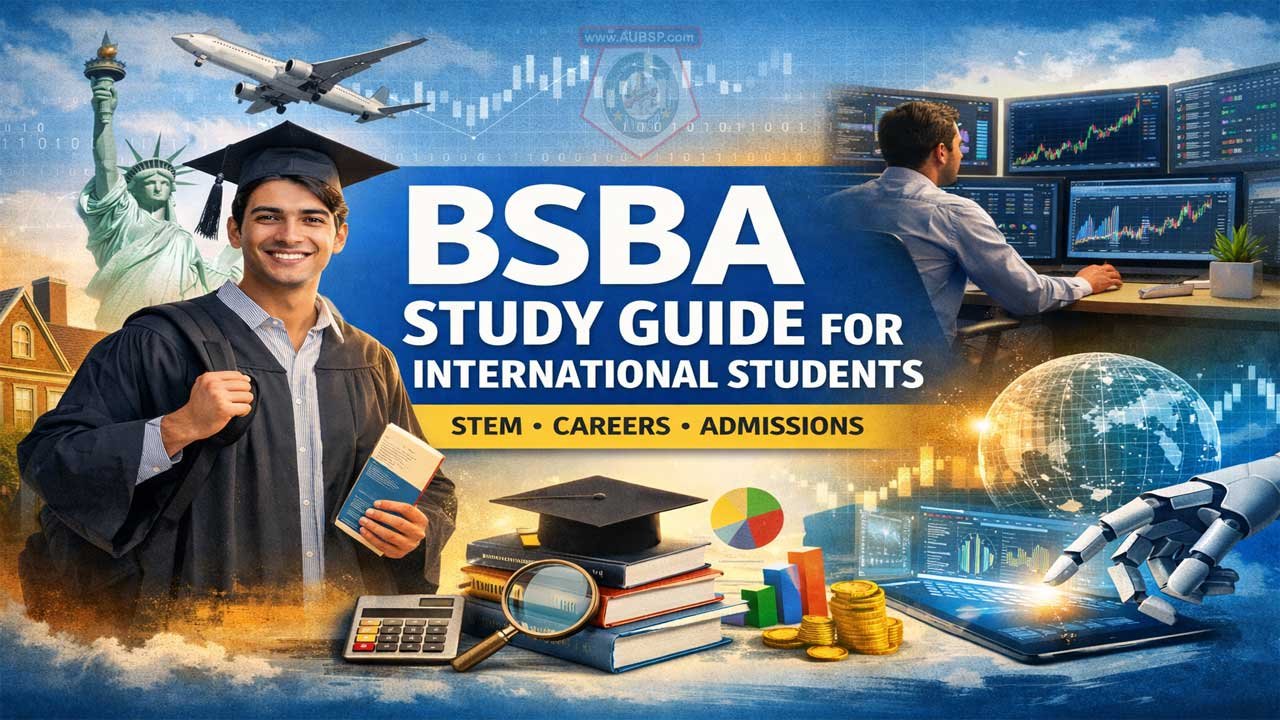
The Bachelor of Science in Business Administration (BSBA) is a modern business degree designed for a data-driven and technology-focused world. Unlike the BBA, which gives a broad overview of management and leadership, the BSBA focuses more on mathematics, analytics, economics, and business technology. International students applying for this degree must meet strict requirements such as math preparation, English proficiency tests (like TOEFL or IELTS), and sometimes SAT or ACT scores.
The program usually requires about 120 credits and includes core business subjects plus specialized concentrations such as finance, business analytics, or supply chain management. Many BSBA programs are STEM-designated, allowing international students in the U.S. to work for up to 36 months after graduation through the OPT extension. Although studying abroad can be expensive, scholarships and internships can help reduce costs and improve job opportunities. Overall, the BSBA prepares students with strong analytical and technical skills, leading to high-demand careers in finance, consulting, analytics, and management.
| Category | Information |
|---|---|
| Degree Name | Bachelor of Science in Business Administration (BSBA) |
| Main Focus | Quantitative analysis, data-driven decision making, and business technology |
| Difference from BBA | BSBA is more technical and math-focused; BBA is broader and management-oriented |
| Typical Duration | 3–4 years (about 120 credit hours) |
| Core Subjects | Accounting, Finance, Business Analytics, Economics, Operations, Strategy |
| Popular Specializations | Business Analytics, Finance, MIS, Supply Chain Management |
| Admission Requirements | High school transcripts, math background, English test (TOEFL/IELTS), sometimes SAT/ACT |
| English Test Benchmarks (2026) | TOEFL ~4.0+ scale, IELTS ~6.5 overall, Duolingo ~115+ |
| STEM Advantage | Up to 36 months of work authorization in the U.S. through OPT extension |
| Average Tuition (International) | $30,000–$75,000 per year depending on country and university |
| Average Starting Salary (2026) | Around $68,000–$81,000 for business graduates |
| Career Paths | Financial Analyst, Business Consultant, Project Manager, Operations Manager |
| Key Benefit | Combines business knowledge with technical and analytical skills for global careers |
BSBA Degree Guide for International Students: Admissions, STEM Benefits, Careers & Costs (2026)
The global architecture of business education is currently navigating a period of profound transformation, characterized by a decisive pivot toward quantitative rigor and technological integration. For the international student, the choice of an undergraduate degree is no longer a simple matter of institutional prestige but a strategic calculation involving academic orientation, post-graduation mobility, and professional sustainability.
At the center of this strategic choice is the Bachelor of Science in Business Administration (BSBA), a degree that has evolved to meet the demands of a data-centric corporate world. Unlike traditional commerce degrees, the BSBA serves as a bridge between foundational management principles and the high-level analytical competencies required by modern industry.
This report examines the multidimensional aspects of the BSBA degree from the perspective of an international applicant. It navigates the pedagogical distinctions that separate it from other business programs, the rigorous admissions frameworks tailored for global students, the complex curricular structures that define its value, and the critical role of STEM designation in securing long-term career outcomes in a competitive international labor market.
Defining the BSBA: Pedagogical Divergence and Technical Depth
To understand the value of a Bachelor of Science in Business Administration, one must first delineate its position relative to the Bachelor of Business Administration (BBA). While both programs share a core objective of preparing students for the commercial sector, their methodologies and intended outcomes differ significantly. The BBA is traditionally categorized as a broad-based undergraduate degree, providing a diverse education across core sectors such as marketing, human resources, and accounting. It emphasizes management and organizational leadership, often incorporating a substantial liberal arts component to foster well-rounded communicators and strategic thinkers.
The BSBA, however, represents a more specialized, technical approach to business education. It prioritizes quantitative and analytical skills, necessitating a more intensive engagement with mathematics, economics, data analytics, and business technology. Academic leadership in elite business colleges suggests that the defining differentiator of the BSBA is its focus on technical competence and data-driven decision-making. This distinction is crucial for international students who are increasingly entering fields where technical fluency is a prerequisite for entry-level roles in finance, supply chain management, and business intelligence.
| Comparative Dimension | Bachelor of Business Administration (BBA) | Bachelor of Science in Business Administration (BSBA) |
|---|---|---|
| Academic Focus | Broad overview of management and leadership | Intensive quantitative and analytical skills |
| Mathematical Rigor | Foundational; lower math requirements | High; emphasizes statistics and modeling |
| Curriculum Structure | Flexible with elective choices | Highly structured and prescribed |
| Technical Integration | General technology use | Advanced data analytics and AI tools |
| Educational Foundation | Strong liberal arts emphasis | STEM-oriented academic foundation |
| Primary Career Goal | General management; entrepreneurship | Analytical roles; financial engineering |
The trend toward the BSBA reflects a broader industry requirement for “decision-ready” graduates who can manipulate complex datasets to craft strategic narratives. For the international student, the choice of a BSBA often indicates a commitment to a high-rigor path that offers specialized skillsets applicable across diverse global industries.
International Admissions: Navigating the 2026 Frameworks
The admission process for international students seeking a BSBA is a multifaceted endeavor that requires meticulous planning and an understanding of shifting global standards. As universities move toward the 2026 academic cycle, several key changes in standardized testing and credential evaluation have become apparent, necessitating a proactive approach to application management.
Credential Evaluation and Mathematical Readiness
For an international transcript to be recognized by a university in the United States or Canada, it must undergo a rigorous evaluation process. Organizations such as World Education Services (WES) and other members of the National Association of Credential Evaluation Services (NACES) act as the vital link between a student’s past education and their future opportunities. These services ensure that the value of an international degree or secondary school diploma is recognized by licensing boards and academic institutions.
A recurring requirement for BSBA applicants is a demonstrated proficiency in mathematics. For example, Drexel LeBow requires three years of mathematics, specifically including Algebra I and II and Geometry, along with a year of laboratory science. Higher-tier programs often expect even greater rigor, looking for Calculus or advanced statistics on the applicant’s record to ensure they can handle the quantitative intensity of the BSBA curriculum.
The 2026 English Proficiency Paradigm Shift
English language proficiency is perhaps the most critical component of the international application. While the TOEFL and IELTS remain the standard benchmarks, the year 2026 marks a significant transition in how scores are reported and interpreted. The TOEFL iBT is implementing a new scoring scale that will require students to achieve a 4.0 or higher for full admission, replacing the previous minimum of 79.
| English Language Test | 2025 Minimum Standard | 2026 New Scaling Requirement |
|---|---|---|
| TOEFL iBT | 79 – 81 | 4.0 – 4.5 |
| TOEFL Essentials | 8.5 | 9.0 (Expected) |
| IELTS Academic | 6.5 Overall | 6.5 Overall |
| Duolingo (DET) | 110 – 115 | 115 – 120 (Projected) |
| Pearson (PTE) | 53 – 55 | 55 – 60 (Projected) |
Furthermore, the “Limited Status Admission” or “Conditional Admission” routes allow students with slightly lower scores—such as a 3.5 on the new TOEFL scale—to enroll, provided they complete intensive English training before starting their graduate-level or upper-division business coursework. It is also imperative for students to recognize that many universities require higher sub-scores in the speaking section (often a minimum of 26 on the old scale) to ensure students can actively participate in the collaborative, presentation-focused culture of the modern business school.
Standardized Testing: SAT and ACT in the 2026 Context
While many institutions have adopted test-optional policies, standardized test scores such as the SAT and ACT remain powerful tools for international students to demonstrate academic readiness and qualify for merit-based scholarships. At the Kelley School of Business (IU Indianapolis), a minimum SAT score of 1170, with a specific focus on the math section (530+), or a composite ACT of 24 is required for direct admission. This underscores the reality that for a degree as quantitative as the BSBA, mathematical excellence is often the primary filter used by admissions committees to predict student success.
Curricular Architecture: The Pillars of a BSBA Degree
The curriculum of a BSBA is engineered to provide a holistic yet specialized business education. Most programs require 120 credit hours for graduation, though elite institutions like Boston University require 132 units to ensure a broad exposure to both business essentials and global competition. The structure of these programs typically follows a three-tiered approach: the Pre-Business Core, the Business Core, and the Concentration.
The Pre-Business and Foundation Gateway
The first two years of a BSBA program are often structured as a “gateway” period. At the University of Arkansas, students must complete a 37-hour Pre-Business core with a minimum GPA of 2.50 before they are allowed to take upper-division business courses. This foundation includes principles of accounting, microeconomics, and foundations of business analytics. This stage serves to ensure that students have the prerequisite mathematical and analytical skills necessary for advanced modeling and decision-making.
| Core Functional Area | Key Coursework Examples | Learning Objectives |
|---|---|---|
| Accounting | Financial & Managerial Accounting | Understanding financial health and cost control |
| Analytics | Data Visualization & Applied Stats | Extracting insights from large datasets |
| Finance | Corporate Finance & Investments | Capital allocation and asset management |
| Operations | Supply Chain & Ops Management | Efficiency optimization and quality control |
| Strategy | Global Competition & Innovation | Navigating long-term organizational goals |
Specialized Concentrations: Designing a Professional Identity
The true value of the BSBA for the international student lies in the concentration. These specialized tracks allow students to tailor their degree to the specific demands of the global labor market. For instance, Troy University offers concentrations in Risk Management and Insurance, while Boston University provides thirteen distinct concentrations ranging from Innovation & Entrepreneurship to Real Estate.
- Business Analytics: This has emerged as one of the most critical concentrations for the modern era. It involves specific blocks of coursework in business modeling with spreadsheets, statistical programming, and managing data resources.
- Finance and Investment: This track prepares students for corporate finance, investment banking, and international accounting, emphasizing financial modeling and risk assessment.
- Management Information Systems (MIS): This concentration focuses on computer information systems and emerging technologies, preparing students for the intersection of business strategy and IT security.
- Supply Chain Management: Especially relevant for international students, this field focuses on the global movement of goods and the optimization of logistics through quantitative methods.
The integration of “Core Innovation Projects” and experiential learning opportunities—where students write full business plans for real-world products—ensures that these theoretical foundations are immediately applied to practical scenarios.
The STEM Designation: A Strategic Imperative for Global Mobility
For international students studying in the United States, the most significant tactical advantage of a BSBA over a BBA is often the degree’s potential for STEM (Science, Technology, Engineering, and Mathematics) designation. This classification is not merely academic; it has profound implications for a student’s legal ability to work in the U.S. after graduation.
Understanding the STEM OPT Extension
Under normal circumstances, F-1 visa holders are entitled to 12 months of Optional Practical Training (OPT) following the completion of their degree. However, students who graduate from a STEM-designated program are eligible for a 24-month extension, allowing for a total of 36 months of work authorization.
This extended timeline is critical for three primary reasons:
- Professional Experience: It allows graduates to gain three years of intensive professional experience in the U.S. market, making them significantly more competitive if they eventually return to their home countries or seek opportunities elsewhere.
- H-1B Lottery Chances: Because the H-1B visa for skilled workers is allocated via a lottery system, having 36 months of work authorization gives a student three separate chances to enter the lottery, as opposed to the single chance provided by a 12-month OPT.
- Employer Investment: Employers are often more willing to hire and train international graduates if they know they have a guaranteed three-year window of eligibility before a more permanent visa sponsorship is required.
| Program Title | CIP Code | STEM Eligible? | Institutional Examples |
|---|---|---|---|
| Business Analytics | 30.7102 | Yes | UM-Dearborn, BU Questrom |
| Financial Analytics | 30.7104 | Yes | UM-Dearborn, Rider |
| Economics & Math | 45.0603 | Yes | Drexel LeBow |
| Management Science | 52.1301 | Yes | NYU Stern, USC Marshall |
| Accounting Analytics | 52.0301 | Variable | PSU, GWU |
The Department of Homeland Security (DHS) maintains a strict list of STEM-designated CIP (Classification of Instructional Programs) codes. Universities must apply for this designation for individual degree programs, and students must ensure their specific major and CIP code—found on the first page of their I-20 form—aligns with the DHS list to qualify for the extension.
Institutional Ecosystems and Global Rankings 2026
The global prestige of a business school remains a primary driver for international enrollment. For the 2026 academic year, the rankings demonstrate a high degree of stability at the top, though new “Quantitative Analysis” leaders are emerging.
The North American “Target Schools”
In the United States, the Massachusetts Institute of Technology (MIT Sloan) and the University of Pennsylvania (Wharton) are currently tied for the number one position in undergraduate business education. While Wharton remains the premier feeder for traditional investment banking, MIT Sloan has taken the lead in production management and quantitative analysis, areas that are increasingly vital for BSBA students.
The University of California, Berkeley (Haas) and New York University (Stern) follow closely, offering unmatched access to the tech hubs of the West Coast and the financial hub of Wall Street, respectively. For international students, these “target schools” provide a built-in network of alumni and corporate recruiters that significantly lowers the barrier to entry-level roles in prestigious firms.
European and Asian Alternatives
Outside of North America, the 2026 rankings highlight the growing strength of institutions in the UK, Asia, and Europe. The University of Oxford and the University of Cambridge remain the gold standard for academic prestige in the UK, while the London School of Economics (LSE) offers a uniquely focused environment for business and economics. In Asia, Tsinghua University and Peking University in China, along with the National University of Singapore (NUS), have cracked the global top ten, reflecting the shift in economic power toward the East.
| 2026 Global Rank | Institution | Country | Focus Area |
|---|---|---|---|
| 1 | MIT (Sloan) | USA | Technology & Quant |
| 1 | Penn (Wharton) | USA | Finance & Consulting |
| 3 | Stanford University | USA | Innovation & Entrepreneurship |
| 4 | University of Oxford | UK | Global Leadership |
| 7 | Peking University | China | Research Environment |
| 10 | NUS | Singapore | International Outlook |
For the international student, choosing between these institutions often involves a trade-off between the four-year U.S. model, which offers broad exposure and the 36-month OPT, and the three-year UK/European model, which is often more specialized but offers a different post-study work route.
Financial Architectures: Tuition, Living Costs, and Scholarship Strategies
The cost of obtaining a BSBA is a significant consideration for the international cohort. Tuition fees have seen a steady climb, with the 2025/2026 academic year posting notable increases in several major study destinations.
Global Tuition Benchmarks 2026
In Canada, international undergraduate students can expect to pay an average of $41,746 per year, a cost that is more than five times higher than that of their domestic counterparts. In the United States, the range is even broader. Public universities may cost international students between $30,000 and $45,000, while top-tier private institutions often exceed $60,000 in tuition alone.
| Study Destination | Avg. International Tuition (Undergrad) | Est. Monthly Living Cost | Total Annual Est. (2026) |
|---|---|---|---|
| USA (Private) | $55,000 – $75,000 | $1,500 – $2,500 | $73,000 – $105,000+ |
| USA (Public) | $30,000 – $45,000 | $1,200 – $2,000 | $45,000 – $69,000 |
| Canada | $36,000 – $42,000 | $1,200 – $1,700 | $50,000 – $63,000 |
| UK | £22,000 – £35,000 | £900 – £1,400 | £33,000 – £52,000 |
| Australia | AU$35,000 – AU$50,000 | AU$1,800 – AU$2,500 | AU$57,000 – AU$80,000 |
Strategic Scholarship Acquisition
To offset these substantial costs, international students must aggressively pursue scholarship opportunities. Unlike domestic students, who may rely on federal grants, international applicants must focus on merit-based university awards and government-sponsored grants.
- University-Specific Merit Awards: The University of Toronto offers the Lester B. Pearson International Scholarship, which covers tuition, books, incidental fees, and full residence support for four years. Similarly, UBC provides the International Major Entrance Scholarship (IMES) valued at up to $25,000 per year.
- Government-Funded Programs: The GREAT Scholarships (UK) and the Australia Awards are prestigious grants that target high-achieving students from specific regions to drive change as global leaders.
- Specialized Business Grants: Many business schools, like Bristol or NTU, offer specific “Think Big about Business” or “Executive Dean’s” scholarships worth between £3,000 and 50% of the tuition fee.
Students are encouraged to apply for these awards concurrently with their university application, as deadlines often coincide with the January “Regular Decision” windows.
Career Outcomes and Economic Value: The Class of 2026 Projections
The economic return on a BSBA degree remains one of the strongest in higher education. For the Class of 2026, the job market for business graduates is projected to be resilient, even in an environment where overall hiring may remain flat.
Salary Trends and High-Demand Sectors
According to the National Association of Colleges and Employers (NACE) Winter 2026 Salary Survey, starting salaries for business degree graduates are expected to rise by 5.5%, reaching an average of $68,873. This is bolstered by significant growth in specific functional areas:
- Marketing: Projected 8.5% increase in starting salaries.
- Business Administration/Management: Projected 8.4% increase.
- Sales: Projected 8.3% increase.
Furthermore, finance majors remain among the most in-demand, with at least 60% of surveyed employers planning to hire from this pool in 2026. The median annual pay for entry-level roles in the United States, as reported by ZipRecruiter for March 2026, has reached $81,995, with top earners in major metropolitan hubs like San Francisco and New York exceeding $121,000.
Path to the C-Suite: Long-Term Income Potential
The BSBA provides a foundation that often leads to high-impact, high-compensation executive roles. By specializing in accounting, finance, or operations, graduates enter pipelines for leadership positions that command six-figure salaries early in their careers.
| Executive/Specialist Role | Median Annual Salary (2026 Est.) | Primary Accountability |
|---|---|---|
| Chief Accounting Officer (CAO) | $195,437 | Oversight of accounting and regulatory compliance |
| Chief Investment Officer (CIO) | $187,874 | Asset management and capital growth strategies |
| Project Manager | $143,123 (Median) | Leadership of complex organizational initiatives |
| Operations Manager | $120,083 (Median) | Day-to-day productivity and efficiency management |
| Business Consultant | $124,453 (Median) | Strategic advisory and problem-solving |
| Financial Analyst | $80,190 (Median) | Financial health assessment and modeling |
This upward trajectory is supported by the sheer volume of vacancies in the sector. The Bureau of Labor Statistics and other researchers project an average of over 911,400 job vacancies annually in business and financial occupations through 2032, ensuring that BSBA graduates have a high degree of employment security.
Mastering the Application: SOP and LOR Strategies
For the international applicant, the quantitative data on their transcript is often balanced by the qualitative narrative provided in the Statement of Purpose (SOP) and Letters of Recommendation (LOR). These documents are the primary vehicles for demonstrating “fit” and leadership potential.
The Statement of Purpose: Narrative Architecture
A successful SOP for a BSBA program must go beyond a simple declaration of interest. It is a formal, academically focused essay that should follow a logical seven-step structure:
- The Hook: An engaging introduction that specifies the real-life incidents or passions that led to choosing business administration.
- Academic Journey: A reflection on school projects and academic interests that goes beyond the marksheet.
- Extracurricular Impact: Descriptions of leadership roles, sports, or volunteering, emphasizing what was learned (e.g., teamwork, resilience).
- Institutional Alignment: Deep research into the university’s specific modules or student clubs (e.g., “The practical approach of the Innovation Project course”).
- Professional Aspirations: Clearly articulated short-term and long-term career goals.
Admissions committees at top universities like Simon Fraser or Caltech look for candidates who exhibit curiosity, passion, and a strong fit for their specific community culture. Avoiding clichés like “from a young age” and maintaining a formal yet authentic tone is paramount.
Strategic Recommendation Letters
The strategy for obtaining Letters of Recommendation has shifted toward prioritizing substance over prestige. A common myth is that a letter from a CEO or a high-ranking official is more valuable than one from a direct supervisor. In reality, admissions committees value the “intimate knowledge of impact” that only a direct supervisor or professor can provide.
International students are advised to:
- Choose Wisely: Select individuals who have directly supervised their work or mentored their academic progress.
- Provide a Brief: Give recommenders a “recommender brief” that summarizes key projects, accomplishments, and traits to help them write a more specific, evidence-based letter.
- Ensure Confidentiality: Waive the right to see the letter. Admissions committees give significantly more weight to confidential recommendations, as they are believed to be more candid.
A strong letter should validate the applicant’s impact, add depth to their story, and provide specific examples of leadership behaviors like strategic thinking and collaboration.
Experiential Learning: The Co-op and Internship Advantage
For the international student, the ability to work during their studies is not just a financial benefit but a critical career-building opportunity. Universities that offer robust co-operative education (co-op) programs, such as Northeastern and Drexel, provide a distinct advantage in this regard.
The Co-op Framework
In a co-op program, students alternate between standard academic terms and full-time, paid professional work related to their major. Students typically graduate with up to 18 months of professional experience, and the statistics are compelling: Northeastern reports that 93% of its graduates find employment within nine months.
| Component | Internship | Co-operative Education (Co-op) |
|---|---|---|
| Duration | Typically 8-12 weeks (Summer) | 4-6 months |
| Intensity | Often part-time or seasonal | Full-time professional role |
| Integration | Often optional/supplemental | Often an integral part of curriculum |
| Visa Authorization | CPT or OPT | Curricular Practical Training (CPT) |
For F-1 students, participation in a co-op falls under CPT authorization. It is essential to manage this carefully, as exceeding 364 days of full-time CPT will result in the loss of post-graduation OPT. This balance is the subject of much strategic planning for international students, who often choose to do one or two domestic co-ops and one international co-op to gain experience while preserving their 36-month STEM-OPT window.
Conclusion: Synthesizing the BSBA Value Proposition
The Bachelor of Science in Business Administration represents a sophisticated, high-rigor gateway to the global corporate world. For the international student, the degree is characterized by a unique intersection of mathematical intensity, specialized concentrations, and strategic work authorization benefits. The transition to the 2026 academic standards—marked by new English proficiency scales and a robust salary outlook for graduates—underscores the degree’s enduring relevance.
Ultimately, the success of an international student in a BSBA program depends on their ability to navigate three critical dimensions: the technical requirements of the curriculum, the legal frameworks of the host country’s work permits, and the qualitative demands of the application process.
By selecting programs with STEM designation, pursuing merit-based financial support, and leveraging experiential learning models like co-ops, international students can effectively bridge the gap between their global origins and their aspirations for leadership in the 2026 marketplace and beyond. The BSBA is more than an academic credential; it is a meticulously constructed foundation for a career defined by analytical precision and strategic impact.
FAQs about BSBA degree
What is a BSBA degree?
A BSBA (Bachelor of Science in Business Administration) is an undergraduate business degree that focuses on analytical, quantitative, and technology-driven business skills. It prepares students for data-driven roles in modern industries.
How is a BSBA different from a BBA?
A BSBA emphasizes mathematics, statistics, and data analytics, while a BBA focuses more on general management, leadership, and business communication with fewer technical requirements.
Is a BSBA good for international students?
Yes, the BSBA is highly valuable for international students because it offers specialized skills, strong global career prospects, and in some cases STEM designation that allows extended work opportunities after graduation.
What are the admission requirements for a BSBA program?
Most universities require high school transcripts, proof of English proficiency such as TOEFL or IELTS, and sometimes SAT or ACT scores. A strong background in mathematics is also often expected.
How long does it take to complete a BSBA degree?
A BSBA typically takes four years to complete in the United States and around three years in some countries such as the UK or parts of Europe.
What are the common specializations in a BSBA program?
Popular specializations include Business Analytics, Finance, Management Information Systems (MIS), Supply Chain Management, Marketing, and Entrepreneurship.
Does a BSBA offer STEM benefits in the United States?
Some BSBA programs are STEM-designated, especially those focused on analytics or data science. This allows international students to apply for a 24-month STEM OPT extension, making a total of up to 36 months of work authorization.
What career opportunities are available after a BSBA?
Graduates often work as financial analysts, business consultants, operations managers, project managers, marketing analysts, or data-driven business strategists.
What is the average salary after completing a BSBA?
Starting salaries for business graduates are typically around $65,000 to $80,000 per year, depending on the specialization, employer, and location.
Are scholarships available for international BSBA students?
Yes, many universities offer merit-based scholarships and government-funded programs to support international students with tuition, living costs, and academic expenses.


Leave a Reply
You must be logged in to post a comment.