
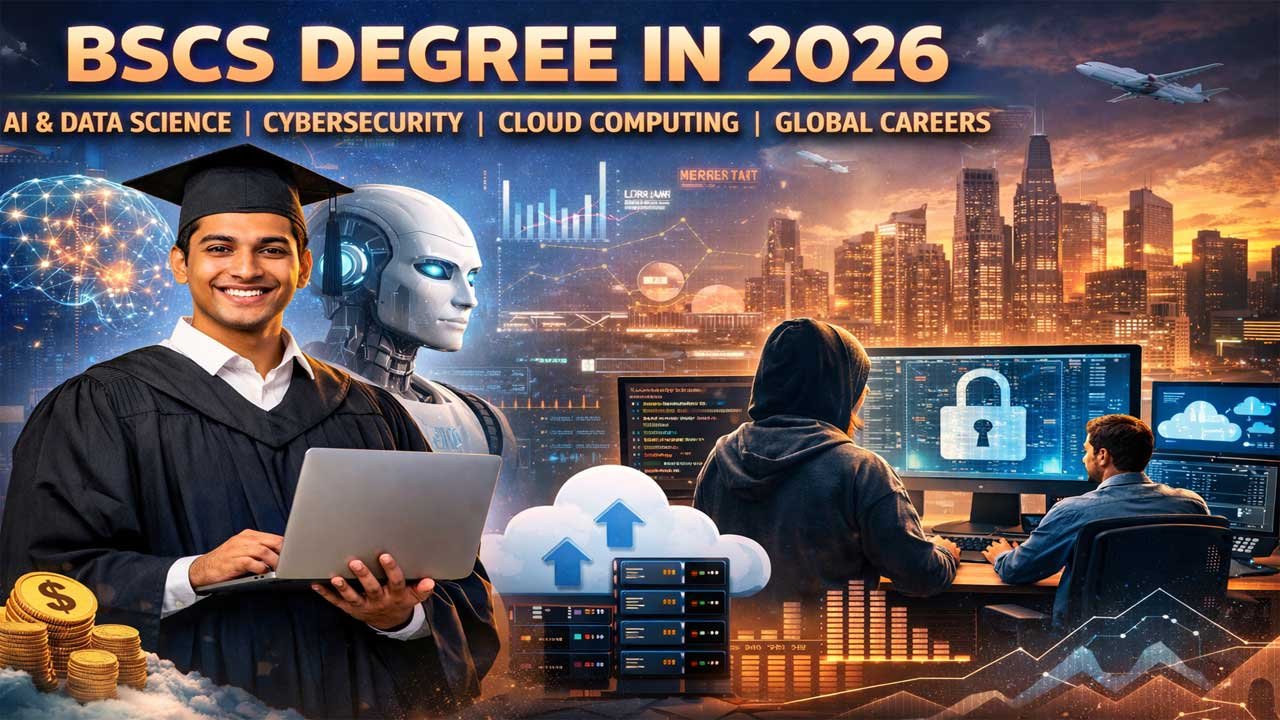
The Bachelor of Science in Computer Science (BSCS) is a globally recognized, high-ROI undergraduate degree that equips students with strong theoretical foundations and practical skills in computing, preparing them for diverse and high-paying careers across industries such as AI, data science, cloud computing, cybersecurity, and software engineering.
Typically completed in 3–4 years, the program covers mathematics, algorithms, programming, systems, and emerging technologies, with flexible pathways including on-campus and online formats. Demand for specialized CS professionals remains strong worldwide in 2026 despite increased competition, offering excellent salary growth, global mobility, and long-term career progression, especially for graduates who build strong portfolios, pursue in-demand specializations, and commit to continuous learning.
Bachelor of Science in Computer Science (BSCS): The Complete Guide to Career Success in 2026
The Bachelor of Science in Computer Science (BSCS) represents one of the most lucrative and globally recognized undergraduate credentials in the technology sector. With the worldwide software development market projected to exceed $730 billion by 2026 and persistent talent shortages in specialized roles like artificial intelligence and cloud engineering, a BSCS degree has become a strategic investment for career growth across all continents.
This comprehensive guide explores every aspect of the BSCS degree—from admission requirements and curriculum structure to global salary comparisons, specialization pathways, and emerging career opportunities. Whether you’re a high school student evaluating educational options, an international applicant considering universities abroad, or a working professional considering degree programs, this article provides data-driven insights to guide your decision.
What Is a BSCS Degree? Core Definition and Overview
The Bachelor of Science in Computer Science (abbreviated as BSCS, BScCS, or BCS) is a three to four-year undergraduate degree program emphasizing the theoretical foundations and practical applications of computing. Unlike engineering-focused programs, BSCS degrees prioritize mathematical principles, algorithms, computational theory, and software development methodologies, preparing graduates for diverse technical careers in technology, finance, healthcare, and government sectors.
| Aspect | Details |
|---|---|
| Full Form | Bachelor of Science in Computer Science |
| Duration | 3 years (standard) or 4 years (with honors/research) |
| Degree Type | Undergraduate (Bachelor’s) |
| Academic Focus | Theory + practical programming, algorithms, data structures |
| Common Abbreviations | BSCS, BScCS, BCS, BComp Sci |
| Global Recognition | Highly valued in USA, UK, Canada, India, EU, and beyond |
The program differs from a Bachelor of Technology (B.Tech) in Computer Science, which emphasizes engineering applications and hardware-software integration, and from a Bachelor of Computer Applications (BCA), which focuses on practical software development for immediate industry employment.
BSCS Curriculum: What You’ll Study
Modern BSCS programs follow rigorous academic structures aligned with international standards. Most curricula organize content across three years (six semesters) with core requirements and elective specializations.
First Year: Foundations
The first year establishes mathematical and programming fundamentals essential for advanced coursework:
- Programming Fundamentals: Introduction to programming using languages like C, Python, or Java
- Mathematics: Linear algebra, discrete mathematics, calculus, probability and statistics
- Computer Science Basics: Digital electronics, computer organization, number systems
- Technical Communication: Professional writing and presentation skills
- General Education: Environmental science, professional ethics, social sciences
Second Year: Core Computer Science
Year two deepens technical knowledge with specialized CS courses:
- Data Structures & Algorithms: Implementation and optimization of core computational concepts
- Object-Oriented Programming: Advanced programming using C++, Java, or Python
- Operating Systems: Process management, memory management, file systems
- Database Management Systems: SQL, data modeling, normalization, transaction control
- Computer Networks: Protocols, TCP/IP, network security basics
- System Analysis & Design: Software engineering principles and methodologies
Third Year: Specializations and Capstone
The final year allows concentration in emerging technologies through electives and capstone projects:
- Advanced Specialization Courses (choose based on career goals):
- Artificial Intelligence and Machine Learning
- Cybersecurity and Network Security
- Cloud Computing and Distributed Systems
- Data Science and Big Data Analytics
- Web Development and Mobile Applications
- Compiler Design and Theory of Computation
- Capstone Project: Real-world software development project demonstrating integration of learned concepts
- Internship/Industry Collaboration: Hands-on experience with professional tools and methodologies
Global Variations: BSCS Programs by Region
United States
American BSCS programs, particularly from universities ranked in the top 100 globally, command premium starting salaries and immediate employment opportunities. Admission typically requires:
- High school diploma or GED
- Standardized test scores (SAT/ACT)
- Strong performance in mathematics and sciences
- 3-4 year full-time program with extensive internship opportunities
Estimated Costs: $30,000-$60,000 per year for international students; $10,000-$20,000 for U.S. residents at public universities
United Kingdom
The UK model offers a three-year undergraduate degree, completing faster than the American four-year standard. Entry requirements are more competitive:
- A-level qualifications: AAA including A* in Mathematics and at least one science subject
- IELTS 7.0+ for non-native English speakers
- Strong performance in physics or computer science A-levels
Estimated Costs: £13,500-£44,000 per year for international students. UK universities include Oxford, Cambridge, UCL, Manchester, and Edinburgh, all offering world-leading programs.
Canada
Canadian BSCS programs provide a middle ground between U.S. and UK models, with lower tuition than comparable American universities:
- High school diploma with strong math and science backgrounds
- Competitive entrance exam scores
- Some universities accept both domestic and international applications through centralized systems
Estimated Costs: $15,000-$35,000 per year for international students
India
India has emerged as a major hub for BSCS education, offering globally competitive programs at significantly lower costs:
- 10+2 (Class XII) from recognized board with 50%+ aggregate in science stream
- Some universities conduct entrance examinations (CUET, state-level exams)
- Both government and private institution options available
- Online distance learning programs available through IGNOU and other universities
Estimated Costs:
- Government colleges: ₹540-₹1.76 Lakh ($6-$2,100 USD) for entire 3-year degree
- Private colleges: ₹3-7 Lakh ($3,600-$8,400 USD) for entire degree
- Online programs: ₹19,600-₹54,000 ($235-$650 USD) per year
India’s cost advantage, combined with rising quality of education and global recognition of degrees from institutions like BITS Pilani, Ashoka University, and VIT, has attracted significant international interest.
Specialization Pathways: Choosing Your Technical Direction
BSCS students typically select specializations in their second or third year based on career interests. The top specializations offer the highest salary potential and strongest job market demand.
Artificial Intelligence & Machine Learning
Focus: Neural networks, deep learning, natural language processing, computer vision, generative AI
Required Skills: Python, TensorFlow, PyTorch, statistics, mathematics
Career Roles:
- AI/ML Engineer (₹3-22 LPA in India; $119,000+ in USA)
- Data Scientist (₹6-12 LPA; $98,000+ in USA)
- NLP Engineer
- Computer Vision Specialist
Industry Demand: Extremely high, with significant investment across healthcare, finance, e-commerce, and autonomous systems sectors.
Cybersecurity
Focus: Network security, ethical hacking, cryptography, threat detection, compliance frameworks
Required Skills: Network protocols, penetration testing tools, security analytics, compliance standards (ISO 27001, NIST)
Career Roles:
- Security Analyst (₹5-10 LPA)
- Ethical Hacker
- Security Architect
- Threat Intelligence Engineer
- IT Security Specialist (₹5.8-29 LPA)
Salary Premium: Cybersecurity roles command a 15-20% salary premium over general software development due to persistent skills shortage
Data Science & Analytics
Focus: Statistical modeling, big data processing, data visualization, business intelligence, predictive analytics
Required Skills: Python/R, SQL, machine learning algorithms, Tableau/Power BI, statistics
Career Roles:
- Data Analyst (₹4.8-15 LPA; $85,000+)
- Data Engineer (₹5-12 LPA; $98,000+)
- Business Intelligence Analyst
- Data Scientist
- Quantitative Analyst (FinTech)
Cloud Computing & Infrastructure
Focus: AWS, Azure, Google Cloud, Kubernetes, containerization, serverless architecture, DevOps
Required Skills: Docker, Kubernetes, cloud platforms, infrastructure automation, DevSecOps
Career Roles:
- Cloud Architect
- Cloud Engineer
- DevOps Engineer
- Site Reliability Engineer (SRE)
- Infrastructure Automation Specialist
Market Growth: 89% of major firms have integrated at least one cloud service, driving sustained demand
Web & Mobile Application Development
Focus: Full-stack development, responsive design, cross-platform development, API design
Required Skills: JavaScript, React/Angular, Python/Java backend, mobile frameworks (Flutter, React Native), databases
Career Roles:
- Full Stack Developer (₹3.7-15.2 LPA; $87,000 in USA)
- Front-End Engineer
- Back-End Engineer
- Mobile App Developer
- Software Architect
BSCS Salary Potential: Global Comparison
One of the strongest advantages of a BSCS degree is the immediate earning potential and consistent salary growth across all major economies.
Entry-Level Salaries by Region
| Region | Currency | Starting Salary | Notes |
|---|---|---|---|
| India | INR | ₹2.5-4 LPA (₹20,000-40,000/month) | Varies by college tier and specialization |
| USA | USD | $50,000-$70,000/year | Higher in tech hubs (Silicon Valley, Seattle, NYC) |
| UK | GBP | £25,000-£35,000/year | Entry-level software engineer roles |
| Canada | CAD | $50,000-$70,000/year | Competitive with US rates |
| Australia | AUD | $55,000-$75,000/year | Strong demand for tech talent |
Mid-Career Salary Growth (5-10 Years Experience)
The earning trajectory for BSCS graduates accelerates significantly with specialization and experience:
| Role | India (LPA) | USA (Annual) | UK (Annual) |
|---|---|---|---|
| Software Developer | ₹6-8 | $95,000 | £40,000-£50,000 |
| Data Scientist | ₹8-12 | $120,000+ | £55,000-£70,000 |
| Cloud Architect | ₹10-15 | $130,000+ | £60,000-£80,000 |
| Machine Learning Engineer | ₹8-15 | $119,000 | £65,000-£85,000 |
| Cybersecurity Specialist | ₹8-12 | $110,000+ | £50,000-£70,000 |
| Enterprise Architect | ₹20-40 | $140,000-$170,000 | £80,000-£120,000 |
High-Earning Specialization: Enterprise Architecture and Principal Engineering roles command the highest compensation, with enterprise architects earning ₹20.4-75 LPA in India and $140,000-$170,000+ in the USA.
Senior-Level Earning Potential
Senior technical positions including Principal Software Engineer, Engineering Manager, and VP of Engineering roles command salaries exceeding:
- ₹1,00,000+ per month (₹12+ LPA) in India
- $150,000+ per year in the USA
- £100,000+ per year in the UK
Career Opportunities and Job Market Outlook
Current Job Market Dynamics (2026-2027)
The technology employment landscape is experiencing significant transformation. While overall CS graduate unemployment has risen due to AI automation and market consolidation, opportunities in specialized fields remain robust:
High-Demand Roles in 2026-2027:
- AI/ML Engineers – 26% projected employment growth through 2033
- Cloud Engineers – 9% employment growth with strong salary trajectory
- Data Engineers – 9% projected growth; average salary $98,000
- Cybersecurity Specialists – Persistent skills shortage driving premium salaries
- Full Stack Developers – 35% YoY demand growth (2015-2020)
- Blockchain Engineers – Entry-level: £65,000; experienced: £90,000
Recruitment Trends by Region
India: Major IT services firms plan to hire approximately 85,000 freshers in FY26, though increasingly favoring specialized positions over routine coding roles. Top recruiters include TCS, Infosys, Wipro, HCLTech, and LTIMindtree.
USA & Global Tech Companies: Google, Microsoft, Amazon, Meta, and Apple continue recruiting BSCS graduates for specialized roles in AI, cloud infrastructure, security, and product development, though competition is intensifying.
Essential Programming Languages: What You’ll Learn
A BSCS curriculum emphasizes learning multiple programming languages to develop foundational competency across paradigms. The most widely taught languages include:
Python
Usage: Data science, AI/ML, automation, web development, scripting
Advantages: Simple syntax, extensive libraries (NumPy, Pandas, TensorFlow), rapid development
Industry Applications: Data analysis, machine learning, artificial intelligence, scientific computing
Learning Curve: Beginner-friendly; ideal starting language
Java
Usage: Enterprise applications, Android development, backend systems, desktop applications
Advantages: Platform independence (runs on any JVM), strong typing, security features, massive ecosystem
Industry Applications: Banking systems, e-commerce platforms, enterprise resource planning
Learning Curve: Moderate; more verbose than Python but transfers to C++ and other OOP languages
C++
Usage: Systems programming, embedded systems, game engines, high-performance computing, robotics
Advantages: Exceptional performance, memory control, suitable for real-time systems
Industry Applications: Operating systems, firmware, game development (Unreal Engine), AI inference
Learning Curve: Steep; complex syntax and memory management require significant practice
JavaScript
Usage: Web development, frontend applications, server-side (Node.js), progressive web apps
Advantages: Runs natively in browsers, event-driven paradigm, massive npm ecosystem
Industry Applications: User interface development, interactive web applications
C (Systems Programming)
Usage: Operating system kernels, embedded systems, compilers, database engines
Advantages: Low-level hardware access, minimal overhead, efficient code
Learning Curve: High; requires understanding memory management and pointer concepts
SQL
Usage: Database querying, data analysis, data management
Advantage: Universal database language; essential for any data-intensive role
Industry Requirement: Mandatory knowledge for backend development, data science, and database administration
Internship and Placement Opportunities
Internship Timeline and Strategy
The most successful BSCS students secure internships beginning in their second year. Industry best practices recommend:
Timeline for 2026:
- Month 1-3: Update portfolio, build GitHub projects, identify target companies
- Month 4-6: Apply for summer internship 2026 positions; prepare for technical interviews
- Month 7-9: Interview preparation using platforms like LeetCode and HackerRank
- Month 10-12: Complete internships, document learning, evaluate PPO (Pre-Placement Offer) conversions
Top Recruiting Companies
| Companies | Typical Roles | Regions |
|---|---|---|
| IT Services | Software Developer, Systems Engineer, Database Admin | Global |
| TCS, Infosys, Wipro, Cognizant, Accenture, Capgemini, HCL | ||
| Technology Giants | Software Engineer, ML Engineer, Cloud Engineer | Global |
| Google, Microsoft, Amazon, Facebook, Apple, IBM, Oracle | ||
| Startups | Full Stack Developer, AI Engineer, Security Engineer | USA, Europe, India |
| AI startups, fintech firms, cybersecurity companies | ||
| Specialized Sectors | Domain-specific roles | Sector-specific |
| JPMorgan Chase, Goldman Sachs (FinTech) | Quant Analyst, Fraud Detection | Finance |
| Cisco, Palo Alto Networks (Security) | Security Engineer | Cybersecurity |
| AWS, Google Cloud, Azure | Cloud Solutions Architect | Cloud |
Average Internship Compensation (2025-2026)
- Premium Tech Companies: ₹40,000-₹80,000/month in India; $25-$40/hour in USA
- Startups: ₹15,000-₹40,000/month in India; $15-$25/hour in USA
- Government/Research Institutions: ₹10,000-₹25,000/month
Placement Success Metrics
Strong BSCS programs report:
- Placement Rate: 85-95% within 6 months of graduation
- Average Package: ₹3-6 LPA in India; $60,000-$85,000 in USA (without specialization)
- Highest Packages: ₹15-30+ LPA in India; $150,000+ in USA (specialized roles at top tech companies)
Cost of Education: Comprehensive Breakdown
India
India offers the most cost-effective BSCS education globally:
| Institution Type | Annual Cost | 3-Year Total | Typical Examples |
|---|---|---|---|
| Top Government Universities | ₹7,500-₹25,000 | ₹22,500-₹75,000 | IIT, University of Delhi, BHU |
| Mid-Tier Government | ₹20,000-₹50,000 | ₹60,000-₹1,50,000 | State universities |
| Private Universities | ₹1.2-2.5 Lakh | ₹3.6-7.5 Lakh | BITS Pilani, VIT, Ashoka |
| Premium Private | ₹1.5-2.8 Lakh | ₹4.5-8.4 Lakh | Christ University, SRM |
| Distance/Online | ₹7,000-₹20,000/year | ₹21,000-₹60,000 | IGNOU, open universities |
Scholarships in India: Merit-based scholarships, SC/ST/OBC reservations, and government-sponsored schemes make BSCS education accessible to disadvantaged students.
United Kingdom
UK tuition represents a significant investment for international students:
- UK Domestic Students: £9,790/year (capped tuition); £2,526 for placement year
- International Students: £16,840/year; total 3-year cost ≈ £50,520-£60,000
- Living Costs: £15,000-£25,000/year
- Total Cost: £2.5-3.5 lakh (~$30,000-$42,000 USD) for entire degree
United States
The US features the widest cost variation:
- Public Universities (In-State): $10,000-$20,000/year
- Public Universities (Out-of-State/International): $30,000-$50,000/year
- Private Universities: $40,000-$65,000/year
- Living Costs: $15,000-$25,000/year
- Total 4-Year Cost: $120,000-$360,000
US Financial Aid: Many universities offer significant merit-based and need-based aid for domestic and international students, potentially reducing net costs substantially.
Canada
Canada provides a balanced option:
- International Student Tuition: $15,000-$35,000/year
- Living Costs: $10,000-$20,000/year
- Total Cost: $100,000-$220,000 for 4-year degree
Online and Distance Learning Options
The rise of digital education has democratized access to BSCS programs:
Fully Online Programs
BITS Pilani Online BSc (via Coursera)
- Structure: 30 courses, 2 projects
- Duration: Flexible; typically 2-3 years
- Admission: High school diploma
- Cost: ~₹32,445/course; total ≈ ₹9-12 Lakh
- Recognition: Degree equivalent to on-campus BITS program
IGNOU BSc Computer Science
- Duration: 3-6 years (flexible)
- Mode: Fully online with periodic practical assessments
- Cost: Minimal; highly affordable
- Recognition: UGC-approved; suitable for working professionals
University of London BSc Computer Science
- Duration: 3-4 years flexible
- Mode: Hybrid online with some in-person assessments
- Cost: Competitive international rates
- Recognition: Globally recognized degree from prestigious institution
Advantages of Online BSCS Programs
- Flexibility: Study at your own pace while working or managing other responsibilities
- Affordability: Typically 40-60% cheaper than on-campus programs
- Accessibility: Available globally regardless of geographical location
- Career Compatibility: Pursue internships and professional experience while studying
Limitations to Consider
- Reduced Networking: Limited campus placement opportunities and peer networking
- Self-Discipline: Requires strong motivation and time management
- Practical Limitations: Lab-intensive courses may require occasional campus visits
- Employer Perception: Some traditional employers may prefer on-campus degrees, though this is rapidly changing
Emerging Trends Shaping BSCS Education (2026-2027)
Key Technological Trends
1. Artificial Intelligence & Machine Learning Integration
AI is no longer a specialty subject—it’s becoming embedded across all computer science courses. Modern BSCS programs teach:
- AI fundamentals in core curriculum
- Machine learning as a required or strongly encouraged course
- Ethical AI and responsible computing principles
- Practical applications across all specializations
2. Cloud-Native Development
Cloud platforms are becoming the default infrastructure:
- AWS, Azure, Google Cloud certifications integrated into curricula
- Kubernetes and Docker as standard DevOps practices
- Serverless architecture patterns
- Edge computing and distributed systems
3. Cybersecurity by Design
Security is shifting from a specialized subject to a foundational principle:
- Security embedded in all software development courses
- DevSecOps practices taught alongside DevOps
- Ethical hacking and penetration testing fundamentals
- Compliance frameworks (GDPR, CCPA, etc.)
4. Data-Driven Decision Making
Data literacy is becoming essential:
- Big data fundamentals integrated across curriculum
- Data visualization and storytelling skills
- Statistical thinking and experimental design
- IoT and sensor data management
5. Blockchain & Distributed Systems
Emerging technologies gaining traction:
- Blockchain fundamentals and cryptocurrency technology
- Distributed ledger technology applications
- Consensus mechanisms and cryptography
- Enterprise blockchain platforms
6. Quantum Computing Awareness
Early-stage integration of quantum computing concepts:
- Quantum mechanics for computer scientists
- Quantum algorithms and complexity theory
- Practical quantum computing platforms (IBM Quantum, Google Quantum AI)
- Implications for cryptography and current security models
7. Low-Code/No-Code Platforms
Democratization of application development:
- Visual development tools and platforms
- Integration with traditional coding
- Rapid prototyping frameworks
- Citizen developer enablement
Curriculum Evolution
Universities are adopting flexible 3-4 year models aligned with National Education Policy:
- 3-year Standard BSc: Core degree in 3 years
- 4-year BSc Honours: Enhanced curriculum with deeper specialization
- 4-year BSc Honours with Research: Includes research project and thesis
Scholarships, Funding, and Financial Aid
India-Based Scholarships
| Scholarship | Eligibility | Amount | Type |
|---|---|---|---|
| Merit-Based | Top 10-20% entrance exam scores | 50-100% tuition | Government/Institution |
| SC/ST/OBC | Caste-based reservations | Tuition waiver + stipend | Government |
| Need-Based | Low family income | Partial/full tuition | Government/Private |
| Sports | Athletic achievement | Tuition + coaching | Institution-specific |
| Minority | Religious/minority status | Varies | Government |
International Scholarships
- Chevening Scholarships (UK government): Full or partial funding for UK study
- Erasmus Mundus (EU): Funded masters programs; sometimes accept BSCS graduates
- ICCR Scholarships (India): For international students studying in Indian institutions
- University-Specific Merit Aid: MIT, Stanford, Oxford, Cambridge offer aid to qualified international applicants
Comparison: BSCS vs. Alternative Degrees
BSCS vs. B.Tech Computer Science
| Aspect | BSCS | B.Tech CS |
|---|---|---|
| Duration | 3 years | 4 years |
| Curriculum Focus | Theoretical foundations, mathematics, computer science principles | Engineering applications, hardware-software integration |
| Industry Readiness | Moderate; requires additional training in industry tools | High; direct alignment with job requirements |
| Salary Starting | ₹3-5 LPA | ₹5-8 LPA |
| Research Suitability | Excellent for further study (M.Sc, Ph.D.) | Good for industry; adequate for research |
| Cost in India | ₹3-7 Lakh | ₹5-10 Lakh |
| Global Recognition | Extremely high | Very high (primarily India-centric) |
Verdict: BSCS suits those interested in research, academic pursuits, theoretical depth, and international opportunities. B.Tech suits those seeking immediate industry employment and engineering-focused roles.
BSCS vs. BCA (Bachelor of Computer Applications)
| Aspect | BSCS | BCA |
|---|---|---|
| Curriculum | Academic, theoretical CS concepts | Practical, application-focused development |
| Programming Emphasis | Balanced between theory and practice | Heavy practical coding |
| Mathematics | Extensive (linear algebra, discrete math, probability) | Basic mathematics sufficient |
| Specializations | AI/ML, Data Science, Cybersecurity, Cloud | Web Dev, Mobile Dev, Game Dev, IT Services |
| Entry Requirements | Science stream preferred | Any stream eligible (in some countries) |
| Job Placement | Software engineer, Data scientist, AI/ML roles | Web developer, IT support, software developer |
| Salary Potential | ₹3-6 LPA starting; strong growth trajectory | ₹2.5-4 LPA starting |
| Higher Studies | Excellent pathway to M.Sc/Ph.D. | Good for M.Tech or MBA |
Verdict: BSCS offers better research and career growth potential; BCA provides faster path to employment in web and app development.
Admission Requirements: Detailed Regional Guide
India
Eligibility Criteria:
- Class 12 (10+2) completion from recognized board
- Science stream: Physics, Chemistry, Mathematics
- Minimum 50-55% aggregate marks (varies by institution)
- Some universities conduct entrance exams (CUET, state exams)
Documents Required:
- 10th and 12th grade marksheets
- Birth certificate
- Caste certificate (if applicable)
- Domicile certificate
- 4-5 passport-size photos
Timeline: Admission typically occurs June-July each year; online portal-based applications
United States
Admission Requirements:
- High school diploma or GED
- SAT score (minimum 1400-1500 for competitive universities)
- ACT score alternative (minimum 32-35)
- Strong performance in AP/IB computer science, calculus, physics
- Letters of recommendation (typically 3)
- Statement of purpose/personal essay
- TOEFL/IELTS for international students (minimum 100+ iBT/7.0+)
Timeline: Fall admission application by December-January; notifications April-May
United Kingdom
Entry Requirements:
- A-level: AAA including A* in Mathematics or Further Mathematics
- At least one science: Computer Science, Physics, Chemistry, or Biology preferred
- GCSE: English Language and Mathematics at grade B/6 or above
- IELTS 7.0 overall (minimum 6.5 per section) for non-UK students
- For mature students: GCSE equivalents; sometimes accept professional qualifications
Timeline: UCAS application deadline October 15; decisions March-May
Canada
Admission Requirements:
- High school diploma with strong grades (typically 75%+ required)
- Transcripts in English or French
- Standardized test scores (SAT/ACT sometimes required; increasingly optional)
- TOEFL 80+ iBT or IELTS 6.5+ for international students
- Statement of intent and references (institution-specific)
Timeline: Varies by province and institution; typically January-March application deadlines
Skills Development Beyond the Classroom
Top BSCS graduates develop skills through experiences beyond formal coursework:
Coding Competitions & Hackathons
- Platforms: HackerRank, LeetCode, CodeChef, Codeforces
- Benefits: Problem-solving practice, algorithm optimization, portfolio building
- Awards: Recognition on LinkedIn, potential internship/job offers
- Time Commitment: 5-10 hours/week during competition season
Open-Source Contributions
- Platforms: GitHub, GitLab, SourceForge
- Benefits: Real-world code experience, collaborative development, portfolio credibility
- Impact: Demonstrable impact on software used by millions
- Examples: Contributing to Linux kernel, Django, TensorFlow, React
Certifications
| Certification | Scope | Exam Cost | Relevance |
|---|---|---|---|
| AWS Solutions Architect | Cloud computing | $150 | High for cloud roles |
| Microsoft Azure Fundamentals | Cloud platforms | $165 | Cloud roles (Microsoft ecosystem) |
| Google Cloud Certified | Google Cloud Platform | $200 | Data science, ML roles |
| Certified Ethical Hacker (CEH) | Cybersecurity | $1,000+ | Security specialist roles |
| Certified Kubernetes Administrator | DevOps/Cloud | $395 | Infrastructure/DevOps roles |
| Python/Java OCJP | Programming languages | $245 | Software engineer roles |
Personal Projects
Successful BSCS graduates maintain GitHub portfolios showcasing:
- Full-stack web applications
- AI/ML projects with datasets
- Open-source contributions
- Systems programming implementations
- Mobile applications
Career Progression Path
A typical BSCS graduate’s career trajectory spans 10-15 years from entry-level to senior leadership:
Year 0-2: Junior Software Developer/Engineer
- Salary: ₹2.5-4 LPA (India), $50,000-$70,000 (USA)
- Focus: Learning codebase, writing tested code, code reviews
- Key Skills: Language proficiency, debugging, git/version control
Year 2-5: Software Developer/Engineer
- Salary: ₹4-8 LPA (India), $70,000-$100,000 (USA)
- Focus: Feature development, mentoring juniors, technical design
- Key Skills: System design, architectural thinking, communication
Year 5-10: Senior Engineer/Tech Lead
- Salary: ₹8-15 LPA (India), $100,000-$140,000 (USA)
- Focus: Team leadership, architectural decisions, strategic projects
- Key Skills: Leadership, system architecture, stakeholder management
Year 10+: Staff/Principal Engineer or Management
- Salary: ₹20+ LPA (India), $150,000+ (USA)
- Focus: Engineering direction, innovation, culture setting
- Paths: Technical track (Staff Engineer) or managerial track (Director/VP)
Challenges and Real-World Considerations
The AI Displacement Reality
While the BSCS degree remains valuable, the 2026 job market reflects new challenges:
- AI Code Assistants: Tools like ChatGPT, GitHub Copilot, and Claude handle routine coding tasks, reducing junior developer demand
- Automation of Hiring: Automated screening systems filter candidates based on narrow criteria, increasing competition
- Specialization Requirement: Generic “software developer” roles declining; demand concentrating in AI/ML, cloud, security specializations
- Competitive Saturation: CS degree enrollment increasing while entry-level positions contracting
Mitigation Strategies:
- Develop Specialization Early: Build expertise in in-demand areas (AI, cybersecurity, cloud)
- Build Demonstrable Portfolio: GitHub projects, personal applications, open-source contributions
- Focus on Human Skills: Communication, leadership, problem-solving (AI cannot replicate)
- Continuous Learning: Commit to upskilling in emerging technologies
- Internship Excellence: Convert internships to full-time offers through exceptional performance
Work-Life Balance Concerns
Tech careers present known challenges:
- Crunch Periods: Deadline-driven cultures, especially in startups and financial institutions
- On-Call Responsibilities: DevOps and infrastructure roles require after-hours availability
- Continuous Learning Pressure: Technology changes rapidly; ongoing education required
- Geographic Flexibility Required: Remote work availability varies; relocation sometimes necessary
Cost-Benefit Analysis
Return on Investment for BSCS Degree:
| Country | Total Cost | 5-Year Earnings | 10-Year Earnings | ROI |
|---|---|---|---|---|
| India | ₹3-7 Lakh | ₹20-35 Lakh | ₹50-100 Lakh | 6-10x |
| USA | $120,000-$200,000 | $300,000-$400,000 | $700,000-$1M+ | 2.5-5x |
| UK | £50,000-£60,000 | £150,000-£200,000 | £350,000-£500,000 | 3-8x |
Verdict: Exceptional ROI across all regions, particularly in India where education costs are minimal. Even in the USA and UK, the BSCS degree pays for itself within 2-3 years of employment.
Conclusion: Is a BSCS Degree Right for You?
A Bachelor of Science in Computer Science remains one of the world’s most valuable undergraduate credentials in 2026, offering:
- ✓ Excellent earning potential: Entry-level salaries of ₹2.5-7 LPA (India), $50,000-$70,000 (USA)
- ✓ Strong career growth: Path to senior technical or management roles with ₹20+ LPA (India), $150,000+ (USA)
- ✓ Global opportunities: Highly recognized worldwide; strong mobility across countries and organizations
- ✓ Diverse specializations: AI/ML, cybersecurity, cloud computing, data science, blockchain—choose based on interests
- ✓ Emerging tech focus: Exposure to cutting-edge technologies shaping the future
- ✓ Flexible pathways: Online programs, distance learning, and traditional formats available
- ✓ Continuous demand: Global talent shortage in specialized CS roles ensures persistent job security
However, success requires:
- Development of specialized skills beyond generic programming
- Continuous learning and adaptation to emerging technologies
- Strong portfolio and practical experience through internships and projects
- Soft skills development: communication, collaboration, problem-solving
- Proactive career management and networking
Who should pursue a BSCS degree?
- Students passionate about problem-solving and technology innovation
- Those seeking strong earning potential and career growth
- Individuals interested in AI, data science, cybersecurity, or cloud computing
- Aspiring researchers or academics in computer science
- International students seeking globally recognized credentials
- Working professionals upgrading skills through online programs
The BSCS degree remains a foundational credential for technology careers. Combined with specialization, continuous learning, and strategic career management, it opens doors to some of the world’s most rewarding and impactful technical careers.
FAQs
What is a BSCS degree?
A BSCS (Bachelor of Science in Computer Science) is an undergraduate degree focused on computing theory, programming, algorithms, mathematics, and software systems.
What is the full form of BSCS?
The full form of BSCS is Bachelor of Science in Computer Science.
How long is a BSCS program?
A BSCS program typically lasts 3 years, or 4 years if it includes honors, research, or follows the US education system.
Is BSCS better than B.Tech Computer Science?
BSCS is more theory- and research-oriented, while B.Tech focuses on engineering and applied skills; the better choice depends on career goals.
Is BSCS better than BCA?
BSCS offers deeper theoretical foundations and better long-term growth, while BCA is more application-focused and job-oriented in the short term.
What subjects are taught in BSCS?
Core subjects include programming, data structures, algorithms, operating systems, databases, computer networks, mathematics, and electives like AI or cybersecurity.
Which programming languages are taught in BSCS?
Common languages include Python, C, C++, Java, JavaScript, and SQL.
Is mathematics important for BSCS?
Yes, mathematics is essential and includes discrete math, linear algebra, probability, statistics, and calculus.
Who should choose a BSCS degree?
Students interested in problem-solving, logic, mathematics, research, and long-term tech careers should choose BSCS.
Can non-math students pursue BSCS?
Most universities require mathematics at the high school level, as it is fundamental to the curriculum.
What are the eligibility criteria for BSCS in India?
Completion of 10+2 with science stream (PCM) and usually 50–55% aggregate marks.
What are the eligibility requirements for BSCS abroad?
Requirements include a high school diploma, strong math background, standardized tests (optional in some countries), and English proficiency scores.
Is BSCS good for international students?
Yes, BSCS is globally recognized and offers strong career mobility and employment opportunities worldwide.
What is the scope of BSCS in 2026?
BSCS has excellent scope due to demand in AI, data science, cloud computing, cybersecurity, and software engineering.
What jobs can I get after BSCS?
Graduates can work as software engineers, data scientists, AI engineers, cloud engineers, cybersecurity analysts, and developers.
What is the starting salary after BSCS?
Starting salaries range from ₹2.5–7 LPA in India and $50,000–70,000 per year in countries like the USA.
What is the highest salary after BSCS?
Senior roles can earn ₹20–75 LPA in India and $150,000+ annually in the USA.
Which BSCS specialization has the highest salary?
AI/ML, cloud architecture, enterprise architecture, and cybersecurity typically offer the highest pay.
Is BSCS good for AI and machine learning careers?
Yes, BSCS provides the mathematical and algorithmic foundation essential for AI and ML roles.
Can I become a data scientist with a BSCS degree?
Yes, BSCS is one of the best degrees for data science when combined with statistics and machine learning skills.
Is BSCS good for cybersecurity?
Yes, BSCS graduates can specialize in cybersecurity and access high-demand, high-paying security roles.
Can BSCS graduates work in government jobs?
Yes, BSCS graduates are eligible for various government, PSU, and research roles.
Is BSCS suitable for research and higher studies?
Yes, BSCS is ideal for pursuing MSc, MS, PhD, or research-focused careers.
Can I do MS or PhD after BSCS?
Yes, BSCS is a strong foundation for postgraduate and doctoral studies worldwide.
Is BSCS hard?
BSCS can be challenging due to math, algorithms, and theory, but manageable with consistent effort.
Does BSCS require coding experience before admission?
No prior coding is required, though basic familiarity is helpful.
Is BSCS good for software development?
Yes, BSCS prepares students for software development with strong fundamentals and problem-solving skills.
Can I do BSCS online?
Yes, several universities offer fully online or hybrid BSCS programs.
Are online BSCS degrees valid?
Yes, if offered by accredited and recognized universities, online BSCS degrees are valid.
Is BSCS better than short-term coding courses?
Yes, BSCS provides long-term career stability and deeper understanding compared to short-term courses.
Do companies prefer BSCS or B.Tech graduates?
Top companies value skills and projects, but both degrees are widely accepted.
Is BSCS good for startups?
Yes, BSCS graduates are well-suited for startups due to strong problem-solving and adaptability.
Does BSCS guarantee a job?
No degree guarantees a job, but BSCS significantly improves employability with the right skills.
Are internships important during BSCS?
Yes, internships are critical for practical experience and better placement outcomes.
What skills should BSCS students develop?
Key skills include programming, algorithms, system design, communication, teamwork, and continuous learning.
Is BSCS affected by AI automation?
Routine roles are affected, but specialized BSCS graduates remain in high demand.
Can BSCS graduates work abroad?
Yes, BSCS is one of the most internationally portable degrees.
Is BSCS worth the cost?
Yes, BSCS offers strong return on investment, especially in India and other low-cost education regions.
What is the future of BSCS graduates?
The future is strong for those who specialize, build portfolios, and adapt to emerging technologies.
Can working professionals pursue BSCS?
Yes, through online and distance-learning BSCS programs.
Is BSCS suitable for career switchers?
Yes, especially via online programs combined with hands-on projects.
Does BSCS focus more on theory or practice?
BSCS balances theory and practice, with a stronger emphasis on foundational concepts.
Is BSCS globally recognized?
Yes, BSCS is recognized and respected by universities and employers worldwide.
What makes BSCS valuable in the long term?
Its strong foundations, adaptability, global acceptance, and alignment with future technologies make it highly valuable.


Leave a Reply
You must be logged in to post a comment.