
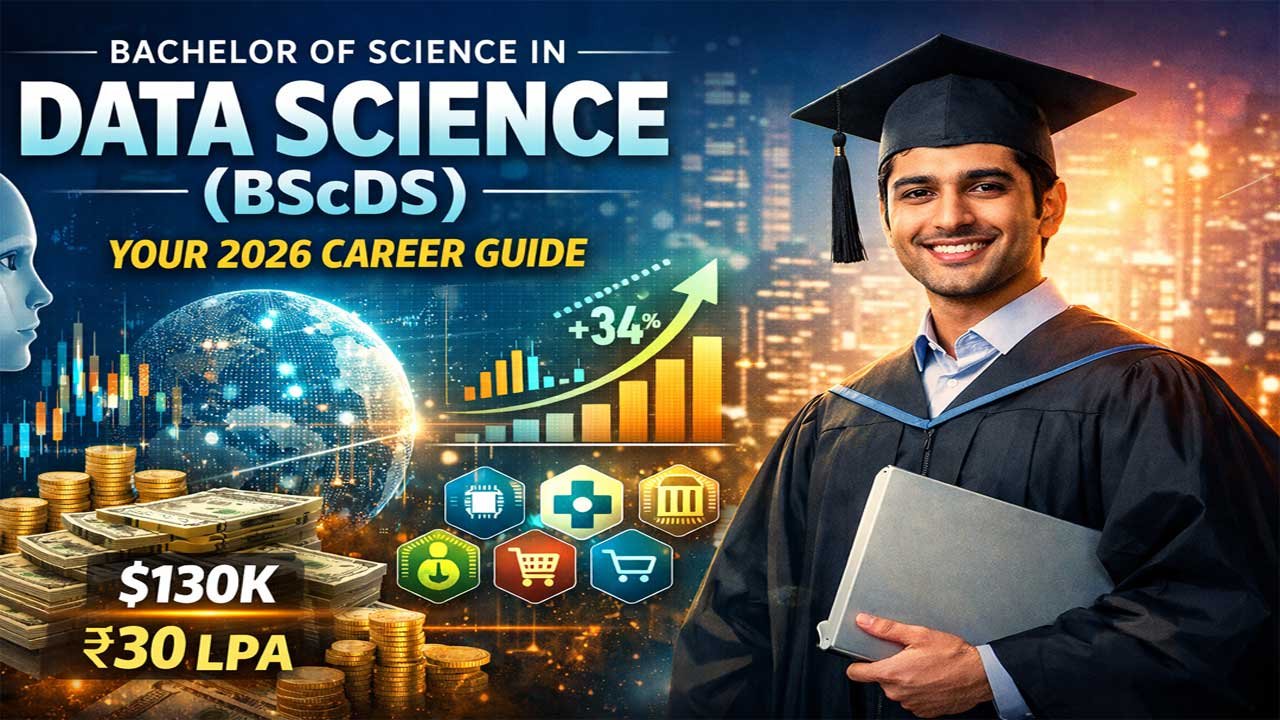
A Bachelor of Science in Data Science (BScDS) is one of the smartest educational investments for 2026, driven by explosive global demand (34% projected job growth), strong job security, and exceptional long-term ROI.
We will explains how the degree uniquely blends mathematics, statistics, programming, and real-world applications to prepare graduates for data-driven roles across industries, offering high starting salaries ($80k–$130k in the US; ₹6–14 LPA in India) and rapid career progression to senior, leadership, and specialized AI roles.
This AUBSP article details curriculum structure, admission requirements, top global universities, career paths, and salary benchmarks by country, while comparing BScDS with alternatives like bootcamps and master’s degrees. Its conclusion is clear: for students strong in math and coding, a BScDS provides unmatched versatility, resilience against economic downturns, and long-term wealth creation potential, making it a powerful gateway to the future data-driven economy.
| Aspect | Information |
|---|---|
| Degree | Bachelor of Science in Data Science (BScDS) |
| Duration | 3–4 years |
| Core Focus | Data analysis, machine learning, statistics, programming |
| Key Skills | Python, R, SQL, ML, AI, statistics, data visualization |
| Job Growth | ~34% projected growth (2024–2034) |
| Entry Salary (US) | $80,000–$130,000 |
| Entry Salary (India) | ₹6–14 LPA |
| Mid–Senior Salary (US) | $150,000–$210,000+ |
| Mid–Senior Salary (India) | ₹20–30 LPA (up to ₹96 LPA for leads) |
| Top Roles | Data Scientist, ML Engineer, Data Engineer, BI Analyst |
| Industries | Tech, finance, healthcare, e-commerce, government |
| Placement Rate | ~90%+ in top institutions |
| ROI | Payback in ~3–4 years; strong long-term earnings |
| Further Study | MS in Data Science/AI (often employer-sponsored) |
Bachelor of Science in Data Science (BScDS): The Complete 2026 Guide to Career Success and ROI
Is Data Science the Most Lucrative Career Choice Right Now?
The demand for data science professionals has reached unprecedented levels. According to the U.S. Bureau of Labor Statistics, employment in data science occupations is projected to grow by 34% between 2024 and 2034—significantly exceeding the average growth rate for all occupations. This explosive demand translates into one unmistakable reality: a Bachelor of Science in Data Science (BScDS) is one of the most strategically sound educational investments you can make in 2026.
The financial opportunity is equally compelling. Entry-level data scientists in the United States earn an average of $80,000 to $130,000 annually, with experienced professionals commanding $180,000 to $200,000+ in base salary alone. Even in India’s competitive market, graduates start at ₹6–14 LPA (lakhs per annum) and rapidly scale to ₹20–30 LPA within five to seven years. What makes the BScDS degree particularly attractive is its versatility—the knowledge and skills are directly applicable across finance, healthcare, technology, e-commerce, and government sectors globally.
This comprehensive guide examines every dimension of the Bachelor of Science in Data Science degree: curriculum structure, career trajectories, salary projections across multiple countries, top-tier institutions, and critical ROI analysis to help you determine if this program aligns with your professional ambitions.
What Exactly Is a Bachelor of Science in Data Science (BScDS)?
The BScDS is a specialized undergraduate degree that combines computer science, statistics, and applied mathematics to prepare students for careers analyzing and interpreting complex datasets. Unlike traditional computer science programs that focus broadly on software development, the BScDS is engineered specifically for the data-driven economy.
The degree typically spans three to four years and emphasizes both theoretical foundations and practical, hands-on application. Students learn to extract actionable insights from massive datasets, build predictive models, design machine learning systems, and communicate findings to non-technical stakeholders. The program bridges the gap between pure statistics and applied computer science, creating professionals who understand both the mathematics underlying data science and the engineering required to implement solutions at scale.
The curriculum balances three core pillars:
- Mathematical Rigor: Linear algebra, probability theory, statistical inference, and calculus
- Programming Proficiency: Python, R, SQL, and Java for data manipulation and algorithm implementation
- Practical Application: Real-world projects involving data visualization, machine learning, deep learning, and business analytics
Why Choose a BScDS in 2026? Five Compelling Reasons
1. Explosive Job Market Growth and Security
The data science field is not experiencing incremental growth—it is experiencing exponential expansion. Approximately 23,400 new data science job openings annually are projected over the next decade. This is not competition for a shrinking pool of roles; it is unprecedented demand for talent.
Elite programs report that 91% of graduates seeking new employment receive full-time job offers. This statistic is representative across tier-one institutions globally. Unlike many degree programs where graduates compete fiercely for limited positions, data science graduates have the luxury of choice.
2. Exceptional and Rapidly Appreciating Salary Trajectory
| Career Stage | USA (2026) | India (2026) | Global Average |
|---|---|---|---|
| Entry-Level (0-2 years) | $80,000-$130,000 | ₹6-14 LPA | $90,000+ |
| Mid-Level (2-5 years) | $120,000-$175,000 | ₹9-15 LPA | $140,000+ |
| Senior (5+ years) | $180,000-$210,000 | ₹20-30 LPA | $190,000+ |
| Principal/Lead (10+ years) | $210,000-$234,000 | ₹24-96 LPA | $220,000+ |
The salary progression is notably steep compared to other technical fields. A data scientist with 15+ years of experience can expect average annual compensation of $234,000 in the United States alone. Graduate data scientists in premium markets (San Francisco, New York, London) command even higher premiums.
India’s data science salaries are equally compelling when adjusted for cost of living. A principal data scientist in India earns ₹24–96 LPA, positioning elite practitioners firmly in India’s 0.1% income bracket. Bootcamp graduates, while earning less initially ($73,000-$82,944), still represent strong ROI given their faster market entry.
3. Global Recession-Proof Career Stability
Data science is fundamentally economic-resistant. During economic downturns, companies cut marketing budgets and delay infrastructure projects—but they never stop needing to extract value from their data. Organizations rely increasingly on data-driven decision-making for competitive advantage, making data scientists indispensable.
Data science professionals demonstrate exceptionally high career satisfaction and internal mobility. This is markedly higher than most STEM fields, indicating that once in the field, professionals find sustainable, fulfilling career paths.
4. Unparalleled Career Flexibility and Specialization Pathways
Unlike specialized degrees that narrow career options, the BScDS opens doors across virtually every industry. Graduates transition into roles such as:
- Data Scientist (30.9% of placements in elite programs)
- Machine Learning Engineer (3.7-10% depending on specialization)
- Data Engineer (8.6%)
- Business Intelligence Developer (8.2%)
- Consultant (14.8%)
- Software Engineer (7.4%)
This diversity is critical. A graduate unhappy in a data scientist role can pivot to machine learning engineering, business analytics, or product management without additional training. The degree provides optionality.
5. Master’s Degree Pathway with Minimal Additional Investment
A BScDS is not a terminal degree. Graduates frequently pursue Master’s programs in Data Science, Machine Learning, or specialized domains (Computer Vision, NLP, Reinforcement Learning). The foundational knowledge acquired in the undergraduate degree dramatically reduces master’s program difficulty and time investment.
Moreover, many employers offer tuition reimbursement for advanced degrees—meaning you can pursue an M.S. while employed and earning, with the company subsidizing 50-100% of tuition costs.
Eligibility and Admission: What You Need to Know
The barriers to entry for a BScDS are remarkably low compared to the earning potential, making it an accessible investment for a broad audience.
Minimum Eligibility Requirements
| Criterion | Requirement |
|---|---|
| Academic Background | 12th Standard (Class XII) pass |
| Subject Requirements | Science stream with Mathematics as compulsory subject |
| Minimum Marks | 50-60% aggregate in 12th standard (varies by university) |
| Reserved Category | 40-45% (relaxation provided) |
| English Proficiency | Varies by institution; TOEFL/IELTS for international programs |
Entrance Examinations
Most universities in India conduct merit-based admissions or administer university-level entrance exams. Common exams include:
- CUET (Common University Entrance Test)
- MET (University-specific Merit-based tests)
- State-level engineering/science entrance exams (JEE Main for some programs)
In the United States and international institutions, admissions typically require:
- High school transcript with strong performance in mathematics and science
- SAT/ACT scores (average SAT for top programs: 1,300-1,500)
- Application essay outlining interest in data science
- Letters of recommendation
For International Students
International applicants must typically demonstrate English proficiency via TOEFL (90-100+) or IELTS (6.5-7.0). Visa requirements vary by destination country but are generally straightforward for educational purposes.
The critical insight: eligibility is not a barrier. The real differentiator is choosing the right institution for your goals and circumstances.
Detailed Curriculum: What You’ll Actually Learn
The BScDS curriculum is deliberately designed to progress from foundational theory to advanced applications, building competency sequentially. Here’s what a typical four-year program looks like:
Year 1: Mathematical and Programming Foundations
Semester I
- Linear Algebra (matrix operations, eigenvalues, eigenvectors)
- Basic Statistics and Probability Theory
- Programming Fundamentals in Python or C
- Communication Skills in English
Semester II
- Probability and Inferential Statistics
- Discrete Mathematics
- Data Structures and Program Design
- Computer Organization and Architecture
Expected Outcomes: By the end of Year 1, students are proficient in at least one programming language, understand fundamental statistical concepts, and can implement basic algorithms and data structures. This foundation is critical—it determines whether you can handle more complex coursework.
Year 2: Core Data Science Concepts
Semester III
- Object-Oriented Programming in Java
- Database Management Systems
- Operating Systems
- Design and Analysis of Algorithms
- Data Visualization Fundamentals
Semester IV
- Machine Learning Fundamentals (Supervised Learning)
- Introduction to Artificial Intelligence
- Cloud Computing (AWS, Google Cloud Platform)
- Time Series Analysis
- Data Warehousing and Multidimensional Modeling
Expected Outcomes: Graduates of Year 2 can build and evaluate machine learning models, understand data pipeline architecture, visualize complex datasets effectively, and deploy solutions on cloud platforms. This is where the “data scientist” identity truly emerges.
Year 3-4: Specialization and Advanced Topics
Advanced Machine Learning
- Deep Learning and Neural Networks (CNNs, RNNs, Transformers)
- Natural Language Processing (NLP) techniques
- Reinforcement Learning and optimization
- Generative AI and Large Language Model (LLM) applications
Specialization Tracks (Choose based on career goals)
- AI and Machine Learning: Advanced neural architectures, computer vision, reinforcement learning applications
- Blockchain Technology: Smart contracts, cryptocurrency systems, decentralized applications
- Cloud and Distributed Systems: Kubernetes, Apache Spark, distributed computing
- Healthcare AI: Medical imaging, disease prediction, personalized medicine
- Business Analytics: Revenue optimization, supply chain analytics, HR analytics
- Cybersecurity: Data encryption, threat detection, security protocols
Capstone Project
Most programs require a comprehensive capstone project or dissertation where students apply all learned skills to solve a real-world data problem—a critical differentiator on job applications.
Curriculum Comparison: BScDS vs Related Degrees
| Aspect | BScDS | BTech CSE | Computer Science + Statistics Minor |
|---|---|---|---|
| Focus | Data-centric | Broad software engineering | Theoretical foundation, less applied |
| Practical Projects | Numerous ML/analytics projects | Software development projects | Limited hands-on experience |
| Industry Alignment | High (job-ready) | Moderate (requires specialization) | Low (requires additional training) |
| Placement Rates | 91%+ in top programs | 80-90% | Variable by institution |
| Entry-Level Salary | $80-130K | $70-100K | $60-90K |
The BScDS’s advantage is specialization combined with practical application. You are not a generalist who happens to like data; you are trained specifically for data-driven roles.
Top Universities and Programs: Where to Study
United States (Tier-1 Institutions)
| University | QS Ranking | Acceptance Rate | Median Salary (Post-Graduation) | Key Features |
|---|---|---|---|---|
| MIT | #1 | 5% | $130,000+ | Rigorous curriculum, elite network, unmatched placement |
| Harvard University | #5 | 3-4% | $130,000+ | Research-focused, extensive resources, global recognition |
| UC Berkeley | #17 | 9% | $125,000+ | California tech hub proximity, strong industry connections |
| Carnegie Mellon | #52 | 9% | $120,000+ | Specialized algorithms program, cutting-edge research |
| University of Chicago | #13 | 6% | $120,000+ | Applied data science focus, diverse student body |
| Yale University | #21 | 4% | $115,000+ | Interdisciplinary approach, strong humanities integration |
India (Leading Institutions)
| University | Program Type | Duration | Annual Fee (INR) | Placement Rate | Key Strengths |
|---|---|---|---|---|---|
| IIM Sambalpur | B.S. Data Science & AI | 4 years | ₹7,03,000 | 95%+ | Industry partnerships, modern curriculum, global recognition |
| IIM Bangalore | B.Sc. Honours Data Science | 3 years | ₹6-8 LPA approx | 92%+ | Economics focus, research orientation, top-tier faculty |
| MIT World Peace University | B.Sc. Data Science & Big Data Analytics | 3 years | Variable | 88%+ | Strong IT placement network, emerging tech focus |
| Christ University (Lavasa) | B.Sc. Data Science | 3 years | ₹4-5 LPA approx | 85%+ | Balanced theory and practice, diverse industry connections |
| UPES, Dehradun | B.Sc. Computer Science (Data Science) | 4 years | ₹5-6 LPA approx | 82%+ | Energy and fintech focus, international partnerships |
International (Canada, UK, Australia)
- University of Toronto (Canada): Highly regarded data science programs with strong North American placement
- University of Melbourne (Australia): Strong research reputation and local job market advantage
- University of Edinburgh (UK): Global recognition with internship opportunities across Europe
Selecting the Right Institution for Your Goals
If you prioritize prestige and maximum earning potential: MIT, Harvard, Carnegie Mellon (US); IIM Sambalpur, IIM Bangalore (India)
If you prioritize affordability with strong outcomes: MIT-WPU, Christ University, UPES (India)
If you prioritize international mobility: Canadian or UK institutions (visa and job market advantage)
If you plan bootcamp + career pivot: Cheaper options provide adequate training; focus on building a portfolio instead
Career Paths and Salary Expectations by Country
United States Market
Entry-level data scientists in major tech hubs command the highest salaries globally:
- Base Salary Range: $80,000-$130,000 (with bonus and equity)
- With 4-6 years experience: $150,000-$175,000
- With 10+ years experience: $210,000-$234,000+
Industry Premium Breakdown:
- Technology (FAANG): $120,000-$200,000+ base
- Finance/Banking: $100,000-$180,000
- Healthcare: $90,000-$150,000
- Consulting: $100,000-$160,000
- E-commerce/Retail: $85,000-$140,000
Top Employers: Google, Amazon, Microsoft, Meta, Apple, JPMorgan, Goldman Sachs, McKinsey, Deloitte
Indian Market
India’s data science market offers exceptional ROI due to cost-of-living advantages:
| Experience Level | Salary (LPA) | Equivalent USD* |
|---|---|---|
| Fresher/Entry-Level | 6-14 LPA | $7,000-17,000 |
| Junior (1-2 years) | 8-18 LPA | $10,000-22,000 |
| Mid-Level (2-5 years) | 9-15 LPA | $11,000-18,000 |
| Senior (5+ years) | 20-30 LPA | $24,000-36,000 |
| Principal/Lead | 24-96 LPA | $29,000-115,000 |
Top Employers in India: TCS, Infosys, Accenture, Wipro, Microsoft India, Google India, Amazon, Flipkart, Jio Platform
India’s advantage: dual-arbitrage opportunity. Earn competitive salaries (3-5x local average) while maintaining low living costs. Many graduates leverage 2-3 years of Indian experience, then relocate to the US/UK for exponential salary jumps.
United Kingdom and Europe
- Entry-level: £35,000-£50,000
- Mid-level: £50,000-£75,000
- Senior: £75,000-£120,000+
Visa Advantage: Post-study work visas in the UK (up to 3 years) allow graduates to work and earn UK-market rates immediately.
Comparative Analysis: BScDS vs. Alternative Pathways
BScDS vs. Data Science Bootcamp
| Factor | BScDS | Bootcamp |
|---|---|---|
| Duration | 3-4 years | 3-6 months |
| Cost | $60,000-200,000+ (US); ₹5-8 LPA (India) | $10,000-20,000 |
| Entry-Level Salary | $80-130K | $73-82K |
| Theoretical Depth | Excellent | Limited |
| Job Placement Rate | 91%+ | 74-90% |
| Career Progression | Faster to senior roles | Plateaus without further education |
| Industry Perception | Universally respected | Strong for entry-level, limited for advancement |
| Ideal For | Long-term careers, research, leadership roles | Fast career transition, immediate earnings |
Verdict: A BScDS is the superior choice if you can invest 3-4 years. Bootcamps are viable only for career changers with time/budget constraints or those seeking minimum viable technical skills.
BScDS vs. Master’s in Data Science
| Aspect | BScDS | M.S. Data Science |
|---|---|---|
| Prerequisites | None (from scratch) | Bachelor’s degree required |
| Duration | 3-4 years | 1.5-2 years |
| Cost | $60-200K (US) | $40-100K (US) |
| Entry-Level Salary | $80-130K | $101-130K |
| Advanced Roles | Requires M.S. for research/academia | Direct access |
| Ideal For | School-leavers, career launchers | Established professionals, quick pivots |
Verdict: A BScDS + work experience is often superior to a Master’s degree alone. You build real-world experience while earning, then can pursue a Master’s later (often with employer sponsorship) if needed.
Return on Investment (ROI) Analysis
The financial case for a BScDS is compelling:
US Scenario
- Total Investment: $120,000 (tuition) + $40,000 (living costs) = $160,000
- Opportunity Cost: $200,000 (forgone wages over 4 years)
- Total Cost: ~$360,000
- Entry-Level Salary: $100,000
- Salary at Year 5: $160,000
- Cumulative Earnings (5 years): $520,000
- Net Benefit (Year 5): $520,000 – $360,000 = $160,000 profit
- Payback Period: 3-4 years
- 20-Year Career Earnings: $2.8-3.2 million
India Scenario
- Total Investment: ₹6-8 LPA total (3-4 years) = ₹18-32 LPA
- Opportunity Cost: ₹10-15 LPA (entry-level IT salary forgone) = ₹40-60 LPA
- Total Cost: ₹58-92 LPA
- Entry-Level BScDS Salary: ₹12 LPA
- Salary at Year 5: ₹18 LPA
- Cumulative Earnings (5 years): ₹75 LPA
- Net Benefit: ₹75 LPA – ₹92 LPA (slightly break-even, but trajectory superior)
- 30-Year Career Earnings Advantage: ₹2-3 Cr (₹2-3 million+)
Insight: The BScDS is not a break-even investment—it is a wealth-creation vehicle. Graduates have 20-30 year career horizons earning 2-3x median salaries in their countries.
Essential Skills You’ll Gain (Beyond Technical Proficiency)
Employers value more than pure technical skills. A BScDS develops:
Hard Skills
- Programming: Python, R, SQL, Java, Scala (depending on curriculum)
- Statistical Methods: Hypothesis testing, Bayesian inference, causal inference
- Machine Learning Algorithms: Regression, classification, clustering, ensemble methods, deep learning
- Data Engineering: ETL pipelines, data warehousing, distributed computing (Spark, Hadoop)
- Cloud Platforms: AWS, Google Cloud Platform, Microsoft Azure deployment and management
- Data Visualization: Tableau, Power BI, matplotlib, ggplot2
- Version Control: Git, collaborative development practices
Soft Skills (Often Overlooked but Critical)
- Communication: Translating complex technical findings to non-technical stakeholders
- Business Acumen: Understanding how data insights drive business value
- Project Management: Coordinating cross-functional teams, managing timelines
- Critical Thinking: Problem decomposition, hypothesis formulation, experimental design
- Curiosity and Learning Agility: Continuous skill upgrading as tools and methods evolve
Top-tier universities emphasize this balance. A pure computer scientist might excel at algorithms but struggle to explain findings to executives. A BScDS graduate is trained to be both technically rigorous and business-fluent.
How to Prepare for BScDS Admission
For Current High School Students
12-18 Months Before Application:
- Focus on Math and Science: Strong performance in Mathematics, Physics, and Chemistry is non-negotiable
- Build a STEM Foundation: Consider advanced/honors classes in calculus, statistics, computer science
- Learn Programming: Self-teach Python or Java using free resources (Codecademy, Khan Academy)
- Standardized Tests: Prepare for entrance exams (SAT/ACT for US; JEE/CUET for India) with structured planning
- Develop a Genuine Interest: Read about data science applications, follow industry leaders, document your motivation
For Career Changers
- Online Bootcamp/MOOCs: Complete 1-2 foundational courses (Coursera, DataCamp) to assess fit
- Build a Portfolio: Complete 3-5 personal projects demonstrating data analysis and visualization skills
- Entry-level Role: Consider first landing a data analyst role (lower barrier) to build experience and credibility
- Formal Education Path: Some universities accept experienced candidates without traditional transcripts
Application Strategy (US Universities)
- School Selection: Target balance (reaches, matches, safety schools based on SAT/GPA)
- Statement of Purpose: Clearly articulate why data science, specific research interests, long-term vision
- Recommendation Letters: Secure letters from math/science teachers or technical mentors emphasizing problem-solving and intellectual curiosity
- Extracurricular Activities: Data science competitions (Kaggle), coding clubs, STEM projects enhance candidacy
Application Strategy (Indian Universities)
- Entrance Exam Preparation: Dedicate 6-12 months to JEE Main/CUET with structured coaching (if needed)
- Merit-Based Selection: Ensure 60%+ in 12th standard to be competitive for top-tier universities
- Engineering Entrance Cutoffs: Top universities like IIM Sambalpur typically expect JEE Main ranks in top 50,000
Frequently Asked Questions (FAQs)
Q: Is a BScDS degree worth it in 2026?
A: Absolutely. With 34% projected job growth, starting salaries of $80-130K (US) or ₹6-14 LPA (India), and average career earnings of $2.8-3.2 million (US) over 20 years, the ROI is exceptional. The payback period is 3-4 years.
Q: How does BScDS compare to bootcamps?
A: Bootcamps enable faster market entry but plateau at mid-level roles without further education. BScDS provides stronger theoretical foundation, faster career progression, and superior 10+ year earnings. Bootcamps are viable only for time/budget-constrained career changers.
Q: What’s the job market like in India vs. the US?
A: Both markets are healthy. US offers 3-5x higher salaries but requires visa sponsorship. India offers 95%+ placement rates, lower living costs, and dual-arbitrage (earn in rupees, expand to US later).
Q: Can I switch careers into data science with a BScDS?
A: Yes. Unlike specialized degrees, BScDS graduates pivot into machine learning engineering, business analytics, product management, consulting, and software engineering without friction.
Q: How important is the university prestige?
A: Moderate importance. MIT/Harvard graduates command 10-15% salary premiums, but graduates from tier-2 universities still achieve strong outcomes. Portfolio and interview performance matter more after the first role.
Q: Should I pursue a Master’s after my BScDS?
A: Optional. Many employers sponsor master’s degrees for high-performing employees. Pursuing an M.S. while employed (part-time online) is often superior to back-to-back degrees.
Q: What’s the future of data science careers?
A: Increasingly specialized and integrated with emerging tech (generative AI, quantum computing). Continuous learning is mandatory, but this creates job security (constant demand for reskilling).
Q: Is coding ability essential for BScDS?
A: Yes. You cannot succeed without strong programming fundamentals. If you dislike coding, data science is not the right path.
Q: What’s the gender representation in data science?
A: Improving but still male-dominated. Women represent 25-35% of data science professionals. Many universities and companies actively recruit women, creating favorable conditions.
Conclusion: Your Path to a Data-Driven Career
The Bachelor of Science in Data Science is not merely an educational credential—it is a strategic entry ticket into one of the 21st century’s most economically important fields. With 34% projected job growth, starting salaries of $80-130K in the US (or ₹6-14 LPA in India), and career earnings potential exceeding $2.8 million over 20 years, the financial case is indisputable.
The degree’s power lies not just in earning potential but in optionality. Graduates transition into data scientist, machine learning engineer, consultant, product manager, or founder roles without friction. The skills are universally applicable across industries—technology, finance, healthcare, e-commerce, government.
Your decision framework:
- If you excel in mathematics and coding: Pursue a BScDS immediately
- If you’re an established professional: Consider a master’s degree (1.5-2 years) for faster credential acquisition
- If you’re time/budget-constrained but committed: A bootcamp provides functional skills (but expect lower initial salary and ceiling)
- If you’re undecided about technical careers: The first 6-12 months of a BScDS will clarify whether this is your path
The future belongs to organizations that make decisions based on data. Organizations employ data scientists. Your education in the BScDS equips you to be indispensable in that future.


Leave a Reply
You must be logged in to post a comment.