
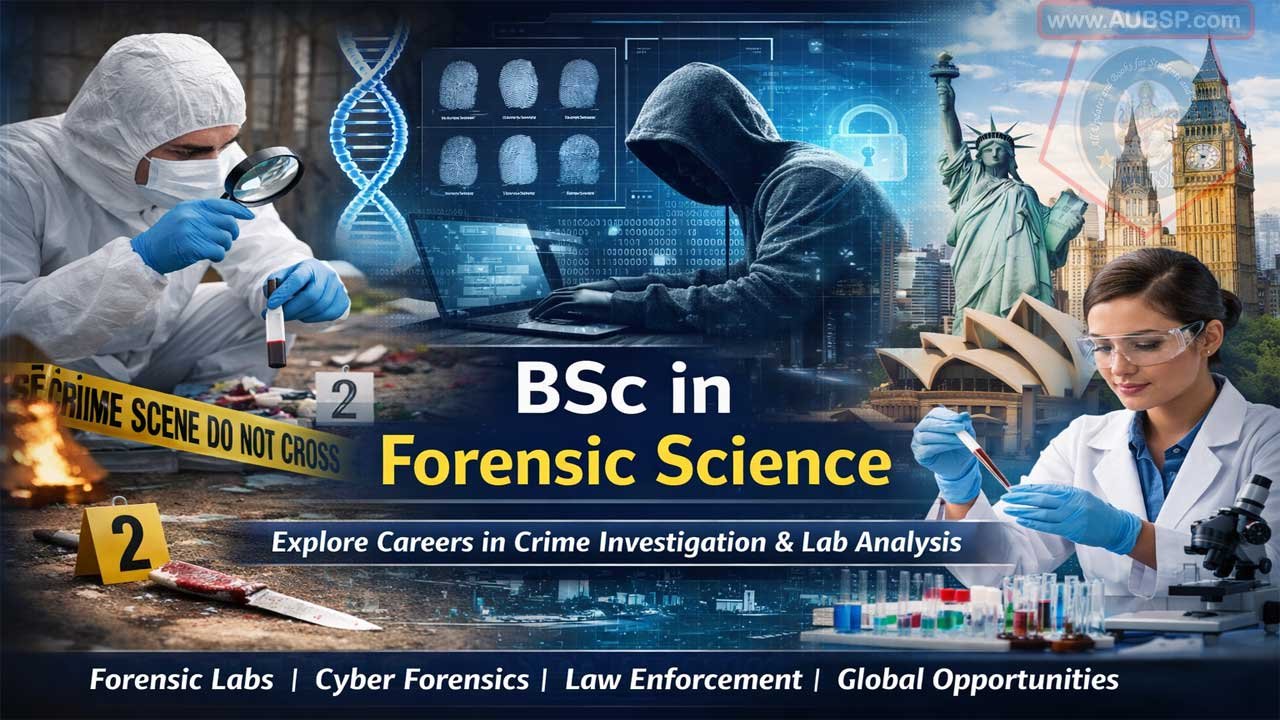
The Bachelor of Science in Forensic Science (BScFS) is a 3–4 year interdisciplinary undergraduate degree that blends science, law, and criminal investigation to prepare students for careers in crime analysis, evidence examination, and justice delivery.
Combining subjects like chemistry, biology, physics, psychology, digital forensics, and criminal law, the program emphasizes hands-on laboratory work, crime scene simulations, and internships, with specialization options such as DNA analysis, toxicology, cyber forensics, ballistics, and anthropology.
Graduates can pursue roles in government forensic labs, law enforcement, intelligence agencies, cybersecurity firms, healthcare, academia, and private investigations, with strong salary potential in India and abroad—especially in high-demand areas like digital forensics. With growing global crime complexity and a projected job growth of over 12%, BScFS offers strong career security, international mobility, and attractive returns on investment, making it a compelling choice for science-oriented students passionate about investigation and justice.
| Aspect | Details |
|---|---|
| Degree | Bachelor of Science in Forensic Science (BScFS) |
| Duration | 3 years (India/UK/Europe), 4 years (USA/Canada) |
| Eligibility | 10+2 with PCM/PCB, 50–60% marks |
| Admission | AIFSET, university entrance test, or merit-based |
| Core Subjects | Forensic Biology, Chemistry, Toxicology, Ballistics, Digital Forensics |
| Specializations | DNA Analysis, Cyber Forensics, Toxicology, Ballistics, Anthropology |
| Practical Training | Labs, mock crime scenes, internships |
| Average Fees (India) | ₹3–4.5 lakhs (total) |
| Average Fees (Abroad) | ₹20–90+ lakhs (total, varies by country) |
| Career Sectors | Govt. Forensic Labs, Police, Cybersecurity, Research, Private Firms |
| Entry Salary (India) | ₹3–5 LPA |
| Entry Salary (Abroad) | $50,000–$70,000 per year |
| Top Countries | India, USA, UK, Canada, Australia |
| Job Growth | ~12.8% (high demand, esp. digital forensics) |
Bachelor of Science in Forensic Science (BScFS): Your Complete Guide to Career, Admission & Global Opportunities
The Bachelor of Science in Forensic Science (BScFS) is a transformative undergraduate degree that bridges the gap between scientific investigation and criminal justice. As cybercrimes surge, the demand for skilled forensic professionals has never been higher. This degree equips students with expertise in analyzing evidence, solving crimes through scientific methods, and supporting the justice system worldwide.
Whether you aspire to work for law enforcement agencies, government forensic laboratories, or international investigative firms, a BScFS degree opens doors to a secure career with competitive compensation. This guide provides aspiring forensic scientists with everything they need to know about admission, career prospects, salary expectations, and international opportunities.
What is a Bachelor of Science in Forensic Science?
A Bachelor of Science in Forensic Science is a specialized undergraduate program that combines theoretical knowledge of physical and biological sciences with practical investigative techniques. The curriculum integrates principles from chemistry, biology, physics, psychology, and criminal law to train students in the examination and analysis of physical evidence from crime scenes.
The program typically lasts 3-4 years depending on the country—3 years in India and Europe, and 4 years in North America. Students gain hands-on experience through laboratory work, mock crime scene simulations, and internships with law enforcement agencies and forensic laboratories.
Key Characteristics
- Interdisciplinary approach: Combines science, law, and criminology
- Practical emphasis: Extensive laboratory and field work
- Industry exposure: Real-world case studies and agency partnerships
- Specialization options: DNA analysis, digital forensics, toxicology, ballistics, and more
- Global recognition: Qualifications are valued across multiple countries
BScFS Eligibility Requirements
Entry Requirements for Bachelor’s Program
| Requirement | Details |
|---|---|
| Educational Qualification | 10+2 (12th Grade) or equivalent |
| Stream | Science stream with Physics, Chemistry, Biology/Mathematics |
| Minimum Marks | 50-60% aggregate (varies by institution) |
| Age Limit | 17-25 years (institution-dependent) |
| International Students | TOEFL 75+ or IELTS 6.5+ for English proficiency |
Eligibility for Master’s Degree
Students wishing to pursue an M.Sc. in Forensic Science must meet these criteria:
- Bachelor’s degree in Forensic Science or related discipline (Biology, Chemistry)
- Minimum 55% aggregate marks
- English language proficiency: TOEFL 80+ or IELTS 6.5+
- Recommendation letters from previous academic supervisors
Entrance Examinations in India
Several universities in India conduct entrance tests for BScFS admission:
- AIFSET (All India Forensic Science Entrance Test): National-level exam with standardized criteria
- Merit-based admission: Some universities waive entrance exams for high-scoring students
- Personal interviews: Mandatory at most institutions to assess aptitude and motivation
BScFS Program Structure & Curriculum
Duration and Course Load
The typical 3-year undergraduate program is divided into 6 semesters, with each semester spanning 4-6 months.
Core Subjects by Semester
| Semester | Core Courses | Focus Area |
|---|---|---|
| 1-2 | Crime Scene Investigation, Forensic Chemistry, Forensic Biology, General Physics, General Chemistry | Foundation & Introduction |
| 3-4 | Forensic Psychology, Forensic Toxicology, Ballistics, Forensic Medicine, Wildlife Forensics | Specialized Analysis |
| 5-6 | Digital Forensics, DNA Fingerprinting, Anthropology, Instrumental Techniques, Cyber Law | Advanced & Emerging Fields |
Specialization Tracks
Most programs allow students to choose specialization areas in final semesters:
- Forensic DNA Analysis: DNA profiling, paternity testing, population genetics
- Toxicology: Drug analysis, alcohol testing, poison identification, pharmaceutical investigation
- Forensic Ballistics: Firearm examination, toolmark analysis, gunshot residue patterns
- Digital/Cyber Forensics: Computer evidence recovery, network analysis, mobile device investigations
- Forensic Anthropology: Skeletal analysis, mass disaster victim identification
- Document Examination: Questioned document analysis, handwriting comparison, forgery detection
Practical Training
Students engage in:
- Laboratory work (40-50% of coursework)
- Mock crime scene investigations with realistic scenarios
- Internships with police departments, forensic labs, and investigating agencies
- Field work under professional supervision
BScFS Program Costs: India vs. Abroad
Cost in India
| University Type | Annual Fee | Total 3-Year Cost |
|---|---|---|
| Government Universities | ₹65,000-₹1,00,000 | ₹1.95-3.00 lakhs |
| Private Universities | ₹1,15,000-₹2,50,000 | ₹3.45-7.50 lakhs |
| Average (All India) | ₹1,00,000-₹1,50,000 | ₹3.00-4.50 lakhs |
Examples:
- Parul University: ₹1,15,000 per annum
- NFSU, Pune: ₹65,000 per semester (government)
- SAM Global University: Competitive rates with placement assistance
Cost in Popular Abroad Countries
| Country | Annual Tuition | Currency | 3-Year Total | Living Costs/Year |
|---|---|---|---|---|
| UK | £17,670 | GBP | £53,010 | £15,000-20,000 |
| USA | $44,850 | USD | $134,550+ | $20,000-35,000 |
| Australia | $30,000-45,000 | AUD | $90,000-135,000 | $25,000-35,000 |
| Canada | $25,000-40,000 | CAD | $75,000-120,000 | $18,000-28,000 |
Key insight: India offers significant cost advantages while maintaining global-standard education quality, making it attractive for budget-conscious international students.
BScFS Career Opportunities & Job Market
Employment Sectors
Forensic science graduates have diverse career pathways across government and private sectors:
Government Agencies
- Central Forensic Science Laboratory (CFSL)
- State Forensic Science Laboratories (SFSL)
- Police departments (crime investigation units)
- Central Bureau of Investigation (CBI)
- National Investigation Agency (NIA)
- Intelligence Bureau (IB)
- Customs and excise departments
Private Sector
- Private detective and investigation agencies
- Insurance companies
- Banks (fraud investigation)
- Hospitals and medical facilities
- Environmental and wildlife conservation agencies
- Cybersecurity firms (digital forensics)
Academic & Research
- Universities (research and teaching)
- PhD programs in specialized forensic disciplines
- Consultancy firms
Top Job Positions & Entry Salary
| Job Title | Entry-Level Salary | Experience (5-8 yrs) | Senior Role |
|---|---|---|---|
| Forensic Scientist | $50,000-60,000 (USA) | $70,000-85,000 | $95,000-115,000+ |
| DNA Analyst | $48,000-55,000 | $70,000-85,000 | $95,000-115,000 |
| Toxicologist | $48,000-55,000 | $65,000-75,000 | $95,000-110,000 |
| Crime Scene Investigator | $42,000-50,000 | $65,000-75,000 | $85,000-95,000 |
| Digital Forensics Analyst | $50,000-60,000 | $70,000-85,000 | $100,000-120,000+ |
India Salary Range (after 3-year experience)
- Entry-level: ₹3-5 lakhs per annum
- Mid-career (5-8 years): ₹6-12 lakhs per annum
- Senior positions: ₹12-20 lakhs per annum
Global Salary Comparison
| Country | Annual Salary Range | Currency |
|---|---|---|
| USA | $60,000-$100,000 | USD |
| United Kingdom | £45,000-£60,000 | GBP |
| Australia | $90,000-$140,000 | AUD |
| Canada | $80,000-$120,000 | CAD |
| Singapore | $80,000-$100,000 | SGD |
| Europe | €55,000-€80,000 | EUR |
| India | ₹4,50,000-₹15,00,000 | INR |
Career growth potential: The forensic science field is projected to grow by 12.8% through 2034, faster than average for all occupations, with particularly strong demand in digital forensics and cybercrime investigation.
Specializations: Which Path Suits You?
1. Forensic DNA Analysis
What it involves: Extracting and analyzing DNA from biological evidence, creating genetic profiles, comparing samples with databases
Skills developed: Molecular biology, statistical analysis, paternity/relationship testing, cold case investigation
Salary expectation: $70,000-$85,000 (entry), $95,000-$115,000 (experienced)
Best for: Those with strong biology background, detail-oriented individuals, people passionate about solving major crimes
2. Forensic Toxicology
What it involves: Analyzing blood, urine, and tissue samples for drugs, alcohol, poisons, and pharmaceuticals
Skills developed: Chemistry proficiency, pharmacology understanding, instrumental analysis, expert report writing
Salary expectation: $70,000-$82,000 (entry), $95,000-$110,000 (experienced)
Best for: Chemistry enthusiasts, pharmaceutical researchers, those interested in drug-related crime investigation
3. Digital/Cyber Forensics
What it involves: Recovering digital evidence from computers, mobile devices, networks; investigating cybercrimes, data breaches, financial fraud
Skills developed: Computer networking, data recovery, cybersecurity fundamentals, mobile device analysis
Salary expectation: $50,000-$60,000 (entry), $70,000-$85,000 mid-career, $100,000-$120,000+ (senior roles)
Best for: Tech-savvy individuals, those interested in IT security, growth-oriented career seekers
Market insight: Digital forensics is the fastest-growing specialization due to rising cybercrime rates and global digital transformation.
4. Forensic Ballistics
What it involves: Analyzing firearms, ammunition, bullet trajectories, gunshot residues, toolmark comparisons
Skills developed: Physics, metallurgy, microscopy, 3D pattern analysis, trajectory calculation
Salary expectation: $60,000-$72,000 (entry), $85,000-$95,000 (experienced)
Best for: Physics-oriented students, those interested in firearm evidence, precision-focused investigators
5. Forensic Anthropology
What it involves: Skeletal analysis, human identification, trauma analysis, mass disaster victim recovery
Skills developed: Human anatomy, bone pathology, archaeological methods, victim identification protocols
Salary expectation: $55,000-$70,000 (entry), $85,000-$95,000 (senior roles)
Best for: Those with anthropology/biology interest, compassionate professionals, field-work enthusiasts
International Study: Top Destinations
Why Study Forensic Science Abroad?
✓ Access to state-of-the-art laboratories and equipment
✓ Exposure to diverse legal systems and investigative practices
✓ Networking with international forensic professionals
✓ Enhanced global job market credentials
✓ Experience with advanced investigative techniques
✓ Higher salary potential in developed countries
Top Countries for BScFS
United Kingdom
- Duration: 3 years
- Top universities: University of Bath, Edinburgh University, Nottingham Trent
- Annual cost: £17,670 (tuition only)
- Graduate salary: £45,000-£60,000
- Visa pathway: Post-study work visa available
United States
- Duration: 4 years
- Top universities: John Jay College, San Francisco State, Towson University
- Annual cost: $44,850+
- Graduate salary: $60,000-$100,000
- Advantages: Widest job market, FBI/DEA opportunities, highest salaries
Australia
- Duration: 3 years
- Strong universities with excellent laboratories
- Annual cost: $30,000-$45,000 AUD
- Graduate salary: $90,000-$140,000 AUD
- Visa benefits: Post-graduation work rights
Canada
- Duration: 3-4 years
- Annual cost: $25,000-$40,000 CAD
- Graduate salary: $80,000-$120,000 CAD
- Pathway to permanent residency available
Admission Process: Step-by-Step
In India
- Check eligibility: 12th pass with 50%+ marks in PCM/PCB stream
- Register for entrance exam: AIFSET, university-specific exams, or merit-based admission
- Appear for written test: Physics, Chemistry, Biology/Mathematics (10+2 level)
- Attend counseling: Based on exam rank or merit
- Personal interview: Assessment of aptitude, communication skills, motivation
- Document verification: Submit mark sheets, certificates, identity proof
- Secure admission: Pay fee, complete enrollment
For International Students
- Research programs: Identify universities and admission requirements
- Prepare standardized tests: GRE (if required), TOEFL/IELTS
- Gather documents: Academic transcripts, recommendation letters, statement of purpose
- Submit applications: Early preparation (12-18 months before enrollment)
- Secure admission letter: Wait for university response
- Apply for student visa: Proof of funds, admission letter, health insurance
- Complete visa process: Pre-arrival and arrival formalities
Required Documents (International)
- Bachelor’s degree transcripts
- TOEFL 80+ or IELTS 6.5+ score
- 2-3 recommendation letters
- Personal statement/statement of purpose
- Valid passport
- Proof of financial resources
- Health insurance certificate
Digital Forensics & Cyber Forensics: The High-Demand Specialization
Digital forensics has become the hottest specialization in forensic science due to the explosion of cybercrime globally.
Why Digital Forensics Matters
Growing threat landscape
- Ransomware attacks targeting organizations
- Cryptocurrency fraud and hacking
- Data breaches and intellectual property theft
- Online financial fraud (credit cards, UPI, e-banking)
- Cybercrime costs to economies: billions annually
Career advantages
- Highest salary growth trajectory
- Global demand across all industries
- Private sector opportunities (higher pay than government)
- Technology sector expansion creating new roles
- Government investments in cybersecurity infrastructure
Skills Required for Digital Forensics
- Computer networks and protocols (TCP/IP, DNS)
- Operating system knowledge (Windows, Linux, macOS)
- Data recovery and evidence preservation
- Encryption and steganography understanding
- Scripting/programming basics
- Chain of custody documentation
- Court-admissible report writing
Salary in Digital Forensics
Digital Forensics Analyst
- Entry-level: $50,000-$60,000 (USA), ₹4-6 lakhs (India)
- Mid-career: $70,000-$85,000 (USA), ₹8-12 lakhs (India)
- Senior specialist: $100,000-$120,000+ (USA), ₹15-25 lakhs+ (India)
Frequently Asked Questions
Q: How long does a BScFS degree take?
A: Typically 3-4 years. India and Europe offer 3-year programs, while North America requires 4 years.
Q: What’s the difference between BScFS and BCJ (Bachelor of Criminal Justice)?
A: BScFS emphasizes scientific methods and laboratory analysis of physical evidence, while BCJ focuses on the criminal justice system, law, and investigation procedures. BScFS graduates typically earn higher salaries due to specialized technical skills.
Q: Can I pursue BScFS with PCM (Physics, Chemistry, Math) instead of Biology?
A: Yes. While Biology is preferred, institutions accept PCM students with strong chemistry and physics backgrounds. Some subjects may require additional foundational courses.
Q: What entrance exams should I attempt?
A: In India, the AIFSET (All India Forensic Science Entrance Test) is the primary exam. Many universities also conduct merit-based admissions or their own entrance tests.
Q: Is a BScFS degree worth the investment?
A: Yes. With job growth of 12.8% and median salaries of $67,440 (USA) or ₹8-12 lakhs (India mid-career), the degree offers solid ROI. International opportunities further increase earning potential.
Q: What’s the best country to study forensic science?
A: USA: Highest salaries, FBI/DEA opportunities. UK: Cost-effective, 3-year program, good employment. Australia: Strong infrastructure, post-graduation work rights. India: Most affordable, growing job market, global recognition.
Q: Can I work while studying?
A: International students typically work 20 hours/week during semesters, full-time during breaks (varies by country regulations). Indian students must check institutional policies.
Q: What’s the job market like for forensic scientists in 2025-2026?
A: Excellent and growing, especially in digital/cyber forensics, DNA analysis, and toxicology. Demand is driven by increasing crime complexity and cybercrime surge.
Conclusion
The Bachelor of Science in Forensic Science represents a compelling career choice for scientifically-minded individuals passionate about justice and investigation. With job market growth of 12.8% projected through 2034, competitive global salaries ranging from ₹8-12 lakhs (India) to $100,000+ (USA), and diverse specialization options, BScFS graduates enjoy exceptional career security and earning potential.
Whether you choose to study in India at an affordable cost or pursue your degree internationally for advanced exposure, the forensic science field is experiencing unprecedented demand. The surge in cybercrime, evolving investigative technologies, and the judiciary’s dependence on expert evidence ensure continuous growth in this dynamic profession.
Start your journey today—research universities, prepare for entrance exams, and position yourself for a rewarding career solving crimes and seeking justice on a global stage.


Leave a Reply
You must be logged in to post a comment.