
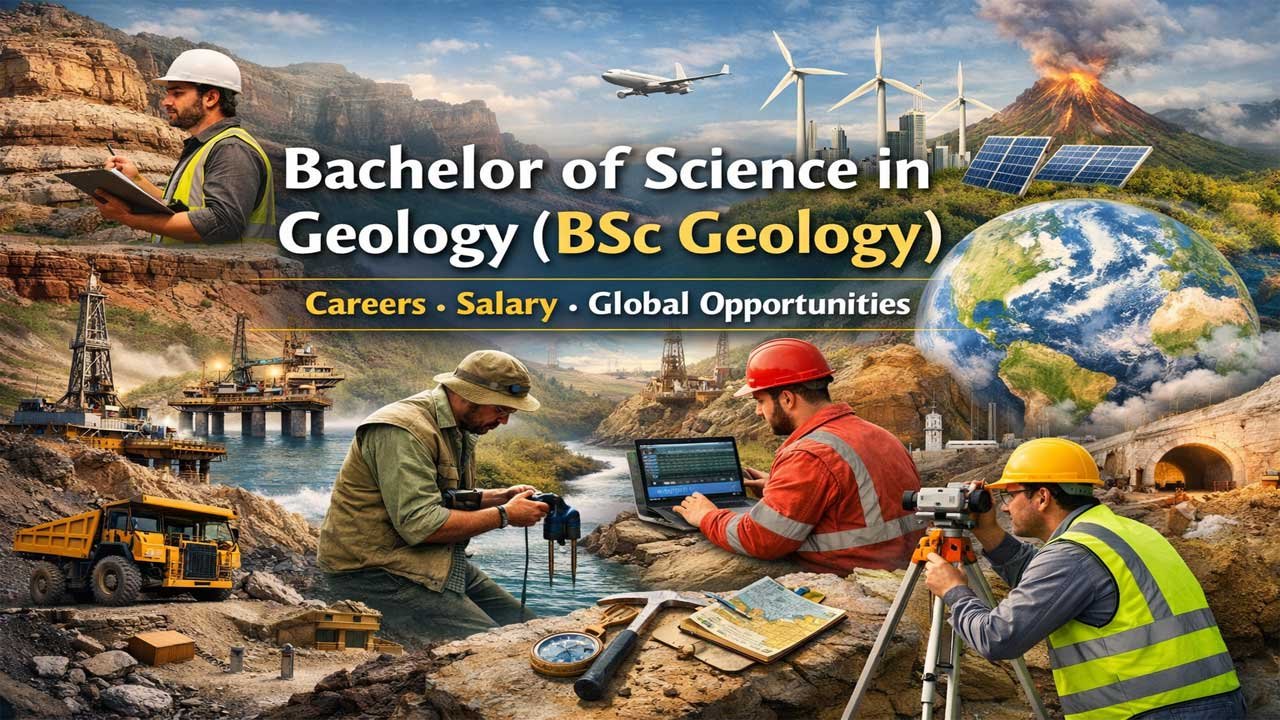
A Bachelor of Science in Geology (BSc Geo) is an undergraduate degree that studies the Earth, its materials, processes, and resources, and it offers strong career opportunities worldwide.
The course usually lasts three years (or four years for honours) and includes classroom learning, lab work, and fieldwork, covering subjects like minerals, rocks, water resources, environmental geology, and GIS. Geology graduates are in demand due to needs in environmental protection, renewable energy, mining, water management, and infrastructure development, with good job growth and competitive salaries in India and abroad.
Careers include environmental geologist, hydrogeologist, mining geologist, petroleum geologist, GIS specialist, and engineering geologist, with higher pay and better roles often available after a master’s degree. Studying geology abroad can boost global job prospects, and skills like GIS, remote sensing, and data analysis are especially important. Overall, BSc Geology is a good choice for students interested in science, fieldwork, and solving real-world problems related to resources, climate, and sustainability.
| Aspect | Information |
|---|---|
| Degree Name | Bachelor of Science in Geology (BSc Geology / BSc Geo) |
| Duration | 3 years (4 years for Honours in some countries) |
| Eligibility | Class 12 (Science stream) with Physics, Chemistry, Biology |
| Admission Process | Merit-based or Entrance Exams (CUET, AMU, IISER, etc.) |
| Core Subjects | Mineralogy, Petrology, Structural Geology, Hydrogeology, GIS |
| Practical Training | Fieldwork, laboratory analysis, geological mapping |
| Top Career Options | Environmental Geologist, Mining Geologist, Hydrogeologist, Petroleum Geologist, GIS Specialist |
| Average Salary (India) | ₹5.5 – 13 LPA (higher with experience & MSc) |
| Average Salary (Abroad) | $55,000 – $120,000+ per year |
| Higher Studies | MSc Geology, Geophysics, Hydrogeology, Environmental Geology |
| Key Skills Required | Field mapping, GIS & Remote Sensing, data analysis |
| Global Job Markets | USA, Canada, Australia, UK, Middle East |
| Future Growth Areas | Renewable energy, climate change, water resources |
| Best For Students Who | Enjoy science, outdoor work, and problem-solving |
Bachelor of Science in Geology (BScGeo): Complete Guide to Career, Salary & Global Opportunities
The Bachelor of Science in Geology (BScGeo) has emerged as one of the most dynamic and lucrative undergraduate degrees in the 21st century. As global industries increasingly focus on sustainable resource management, climate change adaptation, and renewable energy transition, geology graduates find themselves in unprecedented demand across multinational corporations, government agencies, and research institutions worldwide.
This comprehensive guide covers everything you need to know about pursuing a geology degree—from admission requirements and program structure to international career prospects and earning potential. Whether you’re considering geology as your undergraduate major or exploring educational options across different countries, this article provides evidence-based insights to guide your decision.
What is Bachelor of Science in Geology?
Program Overview
The Bachelor of Science in Geology is a three-year undergraduate degree program designed to equip students with specialized knowledge of Earth’s structure, composition, mineral systems, and geological processes. The program combines theoretical learning with extensive practical fieldwork, laboratory analysis, and hands-on research experiences that prepare graduates for immediate employment or advanced studies.
The typical BScGeo curriculum is divided into six semesters and covers core subjects including Earth System Science, Mineral Science, Structural Geology, Geochemistry, Petrology, Paleontology, and Hydrogeology. Most universities also offer an advanced four-year B.Sc. (Honours) variant aligned with modern educational standards, featuring research-oriented coursework and deeper specialization opportunities.
Program Structure & Duration
The standard three-year BScGeo program follows a semester-based structure:
| Semester | Core Subjects | Practical Components |
|---|---|---|
| Semester I | Earth System Science, Mineral Science, Communicative English | Field observations, mineral identification |
| Semester II | Structural Geology, Geochemistry, Environmental Science | Structural analysis, mapping exercises |
| Semester III | Igneous Petrology, Sedimentary Petrology, Paleontology | Rock classification, fossil analysis |
| Semester IV | Metamorphic Petrology, Hydrogeology, Stratigraphy | Advanced fieldwork, water resource surveys |
| Semester V | Economic Geology, Geomorphology, Discipline-Specific Electives | Mineral deposit studies, landscape analysis |
| Semester VI | Engineering Geology, Remote Sensing & GIS, Capstone Project | Digital mapping, comprehensive research project |
The four-year honours variant adds advanced modules in specialization areas, research methodology, and independent thesis work, making graduates particularly attractive to employers and graduate programs globally.
Global University Rankings & Top Institutions
Best Universities for Geology Worldwide
The choice of institution significantly impacts your career trajectory, network, and earning potential. Here are the world’s leading geology programs:
Europe
- University of Cambridge (UK) – Acceptance rate: 21%
- University of Oxford (UK) – Acceptance rate: 22%
- Imperial College London (UK) – Highly specialized geology research
- ETH Zurich (Switzerland) – Acceptance rate: 8%, world-class Alpine geology research
- University of Leeds (UK) – Renowned for geological field programs
- University of Manchester (UK) – Strong environmental and hydrogeology focus
United States
- California Institute of Technology (Caltech) – Established 1891, world-class geophysics and tectonics
- University of California, Berkeley – #1 ranked geology program in US
- Stanford University – Leading geoscience research
- University of Texas at Austin – Strong in petroleum and hydrogeology
- Colorado School of Mines – Ranked #8 for geology, #5 for geophysics in US
Australia
- University of Melbourne – Consistently ranked top 10 globally
- Curtin University – Strong mining geology and field-based programs
- Australian National University – Excellence in paleontology and tectonics
Canada
- University of British Columbia – Ranked top 3 in Canada
- University of Toronto – Comprehensive geoscience programs
- McGill University – 30% international students, strong research opportunities
- University of Alberta – Excellent petroleum geology and mineral resources programs
India
- Banaras Hindu University (BHU)
- Delhi University – Department of Geology
- Indian School of Mines, Dhanbad
- Parul University – Modern facilities and industry collaboration
- University of Rajasthan
Admission Requirements & Eligibility
Prerequisites for BScGeo Programs
In India:
- Completion of Class 12 (Higher Secondary) from a recognized board
- Science stream with Physics, Chemistry, and Biology (PCB)
- Minimum 60% marks across subjects
- Entrance exams: CUET (Common University Entrance Test), AMU Entrance, PUBDET, IISER Entrance
- Age requirement: Usually 17-18 years at time of admission
International (UK/Europe/US):
- A-level qualifications (AAA minimum) or International Baccalaureate (39+ points)
- Strong performance in Chemistry, Physics, and Biology
- IELTS 6.5+ or equivalent English proficiency for international students
- Some universities require interviews or geology aptitude assessments
- Application deadline: Usually 15 October for UK universities
Australia & Canada:
- High school diploma or equivalent
- Prerequisite subjects: Chemistry, Physics, Biology/Environmental Science
- English language requirements for non-native speakers
- IELTS 6.0-7.0 depending on institution
- Application through centralized systems (UCAS, Common App, etc.)
Program Fees & Cost of Study
Tuition & Total Cost Analysis
| Country/Institution Type | Annual Tuition | 3-Year Total | Additional Costs |
|---|---|---|---|
| India (Government) | ₹50,000-2,00,000 | ₹1.5-6 Lakh | ₹50,000 (fieldwork, lab materials) |
| India (Private) | ₹3-10 Lakh | ₹9-30 Lakh | ₹1-2 Lakh (additional labs) |
| India (Distance Education) | ₹7,700-6,16,000 | ₹23,000-18.5 Lakh | Minimal (online delivery) |
| UK Universities | £9,250-12,000 | £27,750-36,000 | £5,000-8,000 (labs, fieldwork) |
| USA Universities | $40,000-60,000 | $120,000-180,000 | $10,000-15,000 (research, travel) |
| Australia | AUD $15,000-25,000 | AUD $45,000-75,000 | AUD $5,000-10,000 (fieldwork) |
| Canada | CAD $15,000-25,000 | CAD $45,000-75,000 | CAD $3,000-7,000 (equipment) |
Cost-Benefit Analysis: While international programs require higher upfront investment, graduates from Tier-1 universities (Cambridge, MIT-affiliated, Australian Group of Eight) command salary premiums of 30-50% compared to regional institutions, often recovering their investment within 3-5 years.
Career Opportunities & Salary Expectations
Market Demand & Job Growth
The global geology job market is experiencing robust growth driven by:
- 7% employment growth through 2030, with 3,100+ new positions annually
- Environmental regulations driving demand for contamination specialists
- Renewable energy transition requiring geological expertise for geothermal and wind site assessment
- Mining companies seeking advanced exploration geologists
- Government agencies expanding environmental and hazard assessment roles
Top Career Paths for Geology Graduates
1. Petroleum Geologist
Average Salary: $92,000-$150,000+ USD (entry-level bachelor’s to experienced professional)
Petroleum geologists assess subsurface geology to identify viable oil and gas reserves. Entry-level geologists earn approximately $62,000-$92,000, while experienced professionals in high-demand regions (Middle East, Texas, Alaska) command six-figure salaries. Those with advanced degrees or specialized expertise in deep-water or unconventional resource exploration earn significantly more.
Key Markets: Saudi Arabia, UAE, Norway, Canada, USA, Australia
2. Environmental Geologist
Average Salary: $50,130-$134,830+ USD (by experience level)
- Entry-level (10th percentile): $50,130
- Early career (25th percentile): $62,090
- Mid-career median: $76,530
- Senior level (90th percentile): $134,830+
Employment projected to grow 6% through 2032 with 6,900 annual job openings. Environmental geologists assess contaminated sites, design remediation strategies, and manage waste disposal operations. The field is experiencing steady demand as communities prioritize environmental protection and climate adaptation.
3. Mining Geologist
Average Salary: $70,000-$120,000 USD (varies by commodity and location)
Mining geologists conduct exploration surveys, determine ore quality and deposit size, and plan extraction strategies. The capital-intensive nature of mining projects means accurate geological assessments directly impact project profitability, enabling experienced geologists to command premium compensation, particularly in remote or high-risk locations.
4. Engineering Geologist
Average Salary: $65,000-$110,000 USD
Engineering geologists assess subsurface conditions for civil infrastructure projects (dams, tunnels, highways, buildings). Specialization in high-risk environments (seismic zones, subsidence areas) commands higher salaries due to critical safety implications.
5. Hydrogeologist
Average Salary: $60,000-$105,000 USD
Hydrogeologists specialize in groundwater systems, water resource management, and aquifer assessment. With global water scarcity concerns, demand for hydrogeology expertise is rising steadily, particularly in water-stressed regions.
6. Geophysicist
Average Salary: $80,000-$140,000+ USD (especially in petroleum exploration)
Geophysicists employ physical principles and advanced technology to study Earth’s structure. The field demands strong physics and mathematics backgrounds. Colorado School of Mines’ Geophysics program is ranked #5 in the US, reflecting high employer demand.
7. Remote Sensing & GIS Specialist
Average Salary: $55,000-$95,000 USD
These professionals leverage satellite imagery, LiDAR, and geographic information systems for geological mapping, mineral exploration, hazard assessment, and environmental monitoring. The rapidly expanding applications of spatial technology create strong job security and advancement potential.
Emerging & High-Growth Career Sectors
Renewable Energy & Climate Transition
As global energy systems shift toward renewables, geologists with expertise in:
- Geothermal energy assessment – evaluating subsurface heat resources for direct use and electricity generation
- Wind farm site geology – assessing ground stability and foundation conditions for turbines
- Solar farm development – soil and rock stability analysis for utility-scale installations
- Mineral extraction for batteries – lithium, cobalt, and other battery metal exploration
Professionals in these areas earn $70,000-$120,000+ USD and benefit from the fastest-growing energy sector globally.
Climate Change & Natural Hazard Mitigation
- Geological hazard assessment – earthquake risk mapping, landslide prediction, volcanic hazard assessment
- Climate adaptation consulting – coastal erosion mitigation, glacial lake outburst flood (GLOF) prevention, permafrost stability
- Carbon capture & storage (CCS) – assessing geological formations for permanent CO₂ sequestration
Average salary: $75,000-$125,000 USD; employment growth: 8-10% annually.
Master’s Degree & Career Advancement
Why Pursue an M.Sc. in Geology?
A master’s degree fundamentally transforms career prospects and earning potential:
- Salary Premium: Master’s holders earn 20-35% more than bachelor’s graduates
- Starting Salary (M.Sc.): $100,000-$110,000 USD (petroleum geologists reach $103,800+)
- Career Trajectories: Access to research positions, senior technical roles, management opportunities
- Job Market Position: Master’s degree holders face 35% job growth projection (nearly 3x average)
Master’s programs typically require 2 years and offer specializations including:
| Specialization | Focus Areas | Career Path |
|---|---|---|
| Hydrogeology | Groundwater systems, water resource management, contaminant transport | Environmental consulting, water agencies, mining |
| Geophysics | Seismic analysis, gravity mapping, electromagnetic surveys | Oil/gas exploration, earthquake research, infrastructure |
| Environmental Geology | Contamination remediation, hazard assessment, site rehabilitation | Environmental firms, government agencies, consulting |
| Petroleum Geology | Reservoir characterization, exploration strategy, prospect evaluation | Oil/gas industry, exploration companies |
| Economic Geology | Mineral deposit analysis, ore genesis, mining optimization | Mining companies, exploration firms, resource assessment |
| GIS & Geoinformatics | Spatial data analysis, remote sensing, geological mapping | Tech companies, government, consulting, research |
Top Master’s Programs Globally
- Colorado School of Mines (USA) – Ranked #8 geology, #5 geophysics, #13 geochemistry in US
- University of Cambridge (UK) – Internationally recognized research degree
- University of Melbourne (Australia) – Strong applied geology focus
- University of British Columbia (Canada) – Excellent hydrogeology and environmental specialization
- ETH Zurich (Switzerland) – World-leading geophysics and tectonics
Essential Skills & Technical Competencies
Core Professional Skills
Modern geology graduates must develop competency in several interconnected skill areas:
1. Field Geology & Mapping
- Geological field surveying and rock/mineral identification
- Stratigraphic analysis and cross-section interpretation
- Structural geology mapping including fault and fold analysis
- Field equipment operation (GPS, compass clinometer, pH meters, spectroscopy tools)
2. Geochemistry & Laboratory Analysis
- Mineral and rock sample preparation and analysis
- X-ray diffraction (XRD) and X-ray fluorescence (XRF) techniques
- Isotopic analysis for dating and tracing geological processes
- Water quality and contamination analysis
3. GIS & Remote Sensing Technology
Critical for career competitiveness. Employers consistently prioritize these skills:
- ArcGIS and QGIS proficiency for geological mapping and spatial analysis
- Satellite imagery interpretation (Landsat, Sentinel, MODIS data)
- LiDAR data processing for topographic and structural analysis
- Hyperspectral imaging for mineral identification
- SAR (Synthetic Aperture Radar) for displacement and deformation monitoring
Certifications that enhance employability:
- Esri Technical Certifications (ArcGIS Desktop, Online)
- Google Earth Engine certification
- Remote Sensing/GIS professional credentials (Esri Associate/Professional)
4. Data Analysis & Programming
- Python and R for geological data processing
- Statistical analysis and uncertainty quantification
- Geostatistics for reserve estimation (kriging methods)
- Numerical modeling software (COMSOL, FLAC, similar)
5. Professional Communication
- Technical report writing for government and industry stakeholders
- Geological map and cross-section interpretation
- Scientific presentation skills for conferences and peer review
- Stakeholder communication for environmental impact assessments
6. Professional Certifications
- Professional Geologist (PG) Licensure – Required in many regions for independent practice; requires degree + supervised work experience + examination
- OSHA HAZWOPER Training – Essential for contamination site work
- GIS Professional Credentials – Demonstrates advanced technical competency
- AIPG Membership & Certifications – American Institute of Professional Geologists credentialing
International Study Options & Visa Pathways
Benefits of Studying Geology Abroad
Career Advantages:
- Graduates from Tier-1 institutions (Cambridge, Stanford, University of Melbourne) command 30-50% salary premiums
- International qualifications improve job prospects in multinational companies
- Expanded professional networks across countries facilitate global career mobility
- Exposure to different geological settings enhances practical knowledge
Scholarship & Funding Options:
- UK Government FCDO Scholarships
- Erasmus Mundus Joint Masters (Europe)
- Australia Awards Scholarships (fully funded for developing countries)
- Canada-based scholarships through MITACS, NSERC programs
- University-specific merit scholarships (Cambridge, Stanford, Australian universities offer substantial aid)
Visa & Post-Study Work Pathways:
- UK: Graduate visa allows 2 years’ work post-graduation (recently extended from 6 months)
- Australia: Post-study work visa up to 3-4 years depending on qualifications and regional demand
- Canada: Post-graduation work permit up to 3 years, leading to permanent residency pathway
- USA: Optional Practical Training (OPT) allows 1-3 years post-graduation depending on STEM classification
- EU: Work permits available; EU citizens have unrestricted mobility
Study Options in India for International Students
Several Indian institutions welcome international students:
- Banaras Hindu University – UG & PG programs
- Delhi University – Competitive admission, strong faculty
- Indian School of Mines, Dhanbad – Leading mining geology programs
- Parul University – Modern labs, industry connections, scholarship support
- University of Rajasthan – Affordable tuition, quality education
Advantages:
- Cost (typically ₹3-10 Lakh annually)
- Strong geology programs
- Diverse geological settings for fieldwork
- Gateway to Asian employment markets
Industry Sectors Employing Geology Graduates
Primary Employment Sectors
| Sector | Job Roles | Growth Rate | Geographic Hotspots |
|---|---|---|---|
| Oil & Gas Exploration | Petroleum geologist, subsurface analyst, reservoir engineer | 5-7% | Middle East, North America, West Africa, SE Asia |
| Mining & Minerals | Exploration geologist, mine geologist, resource estimator | 4-6% | Australia, Canada, Chile, Peru, Indonesia, Africa |
| Environmental Consulting | Environmental geologist, contamination specialist, site assessor | 6-8% | North America, Western Europe, Australia |
| Government Agencies | USGS, EPA, state geological surveys, mining boards | 3-5% | USA, UK, Canada, Australia, India |
| Water Resource Management | Hydrogeologist, water resource engineer, groundwater modeler | 6-8% | Water-stressed regions: Middle East, South Asia, California |
| Engineering & Infrastructure | Engineering geologist, foundation engineer, geotechnical consultant | 5-7% | Developing infrastructure: Southeast Asia, Africa, India |
| Renewable Energy | Geothermal specialist, site geologist, resource assessor | 10-15%* | Global, especially: Iceland, New Zealand, Philippines, USA, East Africa |
| Research & Academia | Research geologist, university lecturer, scientific researcher | 2-4% | Major universities globally |
*Fastest-growing sector driven by global energy transition
Geographic Salary Variations
Salary expectations vary significantly by region, reflecting economic development, resource abundance, and cost of living:
| Region | Entry-Level | Mid-Career | Senior | Cost of Living Factor |
|---|---|---|---|---|
| USA | $55,000-75,000 | $85,000-120,000 | $120,000-200,000+ | High (expensive metros) |
| UK | £28,000-35,000 | £45,000-70,000 | £70,000-120,000 | High (London & South) |
| Canada | CAD $55,000-70,000 | CAD $80,000-110,000 | CAD $110,000-180,000 | Moderate-High |
| Australia | AUD $60,000-75,000 | AUD $90,000-130,000 | AUD $130,000-200,000+ | High (Sydney, Melbourne) |
| India | ₹5.5-8 Lakh | ₹10-15 Lakh | ₹15-25 Lakh+ | Low-Moderate |
| Middle East | $80,000-120,000 | $120,000-180,000 | $150,000-300,000+ | High, but higher salaries |
Key Insight: While salaries vary, petroleum geologists in the Middle East, experienced engineers in Australia’s mining sector, and senior environmental consultants in North America command the highest absolute salaries globally, offset by higher living costs in developed nations.
Online Learning & Continuous Skill Development
Distance Education Programs
For working professionals or those unable to relocate:
| Institution | Program | Duration | Cost | Industry Recognition |
|---|---|---|---|---|
| Ambedkar Open University, India | B.Sc. Geology (Distance) | 3 years | ₹7,700 | UGC-approved in India |
| IMTS Institute, India | B.Sc. Geology (Online) | 3 years | ₹60,000-80,000 | Flexible, working professionals |
| University of London (International) | Geology programs (online) | Flexible | £5,000-12,000 | University of London credentials |
| Colorado School of Mines | M.Sc. GIS & Geoinformatics (online) | 2 years | $40,000-50,000 | Top-ranked, industry-recognized |
MOOCs & Professional Certifications
Supplement formal education with affordable online courses:
Free/Low-Cost Platforms:
- Coursera: Geology, GIS, remote sensing courses (university-level quality, certificates: $30-50)
- FutureLearn: Introductory and specialized geology courses (free auditing, certificate: £20-30)
- Geological Survey of India (GSI) Training Institute: Free basic courses in remote sensing, geomorphology, gravity exploration
- USGS (United States Geological Survey): Free learning modules and datasets
Premium Certifications (High ROI):
- Esri GIS Certifications: $300-500, dramatically improves employment prospects
- Google Earth Engine Certification: Free training, essential for remote sensing career
- AIPG Professional Geologist (PG): $500-1,000 registration, required for independent practice in most US states
Strategic Approach: Pursue GIS/Remote Sensing certifications while completing your degree—employers prioritize candidates with demonstrated technical competency in these high-demand areas.
Entrance Exams & Preparation Strategy
Major Entrance Examinations
In India:
- CUET (Common University Entrance Test): Competitive national exam for central universities; covers General Test + domain-specific subjects
- AMU Entrance (Aligarh Muslim University): Strong geology program, entrance exam, fellowship opportunities
- IISER Entrance: Indian Institutes of Science Education and Research; highly competitive, excellent research opportunities
- PUBDET: Punjab University Board entrance
Preparation Tips:
- Mock tests (solve 20+ previous years’ papers)
- Coaching institutes for targeted guidance (3-6 months)
- Self-study: Focus on NCERT chemistry, physics, biology basics plus advanced ecology/earth science topics
- Score target: 85th percentile minimum for top central universities
Internationally:
- A-levels (UK/Commonwealth): Standard high school qualification; geology optional, but chemistry/physics essential
- IB Diploma (International): 38+ points for competitive universities; no geology requirement but science background essential
- SAT/ACT (USA): Generally 1450+ SAT or 33+ ACT for top-50 universities
- IELTS: 6.5+ for UK, 6.0+ for Australia/Canada (international students)
Challenges & Considerations
Realistic Assessment Before Choosing Geology
Challenges You Should Know:
- Fieldwork demands: 25-40% of coursework involves outdoor field seasons; physically demanding, remote locations
- Job market cyclicality: Petroleum geology and mining are commodity-dependent; layoffs occur during price downturns
- Climate resilience: Physical work in extreme climates (Arctic, desert, tropical rainforests)
- Master’s degree often necessary: Entry-level positions with bachelor’s degree limited; career advancement requires M.Sc. or M.Tech.
- Geographic flexibility required: Best opportunities often in remote or developing regions (international mobility essential)
Solutions:
- Seek internships early to assess fieldwork suitability
- Develop complementary tech skills (GIS, programming) for office-based roles
- Consider environmental/engineering specialization for more stable employment
- Target renewable energy sector for future-proof career growth
Frequently Asked Questions
Q1: Is geology a good career choice in 2026?
A: Yes, with important caveats. Overall geology job growth (7% through 2030) exceeds average job growth. However, opportunities concentrate in specific sectors: environmental geology (6% growth), renewable energy (10-15% growth), and geotechnical engineering (5-7% growth).
Petroleum geology faces long-term headwinds due to energy transition. Master’s degree holders experience 35% projected job growth—nearly 3x overall average. Strategic specialization in high-growth areas (renewable energy, environmental remediation, hydrogeology) ensures strong employment prospects.
Q2: Can I work internationally with an Indian B.Sc. Geology degree?
A: Yes, but strategically. Indian geology degrees from recognized universities (Delhi University, Banaras Hindu University, Indian School of Mines) are accepted globally, but:
- Multinational companies often prefer master’s degrees for sponsorship
- Professional licensure (like Professional Geologist credentials) may require additional examination
- English proficiency (IELTS 6.5+) essential for international roles
- Recommendation: Pursue master’s degree in developed country (UK, Canada, Australia) to establish international credentials and secure visa sponsorship for work.
Q3: What’s the best country to study geology abroad?
A: Decision depends on priorities:
- Career prospects: UK (Cambridge, Oxford, Imperial), Australia (Group of Eight universities), USA (Caltech, Berkeley, Stanford)
- Cost-effectiveness: Canada (good quality + reasonable costs + post-study work visas), Australia (post-study work up to 4 years)
- Field-based training: Australia (diverse geological environments), USA (varied landscapes), Switzerland (Alpine geology)
- Research opportunities: ETH Zurich, University of Cambridge, MIT-affiliated programs
- Visa pathway to permanent residency: Canada (2-year work permit → permanent residency accessible) and Australia (3-4 year work visa)
Q4: How important are GIS and remote sensing skills?
A: Critically important. Employers consistently rank GIS/remote sensing as top-3 required technical skill for 60%+ of geology positions. Candidates with these certifications command 15-25% salary premiums. Strategic approach: Obtain ArcGIS or Google Earth Engine certification during undergraduate studies—dramatically improves internship and entry-level job prospects.
Q5: What’s the job market like for environmental geologists?
A: Strong and growing. Environmental geology positions are projected to grow 6% through 2032 with ~6,900 annual openings. Median salary $76,530 (well above average), with experienced professionals earning $103,000-$135,000+. Growth drivers include aging infrastructure requiring environmental assessment, regulatory expansion, contamination cleanup demand, and climate adaptation projects. Environmental geology is one of the most recession-resistant geology specializations.
Conclusion: Is a BScGeo Degree Right for You?
The Bachelor of Science in Geology offers genuine value for motivated students willing to commit to technical skill development and international career mobility. The field provides:
- ✅ Strong Employment Prospects: 7% job growth, significantly above average
- ✅ Competitive Compensation: Entry-level $55,000-75,000 USD (India ₹5.5-13 LPA); experienced professionals $100,000-200,000+ USD
- ✅ Career Flexibility: Diverse sectors (oil/gas, mining, environmental, renewable energy, government, research)
- ✅ International Opportunities: Global demand for geologists, visa pathways to permanent residency in developed countries
- ✅ Future-Proof Specializations: Renewable energy, climate adaptation, water resources—aligned with global megatrends
Critical Success Factors:
- Develop GIS/remote sensing expertise early (certifications during undergrad)
- Pursue internships in your specialty (directly correlates to first job placement)
- Consider master’s degree for career advancement and higher earning potential
- Build international credentials through study abroad or recognized institutions
- Stay adaptable as energy sector transitions; hydrogeology, environmental geology, and geothermal specializations offer best long-term stability
Final Recommendation: A BScGeo degree combined with technical skills (GIS, programming), professional certifications, and strategic career planning positions graduates for lucrative, meaningful careers contributing to global challenges of sustainable resource management, climate adaptation, and environmental protection.
The next decade belongs to geologists who embrace technology, adapt to changing market needs, and leverage the global mobility that a geology degree provides. If you’re analytically minded, enjoy problem-solving, and want a career with genuine impact, geology deserves serious consideration.


Leave a Reply
You must be logged in to post a comment.