
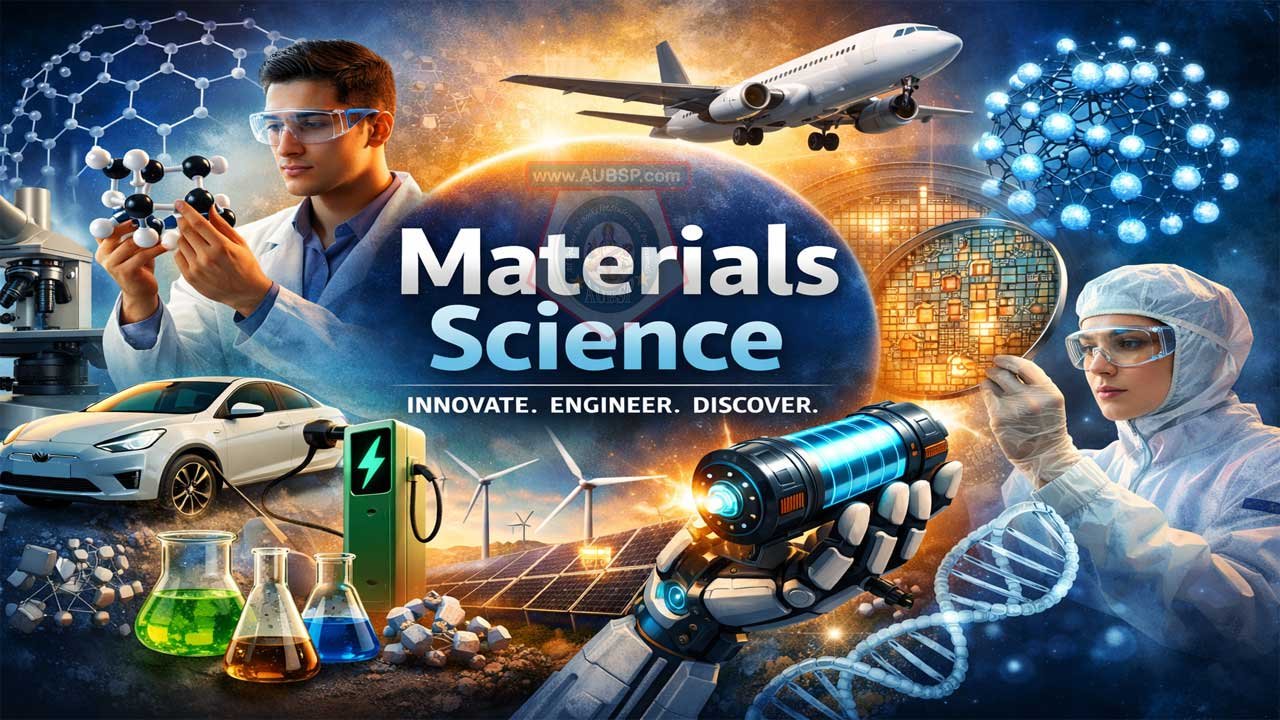
The Bachelor of Science in Materials Science (BScMatSci) is a highly interdisciplinary and future-focused undergraduate degree that blends physics, chemistry, and engineering to understand, design, and optimize materials used across virtually all modern industries, from batteries, semiconductors, and aerospace composites to biomaterials and sustainable polymers.
Typically lasting 3–4 years, the program combines strong foundations in math and science with core materials subjects, specializations, hands-on labs, internships, and a major research project, leading to strong global employability, above-average salary prospects, and career flexibility across engineering, R&D, manufacturing, data science, sustainability, and business roles.
Driven by megatrends such as electrification, clean energy, advanced manufacturing, AI-driven materials discovery, and healthcare innovation, demand for materials scientists is growing worldwide, making BScMatSci a strategically valuable degree in 2026 and beyond for students seeking long-term relevance, global mobility, and the chance to shape the technologies that define the 21st century.
| Category | Information |
|---|---|
| Degree Name | Bachelor of Science in Materials Science (BScMatSci) |
| Duration | 3–4 years |
| Core Disciplines | Physics, Chemistry, Engineering, Mathematics |
| Main Focus | Understanding, designing, and optimizing materials |
| Materials Covered | Metals, polymers, ceramics, composites, semiconductors, biomaterials, nanomaterials |
| Common Specializations | Energy materials, biomaterials, polymers, composites, nanotechnology, sustainability |
| Entry Requirements | Strong background in Mathematics + Physics/Chemistry |
| Practical Experience | Labs, industrial internships, final-year research project |
| Top Industries | Aerospace, automotive, energy, electronics, medical devices, manufacturing |
| Typical Roles | Materials Engineer, R&D Scientist, Battery Engineer, Process Engineer |
| Global Demand | High and growing due to EVs, clean energy, semiconductors, AI |
| Entry-Level Salary (Global Avg.) | ~$60,000–$75,000 equivalent |
| Career Progression | Strong salary growth; leadership and specialist roles available |
| Further Study Options | Master’s, PhD, professional certification (e.g., CEng, IOM3) |
| Career Flexibility | High – transferable to tech, data, consulting, IP, and finance |
Bachelor of Science in Materials Science (BScMatSci): Complete Guide 2026
The Bachelor of Science in Materials Science (BScMatSci) represents one of the most strategically positioned undergraduate degrees in today’s economy. As industries worldwide confront unprecedented demands for innovation in battery technology, sustainable manufacturing, aerospace composites, and biomedical devices, materials scientists have become essential architects of technological progress.
This comprehensive AUBSP guide explores every dimension of a BScMatSci degree—from program structure and global career opportunities to salary outcomes, industry demand, and the emerging specializations shaping the field’s future.
What Is Materials Science and Engineering?
Materials science and engineering is an interdisciplinary field that combines principles from physics, chemistry, and engineering to understand, improve, and create new materials. The discipline sits at the intersection of fundamental science and practical application, addressing how processing, structure, and composition influence material properties and performance in real-world applications.
Unlike traditional chemistry or physics degrees, materials science takes a systems approach: understanding why materials behave as they do, predicting how they’ll perform under stress or environmental conditions, and designing entirely new materials with tailored properties. This practical orientation—coupled with deep scientific rigor—makes BScMatSci graduates exceptionally valuable across industrial sectors.
Materials engineers work with diverse classes of materials: metals and alloys, ceramics and glasses, polymers and plastics, composites, semiconductors, nanomaterials, and increasingly, biomaterials and smart materials. The field encompasses graphene research, advanced battery chemistry, lightweight aerospace alloys, biocompatible implants, sustainable packaging solutions, and self-healing polymers.
BScMatSci Program Structure and Curriculum
Duration and Credit Framework
A typical BScMatSci program spans three to four years, with 180-240 credit hours depending on the institution and country. The curriculum divides into distinct phases: foundational sciences, core materials science, specialization modules, and applied research projects.
Foundation Phase (Years 1-2):
- Mathematics: Calculus, linear algebra, differential equations
- Physics: Classical mechanics, thermodynamics, quantum mechanics, material properties
- Chemistry: Inorganic chemistry, organic chemistry, physical chemistry
- Engineering Fundamentals: Technical mechanics, materials characterization, scientific methodology
Core Materials Science Phase (Years 2-3):
- Metals and Alloys: Ferrous metallurgy, non-ferrous metals, phase diagrams, crystallography
- Polymers: Polymerization reactions, polymer structure-property relationships, processing techniques
- Ceramics and Glasses: Crystal structures, sintering, mechanical properties, applications
- Composites: Fiber-reinforced polymers, matrix materials, composite manufacturing, failure analysis
- Electronic and Energy Materials: Semiconductors, battery materials, photovoltaic materials, superconductors
- Nanomaterials: Carbon nanotubes, graphene, nanoparticles, characterization techniques
Specialization and Research (Year 3-4):
Students typically select 2-4 core subject specializations from nine available areas: general materials properties, metals engineering, glass and ceramics, surface science and corrosion, polymer materials, electronics and energy technology, biomaterials, materials simulation, and micro/nanostructure research.
The final year culminates in a substantial research project—typically 20-30 weeks—conducted within university research groups or industry partnerships. Students design experiments, conduct materials testing, analyze data, and present findings. This immersive research experience develops independent thinking and provides direct exposure to the scientific method in action.
Specialization Tracks and Emerging Focus Areas
Traditional Specializations:
- Metallurgy and Alloys: Developing high-performance metals for aerospace, automotive, and defense applications
- Polymer Science: Creating advanced polymers for medical devices, packaging, and industrial applications
- Ceramics Engineering: Designing ceramic materials for high-temperature applications, electronics, and biomedical uses
- Composite Materials: Engineering fiber-reinforced polymers and advanced composites for lightweight structures
Emerging High-Growth Specializations:
- Energy Materials: Battery chemistry (lithium-ion, LFP, solid-state), hydrogen storage, fuel cell materials
- Sustainability and Circular Materials: Bio-based polymers, recycled materials science, upcycling technologies
- Biomaterials and Medical Engineering: Tissue engineering scaffolds, biocompatible implants, drug delivery systems
- Nanomaterials and Advanced Coatings: Graphene applications, nanocomposites, functional surface coatings
- Materials Informatics: Machine learning for materials discovery, computational materials design, AI-driven optimization
- Additive Manufacturing Materials: 3D printing polymers, metals, and ceramics; materials for rapid prototyping
Entry Requirements and Admission Standards
Academic Qualifications by Region
United Kingdom and International (A-Level Equivalent):
- Mathematics: Required at grade A or equivalent
- Physics or Chemistry: Required at grade A or B
- Third subject: Further Mathematics, Chemistry, Physics, or Computer Science (minimum grade B)
- Overall qualification: ABB to AAB across three A-levels
International Baccalaureate (IB):
- Higher Level (HL) Maths: 6 or above
- HL Physics or Chemistry: 6 or above
- Third HL subject: 5 or above
- Total points: 32+ across all subjects
United States (High School):
- Advanced Placement (AP) Calculus, Physics, Chemistry: Score of 4-5
- Strong performance in honors or AP physics and chemistry courses
- SAT/ACT scores (typically SAT 1400+, ACT 32+)
Indian 12th Standard:
- 75%+ in Physics, Chemistry, Mathematics
- JEE Main/Advanced qualification for top-tier institutions
Beyond Academic Scores: What Top Universities Seek
Leading institutions assess applicants holistically beyond test scores:
- Demonstrated interest in materials science through extracurricular projects or research
- Practical experience: Lab work, summer internships, materials science competitions
- Problem-solving portfolio: Evidence of engaging with engineering challenges
- Personal statement: Clear articulation of career goals and understanding of the field
- Leadership and communication: Particularly for highly selective programs like Oxford, Cambridge, MIT
Global Career Landscape: Market Size, Growth, and Opportunity
Industry Demand and Market Projections
The global materials science market is experiencing unprecedented growth driven by structural industry shifts:
| Market Segment | 2024-2025 Valuation | 2032-2035 Projection | CAGR | Key Driver |
|---|---|---|---|---|
| Advanced Materials | $93.6 billion | $136.43 billion | 6.4% | Energy transition, electronics, aerospace |
| Battery Materials | $62.90 billion | $109.31 billion | 5.68% | EV adoption, grid storage |
| EV Battery Market | $91.93 billion | $251.33 billion | 9.6% | Electrification, policy incentives |
| Polymer Industry | $0.99 trillion | $1.21 trillion | 5.1% | Sustainability, advanced applications |
Employment growth for materials engineers is projected at 6% through 2034—faster than the average for all occupations—with approximately 1,500 new positions created annually in the United States alone. Job postings in polymer-related materials roles increased 47% from 2023 to 2025, indicating accelerating demand.
Career Paths and Job Titles
BScMatSci graduates enter diverse professional roles across multiple industries:
Engineering and Research Roles (40% of graduates):
- Materials Engineer: Develops and tests materials for specific applications
- Aerospace Engineer: Designs lightweight alloys and composites for aircraft and spacecraft
- Automotive Engineer: Creates advanced materials for vehicle lightweighting, battery systems, and performance optimization
- Product Development Scientist: Leads research and development of new materials and processes
- Quality Assurance Engineer: Tests materials compliance, failure analysis, reliability
- Research Scientist: Conducts fundamental and applied research in academic or industrial labs
Manufacturing and Operations (20% of graduates):
- Manufacturing Engineer: Optimizes material processing and production efficiency
- Process Engineer: Develops and scales manufacturing processes from lab to production
- Metallurgist: Analyzes and improves metal properties and alloys
- Ceramics Engineer: Develops ceramic materials for industrial and specialized applications
- Polymer Engineer: Designs polymers for specific performance requirements
Specialized and Emerging Roles (15% of graduates):
- Materials Data Scientist: Applies machine learning to materials discovery and property prediction
- Sustainability Engineer: Develops recycled and sustainable materials; optimizes circular economy practices
- Biomedical Engineer: Creates materials for medical devices and tissue engineering applications
- Battery Engineer: Develops lithium-ion, LFP, and next-generation battery materials
- Nanomaterials Specialist: Works with graphene, nanotubes, and nanocomposites
Business and Technical Roles (25% of graduates):
- Technical Sales Engineer: Supports customers in material selection and application
- Patent Examiner: Evaluates patent applications in materials science and engineering
- Management Consultant: Advises companies on materials strategy and manufacturing optimization
- Finance and Investment Analyst: Analyzes materials and advanced manufacturing companies
- Entrepreneur: Launches materials science startups
Top Employing Industries
Materials science graduates secure positions across virtually every manufacturing and technology sector:
| Industry Sector | Key Employers | Applications |
|---|---|---|
| Aerospace & Defense | Boeing, Airbus, Lockheed Martin, SpaceX | Lightweight composites, heat-resistant alloys, advanced coatings |
| Automotive | Tesla, BMW, Ford, General Motors, Toyota | Battery materials, lightweight alloys, composites, EV components |
| Electronics & Semiconductors | Intel, TSMC, Samsung, Apple | Silicon processing, materials for chips, interconnect materials |
| Energy & Power | ExxonMobil, Shell, NextEra Energy, hydrogen companies | Battery materials, materials for nuclear energy, hydrogen storage |
| Medical Devices | Medtronic, Boston Scientific, Johnson & Johnson | Biocompatible polymers, implant materials, drug delivery systems |
| Materials Manufacturing | Mitsubishi, Specialty Polymers, Composite manufacturers | Process optimization, material development, quality improvement |
| Chemical Manufacturing | DuPont, BASF, Dow, Huntsman | Polymer development, advanced materials, process chemistry |
| Renewable Energy | SunPower, First Solar, battery manufacturers | Photovoltaic materials, wind turbine composites, battery technology |
Salary Outcomes Across Geographies and Career Stages
Entry-Level Salaries (0-2 Years)
United States:
- Bachelor’s degree entry-level: $59,808–$80,000 annually
- Premium tech/aerospace positions: $85,000+
- With strong internship experience: $75,000–$85,000
United Kingdom:
- Typical starting salary: £28,000–£35,000
- Aerospace/automotive premium: £35,000–£42,000
- With graduate schemes: £40,000+
Germany:
- Entry-level: €39,000–€50,000 annually
- Salary progression more gradual than Anglo-American markets
India:
- Entry-level (major metros): ₹10–15 lakhs annually
- Tech/aerospace positions: ₹15–20 lakhs
- Fastest entry-level salary growth among developed economies
Global Average: $60,000–$75,000 equivalent salary for 2026-2027, with significant variation by location and company prestige.
Mid-Career Salaries (5-10 Years Experience)
United States:
- Median mid-career: $85,000–$120,000
- Senior specialist roles: $110,000–$140,000
- Leadership positions: $130,000–$160,000
United Kingdom:
- Mid-career range: £50,000–£75,000
- Senior roles: £70,000–£95,000
Germany:
- Mid-career: €55,000–€85,000
- Emphasis on work-life balance and job security
India:
- Rapid progression: ₹25–45 lakhs
- Multinational companies: ₹35–60 lakhs
Senior and Specialized Roles (10+ Years Experience)
United States:
- Senior materials engineer/scientist: $130,000–$170,000
- Principal engineer/research director: $150,000–$210,000+
- Median materials scientist (all experience): $104,160
Salary-Driving Factors:
- Location (Silicon Valley, Boston, Detroit premium of 15–25%)
- Company size (multinational corporations pay 20–30% above startups)
- Specialization (battery materials and semiconductors command 10–20% premium)
- Advanced degree (Master’s adds 10–15%; PhD adds 15–25% to earning potential)
- Certifications and professional registration (Chartered Engineer status increases salary by 5–10%)
Global Opportunities: Regional Market Strengths and Salary Comparison
United States: World’s Innovation Hub
Strengths:
- Largest R&D budgets (NSF, Department of Energy, NASA funding)
- Tech giants (Apple, Google, Microsoft, Tesla) driving materials innovation
- Aerospace dominance (Boeing, SpaceX, Lockheed Martin)
- Semiconductor leadership and strategic investment
- Highest absolute salaries in the world ($92,639 median)
Growth Areas:
- Battery manufacturing expansion (Inflation Reduction Act investments)
- Semiconductor reshoring and domestic supply chain development
- Advanced manufacturing hubs across Midwest and Southeast
- EV battery production capacity expansion
Visa/Work Eligibility: International graduates may access H-1B visas (specialty occupation requirement); Master’s degree holders have better visa prospects.
United Kingdom: Heritage, Research Excellence, and Professional Standards
Strengths:
- World-class universities (Cambridge, Oxford, Imperial, Manchester, Sheffield)
- 150+ years of industrial materials heritage
- Strong aerospace and automotive sectors
- Professional credentialing (IOM3 accreditation, Chartered Engineer pathway)
- Access to EU markets and research collaborations
- Lower cost of living than US equivalents
Growth Areas:
- Clean energy transition and sustainable materials
- Battery gigafactory development
- Advanced manufacturing in aerospace
- Medical device and healthcare materials
Post-Study Work: UK Graduate Route allows 2–3 years post-graduation to work in any role, easing transition from study to career.
Europe (Germany, Switzerland, Netherlands): Engineering Excellence and Work-Life Balance
Strengths:
- World-class engineering programs (ETH Zurich, RWTH Aachen, TU Munich)
- Strong manufacturing and automotive sectors (Siemens, Bosch, BMW)
- Research excellence in advanced materials
- Free or low-cost tuition at many public universities (Germany, France)
- 5+ weeks annual vacation standard
- Work councils and strong labor protections
Typical Compensation Structure:
- Lower absolute salaries than US/UK but superior benefits
- Work-life balance highly valued
- Excellent pension and healthcare systems
- Strong worker protections and job security
Language Considerations: German fluency increasingly required for non-English programs; however, English-taught programs expanding.
Asia-Pacific: Rapid Industrialization and Strategic Growth
China:
- Government-backed investment in semiconductor self-sufficiency
- World’s largest EV battery production capacity
- High-speed rail, aerospace, and automotive materials demand
- Competitive salaries for international graduates
- Rapid advancement opportunities for skilled engineers
- Challenge: Potential visa restrictions for certain foreign nationals
India:
- Fastest salary growth trajectory globally
- Make in India initiative driving manufacturing sector expansion
- Growing automotive and aerospace sectors
- Biomedical and pharmaceutical materials development
- Lower entry salaries but rapid progression (20%+ annual growth for top performers)
- Strong IT and materials informatics integration
- English-speaking workforce advantage
Singapore, South Korea, Japan:
- Premium salaries and excellent quality of life
- Advanced semiconductor and electronics clusters
- Strong materials research universities
- High cost of living offsets salary premiums
- Competitive visa and permanent residency pathways
Key Industry Drivers Creating Unprecedented Demand
1. Electric Vehicle Battery Revolution
The electrification of transportation represents the single largest materials science opportunity of the next decade. EV battery markets are projected to reach $251.33 billion by 2035—growing at 9.6% annually—with electric vehicles expected to capture 38.5% of global vehicle market share by 2026.
Materials Needed:
- Cathode materials: High-nickel NMC (nickel-manganese-cobalt), lithium iron phosphate (LFP), LMFP
- Anode materials: Graphite, silicon-based anodes, lithium metal
- Electrolytes: Solid-state electrolytes, ionic liquid electrolytes
- Separator materials: Ceramic-coated separators, advanced polymers
- Thermal management: Advanced polymers and composites for battery cooling
Career Implications: Battery materials scientists and engineers command premium salaries ($100,000–$140,000 entry to mid-career) due to acute talent shortages and strategic importance.
2. Lightweight Materials for Aerospace and Automotive
The push for fuel efficiency and performance drives demand for advanced composites and lightweight alloys. Carbon fiber composites, titanium alloys, and aluminum-lithium alloys reduce vehicle weight by 15–25%, directly improving fuel efficiency and EV range.
Applications:
- Aircraft fuselage and wing structures
- Automotive body panels and chassis
- Truck components
- High-speed rail vehicles
- Spacecraft and satellite structures
Specialization Value: Composites engineers and aerospace materials specialists command salary premiums of 15–25% over general materials engineers.
3. Sustainability and Circular Economy Materials
Regulatory pressure, consumer demand, and business strategy are driving rapid expansion in sustainable materials:
- Bio-based polymers: Polylactic acid (PLA), polyhydroxyalkanoates (PHAs)
- Recycled content materials: Upcycled polymers, recovered carbon fiber
- Low-carbon manufacturing processes: Reduced energy, fewer emissions
- Circular design: Materials engineered for disassembly and reuse
The circular economy in manufacturing is reshaping supply chains, with manufacturers retaining control of material lifecycles to reduce dependency on virgin resources and geopolitical supply vulnerabilities.
4. Advanced Semiconductor and Electronics Materials
Drivers:
- AI data center expansion requiring advanced cooling and materials
- 5G and 6G infrastructure rollout
- Quantum computing materials development
- Advanced packaging and interconnect materials
- Silicon alternatives (GaN, SiC) for power electronics
Market Impact: Semiconductor materials specialists earn 10–20% premium salaries; Moore’s Law continuation depends entirely on materials innovations.
5. Biomedical and Healthcare Materials
An aging global population and advances in regenerative medicine drive biocompatible materials demand:
- Joint and spine implants
- Tissue engineering scaffolds
- Drug delivery systems
- Bioactive coatings
- 3D-printed medical devices
Growth Rate: Medical device materials sector growing at 7–9% annually, significantly faster than general materials engineering.
6. Materials Informatics and AI-Driven Discovery
Artificial intelligence is revolutionizing materials discovery timelines. Machine learning models can reduce development cycles from 5–10 years to 12–18 months by predicting material properties, identifying optimal compositions, and accelerating experimental design.
Emerging Skill Premium: Materials scientists with Python, machine learning, and data science skills command 15–25% salary premiums; this gap is widening as the field rapidly adopts AI methodologies.
Top Universities for BScMatSci Worldwide
Global Top 10
| Rank | University | Country | Highlights | Notes |
|---|---|---|---|---|
| 1 | MIT | USA | World’s leading materials research; exceptional industry partnerships; highest employment outcomes | Most selective (5% acceptance); tuition $59,750/year |
| 2 | Stanford University | USA | Leading nanomaterials and energy materials research; strong startup ecosystem | Selective (4%); strong entrepreneurship culture |
| 3 | Harvard University | USA | Materials science excellence across all disciplines; world-class faculty | Highly selective (3%); need-blind international admission |
| 4 | University of Cambridge | UK | 900-year heritage; rigorous theoretical foundations; strong mathematics integration | Highly selective (21%); lower tuition (~£30k/year) than US |
| 5 | ETH Zurich | Switzerland | Leading European materials school; exceptional research infrastructure; world-class faculty | Tuition €1,350/year; highly competitive |
| 6 | University of Oxford | UK | Tutorial system ensures personalized education; premier research facilities | Highly selective; tuition £30k+/year for non-EU |
| 7 | UC Berkeley | USA | Materials discovery and characterization leadership; strong diversity | Selective (12%); public institution with lower costs |
| 8 | EPFL | Switzerland | Advanced materials engineering focus; industry partnerships; startup success | Tuition €1,500/year; English-taught programs |
| 9 | Imperial College London | UK | Practical, applied materials engineering; strong industry connections | Highly selective; £41,000/year non-EU tuition |
| 10 | National University of Singapore | Singapore | Fastest-growing materials research hub in Asia; excellent industry partnerships | Growing prominence; Southeast Asia regional leader |
Strong UK and Europe Programs
- University of Manchester (UK): Europe’s largest materials science activity; nanomaterials and advanced composites research; excellent graduate outcomes
- University of Birmingham (UK): Accredited by IOM3; strong manufacturing partnerships; internship pipeline
- RWTH Aachen (Germany): Leading composites and advanced materials research; strong automotive partnerships
- Technical University of Munich (Germany): Exceptional energy materials and aerospace composites programs
- KIT Karlsruhe (Germany): Materials simulation and computational design leadership
- Delft University (Netherlands): Strong aerospace materials and composites engineering
Indian Institutions
- Indian Institute of Technology Bombay: Leading materials science program in India; IIM placements; strong research output
- Indian Institute of Science (IISc), Bangalore: Excellent research facilities; faculty quality rivals global standards
- MIT-WPU, Pune: Emerging program with 1,600+ industry partnerships; bio-based materials focus
Professional Certification and Advanced Qualifications
IOM3 Accreditation and Professional Registration Pathways
The Institute of Materials, Minerals & Mining (IOM3) is the professional body governing materials scientists and engineers in the UK and internationally. Over 18,000 members worldwide represent the field’s professional standards.
Chartered Engineer (CEng):
- Typically requires 3–5 years professional experience post-graduation
- Full professional registration status
- Leadership recognition in technical field
- Salary premium: 5–10% above non-chartered peers
- International recognition via Engineering Council
Incorporated Engineer (IEng):
- For individuals with bachelor’s degree and 2–3 years experience
- Mid-level professional recognition
- Manages established processes and problem-solving
Chartered Scientist (CSci):
- Alternative pathway for research-focused careers
- Particularly valuable in academic and specialized research roles
Value Proposition: Professional registration demonstrably increases career advancement and earning potential. Organizations increasingly require or prefer registered engineers for leadership roles.
Hands-On Experience: Internships, Research Projects, and Industry Engagement
Industrial Internship Programs
The vast majority of BScMatSci programs include mandatory industrial internship components—typically 20–24 weeks, often in Year 3:
Typical Internship Activities:
- Materials testing and characterization using advanced equipment (scanning electron microscopy, X-ray diffraction)
- Process development and optimization
- Failure analysis and materials forensics
- New materials evaluation for product applications
- Sustainability assessments and circular economy implementations
- Data analysis and technical reporting
Career Outcomes: Internship experience directly correlates with post-graduation employment. 60–70% of undergraduates secure permanent positions at companies where they interned.
Premium Internship Destinations:
- Battery technology companies (Tesla, EV OEMs, battery manufacturers)
- Aerospace (Boeing, Airbus, SpaceX)
- Automotive (BMW, Mercedes, Ford)
- Specialty materials (BASF, DuPont, specialty polymers)
- Research institutes (national labs, Max Planck)
Research Project Opportunities
Final-year research projects provide authentic R&D experience:
- Project scope: Typically 40–60% of final-year grade
- Duration: 20–30 weeks of focused research
- Outcomes: Publication in peer-reviewed journals or conference presentations
- Funding: Some students secure research grants or innovation prizes
- Career value: Research experience strongly signals capability for advanced roles or graduate programs
Industry Partnerships and Case-Based Learning
Leading programs integrate industry partnerships throughout the curriculum:
- Guest lectures from materials engineers at major companies
- Case-based modules analyzing real product development challenges
- Collaborative projects with industry on actual problems
- Facility access: Undergraduate use of research labs at university and industrial partners
- Mentorship: Senior engineers providing career guidance
Example: MIT-WPU maintains 1,600+ industry partnerships providing structured internship pathways and real-world project opportunities integrated into coursework.
Emerging Specializations and Future-Focused Career Directions
Materials Informatics and AI
Machine learning is accelerating materials discovery timelines. BScMatSci graduates with data science, Python, and machine learning skills command significant salary premiums (15–25% above peers) and access to cutting-edge roles.
Skill Development: Python programming, TensorFlow/PyTorch, materials databases, high-throughput screening, computational thermodynamics.
Circular Economy and Sustainable Materials
Green chemistry, upcycling, lifecycle assessment, and circular design are rapidly transitioning from academic niches to core industry competencies. Companies are actively recruiting sustainability-focused materials engineers.
Emerging Roles: Circular economy engineer, sustainability consultant, recycling process engineer, bio-based materials developer.
Additive Manufacturing (3D Printing)
Advanced 3D printing requires materials engineering expertise in polymers, metals, and ceramics specifically formulated for printing processes. The $50 billion additive manufacturing market (projected 2030) creates specialized career paths.
Medical Device and Biomaterials Engineering
Tissue engineering, implant materials, and biocompatible polymers represent the fastest-growing specialty within materials science (7–9% annual growth). This field requires integration of materials science with biology and medicine—creating premium roles for specialized graduates.
Quantum and Advanced Electronics Materials
The quantum computing industry is in nascent stages but advancing rapidly. Materials scientists working on superconductors, quantum dots, and topological materials represent the frontier of materials science.
Study Abroad and International Education Considerations
International Student Perspectives
Advantages of International Study:
- Exposure to different teaching philosophies and research approaches
- Networking with global materials science community
- Career optionality across multiple countries
- English-language instruction at top universities worldwide
- Potential post-study work visas (2–3 years in UK, up to 3 years in some US OPT extensions)
Regional Considerations:
| Destination | Cost Range | Post-Study Work | Visa Ease | Language |
|---|---|---|---|---|
| USA | $50–80k/year | 2–3 years OPT (STEM extension) | Moderate (H-1B competition) | English |
| UK | $30–45k/year | 2–3 years Graduate Route | Good | English |
| Germany | €1–15k/year | 18 months post-study | Moderate | German or English programs |
| Switzerland | €20–40k/year | Limited (very selective) | Difficult | German/English mixed |
| Singapore | SGD 30–50k/year | Possible pathways | Good | English |
| India | ₹8–20 lakhs/year | Limited international focus | N/A | English |
Scholarship and Financial Support
Major funding sources for international materials science students:
- Fully-funded scholarships: Cambridge International, Oxford scholarship programs, Singapore government scholarships
- Partial scholarships: Merit-based aid from universities (10–50% tuition coverage)
- Government schemes: Some nations offer scholarships for international students studying materials in critical sectors
- Employer sponsorship: Companies sometimes sponsor promising international students
Addressing Common Questions About BScMatSci
“Is the degree employable?”
Definitively yes. Materials engineers and scientists have among the highest employment rates of all engineering graduates. 57.2% secure employment, 24.6% continue to advanced study (Master’s, PhD), with only 3.5% unemployed 6 months post-graduation. The field’s broad applicability across industries—from aerospace to pharmaceuticals—creates exceptional employment security.
“What math and physics knowledge is required?”
A strong foundation in calculus (derivatives, integrals, differential equations), linear algebra, and physics (mechanics, thermodynamics, electromagnetism) is essential. However, the curriculum teaches all required material—so while strong high school fundamentals help, dedicated students without exceptional early preparation can succeed.
“Can I pivot to other fields with a materials science degree?”
Absolutely. The combination of physics, chemistry, mathematics, and engineering creates versatile graduates. Pivot options include: finance, management consulting, law (patent law particularly), business/entrepreneurship, policy, and other engineering disciplines. This versatility is a genuine competitive advantage.
“What is the difference between Materials Science and Materials Engineering?”
Materials Science emphasizes understanding material behavior—why properties emerge from atomic structure. Materials Engineering emphasizes application—selecting and designing materials for specific products. Most BScMatSci programs integrate both perspectives. Graduates are trained in both discovery (science) and application (engineering).
“Are there geographic regions where materials scientists earn significantly more?”
Yes. Silicon Valley, Boston (MIT/Harvard ecosystem), Detroit (automotive), and Singapore represent salary premium regions (+15–25% above national averages). However, cost of living must be factored; a $120,000 salary in San Francisco may deliver less purchasing power than $80,000 in many secondary US cities or in Germany.
“Should I pursue a Master’s degree immediately after my bachelor’s?”
This depends on career goals. For research-focused careers or academic pathways, a Master’s is valuable. For industry roles, many employers prefer hiring bachelor’s graduates and providing on-the-job training, allowing earlier entry into meaningful work and earning. However, a Master’s typically leads to 10–15% higher starting salaries and faster advancement to senior roles. Advanced degrees are essential for senior research positions and academic careers.
Conclusion: The Strategic Value of BScMatSci in 2026 and Beyond
The Bachelor of Science in Materials Science degree occupies a unique position in global higher education: it combines fundamental science rigor with direct industrial applicability, offers global career optionality, and leads to competitive compensation across all career stages.
The structural drivers—electrification, sustainability mandates, advanced manufacturing, AI-driven discovery—are not cyclical trends but fundamental shifts in how industries operate. This creates unusual employment security. A materials engineer graduating in 2026 has exceptional visibility into decades of sustained demand.
For international students, the BScMatSci degree provides pathways to work in leading technology economies (USA, UK, Germany, Singapore) and emerging innovation hubs (China, India, South Korea). The quantitative and analytical skills developed transfer seamlessly across geographies.
For ambitious students drawn to innovation at the atomic and molecular scales—who want to understand why silicon conducts electricity, how graphene can revolutionize electronics, or how polymers can be designed for sustainability—the field offers intellectual fulfillment, professional respect, and material reward.
The materials science field is not entering maturity or contraction. It is entering the most transformative phase in its history. The next generation of materials scientists will literally design the materials defining the 21st century: batteries powering global transport, composites building sustainable structures, biomaterials extending and improving human health, and smart materials enabling emerging technologies not yet imagined.
For detail-oriented, curious minds with strong quantitative skills and a desire to solve tangible problems that benefit society at scale, the BScMatSci degree represents one of the highest-impact educational choices available in 2026–2027.


Leave a Reply
You must be logged in to post a comment.