
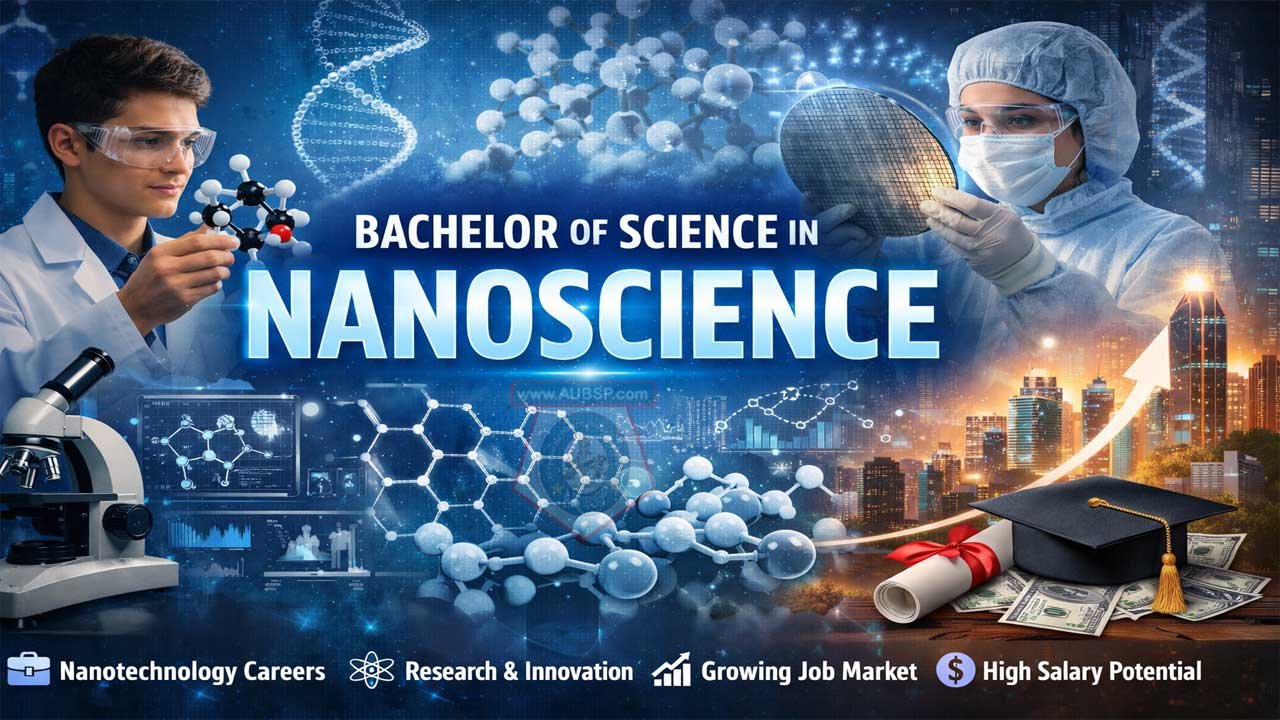
The Bachelor of Science in Nanoscience (BScNano) is a highly interdisciplinary, research-driven undergraduate degree focused on studying and engineering matter at the atomic and molecular scale, where physics, chemistry, biology, engineering, and materials science converge to create novel technologies.
With the global nanotechnology market projected to grow explosively from $8.78 billion in 2025 to over $115 billion by 2034, the field underpins major advances in semiconductors, biomedicine, energy, advanced materials, and environmental solutions. BScNano programs emphasize strong foundations in core sciences, extensive hands-on laboratory training with advanced instruments, and specialization in areas like nanoelectronics, nanomedicine, or nanomaterials, offered across a wide range of global universities with tuition costs varying from free or low-cost options in Europe and India to high-cost programs in the US.
While the market is expanding rapidly, job growth for nanoscience graduates is competitive rather than abundant, often favoring candidates with research experience, internships, and graduate degrees, making the program best suited for students passionate about cutting-edge science, willing to specialize deeply, and prepared for a research-intensive and strategically planned career path.
| Aspect | Information |
|---|---|
| Degree | Bachelor of Science in Nanoscience (BScNano) |
| Field Focus | Atomic- and molecular-scale science (1–100 nm) |
| Core Disciplines | Physics, Chemistry, Biology, Engineering, Materials Science |
| Market Outlook | Global market growing rapidly (>$100B projected by 2034) |
| Key Applications | Semiconductors, nanomedicine, energy, advanced materials, environment |
| Skills Gained | Nanofabrication, materials characterization, microscopy, research |
| Program Nature | Highly interdisciplinary and research-focused |
| Tuition Range | Free–low cost (Germany/India) to high cost (US/UK) |
| Career Paths | Materials science, semiconductors, biotech, energy, research |
| Job Market | Competitive; growth slower than market expansion |
| Education Beyond BSc | MS/PhD often preferred for research and senior roles |
| Best Fit For | Students passionate about research and cutting-edge science |
The Future of Science at the Atomic Scale
The Bachelor of Science in Nanoscience (BScNano) is one of the most cutting-edge undergraduate programs shaping careers in the fastest-growing scientific field of the 21st century. As nanotechnology revolutionizes industries from semiconductors to biomedicine, students pursuing a BScNano degree position themselves at the frontier of technological innovation.
The global nanotechnology market, valued at $8.78 billion in 2025, is projected to explode to $115.41 billion by 2034—a staggering compound annual growth rate of 33.14%. Despite this explosive market growth, the field presents both extraordinary opportunities and important realities for aspiring nanoscientists to understand before committing to this specialized educational path.
This comprehensive guide covers everything international students need to know about pursuing a Bachelor of Science in Nanoscience: program structure, tuition costs worldwide, career prospects, salary expectations, top universities, and insider insights about the realistic job market for nanoscience graduates.
What is a Bachelor of Science in Nanoscience?
Defining Nanoscience and Nanotechnology
Nanoscience is the science of extremely small matter—typically materials and particles measuring less than 100 nanometers (nm). To put this in perspective, a sheet of paper is 100,000 nm thick. At this infinitesimally small scale, the laws of physics, chemistry, and biology converge, creating entirely new material properties and behaviors that don’t exist at larger scales.
A nanometer is one billionth of a meter. This ultra-miniaturization enables scientists to manipulate individual atoms and molecules, creating materials with unprecedented properties: stronger than steel yet lighter than aluminum, semiconductors millions of times smaller than today’s chips, and drug delivery systems that target cancer cells with surgical precision.
Nanotechnology, the engineering application of nanoscience, represents humanity’s capacity to manufacture and manipulate matter at its most fundamental levels. According to the U.S. National Nanotechnology Initiative, nanotechnology is “science, engineering and technology conducted at the nanoscale, which is about 1 to 100 nanometers.”
Interdisciplinary Nature of the Field
A BScNano degree is inherently interdisciplinary, drawing expertise from:
- Physics: Quantum mechanics, materials physics, nanoelectronics
- Chemistry: Molecular synthesis, chemical properties at nanoscale, nanocomposites
- Biology: Nanomedicine, biocompatible nanomaterials, cellular-level applications
- Engineering: Nanofabrication, device design, manufacturing processes
- Materials Science: Material characterization, structure-property relationships
This multidisciplinary approach means BScNano graduates develop versatile skill sets applicable across numerous industries, though the breadth sometimes means less depth in any single traditional discipline compared to specialized degrees in chemistry or physics alone.
BScNano Program Structure and Coursework
Typical Curriculum Components
While specific curricula vary by institution, most BScNano programs follow a similar structure:
Foundation Courses (Years 1-2)
- Advanced chemistry (organic, inorganic, physical)
- Physics (quantum mechanics, thermodynamics, electromagnetism)
- Mathematics (calculus, differential equations, linear algebra)
- Materials science fundamentals
- Introduction to nanotechnology
Specialization Courses (Years 2-3)
- Nanomaterials synthesis and characterization
- Nanoelectronics and quantum devices
- Nanophotonics
- Biomolecular engineering
- Computational nanotechnology
- Nanofabrication techniques
- Laboratory instrumentation (electron microscopy, spectroscopy)
Advanced and Research Components (Year 3-4)
- Capstone project or honors thesis
- Industrial research internship
- Elective specializations (bionanoscience, nanoenergy, nanomedicine)
- Professional development seminars
Practical Laboratory Experience
Hands-on laboratory training is central to BScNano education. Students gain experience with sophisticated instrumentation including:
- Scanning Electron Microscopes (SEM)
- Transmission Electron Microscopes (TEM)
- Atomic Force Microscopes (AFM)
- X-ray Diffraction equipment
- Spectroscopic analysis tools
- Cleanroom fabrication facilities
This practical exposure to cutting-edge research equipment provides students with marketable skills that employers highly value, setting nanoscience graduates apart from pure theoreticians.
BScNano Tuition Costs: Global Comparison
United States
The United States hosts some of the world’s leading nanoscience research institutions, but tuition comes at a premium.
Annual Tuition Range: $20,000 – $50,000+
Major institutions offering BScNano programs:
- UC San Diego: Among the top nanoengineering programs globally
- UCLA: Strong materials and nanoscience focus
- Duke University: Renowned for interdisciplinary nanoscience research
- Boston University: Chemistry specialization in materials and nanoscience
Total 4-Year Cost: $80,000 – $250,000+ before living expenses, books, and equipment fees
Many U.S. universities offer merit-based scholarships and graduate assistantships that can significantly reduce out-of-pocket costs.
United Kingdom
The UK is a popular destination for international nanoscience students, offering world-class research facilities and a structured 3-year program (vs. 4 years in the US).
Annual Tuition (International Students): £12,840 – £33,450 ($15,900–$41,500 USD)
University of Bristol offers an MSc in Nanoscience and Functional Nanomaterials at approximately £28,400 annually, ranked #13 in Physics in the UK.
Total 3-Year Cost: £38,520 – £100,350 ($48,000–$125,000 USD)
Living Expenses: Approximately £14,832 annually in cities like Bristol
Europe (EU and Non-EU)
Europe offers the most affordable nanoscience education, particularly in EU countries with tuition-free or low-cost programs.
Germany:
- Cost: Free or minimal fees at public universities
- Program Language: Some programs taught in English
- Benefits: Strong research infrastructure, no student debt
- Cities: Berlin, Munich, Frankfurt host major nanoscience research centers
Nordic Countries:
- Cost: €17,000–€36,000 annually (international students)
- Examples: Lund University (Sweden), Technical University of Denmark
- Quality: Among Europe’s best research universities
Netherlands & Belgium:
- Cost: €1,500–€6,000 annually
- Erasmus Mundus Programs: €1,500/year (EU students), €9,000/year (non-EU)
- Advantage: English-language instruction, strong research networks
General EU Range: Free – €3,000 annually (EU citizens at public universities)
India and South Asia
For students from South Asia, pursuing nanoscience education domestically offers exceptional value.
India – Domestic Students:
- IIT Bombay, IIT Madras: $200–$1,400 annually
- NIT Surathkal, Amity University: Under $1,500/year
- Jadavpur University: $580 total for entire program
India – International Students: Slightly higher fees, typically $2,000–$5,000 annually
Advantages:
- Minimal financial burden
- Access to quality research institutions
- Growing nanotechnology research ecosystem
- Lower cost of living
Canada
Estimated Annual Tuition: CAD $15,000–$30,000 for international students ($11,000–$22,000 USD)
Total 4-Year Program: CAD $60,000–$120,000
Australia
Estimated Annual Tuition: AUD $25,000–$45,000 ($17,000–$30,000 USD)
Monash University offers strong nanotechnology programs with good international student support.
Career Opportunities After BScNano: Realistic Expectations
The Growth Paradox: Market Expansion vs. Job Realities
One critical fact aspiring nanoscience students must understand: the nanotechnology market is exploding, but graduate job availability remains modest.
The global nanotechnology market is experiencing phenomenal growth, with projections of $330 billion by 2032 (17% compound annual growth rate). The U.S. nanotechnology industry employs over 171,000 people across 3,700 companies engaged in R&D. However, employment growth for nanoscientists and nanoengineers remains slow.
Current Employment Snapshot (USA):
- Nanotechnology Technicians/Technologists: 74,600 (1–2% projected growth 2024-2034)
- Projected Job Openings: 6,300 over the next decade
- Nanotechnology Engineers: 170,300 (3.3% projected growth)
- Projected Openings for Engineers: ~9,000 over next decade
Employability Rating: CareerExplorer rates nanotechnology engineers with a “C” rating, indicating moderate employment opportunities. While the field is growing, it’s not expanding rapidly enough to absorb all graduates.
The Supply-Demand Problem: Many universities have launched nanoscience programs, producing more graduates than the current job market demands. This creates a competitive landscape where differentiation through research experience, internships, and additional specializations becomes crucial.
High-Demand Career Paths for Nanoscience Graduates
Despite competitive conditions, several career paths offer strong prospects for BScNano graduates:
1. Materials Science and Engineering
- Roles: Materials scientist, research scientist, product development engineer
- Industries: Aerospace, automotive, construction, consumer products
- Salary Range (USA): $70,000–$130,000+
- Growth: Faster than general nanotechnology field
- Demand Drivers: Lightweighting in aerospace, advanced composite development, battery materials
2. Nanoelectronics and Semiconductor Manufacturing
- Roles: Process engineer, device engineer, fab technician, quality assurance
- Industries: Intel, TSMC, Samsung, Qualcomm, smaller fab companies
- Salary Range: $75,000–$150,000+
- Demand: High and growing as chip miniaturization continues
- Geographic Hubs: Silicon Valley (USA), Taiwan, South Korea, Japan
3. Nanofabrication Engineering
- Roles: Nanofabrication engineer, process technician, equipment specialist
- Industries: Semiconductor, solar, defense, medical device manufacturing
- Salary Range (USA): $50,000–$100,000+ (based on web:16: Nanofabrication Engineer $100,103)
- Demand: Steady as cleanroom manufacturing expands
4. Nanomedicine and Biotech
- Roles: Bionanotechnology researcher, formulation scientist, drug delivery specialist
- Industries: Pharmaceutical companies, biotech startups, medical device manufacturers, hospitals
- Salary Range: $65,000–$140,000+
- Growth: Strong, driven by personalized medicine and advanced drug delivery
- Education: Often requires graduate degree (MS or PhD) for research positions
5. Energy Sector (Solar, Batteries, Hydrogen)
- Roles: Materials scientist, electrochemist, renewable energy engineer
- Industries: Tesla, NextEra Energy, solar manufacturers, hydrogen fuel cell companies
- Salary Range: $70,000–$130,000+
- Demand: Very strong as world transitions to renewable energy
- Career Growth: Excellent long-term prospects
6. Environmental Remediation
- Roles: Environmental engineer, water treatment specialist, pollution control engineer
- Applications: Nanotechnology for water purification, air filtration, contamination cleanup
- Salary Range: $60,000–$110,000+
- Growth: Strong as environmental regulations tighten globally
7. Academic and Research Careers
- Roles: University researcher, laboratory director, physics/chemistry professor
- Requirements: Graduate degree (MS or PhD)
- Salary Range: $60,000–$120,000+ (plus research funding)
- Path: Requires passion for research and publication record
Geographic Hotspots for Nanoscience Careers
Silicon Valley, California (USA)
- Semiconductor manufacturing, nanoelectronics R&D, tech companies
- Highest salaries but also highest cost of living
- CareerExplorer data shows concentration of positions in: Massachusetts, California, New York, Washington
Boston, Massachusetts (USA)
- Biotech and nanomedicine hubs
- Strong university research programs (MIT, Harvard, BU)
- Growing startup ecosystem
Germany and Switzerland
- Strong industrial base for nanomaterials
- High salaries, good work-life balance
- ETH Zurich has world-class nanoscience research
East Asia (South Korea, Taiwan, Japan, China)
- Major semiconductor and electronics manufacturing
- Growing nanomaterial production
- Strong government investment in nanotechnology
India (Emerging)
- Growing research infrastructure
- Lower salaries but rapidly expanding job opportunities
- Government emphasis on “Make in India” nanotechnology initiatives
Salary Expectations for Nanoscience Graduates
United States
Average Nanoscience Salary: $120,442 per year (CareerExplorer)
Salary Range by Position:
- Nanofabrication Engineer: $100,103
- Nano Engineer: $92,018
- Nano Fabrication Engineer: $87,296
- Nanotechnology Faculty: $83,896
- Nanotechnology Engineering Technician: $43,661
Entry-Level (0-3 years): $50,000–$70,000
Mid-Career (5-10 years): $80,000–$120,000
Senior/Principal Roles: $120,000–$200,000+
Geographic Salary Variations (Highest paying cities):
- Seattle, WA: $63,696
- Santa Barbara, CA: $63,218
- Sunnyvale, CA: $62,895
India
Average Nanoscience Salary: ₹22.4 lakhs annually (~$27,000 USD)
Salary Range:
- Entry-Level: ₹15.8–18 lakhs ($19,000–$22,000)
- Mid-Career: ₹25–35 lakhs ($30,000–$42,000)
- Senior Positions: ₹40–64+ lakhs ($48,000–$77,000+)
- Top 1%: ₹64+ lakhs ($77,000+)
Note: Salary growth is rapid in India’s growing tech and pharma sectors, with some top researchers earning ₹71.7 lakhs+.
United Kingdom
Master’s Graduate Salary: £25,000–£40,000 initially
Mid-Career: £45,000–£75,000+
Europe (Germany, Netherlands, Switzerland)
Average Starting Salary: €35,000–€55,000
Senior Researcher: €60,000–€100,000+
Germany offers some of the best work-life balance with competitive salaries, particularly attractive for those prioritizing quality of life over maximum earnings.
Top Universities for BScNano Programs: Global Ranking
United States
1. UC San Diego (University of California)
- Program: BS in Nanoengineering
- Specializations: Biomedical nanotechnology, molecular and nanomaterials, energy and environmental technologies
- Ranking: Top 5 globally for nanoengineering
- Research Centers: California NanoSystems Institute (CNSI)
- Cost: ~$35,000–$45,000/year (including living expenses)
2. Duke University
- Program: BS with nanoscience specialization
- Focus: Interdisciplinary approach spanning physics, chemistry, engineering, biology
- Research: Graduate certificate program emphasizes biomedical applications
- Strength: Strong industry partnerships and research funding
- Cost: ~$60,000+/year
3. UCLA (University of California, Los Angeles)
- Program: Materials and Nanoscience specialization
- Focus: Nanomaterials, nanophotonics, nanoelectronics
- Applications: Electronics, energy, biomaterials, sensors
- Research Collaborations: California NanoSystems Institute
- Cost: ~$30,000–$40,000/year
4. Boston University
- Program: BA/BS in Chemistry with Materials and Nanoscience specialization
- Courses: 18+ courses in chemistry, materials science
- Career Paths: Materials chemistry, process engineering, instrument specialists
- Strong In: Biocompatible materials, sustainable energy applications
- Cost: ~$55,000–$65,000/year
United Kingdom
1. University of Bristol
- Program: MSc Nanoscience and Functional Nanomaterials (12 months)
- Ranking: #13 in Physics (UK)
- Cost: £28,400/year (~$35,000 USD)
- Living Costs: £14,832 annually
- Total 3-Year Equivalent: ~$100,000–$125,000
- Research Focus: Advanced materials, functional nanomaterials, applications in electronics and energy
Germany (No Tuition Fees)
1. Technical University of Munich (TUM)
- Program: Nanoscience and Nanotechnology
- Cost: Free for all students (no tuition, only semester fees ~€300)
- Language: Some programs in English
- Living Costs: €900–$1,400/month
- World Ranking: Top 50 globally
2. University of Tübingen
- Cost: ₹3 Lakh (~$3,600) total
- Living Costs: Reasonable in smaller German city
- Research: Strong materials science program
3. Dresden University of Technology
- Cost: No tuition fees
- Strength: World-class nanotechnology research facilities
- Living Costs: Very affordable (~€700/month)
Scandinavia
1. Lund University (Sweden)
- Program: Nanoscience Master’s (2 years, 120 credits)
- Cost: €17,000–€36,000/year (international)
- Curriculum: Physics-based with specializations in nanoelectronics, materials science, biophysics
- Research: Hands-on from semester 1, concluding with master thesis
- Quality: Among Europe’s best research universities
2. Technical University of Denmark (DTU)
- Program: Nanoscience specialization
- Cost: ~€6,000/year
- Language: English-taught programs available
Netherlands
1. Erasmus University Rotterdam
- Program: Erasmus Mundus in Nanoscience
- Cost: €1,500/year (EU), €9,000/year (non-EU)
- Duration: 2 years
- Network: International mobility between partner institutions
- Strong In: Interdisciplinary approach, industry partnerships
India
1. IIT Bombay
- Program: BS in Physics/Chemistry with nanotechnology options
- Cost: $200–$1,400/year
- Quality: Top-ranked research institution globally
- Advantage: World-class research at minimal cost
2. IIT Madras
- Cost: $200–$1,400/year
- Research: Strong nanotechnology and materials science labs
3. Jadavpur University (Kolkata)
- Cost: $580 total for entire program
- Location: West Bengal (same as you!)
- Advantage: Extremely affordable, growing research programs
Asia-Pacific
1. Monash University (Australia)
- Program: Multiple nanotechnology-related courses
- Cost: AUD $25,000–$45,000/year ($17,000–$30,000 USD)
- Ranking: Strong in nanotechnology research
- Living: Melbourne is expensive but livable
Specialization Options Within BScNano
1. Nanomedicine and Bionanotechnology
Focus: Application of nanomaterials in medicine, drug delivery, diagnostics
Key Topics:
- Nanoparticle design for targeted drug delivery
- Biocompatibility and toxicology of nanomaterials
- Nanosensors for disease detection
- Cancer-fighting nanoparticles
- Tissue engineering with nanoscaffolds
Career Opportunities: Pharmaceutical companies, biotech startups, medical device manufacturers, hospitals, research institutes
Salary Advantage: High (biotech pays premium salaries)
Example Application: Carbon nanotubes specifically engineered to target and destroy cancer cells while leaving healthy tissue unharmed
2. Nanoelectronics
Focus: Miniaturization of electronic components beyond current silicon capabilities
Key Topics:
- Quantum dots
- Carbon nanotube transistors
- Graphene electronics
- Semiconductor physics at nanoscale
- Device fabrication techniques
Career Opportunities: Intel, TSMC, Samsung, IBM, Qualcomm, smaller semiconductor companies
Salary Advantage: Highest-paying sector for nanoscience graduates
Market Reality: Intense global competition from Asia (Taiwan, South Korea, Japan)
Example Application: Carbon nanotubes as replacements for silicon in future microprocessors, enabling faster, more efficient chips consuming less power
3. Nanomaterials Science
Focus: Creating and characterizing new materials with engineered properties at nanoscale
Key Topics:
- Nanocomposites (carbon fiber, graphene composites)
- Nanocoatings
- Self-assembling materials
- Quantum effects in materials
- Mechanical and thermal properties
Career Opportunities: Materials scientists, aerospace, automotive, sports equipment, construction materials
Market Growth: Strong, as industries seek stronger yet lighter materials
Example Application: Graphene-enhanced composites making aircraft lighter, more fuel-efficient, and more durable
4. Nanophotonics
Focus: Interaction of light with nanoscale materials and structures
Key Topics:
- Plasmonic nanostructures
- Photonic crystals
- Optical metamaterials
- Nanolasers
- Quantum light generation
Career Opportunities: Optics companies, telecommunications, display manufacturers, laser manufacturers
Example Application: Ultra-thin plasmonic devices enabling next-generation displays and optical computing
5. Nanoenergy
Focus: Nanomaterials for energy generation, storage, and conversion
Key Topics:
- Solar cells (perovskite nanocrystals, quantum dots)
- Battery materials (silicon nanowires, graphene)
- Hydrogen fuel cells
- Supercapacitors
- Thermoelectric devices
Career Opportunities: Tesla, renewable energy companies, utilities, battery manufacturers, oil & gas (transition roles)
Market Reality: Excellent long-term prospects driven by global climate action and energy transition
Salary Outlook: Growing rapidly, premium salaries
Example Application: Nanowire-based lithium-ion batteries providing 10x longer life and faster charging
6. Environmental Nanotechnology
Focus: Using nanomaterials for environmental remediation and sustainability
Key Topics:
- Water purification (nanofilters, nanosorbents)
- Air pollution control
- Soil remediation
- Carbon capture
- Environmental sensors
Career Opportunities: Environmental agencies, water utilities, consulting firms, sustainability-focused companies
Market Growth: Strong as regulations tighten globally
Example Application: Nano-membranes purifying contaminated water to drinking-water standards
Pros and Cons of a BScNano Degree
Advantages
✅ Cutting-Edge Field: Work at the forefront of technological innovation affecting real-world problems
✅ Interdisciplinary Education: Develop versatile skills applicable across chemistry, physics, biology, engineering
✅ High Market Growth: Nanotechnology market expanding 30%+ annually
✅ Global Career Opportunities: Nanoscience is a global field with opportunities worldwide
✅ Premium Salaries: Average $120,000+ in USA, competitive globally
✅ Research-Focused: Excellent preparation for graduate studies and research careers
✅ Practical Skills: Hands-on lab experience with cutting-edge instrumentation
✅ Prestige and Intellectual Appeal: Exciting, intellectually stimulating field
✅ Affordable Education (Selective Regions): Germany, India, some Scandinavian countries offer low/free tuition
Disadvantages
❌ Competitive Job Market: Graduate supply exceeds entry-level position demand
❌ “C” Employability Rating: Moderate employment opportunities, not abundant
❌ Geographic Concentration: Most jobs concentrated in specific regions (Silicon Valley, Boston, East Asia)
❌ Requires Specialization: Success often demands graduate degree or strong research focus
❌ Narrow Career Paths: May not translate easily to non-research careers
❌ Graduate Degree Preference: Many senior positions prefer/require MS or PhD
❌ High Tuition (USA): $80,000–$250,000 for undergraduate degree
❌ Research-Heavy: Less suitable for students preferring applied, field-based careers
❌ Salary Ceiling (Entry-Level): Starting salaries modest compared to some tech careers
❌ Job Search Challenges: Requires strategic planning, strong research portfolio, networking
Admission Requirements and Prerequisites
Academic Prerequisites
High School Requirements (for undergraduate admission):
- Strong performance in Chemistry (essential)
- Advanced Mathematics (Calculus recommended)
- Physics (strongly recommended)
- AP/IB/A-Level qualifications in STEM subjects boost competitiveness
Standardized Test Scores:
- USA: SAT (1450+) or ACT (33+) for competitive universities
- UK: A-Levels (AAA–AAB) or equivalent IB scores
- Germany: Abitur or equivalent qualification
English Language Requirements
For International Students:
- TOEFL: 90+ (internet-based)
- IELTS: 6.5–7.0+
- PTE: 65+
- Duolingo: Accepted at many universities (120+)
Application Materials
- Transcripts and academic records
- Personal statement/essay
- Letters of recommendation (usually 2–3)
- Resume/CV
- GRE or similar standardized tests (sometimes required for graduate programs)
Selection Criteria
- Academic Excellence: GPA/grades most critical
- Research Experience: Laboratory internships or research projects highly valued
- Demonstrated Interest: Clear motivation for nanoscience career
- Soft Skills: Leadership, teamwork, communication
Scholarship and Funding Opportunities
Full Tuition Coverage
Erasmus Mundus Scholarships
- €1,500/year for EU students
- €9,000/year for non-EU (often renewable)
- Covers tuition + living expenses for 2-year master’s
- Website: erasmusmundus.eu
German University Scholarships
- DAAD (German Academic Exchange Service)
- Covers full tuition (free) + living allowance (~€934/month)
- Highly competitive, merit-based
- Website: daad.de
- Alexander von Humboldt Foundation: Research scholarships
UK Government Scholarships
- British Council: Various scholarship schemes
- Leverhulme Trusts: Research funding
Partial/Merit-Based Scholarships
USA:
- UCSD: Merit scholarships available
- Duke University: Need-based and merit aid
- MIT: Full need-based aid guarantee
- NSF Scholarships: For US citizens pursuing STEM
India:
- IIT Fellowships: For exceptional students
- Government of India Scholarships: Various schemes
- College-specific aid: Most institutions offer merit scholarships
Canada:
- NSERC Scholarships: For Canadian citizens/permanent residents
- Vanier Canada Graduate Scholarships
Research and Teaching Assistantships
- Many universities offer RA/TA positions covering tuition + stipend
- Typically available for graduate students, sometimes undergraduates
- Salaries: $500–$2,000+ per month depending on position and university
The Real Job Market: What Employers Actually Want
Beyond the Degree: What Makes You Hireable
Research shows that having a BScNano degree alone may not be sufficient in today’s competitive market. Employers prioritize:
1. Research Experience (Most Critical)
- Published research or thesis work
- Presentations at conferences
- Patent involvement
- Laboratory experience with specific instruments
- Action: Seek research positions during summer breaks; volunteer in professor’s lab
2. Industry Internships
- 6–12 months hands-on experience with real products/processes
- Preferred by 95%+ of employers
- Often leads directly to job offers
- Action: Apply for internships at target companies starting freshman year
3. Technical Specializations
- Expertise in specific sub-field (nanoelectronics, biomedicine, materials, etc.)
- Software skills (MATLAB, Python, simulation software)
- Instrumentation proficiency (SEM, AFM, etc.)
4. Soft Skills
- Communication (ability to explain complex concepts)
- Project management
- Teamwork and collaboration
- Problem-solving
5. Networking
- Professional connections in target industry
- Participation in nanotechnology conferences
- Membership in professional organizations (MRS, ACS, IEEE)
Career Transition Realities
Important Warning: The path from BScNano to employment is NOT automatic. Graduates reporting difficulty finding nanoscience-specific jobs should be prepared to:
- Consider adjacent roles in materials science, chemistry, or physics
- Pursue graduate degrees (MS or PhD) for research positions
- Transition into biotech, pharma, or semiconductor companies (which value nanotech skills)
- Explore patent law or technical consulting
- Consider roles in adjacent industries: energy, aerospace, automotive
Emerging Trends and Future Outlook for Nanoscience
Market Drivers (2026–2034)
1. Semiconductor Miniaturization
- Need for continued chip downsizing beyond current silicon limits
- Geopolitical concerns driving localized manufacturing (USA, Europe, India)
- CAGR for nanoelectronics: 10–15%
2. Green Energy Transition
- Nanomaterials critical for next-gen solar cells, batteries, fuel cells
- Global renewable energy investment: $350+ billion annually
- Expected CAGR: 20%+
3. Biomedical and Healthcare Applications
- Nanotechnology in drug delivery, diagnostics, medical devices
- Aging populations driving healthcare innovation spending
- Expected CAGR: 18%
4. Industrial Manufacturing (Advanced Materials)
- Nanocomposites in aerospace, automotive, construction
- Lightweight materials reducing energy consumption
- Expected growth: 12–15% CAGR
5. Environmental Remediation and Water Purification
- Water scarcity driving investment in nano-filtration
- Climate-driven environmental regulations
- Expected growth: 15%+ CAGR
Emerging Specializations (High-Opportunity Areas)
✨ AI-Assisted Nanomaterial Design: Using machine learning to predict material properties and optimize synthesis
✨ Quantum Computing Materials: Developing nanomaterials for quantum information processing
✨ Nano-Scale Sensors: IoT and wearable nanosensors with real-time monitoring capabilities
✨ Self-Assembling Nanomaterials: Programmable matter and responsive materials
✨ Sustainable Nanotechnology: Green synthesis, biodegradable nanoparticles, minimal-waste manufacturing
BScNano vs. Alternative STEM Degrees: Comparison
BScNano vs. Chemistry
- BScNano: More specialized, stronger nanotech focus, better for cutting-edge research
- Chemistry: Broader applicability, easier job market entry, more traditional career paths
- Verdict: Chemistry offers more flexibility; BScNano for committed researchers
BScNano vs. Physics
- BScNano: Applied focus, more interdisciplinary
- Physics: Deeper theoretical understanding, broader career options
- Verdict: Physics graduates often have better job market prospects
BScNano vs. Materials Science
- BScNano: Nanoscale focus, cutting-edge
- Materials Science: Broader scope, more established career paths
- Verdict: Materials Science often provides better employability
BScNano vs. Electrical Engineering
- BScNano: Research-focused
- Electrical Engineering: Applied, industry-focused, better job prospects
- Verdict: EE graduates earn more ($65k–$110k vs. $50k–$90k entry-level)
Practical Steps to Maximize Your BScNano Career Prospects
During Undergraduate Years
Year 1
- Master foundational chemistry, physics, mathematics
- Join a research group (even if unpaid initially)
- Attend nanoscience seminars and department talks
- Build relationships with professors
Year 2
- Secure paid research position or industry internship
- Identify nanotechnology specialization of interest
- Take advanced courses in chosen specialization
- Begin attending conferences (even as observer)
Year 3
- Lead your own research project or thesis work
- Publish or present findings if possible
- Build industry network through internships
- Prepare portfolio of research and technical work
Year 4
- Complete capstone project
- Decide: Graduate school vs. industry
- Secure full-time position or graduate school admission
- Maintain strong academic record for graduate admissions
Professional Development
- Certifications: SEM operation, specific fabrication techniques
- Software Skills: MATLAB, Python, computational modeling
- Professional Memberships:
- Materials Research Society (MRS)
- American Chemical Society (ACS)
- IEEE Nanotechnology Council
- Local nanotechnology groups
Networking
- Attend nanotechnology conferences (Nanotech, MRS, ACS)
- Join LinkedIn groups for nanoscience professionals
- Connect with alumni working in target companies
- Informational interviews with professionals
Global Nanotechnology Industry Analysis
Regional Opportunities
Asia-Pacific (Fastest Growing)
- Market Growth: 35%+ CAGR through 2034
- Hubs: China, Taiwan, South Korea, Japan, India
- Drivers: Manufacturing, electronics, semiconductors
- Opportunities: Highest job growth, manufacturing focus
- Salary: Lower than USA/Europe but rapidly increasing
North America
- Market: $2.5+ billion annually
- Hubs: Silicon Valley (USA), Toronto (Canada)
- Drivers: Innovation, R&D, semiconductor, aerospace
- Salary: Highest globally ($120,000+)
- Challenge: Job growth slow (1–2% annually)
Europe
- Market: €1.2+ billion annually
- Hubs: Germany, France, Switzerland, Nordic countries
- Drivers: Research, advanced manufacturing, sustainability
- Salary: Competitive ($70,000–$100,000)
- Advantage: Free/low-cost education, strong research infrastructure
India
- Market: Emerging and rapidly growing
- Opportunities: Manufacturing, pharmaceuticals, renewable energy
- Cost of Living: Very low
- Career Growth: Rapid
- Salary: Increasing ($27,000 average, but growing 15%+ annually)
Conclusion: Is a BScNano Degree Right for You?
Ideal Candidates
A Bachelor of Science in Nanoscience is an excellent choice if you:
✓ Have genuine passion for cutting-edge scientific research
✓ Excel at chemistry, physics, and mathematics
✓ Enjoy hands-on laboratory work
✓ Are willing to pursue graduate studies or specialized roles
✓ Prioritize intellectual stimulation over job market ease
✓ Have strong networking and research portfolio-building commitment
✓ Can afford education (or have access to affordable programs in Germany, India)
✓ Are geographically flexible and willing to relocate for opportunities
Reconsider If:
✗ You want guaranteed, abundant job opportunities immediately after graduation
✗ You prefer applied, field-based careers over research
✗ Your primary motivation is maximum salary (look at engineering instead)
✗ You cannot afford USA tuition without substantial scholarships
✗ You struggle with theoretical or abstract concepts
✗ You prefer established, traditional career paths
The Bottom Line
The Bachelor of Science in Nanoscience opens doors to one of humanity’s most fascinating and consequential scientific fields. The global nanotechnology market is exploding—projected to grow from $8.78 billion (2025) to $115 billion (2034). However, the graduate job market is competitive but not abundant, requiring strategic career planning, strong research credentials, and specialization.
For the right student—one with scientific passion, research drive, and realistic expectations—a BScNano degree leads to intellectually fulfilling careers in cutting-edge research, well-paid positions in industry, and the satisfaction of contributing to technological breakthroughs that shape humanity’s future.
Success requires: Excellence in foundational sciences, active research engagement, industry internships, professional networking, and often graduate education. With these elements, BScNano graduates access roles in nanotechnology’s highest-growth sectors: semiconductor miniaturization, renewable energy, biomedical applications, and advanced materials.
The question isn’t whether nanotechnology is the future—it demonstrably is. The question is whether you’re committed to the disciplined, research-intensive path required to thrive in this specialized field. For those who are, the Bachelor of Science in Nanoscience represents an unparalleled opportunity to pioneer the science of tomorrow.
FAQs About Bachelor of Science in Nanoscience
Q: Can I get a job with just a BScNano degree, or do I need a graduate degree?
A: Entry-level technician positions are available with just a bachelor’s degree, typically earning $40,000–$60,000. However, many research and senior positions (salary $80,000+) prefer or require a master’s or PhD. Most career advancement requires further education.
Q: Is nanoscience harder than regular chemistry or physics?
A: Not fundamentally harder, but more specialized. It combines multiple disciplines, so breadth of knowledge matters more than depth in any single area. The math and physics are comparable to chemistry or physics degrees.
Q: What’s the job market like for BScNano graduates right now (2026)?
A: Competitive but manageable. Employment growth is modest (1–3% annually), but positions exist in semiconductors, materials, energy, and biotech. Success requires strong research credentials and specialization. Consider geographic flexibility.
Q: Should I do nanoscience or materials science?
A: Materials Science offers broader applicability and easier job market entry. Nanoscience is more specialized and research-focused. Choose materials science for flexibility; nanoscience for cutting-edge research focus.
Q: Where should I study if cost is my primary concern?
A: Germany (free tuition), India (IITs at $200–$1,400/year), Netherlands (€1,500–€6,000/year). Excellent education at minimal cost.
Q: How much do nanoscience graduates earn?
A: USA: $50,000–$70,000 starting, $80,000–$130,000 mid-career. India: ₹15.8–22.4 lakhs starting, rapidly increasing. Europe: €35,000–€55,000 starting.
Q: Is nanotechnology a dying field or growing?
A: Growing rapidly. Global market projected $115+ billion by 2034. However, job market growth is slower than market growth. It’s a growing field with competitive job prospects.
Q: Can I work internationally with a BScNano degree?
A: Yes. Nanotechnology is highly globalized. Degrees from reputable institutions (UCSD, Duke, ETH Zurich, MIT, IIT) are recognized worldwide.
Ready to pursue a career in nanoscience? Start with strong foundational chemistry and physics, seek research opportunities, and build your network in this transformative field.


Leave a Reply
You must be logged in to post a comment.