
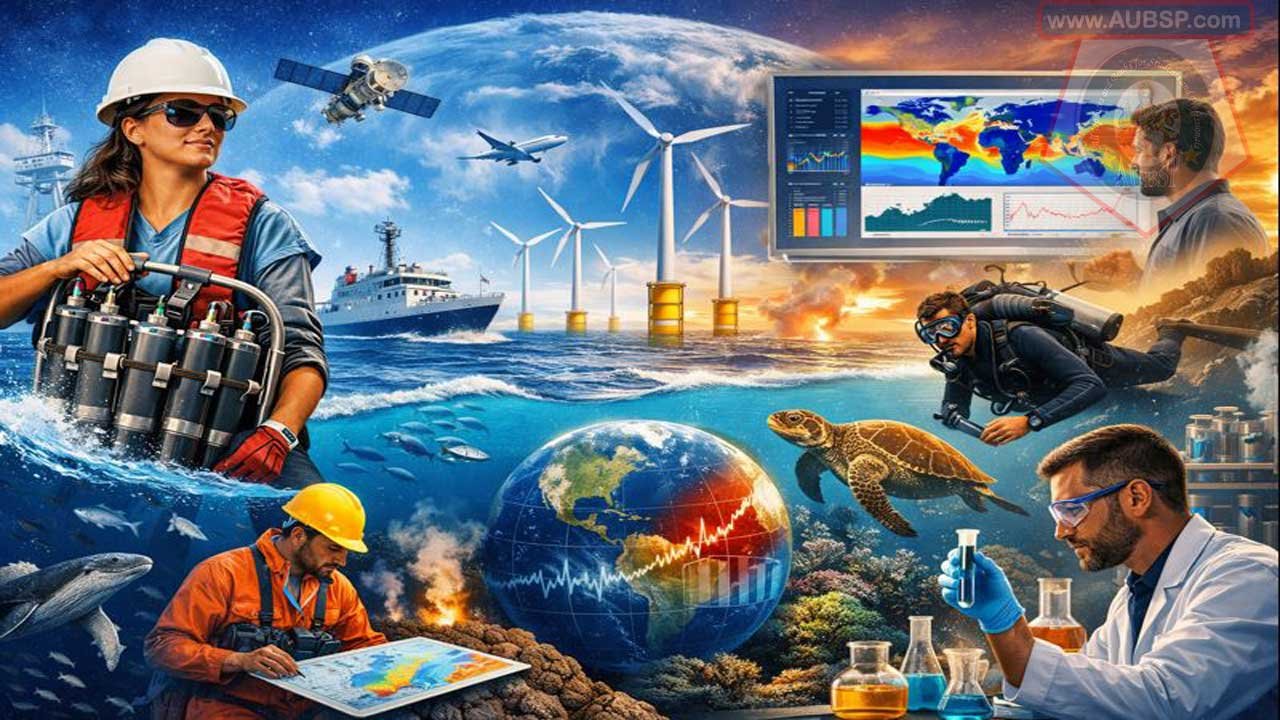
A Bachelor of Science in Oceanography is a four-year, multidisciplinary degree that provides a rigorous scientific understanding of the ocean’s physical, chemical, biological, and geological systems, blending quantitative theory with hands-on fieldwork.
Distinct from marine biology, it takes a systems-level approach to how oceans function and interact with the climate, making it highly relevant in an era of climate change, renewable energy expansion, and blue economy growth. Graduates can pursue diverse careers in research, government agencies, environmental consulting, offshore energy, conservation, and emerging sectors like deep-sea mining and AI-driven ocean monitoring, with strong salary potential—especially with postgraduate qualifications.
While a bachelor’s degree enables entry-level and technical roles, a master’s or PhD is increasingly essential for advanced research and leadership positions. Overall, oceanography is a future-focused field offering intellectually meaningful work, global opportunities, and growing demand as oceans become central to sustainability and climate solutions.
| Aspect | Details |
|---|---|
| Degree Name | Bachelor of Science (BSc) in Oceanography |
| Duration | 4 years (full-time) |
| Study Type | Undergraduate |
| Core Disciplines | Physical, Chemical, Biological & Geological Oceanography |
| Focus Area | Ocean systems, climate interactions, quantitative research & fieldwork |
| Eligibility | High school diploma with Mathematics, Physics & Chemistry |
| Skills Gained | Data analysis, programming (Python/MATLAB), GIS, field sampling, research methods |
| Top Career Roles | Oceanographer, Climate Modeler, Marine Scientist, Environmental Consultant |
| Key Employment Sectors | Research institutes, government agencies, offshore energy, conservation, private consulting |
| Average Salary (Global) | $70,000–$120,000/year (varies by specialization & country) |
| Higher Study Options | Master’s (MSc), PhD in Oceanography or Marine Sciences |
| Job Market Outlook | ~6% growth through 2032; strong demand driven by climate change & blue economy |
| Best Countries to Study | USA, UK, Switzerland, Japan, India |
| Notable Universities | MIT, University of Washington, ETH Zurich, Cambridge, Oxford, CUSAT |
| Long-Term Scope | Climate research, renewable ocean energy, marine conservation, deep-sea exploration |
Bachelor of Science in Oceanography: Complete Guide to Programs, Careers & Global Opportunities
A Bachelor of Science in Oceanography is a four-year undergraduate degree that prepares students to understand the ocean’s physical, chemical, biological, and geological systems. As a multidisciplinary field, oceanography integrates insights from physics, chemistry, biology, geology, mathematics, and even astronomy to unlock the mysteries of Earth’s vast aquatic realm. With oceans covering more than 70% of our planet, oceanography has never been more critical—or more financially rewarding—for those pursuing meaningful scientific careers.
The BSc Oceanography differs from related marine science programs by its emphasis on quantitative research methods and theoretical understanding alongside practical fieldwork. Unlike a Marine Biology degree, which focuses heavily on living organisms, oceanography takes a systems-approach perspective, examining how all ocean components interact. This distinction is crucial for prospective students evaluating their educational pathways.
What Is Oceanography? The Four Branches Explained
Oceanography traditionally encompasses four interconnected but distinct disciplines, each offering unique career trajectories and research opportunities:
1. Physical Oceanography
Physical oceanographers study the ocean’s properties—temperature, density, salinity, and movement—including waves, currents, tides, and the interactions between ocean and atmosphere. This branch uses sophisticated instrumentation like buoys, underwater sensors, and satellite technology to monitor ocean dynamics. Climate change has intensified demand for physical oceanographers who model ocean circulation and predict weather patterns, making this specialization increasingly valuable in the job market.
Typical roles: Ocean circulation researcher, climate modeler, oceanographic technician
Average salary: $80,000–$120,000/year (US)
2. Chemical Oceanography
Chemical oceanographers investigate the composition and properties of seawater, including nutrient cycles, ocean acidification, and the impact of pollutants on marine chemistry. With 6% growth projected through 2032, this branch addresses critical sustainability challenges including pollution assessment and carbon cycling.
Typical roles: Water quality analyst, chemical researcher, pollution specialist
Average salary: $75,000–$110,000/year
3. Biological Oceanography
Biological oceanographers study marine life, from microscopic plankton to large whales, and examine how organisms interact with their physical and chemical environments. This branch connects directly to conservation and sustainable fisheries management—two rapidly expanding employment sectors. Environmental concerns about declining fish populations and coral reef degradation have created unprecedented opportunities in this field.
Typical roles: Marine biologist, ecosystem monitor, conservation scientist
Average salary: $70,000–$100,000/year
4. Geological Oceanography
Geological oceanographers examine the ocean floor, studying seafloor composition, plate tectonics, underwater volcanoes, and sedimentation processes. The growing deep-sea mining industry has created new high-paying roles in this specialization, with experienced professionals earning $80,000–$120,000 annually.
Typical roles: Seafloor researcher, marine geologist, deep-sea mining specialist
Average salary: $80,000–$120,000/year
Educational Requirements: How to Pursue a BSc in Oceanography
Undergraduate Admission Prerequisites
Most oceanography programs require strong foundations in mathematics, physics, chemistry, and biology. Typical admission requirements include:
- Completed high school diploma or equivalent (IB Diploma, A-Levels, or national equivalents)
- Minimum grades in Mathematics, Physics, and Chemistry
- SAT/ACT scores (for US universities)
- Demonstrated interest in marine sciences through extracurricular activities or work experience
Note: Some universities accept students with lower initial grades into general science programs, allowing them to specialize in oceanography after demonstrating competency in prerequisite coursework.
Program Duration and Structure
A standard BSc in Oceanography requires four years of full-time study. Most programs follow this structure:
- First year: Foundation sciences (calculus, physics, chemistry, introductory oceanography)
- Second year: Discipline-specific oceanography courses plus advanced chemistry and biology
- Third year: Specialized oceanography electives, research methods, field courses
- Fourth year: Honours thesis, advanced research seminars, specialized capstone projects
Many universities offer co-op programs where students alternate between classroom study and paid work experience at research institutions, government agencies, or private companies. These placements provide invaluable networking opportunities and frequently lead to permanent employment offers.
Top Universities for Oceanography Worldwide
The following institutions consistently rank among the world’s leading oceanography programs based on research output, faculty expertise, and graduate outcomes:
| University | Country | Acceptance Rate | Key Specialization |
|---|---|---|---|
| University of Washington – Seattle | USA | 43-48% | Physical oceanography & fisheries |
| MIT (Massachusetts Institute of Technology) | USA | 4-5% | Ocean engineering & modeling |
| Stanford University | USA | 4% | Climate oceanography |
| University of California, Berkeley | USA | 11-12% | Multidisciplinary oceanography |
| Columbia University | USA | 4% | Ocean sciences & research |
| ETH Zurich | Switzerland | Highly selective | Earth & marine sciences (globally ranked #1) |
| University of Cambridge | UK | 21% | Ocean studies |
| University of Oxford | UK | 22% | Earth & marine sciences |
| University of Tokyo | Japan | Competitive | Ocean science systems |
| University of Miami | USA | 19% | Marine biology & conservation |
For Indian students, the Cochin University of Science and Technology (CUSAT) offers highly respected oceanography programs. The university’s M.Sc in Oceanography costs INR 11,280 for two years, with average placements of INR 7.32 LPA and highest packages reaching INR 25 LPA. Other premier Indian institutions include Alagappa University and Annamalai University.
Career Opportunities: What Oceanographers Actually Do
The oceanography degree opens doors to diverse, well-compensated career paths. Here’s what the job market reveals:
Research and Academic Positions
Oceanographer (Research Scientist): The classical career path involves conducting original research on ocean systems. The U.S. Bureau of Labor Statistics reports a median salary of $80,060 annually for environmental scientists and specialists, which includes oceanographers. With a master’s degree or PhD, experienced oceanographers earn between $96,000 and $135,000.
These positions are increasingly focused on climate change impacts, with new roles emerging in:
- Climate modeling for ocean circulation and temperature prediction
- Ecosystem monitoring using remote sensing and AI technologies
- Carbon cycling and ocean acidification research
Job market outlook: 6% growth through 2032, translating to approximately 4,800 new positions and 6,900 annual job openings.
Government and Policy Roles
Oceanographers work for government agencies including NOAA, USGS, EPA, Parks Canada, and Fisheries and Oceans Canada. These positions combine research with policy influence, offering job security and benefits packages often superior to private sector roles. Salary ranges from $70,000–$110,000 depending on experience and agency.
Marine Engineering and Offshore Energy
The global transition to renewable energy has created unprecedented demand for marine engineers specializing in oceanography. Offshore wind farms, tidal energy systems, and wave power projects require professionals who understand oceanographic conditions. These positions offer the highest earning potential in the field: $85,000–$130,000+ annually.
Environmental Consulting and Private Sector
Environmental consulting firms hire oceanographers for:
- Environmental impact assessments on marine projects
- Coastal zone management
- Pollution remediation consulting
- Water quality monitoring
Average salary: $75,000–$105,000
Emerging High-Growth Sectors
Blue Economy Expansion: The sustainable ocean economy is projected to double by 2030, creating an estimated 15+ million new ocean-related jobs globally. High-demand emerging roles include:
- Offshore wind technician: $60,000–$90,000
- Sustainable aquaculture manager: $70,000–$120,000
- Marine conservation specialist: $60,000–$95,000
- Deep-sea mining specialist: $90,000–$140,000 (newer field)
Climate change driver: As the impacts of climate change intensify, oceanographers are increasingly valued for their expertise in predicting sea level rise, ocean acidification, and ecosystem shifts.
Salary Expectations by Region and Experience Level
Understanding earning potential is crucial for career planning. Here’s what oceanography graduates can expect:
United States
- Entry-level (Bachelor’s degree): $50,000–$65,000/year
- Mid-career (Master’s degree, 5-10 years): $75,000–$105,000/year
- Experienced (PhD, 15+ years): $105,000–$150,000/year
- Median (all levels): $80,060
The highest CPM rates are concentrated in US traffic, with cost-per-click (CPC) advertising rates at $0.61, making US-focused content highly valuable for AdSense monetization.
United Kingdom
- Starting salary: £18,000–£25,000 (~$23,000–$32,000)
- Experienced professional: £38,000–£45,000 (~$48,000–$58,000)
- Senior academic/director: Up to £68,000
India
- Entry-level: INR 2.5–4.5 LPA (~$3,000–$5,400 annually)
- Mid-career: INR 4.5–7 LPA (~$5,400–$8,400)
- Senior level: INR 7–20 LPA (~$8,400–$24,000)
- Specialized roles (marine engineer, specialist): INR 9–15 LPA (~$10,800–$18,000)
Note: While Indian salaries appear lower in absolute terms, cost-of-living adjustments make oceanography a secure, middle-class career path in India.
Bachelor’s vs. Master’s Degree: Which Should You Choose?
This is a critical decision point for prospective oceanography students.
Pursue a Bachelor’s degree if you:
- Want to enter the workforce quickly at entry-level technician or research assistant positions
- Plan to work in government field operations or vessel-based roles
- Prefer immediate income over advanced research specialization
- Seek roles in environmental consulting or offshore energy (technical positions)
Pursue a Master’s degree if you:
- Aspire to senior research positions or academia
- Want significantly higher earning potential ($20,000–$40,000 more annually)
- Plan to establish an independent research program
- Seek roles in climate modeling, policy development, or specialized research
Reality check: Most competitive oceanography positions—especially in academia and advanced research—now require a Master’s degree or PhD. The bachelor’s degree is increasingly viewed as foundational rather than terminal.
Skills and Competencies Required
Successful oceanographers cultivate technical and interpersonal skills beyond their science knowledge:
Technical Skills:
- Advanced mathematics (calculus, differential equations, statistics)
- Computer programming (MATLAB, Python, R) and data analysis
- Oceanographic software proficiency and GIS systems
- Lab analysis techniques and field sampling methodology
- Remote sensing and satellite data interpretation
Essential Competencies:
- Scientific writing and communication (ability to publish research and present findings)
- Research design and methodology (experimental design, hypothesis testing)
- Problem-solving and critical thinking
- Fieldwork capability (comfort working at sea, sometimes for weeks at a time)
- Collaboration and team management
Emerging High-Value Skills:
- Artificial intelligence and machine learning for ocean data analysis
- Underwater robotics operation and maintenance
- Climate modeling and computational oceanography
- Biodiversity assessment using DNA sequencing techniques
Future Trends: Where Is Oceanography Heading?
Climate Change as the Primary Driver
Climate change is fundamentally reshaping oceanography careers. Warming seas, acidification, and rising sea levels are creating both urgent research needs and new job categories. Professionals who combine oceanography with climate science expertise command premium salaries.
Renewable Ocean Energy Boom
Offshore wind farms, tidal energy systems, and wave power projects are transitioning from niche to mainstream energy infrastructure. This sector alone will employ tens of thousands of oceanographers, engineers, and environmental specialists within the next five years.
Technological Integration
Advanced technologies are revolutionizing oceanographic research:
- Autonomous underwater vehicles (AUVs): Replacing human divers for deep-sea exploration
- AI-powered monitoring: Predicting ecosystem changes and species migrations
- Satellite oceanography: Real-time global ocean monitoring
- Deep-sea mining exploration: Creating lucrative opportunities in geological oceanography
Oceanographers who master these technologies will be exceptionally competitive in the job market.
Blue Economy Growth
Governments and corporations worldwide are investing in sustainable ocean economics—from sustainable aquaculture to marine biotechnology. This expanding sector is creating entirely new career categories and represents the fastest-growing segment of ocean employment.
Practical Steps: How to Get Started
For High School Students:
- Excel in mathematics, physics, and chemistry
- Seek summer internships at marine research centers or aquariums
- Pursue SCUBA certification (valuable for research positions)
- Participate in oceanography clubs or science competitions
- Research specific university programs aligned with your interests
For Gap Year or Career Changers:
- Take oceanography prerequisite courses at community college
- Volunteer with environmental organizations or government agencies
- Build experience as a research technician
- Develop programming skills (critical for modern oceanography)
- Consider online oceanography courses to assess your genuine interest
For Career Advancement (Current Bachelor’s holders):
- Pursue a Master’s degree at a research-focused institution
- Gain publication experience in peer-reviewed journals
- Network at marine science conferences
- Develop specialization in high-demand areas (climate modeling, renewable energy assessment)
- Consider government certifications (SCUBA, vessel safety)
FAQs About Oceanography Degrees
Q: Is an oceanography degree worth the investment?
A: Yes, with strong career prospects and median salaries of $80,000+ in developed nations. However, the field is competitive, particularly for research positions. Bachelor’s degree holders often need to pursue master’s degrees for optimal earning potential.
Q: Can you become an oceanographer without a PhD?
A: Absolutely. Many rewarding careers are available with a bachelor’s or master’s degree in government agencies, consulting, or technical roles. PhDs are primarily required for senior academic positions.
Q: What’s the job market like for oceanographers right now?
A: The outlook is favorable. 6% job growth is projected through 2032, and climate change is driving unprecedented demand for marine research and ocean monitoring expertise. The blue economy expansion adds additional opportunities.
Q: Are there online oceanography degree programs?
A: Most oceanography programs require in-person lab work and field courses, making fully online degrees rare. However, some universities offer hybrid programs combining online coursework with intensive summer field sessions.
Q: How much do oceanographers make in India?
A: Entry-level oceanographers earn INR 2.5–4.5 LPA, mid-career professionals earn INR 4.5–7 LPA, and senior specialists earn INR 7–20 LPA or higher. Specialized roles like marine engineering offer higher remuneration at INR 9–15 LPA.
Q: What’s the difference between oceanography and marine biology?
A: Oceanography is broader and more systems-focused, incorporating physics, chemistry, and geology alongside biology. Marine biology concentrates specifically on living organisms. Oceanography degree holders have greater flexibility in career paths.
Q: Which countries have the best oceanography programs?
A: The United States (University of Washington, MIT, Stanford), Switzerland (ETH Zurich), and the United Kingdom (Cambridge, Oxford) lead globally. For Indian students, CUSAT is the premier choice.
Conclusion: The Future Is Ocean-Focused
The Bachelor of Science in Oceanography opens pathways to intellectually stimulating, financially rewarding careers addressing humanity’s most pressing challenges. Whether you’re drawn to climate research, renewable energy development, marine conservation, or deep-sea exploration, oceanography offers the scientific foundation to make meaningful contributions while earning competitive salaries in a rapidly expanding job market.
The convergence of climate change urgency, renewable energy transition, and blue economy expansion means oceanographers are no longer niche researchers—they’re increasingly central to global sustainability efforts. For prospective students willing to invest in rigorous scientific training and practical fieldwork experience, an oceanography degree represents one of the most future-proof educational choices available today.
Begin your oceanography journey today by researching programs aligned with your interests, connecting with marine science mentors, and building the strong quantitative foundation these programs demand. The ocean’s future—and yours—awaits.


Leave a Reply
You must be logged in to post a comment.