
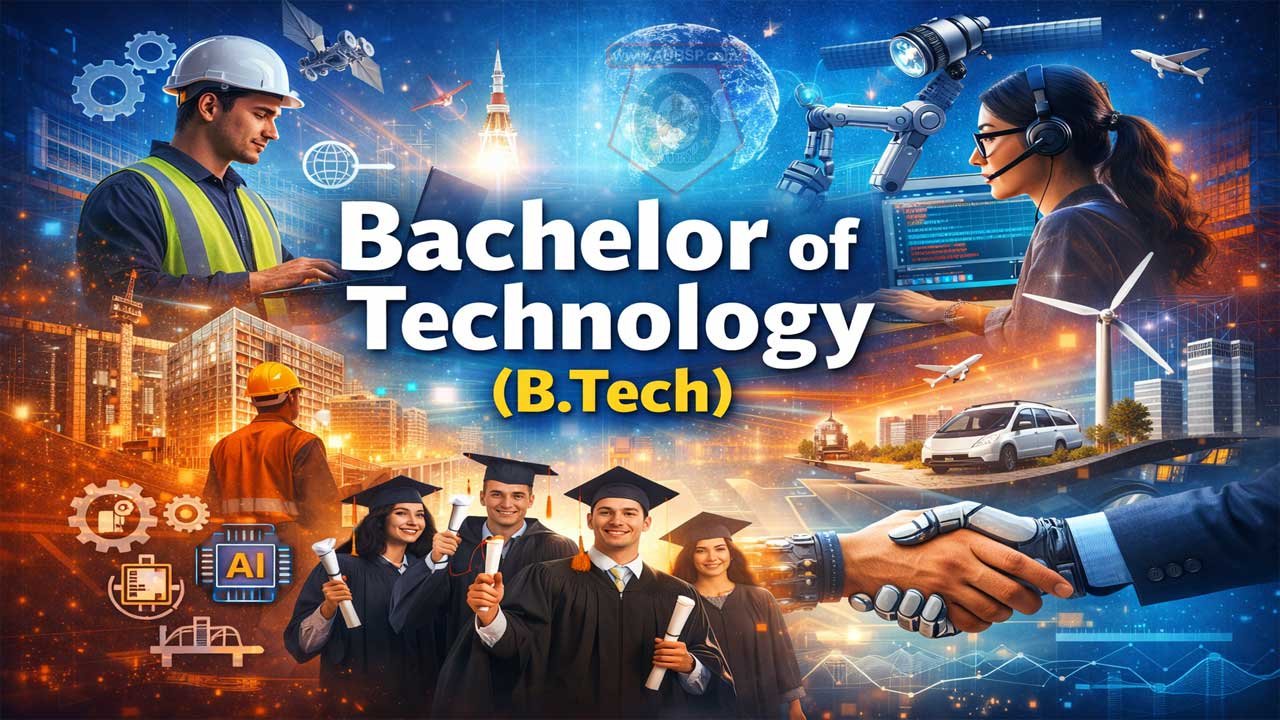
A Bachelor of Technology (BTech) is a four-year undergraduate engineering degree designed to produce industry-ready professionals through a strong blend of core science, engineering fundamentals, hands-on labs, projects, and internships.
Widely offered in India and recognized globally, it covers diverse specializations such as Computer Science, IT, Mechanical, Civil, Electronics, AI, and Data Science, making it highly adaptable to modern technology-driven careers. Admission typically requires a science background with mathematics, often supported by entrance exams, and costs and salaries vary by country, institution, and specialization.
Compared to BE or BS degrees, BTech is generally more application- and practice-oriented, but all are respected when earned from accredited institutions. Overall, BTech offers strong return on investment, global mobility, and long-term career potential across engineering, software, data, infrastructure, and emerging tech sectors.
Bachelor of Technology (BTech): Complete Global Guide for Aspiring Engineers
A Bachelor of Technology (BTech) is one of the most popular undergraduate engineering degrees for students who want a hands-on, industry-focused career in technology and engineering. It is widely offered in India and several other countries and is recognized by employers around the world for producing job-ready engineers.
This AUBSP guide explains what BTech is, who should choose it, course duration, eligibility, fees, salary expectations, career scope, and how it compares with other engineering degrees like BE and BS.
What Is a Bachelor of Technology (BTech)?
Bachelor of Technology (BTech) is an undergraduate academic degree in engineering and technology. It focuses on applying scientific and engineering principles to design, build, and optimize real-world systems, machines, software, and infrastructure.
Key characteristics:
- Degree level: Undergraduate, professional engineering degree
- Nature: Skill-oriented, application-focused, industry-aligned
- Typical duration: 4 years (8 semesters) of full-time study
- Core focus: Strong foundation in mathematics, physics, and core engineering, combined with labs, projects, and internships
Compared to more theory-oriented programs, BTech places heavier emphasis on practical work, tools, and industry exposure, preparing graduates to be job-ready from day one.
Quick Highlights of the BTech Degree
| Feature | Details |
|---|---|
| Full Form | Bachelor of Technology |
| Degree Level | Undergraduate (Professional) |
| Typical Duration | 4 years, 8 semesters |
| Entry Level | After 10+2 / high school (science with math) or equivalent |
| Study Focus | Practical, application-based engineering and technology |
| Common Specializations | CSE, IT, Mechanical, Civil, ECE, Electrical, AI & Data Science, etc. |
| Core Components | Theory + labs + projects + internships + industrial training |
| Outcome | Job-ready engineer / technologist with strong technical skills |
BTech Course Duration and Structure
Most BTech programs worldwide follow a 4-year full-time structure divided into 8 semesters.
Typical structure:
- Year 1 – Foundation:
- Common subjects: Engineering Mathematics, Physics, Chemistry, Basic Programming, Engineering Drawing, Engineering Mechanics
- Objective: Build strong fundamental understanding of engineering principles
- Year 2 – Core Engineering:
- Branch-specific fundamentals: Data Structures, Circuits, Thermodynamics, Digital Electronics, etc., depending on specialization
- Introduction to labs, mini projects, and workshop practice
- Year 3 – Advanced Topics + Projects:
- Advanced subjects in chosen specialization (e.g., Machine Learning, Structural Analysis, VLSI, Fluid Mechanics)
- Major project work, industry-focused assignments, internships begin in many universities
- Year 4 – Specialization, Internships, Final Project:
- Electives and specialization subjects
- Full-semester industry internship / capstone project
- Final-year thesis or major project showing real-world problem-solving
This mix of theory, labs, and industry engagement is designed to ensure that graduates are directly employable in technical roles.
Popular BTech Specializations Worldwide
BTech offers a wide range of specializations to match different interests and career goals.
Some of the most popular and high-demand BTech branches include:
- Computer Science and Engineering (CSE) – Software development, AI, data structures, algorithms, cloud computing, cybersecurity
- Information Technology (IT) – Networks, databases, web development, IT infrastructure
- Electronics and Communication Engineering (ECE) – Communication systems, embedded systems, VLSI, IoT
- Electrical Engineering (EE) – Power systems, control systems, renewable energy, industrial automation
- Mechanical Engineering – Design, manufacturing, thermodynamics, automotive, robotics
- Civil Engineering – Structural engineering, construction, transportation, geotechnical engineering
- Artificial Intelligence & Machine Learning / Data Science – Big data, ML, deep learning, analytics
- Aerospace Engineering – Aircraft, spacecraft, aerodynamics, propulsion
- Mechatronics / Robotics – Combination of mechanical, electronics, and computer control systems
- Biotechnology / Biomedical – Application of engineering to healthcare and biological systems
Specializations like CSE and AI/ML are especially attractive for high-paying, globally mobile careers in software, data, and tech-driven industries.
Eligibility Criteria for BTech (India & International Context)
Exact criteria vary by country and university, but typical minimum eligibility includes:
- Educational Background
- Completion of 10+2 / Grade 12 / A-levels / IB or equivalent
- Compulsory subjects: Mathematics plus Physics and Chemistry or equivalent science subjects
- Minimum Marks / GPA
- Universities often require a minimum percentage or GPA in high school, especially in math and science (thresholds vary by institution and country).
- Entrance Exams (Common in India and Some Other Regions)
- National or state-level engineering entrance exams
- For international students: SAT/ACT or university-specific exams may be required, along with English proficiency tests like IELTS/TOEFL.
- Additional Requirements
- Some universities may ask for:
- Statement of Purpose (SOP)
- Letters of Recommendation (LORs)
- Portfolio or projects (for specialized or interdisciplinary programs)
- Some universities may ask for:
Always check each university’s official website, as exact eligibility and cut-offs differ widely.
Admission Process: Step-by-Step Guide
- Choose Country and Specialization
Decide your preferred country (e.g., India, Germany, Canada, USA, UAE, Australia) and branch (CSE, Mechanical, Civil, etc.). - Shortlist Universities and Colleges Compare:
- Accreditation and rankings
- Industry connections and placement records
- Tuition fees and living costs
- Availability of scholarships and assistantships
- Check Eligibility & Entrance Requirements Review required:
- School subjects and minimum grades
- Entrance tests (JEE/SAT/ACT or local exams)
- English proficiency (IELTS/TOEFL where applicable)
- Prepare for and Take Entrance Exams
Build a study plan for 6–12 months if targeting competitive admissions. - Apply Online Submit:
- Application form and fee
- Academic transcripts
- Test scores
- SOP, LORs, resume (for international admissions or premium institutions)
- Attend Interviews / Counseling (If Applicable)
Some institutions conduct online or in-person interviews, or centralized counselling/seat-allocation processes. - Receive Offer Letter and Confirm Admission
Pay initial fee/deposit and complete any document verification steps. - For International Study: Complete Visa Process
Arrange visa, accommodation, travel, health insurance, and orientation.
BTech Fees, Scholarships, and Return on Investment (ROI)
Tuition fees for BTech vary significantly by country, university reputation, and specialization. In many Asian countries, including India, BTech is considered a relatively cost-effective way to enter engineering, especially compared with private universities in North America and Europe.
In general:
- In private universities, total BTech fees can vary widely across institutions and branches.
- Starting salaries for BTech graduates often begin in a moderate range but can grow rapidly with skills, experience, and the right specialization.
- Graduates in Computer Science, IT, AI, and Data Science typically see stronger starting packages compared with some traditional branches.
To improve ROI:
- Target in-demand branches like CSE, ECE, AI, Data Science, Cybersecurity
- Focus on projects, internships, and certifications alongside your degree
- Use university and government scholarships, need-based aid, and international student grants where available
Globally, engineering and tech degrees consistently rank among the strongest in terms of employability and long-term earnings potential.
Skills You Gain in a BTech Program
Beyond subject knowledge, a BTech degree helps you build a powerful technical and professional skill set.
Typical skills include:
- Strong foundation in math and science – essential for modelling, design, and optimization
- Programming and software tools – common languages, engineering software like CAD, MATLAB, simulation tools
- Problem-solving and analytical thinking – breaking down complex engineering problems into manageable steps
- Practical lab experience – operating instruments, working with circuits, machines, or code in real environments
- Project management and teamwork – completing group projects, meeting deadlines, managing resources
- Communication and documentation – writing reports, presenting solutions, collaborating with cross-functional teams
- Adaptability and continuous learning – staying updated as technology evolves rapidly
These capabilities are widely transferable across industries and countries, making BTech graduates attractive to employers worldwide.
Career Scope and Jobs After BTech
BTech graduates can work in both core engineering sectors and technology-driven industries.
Major Industries Hiring BTech Graduates
- Information Technology and Software – IT services, product companies, startups, SaaS, fintech, gaming
- Manufacturing and Automotive – automobile companies, heavy machinery, robotics, industrial automation
- Construction and Infrastructure – civil engineering firms, real estate, smart city and transportation projects
- Electronics and Telecommunications – semiconductor, embedded systems, telecom networks, IoT solutions
- Energy and Utilities – power generation, renewable energy, oil & gas, smart grids
- Aerospace and Defense – aircraft, spacecraft, defense research and development
- Banking and Finance – tech roles like data analytics, risk modelling, IT infrastructure
- Government and PSUs – public sector companies and engineering services roles
Common Job Roles After BTech
- Software Engineer / Full-Stack Developer / Mobile App Developer
- Data Analyst / Data Engineer / AI & ML Engineer
- Network Engineer / Cloud Engineer / DevOps Engineer
- Civil Engineer / Structural Engineer / Site Engineer
- Mechanical Design Engineer / Production Engineer / Maintenance Engineer
- Electrical Engineer / Instrumentation Engineer / Control Engineer
- Quality Assurance Engineer / Testing Engineer / Reliability Engineer
- Product Manager (Tech) / Project Engineer / Technical Consultant
With experience, BTech graduates can move into senior engineering positions, technical leadership, architecture roles, or management (especially if followed by an MBA or specialized master’s degree).
BTech Salary Expectations
Salary depends on:
- Country and city of employment
- Branch/specialization
- University reputation and personal skill level
- Type of employer (startup vs MNC vs government)
In many markets, BTech graduates in CSE and related fields often command higher starting packages compared to traditional branches, driven by demand in software, AI, data, and cloud technology. Over 3–5 years, salaries can grow strongly as professionals build domain expertise, portfolios, and niche skills.
For international careers, salaries can be significantly higher in tech hubs (North America, Western Europe, parts of the Middle East and Asia), but so are living costs and competition.
BTech vs BE vs BS in Engineering
Students are often confused between BTech, BE (Bachelor of Engineering), and BS (Bachelor of Science in Engineering). The differences are mostly about orientation and naming; all can lead to strong engineering careers when earned from reputable institutions.
| Aspect | BTech (Bachelor of Technology) | BE (Bachelor of Engineering) | BS in Engineering (or similar) |
|---|---|---|---|
| Focus | Practical, application-based, industry-oriented | More theoretical, fundamentals and research-heavy | Varies, often theory + broad science foundation |
| Curriculum Style | More labs, projects, internships, industrial training | More emphasis on conceptual and analytical depth | Often flexible, with strong math/science core |
| Duration | Typically 4 years | Typically 4 years | Typically 4 years |
| Common Regions | Very popular in India and parts of Asia | Common in India and some Commonwealth countries | Common in US, Canada, and several European universities |
| Career Outcome | Strong for industry and technical roles | Strong for research, higher studies, and technical roles | Strong global recognition in academic and research-heavy markets |
| Recognition | Widely accepted as an engineering degree | Widely accepted as an engineering degree | Often seen as equivalent or comparable to engineering degrees |
In practice, employers care more about your skills, projects, and experience than whether your degree is BTech or BE, as long as it is from a recognized, accredited institution.
Is BTech Good for Studying or Working Abroad?
Yes. A BTech from a well-recognized university:
- Is typically accepted as an engineering or technology bachelor’s degree by universities abroad for MS/MSc/MEng admissions
- Qualifies you for skilled migration routes and work visas in many countries (subject to local rules)
- Provides a strong technical base for roles in software, IT, engineering consulting, data, and more
However:
- For immigration and licensing, you may need credential evaluation or professional body recognition, depending on the destination country and profession.
- For regulated fields (like civil engineering in some countries), you may need additional local licensing exams or experience.
How to Choose the Right BTech College and Country
When targeting an international career and maximizing ROI, consider:
- Accreditation and Reputation
- Is the program recognized by national/international accreditation bodies?
- How strong is its placement record, especially in your preferred domain?
- Location and Industry Linkages
- Proximity to tech hubs, industrial clusters, or R&D centers
- Availability of internships and co-op programs
- Specializations Offered
- Does the college offer future-ready branches like AI, Data Science, Cybersecurity, Robotics?
- Faculty and Infrastructure
- Labs, workshops, research centers, incubators, industry partnerships
- Fees, Scholarships, and Living Costs
- Total cost of education vs realistic salary expectations post-graduation
- Global Exposure
- Exchange programs, dual degrees, international internships, partnerships with foreign universities
Choosing the right combination of country + university + specialization is crucial for long-term career and earnings potential.
FAQs About Bachelor of Technology (BTech)
1. Is BTech an engineering degree?
Yes. BTech is a professional undergraduate engineering degree with a strong focus on practical and technological applications. It is treated on par with other engineering degrees like BE or BS in Engineering, especially when awarded by accredited institutions.
2. What is the difference between BTech and BE?
- BTech: More application- and industry-oriented, with emphasis on labs, projects, and internships.
- BE: More theory-focused, emphasizing conceptual and analytical depth and research foundations.
Both are 4-year engineering degrees and can lead to similar careers; the real difference lies in curriculum style and teaching approach.
3. Can BTech graduates work abroad?
Yes. BTech graduates can work abroad in software, IT, core engineering, consulting, and research roles, provided they meet visa, language, and local licensing requirements. Many BTech graduates also pursue MS/MSc/MEng abroad as a pathway to international careers.
4. Can I do an MS or MBA after BTech?
Absolutely. BTech is an excellent foundation for:
- MS/MSc/MEng in engineering or computer science fields
- MBA for management and leadership roles
- Specialized postgraduate diplomas and certifications in areas like data science, cybersecurity, robotics, and more
5. Is an online or distance BTech valid?
In many countries, especially for engineering, regulators prefer or require full-time, regular mode programs because of the heavy lab and practical components. Always check whether:
- The program is approved by the relevant national regulatory body
- The mode of study (online, blended, or distance) is recognized for engineering in your target country
When in doubt, full-time, on-campus accredited BTech programs are safest from an employability and licensing point of view.
6. Which BTech branch has the highest salary potential?
Salary trends change over time, but in recent years:
- Computer Science & Engineering, IT, AI, Data Science, Cybersecurity have offered some of the strongest starting packages, especially in tech hubs and product companies.
- Electronics, Electrical, and Mechanical can also offer excellent long-term careers, especially with specialization in areas like embedded systems, renewable energy, robotics, or advanced manufacturing.
Ultimately, skills, projects, and continuous upskilling matter more than the branch label alone.
7. Is BTech a good choice for the future?
Yes—technology and engineering sit at the center of global growth in areas like AI, automation, clean energy, smart infrastructure, and digital transformation. A BTech degree, especially combined with strong projects, internships, and modern skills, remains one of the most future-relevant qualifications for high-demand, well-paying careers.


Leave a Reply
You must be logged in to post a comment.