
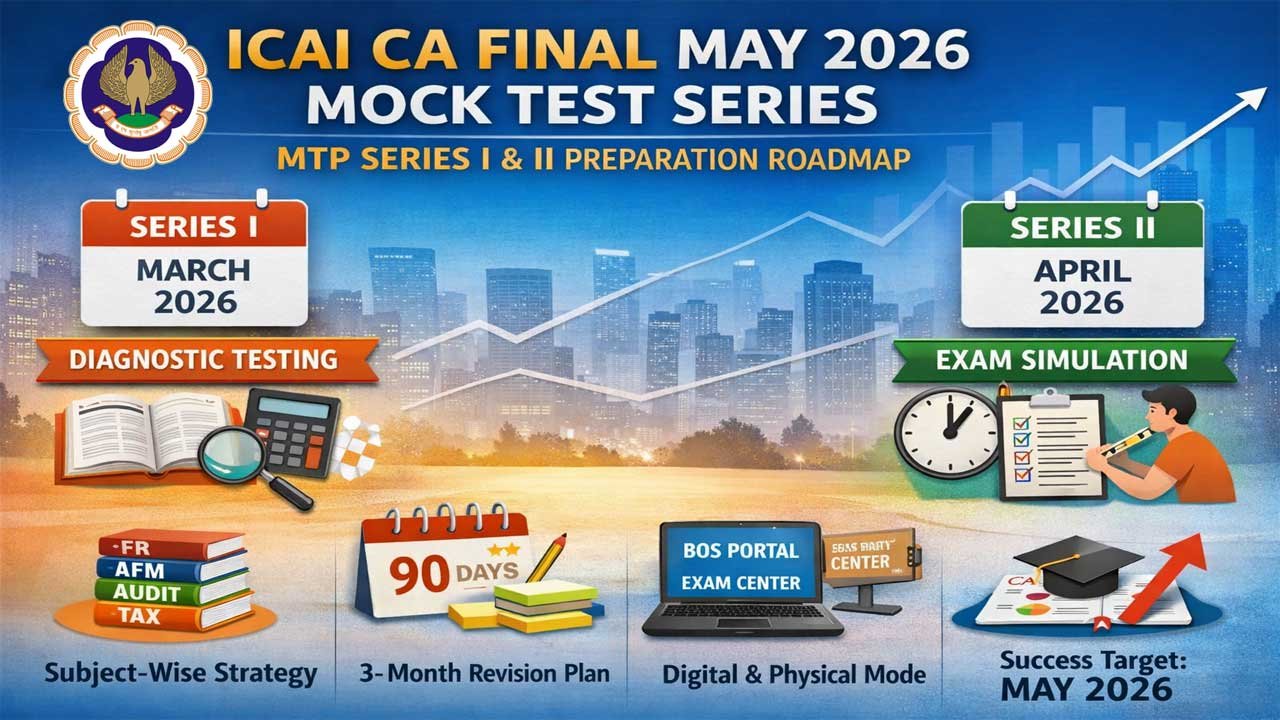
The Institute of Chartered Accountants of India (ICAI) stands as a pillar of financial integrity and professional excellence, orchestrating one of the most rigorous examination cycles globally. With the official announcement of the Mock Test Papers (MTP) Series I and Series II for the May 2026 CA Final Examinations, the countdown for the next cohort of Chartered Accountants has officially commenced.
The ICAI’s announcement of Mock Test Paper (MTP) Series I and II for the May 2026 CA Final exams marks the formal start of the final preparation cycle, with a carefully designed schedule that serves both diagnostic and exam-simulation purposes.
Series I (mid-March) is positioned as a conceptual stress test to identify gaps across all six papers—FR, AFM, Audit, Direct Tax, IDT, and IBS—while sufficient gap days reflect the varying cognitive and syllabus demands of each subject, especially Direct Tax. Series II (early April) functions as a full dress rehearsal, emphasizing time management, presentation, and psychological conditioning under near-exam conditions.
Delivered through both physical centers and digital platforms, the MTP framework integrates self-assessment, subject-wise strategy, and a structured three-month revision roadmap, while also addressing student mental health, burnout risks, and evolving digital learning trends. Overall, the MTPs act as a bridge between preparation and performance, transforming syllabus coverage into exam-ready execution and making success in the May 2026 CA Final a planned, data-driven outcome rather than a matter of chance.
The Strategic Architecture of the May 2026 MTP Schedule
The scheduling of examinations is not merely a logistical exercise; it is a pedagogical statement. The dates chosen for Series I and Series II reflect the ICAI’s expectation of student readiness and the cognitive load associated with each subject.
The Chronology of Series I: Diagnostic Calibration
The first series, commencing on March 16, 2026, serves as a diagnostic tool. Positioned roughly 45 days prior to the main examinations, this series is designed to expose fissures in conceptual understanding while there is still time for remediation.
Structural Analysis of the Series I Timetable
The schedule follows a specific rhythm, interspersed with gap days that are critical for cognitive recovery and rapid revision.
| Date | Paper Code | Subject Name | Strategic Domain | Time |
|---|---|---|---|---|
| 16.03.2026 | Paper-1 | Financial Reporting (FR) | Global Standards & Compliance | 2 PM – 5 PM |
| 18.03.2026 | Paper-2 | Advanced Financial Management (AFM) | Valuation & Risk Strategy | 2 PM – 5 PM |
| 20.03.2026 | Paper-3 | Advanced Auditing, Assurance & Ethics | Assurance & Professional Conduct | 2 PM – 5 PM |
| 23.03.2026 | Paper-4 | Direct Tax Laws & Int. Taxation | Fiscal Statutes & Cross-border Tax | 2 PM – 5 PM |
| 25.03.2026 | Paper-5 | Indirect Tax Laws (IDT) | GST & Customs Framework | 2 PM – 5 PM |
| 27.03.2026 | Paper-6 | Integrated Business Solutions (IBS) | Strategic & Multi-disciplinary Case Study | 2 PM – 6 PM |
Analytical Insight: The schedule reveals a deliberate pacing strategy. Notably, there is a two-day gap preceding Paper 4 (Direct Tax Laws & International Taxation), from the 20th to the 23rd of March. This is a recognition of the sheer volume of the Direct Tax syllabus, which encompasses the Income Tax Act, DTAAs, and Transfer Pricing regulations. This gap is not a luxury; it is a necessity for the retrieval of vast statutory provisions.
Conversely, Paper 5 (Indirect Tax Laws) and Paper 6 (IBS) follow with standard gaps, suggesting an expectation that students should have consolidated these subjects sufficiently to manage with a single day’s revision.
The Chronology of Series II: Simulation and Conditioning
Series II, commencing on April 1, 2026, is the dress rehearsal. Occurring one month before the main exams, this series is less about learning new concepts and more about exam conditioning—managing anxiety, perfecting time allocation, and refining answer presentation.
Structural Analysis of the Series II Timetable
| Date | Paper Code | Subject Name | Strategic Domain | Time |
| 01.04.2026 | Paper-1 | Financial Reporting (FR) | Ind AS Application | 2 PM – 5 PM |
| 03.04.2026 | Paper-2 | Advanced Financial Management (AFM) | Strategic Decision Making | 2 PM – 5 PM |
| 06.04.2026 | Paper-3 | Advanced Auditing, Assurance & Ethics | Reporting Standards | 2 PM – 5 PM |
| 08.04.2026 | Paper-4 | Direct Tax Laws & Int. Taxation | Judicial Precedents | 2 PM – 5 PM |
| 10.04.2026 | Paper-5 | Indirect Tax Laws (IDT) | Statutory Compliance | 2 PM – 5 PM |
| 13.04.2026 | Paper-6 | Integrated Business Solutions (IBS) | Case Study Analysis | 2 PM – 6 PM |
Analytical Insight: The gap preceding Paper 3 (Audit) in Series II (3rd to 6th April) is significant. Audit is historically a subject with high attrition rates due to the precision of language required. A three-day window here allows students to rigorously review Standards on Auditing (SAs) and the Code of Ethics, transitioning their mindset from the calculation-heavy AFM paper to the theory-intensive Audit paper.
Mode of Delivery: The Physical vs. Virtual Paradigm
The ICAI offers a dual-mode delivery system, acknowledging the geographic diversity of its student base.
- Physical Mode: Students may approach local branches. This mode is highly recommended for creating “exam-day simulation.” The sensory experience—the desk, the physical question paper, the silence of the hall—plays a crucial role in reducing anxiety on the actual exam day.
- Virtual Mode: Accessible via the BoS Knowledge Portal (
boslive.icai.org) and the ICAI BOS Mobile App. Question papers are uploaded by 1:30 PM, aligning with the reading time protocol.
Digital Infrastructure: The reliance on the BoS Knowledge Portal and the Mobile App underscores the digital transformation of the profession. Students are expected to navigate these platforms proficiently, downloading papers and eventually self-assessing against the Answer Keys uploaded within 48 hours. This self-assessment mechanism is critical for the “feedback loop” required for rapid improvement.
Subject-Wise Preparation Strategy – Group 1
Group 1 serves as the foundation of the Final Course, comprising Financial Reporting, Advanced Financial Management, and Advanced Auditing.
Paper 1: Financial Reporting (FR)
Financial Reporting is the bedrock of the CA curriculum. It requires a deep understanding of Indian Accounting Standards (Ind AS), which are converged with International Financial Reporting Standards (IFRS).
Strategic Focus Areas for May 2026
Based on recent trends and syllabus weightage, the following areas are critical:
- Consolidated Financial Statements: Mastery of Ind AS 110 (Consolidation), Ind AS 28 (Associates), and Ind AS 111 (Joint Arrangements) is non-negotiable. These topics often command 15-20 marks.
- Financial Instruments: Ind AS 32, 109, and 107. Understanding the nuances of amortized cost, Fair Value Through Other Comprehensive Income (FVTOCI), and Fair Value Through Profit or Loss (FVTPL) is essential. This topic is notoriously difficult but highly rewarding.
- Revenue Recognition: Ind AS 115. The five-step model for revenue recognition is a favorite for case-study questions involving variable consideration and performance obligations.
Mock Test Strategy for FR
- Series I (March 16): Use this session to test conceptual clarity on Business Combinations (Ind AS 103). Identify if you are struggling with the calculation of Goodwill/Bargain Purchase Gain.
- Series II (April 1): Focus on speed. FR papers are lengthy. Aim to complete the paper within the 3-hour limit.
- SEO Context: Discussions on Financial Reporting naturally attract ads for Enterprise Resource Planning (ERP) software like SAP and Oracle, as well as cloud accounting solutions.
Paper 2: Advanced Financial Management (AFM)
AFM tests the strategic financial decision-making capabilities of a candidate. It bridges the gap between theoretical finance and practical market applications.
Core Topics and Analytical Requirements
- Forex and Derivatives: These technical chapters involve complex hedging strategies using futures, options, and swaps.
- Portfolio Management: Modern Portfolio Theory, Capital Asset Pricing Model (CAPM), and Sharpe/Treynor ratios.
- Business Valuation: Valuation of mergers, acquisitions, and startups. This area often integrates concepts from FR.
Mock Test Strategy for AFM
- Calculator Proficiency: Speed with the financial calculator is paramount. Series I is the time to ensure muscle memory for functions like Grand Total (GT) and Present Value (PV) factors.
- Assumption Management: In AFM, multiple correct approaches often exist. The MTPs clarify ICAI’s preferred assumptions for the current term.
- Keyword Synergy: Terms like Investment Banking, Forex Trading, Derivatives, and Portfolio Management are high-CPC goldmines. They attract advertisers from the banking and investment sectors.
Paper 3: Advanced Auditing, Assurance, and Professional Ethics
This subject is often the hurdle for aggregate scores due to its rigorous linguistic standards.
The “Language” of Audit
ICAI expects answers to mirror the technical language of the Standards on Auditing (SAs).
- Professional Ethics: The Code of Ethics is crucial. Questions are practical scenarios involving Chartered Accountants in practice.
- Standards on Auditing (SAs): Grouping SAs (e.g., the 500 series on Audit Evidence, 700 series on Reporting) helps in retention.
Mock Test Strategy for Audit
- Writing Practice: Students often read Audit but fail to write it. The MTPs enforce the habit of writing full-length answers.
- Keyword Highlighting: Practice underlining key terms (e.g., “Material Misstatement,” “Professional Skepticism”) to draw the examiner’s eye.
- Recent Amendments: Pay close attention to recent changes in the Companies Act, 2013, and CARO 2020. MTPs are excellent predictors of which amendments ICAI is prioritizing.
Subject-Wise Preparation Strategy – Group 2
Group 2 includes Direct Tax Laws, Indirect Tax Laws, and the pivotal Integrated Business Solutions paper.
Paper 4: Direct Tax Laws & International Taxation
Direct Tax is vast and highly amended. The May 2026 exam will be based on the Finance Act relevant to the previous fiscal year.
Syllabus Breakdown
- Corporate Taxation: Minimum Alternate Tax (MAT), Alternate Minimum Tax (AMT), and deductions.
- International Taxation: Transfer Pricing (huge weightage), Double Taxation Avoidance Agreements (DTAA), and Base Erosion and Profit Shifting (BEPS).
- Case Laws: Citing relevant Supreme Court and High Court rulings is essential for top scores.
Mock Test Strategy for DT
- Handling Volume: The question paper is lengthy. MTP Series I will reveal if too much time is being spent on the initial MCQ section.
- MCQ Case Studies: DT MCQs are often scenario-based and tricky. MTPs provide a repository of these new-pattern MCQs.
- AdSense Context: Keywords like Tax Return, Income Tax Filing, Corporate Tax, and International Taxation are highly competitive. Content discussing these topics draws ads from tax preparation software and legal consultancy firms.
Paper 5: Indirect Tax Laws (IDT)
IDT is generally considered a scoring subject, comprising GST and Customs Law.
Key Focus Areas
- GST: Input Tax Credit (ITC), Place of Supply, Valuation, and E-Way Bills.
- Customs: Valuation rules, Duty Drawback, and Warehousing.
- Foreign Trade Policy (FTP): Often neglected but carries easy marks.
Mock Test Strategy for IDT
- Section Numbers: Quoting section numbers in GST is highly rewarding if accurate. Use MTPs to verify memory of sections like Sec 16 (ITC) or Sec 17(5) (Blocked Credits).
- Calculation Accuracy: GST questions involve cascading calculations. A single error in the “Value of Supply” can ruin the entire solution. Series II is critical for checking calculation precision.
Paper 6: Integrated Business Solutions (IBS)
Paper 6 represents a paradigm shift in the CA curriculum. Replacing the old elective papers, IBS is a mandatory, open-book, multi-disciplinary case study examination.
Deconstructing the Open Book Format
Unlike other papers, IBS tests application and retrieval. Students are permitted to carry books into the exam hall. The challenge is finding the right concept in a mountain of material within 4 hours.
The IBS Syllabus Matrix
IBS has no distinct syllabus. It is an amalgamation of:
- Financial Reporting (Ind AS)
- Strategic Financial Management (Valuation, Risk)
- Taxation (Direct & Indirect implications of business decisions)
- Corporate Law (Insolvency and Bankruptcy Code, FEMA, Companies Act)
- Strategic Management
Preparation Strategy for IBS
- The Indexing Strategy: The single most important tool for an open-book exam is a Master Index. Students must prepare a comprehensive index mapping concepts to page numbers in their study material.
- Example: If a case study mentions “Merger of a foreign subsidiary,” the index should point to:
- FR: Ind AS 110 (Consolidation)
- AFM: Business Valuation Models
- DT: Capital Gains on cross-border mergers
- FEMA: Cross-border regulations
- Example: If a case study mentions “Merger of a foreign subsidiary,” the index should point to:
- Case Study Practice: The ICAI Case Study Digest is the primary resource. The MTPs (Series I and II) are crucial because they provide fresh, unseen case studies reflecting the latest industry trends.
- Time Management: 4 hours seems long, but reading a 15-page case study takes 20-30 minutes. The MTP helps students calibrate their reading speed vs. solving speed.
Strategic Insight: The IBS paper simulates the role of a “Management Consultant.” Discussing this allows for the integration of keywords like Business Strategy, Consulting Services, Risk Management, and Corporate Governance—all high-value terms for AdSense.
The 3-Month Revision Roadmap (Feb – April 2026)
A mock test schedule is ineffective without a corresponding study plan. Based on snippets , here is a scientifically structured revision timeline.
Phase 1: Conceptual Consolidation (February 2026)
- Goal: Complete the first comprehensive reading of all subjects.
- Focus:
- Identify “A” category topics (high weightage, difficult).
- Prepare summary notes/charts for the “1.5 Day” revision before exams.
- SEO Note: Use keywords like Study Planner, Time Management, Exam Preparation Tips.
Phase 2: Diagnostic Testing (March 1 – March 15)
- Goal: Revision for MTP Series I.
- Activity:
- Solve at least 2 past year papers under timed conditions.
- Review Revision Test Papers (RTPs) for May 2026.
- Action: Register for MTP Series I on
bosmtp.icai.org.
Phase 3: The Series I Simulation (March 16 – March 27)
- Goal: Attempt MTP Series I as if it were the final exam.
- Strategy:
- Adhere strictly to the 2 PM – 5 PM slot.
- Do not evaluate performance immediately. Complete the cycle of papers first.
- Gap Days: Use gap days to revise the next paper, minimizing anxiety about the previous one.
Phase 4: Analysis and Rectification (March 28 – March 31)
- Goal: Analyze Series I performance.
- Activity:
- Check answers against the official key uploaded on the BoS Portal.
- Identify specific weak areas (e.g., “I failed to solve the Consolidated Cash Flow question”).
- Dedicate these 4 days to intense repair of those specific topics.
Phase 5: The Final Polish (April 1 – April 13)
- Goal: Attempt MTP Series II.
- Strategy:
- Focus on presentation: margins, working notes, referencing standards.
- Treat Paper 6 (IBS) seriously. Use the open-book material effectively.
Phase 6: The “Last Lap” (April 14 – May 1)
- Goal: Final revision for the Main Exam (starting May 2, 2026).
- Activity:
- Stop solving new questions.
- Review summary notes.
- Focus on sleep cycles and mental health.
Student Sentiment and Mental Health
The pressure on CA students is unique. Understanding student sentiment is crucial for creating content that resonates.
Managing “Mock Test Shock”
It is common to score low in Series I. This phenomenon, known as “Mock Test Shock,” should be framed positively. It is better to identify weaknesses in March than in May.
- Actionable Advice: Do not let a low score derail confidence. Series I is meant to expose weaknesses.
- Burnout Prevention: Ensure adequate hydration, sleep (min 6-7 hours), and short breaks.
The Isolation Trap
During study leave, students often isolate themselves.
- Recommendation: Schedule “worry time” or “venting time.” Talk to a peer or mentor for 15 minutes daily.
- Physical Activity: A sedentary lifestyle slows cognitive function. 20 minutes of brisk walking can improve focus.
Future Career Paths Post-CA
Passing the CA Final is just the beginning. The qualification opens doors to:
- Investment Banking: Mergers & Acquisitions, Equity Research.
- Management Consulting: Strategy, Operations, Risk Consulting.
- Corporate Finance: CFO roles, Treasury Management.
- Public Practice: Audit, Taxation, Forensic Accounting.
- Entrepreneurship: Many CAs are now founding FinTech startups.
Detailed Syllabus & Weightage Analysis
Expected weightage for May 2026, derived from recent trends and the new scheme.
Financial Reporting (Paper 1)
| Topic Cluster | Estimated Weightage | Key Ind AS |
|---|---|---|
| Assets & Liabilities | 25-30% | Ind AS 16, 38, 116, 36, 105 |
| Group Accounts | 15-20% | Ind AS 110, 28, 111, 27 |
| Financial Instruments | 10-15% | Ind AS 32, 109, 107 |
| Revenue & Ethics | 10-15% | Ind AS 115, Conceptual Framework |
| Other Standards | 20-25% | Ind AS 12, 19, 33, 102 |
Advanced Financial Management (Paper 2)
| Topic Cluster | Estimated Weightage | Key Concepts |
|---|---|---|
| Strategic Fin. Mgt | 10-15% | Fin. Policy, Risk Mgt Theory |
| Valuation | 20-25% | Corporate Valuation, Mergers |
| Security Analysis | 20-25% | Portfolio Mgt, Mutual Funds |
| Derivatives/Forex | 25-30% | Options, Futures, Currency Swaps |
| International Fin. | 10-15% | International Capital Budgeting |
Advanced Auditing (Paper 3)
| Topic Cluster | Estimated Weightage | Key Areas |
|---|---|---|
| Standards (SAs) | 40-45% | SA 200-700 Series |
| Prof. Ethics | 15-20% | CA Act, Code of Ethics |
| Company Audit | 15-20% | CARO 2020, Audit Committee |
| Special Audits | 20-25% | Bank, NBFC, PSU, Peer Review |
Conclusion and Final Recommendations
The ICAI CA Final Mock Test Series for May 2026 is an indispensable component of the exam preparation ecosystem. It bridges the gap between preparation and performance, converting raw knowledge into scorable marks.
Key Takeaways:
- Register Immediately: Use the
bosmtp.icai.orgportal. - Stick to the Schedule: Treat the March 16 (Series I) and April 1 (Series II) dates as sacrosanct milestones.
- Analyze Ruthlessly: A mock test without analysis is a wasted effort.
- Leverage Digital Tools: Use the BoS App for quick access to resources, but maintain a physical writing habit.
By aligning your study strategy with the MTP schedule and maintaining a disciplined, analytical approach, success in the May 2026 CA Final examinations is not just a possibility, but a calculated outcome.
Extended Analysis on Student Performance and Digital Trends
The Psychology of the “Attempt”
The CA Final is often described as a test of character rather than just intellect. The “attempt” is not merely the act of writing the exam but the culmination of months of psychological conditioning.
- Fear of Failure: The high attrition rate creates a pervasive fear. Mock tests serve as “exposure therapy,” allowing students to face the possibility of failure in a controlled environment.
- The “Imposter Syndrome”: Many students feel unprepared even after months of study. Objective scores from MTPs provide the necessary validation to combat this psychological barrier.
Digital Learning Trends in 2026
The landscape of CA education has shifted from physical coaching centers to digital platforms.
- Hybrid Models: Students now combine physical library study with on-demand video lectures.
- Micro-Learning: Concepts are consumed in 15-minute “reels” or “shorts” on platforms like YouTube and Instagram. Content creators who can condense complex Ind AS standards into short videos are seeing massive engagement.
- Community Learning: Platforms like Discord and Reddit have replaced the canteen discussion. Real-time doubt solving and peer support are now digital.
The Global Mobility of Indian CAs
With the increasing recognition of ICAI qualifications globally (through MRAs – Mutual Recognition Agreements), the modern CA is a global professional.
- CPA (USA/Canada/Australia): Many students pursue these qualifications post-CA. Keywords related to “CPA Exam,” “CPA Review Courses,” and “Global Accounting Careers” are extremely high-value for AdSense.
- ACCA: The intersection of CA and ACCA is another lucrative content niche.


