
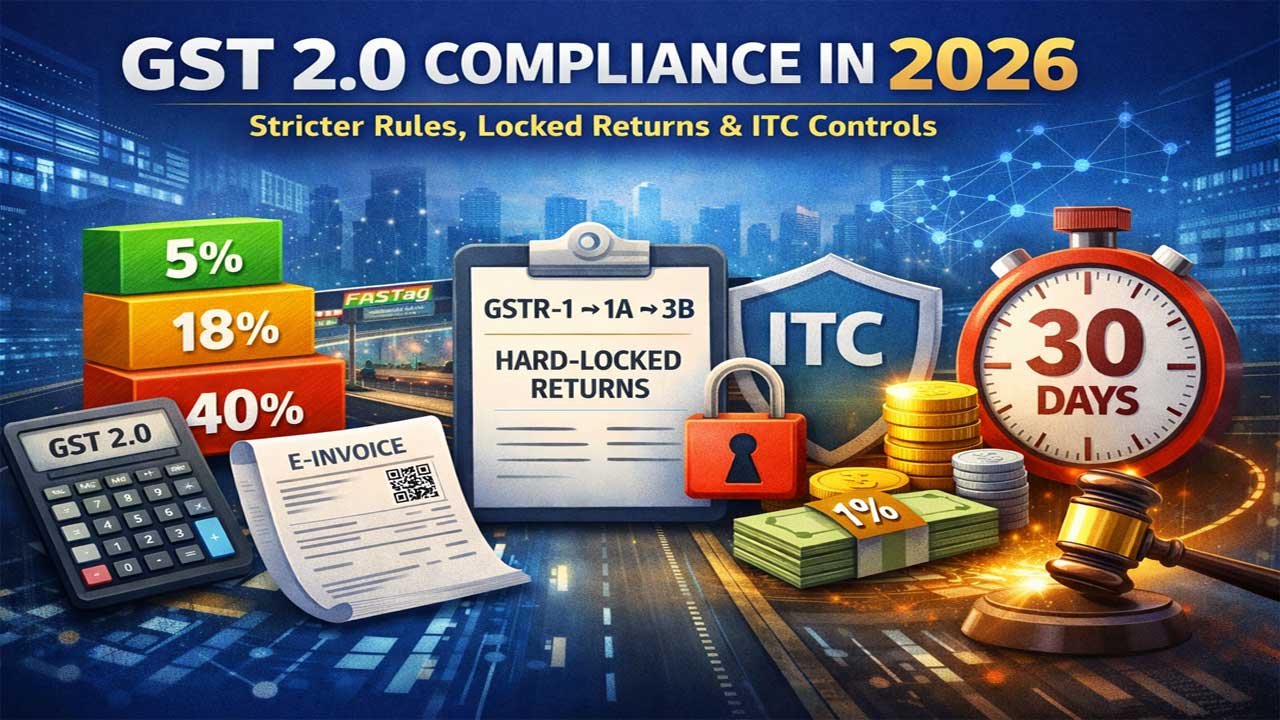
GST 2.0, fully implemented by late 2025, represents a decisive shift to enforced, tech-driven compliance through an integrated digital ecosystem linking e-invoicing, returns, IMS, and financial controls, making evasion and post-facto corrections nearly impossible.
The overhaul includes a simplified but sharper 3-slab tax structure (5%, 18%, 40%) with significant sectoral impacts, a rigid “hard-locked” return filing chain (GSTR-1 → 1A → 3B), and an Invoice Management System that requires active acceptance or rejection of supplier invoices to safeguard ITC. Stringent guardrails like mandatory 1% cash payment (Rule 86B), ITC mismatch lockouts (Rule 88D), a 30-day e-invoice reporting cap, and AI-driven HSN validation directly affect cash flow, billing accuracy, and working capital.
With GSTAT operational by 2026 for faster dispute resolution but requiring pre-deposits, businesses—especially CFOs—must adopt real-time reconciliations, disciplined return reviews, proactive IMS monitoring, and tighter cash-flow planning to avoid penalties, blocked credits, and operational disruptions.
The Definitive Guide to GST 2.0: Critical Rules & Compliance for 2026
The transition to GST 2.0, completed in late 2025, marked a shift from “voluntary compliance” to “enforced compliance.” The government’s digitization drive has connected the entire ecosystem—from e-Invoices to returns to highway toll gates (via FASTag integration)—creating a closed loop where evasion is nearly impossible.
This expanded guide breaks down the critical rules, the logic behind them, and the actionable steps required to safeguard your business from penalties and frozen working capital.
The “3-Slab” Rate Rationalization: A Sector-Wise Impact
The historic move to abolish the 12% and 28% slabs in favor of a consolidated 3-tier structure (5%, 18%, 40%) was designed to reduce classification disputes. However, it has distinct winners and losers.
The New Classification Matrix
| Rate | Category | Key Inclusions & Strategic Note |
|---|---|---|
| 5% | Merit & Essentials | • Textiles: Now uniform at 5% (previously varying 5-12%), solving the inverted duty structure refund issues. • Construction: Cement & Steel at 5% has significantly lowered the cost of affordable housing projects. |
| 18% | Standard (Default) | • Services: Almost all B2B services (Legal, IT, Consultancy) remain here. • Machinery: Capital goods are locked at 18%, streamlining ITC claims for manufacturers. • Processed Food: Items previously at 12% (like fruit juices, jams) have moved up to 18%, increasing shelf prices. |
| 40% | Demerit (Sin/Luxury) | • Online Gaming: The 28% debate is settled; it is now taxed at 40% on the full face value. • Luxury Autos: SUVs and high-end sedans face this flat rate plus compensation cess. • Carbon-Intensive Goods: Certain non-green industrial products are being piloted in this slab. |
Strategic Impact: If you deal in multi-category goods (e.g., a supermarket or general store), your billing software must strictly validate HSN codes. Misclassifying an 18% item as 5% will now trigger immediate AI-based red flags due to HSN-to-Price analytical mapping.
The “Hard-Locked” Return Cycle: The 1 → 1A → 3B Chain
The flexibility to edit returns is gone. The new filing lifecycle is a rigid, sequential chain designed to ensure that what you declare as sales is exactly what you pay tax on.
The Workflow Timeline
- Step 1: GSTR-1 (The Declaration)
- Deadline: 11th of the month.
- Function: You report invoice-wise sales. This data “freezes” immediately upon filing.
- Step 2: GSTR-1A (The Correction Window)
- Window: 12th to 19th of the month.
- Function: Realized you missed an invoice or entered a wrong value in GSTR-1? You must file GSTR-1A to amend it.
- Crucial Rule: You cannot skip this step and edit GSTR-3B directly.
- Step 3: GSTR-3B (The Payment)
- Deadline: 20th of the month.
- Function: The liability is auto-populated from GSTR-1 + GSTR-1A.
- Restriction: All fields are “Hard-Locked” (non-editable downward). You can only increase liability (e.g., for interest), not decrease it.
Invoice Management System (IMS): The “Active Acceptance” Protocol
The IMS has shifted the burden of proof entirely to the recipient. Passive bookkeeping is no longer an option.
The Three Actions in IMS
Effective October 2025, every invoice uploaded by your supplier hits your IMS dashboard. You have three choices:
| Action | Meaning | Consequence |
|---|---|---|
| Accept | “I agree this invoice is valid.” | Invoice flows to GSTR-2B → ITC is available. |
| Reject | “This invoice is wrong/not mine.” | Invoice is removed from GSTR-2B → No ITC claimed. Supplier is notified to correct it. |
| Pending | “I am verifying goods receipt.” | Invoice stays in limbo. Does not flow to GSTR-2B. ITC is deferred to the next month. |
The “Deemed Acceptance” Trap
If you take no action by the filing deadline, the system treats the invoice as “Deemed Accepted.”
The Risk: If a supplier wrongly uploads an invoice to your GSTIN and you fail to “Reject” it, you automatically claim the ITC. When the error is caught later during an audit, you will have to reverse that ITC with 18% interest.
Financial Guardrails: Cash & Credit Rules
The government is aggressively curbing “fake credit” circulation through two major financial rules.
Rule 86B (Mandatory 1% Cash Payment)
- Who it hits: Any business with taxable turnover > ₹50 Lakhs in a month.
- The Math: Even if you have ₹1 Crore in your electronic credit ledger (ITC), you can only use it to pay 99% of your output tax.
- Example:
- Output Tax Liability: ₹10,00,000
- Max ITC utilization allowed: ₹9,90,000
- Mandatory Cash Payment: ₹10,000
- Why? To ensure legitimate businesses are contributing at least a fraction of actual cash to the exchequer, and to identify “shell companies” that only rotate credit without cash flow.
Rule 88D (ITC Mismatch Snare)
- The Mechanism: The system compares ITC claimed in GSTR-3B vs. ITC available in GSTR-2B.
- The Trigger: If the divergence exceeds a set limit (currently 5%) or a specific value, you receive Form DRC-01C.
- The Lockout: If you do not explain the discrepancy or pay the excess back within 7 days, you are blocked from filing GSTR-1 for the subsequent period. This stops your ability to issue valid invoices to customers.
E-Invoicing & The “30-Day Lock”
The “real-time” aspect of GST is now enforced strictly via the Invoice Registration Portal (IRP).
- No Backdating: For businesses with turnover > ₹10 Crore, you cannot report an invoice to the IRP if it is older than 30 days.
- Commercial implication: If you raise an invoice dated Jan 1st but forget to generate the IRN (Invoice Reference Number) until Feb 2nd, the portal will reject it. That invoice is legally void. You cannot collect GST on it, and your customer cannot claim ITC.
- Solution: Daily reconciliation of ERP vs. IRP data is now a mandatory SOP for finance teams.
Dispute Resolution: The GSTAT Era
By 2026, the GST Appellate Tribunal (GSTAT) is fully operational. This is a game-changer for litigation.
- Faster Verdicts: Businesses no longer have to approach High Courts for factual disputes.
- Pre-Deposit Requirement: To file an appeal with GSTAT against an order, you must pay a “pre-deposit” (typically 10% of the disputed tax amount). Ensure your litigation budget accounts for this cash blockage.
Actionable Summary for the CFO
| Compliance Area | Risk Level | Required Action |
|---|---|---|
| Return Filing | High | Implement a strict “Review GSTR-1” protocol on the 10th. Use GSTR-1A immediately if errors are found. |
| ITC Management | Critical | Assign a team member to log into IMS weekly to Reject invalid invoices to avoid “Deemed Acceptance.” |
| Cash Flow | Medium | Factor in the 1% mandatory cash payment (Rule 86B) and pre-deposits for appeals when forecasting cash flow. |
| Billing | High | Audit HSN codes against the new 3-slab rates. Ensure e-invoicing is done within 48 hours of transaction (well within the 30-day limit). |
FAQs
What is GST 2.0?
GST 2.0 is the next phase of India’s GST regime that fully enforces technology-driven, real-time compliance with minimal manual intervention.
When did GST 2.0 come into force?
GST 2.0 was effectively completed and enforced by late 2025, with full operational impact seen in 2026.
What is the biggest change under GST 2.0?
The biggest change is the shift from voluntary compliance to enforced compliance through system lock-ins and automated checks.
How many tax slabs exist under GST 2.0?
GST 2.0 follows a 3-slab structure of 5%, 18%, and 40%.
Which slabs were removed under GST 2.0?
The 12% and 28% slabs were abolished to reduce classification disputes.
Which goods fall under the 5% slab?
Essential and merit goods like textiles, cement, and steel used in affordable housing fall under 5%.
Which goods and services fall under the 18% slab?
Most services, capital goods, machinery, and processed food items fall under the 18% slab.
Which items are taxed at 40%?
Luxury goods, online gaming, high-end automobiles, and carbon-intensive products are taxed at 40%.
Why is HSN classification critical under GST 2.0?
Incorrect HSN classification triggers AI-based red flags and can result in penalties and blocked credits.
What is the new return filing sequence?
The mandatory sequence is GSTR-1, followed by GSTR-1A, and then GSTR-3B.
Can GSTR-3B be edited directly?
No, GSTR-3B is hard-locked and cannot be edited downward under any circumstance.
What is GSTR-1A used for?
GSTR-1A allows correction of errors or omissions made in GSTR-1 within a limited time window.
What happens if errors are not corrected in GSTR-1A?
The incorrect liability auto-flows into GSTR-3B and must be paid, even if wrong.
What is the Invoice Management System (IMS)?
IMS is a system where recipients must actively accept, reject, or keep supplier invoices pending.
What happens when an invoice is accepted in IMS?
The invoice flows to GSTR-2B and eligible ITC becomes available.
What happens when an invoice is rejected in IMS?
The invoice is removed from ITC eligibility and the supplier is notified for correction.
What does ‘Pending’ status mean in IMS?
Pending means ITC is deferred until the next tax period after verification.
What is deemed acceptance in IMS?
If no action is taken by the deadline, the system treats the invoice as accepted automatically.
Why is deemed acceptance risky?
Wrong invoices deemed accepted lead to wrongful ITC claims, which must later be reversed with interest.
What is Rule 86B under GST?
Rule 86B mandates a minimum 1% cash payment of output tax for high-turnover businesses.
Who is impacted by Rule 86B?
Businesses with taxable turnover exceeding ₹50 lakh in a month are impacted.
Can full ITC be used to pay output tax under GST 2.0?
No, at least 1% of the tax liability must be paid in cash under Rule 86B.
What is Rule 88D?
Rule 88D deals with mismatches between ITC claimed in GSTR-3B and ITC available in GSTR-2B.
What triggers a DRC-01C notice?
A mismatch exceeding the prescribed percentage or value triggers DRC-01C.
What happens if DRC-01C is not responded to?
The taxpayer may be blocked from filing GSTR-1, halting invoice issuance.
What is the 30-day e-invoice rule?
E-invoices must be reported to the IRP within 30 days of the invoice date.
Who must comply with the 30-day e-invoice rule?
Businesses with turnover above ₹10 crore must strictly comply.
What happens if an e-invoice is reported after 30 days?
The IRP rejects it, making the invoice legally invalid.
Can GST be collected on a rejected e-invoice?
No, GST cannot be collected and ITC cannot be claimed on such invoices.
Why is daily reconciliation now important?
To ensure ERP data matches IRP, IMS, and GST returns in real time.
What is GSTAT?
GSTAT is the GST Appellate Tribunal for faster resolution of GST disputes.
Is GSTAT functional in 2026?
Yes, GSTAT is fully operational by 2026.
Is a pre-deposit required for GST appeals?
Yes, typically 10% of the disputed tax must be paid before filing an appeal.
How does GST 2.0 affect working capital?
Locked ITC, mandatory cash payments, and pre-deposits increase working capital pressure.
What is the biggest ITC risk under GST 2.0?
Deemed acceptance of wrong invoices and ITC mismatches.
How often should IMS be reviewed?
At least weekly to avoid deemed acceptance risks.
What is the biggest compliance risk for CFOs?
Missing timelines and system lockouts that freeze cash flow and invoicing.
Is GST 2.0 suitable for manual accounting systems?
No, GST 2.0 effectively requires automated, system-driven compliance.
What is the key compliance takeaway of GST 2.0?
Accuracy, timeliness, and proactive monitoring are mandatory—errors are costly and hard to reverse.


Leave a Reply
You must be logged in to post a comment.