
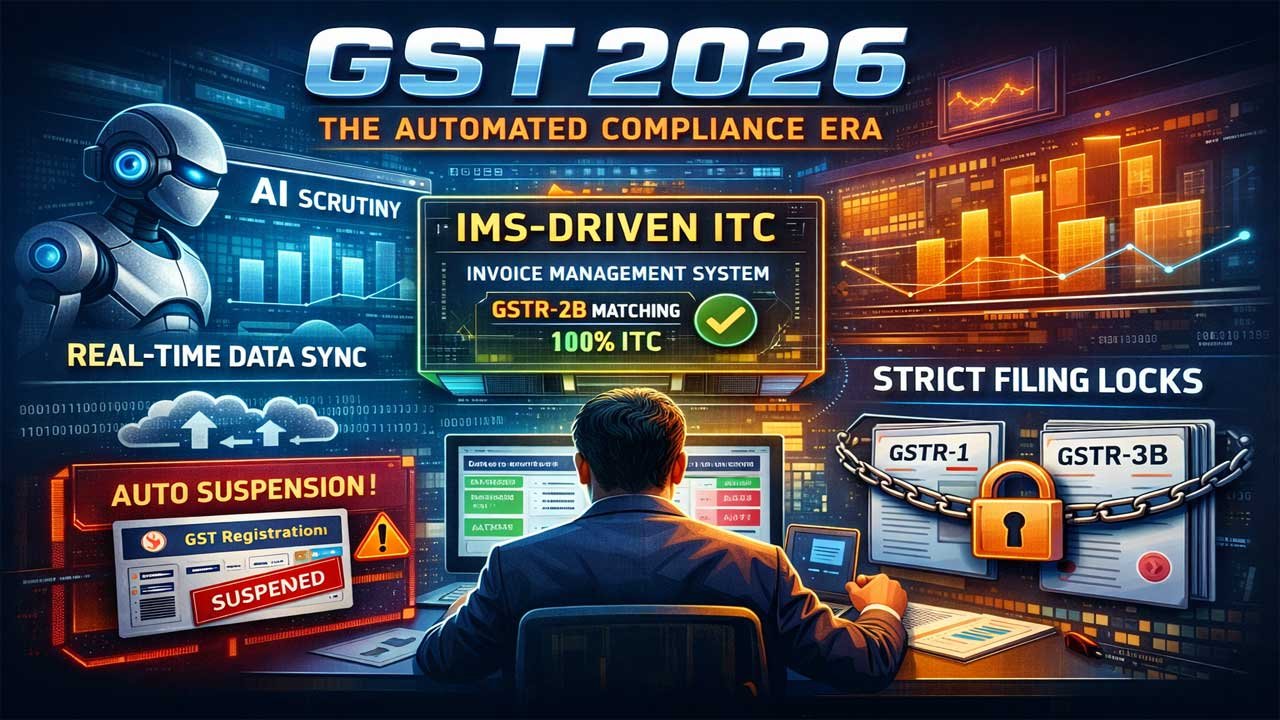
The Goods and Services Tax (GST) landscape has evolved from simple digitization to full-scale automation. With the full implementation of the Invoice Management System (IMS) and AI-driven scrutiny, the margin for error has vanished.
As of 2026, the margin for error has effectively vanished. With tax authorities utilizing AI-driven analytics to cross-verify data in real-time, compliance is no longer just about filing returns—it is about data integrity and synchronization.
For accountants, GST is no longer just about filing returns—it is about real-time data synchronization. This guide covers the strict compliance protocols, automated blocking rules, and the new ITC workflow that every accountant must master in 2026.
Why This Matters: The “Provisional ITC” concept is dead. In 2026, if the system doesn’t see it, you cannot claim it. Non-compliance now triggers automated registration suspension without human intervention.
This guide is designed for Chartered Accountants, Tax Practitioners, and Finance Professionals navigating the strict GST regime of 2026.
Quick Reference: The 2026 Accountant’s Dashboard
| Parameter | Compliance Detail |
|---|---|
| SAC Code | 998313 (Accounting, auditing, and bookkeeping services) |
| GST Rate | 18% (9% CGST + 9% SGST or 18% IGST) |
| Registration Threshold | ₹20 Lakhs (Service Providers) |
| Key Deadline | GSTR-3B: 20th of the following month |
| ITC Condition | 100% conditional on GSTR-2B + IMS Action |
| Mandatory Tech | Biometric Aadhaar Auth & Verified Bank Account |
GST Registration: Thresholds & Requirements
When Must Accountants Register?
While voluntary registration is allowed, you must register if:
- Turnover > ₹20 Lakhs: Your aggregate annual turnover from services exceeds ₹20 Lakhs.
- Interstate Supply: You provide services to clients in other states (IGST applicable).
- E-Commerce Aggregators: You sell services through platforms (e.g., Urban Company, Fiverr India).
- Reverse Charge: You are liable to pay tax under RCM (e.g., import of services).
The “Aadhaar Shield” & Biometric Verification (2026 Update)
Biometric Authentication is now standard for “High-Risk” profiles.
- Trigger: If your application is flagged by data analytics (e.g., suspicious documents, geo-coding mismatch), you must visit a GST Suvidha Kendra (GSK) for biometric verification.
- Home State Facility: Directors/Partners can now complete this verification in their home state, avoiding the need to travel to the state of registration.
- Risk: Registrations without valid Aadhaar linkage are flagged and often face summary suspension.
Documents Checklist
- Identity: PAN Card (Business + Promoter), Aadhaar Card.
- Address: Proof of Business Address with Geocoding (Electricity bill/Rent Agreement).
- Banking: Cancelled cheque/Bank Statement (Must be linked to PAN).
- Professional: Certificate of Practice (for CAs/CS/CMAs).
Input Tax Credit (ITC): The 2026 Workflow
In 2026, ITC is not a right; it is a privilege earned through strict matching. The concept of “Provisional ITC” does not exist.
The “All-or-Nothing” Conditions
You can only claim ITC if ALL the following are true:
- Possession: You hold a valid E-Invoice/Tax Invoice.
- Receipt: Services/Goods have been received.
- Filings: The supplier has filed their return and paid the tax.
- GSTR-2B & IMS: The invoice appears in your GSTR-2B AND you have accepted/no-actioned it in the Invoice Management System (IMS).
- Payment: You pay the supplier within 180 days of the invoice date.
The IMS Action Cycle (Critical for 2026)
Before filing GSTR-3B, you must log in to the IMS dashboard and take one of three actions on every invoice:
- Accept: Confirms eligibility. Moves to GSTR-2B -> GSTR-3B.
- Reject: Confirms ineligibility (e.g., mistake/not ordered). Does not flow to GSTR-3B.
- Pending: Defers the claim to a future month.
- Note: If no action is taken, invoices are “Deemed Accepted” and will auto-populate in GSTR-3B.
Section 17(5): Blocked Credits (No ITC Allowed)
- Personal Use: Goods/services used for non-business purposes.
- Motor Vehicles: Seating capacity ≤ 13 (unless for specific business use).
- Lifestyle: Food, beverages, beauty treatment, health services, gym memberships.
- Construction: Works contract services for construction of immovable property (other than plant & machinery).
Return Filing: The “3-Step” Monthly Cycle
The 2026 filing cycle is rigid. Missing a step results in automated blocking.
Step 1: GSTR-1 (Outward Supplies)
- Deadline: 11th of the next month.
- Content: Invoice-level details of sales.
- Critical 2026 Rule: You cannot file GSTR-1 if the previous month’s GSTR-3B is pending.
Step 2: Invoice Management System (IMS) & GSTR-2B
- Timeline: Between the 12th and 14th.
- Action: Review the auto-generated GSTR-2B. Use the IMS dashboard to Accept, Reject, or keep invoices Pending.
- Result: Only “Accepted” or “No Action” invoices flow into your GSTR-3B ITC balance.
Step 3: GSTR-3B (Payment & Net Liability)
- Deadline: 20th of the next month.
- Content: Auto-populated liabilities (from GSTR-1) and ITC (from GSTR-2B).
- Payment: Tax must be paid electronically.
- Restriction: You cannot edit the auto-populated tax liability downwards without triggering a DRC-01B notice.
New Compliance Rules (Effective Jan 2026)
The system is now “Governance by Algorithm.” Here is what changed:
A. Automated ITC Blocking (Rule 88D)
If the ITC claimed in GSTR-3B exceeds the ITC available in GSTR-2B by a specific margin, the system automatically sends a notice.
Consequence: You must explain the difference or pay the excess within 7 days. Failure to do so blocks the next GSTR-1 filing.
B. Sequential Filing Hard-Lock
You cannot file GSTR-1 for the current month if GSTR-3B for the previous month is not filed. This prevents “tax liability parking” (declaring sales but not paying tax).
C. The 30-Day Bank Rule
If a new registration does not validate a bank account within 30 days:
- Day 31: Automatic suspension of GSTIN.
- Day 32: E-way bill generation blocked.
Reconciliation: The Heart of Compliance
Reconciliation is now a continuous process, not a month-end task.
The 4-Way Match Strategy
- GSTR-2B vs. Books: Ensure every purchase in your ledger exists in 2B.
- GSTR-1 vs. Books: Ensure every sales invoice issued is reported.
- E-Way Bill vs. GSTR-1: Ensure movement of goods matches reported sales.
- IMS Action: Ensure rejected invoices in IMS are removed from your ledgers.
Recommended Tool Stack
- SME Firms: TallyPrime / Zoho Books (Built-in GSTR connection).
- Large Firms: ClearTax / Computax (Advanced reconciliation features).
- Essential: Automated fetching of GSTR-2B JSON files.
Common Pitfalls & How to Avoid Them
| Mistake | Consequence | Prevention Strategy |
|---|---|---|
| Wrong HSN/SAC | 18% tax demand on exempt goods | Use the HSN search tool on the GST portal for every new item. |
| Ignoring RCM | Interest + Penalty + Tax | Review P&L for “Legal Fees,” “Transport,” and “Import of Service.” |
| Late Filing | Late fees + Blocked E-Way Bills | Set internal deadline to the 15th, not the 20th. |
| Vendor Non-Payment | ITC Reversal with Interest | Add a clause in contracts: “GST payment only after credit reflection in 2B.” |
Frequently Asked Questions (FAQ)
Q: Can I claim ITC if the supplier filed GSTR-1 but not GSTR-3B?
A: Strictly speaking, no. The law requires tax to be “paid” to the government. However, GSTR-2B reflects invoices from GSTR-1. In 2026, the system tracks “GSTR-3B filing status” of your suppliers. If they default, you may receive a notice to reverse that ITC.
Q: What is the penalty for not registering if liable?
A: 100% of the tax due or ₹10,000, whichever is higher. Additionally, you cannot recover GST from clients for that period.
Q: Is E-Invoicing applicable to Accountants?
A: Yes, if your aggregate annual turnover (PAN-based) exceeds ₹5 Crores (Note: Check current notification as limits lower frequently). If applicable, you must generate an IRN for all B2B invoices.
Q: Can I amend GSTR-3B?
A: No. GSTR-3B cannot be revised. Any errors must be adjusted in the next month’s return, subject to the deadline of November 30th of the following financial year.
Conclusion
In 2026, a “Reactive” accountant is a “Non-Compliant” accountant. The shift to automated scrutiny means that your books must mirror the GST portal in real-time.
Your Action Plan for Today:
- Run a GSTR-2B vs. Purchase Register report for the last quarter.
- Verify Bank Validation status on the GST Portal for all clients.
- Check Supplier Compliance: Identify vendors who consistently file late and consider switching.
GST compliance is now continuous and system-enforced. Stay informed, stay compliant, stay ahead.


Leave a Reply
You must be logged in to post a comment.