
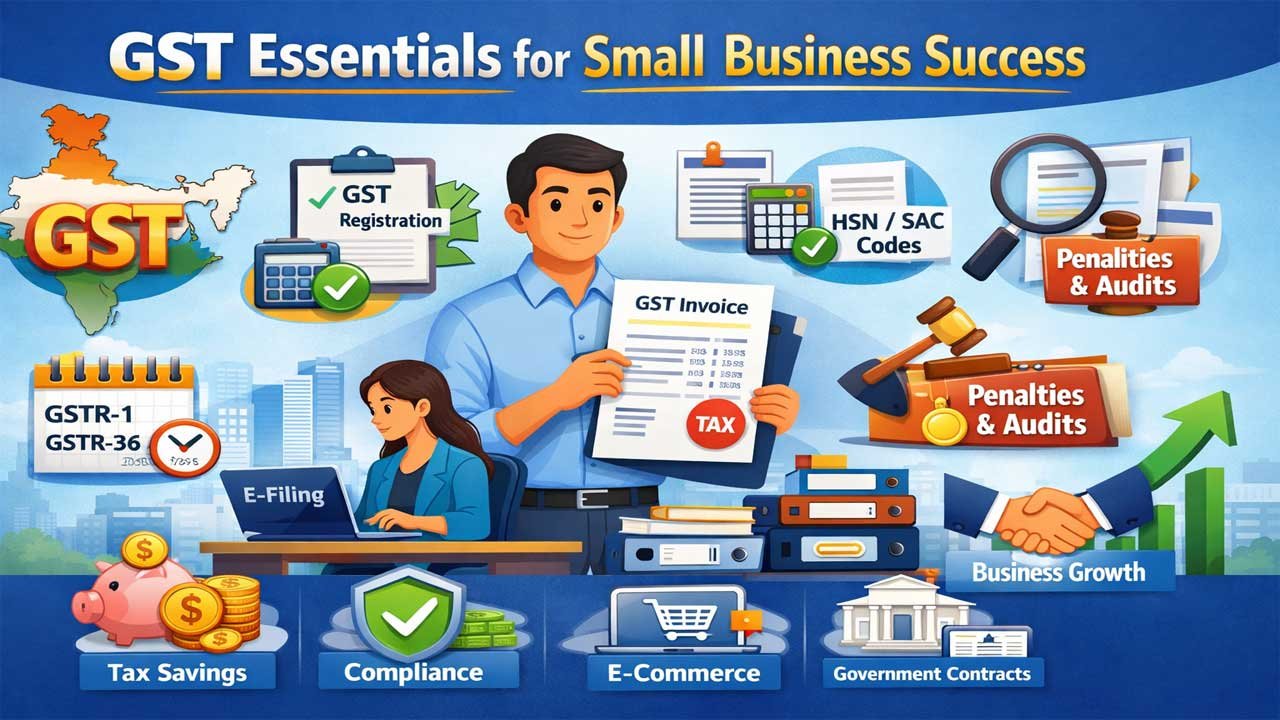
GST is a nationwide indirect tax introduced in July 2017 that replaced multiple older taxes and made tax compliance digital, transparent, and strictly enforced, making GST knowledge essential for every small business in India.
Businesses must understand registration thresholds, correct GST rates, HSN/SAC codes, input tax credit (ITC), return filing (GSTR-1, GSTR-3B), and deadlines to avoid penalties and cash losses. GST allows businesses to offset tax paid on purchases against tax collected on sales, significantly reducing costs, but only if invoices, records, and filings are accurate and timely.
Mandatory or voluntary registration improves credibility, enables e-commerce and government contracts, and supports growth, while non-compliance can lead to heavy penalties, interest, audits, or business disruption. With proper record-keeping, timely filings, correct classification, and use of software or professional help, GST becomes not just a legal requirement but a tool for savings, smoother operations, and long-term business success.
Introduction: Why Every Small Business Needs GST Knowledge
GST changed India’s tax system forever. It happened in July 2017. It unified tax rules across all states. Today, understanding GST is essential for your business success.
Small business owners face a simple truth: you must know GST rules. The government now tracks transactions in real-time. Mistakes cost money. Compliance saves money. This guide explains everything you need to know.
Key Facts About GST:
- One national tax replaces multiple old taxes
- It applies to goods and services
- Your business likely needs GST registration
- Digital filing is now mandatory
- Penalties are strict in 2026
What Is GST? Simple Explanation for Small Business Owners
GST stands for Goods and Services Tax. It’s a single indirect tax on goods and services. India uses GST instead of VAT, excise duty, and service tax.
How GST Works:
- You charge GST on your sales (output tax)
- You pay GST on your purchases (input tax)
- You claim credit for taxes paid
- You pay only the difference to government
GST rates in India are 0%, 0.25%, 1.5%, 3%, 5%, 18%, 28%, and 40%. Different products fall into different categories. Your business must use the correct rate. Wrong rates mean penalties.
The Simple Math:
If you sell ₹1,00,000 worth of goods at 18% GST:
- You collect ₹18,000 in GST from customers
- If you paid ₹10,000 GST on purchases
- You pay government: ₹18,000 – ₹10,000 = ₹8,000
- This ₹10,000 is called input tax credit
When Is GST Registration Mandatory for Small Business?
Not all businesses need GST registration. The government set turnover limits. These limits changed recently. You must know if you qualify.
Mandatory GST Registration Thresholds:
For Goods Suppliers:
- Annual turnover exceeds ₹40 lakh
- You must register immediately
- No choice in the matter
For Service Providers:
- Annual turnover exceeds ₹20 lakh
- Registration becomes mandatory
- Delay means penalties
Special Cases (Always Register):
- You do interstate supply of goods
- You do interstate supply of services
- You’re an e-commerce platform operator
- You supply through marketplaces
- You make supplies of specific notified services
Voluntary Registration Benefits:
- You can register even if below threshold
- You get input tax credit benefits
- You improve business credibility
- You access marketplace platforms
- You grow faster with GST status
Small businesses often benefit from voluntary registration. The input tax credit alone saves money. Plus, GST certificate boosts customer trust.
GST Registration Process: Step-by-Step Guide for Small Business
GST registration is completely online now. It’s faster than you think. Most small businesses complete it in 3-7 days.
Step 1: Get Your Documents Ready
Gather these documents before applying:
- PAN card (Permanent Account Number)
- Aadhaar card
- Bank account details
- Business address proof (electricity bill, rent agreement, or ownership proof)
- Shop or office photos (recent, clear images)
- List of business activities (what you sell or services you provide)
- Proprietor/partner/director ID proof
Step 2: Visit GST Portal and Create Account
Go to www.gst.gov.in
- Click “Services” section
- Select “Registration”
- Choose “New Registration”
- Enter your PAN number
- Verify with OTP on registered mobile
The system generates a Temporary Reference Number (TRN). Save it carefully. You’ll need it for the complete application.
Step 3: Fill GST Form REG-01
This is the main registration form. It asks for:
- Legal business name
- Trade name (if different)
- Business address details
- State and district information
- Primary business activity (with HSN/SAC codes)
- Promoter and partner details (if applicable)
- Bank account information
- Email and phone numbers
Pro Tip: Fill slowly. Mistakes cause rejection. Check every field twice. GST portal saves your work automatically.
Step 4: Upload Required Documents
All documents must be in PDF or image format. File size should be under 5 MB each.
Upload:
- PAN certificate scanned copy
- Aadhaar details
- Address proof document
- Shop/office photos
- Bank account statement (first page)
- Authorization letter (if applicable)
Step 5: Apply Digital Signature or E-Verify
You have two options:
- Digital Signature Certificate (DSC) – for formal companies
- E-Verification via Aadhaar OTP – easiest for sole proprietors
Most small businesses use Aadhaar e-verification. It’s fast and simple.
Step 6: Receive ARN and Wait for Approval
After submission, you get an ARN (Application Reference Number).
The government reviews your application. This typically takes 3-7 days. You can track status using ARN on the portal. The department may ask for additional documents. Respond quickly to speed up approval.
Step 7: Receive GSTIN Certificate
Once approved, you receive:
- GSTIN (15-digit unique number)
- Registration Certificate (Form GST REG-06)
- GST Registration Acknowledgement
- Login credentials for GST Portal
Now you’re officially GST-registered! Your business is legal. You can file returns. You can claim input tax credit.
Understanding GSTIN: Your 15-Digit Business Tax ID
GSTIN is your Goods and Services Tax Identification Number. It’s unique. It’s permanent. It identifies your business in the GST system.
What Is GSTIN Structure?
GSTIN has 15 characters:
- First 2 digits: State code
- Next 10 digits: PAN number (Permanent Account Number)
- Next 1 digit: Entity number (usually zero for first registration)
- Last 1 digit: Check digit (for system validation)
Example: 18AABDU5055K2Z0
Why GSTIN Matters for Your Business:
1. Legal Requirement
- Must appear on all invoices
- Must be used in all GST filings
- Required for e-way bill generation
- Needed for input tax credit claims
2. Business Credibility
- Shows customers you’re registered
- Builds trust with suppliers
- Helps secure bank loans
- Improves vendor relationships
- Opens government tender opportunities
3. Tax Advantages
- Enables input tax credit claims
- Reduces your actual tax burden
- Improves cash flow
- Allows business deductions
4. Government Visibility
- Authorities can verify your status
- Your transactions are tracked
- You maintain compliance record
- Easier for audits and inspections
5. Digital Operations
- Required for e-commerce sellers
- Needed for online marketplaces
- Essential for interstate trade
- Used in GST portal filing
Where to Find Your GSTIN:
- GST certificate (Form GST REG-06)
- GST registration acknowledgement
- GST portal login (Services > My Profile)
- Business invoices
- GST return forms
Input Tax Credit (ITC): The Most Important GST Benefit for Small Business
Input tax credit is the secret to GST savings. Most small business owners don’t claim it fully. This costs them thousands of rupees.
What Is Input Tax Credit?
ITC means claiming credit for GST you paid on purchases. You subtract this from GST you collected on sales. You pay only the difference.
Real Example:
- Your business buys materials for ₹50,000 (18% GST = ₹9,000)
- You sell products for ₹1,00,000 (18% GST = ₹18,000)
- You claim ITC of ₹9,000
- You pay government: ₹18,000 – ₹9,000 = ₹9,000
- Without ITC, you’d pay ₹18,000 (double!)
ITC is the biggest benefit of GST registration.
What Expenses Qualify for ITC?
You CAN claim ITC on:
- Raw materials and goods purchased
- Packaging materials
- Equipment and machinery
- Office supplies
- Tools and assets
- Services used in business
- Transportation and logistics
- Electricity and utilities (for business use)
- Rent and lease expenses
- Professional services (CA, lawyers, consultants)
You CANNOT claim ITC on:
- Personal use items
- Food and beverages (personal consumption)
- Motor vehicles (some exceptions)
- Alcohol and tobacco products
- Personal entertainment
- Luxury items
- Exempt supplies
How to Claim Input Tax Credit:
Step 1: Get Valid Tax Invoices
- Supplier must issue proper GST invoice
- Invoice must have GSTIN of both parties
- Must have correct HSN/SAC codes
- Must show GST separately
Step 2: Check GSTR-2B Auto-Drafted Statement
- Log into GST portal
- Go to Services > Returns > GSTR-2B
- Review all invoices from suppliers
- Check for mistakes or missing items
- Contact suppliers to correct errors
Step 3: Reconcile with Purchase Register
- Compare your purchase records
- Match with GSTR-2B data
- Find and fix discrepancies
- Keep evidence of purchases
Step 4: Report in GSTR-3B Return
- File monthly GSTR-3B return
- Enter ITC details in Table 4
- Only claim available ITC from GSTR-2B
- Submit return before deadline
Step 5: Monitor GST Credit in Portal
- Track claimed ITC status
- Watch for tax notices
- Keep all supporting documents
- Respond to any authority queries
Common ITC Mistakes Small Businesses Make:
Mistake 1: Not Keeping Invoices
- You must keep supplier invoices for 5 years
- Without invoices, you can’t prove ITC
- Tax department may deny claims
- Solution: Digital storage of all invoices
Mistake 2: Not Matching with GSTR-2B
- Government provides GSTR-2B statement
- Your ITC must match this data
- Suppliers must file GSTR-1 first
- Solution: Check GSTR-2B every month
Mistake 3: Claiming Personal Expenses
- You cannot claim personal use ITC
- Mixing business and personal is risky
- Authorities reject these claims
- Solution: Keep business and personal separate
Mistake 4: Missing the ITC Claim Deadline
- ITC must be claimed by specific date
- Usually by annual return filing date
- Late claims are rejected
- Solution: File returns on time every month
Mistake 5: Not Using Correct Invoice Documents
- Not all documents qualify for ITC
- You need proper tax invoices
- Receipts and bills may not qualify
- Solution: Ask suppliers for GST invoices specifically
HSN Codes and SAC Codes: Classification System Explained
HSN and SAC codes classify products and services. They determine your GST rate. Wrong codes mean penalties. Correct codes save money.
What Is HSN Code?
HSN stands for Harmonized System of Nomenclature. It’s a global classification system. India uses it for GST purposes.
HSN Code Structure:
- HSN codes have 6 or 8 digits
- First 2 digits = Chapter (product category)
- Next 2 digits = Heading (sub-category)
- Next 2 digits = Sub-heading
- Last 2 digits (if 8-digit code) = Tariff item
Example:
- HSN 6204 = Women’s suits
- HSN 8471 = Automatic data processing machines (computers)
What Is SAC Code?
SAC stands for Services Accounting Code. It classifies services instead of goods.
SAC Code Structure:
- SAC codes have exactly 6 digits
- All service codes start with 99
- Examples: 998300 (Engineering services), 998399 (Other professional services)
When Must You Use HSN/SAC Codes?
HSN Code Mandatory If:
- Your business turnover is ₹5 crore or above → Use 6-digit HSN code
- Your turnover is ₹1.5 crore to ₹5 crore → Use 4-digit HSN code
- You’re below ₹1.5 crore → Optional but recommended
SAC Code Mandatory If:
- You supply any taxable services
- Your turnover exceeds ₹20 lakhs (service providers)
How to Find Correct HSN/SAC Codes:
Method 1: Use Official Resources
- Visit HSN Search on GST portal
- Download HSN/SAC master from portal
- Check Central Board of Indirect Taxes (CBIC) lists
- Consult product-specific guidelines
Method 2: Use Online Tools
- HSN Code finder websites
- GST portal HSN search function
- Tally and other accounting software
- Industry associations and trade bodies
Method 3: Professional Help
- Ask your chartered accountant
- Consult GST consultants
- Contact industry bodies
- Get supplier recommendations
Benefits of Using Correct HSN/SAC Codes:
1. Correct GST Rate Application
- Each code has a specific GST rate
- Wrong code = wrong GST rate
- Correct code = compliance and savings
2. Simplified Return Filing
- GST returns auto-categorize transactions
- Reduces manual entry errors
- Faster processing by authorities
- Easier internal auditing
3. Avoid Penalties
- Tax authorities check for code misuse
- Wrong codes trigger notices
- Correct codes prevent disputes
- Smooth government audits
4. Enhanced Credibility
- Proper classification shows professionalism
- Customers trust accurate invoicing
- Suppliers view you as legitimate
- Banks approve loans faster
5. Data Analytics Benefits
- Government tracks industry trends using codes
- Better policy decisions
- You get industry insights
- Competitive advantages emerge
GST Return Filing: GSTR-3B, GSTR-1, and Other Forms Explained
GST returns are mandatory. You must file them every month. The deadline is strict. Missing deadlines means penalties.
What Is GSTR-3B?
GSTR-3B is the monthly GST return. All small businesses file this return.
What GSTR-3B Contains:
- Your total sales (output tax)
- Your total purchases (input tax credit claimed)
- Net GST payable or refund due
- Advance tax paid information
- Previous month adjustments
GSTR-3B Filing Steps:
- Log into GST portal with credentials
- Go to Services > Returns > File Return
- Select GSTR-3B and filing month
- Enter output tax (GST you collected)
- Enter input tax credit claimed (from GSTR-2B)
- Calculate net payable amount
- Pay tax online or offline
- File return before deadline
- Receive acknowledgement
Deadline: 20th of next month (some deadlines extended for delays)
What Is GSTR-1?
GSTR-1 is the sales return. It lists all your invoices issued.
When to File GSTR-1:
- Monthly (generally)
- Details of supplies made
- HSN/SAC-wise breakup
- Taxes collected
What Is GSTR-2B?
GSTR-2B is an auto-drafted statement provided by government. It shows all purchases from registered suppliers.
What GSTR-2B Does:
- Lists all invoices from your suppliers
- Shows eligible input tax credit
- Helps you reconcile with your records
- Assists in GSTR-3B filing
What Is GSTR-5A?
GSTR-5A is for non-resident persons making supplies. Most small businesses don’t file this.
What Is GSTR-6?
GSTR-6 is for input service distributors. It distributes input tax credit to branches. Not applicable to most small businesses.
2026 GST Filing Updates:
1. Mandatory Invoice Matching
- Your invoices must match suppliers’ records
- Mismatches block input tax credit
- You must correct errors immediately
- No delay is allowed
2. Real-Time Reporting
- Invoices now uploaded in real-time
- Government tracks instantly
- Discrepancies noticed faster
- Immediate notice if issues found
3. Higher Penalties for Late Filing
- One day late = penalty applies
- Penalties are stricter now
- Interest adds up quickly
- Best to file early
4. Stricter Data Matching
- Government matches your data with suppliers
- Machine learning algorithms find errors
- Automatic notices for mismatches
- You must respond quickly
GST Compliance Checklist for Small Business Owners
Compliance prevents problems. The easiest GST errors cause the biggest penalties. Follow this checklist monthly.
Monthly Checklist:
Before Filing Returns:
- [ ] Collect all invoices from suppliers
- [ ] Verify all invoices have GSTIN
- [ ] Check HSN/SAC codes are correct
- [ ] Ensure GST rates match invoice
- [ ] Compare supplier invoices with GSTR-2B
- [ ] Reconcile purchase register
- [ ] Check for invoice mismatches
- [ ] Correct any supplier errors
- [ ] Prepare output tax calculation
- [ ] Calculate ITC eligible for claiming
During Filing:
- [ ] Log into GST portal
- [ ] Access GSTR-3B for filing month
- [ ] Enter correct output tax amount
- [ ] Enter eligible input tax credit
- [ ] Check calculations twice
- [ ] Review all numbers before submission
- [ ] Attach supporting documents if needed
- [ ] Pay tax amount on time
- [ ] Submit return before deadline
After Filing:
- [ ] Save and print acknowledgement
- [ ] Store all invoices safely
- [ ] Keep backup of digital records
- [ ] Monitor for government notices
- [ ] Respond to any queries quickly
Quarterly Compliance Tasks:
- [ ] Review GST ledger balance
- [ ] Check for pending refunds
- [ ] Update business records
- [ ] Review supplier relationships
- [ ] Audit invoice documentation
- [ ] Prepare for audits
- [ ] Review compliance status
Annual Compliance Tasks:
- [ ] File annual GSTR-9 return
- [ ] Reconcile annual accounts
- [ ] Keep 5-year record backup
- [ ] Plan for next year’s compliance
- [ ] Review GST savings opportunities
- [ ] Consult professional for optimization
- [ ] Archive all documents
Penalties: What Happens If You Don’t File GST Returns
Penalties are expensive. They’re also increasing in 2026. Missing GST compliance isn’t worth the risk.
Late Filing Penalties:
For GSTR-3B Late Filing:
- ₹100-500 per day late (depending on amount)
- Minimum ₹100 per return
- Maximum penalty depends on tax amount
- Interest at 18% per annum adds up
- Late payment increases total due amount
Real Impact Example:
- Tax due: ₹10,000
- Filed 5 days late
- Penalty: ₹500-2,500
- Interest: ₹246 (approximately)
- Total cost: ₹10,746 instead of ₹10,000
Penalties for Wrong Information:
Wrong HSN Code:
- Penalty up to 10% of tax short-paid
- Can range from ₹1,000 to ₹1,00,000
- Notice issued first, then payment
False ITC Claims:
- Penalty of 10% to 100% of wrongly claimed credit
- Can be ₹5,000 to ₹5,00,000+
- Criminal action possible in serious cases
- Jail time in extreme fraud cases
Penalties for Non-Registration:
Operating Without GST When Required:
- Business premises sealed
- Inventory confiscated
- Bank accounts frozen
- Up to ₹25,000 penalty per offense
- Criminal prosecution possible
GST Benefits and Advantages for Small Business Owners
GST isn’t just compliance. It brings real business benefits. Smart business owners use GST to grow.
Financial Benefits:
1. Input Tax Credit Saves Money
- Reduce actual tax burden significantly
- Improve cash flow monthly
- Claim credit for all business expenses
- Lower final cost to customers
2. No Tax Cascading
- Old system taxed the tax (cascading)
- GST taxes only the value-add
- Prices become competitive
- Final customer pays less
3. Better Pricing Power
- GST registration shows legitimacy
- Customers prefer registered businesses
- You can charge for services
- Higher profit margins possible
Business Benefits:
1. Access Government Marketplaces
- Most platforms require GST registration
- Amazon, Flipkart demand GSTIN
- e-commerce selling impossible without GST
- Marketplace revenue becomes available
2. Loan Approval Becomes Easier
- Banks check GST compliance
- Clean GST record gets loans faster
- Better credit ratings
- Lower interest rates offered
3. Government Contracts and Tenders
- Government buys only from registered businesses
- Tender opportunities open up
- Higher revenue sources available
- Growth acceleration possible
4. Supplier Relationships Improve
- Registered businesses get better terms
- Wholesale suppliers prefer registered buyers
- Credit terms become available
- Bulk discounts easier to negotiate
5. Customer Trust Builds
- GSTIN on invoice shows legitimacy
- Customers feel secure
- Repeat business increases
- Referrals become more frequent
Common GST Mistakes and How to Avoid Them
These mistakes cost small businesses thousands. They’re easily avoidable.
Mistake 1: Not Registering When Required
The Problem:
- Government tracks turnovers through market databases
- Operating unregistered is illegal
- Penalties include business closure
The Solution:
- Register immediately after reaching threshold
- Keep registration current and active
- Update business details promptly
Mistake 2: Wrong HSN/SAC Codes
The Problem:
- Wrong code = wrong GST rate
- Government checks code usage
- Notices and penalties follow
The Solution:
- Use correct codes from day one
- Verify codes for all products
- Update codes if business changes
- Consult professionals if unsure
Mistake 3: Missing Invoice Details
The Problem:
- Invoices without GSTIN don’t qualify for ITC
- Missing details mean credit denial
- Authorities reject claims
The Solution:
- Always demand GST invoices
- Check invoice for all required fields
- Keep copies of every invoice
- Train staff on invoice requirements
Mistake 4: Not Maintaining Records
The Problem:
- You must keep records for 5 years
- Authorities ask for proof
- Without records, you can’t claim credit
- Penalties and denial of benefits result
The Solution:
- Store invoices digitally
- Keep backup copies
- Maintain organized filing system
- Use accounting software for records
Mistake 5: Claiming Ineligible ITC
The Problem:
- Personal expenses don’t qualify
- Prohibited items list is specific
- Claiming ineligible credit invites notice
- Penalties include reversal plus interest
The Solution:
- Know what qualifies for ITC
- Keep business and personal separate
- Ask professionals about borderline items
- Maintain proper documentation
Mistake 6: Filing Late Without Justification
The Problem:
- Late filing = penalty
- Even one day triggers cost
- Multiple months of lateness multiply penalties
- Interest compounds monthly
The Solution:
- Mark deadline on calendar
- File early rather than last day
- Use auto-reminders
- Keep accountant on deadline track
GST for Different Business Types
Different business structures have different requirements. Understanding yours saves stress.
Sole Proprietorship GST
Registration:
- Simplest registration process
- Only you sign documents
- PAN and Aadhaar sufficient
- Few documents needed
Benefits:
- Fastest registration approval
- Less compliance burden
- Personal account control
- Minimal formalities
Challenges:
- Personal and business liability linked
- You sign all documents
- All responsibility on one person
Partnership GST
Registration:
- All partners must provide details
- Partnership deed required
- Board resolution needed
- Multiple signatures required
Features:
- Can file jointly
- Partners share responsibility
- Flexibility in ownership
- Shared decision-making
Private Limited Company GST
Registration:
- Company PAN required
- Director details mandatory
- Board resolution needed
- Most formal process
Advantages:
- Limited liability protection
- Separate legal entity
- Professional image
- Government tender eligibility
LLP (Limited Liability Partnership)
Registration:
- Combined features of partnership and company
- LLP agreement required
- Directors and members specified
- Modern business structure
One Person Company (OPC)
Registration:
- Sole member required
- Director details needed
- Company structure with limited liability
- Growing for small businesses
GST Refunds: Getting Your Money Back
The government sometimes owes you money. Here’s how refunds work.
Types of GST Refunds:
1. ITC Refund (Input Tax Credit Excess)
- Your ITC exceeds output tax
- Common for exporters and wholesalers
- Government pays you the difference
- File refund claim
2. Refund of Erroneously Paid Tax
- You paid GST by mistake
- Wrong rate applied
- Duplicate payment made
- File rectification and claim
3. Refund Due to Return Rejection
- Return rejected by authorities
- Already paid tax
- Government refunds the amount
- Automatic process usually
How to Claim GST Refund:
Steps:
- File return showing refund due
- Go to GST portal > Services > Returns > Refund
- Click “New Refund Application”
- Select refund type
- Enter refund amount
- Attach supporting documents
- Submit application
- Wait for processing (typically 30-60 days)
Processing Time:
- Simple cases: 30 days
- Complex cases: 60 days
- With audit: 90 days
- Government can take longer if needed
GST for E-Commerce and Online Sellers
Online businesses face stricter GST rules. Platforms enforce compliance strictly.
Marketplace GST Requirements:
Mandatory Registration:
- All sellers must have GSTIN
- No exceptions on major platforms
- Amazon, Flipkart, others check actively
- Unregistered sellers get delisted
Separate Registration Per State:
- If you operate across states
- Might need separate GSTIN per state
- Check platform requirements
- Compliance varies by platform
E-Commerce GST Specifics:
Supplier Responsibilities:
- Upload invoices to GSTR-1
- Provide GSTIN to platforms
- Ensure invoice accuracy
- Keep records organized
Input Tax Credit:
- Same ITC rules apply
- Keep supplier invoices
- Claim in GSTR-3B
- Match with GSTR-2B
Platform Responsibility:
- Provide seller data to authorities
- Report all transactions
- Track GST compliance
- De-list non-compliant sellers
GST Software and Tools for Small Business
Managing GST manually is risky. Software helps prevent errors.
Recommended Solutions:
1. GST Portal (Free Official Option)
- Www.gst.gov.in
- File returns directly
- Government-approved
- No additional cost
2. Tally ERP9
- Accounting and GST software
- Auto-generates GSTR forms
- Invoice management
- Cost: ₹10,000-30,000 one-time
3. QuickBooks Online
- Cloud-based accounting
- GST compliance built-in
- Easy invoice generation
- Cost: ₹100-300 per month
4. Zoho Books
- Online accounting software
- GST-ready features
- Mobile app available
- Cost: ₹500-5,000 per month
5. Microsoft Excel or Google Sheets
- Manual but comprehensive
- Free tools
- Requires discipline
- High error risk
Features to Look For:
- [ ] Auto-generates GSTR forms
- [ ] ITC tracking and reconciliation
- [ ] HSN/SAC code management
- [ ] Invoice recording and storage
- [ ] GST payment tracking
- [ ] Deadline reminders
- [ ] Multi-state support
- [ ] Mobile access
- [ ] Customer support
- [ ] Data backup
Professional Help: When to Hire a GST Consultant
Sometimes you need expert help. Knowing when saves money in the long run.
Hire a Professional If:
Complex Business Structure:
- Multiple GST registrations needed
- Interstate supply operations
- E-commerce marketplace seller
- Import-export business
- High-value transactions
Compliance Issues:
- Notices from tax department
- Rejected returns
- Penalty disputes
- Audit preparation
- Recovery from mistakes
When Starting Out:
- First-time registration
- Unsure about registration threshold
- Confused about HSN codes
- Business structure decision pending
- Multiple business locations
What GST Professionals Offer:
- Registration guidance
- HSN/SAC code consultation
- Return filing and submission
- ITC reconciliation support
- Penalty defense
- Audit representation
- Strategic planning
- Compliance calendar setup
Cost Considerations:
Typical Fees:
- Registration assistance: ₹2,000-5,000
- Monthly filing: ₹1,000-3,000
- Annual audit: ₹5,000-15,000
- Consulting: ₹500-2,000 per hour
Return on Investment:
- Proper ITC claims save thousands
- Penalties avoided: ₹5,000-50,000+
- Time saved: 20-30 hours monthly
- Peace of mind: Priceless
GST Compliance Deadlines for 2026
Missing deadlines costs money. Mark these dates on your calendar.
Monthly Deadlines:
GSTR-1 (Sales Return):
- Due: 11th of next month
- What: Sales and supplies made
- Who: All registered businesses
GSTR-3B (Tax Return):
- Due: 20th of next month
- What: Tax calculation and payment
- Who: All regular taxpayers
GSTR-2B (Auto-drafted Statement):
- Available: Usually by 15th of next month
- What: Your purchases from suppliers
- When: Review before filing GSTR-3B
Quarterly Deadlines:
GSTIN Address Update:
- Check address every quarter
- Update if changed
- Affects communications
ITC Reconciliation:
- Match GSTR-2B monthly
- Fix discrepancies quarterly
- Prevent year-end problems
Annual Deadlines:
GSTR-9 (Annual Return):
- Due: December 31st
- What: Complete annual summary
- Who: Regular taxpayers
GSTR-9C (Audit Report):
- Due: January 31st (if required)
- What: Auditor certification
- Who: Businesses above threshold
Frequently Asked Questions About GST for Small Business
Q1: Can a business below GST threshold register voluntarily?
A: Yes, absolutely. Voluntary registration has benefits. You get input tax credit even below the threshold. Many small businesses do this strategically.
Q2: How long does GST registration take?
A: Usually 3-7 days if documents are correct. Sometimes takes 14 days if authorities need clarification. Delays happen if documents are incomplete or incorrect.
Q3: What if I accidentally used wrong HSN code?
A: Correct it in next month’s return. Send rectification letter to tax office. File amended returns if needed. Don’t worry too much—authorities understand mistakes.
Q4: Can I claim ITC on office rent?
A: Only if building/office is used for business. If you mix personal and business use, you can claim partial ITC only. Keep clear documentation.
Q5: What happens if suppliers don’t provide GST invoices?
A: Ask them to issue GST invoices. Without these invoices, you cannot claim ITC. Send formal request if needed. Change suppliers if they refuse.
Q6: Is it legal to have multiple GSTIN registrations?
A: Yes, if justified. Multiple locations or state operations may need separate registrations. Always inform tax authorities about all registrations.
Q7: Can I cancel GST registration if business closes?
A: Yes, file an application for cancellation. Returns must be filed and taxes paid. Process takes 30 days. Ensure no pending dues remain.
Q8: What’s the penalty for not maintaining records?
A: Penalties can be ₹5,000-10,000. Authorities may deny all ITC claims. Worst case: business shutdown for non-compliance.
Q9: Can spouses have separate GST registrations?
A: Only if they operate separate businesses independently. Cannot share same premises or business. Must be genuinely different businesses.
Q10: How is GST calculated on services?
A: Same as goods. Applicable rate applies based on service SAC code. Charge GST on service value. Claim ITC on business purchases. File returns same way.
Conclusion: Your GST Success Action Plan
GST compliance doesn’t have to be stressful. Smart small business owners treat it as an investment, not a burden.
Your 30-Day Action Plan:
Week 1:
- [ ] Check if you need GST registration
- [ ] Gather required documents
- [ ] Create email account if needed
Week 2:
- [ ] Start GST registration process
- [ ] Upload all documents
- [ ] Get ARN number
Week 3:
- [ ] Receive GSTIN approval
- [ ] Download registration certificate
- [ ] Set up record-keeping system
Week 4:
- [ ] File first return
- [ ] Organize monthly processes
- [ ] Mark deadlines in calendar
Long-Term Success Tips:
- Make GST a habit, not a hassle – Regular small tasks beat last-minute panic
- Keep excellent records – Everything digital with backup
- Stay updated on changes – GST rules evolve; stay informed
- File early, not late – Remove deadline pressure
- Claim all eligible ITC – This is free money your government owes you
- Use software or professional help – Time saved pays for itself
- Respond to authorities quickly – Fast responses prevent problems
- Network with other business owners – Learn from their experiences
- Plan your business with GST in mind – Smart GST planning increases profits
- Remember: GST is not a punishment – It’s a system designed to work for legitimate businesses
Your business deserves GST compliance done right. Start today. Grow faster. Sleep better.
Additional Resources
Official Sources:
- GST Council Website: www.gstcouncil.gov.in
- Central Board of Indirect Taxes & Customs: cbic.gov.in
- Official GST Portal: gst.gov.in
HSN/SAC Code Lookup:
- GST Portal HSN Search
- Tally ERP Master
- Industry-specific databases
- Professional accountant consultation
Learning Resources:
- YouTube tutorials on GST filing
- Chartered accountant blogs
- Government training sessions
- Business networking groups
Support Contacts:
- GST Helpline: 1800-GSTSUPPORT (similar numbers vary by state)
- Email: support at your state GST office
- Local GST Facilitation Centre
- Chartered accountants in your area


Leave a Reply
You must be logged in to post a comment.