
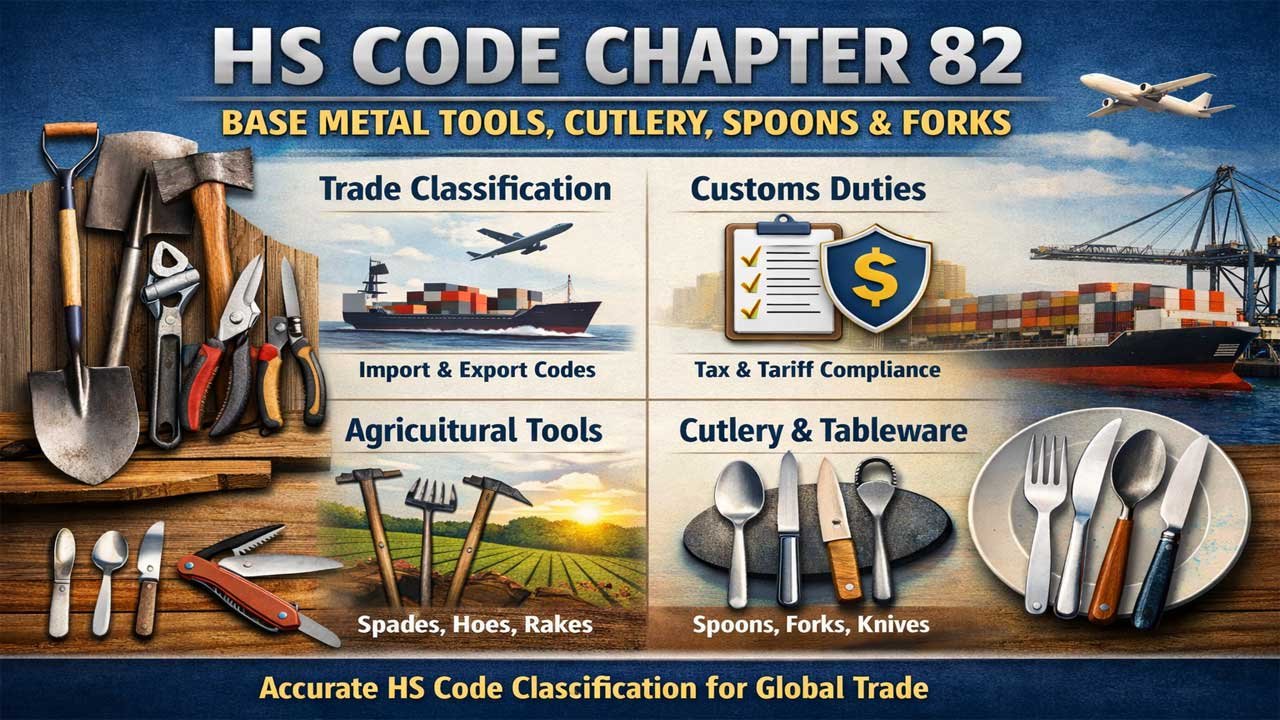
HS Code Chapter 82 covers tools and implements made from base metal. Cutlery, spoons, and forks are included in this chapter. Base metal tools and implements fall under this classification system. The harmonized system identifies these products clearly. Chapter 82 helps classify products for import and export purposes.
Base metal means common metals like iron, steel, aluminum, and copper. These materials are not precious metals. The HS code system uses this chapter for trade classification worldwide.
Understanding Base Metal Tools Classification
Base metal tools are everyday items. They include hand tools used in agriculture and industry. Implements made from base metal are common in households and workshops. The HS code classification makes trading easier for businesses.
Tools and implements of base metal are standardized in customs duties. Classification helps governments collect proper taxes. Importers need correct HS codes for clearance. Exporters use these codes for shipping documents. The harmonized system keeps international trade organized.
HS Code 8201: Hand Tools for Agriculture
HS Code 8201 covers specific hand tools. Spades and shovels fall under this code. Mattocks and picks are included here. Hoes and rakes are classified as HS 8201. Axes and bill hooks have this classification. Pruning tools also fit in this category.
These hand tools are used in agriculture. Horticulture and forestry industries rely on these implements. The tools are manually operated without power. Base metal construction is standard for these items. Forks used for agricultural purposes are in HS code 8201.
HS Code 8201 Subheadings
HS Code 8201 10 00 covers spades and shovels. HS Code 8201 30 00 includes mattocks, picks, hoes, and rakes. HS Code 8201 40 00 classifies axes and bill hooks. HS Code 8201 50 00 covers pruning shears. HS Code 8201 60 00 includes hedge shears. HS Code 8201 90 00 covers other agricultural hand tools.
Each subheading has specific product descriptions. These distinctions help in accurate classification. Traders must identify the exact product type. The correct subheading ensures proper duty calculation. Mistakes in classification can delay shipments.
HS Code 8202: Hand Saws and Saw Blades
HS Code 8202 covers hand saws exclusively. Saw blades for all types are included here. Metal-working hand saws have this classification. Wood-working saws also fall under 8202. Slitting and slotting saw blades are HS 8202.
Band saw blades have specific HS code 8202 20 00. Circular saw blades are HS Code 8202 31 00 or 8202 39 00. Chain saw blades are classified as HS 8202 40 00. Other saw blades fall under HS 8202 99 00.
The classification includes blade design variations. Machine-operated blades differ from hand-operated blades. Steel working part blades have separate codes. The HS code reflects the specific blade purpose. Importers must identify blade type correctly.
HS Code 8203: Files, Pliers, and Cutting Tools
HS Code 8203 includes many hand tools. Files and rasps are base metal cutting tools. Pliers and cutting pliers belong here. Pincers and tweezers have this classification. Metal cutting shears fall under HS 8203. Pipe-cutters and bolt croppers are included.
Perforating punches have HS Code 8203 40 10. These are specialized base metal tools. The tools serve industrial cutting purposes. Manual operation is typical for these implements. Base metal construction enables affordable pricing.
HS Code 8203 Detailed Breakdown
HS Code 8203 10 00 covers files and rasps. HS Code 8203 20 00 includes pliers, pincers, and tweezers. HS Code 8203 30 00 classifies metal cutting shears. HS Code 8203 40 covers pipe-cutters and bolt croppers. Each category has distinct functionality. Traders must differentiate between these tools carefully.
HS Code 8204: Hand-Operated Spanners and Wrenches
HS Code 8204 covers hand-operated spanners and wrenches. Torque meter wrenches are included in this classification. Interchangeable spanner sockets fall under HS 8204. Base metal spanners and wrenches require this code.
Non-adjustable spanners have HS Code 8204 11 00. Adjustable spanners are HS Code 8204 12 00. Interchangeable spanner sockets are HS 8204 20 00. Each type serves different mechanical purposes. Importers distinguish between adjustable and non-adjustable models.
These are essential mechanical tools. Automotive and industrial sectors use these extensively. Base metal construction provides durability. Affordable pricing makes them widely accessible. The HS code classification reflects tool type variations.
HS Code 8205: Other Hand Tools Not Elsewhere Specified
HS Code 8205 is the catch-all for hand tools. Tools not classified elsewhere fall here. Glaziers’ diamonds are included in this category. Drilling, threading, and tapping tools are HS 8205 10 00. Hammers and sledge hammers are HS 8205 20 00.
Planes and chisels for wood-working are HS 8205 30 00. Screwdrivers are classified as HS 8205 40 00. Household tools like can openers are HS 8205 51 00. Other hand tools without specific classification belong here.
HS Code 8205 Special Categories
Blow lamps are HS Code 8205 60 00. Vices and clamps are HS 8205 70 00. Anvils and portable forges are HS 8205 90 10. Grinding wheels with frames are HS 8205 90 20. Tool sets combining multiple items are also classified here.
This code provides flexibility in classification. New tools not fitting other codes use this. Base metal construction is standard. The versatility makes HS 8205 important for traders.
HS Code 8211: Kitchen and Table Knives
HS Code 8211 covers knives with cutting blades. Table knives with fixed blades are included. Other knives with fixed blades belong here. Pocket knives fall under HS Code 8211 93 10. Knife blades are separately classified as HS 8211 94 00.
Sets of assorted knives are HS Code 8211 10 00. These sets must contain multiple matching items. Base metal handles are classified as HS 8211 95 00. Knife blades for replacement purposes are also covered. Different knife types have distinct subheadings.
HS Code 8215: Spoons, Forks, and Kitchen Tableware
HS Code 8215 is the primary code for spoons and forks. Kitchen tableware items fall under this classification. Ladles and skimmers have HS Code 8215. Cake-servers and fish-knives are included here. Butter-knives and sugar tongs are HS 8215 items.
Sets containing at least one precious metal-plated item are HS 8215 10 00. Other sets of assorted articles are HS 8215 20 00. Items plated with precious metal are HS 8215 91 00. Base metal items without plating are HS 8215 99 00.
Spoons and Forks Classification
Spoons made from base metal are essential kitchen items. Forks for table use fall under HS Code 8215. These are distinct from agricultural forks. Table use defines the classification. Material composition doesn’t change the HS code. Base metal spoons and forks are widely traded.
HS Code 8206: Tool Sets for Retail Sale
HS Code 8206 covers tool sets specifically. These are combinations of multiple tools. Sets must contain tools from headings 8202 to 8205. The tools must be packaged together. Retail sale is a key requirement for this classification.
Garage tools in sets are HS Code 8206 00 10. Mixed tool sets are HS 8206 00 90. The combination determines the classification. Packaging together is mandatory. Individual tools use their specific codes. Only packaged sets qualify for HS 8206.
Understanding Parts of Base Metal Tools
Parts of base metal tools have special classification rules. Parts classified with the complete articles they belong to. Separately specified parts follow their own codes. Tool-holders for hand tools are HS 8466. General-use parts excluded from this chapter.
This means replacement parts follow parent article codes. Handles for cutlery are base metal parts. Blades and cutting edges are classified separately in some cases. The rule ensures logical classification. Traders must understand parent-child relationships.
Import-Export Requirements for HS Code Chapter 82
Importers must identify the correct HS code. Export documentation requires accurate classification. Customs duties depend on proper HS coding. Incorrect codes result in penalties. Countries apply tariff rates based on HS codes.
The first six digits are standardized globally. Additional digits vary by country. India uses 8-digit ITC HS codes. The first six digits remain identical. Last two digits reflect national requirements. Traders must use country-specific formats.
GST Rates for Base Metal Tools in India
GST rates apply to tools and cutlery in India. HS Code Chapter 82 items have varying GST rates. Most base metal tools attract 5% to 18% GST. Kitchen utensils typically fall under lower GST brackets. Hand tools have moderate GST rates.
The GST rate depends on product classification. Precise HS codes determine applicable rates. Invoices must show correct HS codes. GST compliance requires accurate classification. Traders must verify rates before transactions.
Key Differences Between HS Codes
HS Code 8201 is for agricultural hand tools. HS Code 8203 covers cutting and piercing tools. HS Code 8204 focuses on spanners and wrenches. HS Code 8205 includes general hand tools. HS Code 8211 is for knives and blades. HS Code 8215 covers spoons, forks, and tableware.
Understanding differences prevents classification errors. Each code serves a specific purpose. Purpose and function determine the correct code. Material composition is secondary. End-use defines the primary classification. Traders must learn these distinctions.
Common Mistakes in HS Code Classification
Confusing HS 8201 forks with HS 8215 forks is common. Agricultural forks differ from table forks. Function determines the correct code. Using wrong codes delays shipments. Penalties apply to incorrect classifications.
Another error is misclassifying tool sets. Individual tools differ from packaged sets. HS 8206 applies only to retail sets. Mixing products incorrectly classified causes problems. Careful identification prevents these errors.
How to Verify HS Code Classification
Import-export data websites help verify codes. Official tariff books provide authoritative information. Chamber of commerce can assist with classification. Customs authorities provide formal classifications. Trade associations offer guidance. Expert consultants help with complex items.
Perplexity.ai and similar tools provide quick information. However, official sources should confirm classifications. Document all classification decisions. Keep records for audits. Proper documentation protects businesses from penalties.
Benefits of Accurate HS Code Classification
Correct classification ensures smooth customs clearance. Accurate codes reduce trade delays significantly. Proper tariff application provides fair pricing. Businesses avoid penalties and legal issues. Accurate records enable better supply chain planning.
Correct codes attract the right buyers. Import-export facilitation improves business efficiency. Trading partners gain confidence. Documentation becomes straightforward. Financial planning becomes more reliable. Accurate classification is business best practice.
Conclusion
HS Code Chapter 82 classifies tools, implements, cutlery, spoons, and forks of base metal. Each specific product has a designated code. Base metal construction is common for these items. The classification system serves international trade purposes. Accurate coding is essential for import-export business.
Understanding these codes is crucial for traders. Different types require different classifications. Agricultural tools differ from kitchen utensils. Packaged sets have special codes. Individual products follow distinct rules.
Importers and exporters must master HS coding. Mistakes lead to delays and penalties. Accurate classification ensures business success. Using correct HS codes streamlines operations. Professional guidance helps avoid costly errors. Chapter 82 products remain essential for global trade.


