
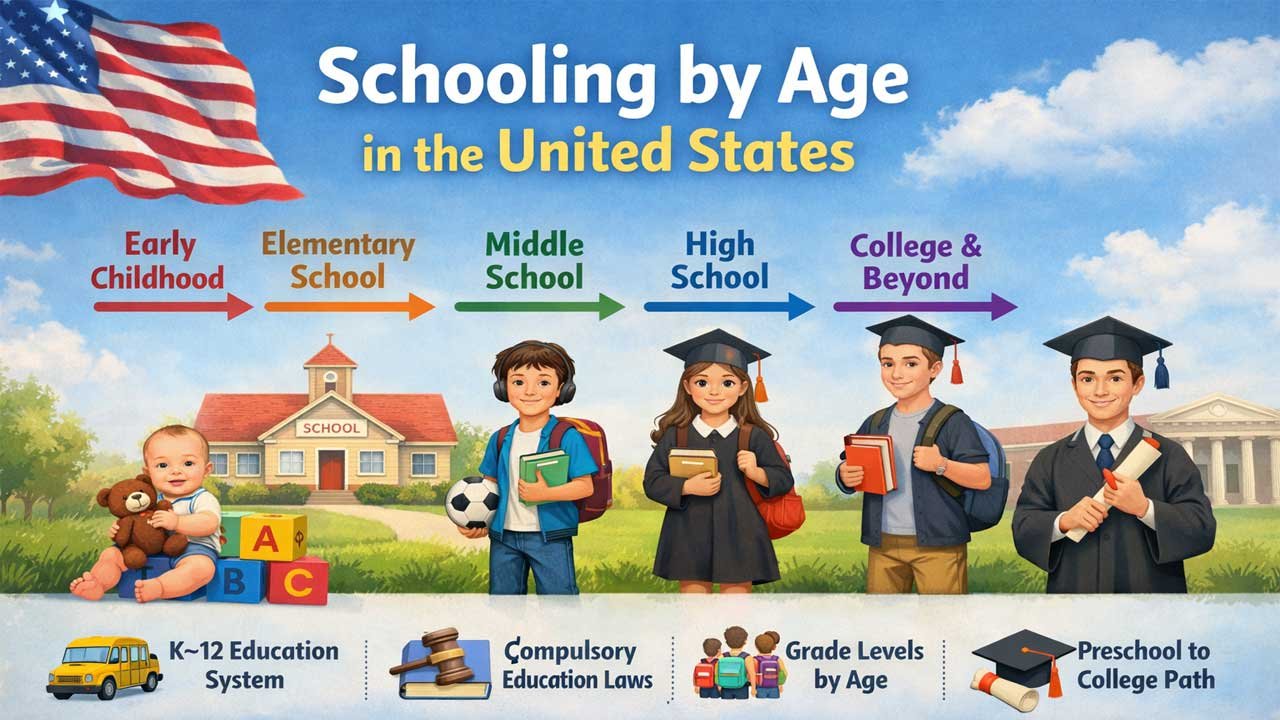
The United States education system follows a generally standardized K–12 structure that places children in grade levels primarily by age, while allowing flexibility across states and school districts.
Children typically begin optional early childhood education from birth to age four, enter kindergarten at age five, progress through elementary school (grades K–5), middle school or junior high (grades 6–8 or 7–9), and high school (grades 9–12), graduating around ages 17–18 before moving on to college or other postsecondary options.
Although grade-by-age placement is fairly consistent nationwide, compulsory attendance laws, kindergarten cutoff dates, and schooling options vary by state. Beyond age, successful progression depends heavily on social-emotional, physical, and academic readiness, with support systems such as special education, homeschooling, charter, magnet, and private schools providing alternatives to traditional public schooling.
Overall, the US system emphasizes developmental appropriateness, legal flexibility, and multiple educational pathways to support students from early childhood through adulthood.
Schooling by Age in United States: Complete Guide to US Education System
Understanding the American education system and knowing what grade your child should be in at a specific age is essential for parents planning their children’s academic future.
The United States follows a standardized K-12 education system where children progress through specific grade levels based on their age. This comprehensive guide breaks down schooling by age, compulsory education laws, grade levels, transitions, and available educational options.
Understanding the US Education System Structure
The American education system is organized into several distinct stages, each serving specific age groups and developmental needs. The system is primarily decentralized, meaning individual states set many of their own requirements while following federal guidelines for special education and other mandates.
The education system typically includes:
- Early childhood education (birth to age 4)
- Elementary school (kindergarten through 5th grade)
- Middle school or junior high (grades 6-8 or 7-9)
- High school (grades 9-12)
- College and higher education (18 years and older)
Each stage addresses the developmental, social, emotional, and academic needs of students at that age.
Grade Levels and Corresponding Ages
The following chart shows the standard relationship between grade levels and student age in the United States:
| Grade Level | Age | School Level |
|---|---|---|
| Kindergarten | 5 years old | Elementary School |
| 1st Grade | 6 years old | Elementary School |
| 2nd Grade | 7-8 years old | Elementary School |
| 3rd Grade | 8-9 years old | Elementary School |
| 4th Grade | 9-10 years old | Elementary School |
| 5th Grade | 10-11 years old | Elementary School |
| 6th Grade | 11-12 years old | Middle School |
| 7th Grade | 12-13 years old | Middle School |
| 8th Grade | 13-14 years old | Middle School |
| 9th Grade (Freshman) | 14-15 years old | High School |
| 10th Grade (Sophomore) | 15-16 years old | High School |
| 11th Grade (Junior) | 16-17 years old | High School |
| 12th Grade (Senior) | 17-18 years old | High School |
These age ranges represent typical progression through the system. A child’s specific grade placement depends on their birth date and state-specific cutoff dates for kindergarten enrollment.
Early Childhood Education (Birth to Age 4)
Infants and Toddlers (Birth to Age 2)
Early intervention services are available for infants and toddlers with identified disabilities or developmental delays. Under the Individuals with Disabilities Education Act (IDEA) Part C, children birth through age 2 with disabilities and their families receive early intervention services. These services focus on developmental support in areas including:
- Cognitive development
- Communication skills
- Physical development
- Social-emotional development
- Adaptive daily living skills
While not compulsory, these services are free for eligible children and can make significant differences in long-term outcomes.
Preschool and Pre-K (Ages 3-4)
Preschool is optional in all 50 states and typically serves children ages 3 to 4 years old. High-quality preschool programs focus on social-emotional development, language development, early literacy and numeracy skills, and play-based learning.
Research shows that children who participate in preschool develop stronger social-emotional competencies that support their later academic success. Kindergarten readiness extends far beyond academic knowledge—it requires:
- Self-awareness and emotional regulation
- Social skills and peer interaction abilities
- Following directions and understanding expectations
- Fine motor skills for writing and cutting
- Gross motor skills for physical activities
- Language comprehension and expression
Kindergarten (Age 5) and Elementary School (Ages 6-10)
Kindergarten Entry Requirements
Kindergarten enrollment begins at age 5 in most states. However, specific kindergarten entrance age requirements vary by state:
- Early entrance states (Age 5 by July-August): Alaska, Arizona, California, Colorado, Florida, Georgia, Illinois, Iowa, Kentucky, Michigan, Mississippi, Nebraska, Oregon, Tennessee, Texas, Utah, West Virginia, and Wisconsin
- Mid-year entrance states (Age 5 by September 1): Connecticut, Delaware, Hawaii, Maryland, New Mexico, Oklahoma, Rhode Island, South Carolina, South Dakota, and Virginia
- Late entrance states (Age 5 by October-December): Arkansas, Colorado, Maine, Missouri, and North Dakota
- Variable entrance (School board determines): Massachusetts, New Hampshire, New Jersey, New York, and Pennsylvania
Some states also allow early admission of children who turn 5 near the cutoff date, provided they meet readiness criteria.
Elementary School Years (Grades K-5)
Elementary school focuses on foundational academic skills including reading, writing, mathematics, science, and social studies. The elementary years emphasize:
- Basic literacy development (K-2)
- Early mathematics competencies
- Social development and peer relationships
- Gross and fine motor skill development
- Artistic and physical education
- Gradually increasing academic expectations
Elementary school teachers often teach multiple subjects in self-contained or partially departmentalized classroom settings, emphasizing interdisciplinary learning.
Compulsory School Attendance Laws
Compulsory education requirements vary significantly by state, but all 50 states require children to attend school during specified age ranges. Understanding your state’s requirements is crucial for legal compliance.
Minimum and Maximum Compulsory Attendance Ages by State
| Minimum Compulsory Age | States | Maximum Compulsory Age | States |
|---|---|---|---|
| 5 years old | Arkansas, Connecticut, Delaware, District of Columbia, Maryland, New Mexico, Oklahoma, Rhode Island, South Carolina, Virginia | 16 years old | 19 states |
| 6 years old | 24 states including California, Florida, Georgia, Illinois, Michigan, New York, Texas | 17 years old | 11 states |
| 7 years old | 16 states including Alaska, Idaho, Indiana, Kansas, Louisiana, Minnesota, Missouri, Montana, Nevada, North Carolina, North Dakota, Wyoming | 18 years old | 20 states including Colorado, Connecticut, District of Columbia, Hawaii, Kansas, Louisiana, Nebraska, Nevada, New Mexico, Ohio, Oklahoma, Oregon, Rhode Island, Texas, Utah, Washington, Wisconsin |
Note: Some states allow parents to opt out of kindergarten enrollment at age 6 by filing notice with the school board, while still maintaining legal compliance with compulsory attendance laws.
Middle School (Ages 11-14)
Middle School Structure and Focus
Middle school typically serves grades 6-8 and includes students ages 11-14. This stage represents a critical transition from childhood to early adolescence. Middle schools emphasize:
- Holistic development (social, emotional, academic, and physical)
- Transition support from self-contained elementary classrooms to departmentalized instruction
- Exploration of diverse interests through electives and clubs
- Development of organizational and study skills
- Social-emotional learning and peer relationships
Middle School vs. Junior High: Key Differences
While most public schools use the “middle school” model (grades 6-8), some districts employ a “junior high” structure (grades 7-9). The distinction matters for student development:
Middle School (Grades 6-8, Ages 11-14):
- Interdisciplinary, exploratory curriculum
- Longer block schedules
- Focus on developmental support
- Emphasis on transition and emotional readiness
- Broader extracurricular offerings
- Teacher teams working together
Junior High (Grades 7-9, Ages 12-15):
- Subject-specific, departmentalized instruction
- Traditional 6-8 period daily schedule
- Increased academic rigor and expectations
- Greater emphasis on independence
- More competitive extracurricular structure
- More similar to high school format
Research suggests that middle school structures provide better developmental support for young adolescents, helping them navigate the significant physical, emotional, and cognitive changes of early adolescence.
Developmental Changes During Middle School
Adolescents in grades 6-8 experience significant developmental changes:
- Physical Development: Puberty begins or continues; rapid growth spurts; increased concern about body image
- Cognitive Development: Abstract thinking develops; problem-solving abilities increase; capacity for complex reasoning grows
- Social-Emotional Development: Peer relationships become more important; independence from family increases; identity formation begins; mood swings are common
- Academic Demands: Multi-teacher systems; multiple classes and transitions; increased homework and independent work expectations
High School (Ages 14-18)
High School Structure (Grades 9-12)
High school serves grades 9-12 and primarily includes students ages 14-18. This stage focuses on academic specialization, college and career preparation, and increasing independence.
High school coursework becomes more rigorous and specialized, with opportunities for:
- Honors and Advanced Placement (AP) courses
- Dual enrollment college courses
- Career and Technical Education (CTE) programs
- International Baccalaureate (IB) programs
- Specialized magnet or charter programs
Adolescent Development in High School
Teenagers in grades 9-12 continue developing toward adulthood while managing significant transitions:
Freshman Year (Age 14-15):
- Adjustment to larger school environment
- Increased academic expectations and workload
- Formation of new friendships in larger peer groups
- Beginning of serious interest in romantic relationships
- Developing stronger sense of identity
Sophomore Year (Age 15-16):
- Greater emotional regulation and coping skills
- More developed study habits and organizational skills
- Stronger self-awareness of strengths and weaknesses
- Planning for academic tracks and future goals
Junior Year (Age 16-17):
- Highest academic demands and stress levels
- Greater independence and autonomy in decision-making
- College planning and preparation activities
- Deeper romantic and social relationships
- Increased interest in social and political issues
Senior Year (Age 17-18):
- Transition planning for post-secondary options
- Development of greater emotional maturity and perspective
- More adult-like communication and reasoning
- Preparation for independence and adulthood responsibilities
- Decision-making regarding college, military, or workforce
Compulsory Attendance and When Students Can Leave School
All 50 states require school attendance until a minimum age (typically 16-18). Once students reach the maximum compulsory age in their state, they may withdraw from school with appropriate documentation, though graduation is still encouraged.
Some states allow early withdrawal if a student:
- Reaches the compulsory school age
- Has completed specific requirements
- Has parental permission (for students under 18)
However, students should understand that without a high school diploma or GED, employment and educational opportunities are significantly limited.
College and Higher Education (Age 18+)
Typical College Entry Age
Students typically enter college at age 18, though there is no mandatory age requirement. The typical ages for post-secondary education include:
- Associate’s Degree (2 years): Ages 18-20
- Bachelor’s Degree (4 years): Ages 18-22
- Master’s Degree (2 years): Ages 22-24
- Doctoral Degree (4-6 years): Ages 26-33
No Age Limits in US Higher Education
Unlike some countries, the United States has no upper age limit for pursuing higher education. Universities welcome:
- Recent high school graduates
- Adults returning to education after career breaks
- Older adult learners pursuing degrees for personal enrichment
- Career changers seeking new qualifications
Many US universities offer flexible formats including online courses, evening classes, and part-time options to accommodate diverse student populations.
Special Education Services by Age
Early Intervention (Birth to Age 2)
Under IDEA Part C, infants and toddlers with disabilities or developmental delays receive early intervention services at no cost to families. These services support child development and family functioning across multiple domains.
Special Education (Ages 3-21)
Children and youth ages 3 through 21 with disabilities receive special education and related services under IDEA Part B. Services are provided through:
- Individualized Education Programs (IEPs)
- Free appropriate public education (FAPE)
- Least restrictive environment (LRE) placement
- Services across all educational settings
The most common disability categories served include:
- Specific learning disabilities
- Speech or language impairments
- Autism spectrum disorder
- Intellectual disabilities
- Emotional/behavioral disabilities
- Physical disabilities
- Sensory disabilities (hearing, vision)
- Other health impairments (ADHD, asthma)
Alternative Schooling Options by Age
Homeschooling
Homeschooling is a legal educational option in all 50 states. Compulsory homeschooling ages vary by state:
- Most common compulsory ages: 6-18 or 7-16
- States with later start ages: Washington (8 years old), several states beginning at age 7
- States with earlier requirements: Some states require homeschooling enrollment at age 5
Homeschooling laws vary significantly regarding:
- Required parental qualifications
- Curriculum requirements
- Assessment and testing
- Record-keeping
- Notification procedures
Parents should research their specific state’s homeschooling regulations before beginning.
Charter Schools
Public charter schools are available in most states and serve students kindergarten through 12th grade. Charter schools operate with greater flexibility than traditional public schools while remaining publicly funded and free to attend.
Magnet Schools
Magnet schools are public schools with specialized curricula (STEM, arts, medical sciences, etc.) serving elementary through high school levels. About 3.5 million students attend magnet schools nationwide. Magnet school entry is typically through:
- Application process
- Lottery selection (if oversubscribed)
- Auditions for specialized programs
- Criteria-based entry requirements
Private Schools
Private schools serve students from preschool through 12th grade and operate independently with their own admissions requirements and tuition costs.
Kindergarten Readiness: Skills Beyond Age
While age and grade placement are important, kindergarten readiness involves much more than chronological age. Kindergarten teachers emphasize that success depends on multiple domains:
Academic Skills
- Letter and number recognition
- Counting ability
- Pre-reading and pre-writing skills
- Ability to focus and follow simple lessons
Social-Emotional Skills (Most Important)
- Self-awareness and ability to identify feelings
- Emotional regulation and self-control
- Ability to sit, listen, and attend to tasks
- Cooperation and sharing abilities
- Following directions
- Interacting appropriately with peers and adults
- Adapting to routines and transitions
Physical Development
- Gross motor skills (running, jumping, hopping, skipping)
- Fine motor skills (holding a pencil, using scissors, drawing)
- Ability to maintain focus during activities
Language Development
- Understanding spoken language
- Expressive communication abilities
- Ability to follow multi-step directions
- Listening comprehension
Research from the Collaborative for Academic, Social, and Emotional Learning (CASEL) demonstrates that children with strong social-emotional skills perform better academically, adapt more quickly to school environments, and build more positive relationships with peers and teachers.
State-Specific Variations in Schooling
Beyond compulsory attendance ages, state requirements vary in:
- Kindergarten entrance dates: Cutoff dates ranging from July 31 to October 15
- School year length: Most states require 180 days; some require 175-185 days
- Early childhood programs: Varying levels of state-funded pre-K availability
- Special education services: Extended services beyond age 21 in some states
- Homeschooling regulations: Ranging from minimal oversight (Alaska) to extensive requirements (New York)
- Character education: Specific subject requirements vary by state
Parents should verify their specific state’s requirements with their state department of education or local school district.
Supporting Your Child Through School Transitions
Kindergarten Transition
Prepare for kindergarten entry by:
- Visiting the kindergarten classroom or school multiple times
- Reading books about starting school
- Practicing self-care skills (bathroom use, hand washing, eating independently)
- Establishing consistent bedtime and morning routines
- Encouraging independence in dressing and decision-making
- Arranging playdates to build social skills
- Meeting the kindergarten teacher before school starts
- Practicing separation from parents in low-stress environments
Elementary to Middle School Transition
Support your child through this major transition by:
- Taking a tour of the middle school
- Meeting teachers and counselors
- Practicing organization skills and multiple-class transitions
- Building social connections before school starts
- Discussing expectations for increased independence
- Developing time management and study skills
- Identifying extracurricular interests
- Maintaining open communication about adjustment
Middle School to High School Transition
Prepare for high school by:
- Touring the high school campus
- Understanding course selection and tracking options
- Discussing course rigor and college preparation
- Exploring extracurricular and sports opportunities
- Addressing social concerns and new social dynamics
- Planning for increased homework and study requirements
- Discussing college and career planning
- Supporting development of independence and responsibility
High School to College Transition
College preparation includes:
- Taking challenging courses in high school
- Developing strong study habits and time management
- Exploring college and university options early
- Taking SAT or ACT tests
- Developing a well-rounded profile
- Seeking college counselor guidance
- Understanding financial aid and scholarship options
- Practicing independence in decision-making and organization
Conclusion
Understanding schooling by age in the United States provides a roadmap for parents, educators, and students as they navigate the American education system. While chronological age determines grade placement, true school readiness encompasses academic, social-emotional, physical, and language development. Each stage of education—from early childhood through high school—serves crucial developmental purposes and prepares students for subsequent stages.
The American education system offers flexibility with compulsory attendance laws, alternative educational options like homeschooling and charter schools, and specialized programs for students with disabilities. By understanding age-appropriate expectations, supporting successful transitions, and focusing on holistic development, parents and educators can ensure students thrive throughout their educational journey.
Whether your child follows the traditional public school path or explores alternative options, success depends on recognizing developmental needs, maintaining high expectations, and providing appropriate support during each stage of growth. As education continues to evolve, these foundational structures remain constant in supporting American students from kindergarten through college.
FAQs About Schooling by Age in USA
What age do children start kindergarten in the US?
Children typically start kindergarten at age 5, though the specific age requirement varies by state. Most states require children to be 5 years old by a cutoff date between July 31 and October 15 of the school year they plan to enter.
Is kindergarten mandatory in the US?
Kindergarten mandatory attendance varies by state. Some states require kindergarten enrollment, while others allow parents to opt out and begin formal schooling in first grade.
What is the difference between middle school and junior high?
Middle school (grades 6-8) focuses on holistic development with an exploratory curriculum and block scheduling. Junior high (grades 7-9) emphasizes academic specialization with traditional departmentalized classes and is more similar to high school.
When does a child have to start school?
Compulsory school attendance begins between ages 5-8 depending on the state, with most requiring enrollment at age 6 or 7.
Can my child skip a grade?
Grade acceleration is possible in many districts for advanced students. Decisions depend on academic ability, social-emotional readiness, and district policies.
What are the benefits of kindergarten programs?
Quality kindergarten supports academic preparation, social skill development, emotional regulation, and school readiness. Research shows kindergarten participants have better school success than non-participants.
How can I help my child transition to a new school?
School tours, meeting teachers, reading books about transitions, practicing routines, and maintaining open communication support successful transitions.


Leave a Reply
You must be logged in to post a comment.