
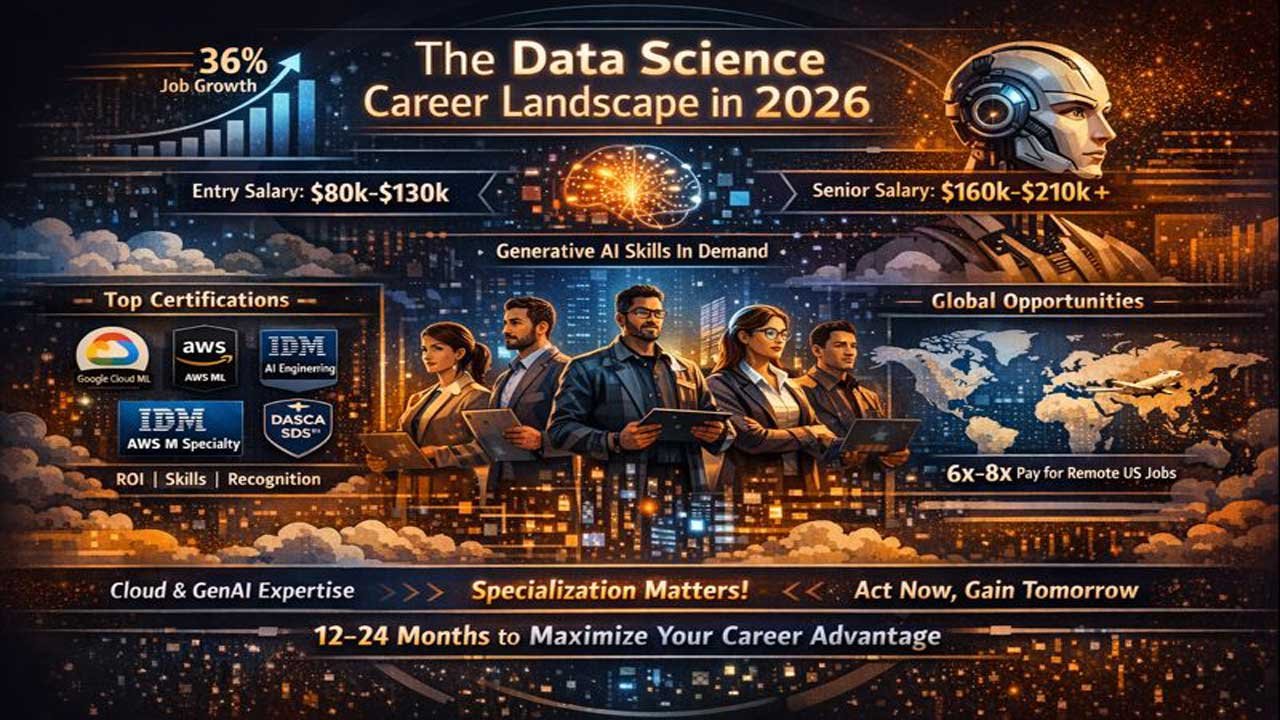
The data science job market has exploded into one of the fastest-growing sectors globally. The U.S. Bureau of Labor Statistics projects 36% employment growth from 2023 to 2033, significantly outpacing average job growth. Simultaneously, salary expectations for certified data professionals have climbed dramatically—from $80,000–$130,000 for entry-level positions to $160,000–$210,000+ for senior roles with specialized expertise.
However, not all certifications are created equal. A certification’s value hinges on three critical factors: return on investment (ROI), employer recognition, and skill-to-salary alignment. In 2026, the emergence of generative AI has fundamentally reshaped which certifications matter most and which career paths command premium compensation.
This guide dissects the top certifications, breaks down real salary data across markets, and maps career trajectories so you can make an informed decision aligned with your financial goals and geographic location.
| Area | Insight |
|---|---|
| Market Growth | Data science jobs growing 36% (2023–2033), far above average |
| Salary Range (US) | Entry: $80k–$130k · Senior: $160k–$210k+ |
| Biggest Salary Drivers | Cloud ML, GenAI, MLOps, LLMOps |
| Top ROI Certifications | Google Cloud ML, AWS ML Specialty, IBM AI Engineering, DASCA SDS™ |
| Highest ROI Skill | Generative AI + Cloud ML |
| GenAI Impact | Created new roles (LLMOps, GenAI Strategist, Synthetic Data Architect) |
| Certification Value Factors | ROI, employer recognition, skill–salary alignment |
| Best for Career Switchers | IBM AI / Data Science (Coursera) |
| Best for Senior Roles | DASCA SDS™, MIT Applied AI |
| Global Opportunity | Remote US roles = 6–8× pay uplift for emerging markets |
| Trend for 2026 | Specialization > generalist data scientist |
| Window of Advantage | Next 12–24 months before certification premiums compress |
The Current State of Data Science Careers in 2026
Market Demand & Growth Trajectory
Data science isn’t just growing—it’s accelerating. Organizations across every sector—finance, healthcare, retail, manufacturing—are racing to operationalize AI and extract value from data. This urgency creates two dynamics favorable for professionals:
First, talent scarcity. An estimated 11.5 million data science jobs will be generated by 2026, but qualified candidates remain scarce. This scarcity drives up salaries and increases the ROI of certifications that signal readiness.
Second, skill premiums. Professionals with specialized expertise—particularly in machine learning operations (MLOps), generative AI integration, and cloud infrastructure—command salary premiums of 20–50% over baseline data scientist roles. A certified data scientist with MLOps expertise, for instance, can command $150,000–$180,000 in the U.S. market versus $110,000–$130,000 for generalists.
The GenAI Inflection Point
Generative AI has introduced a critical inflection point in data science careers. The traditional linear path—data cleaning → statistical modeling → business insight—is being restructured. Roles are fragmenting into specialized archetypes:
- Generative AI Data Strategist: Architecting where and how to apply GenAI to organizational data
- Synthetic Data Architect: Building privacy-preserving datasets using generative techniques
- AI-Aware Model Developer: Leveraging GenAI for rapid prototyping and validation
- LLMOps Engineer: Deploying, monitoring, and optimizing large language models in production
Certifications that integrate GenAI literacy—prompt engineering, RAG (Retrieval-Augmented Generation) pipelines, and vector database management—now carry premium career value.
Top Data Science Certifications Ranked by ROI and Career Impact
| Certification | Cost | Duration | Experience Required | Salary Uplift | Best For | Employer Recognition |
|---|---|---|---|---|---|---|
| Google Cloud Professional ML Engineer | $200 | 3–5 months | Intermediate+ | ~25% (+$32k) | Cloud ML engineers, advanced practitioners | Excellent; top cloud employer demand |
| AWS Certified ML – Specialty | $300 | 4–6 months | Intermediate+ | ~20% (+$24k) | AWS-focused roles, MLOps engineers | Excellent; 60%+ enterprise ML workloads |
| IBM AI Engineering Professional Certificate | $49/month ($200–300 total) | 6–9 months | Beginner–Intermediate | 15–20% on entry-level | Career switchers, portfolio builders | Good; Coursera credibility + IBM brand |
| DASCA Senior Data Scientist (SDS™) | $950 | 6 months (self-paced) | Advanced (4–5 years) | ~30% for senior roles | Senior practitioners, leadership track | Excellent; vendor-neutral, prestigious |
| Databricks ML Professional (Associate) | $200 | 2–3 months | Intermediate | 15–18% | Spark/Databricks ecosystem specialists | Growing; strong in big data orgs |
| MIT Applied AI & Data Science | ~$2,000–2,500 | 12–14 weeks (intensive) | Intermediate+ | 20–28% | Career accelerators, premium market positioning | Excellent; Ivy League prestige |
| SAS Certified AI & ML Professional | $610 total (3 exams) | 4–6 months | Intermediate | 18–22% | Enterprise AI practitioners, regulated industries | Good; strong in finance/healthcare |
| IBM Generative AI Engineering Certificate | $49/month ($200–300) | 5–7 months | Beginner+ | 20–30% (emerging roles) | GenAI specialists, prompt engineers | Emerging; cutting-edge demand |
Deep Dive: Top 4 Certifications for Maximum Career Impact
1. Google Cloud Professional ML Engineer
Best for: Engineers already comfortable with cloud infrastructure seeking maximum salary uplift.
ROI Analysis: At $200, this certification offers the best cost-to-salary ratio. Professionals holding this credential typically command $130,000–$160,000+ salaries, representing a ~25% uplift over non-certified peers. The 3–5 month timeline is aggressive but achievable for intermediate practitioners with prior ML experience.
Real-World Impact: Organizations using Google Cloud (particularly early-stage tech companies and Fortune 500 enterprises standardizing on GCP) actively seek this credential. Job posting frequency for “Google Cloud ML Engineer” increased 34% year-over-year as of Q4 2025.
Demand Trend: As enterprises migrate AI workloads to the cloud, demand for platform-specific ML expertise is escalating. Unlike generic data science credentials, this certificate directly correlates with hiring velocity.
2. AWS Certified Machine Learning – Specialty
Best for: Practitioners in AWS-dominated ecosystems; data engineers transitioning to ML.
ROI Analysis: The $300 exam fee and 4–6 month prep timeline represent a moderate investment with proven returns. AWS ML specialists command a ~20% salary premium, equating to $24,000–$30,000 annual uplift for mid-level professionals. Critically, AWS powers over 60% of enterprise ML infrastructure, making this credential highly fungible across employers.
Real-World Impact: The AWS ML certification has become table-stakes for data engineers transitioning to ML roles at organizations using SageMaker. Hiring managers frequently list this as a “nice-to-have” that meaningfully accelerates offer timelines.
International Applicability: AWS is globally dominant, making this credential valuable across geographies—particularly in Canada, Germany, and Australia where AWS adoption is high.
3. IBM AI Engineering Professional Certificate (Coursera)
Best for: Career switchers, entry-level professionals, those seeking portfolio-driven proof of skill.
ROI Analysis: At $49/month, this credential is the most accessible pathway into professional data science roles. Coursera reports that 87% of IBM AI Engineering completers transition into AI-related roles within three months of certification. For entry-level professionals, this translates to a jump from $60,000–$75,000 (no credential) to $80,000–$110,000 (with credential), a 25–45% uplift.
Real-World Impact: This certificate excels because it emphasizes portfolio projects. Rather than passing a single exam, learners build GitHub-ready projects that directly address hiring manager concerns. The certificate includes capstone work deploying real AI models, creating immediate credibility.
Portfolio Advantage: Hiring managers openly acknowledge that practical project experience outweighs generic certifications. The IBM track delivers this at scale and low cost.
4. DASCA Senior Data Scientist (SDS™)
Best for: Experienced practitioners (4–5+ years) seeking prestigious, vendor-neutral credentials for senior/leadership roles.
ROI Analysis: At $950 with a 6-month self-paced timeline, this is a mid-premium investment. However, the ROI is substantial for senior practitioners: SDS™ holders typically command 25–35% salary premiums in leadership transitions, translating to $35,000–$60,000+ annual uplift. For a senior data scientist earning $150,000 baseline, SDS™ certification can position them for $185,000–$210,000 principal or staff roles.
Prestige Factor: Unlike vendor-specific credentials, DASCA’s SDS™ is vendor-neutral and emphasizes leadership, business impact, and large-scale project execution. Hiring managers for senior/principal roles explicitly value this distinction—it signals readiness for strategic roles, not just execution.
Eligibility Barrier = Quality Signal: The stringent prerequisites (4–5 years experience + relevant degree) create a self-selecting cohort, making the credential credible to C-suite hiring committees.
Global Data Science Salary Benchmarks by Certification
Understanding geographic salary differentials is critical for career strategy, especially for remote-eligible roles. Certified professionals command meaningful premiums, but these vary dramatically by region.
United States (Highest Absolute Salaries)
| Experience Level | No Certification | With Entry-Level Cert (IBM/Google) | With Advanced Cert (AWS/Google ML) | With Senior Cert (DASCA SDS) |
|---|---|---|---|---|
| Entry (0–2 years) | $60,000–$75,000 | $75,000–$95,000 | N/A | N/A |
| Mid (2–5 years) | $90,000–$120,000 | $110,000–$140,000 | $130,000–$160,000 | N/A |
| Senior (5–10 years) | $130,000–$160,000 | $150,000–$185,000 | $160,000–$210,000 | $185,000–$240,000 |
| Principal/Lead (10+ years) | $160,000–$210,000 | $190,000–$250,000 | $220,000–$290,000 | $240,000–$320,000+ |
Regional Premium: Tech hubs (Bay Area, NYC, Seattle) add 15–25% to these figures. Remote roles for U.S. companies range from $95,000–$160,000 for mid-level, independent of location.
India (Highest Growth Market)
| Experience Level | No Certification | With Entry-Level Cert | With Advanced Cert | With Senior Cert |
|---|---|---|---|---|
| Entry (0–2 years) | ₹4–7 LPA ($4,800–$8,400) | ₹6–9 LPA ($7,200–$10,800) | N/A | N/A |
| Mid (2–5 years) | ₹9–15 LPA ($10,800–$18,000) | ₹12–18 LPA ($14,400–$21,600) | ₹15–22 LPA ($18,000–$26,400) | N/A |
| Senior (5+ years) | ₹20–30 LPA ($24,000–$36,000) | ₹25–36 LPA ($30,000–$43,200) | ₹30–45 LPA ($36,000–$54,000) | ₹40–60 LPA ($48,000–$72,000) |
Strategic Opportunity: Remote roles for U.S./European companies paying global rates (not India-adjusted) represent exceptional opportunities. A mid-level data scientist in India earning ₹12 LPA ($14,400 locally) can access $90,000–$120,000 USD roles for U.S. companies, a 6–8x income differential.
United Kingdom (European Benchmark)
| Experience Level | No Certification | With Certification | Senior with Premium Cert |
|---|---|---|---|
| Mid (2–5 years) | £55,000–£75,000 ($69,000–$94,000) | £68,000–£90,000 ($85,000–$113,000) | £85,000–£110,000 ($107,000–$138,000) |
| Senior (5+ years) | £80,000–£110,000 ($100,000–$138,000) | £100,000–£135,000 ($125,000–$169,000) | £125,000–£160,000 ($157,000–$201,000) |
Canada, Australia, and Continental Europe
| Country | Entry-Level | Mid-Level | Senior | Certification Premium |
|---|---|---|---|---|
| Canada | CAD $55–70k ($41–$52k USD) | CAD $75–95k ($56–$71k USD) | CAD $100–130k ($75–$97k USD) | +18–22% |
| Australia | AUD $65–80k ($42–$52k USD) | AUD $95–120k ($62–$78k USD) | AUD $130–160k ($85–$104k USD) | +15–20% |
| Germany | €42–55k | €60–80k | €85–115k | +20–25% |
| Switzerland | CHF 95–120k ($110–$139k) | CHF 130–170k ($150–$197k) | CHF 170–220k ($197–$254k) | +15–20% |
Switzerland Anomaly: Despite highest absolute salaries, certification premiums are lower due to already-premium baseline salaries. However, absolute salary gains are highest here.
Career Progression Pathways: From Entry to Principal
Pathway 1: The Fast-Track Cloud ML Engineer (3–5 Year Timeline)
Target Final Salary: $180,000–$240,000 (U.S.)
- Year 0–1: Foundation → IBM AI Engineering Cert ($200–300) → Entry-level ML Engineer role ($80,000–$95,000)
- Year 1–2: Platform Specialization → AWS ML Specialty ($300) → Mid-level ML Engineer ($120,000–$140,000)
- Year 2–3: Advanced Platform → Google Cloud Professional ML Engineer ($200) → Senior ML Engineer ($150,000–$180,000)
- Year 3–5: Leadership → Optional: DASCA SDS™ ($950) → Staff/Principal ML Engineer ($200,000–$240,000+)
Investment: ~$1,650 in certifications
Salary Progression: $80k → $240k+ (~200% increase)
ROI: 145x cost recovery in annual salary uplift alone
Pathway 2: The Enterprise Data Scientist (4–7 Year Timeline)
Target Final Salary: $160,000–$220,000 (U.S.)
- Year 0–1: Foundations → IBM Data Science Professional Cert ($200–300) + portfolio projects → Junior Data Scientist ($70,000–$85,000)
- Year 1–3: Specialization → SAS AI & ML Professional ($610) OR AWS ML ($300) → Data Scientist ($110,000–$140,000)
- Year 3–5: Leadership Positioning → DASCA SDS™ ($950) → Senior Data Scientist ($150,000–$185,000)
- Year 5–7: Principal/Strategy → Optional: Harvard/MIT advanced cert → Principal Data Scientist/Data Science Manager ($200,000–$220,000+)
Investment: ~$2,000–2,500 in certifications
Salary Progression: $70k → $220k+ (~215% increase)
Timeline: Longer but emphasizes depth and business impact
Pathway 3: GenAI Specialist (Accelerated 2–3 Year Track)
Target Final Salary: $150,000–$220,000+ (emerging premium)
- Month 0–3: IBM Generative AI Engineering + Coursera DeepLearning.AI GenAI courses (~$300) → Prompt engineer/GenAI specialist role ($85,000–$110,000)
- Month 3–9: Advanced GenAI certification (RAG, LLMOps) → Senior GenAI/LLM Engineer ($130,000–$160,000)
- Month 9–24: Optional: Cloud ML cert (AWS/Google) + advanced role → Principal GenAI Architect ($180,000–$250,000+)
Investment: ~$800–1,200
Salary Progression: $85k → $220k+ (~160% increase)
Timeline: Fastest ROI trajectory; capitalizes on emergent skill scarcity
In-Demand Skills That Define Career Value in 2026
Certifications are valuable proxies, but the underlying skills they validate drive actual salary outcomes. Here’s the hierarchy:
Tier 1: Foundational Skills (Table-Stakes)
- Python proficiency (pandas, NumPy, scikit-learn) — Appears in ~90% of job postings
- SQL and data manipulation — Essential for 95%+ of roles
- Statistics and mathematics (probability, linear algebra, calculus) — Differentiates mid-level from entry-level
Salary Impact: +$5,000–$15,000 over baseline
Tier 2: Intermediate Specializations (Career Accelerators)
- Machine Learning (69% of postings) → Advanced feature engineering, model validation, hyperparameter tuning
- Data visualization (Tableau, Power BI, matplotlib) → Storytelling and stakeholder communication
- Cloud platforms (AWS, Azure, GCP) — Now in 20% of postings and growing
- Deep Learning/NLP — Demand for NLP skills jumped from 5% (2023) to 19% (2024) of job postings
Salary Impact: +$20,000–$50,000 over baseline
Tier 3: Emerging Premium Skills (2026 Salary Multipliers)
- Generative AI & LLM deployment — RAG pipelines, prompt engineering, LLMOps
- MLOps/LLMOps — Model monitoring, CI/CD for ML, cost optimization
- Synthetic data generation — Privacy-preserving ML, regulatory compliance
- Vector databases (Pinecone, Weaviate, Milvus) — Critical for GenAI applications
Salary Impact: +$30,000–$80,000 over baseline; premium roles can command $180,000–$280,000
Tier 4: Business Multipliers (Leadership Differentiation)
- Strategic thinking — Where to apply AI for business value
- Cross-functional communication — Data translation for non-technical stakeholders
- Domain expertise — Healthcare, finance, supply chain knowledge accelerates impact
Salary Impact: Multiplicative on all other factors; enables principal/executive roles
Certification Decision Framework
Choosing the right certification requires aligning certification characteristics with your current state and target role.
Quick Decision Matrix
Question: What is your current experience level?
- Zero to 1 year (Career switcher) → IBM AI Engineering ($200–300, 6–9 months) OR Coursera Google Data Analytics/Science ($39/month). These build portfolios, not just credentials.
- 1–3 years (Early career, foundational skills present) → AWS ML Specialty ($300) OR Google Cloud ML Engineer ($200) depending on your cloud stack.
- 3–5 years (Mid-career, some specialization) → Cloud specialist cert (AWS/Google, $200–300) OR SAS AI & ML ($610) for enterprise credibility.
- 5+ years (Senior, deep expertise) → DASCA SDS™ ($950) for leadership positioning. Your network and project portfolio matter more than entry-level certs.
Question: What is your geographic target market?
- US-based roles → Google Cloud Professional ML Engineer or AWS ML Specialty deliver highest ROI ($130k+ average salary).
- International (India, Southeast Asia) → IBM Coursera certs provide cost-effective entry; cloud certs unlock premium remote U.S. company roles.
- European roles → SAS or vendor-neutral certifications (DASCA) carry premium prestige; cloud certs also strong.
Question: What is your budget?
- <$500 total → IBM Coursera certificates, Google Data Analytics Pro
- $500–$1,000 → AWS ML Specialty, Google Cloud ML Engineer, SAS AI & ML
- $1,000+ → DASCA SDS™, MIT/Harvard advanced certificates, intensive programs
Top Certifications Summary & Recommendations
For Maximum Career Acceleration (1–3 Years to $150k+)
Recommendation: Pair IBM AI Engineering ($200–300) with AWS ML Specialty ($300) or Google Cloud ML Engineer ($200).
- Timeline: 9–12 months of concurrent/sequential study
- Total Investment: $700–$800
- Expected Salary Outcome: $130,000–$160,000 (U.S.), or $85,000–$110,000 (remote-global rates)
- ROI: 150–200x cost recovery in annual salary gains
For Prestige & Senior-Level Positioning
Recommendation: DASCA Senior Data Scientist (SDS™) or MIT Applied AI & Data Science.
- Timeline: 12–14 weeks (MIT) or 6 months (DASCA)
- Total Investment: $950–$2,500
- Expected Salary Outcome: $185,000–$240,000+ (U.S.)
- ROI: 80–100x cost recovery; emphasis on leadership roles
For GenAI Specialization & Emerging Market Opportunity
Recommendation: IBM Generative AI Engineering Certificate + advanced RAG/LLMOps courses.
- Timeline: 5–7 months
- Total Investment: $400–$600
- Expected Salary Outcome: $140,000–$220,000+ (premium for scarcity)
- ROI: 200–300x; fastest-growing specialization
For Budget-Conscious Career Switchers
Recommendation: IBM Data Science Professional Certificate (Coursera) or Google Data Analytics Advanced Certificate.
- Timeline: 6–9 months
- Total Investment: $200–$300
- Expected Salary Outcome: $75,000–$95,000 (entry-level)
- ROI: 250–400x cost recovery; entry point into high-income field
Emerging Trends & The Future of Data Science Credentials in 2026
The GenAI Credentialization Rush
Certifications specifically addressing generative AI, prompt engineering, and LLM deployment have emerged as the fastest-growing segment. IBM, Google, and Microsoft have all released GenAI-specific credentials within the past 18 months. Demand for these certifications is outpacing supply, creating a temporary premium for holders.
However, this premium will likely compress as supply catches up—suggesting that early adopters will see outsized returns.
Specialization Over Generalization
The era of “generic data scientist” is ending. Instead, market fragmentation is accelerating:
- Data Engineer + ML → 15–20% premium
- ML + GenAI → 25–35% premium
- Data + Domain Expertise (Healthcare/Finance) → 30–50% premium
- MLOps/LLMOps focus → 25–40% premium
Certifications that credibly signal deep specialization (AWS ML, Google Cloud, DASCA SDS™) are gaining market value faster than broad credentials.
Vendor-Neutral vs. Platform-Specific Bifurcation
Two certification tracks are emerging:
- Vendor-Neutral (DASCA, Open CDS, Harvard, MIT) — Valuable for career longevity and executive positioning. Slower hiring signal but higher prestige.
- Platform-Specific (AWS, Google Cloud, Azure, Databricks) — Faster hiring signal, 18–24 month half-life as platforms evolve. Must be continuously updated.
Forward-thinking professionals are pursuing both: a platform-specific cert for immediate hiring velocity + a vendor-neutral cert for career longevity.
Conclusion: Mapping Your 2026 Data Science Certification Strategy
The data science certification landscape in 2026 offers unprecedented opportunity—but only for professionals who align certification choices with career strategy and geographic context.
Key Takeaways:
- Certifications drive measurable salary premiums — 15–35% uplift on baseline salary, translating to $15,000–$80,000 annual gains depending on experience and geography.
- Platform-specific credentials (AWS, Google Cloud) deliver fastest hiring signals — Ideal for mid-level professionals seeking rapid advancement.
- Vendor-neutral credentials (DASCA SDS™) position for leadership — Ideal for senior practitioners targeting principal/executive roles.
- GenAI specialization is the highest-growth opportunity — Emerging roles command 25–50% premiums, but windows of scarcity advantage are closing rapidly.
- Geographic arbitrage remains powerful — Remote roles for U.S. companies, combined with India-based cost of living, represent the most attractive income-to-cost-of-living ratio globally.
- Skill investment compounds — Python + ML + Cloud + GenAI creates multiplicative career acceleration. Each skill layer increases your market value exponentially.
The 2026 Opportunity: Data science is moving from “hot career” to “critical infrastructure.” Organizations that haven’t yet embedded data science are now forced to compete for talent. This creates a narrow window—likely 12–24 months—where certifications are still powerful signals. As the field matures, certifications will matter less and demonstrated impact more. Now is the optimal time to certify.
FAQs
Are data science certifications worth it in 2026?
Yes. In 2026, certifications deliver measurable ROI, often increasing salaries by 15–35%, especially when paired with cloud, GenAI, or MLOps skills.
Which data science certification has the highest ROI?
Google Cloud Professional ML Engineer and AWS ML Specialty offer the highest ROI due to low cost, strong employer demand, and direct salary impact.
Do certifications matter more than experience?
No. Experience matters more long term, but certifications accelerate hiring, salary negotiation, and role transitions—especially at early and mid-career stages.
What is the best certification for career switchers?
IBM AI Engineering or IBM Data Science Professional Certificate are best for career switchers because they emphasize hands-on projects and portfolio building.
Which certification is best for senior data scientists?
DASCA Senior Data Scientist (SDS™) is best for senior professionals targeting leadership, principal, or strategy-focused roles.
How much salary increase can a certification provide?
Typical salary uplift ranges from $15,000 to $80,000 annually, depending on experience level, geography, and specialization.
Are GenAI certifications worth pursuing now?
Yes. GenAI certifications currently command a scarcity premium of 25–50%, especially for roles involving LLMOps, RAG pipelines, and deployment.
Which skills matter more than certifications?
Python, SQL, machine learning, cloud platforms, and GenAI deployment skills matter most. Certifications are valuable because they signal these skills.
Is AWS or Google Cloud certification better?
AWS is more globally dominant, while Google Cloud often provides slightly higher salary uplift in tech-forward companies. Choice should match your target employers.
Can certifications help land remote US jobs from other countries?
Yes. Cloud and GenAI certifications significantly increase access to US-based remote roles paying global rates rather than local salaries.
How long does it take to see ROI from a certification?
Most professionals see ROI within 3–9 months through job changes, promotions, or salary negotiations.
Do employers trust online certifications like Coursera?
Yes, when backed by strong brands (IBM, Google, DeepLearning.AI) and paired with real portfolio projects.
Are vendor-neutral certifications better than vendor-specific ones?
Vendor-specific certifications drive faster hiring, while vendor-neutral ones offer long-term credibility and leadership positioning. The best strategy combines both.
Is the generic “data scientist” role declining?
Yes. The market is shifting toward specialized roles such as ML Engineer, GenAI Specialist, MLOps Engineer, and Data Strategist.
What certification is best for GenAI roles?
IBM Generative AI Engineering Certificate combined with advanced LLMOps or RAG-focused training is currently the strongest entry point.
How important is geography for salary outcomes?
Extremely important. The same certification can yield vastly different pay depending on whether you target US, European, or global-remote roles.
Will certification value decrease in the future?
Yes, over time. Certifications are most powerful during skill inflection points—2026 is one of those windows due to GenAI adoption.
What matters more: certification prestige or practical skills?
Practical skills and demonstrable impact matter most. Prestige helps mainly at senior levels or when competing for leadership roles.
Is now the right time to invest in data science certifications?
Yes. The next 12–24 months represent a peak opportunity before GenAI and cloud certifications become baseline expectations.


Leave a Reply
You must be logged in to post a comment.