
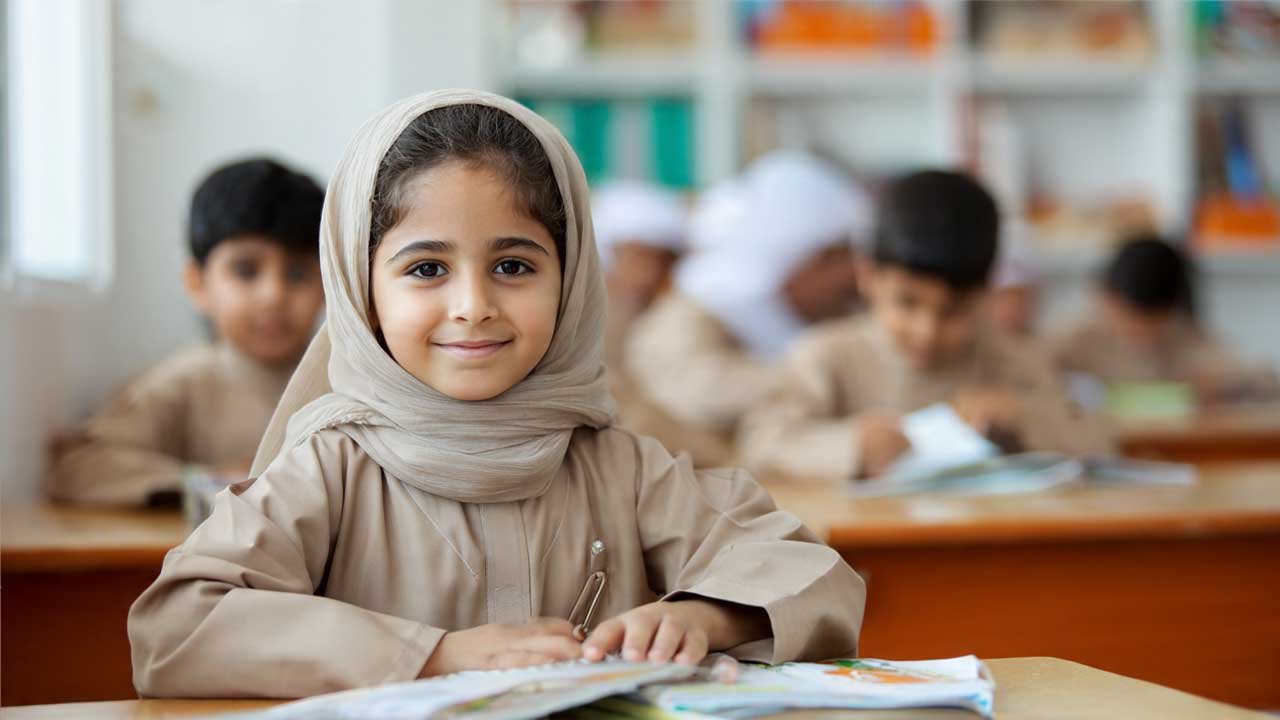
The UAE education system is a globally admired model that combines innovation, inclusivity, and excellence across every stage of learning—from early childhood to higher education. Structured through a clear age-wise framework, it nurtures students’ cognitive, emotional, and social development while aligning with international standards.
With both public and private sectors offering diverse curricula such as the British, American, IB, and Ministry of Education systems, learners gain flexibility and global exposure. The UAE’s investment in world-class universities, research institutions, and digital learning ensures that every student is equipped for the demands of a knowledge-based economy, reflecting the nation’s commitment to lifelong learning and academic leadership.
| Aspect | Details |
|---|---|
| Education Type | Dual System – Public (MoE Curriculum) & Private (International Curricula) |
| Compulsory Education Age | 6 to 18 years (Grades 1–12) |
| Early Childhood Education | Voluntary; Ages 3–5 (Nursery to KG2) |
| Primary Education (Cycle 1) | Ages 6–10; Grades 1–4; Focus on core literacy, numeracy & values |
| Intermediate Education (Cycle 2) | Ages 11–14; Grades 5–8; Focus on analytical thinking & digital skills |
| Secondary Education (Cycle 3) | Ages 15–18; Grades 9–12; Choice of General, Advanced, Applied, or Elite streams |
| Graduation Requirement | Completion of Grade 12 + EmSAT or equivalent qualification |
| Language of Instruction | Arabic in public schools; English or curriculum-specific in private schools |
| Higher Education | Available through public, private, and international universities |
| Major Regulators | Ministry of Education (MoE), KHDA (Dubai), ADEK (Abu Dhabi) |
| Academic Year Start | Typically September (some start in April) |
| Key Curriculum Options | MoE, British (IGCSE/A-Levels), American, IB, Indian (CBSE/ICSE), French |
| Cut-off Dates for Admission | August 31 (September intake) or March 31 (April intake) |
| Goal of the System | To produce globally competitive, innovative, and skilled learners |
The UAE Education System: An Age-Wise Journey Through World-Class Learning 🇦🇪
The UAE’s Bold Vision for Education Excellence: Education in the United Arab Emirates stands as a beacon of transformation, innovation, and inclusion. Over the past few decades, the UAE has reshaped its education system into a modern, globally competitive framework that seamlessly merges national identity with international best practices. With a population that includes both Emiratis and a large expatriate community, the UAE’s education sector caters to diverse linguistic, cultural, and academic needs.
The government’s relentless focus on quality learning, technology integration, and lifelong education underscores its vision for a knowledge-based economy. From nurturing curiosity in early childhood to empowering graduates in world-class universities, the UAE ensures that every stage of learning contributes to building a skilled, creative, and future-ready generation.
Early Childhood Education in the UAE (Voluntary but Vital)
Early childhood education is where the UAE’s journey toward academic excellence begins. Though not compulsory, nursery and kindergarten education enjoy immense popularity among both Emirati and expatriate families. This stage, typically for children aged 3 to 5 years, emphasizes the holistic development of the child—emotionally, socially, linguistically, and physically.
Through structured play, creative exploration, and interactive teaching, children develop foundational skills essential for lifelong learning. UAE nurseries often blend international early learning frameworks such as EYFS (Early Years Foundation Stage) with local cultural elements, ensuring a balanced and inclusive experience. Schools adhere to strict age-placement cut-off dates—August 31 for September-start schools and March 31 for April-start institutions—to maintain uniformity across the education landscape.
Key Stages of Early Learning
| Stage | Age | American/MoE Grade | British Year | Focus |
|---|---|---|---|---|
| Nursery/Pre-KG | 3 years | Pre-KG | FS1 | Socialization, early motor and language skills |
| Kindergarten | 4–5 years | KG1 & KG2 | FS2 & Year 1 | Literacy, numeracy, emotional and social readiness |
AUBSP Insight: Early education is where curiosity begins—parents are encouraged to invest in this stage to foster a love for learning that lasts a lifetime.
Compulsory Schooling (K–12): Building Knowledge and Character
From the age of six, education becomes mandatory for all children in the UAE, continuing until the completion of Grade 12 (around 18 years). The Ministry of Education (MoE) system structures compulsory education into three key cycles, ensuring a seamless, age-appropriate academic journey.
A. Primary Education (Cycle 1)
For students aged 6 to 10 years (Grades 1–4), the focus lies in establishing strong foundations in core subjects such as Arabic, English, Mathematics, Science, and Islamic Studies (for Muslim students). Beyond academics, schools prioritize developing positive learning attitudes, curiosity, and moral awareness. This stage is crucial for fostering creativity, communication, and collaboration skills that will later support higher learning success.
AUBSP Perspective: The UAE’s primary education is not just about knowledge—it’s about nurturing confidence and curiosity in every learner.
B. Intermediate Education (Cycle 2)
At ages 11 to 14 (Grades 5–8), students begin transitioning from fundamental to analytical learning. This phase introduces more complex subjects like Social Studies, Design & Technology, and foreign languages. In public schools, gender segregation often begins at this stage, while private schools generally remain co-educational.
The UAE’s intermediate education cultivates critical thinking, digital literacy, and independent learning—skills aligned with the nation’s futuristic workforce vision. Students are encouraged to question, reason, and innovate rather than memorize, laying the groundwork for specialized secondary studies.
C. Secondary Education (Cycle 3)
Covering ages 15 to 18 (Grades 9–12), this phase marks the transition from general education to specialization. Students choose from academic or vocational streams under the MoE system, aligning education with their strengths and career goals.
The Four Major Streams in UAE Secondary Education:
- General Stream: A balanced academic path preparing students for university entry.
- Advanced Stream: Focused on intensive Math and Science learning for high achievers.
- Professional/Applied Stream: Offers career-oriented training with real-world applications.
- Elite Stream (Advanced Science Program): Designed for exceptional learners, sometimes beginning as early as Grade 6.
Graduation requires passing the national Emirates Standardized Test (EmSAT), securing the General Secondary Education Certificate or equivalent qualifications (A-Levels, IB Diploma, or High School Diploma).
AUBSP Insight: UAE secondary education blends rigor with flexibility, preparing learners for global universities and a knowledge-driven economy.
The Dual System: Public vs. Private Education in the UAE
One of the UAE’s most distinctive educational features is its dual-sector structure, encompassing public (government) and private schools. Each sector operates under federal and local education authorities such as the Ministry of Education (MoE), KHDA (Dubai), and ADEK (Abu Dhabi).
Public schools primarily serve Emirati nationals, offering free education rooted in the national curriculum emphasizing Arabic, Islamic Studies, and UAE heritage. Conversely, private schools cater to both locals and expatriates, delivering globally recognized curricula like the British, American, IB, Indian (CBSE), and French systems.
| Feature | Public Schools | Private Schools |
|---|---|---|
| Target Group | UAE Nationals | Nationals & Expatriates |
| Curriculum | MoE National Curriculum | International Curricula |
| Language of Instruction | Arabic | English or curriculum language |
| Gender Policy | Segregated (from Cycle 2) | Mostly co-educational |
AUBSP Tip: Choosing between public and private schooling depends on language preference, curriculum goals, and long-term university plans.
Higher Education in the UAE (Ages 18+): Gateway to Global Opportunities
Upon completing secondary education, students enter the higher education phase, where the UAE shines as a regional hub for world-class universities. The country’s tertiary ecosystem blends national pride with international excellence, offering degree programs across diverse disciplines.
Public Universities
Institutions like United Arab Emirates University (UAEU), Zayed University, and Higher Colleges of Technology (HCT) provide Emirati students with tuition-free access to top-quality education. These universities emphasize research, innovation, and leadership development aligned with Vision 2030 goals.
Private and International Universities
The UAE hosts numerous international branch campuses—such as New York University Abu Dhabi (NYUAD) and American University in Dubai (AUD)—offering globally accredited degrees. Many private institutions deliver specialized programs in business, engineering, AI, and healthcare, attracting students from over 150 nationalities.
AUBSP Note: The UAE’s higher education landscape represents a fusion of global intellect and local ambition—empowering students to excel anywhere in the world.
Conclusion: A Future-Ready Learning Ecosystem
The UAE education system is not just a national framework—it’s a visionary blueprint for global academic excellence. By combining strong policies, quality assurance, and international collaboration, the UAE ensures every child’s learning journey is meaningful and world-class. From early childhood to advanced research degrees, every stage reflects the nation’s dedication to knowledge, innovation, and lifelong learning.
We believe that understanding education systems like the UAE’s helps parents, educators, and policymakers make informed decisions that shape the leaders of tomorrow. Stay connected with AUBSP for in-depth educational insights, student guidance, and global academic updates that empower your journey toward excellence.
FAQs on UAE Education System
What is the structure of the UAE education system?
The UAE education system follows a structured, age-wise model divided into Early Childhood Education, Primary (Cycle 1), Intermediate (Cycle 2), Secondary (Cycle 3), and Higher Education. It operates under a dual system—public schools using the Ministry of Education (MoE) curriculum and private schools offering international curricula such as British, American, IB, and Indian systems.
At what age does schooling become compulsory in the UAE?
Education becomes compulsory at age six, beginning from Grade 1 and continuing until the completion of Grade 12 or its equivalent qualification, typically around age 18.
Is early childhood education mandatory in the UAE?
No, early childhood education is voluntary but strongly encouraged. Most children attend nursery or kindergarten between ages three and five to develop foundational literacy, numeracy, and social skills.
What are the main stages of education in the UAE?
The main stages are Early Childhood (3–5 years), Primary (6–10 years), Intermediate (11–14 years), Secondary (15–18 years), and Higher Education (18+ years). Each stage focuses on age-appropriate learning outcomes aligned with global standards.
Which languages are used for instruction in UAE schools?
Public schools primarily teach in Arabic with English as a second language. Private schools, however, use English or the primary language of their adopted curriculum, such as French or Hindi.
What are the major curricula offered in UAE private schools?
Private schools offer a wide range of international curricula including British (IGCSE/A-Level), American (High School Diploma), International Baccalaureate (IB), Indian (CBSE/ICSE), and others like French and Canadian programs.
What is the Emirates Standardized Test (EmSAT)?
The EmSAT is a national standardized test administered by the Ministry of Education to evaluate students’ readiness for higher education. Passing the EmSAT is often required for graduation and university admission in the UAE.
What are the education streams in UAE secondary schools?
Students in secondary education can choose from four main streams: General, Advanced, Professional/Applied, and Elite. Each stream is designed to align with specific career paths or higher education goals.
Are UAE public schools free for citizens?
Yes, public schools are free for UAE nationals. Expatriates may enroll in private schools, which charge tuition fees depending on the curriculum and school rating.
When does the academic year start in the UAE?
Most schools begin their academic year in September, following the international calendar. However, some schools—especially those following Indian or Asian curricula—start in April.
Who regulates education in the UAE?
The education system is overseen by multiple authorities: the Ministry of Education (MoE) for federal matters, KHDA (Knowledge and Human Development Authority) in Dubai, and ADEK (Abu Dhabi Department of Education and Knowledge) in Abu Dhabi.
How are students placed into grades in the UAE?
Placement is determined by strict age cut-off dates—August 31 for September-start schools and March 31 for April-start schools. These guidelines ensure consistency across all educational institutions.
Can expatriate students attend public schools?
While public schools primarily serve UAE nationals, a limited number of expatriate students may be admitted, depending on availability and policy updates. Most expatriate families, however, choose private schools.
What subjects are taught in UAE schools?
Core subjects include Arabic, English, Mathematics, Science, and Islamic Studies (for Muslim students). Additional subjects like Social Studies, Technology, and Physical Education are also included.
Is gender segregation practiced in UAE schools?
Yes, gender segregation typically begins in public schools from the Intermediate stage (Cycle 2). Private schools are generally co-educational, though some may follow single-gender models based on cultural or curriculum requirements.
What are the key goals of the UAE education system?
The main goals are to develop critical thinking, innovation, cultural awareness, and lifelong learning. The UAE aims to prepare students for a globalized economy through quality education aligned with Vision 2030.
What higher education options are available in the UAE?
Students can pursue tertiary education at public universities like UAEU and HCT, or private and international branch campuses such as NYU Abu Dhabi, American University in Dubai, and Sorbonne University Abu Dhabi.
Are UAE degrees recognized internationally?
Yes, degrees from accredited UAE universities are globally recognized. Many institutions in the UAE maintain partnerships with international universities to ensure alignment with global academic standards.
How do private schools ensure quality education in the UAE?
Private schools are regularly inspected and rated by authorities like KHDA and ADEK. Ratings assess teaching quality, student outcomes, leadership, and school facilities, ensuring consistent educational standards.
What support does the UAE provide for students with special needs?
The UAE follows an inclusive education policy, ensuring equal learning opportunities for students with special educational needs through tailored programs, trained staff, and accessibility initiatives.
Does the UAE promote digital learning and innovation?
Yes, the UAE strongly integrates digital education through smart classrooms, AI-based learning tools, and e-learning platforms, reinforcing its goal of becoming a global leader in innovation and technology-driven education.
Can students transfer between curricula or schools in the UAE?
Yes, transfers are allowed, provided they meet the age, grade equivalency, and admission criteria of the new curriculum. Schools may require academic transcripts or placement assessments before acceptance.
How do UAE schools prepare students for global universities?
UAE schools focus on international certifications, advanced coursework, and skill-based education that align with university admission requirements worldwide. Many also offer career guidance and counseling.
What is the role of parents in the UAE education system?
Parental involvement is highly encouraged through school councils, progress meetings, and feedback systems. Parents play a key role in shaping their child’s academic and personal development.
How is moral education incorporated in UAE schools?
Moral education is a compulsory component emphasizing ethics, cultural values, tolerance, and civic responsibility, aligning with the UAE’s national vision for character and community development.
What makes the UAE education system unique globally?
Its uniqueness lies in combining international curricula with local heritage, world-class infrastructure, and government-driven innovation, making it one of the most advanced education systems in the Middle East.
What are the admission requirements for higher education in the UAE?
Applicants must have completed secondary education (Grade 12 or equivalent) and meet minimum scores in standardized tests like EmSAT, IELTS, or SAT, depending on the university and program.
How does the UAE ensure equal access to education?
The UAE’s federal policies guarantee access to education for all residents, including expatriates and students with disabilities, through inclusive programs and financial support initiatives.
What role do technology and AI play in UAE classrooms?
Technology and AI are integral to modern UAE classrooms, enhancing personalized learning, online assessment, and interactive teaching through advanced educational platforms and smart systems.
How does the UAE prepare students for the job market?
Through applied learning, vocational training, and partnerships with industries, UAE schools and universities equip students with skills relevant to emerging sectors such as AI, sustainability, and entrepreneurship.
Why is the UAE considered a regional education hub?
The UAE’s world-class infrastructure, international universities, diverse student community, and global academic collaborations have positioned it as a leading education hub in the Middle East.
What future developments are expected in the UAE education system?
Future plans focus on digital transformation, sustainable learning environments, AI integration, and global partnerships to further elevate education quality and future readiness.
How does the UAE promote lifelong learning?
The UAE encourages continuous education through online courses, adult education programs, and professional certifications, supporting citizens and residents in upskilling for evolving global industries.
What is the vision behind UAE’s education reforms?
The UAE’s reforms aim to align education with Vision 2030—creating an innovative, knowledge-based society where education fuels national progress, global competitiveness, and sustainable development.


Leave a Reply
You must be logged in to post a comment.