
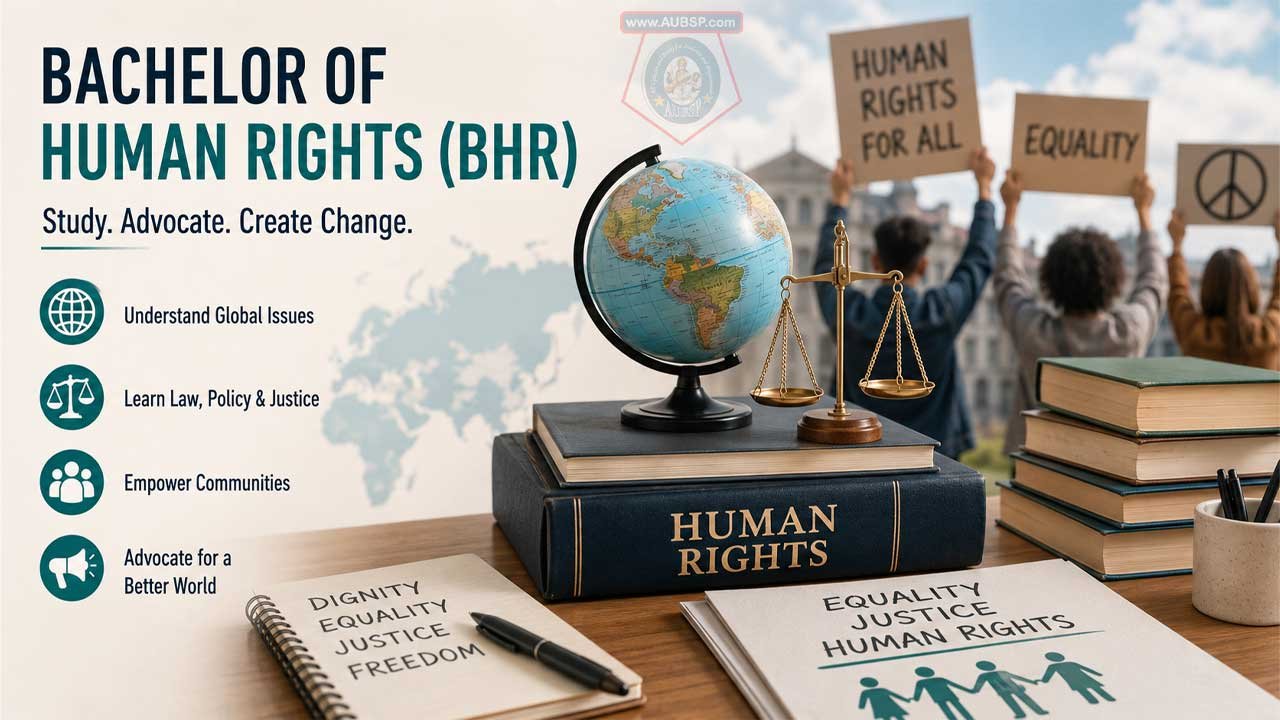
A Bachelor of Human Rights (BHR) is an undergraduate degree that teaches students about human rights, social justice, law, politics, and global issues. It helps students understand inequality and learn how to support marginalized communities through advocacy and policy work.
The course includes topics like international law, global politics, social justice, and practical skills such as report writing, data analysis, and media storytelling. Studying abroad gives international students global exposure, cultural understanding, and networking opportunities.
Graduates can work in NGOs, public policy, corporate social responsibility, research, or continue studies in law and international relations. Internships and extra skills like statistics or language learning can improve career opportunities.
| Topic | Information |
|---|---|
| Degree Name | Bachelor of Human Rights (BHR) |
| Focus Area | Human rights, social justice, law, politics, and advocacy |
| Duration | Usually 3–4 years |
| Main Subjects | Human rights theory, international law, global politics, social justice |
| Practical Skills | Report writing, data analysis, media storytelling, advocacy |
| Study Advantage | Global exposure and cross-cultural learning |
| Top Study Destinations | Australia, USA, Canada, United Kingdom |
| Career Options | NGO worker, policy analyst, ESG officer, researcher, campaign manager |
| Further Study | Law (JD/LLM), International Relations, Public Policy |
| Admission Requirements | Academic transcripts, English test scores, SOP |
| English Requirement | IELTS 6.5 or equivalent |
| Best Tip for Students | Gain internships and build transferable skills |
Bachelor of Human Rights (BHR): A Complete Guide to Careers, Skills, and Global Opportunities
If you are passionate about social justice, international law, and advocating for marginalized communities, a Bachelor of Human Rights (BHR)—or a Bachelor of Arts majoring in Human Rights—is one of the most impactful undergraduate degrees you can pursue.
This degree offers a unique gateway to global careers in non-governmental organizations (NGOs), international development, corporate social responsibility, and diplomacy. This detail guide by AUBSP breaks down everything you need to know about pursuing a BHR degree.
What is a Bachelor of Human Rights (BHR)?
A Bachelor of Human Rights is an interdisciplinary undergraduate degree designed to equip students with a deep understanding of the legal, historical, political, philosophical, and sociological foundations of human rights.
Unlike a traditional law degree, which focuses heavily on domestic legal systems and technical statutes, a BHR takes a broader approach. It examines how human rights operate globally, how systemic inequalities develop, and how advocacy, policy, and international frameworks can be leveraged to drive social change.
Why Study Human Rights as an International Student?
Studying human rights abroad provides several distinct advantages that are highly valued in the international job market:
- Global Perspectives: Human rights issues cross borders. Studying in a diverse classroom allows you to learn from the firsthand experiences of classmates from various cultural, political, and socio-economic backgrounds.
- Cross-Cultural Competence: Navigating international policy requires a high level of empathy and cultural sensitivity—skills that are naturally sharpened while living and studying in a foreign country.
- Access to Global Hubs: Many universities offering specialized human rights degrees are located near major political, legal, or non-profit centers (such as New York, Geneva, London, or Canberra), providing direct access to network with global organizations.
Core Curriculum: What You Will Study
Because human rights intersect with almost every aspect of society, the curriculum is highly flexible and interdisciplinary. While specific modules vary by university, you can generally expect to study:
1. Foundational Theory
- Introduction to Human Rights: The philosophical and historical evolution of human rights, from ancient philosophies to the Universal Declaration of Human Rights (UDHR).
- Social Justice and Inequality: Exploring how race, gender, class, sexuality, and nationality impact access to justice and equity.
2. Legal and Political Frameworks
- International Humanitarian Law: The rules governing armed conflict and the protection of civilians and prisoners of war.
- Comparative Human Rights Law: How different regions (the Americas, Europe, Africa, Asia) implement or enforce human rights standards.
- Global Politics and Civil Society: The role of the United Nations, state governments, and grassroots movements in monitoring and enforcing rights.
3. Practical and Applied Skills
Many modern BHR programs place a strong emphasis on practical “know-how” so you graduate ready for employment. You will learn:
- Grant and Report Writing: How to secure funding for non-profits and write formal compliance reports.
- Data and Digital Literacy: Using data analysis, satellite imagery, or social media forensics to track and document human rights abuses.
- Storytelling and Media Production: Crafting compelling narratives for advocacy campaigns, documentaries, or journalistic reports.
Top Destinations and Universities
While standalone “Bachelor of Human Rights” titles are unique, many top institutions offer equivalent, highly specialized Bachelor of Arts (BA) programs in the field.
| Country | Notable Institutions | Key Feature / Focus |
|---|---|---|
| Australia | University of Western Australia (UWA) | Offers a dedicated Bachelor of Human Rights; features excellent combined options with Arts or Commerce. |
| United States | Webster University, Columbia University, Bard College | Webster offers a highly practical BA in International Human Rights hosted by its dedicated Institute for Human Rights. |
| Canada | Carleton University, St. Thomas University | Renowned for robust undergraduate human rights majors and strong policy placement pipelines. |
| United Kingdom | University of Essex | Famous for its Human Rights Centre and the undergraduate Human Rights Centre Clinic, which collaborates with the UN. |
Admission Requirements for International Students
To gain admission into a BHR program, you will typically need to fulfill the following requirements:
- Academic Transcripts: Successful completion of high school or secondary education equivalent to the host country’s university entry standards (e.g., IB Diploma, A-Levels, or a high GPA in your domestic curriculum).
- English Language Proficiency: Because human rights degrees involve extensive reading, research, and essay writing, requirements are generally high. You will usually need a minimum IELTS score of 6.5 (with no individual band below 6.0) or equivalent TOEFL/PTE scores.
- Statement of Purpose (SOP): A personal essay outlining why you want to study human rights, your career goals, and any volunteer or advocacy work you’ve previously done.
Career Paths for BHR Graduates
A common misconception is that you must become a lawyer to work in human rights. In reality, a BHR opens doors to a vast range of careers in the public, private, and non-profit sectors:
- Human Rights Researcher / Analyst: Conducting investigations, interviewing victims, and drafting policy briefs for organizations like Amnesty International or Human Rights Watch.
- Program / Campaign Manager: Designing and running public awareness campaigns or managing international development projects for NGOs.
- Public Policy Specialist: Advising government agencies or international bodies on human rights compliance and social policy.
- Corporate ESG (Environmental, Social, and Governance) Officer: Helping multinational corporations ensure their supply chains respect labor rights and sustainability practices.
- Pathway to Law or International Relations: A BHR serves as an exceptional foundation for pursuing a Juris Doctor (JD), Master of International Relations, or specialized Master of Laws (LLM).
Pro-Tips for International Students
If you choose to pursue a Bachelor of Human Rights, remember that your degree is only half of the equation. To truly stand out to global employers, make sure to take advantage of university opportunities:
Prioritize Internships: Look for programs that offer integrated field placements, service learning, or clinical work. Real-world experience at a local legal aid clinic or international NGO is what turns a resume into a job offer.
Build Transferable Skills: Don’t just focus on theory. Take electives in statistics, a second language, or project management. The modern human rights sector needs advocates who can manage budgets and analyze data just as well as they can write essays.
FAQs about Bachelor of Human Rights
What is a Bachelor of Human Rights (BHR)?
A Bachelor of Human Rights is an undergraduate degree that focuses on human rights, social justice, law, politics, and advocacy.
What subjects are included in a BHR course?
Students study human rights theory, international law, social justice, global politics, advocacy, and practical communication skills.
What careers can I pursue after a BHR degree?
Graduates can work in NGOs, public policy, international organizations, research, corporate ESG, and advocacy roles.
Can I study law after completing a BHR degree?
Yes, a BHR provides a strong foundation for further studies in law, international relations, or public policy.
Which countries are best for studying Human Rights?
Australia, the USA, Canada, and the UK are popular destinations for Human Rights programs.
What are the admission requirements for international students?
Most universities require academic transcripts, English proficiency scores like IELTS, and a statement of purpose.
Is IELTS required for a BHR degree?
Yes, many universities require an IELTS score of around 6.5 or equivalent English test scores.
What skills do students gain during a BHR program?
Students develop research, communication, advocacy, report writing, and cross-cultural understanding skills.
Are internships important in a Human Rights degree?
Yes, internships provide practical experience and improve job opportunities after graduation.
Can a BHR degree help in international careers?
Yes, the degree prepares students for global careers in diplomacy, NGOs, policy, and international development.


Leave a Reply
You must be logged in to post a comment.