

A Bachelor of Arts in Latin American Studies (BALAS) is an interdisciplinary degree that focuses on the history, politics, culture, economy, and languages of Latin America, with strong emphasis on Spanish or Portuguese and often study abroad or internships.
The program builds cultural understanding, research, and communication skills that prepare graduates for careers in government, diplomacy, international development, NGOs, business, media, education, and research. While entry-level salaries are often modest—especially in nonprofit and public sectors—earnings grow with experience, advanced language skills, and movement into specialized or private-sector roles, with top earners exceeding $80,000.
Overall, BALAS is well suited for students interested in international careers, cross-cultural work, and meaningful global engagement, and demand for this expertise continues to grow worldwide.
| Category | Information |
|---|---|
| Degree Name | Bachelor of Arts in Latin American Studies (BALAS) |
| Focus | History, politics, culture, economics, and society of Latin America |
| Language Requirement | Spanish or Portuguese (typically intermediate level or higher) |
| Program Type | Interdisciplinary (social sciences, humanities, international studies) |
| Typical Duration | 4 years (120–121 total credits) |
| Experiential Learning | Study abroad, internships, field research, service learning |
| Core Skills Gained | Language fluency, cultural competency, research, analysis, communication |
| Common Careers | Government, diplomacy, NGOs, business, media, education, research |
| Entry-Level Salary | ~$31,000 (median) |
| Mid-Career Salary | ~$50,000–$86,000+ depending on sector and location |
| Best Fit For | Students interested in international careers and cross-cultural work |
What Can You Do With a Latin American Studies Degree? Careers, Jobs, and Pay
The Bachelor of Arts in Latin American Studies (BALAS) is an increasingly sought-after degree for students aiming to understand one of the world’s most dynamic and culturally rich regions. As geopolitical complexities, international development priorities, and cross-border commerce reshape global opportunities, professionals with specialized expertise in Latin America command significant influence—and competitive salaries—across government, international organizations, private enterprise, and academia.
This comprehensive guide explores what BALAS programs offer, career trajectories for graduates, earning potential, and how this degree compares to related fields. Whether you’re a prospective undergraduate, someone considering a career pivot, or evaluating graduate education, this article provides data-backed insights to inform your decision.
What Is a Bachelor of Arts in Latin American Studies?
A Bachelor of Arts in Latin American Studies is an interdisciplinary undergraduate degree combining history, politics, economics, culture, literature, and social development with required language proficiency in Spanish, Portuguese, or indigenous Latin American languages. Rather than siloing content into traditional departments, BALAS programs adopt an integrated approach—examining Latin America through multiple analytical lenses to build nuanced understanding of the region’s complexity.
Core Program Components
Language Requirement: Nearly all BALAS programs mandate fluency in Spanish or Portuguese (typically third to fifth semester proficiency, or equivalent competency). Some programs accept Quechua or other indigenous languages indigenous to Mesoamerica or South America. Language proficiency can be demonstrated through coursework, examination, or native speaker status.
Interdisciplinary Coursework: Students complete courses across:
- History and political science
- Culture, literature, and art
- Economics and development
- Anthropology and sociology
- International relations
- Environmental studies
Experiential Components: Most programs integrate study abroad, internships, service-learning projects, or field research to provide practical, in-country exposure.
Capstone Projects: Many BALAS programs culminate in a senior thesis or major research project, developing original scholarship and analytical depth.
Program Structure & Credit Requirements
Typical bachelor’s programs require 120–121 total credit hours, with 33–40 hours specifically for the major. This allows students to complete general education requirements, develop breadth across disciplines, and pursue a minor or second major. The four-year structure typically follows a deliberate sequence:
- Years 1–2: Foundation courses in Latin American history, culture, and geography; language courses
- Years 2–3: Upper-level seminars in specific subregions or thematic topics; advanced language courses
- Year 4: Capstone research, internship, study abroad, or advanced seminars
Career Paths for BALAS Graduates
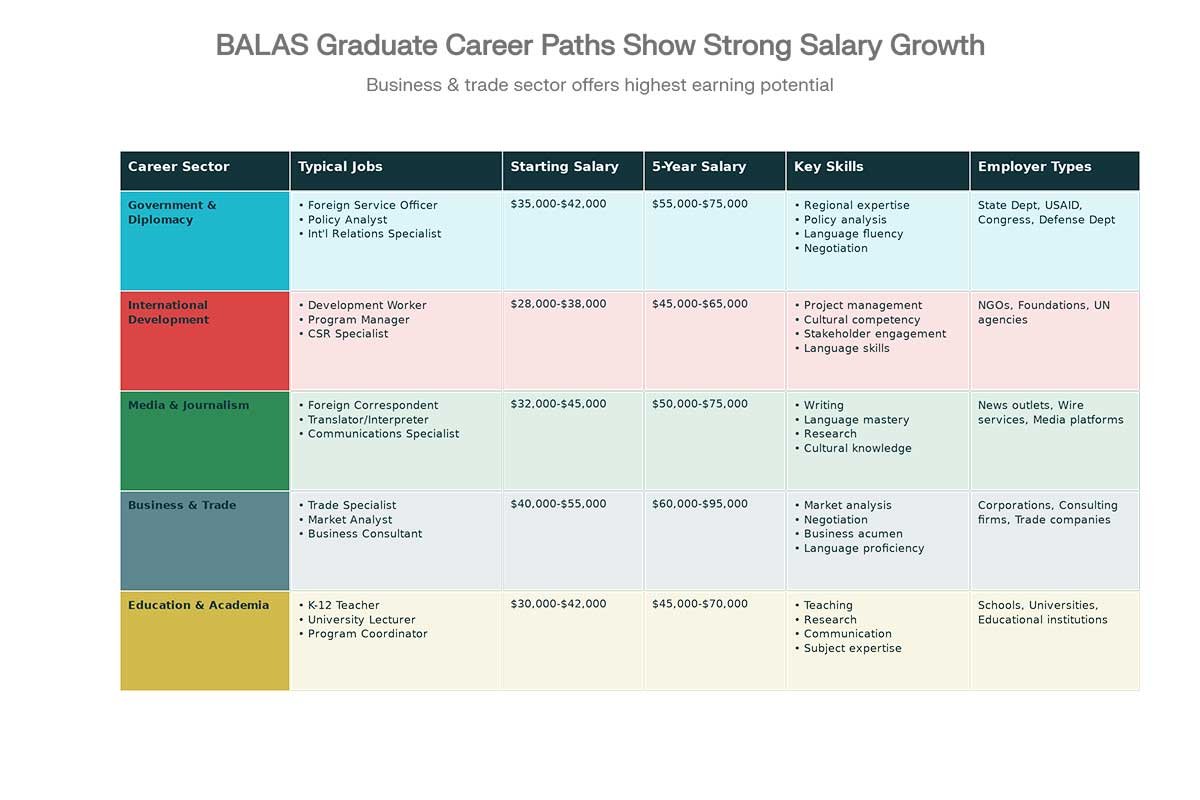
The versatility of a Latin American Studies degree opens pathways across public, private, and nonprofit sectors. Employers value BALAS graduates for their regional expertise, cultural competency, analytical rigor, and multilingual proficiency.
Government & Diplomacy
Foreign Service Officer / Diplomat: The U.S. Department of State, diplomatic missions, and foreign ministries actively recruit BALAS graduates for roles requiring cultural understanding and regional knowledge. Diplomats work on policy development, trade negotiations, and bilateral relations.
Policy Analyst / Government Advisor: Federal agencies, state governments, and international bodies employ BALAS graduates to research Latin American affairs, inform policy recommendations, and manage regional initiatives. Typical employers include the State Department, Defense Department, Agency for International Development (USAID), and Congress.
International Relations Specialist: Roles involving government agencies or defense contractors focusing on Latin American geopolitics, security, or trade relationships.
International Development & NGOs
International Development Worker: NGOs, foundations, and bilateral aid organizations employ BALAS graduates to design, implement, and evaluate development projects in Latin America—from public health to environmental conservation to economic empowerment.
Program Manager (NGO): Human rights organizations, environmental nonprofits, and poverty-alleviation agencies hire BALAS graduates with regional expertise for leadership roles coordinating on-the-ground operations.
Corporate Social Responsibility (CSR) Specialist: Multinational corporations operating in Latin America employ BALAS graduates to manage community development projects, sustainability initiatives, and stakeholder engagement.
Media, Communications & Research
Foreign Correspondent / Journalist: News outlets, wire services, and digital media platforms employ BALAS graduates to report on Latin American news, politics, economics, and culture. Strong writing and communication skills combined with regional expertise are highly valued.
Translator / Interpreter: With advanced Spanish or Portuguese proficiency, BALAS graduates work as professional translators for government agencies, international organizations, courts, media outlets, and private firms. This is one of the most immediate pathways to employment.
Research Analyst: Think tanks, policy research institutes, and academic centers focused on Latin American affairs employ BALAS graduates to conduct research, publish reports, and contribute to policy discussions. Institutions like the Latin American Studies Association (LASA) and regional research centers actively recruit researchers.
Business & Trade
International Trade Specialist: Import-export firms, logistics companies, and multinational corporations hire BALAS graduates to manage Latin American market operations, navigate regulatory environments, and facilitate cross-border commerce.
Market Analyst: Business consulting firms and corporations employ BALAS graduates to analyze Latin American markets, consumer behavior, and business opportunities for expansion or investment.
Tourism Industry Specialist: Hotels, tour operators, and travel agencies hire BALAS graduates to develop cultural tourism experiences and manage international guest relations.
Education & Academia
K–12 Teacher: High schools increasingly employ BALAS graduates to teach Spanish language, Latin American history, and social studies. This remains one of the most accessible entry-level career paths.
University Lecturer / Professor: BALAS graduates pursuing graduate education (MA, PhD) can transition into academia, teaching Latin American Studies courses and conducting scholarly research. Tenure-track positions typically require a PhD.
Academic Program Coordinator: Universities employ BALAS graduates as advisors, program coordinators, or study-abroad administrators in Latin American Studies departments.
Salary Expectations & Earning Potential
BALAS graduates’ earning potential varies significantly based on sector, geographic location, employer type, and career progression. Understanding realistic salary ranges helps inform career planning and negotiation.
Entry-Level Earnings (0–2 Years Post-Graduation)
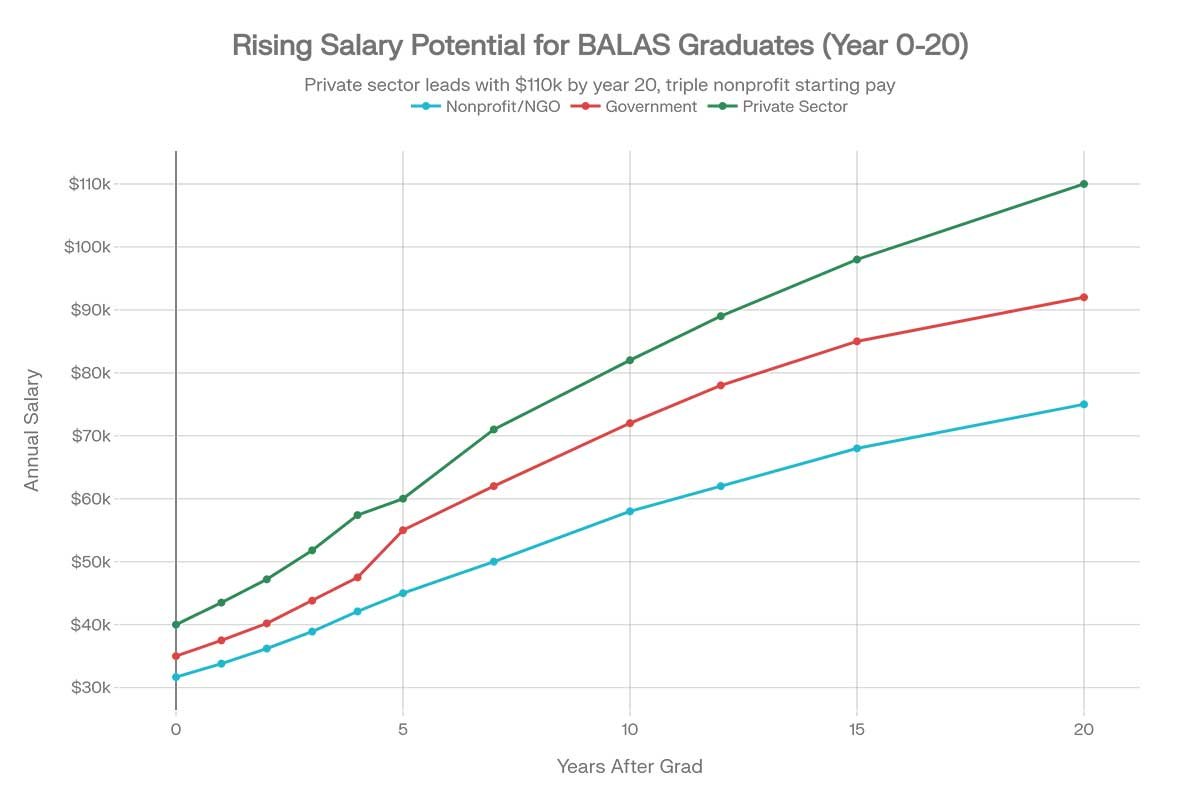
Early-career BALAS graduates typically earn $31,676 (median) upon graduation, reflecting entry-level positions in nonprofits, government agencies, or educational institutions. This is lower than average bachelor’s degree holders but reflects sector choices—nonprofits and government positions prioritize mission over compensation compared to private-sector roles.
Career-Level Earnings (5+ Years Experience)
By five years post-graduation, median salary increases to $49,868. This represents progression into mid-level positions with supervisory or specialized responsibilities.
Overall Median & Range
The overall median salary for Latin American Studies graduates is $51,448, with the bottom 20% earning approximately $30,584 and top earners reaching $86,545. This wide range reflects sector and role variation.
Geographic Variation
Location significantly impacts salary. In New York City (April 2025 data), Latin American Studies professionals earn $59,981 per year on average—approximately 17% above the national median. The salary range in New York spans from $53,100 (25th percentile) to $66,200 (75th percentile), indicating stronger market demand in major urban centers.
Comparative Analysis
BALAS salaries are approximately 7% below average compared to other bachelor’s degree holders. This gap reflects that many BALAS graduates pursue lower-paying sectors (nonprofits, government, education) that prioritize impact over compensation. However, graduates entering business, consulting, or higher-level government roles can exceed average earnings.
International Context
In the United Kingdom, Latin American Studies graduates earn a median of £23,000 (≈$29,000 USD) fifteen months after graduation, reaching £28,000 (≈$35,000 USD) after five years. This reflects lower UK salaries overall and the prevalence of lower-paying sectors in that employment market.
Program Rankings & Top Universities
Multiple universities offer highly-regarded BALAS programs with distinct strengths, locations, and specializations.
| University | Location | Notable Strengths | Program Focus |
|---|---|---|---|
| University of Illinois Urbana-Champaign | Illinois, USA | Integrated cross-disciplinary approach; strong language proficiency emphasis | Regional studies with thematic flexibility |
| Penn State University | Pennsylvania, USA | Well-structured curriculum combining coursework with experiential learning | Comparatist approach combining general education |
| UNC Charlotte | North Carolina, USA | Strong career services; diverse employer connections | Career-focused with alumni network |
| University of Utah | Utah, USA | Rigorous language requirements; research-intensive track | Advanced language proficiency (3rd year Spanish) |
| Stanford University | California, USA | Elite institution; strong graduate placement | High-tier research and academics |
| Indiana University (Hamilton Lugar School) | Indiana, USA | Specialized school for global studies; extensive resources | Global and area studies integration |
| Georgetown University (MA program) | Washington, D.C., USA | MA program ranked in top 25 for international relations; government connections; policy focus | Government and international affairs pathway |
| UCLA | California, USA | MA program; strong research emphasis | Graduate studies and academic track |
International Student Enrollment & Demand
BALAS programs attract significant international student interest, particularly from Latin America itself and from students seeking specialization before pursuing international careers.
Latin American Student Enrollment in the U.S.
The United States hosted 81,945 international students from Latin America in the 2022–23 academic year, representing 5.1% year-over-year growth. This indicates strong and growing demand among Latin American students for U.S. higher education.
Florida stands out as the top destination for Latin American students, with students from Venezuela, Brazil, and Colombia comprising 13% of the state’s international student population—more than 5,800 students. This geographic concentration creates pipeline opportunities for BALAS programs near Latin American population centers or with strong Caribbean/Central American connections.
Brazil, Colombia, and Venezuela represent the primary source countries, with 51% of U.S. institutions reporting increases in new student enrollments from Brazil.
Study Abroad & Exchange Programs
Many BALAS programs emphasize study abroad as a central component. International students and U.S. students alike leverage semester-long or year-long exchanges in Latin American countries to develop language proficiency, conduct research, and build professional networks in the region. Programs typically integrate these experiences into major requirements.
Master’s Degrees & Advanced Education
For those seeking advanced credentials, Master of Arts in Latin American Studies programs offer specialized training and stronger positioning for leadership roles.
Master’s Program Structure
MA programs typically require 1–2 years of full-time study or 2–3 years part-time. Coursework combines advanced seminars, research methods, and often a capstone thesis or major project.
Career Outcomes for Master’s Graduates
Georgetown University reports that 92% of MA graduates in Latin American Studies are employed within six months of graduation. This strong placement rate reflects robust employer demand for advanced expertise.
Master’s graduates pursue careers in:
- Government policy roles with higher responsibility and compensation
- International organizations (UN, World Bank, Regional Development Banks)
- Consulting firms specializing in Latin American markets
- Academic research positions or PhD programs
- Senior management in NGOs and development organizations
Master’s vs. Bachelor’s Earning Potential
While specific master’s salary data is limited, graduate degree holders in related fields (international relations, development studies) typically earn 15–25% more than bachelor’s holders in comparable roles.
Language Requirements & Proficiency
Language proficiency is a defining feature of BALAS programs and a competitive advantage in the job market.
Proficiency Levels
Programs typically require Spanish or Portuguese at the third to fifth semester level (roughly equivalent to intermediate-high proficiency on standardized scales).
Some programs—particularly graduate programs—require even higher proficiency:
- UCLA MA program: 24 quarter-units of Spanish OR 16 quarter-units of Portuguese, plus 12 quarter-units of an additional Latin American language.
- University of Utah MA program: Third-year Spanish/Portuguese proficiency plus first-year proficiency in a second Latin American language.
Fulfilling Language Requirements
Students can satisfy language proficiency through:
- Successful completion of language courses (typically grade B or higher required)
- Passing a proficiency examination administered by the university’s language center
- Demonstrating native speaker status or prior fluency
- Completion of advanced-level courses in the target language
Indigenous Language Options
Some programs accept Quechua, Nahuatl, Maya languages, or other indigenous Latin American languages as alternatives to or complements to Spanish/Portuguese. This allows students with heritage language backgrounds to leverage existing proficiency or pursue specialized linguistic research.
Career Advantage of Language Proficiency
Fluency in Spanish or Portuguese is a substantial competitive advantage. Even among BALAS graduates, those demonstrating native-like fluency or bilingual proficiency command premium compensation, particularly in translation, interpretation, government service, and international business roles.
Skills & Competencies Developed
Beyond content knowledge, BALAS programs systematically develop professional competencies valued across sectors.
Analytical & Research Skills
- Conducting original research using primary and secondary sources
- Analyzing historical documents and contemporary evidence
- Evaluating competing theoretical perspectives
- Synthesizing information across disciplines
Communication & Language Skills
- Writing clear, evidence-based arguments in English and Spanish/Portuguese
- Presenting research findings to academic and non-academic audiences
- Translating and interpreting across languages and cultures
- Communicating complex regional issues to non-specialist audiences
Cultural Competency & Cross-Cultural Leadership
- Understanding diversity and complexity of Latin American cultures and histories
- Recognizing institutional and structural barriers affecting Latin American societies
- Designing interventions and programs sensitive to cultural context
- Leading teams across cultural and linguistic differences
Project Management & Practical Experience
- Planning and executing research or development projects
- Managing cross-border logistics and partnerships
- Developing policy recommendations or program designs
- Working effectively with local stakeholders and communities
Conclusion
A Bachelor of Arts in Latin American Studies positions graduates for meaningful careers spanning government, international development, business, media, academia, and nonprofit sectors. While entry-level salaries ($31,676 median) reflect sector choices toward mission-driven organizations, career progression and strategic sector selection enable earning potential exceeding $86,000+. Strong language skills, cultural competency, and analytical depth create competitive advantages in an increasingly interconnected global economy where Latin American expertise commands premium value.
For prospective students, the BALAS degree offers both professional advantage and intellectual depth—a combination that remains undervalued in popular discourse but highly valued among employers seeking nuanced regional expertise. International enrollment growth, particularly among Latin American students, underscores strong market demand for this specialized credential.
FAQs
What is a Bachelor of Arts in Latin American Studies (BALAS)?
It is an interdisciplinary undergraduate degree that studies Latin America’s history, politics, culture, economy, and society, usually with a required Spanish or Portuguese language component.
What subjects are covered in a BALAS program?
Courses typically include history, political science, economics, anthropology, literature, culture, international relations, and environmental or development studies focused on Latin America.
Is language study required for a Latin American Studies degree?
Yes, most programs require intermediate to advanced proficiency in Spanish or Portuguese, and some also allow indigenous languages like Quechua or Nahuatl.
How long does it take to complete a BALAS degree?
The degree usually takes four years to complete and requires about 120 credit hours, including general education and major-specific courses.
What skills do students gain from a BALAS program?
Students develop language fluency, cultural awareness, research and analytical skills, critical thinking, and strong written and oral communication abilities.
What jobs can you get with a Latin American Studies degree?
Graduates work in government, diplomacy, NGOs, international development, business, media, education, research, tourism, and translation or interpretation.
Is a Latin American Studies degree worth it?
It is worth it for students interested in international careers, public service, and cross-cultural work, especially when combined with strong language skills and internships.
What is the average salary for BALAS graduates?
Entry-level salaries average around $31,000, while mid-career professionals earn about $50,000, with top earners exceeding $80,000 depending on role and sector.
Do BALAS programs include study abroad?
Many programs strongly encourage or require study abroad, internships, or field research in Latin American countries for hands-on experience.
Can a BALAS degree lead to graduate school?
Yes, graduates often pursue master’s or doctoral degrees in international relations, development studies, public policy, law, or academia.
How is BALAS different from International Relations?
BALAS focuses deeply on one region’s culture and history, while International Relations has a broader global and policy-oriented focus.
Are BALAS graduates in demand?
Yes, demand is growing due to globalization, increased U.S.–Latin America ties, and the need for professionals with regional expertise and language skills.


Leave a Reply
You must be logged in to post a comment.