
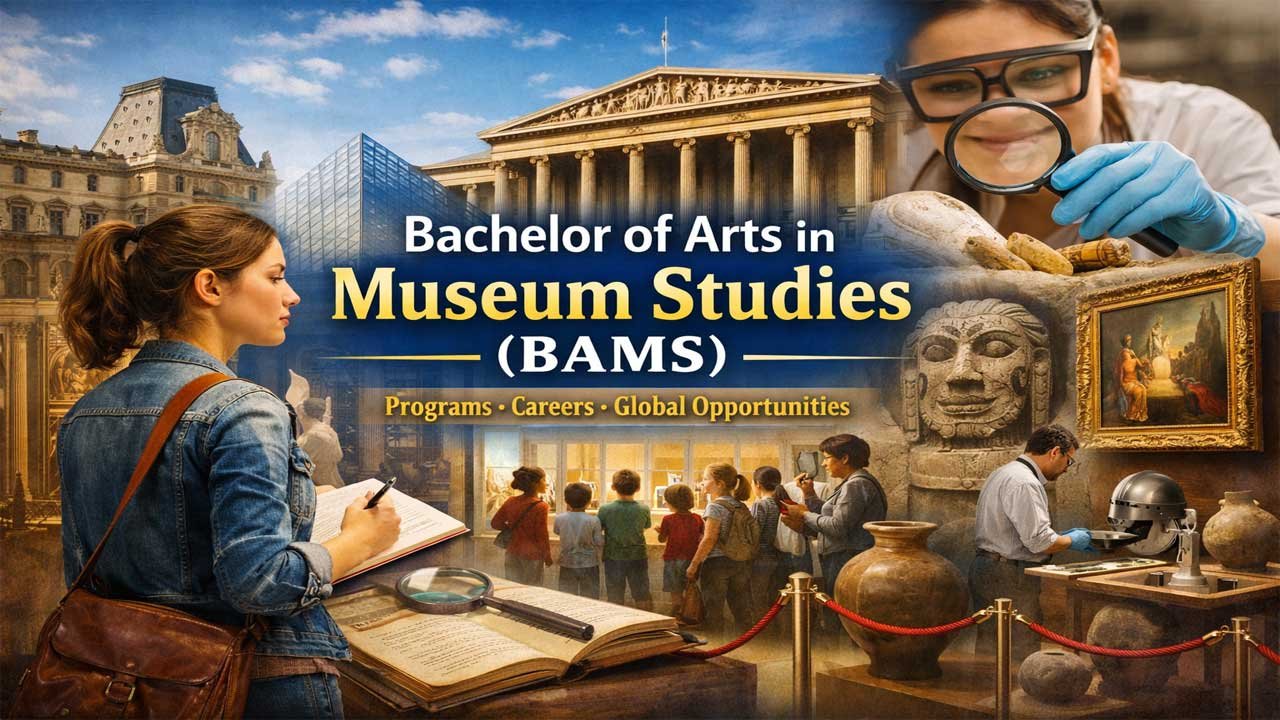
The Bachelor of Arts in Museum Studies (BAMS) is a specialized undergraduate degree that prepares culturally motivated students for careers in museums, galleries, and heritage organizations worldwide by combining academic foundations with extensive hands-on experience in areas like collections management, exhibition design, conservation, education, and museum administration.
Offered across countries such as the US, UK, Canada, and Australia, BAMS programs emphasize preservation, public engagement, and professional management while providing internships, museum labs, and real-world projects that build practical skills and industry networks. Graduates can pursue diverse career paths—including curator, collections manager, educator, conservator, archivist, or museum director—with global opportunities, though the field is competitive, often requires postgraduate specialization for senior roles, and typically offers lower entry-level salaries.
Overall, BAMS is best suited for those driven by passion for cultural heritage, public service, and creative, intellectually engaging work, especially as museums evolve through digital transformation, social justice, sustainability, and inclusive curation.
| Aspect | Information |
|---|---|
| Degree Name | Bachelor of Arts in Museum Studies (BAMS) |
| Duration | 3–4 years (full-time) |
| Study Focus | Museum operations, collections management, curation, conservation, education, and cultural heritage |
| Core Subjects | Collections Management, Exhibition Design, Conservation, Museum Education, Governance, Digital Museums |
| Learning Method | Classroom study + internships, museum labs, fieldwork, exhibitions |
| Eligibility | High school completion (Class 12 or equivalent); GPA 2.5–3.0 (varies) |
| Language Tests | IELTS 6.0–7.5+, TOEFL 80–100+, or equivalent |
| Top Study Destinations | USA, UK, Canada, Australia |
| Career Options | Curator, Collections Manager, Museum Educator, Conservator, Archivist, Exhibition Designer, Director |
| Entry-Level Salary | USD $27,000–$35,000 (varies by country) |
| Mid–Senior Salary | USD $50,000–$120,000+ |
| Further Study Needed | Master’s or PhD for senior curatorial/director roles |
| Global Opportunities | Museums, galleries, cultural NGOs, UNESCO, archives, digital heritage |
| Key Pros | Passion-driven career, global mobility, cultural impact |
| Key Challenges | Competitive job market, lower starting pay, unpaid internships |
Bachelor of Arts in Museum Studies (BAMS): Complete Guide to Programs, Careers, and Global Opportunities
The Bachelor of Arts in Museum Studies (BAMS) has emerged as one of the most rewarding degrees for culturally-minded professionals seeking careers in heritage preservation, curation, and cultural management. Whether you aspire to work in world-renowned institutions like the Louvre, the British Museum, or emerging cultural centers across Asia, Africa, and Latin America, a BAMS degree opens doors to a diverse range of career opportunities that blend academic rigor with hands-on cultural engagement.
This comprehensive guide explores every aspect of museum studies as an undergraduate discipline—from curriculum design and admission pathways to international career opportunities and earning potential. Whether you’re considering this degree from India, the United States, the United Kingdom, Canada, or Australia, you’ll find actionable insights to guide your decision.
What is a Bachelor of Arts in Museum Studies?
A Bachelor of Arts in Museum Studies is a specialized undergraduate degree that equips students with theoretical knowledge and practical skills for working in museums, galleries, cultural institutions, and heritage organizations. Unlike general liberal arts degrees, BAMS programs focus specifically on the operations, ethics, and methodologies that govern modern museums.
The degree typically spans three to four years of full-time study and combines classroom learning with hands-on experience through internships, museum labs, and service learning projects. Students engage with real collections, participate in exhibition design, and work directly with museum professionals.
Core Educational Philosophy
BAMS programs operate on the principle that museums are dynamic public institutions with multiple stakeholder responsibilities. The curriculum reflects this by balancing three critical dimensions:
Preservation and Conservation: Students learn how cultural artifacts and historical objects are protected, documented, and maintained for future generations.
Public Engagement and Education: Programs emphasize how museums serve as educational platforms for diverse audiences, from school groups to researchers and community members.
Professional Management: Students acquire the administrative, financial, and strategic planning skills necessary to operate museums as sustainable organizations.
BAMS Program Structure and Curriculum
Core Courses and Learning Areas
Most accredited BAMS programs worldwide follow a similar structural framework, though specific offerings vary by institution. Here’s what you can typically expect:
| Course Area | Key Topics | Practical Application |
|---|---|---|
| Collections Management | Acquisitions, cataloging, accessioning, deaccessioning, documentation systems | Hands-on work with campus or partner museum collections |
| Exhibition Design & Development | Curatorial concepts, narrative development, visitor experience design, accessibility | Designing and installing real exhibitions |
| Conservation & Preservation | Environmental controls, preventive conservation, object handling, preservation planning | Working with conservators, learning proper artifact care techniques |
| Museum Education | Learning theories, audience development, interpretive programs, community partnerships | Creating educational materials and programs |
| Museum Governance & Administration | Strategic planning, financial management, fundraising, grant writing, legal compliance, HR | Working on real museum budgeting and planning projects |
| Digital Technologies in Museums | Digital collections, online exhibitions, social media strategy, collections management software | Building digital archives and online experiences |
| Art History, History, or Specialized Subject | Discipline-specific knowledge (art, natural history, archaeology, science, etc.) | Deepening expertise in specific collection types |
Experiential Learning Components
Most BAMS programs integrate substantial practical experience:
Internships: Students typically complete 3-6 month internships at museums, galleries, or cultural institutions, applying classroom knowledge in real-world settings.
Museum Labs and Workshops: On-campus teaching collections and dedicated lab spaces where students practice conservation techniques, cataloging systems, and exhibition installation.
Service Learning Projects: Collaboration with local museums on specific institutional needs, combining academic credit with genuine community contribution.
Collections Research: Working directly with campus or partner collections to conduct original research, write exhibition texts, and develop educational materials.
Field Trips: Regular visits to leading museums and cultural institutions to observe professional practices and network with curators, conservators, and managers.
BAMS Programs Around the World
Top Universities in the United States
The United States offers diverse BAMS programs with varying emphases:
University of Tampa – Known for practical, hands-on training focused on registrar, preparator, and archives roles. Strong emphasis on applied museum skills rather than theory alone. International student-friendly with IELTS 6.5+ requirement. Annual fees: approximately USD $33,348.
Harvard University – Prestigious program with emphasis on research and curatorial practice. Graduates earn approximately $7,391 above the typical museum studies graduate. Highly selective admissions.
George Washington University – Strong urban location providing internship opportunities in Washington, D.C.’s numerous cultural institutions. Focus on museum administration and leadership.
Johns Hopkins University – Top-ranked museology program emphasizing collections management and conservation. Located in Baltimore near major cultural institutions.
Columbia University – Offers specialized MA programs ($59,588-$74,010/year) attracting serious museum professionals. Strong connections to NYC’s museum sector.
Syracuse University – Known for innovative exhibition design and public engagement programming. Good balance of theory and practice.
New York University (NYU) – Located in Manhattan with unparalleled access to world-class museums. Master’s programs emphasize curatorial specialization.
Leading Programs in the United Kingdom
UK universities dominate the global museum studies reputation ranking, with several institutions offering distinctive specializations:
University of Leicester – Arguably the UK’s strongest program with emphasis on digital collections and strong placement guarantees. MA fees: £21,000. The university’s museum studies courses are exceptionally well-regarded in the professional sector.
UCL (University College London) – Partnerships with Tate Modern, British Museum, and major London institutions. MA Museum Studies: £24,000. Strong research focus and hands-on London museum access.
University of Glasgow – Access to Hunterton Museum’s collections and Scottish heritage focus. MSc fees: £22,500.
University of Manchester – Collaborations with Whitworth Gallery. MA Art Gallery and Museum Studies: £23,000.
Newcastle University – Unique feature: guaranteed year-long work placement. MA fees: £20,500.
University of Cambridge – Prestigious MPhil in Museum Studies (£25,000) with research projects using Fitzwilliam Museum collections. Highly selective.
University of East Anglia – Innovative focus on climate change and museums. MA fees: £19,500.
University of Brighton – Emphasis on community engagement and social justice in museums. MA fees: £18,500. Good option for values-driven students.
Canadian Institutions
University of British Columbia – 4-year BA in Museum Studies with comprehensive applied experience. Strong international reputation and access to west coast museums.
Algonquin College (Ottawa) – 3-year Applied Museum Studies diploma. Known for practical, job-focused curriculum. Tuition approximately CAD $9,938/year.
Trent University – Strong museum studies curriculum with Ontario access.
Australian Universities
University of Wollongong – BA in Museum Studies or related fields. Ranked top 1% for arts and humanities. Offers part-time and full-time options.
University of Melbourne – Strong cultural institutions and museum sector engagement.
Admission Requirements for BAMS Programs
General Eligibility Criteria
Educational Background:
- High school diploma or equivalent (typically Class 12 in India)
- Minimum GPA: 2.5-3.0 (varies by institution)
- Preferred subjects: English, History, Art History, Social Sciences
Standardized Tests:
- International students: TOEFL (80-100+), IELTS (6.0-7.5+), or Cambridge CAE
- Some programs accept PTE Academic (62+)
Application Materials:
- Transcripts from secondary and any university-level coursework
- Personal statement/essay (typically 500-1000 words)
- 2-3 letters of recommendation
- CV highlighting relevant experience
- Portfolio (optional but beneficial): artwork, writing samples, museum experience documentation
Competitive Advantages:
- Previous museum or gallery experience (internships, volunteering)
- Strong writing samples
- Evidence of cultural engagement
- Community service background
- Language skills (especially for international programs)
Note on BAMS Acronym Confusion
Important: In India, “BAMS” typically refers to “Bachelor of Ayurvedic Medicine and Surgery,” not Museum Studies. For Museum Studies specifically, Indian institutions typically offer BA (Hons) Museum Studies or MA Museum Studies.
Top Career Paths After BAMS
The versatility of a museum studies degree extends across multiple career trajectories:
1. Museum Curator
Responsibilities: Select and acquire objects for collections, develop exhibition concepts, conduct research, write exhibition texts, engage public audiences, manage acquisitions budgets.
Education Path: Most curatorial positions require a PhD in a subject-specific discipline (Art History, Archaeology, Natural History, etc.), though some assistant curator roles accept BA+BAMS with significant experience.
Career Progression: Assistant Curator → Associate Curator → Curator → Senior Curator → Chief Curator → Directorial Roles
Salary Range: Entry-level assistant curators: £18,000-$25,000 USD; Experienced curators: £26,000-$35,000+ USD; Senior curators with PhD: $62,700-$145,000+ USD
2. Collections Manager/Registrar
Responsibilities: Document and catalog collections, manage database systems, oversee proper storage conditions, facilitate loans between institutions, ensure legal compliance, maintain insurance and legal documentation.
Skills Required: Meticulous attention to detail, database management expertise, understanding of archival standards, strong organizational capabilities.
Career Progression: Collections Technician → Assistant Collections Manager → Collections Manager → Senior Collections Manager → Head of Collections
Salary Range: Entry-level: $28,000-$38,000 USD; Experienced: $45,000-$60,000+ USD
3. Conservator/Conservationist
Responsibilities: Assess object condition, develop conservation treatment plans, perform restoration work, monitor environmental conditions, conduct scientific analysis of artifacts.
Education Path: Requires specialized Master’s degree in Conservation (highly competitive, often requiring science background and portfolio).
Career Progression: Assistant Conservator → Associate Conservator → Conservator → Senior Conservator → Head of Conservation → Specialization in specific materials (paintings, textiles, paper, archaeological materials)
Salary Range: Highly specialized; starting conservators: £28,491+; experienced positions: $60,000-$90,000+ USD
4. Museum Educator
Responsibilities: Develop and deliver educational programs, create interpretive materials, work with school groups and diverse audiences, design learning activities, evaluate program effectiveness.
Skills Needed: Teaching ability, public speaking, program design, knowledge of learning theories, community engagement.
Career Progression: Education Coordinator → Educator → Head of Education → Director of Public Programs
Salary Range: Entry-level: $25,000-$32,000 USD; Experienced: $40,000-$55,000+ USD
5. Exhibition Designer/Coordinator
Responsibilities: Conceptualize exhibitions, design exhibition layouts and graphics, coordinate installation, manage exhibition budgets and timelines, evaluate visitor engagement.
Skills Required: Design thinking, project management, curatorial understanding, technical skills (CAD, design software).
Salary Range: Entry-level: $28,000-$36,000 USD; Experienced: $45,000-$65,000+ USD
6. Museum Director
Responsibilities: Strategic leadership and vision, staff management, budget and financial oversight, fundraising, board relations, community engagement, strategic planning.
Education: Typically requires extensive museum experience (10-15+ years) plus postgraduate degree (MA or PhD).
Salary Range: Varies by museum size; small museums: $50,000-$70,000; mid-sized: $70,000-$120,000; large institutions: $120,000-$250,000+
7. Archivist/Librarian
Responsibilities: Manage archival collections, arrange and describe materials, provide reference services, preserve fragile documents, manage digital archives.
Education: Master’s in Library and Information Science (MLIS) or MA in History with archival specialization.
Career Progression: Archivist → Senior Archivist → Head Archivist/Special Collections Manager
Salary Range: Entry-level: $32,000-$40,000 USD; Experienced: $50,000-$70,000+ USD
8. Related Careers Using Museum Studies Skills
Museum studies training applies to roles beyond traditional museums:
- Cultural Heritage Officer – Government roles protecting cultural sites and artifacts
- Development Officer – Fundraising and donor relations for cultural nonprofits
- Grant Writer – Securing funding for cultural institutions
- Museum Marketing Manager – Audience development and institutional promotion
- Digital Archives Specialist – Managing online collections and digital preservation
- Cultural Consultant – Advising organizations on heritage management and curation
- UNESCO or International Organization Professional – Global heritage protection and cultural diplomacy
- Academic Researcher – University positions focusing on museology and cultural studies
- Independent Curator – Creating self-directed exhibitions and cultural projects
Global Salary and Career Prospects
By Region
United States:
- Entry-level museum positions: $27,000-$35,000 USD
- Median museum studies graduate salary: $54,936 USD
- 5-year career progression: $50,000-$65,000 USD
- Senior positions (director, senior curator): $100,000-$250,000+ USD
United Kingdom:
- Entry-level assistant curator: £18,000-£25,000
- Museum educator/coordinator: £22,000-£30,000
- Senior curator/manager: £45,000-£75,000+
- Director positions: £60,000-£150,000+
India:
- Entry-level museologist: ₹25,000-₹40,000/month (approximately $300-$480 USD/month)
- Mid-career: ₹45,000-₹60,000+/month
- International experience significantly increases earning potential
- Government museum positions offer job security but lower salaries
Canada:
- Entry-level: CAD $30,000-$40,000
- Experienced professionals: CAD $50,000-$75,000
- Senior management: CAD $70,000-$120,000+
Australia:
- Entry-level: AUD $45,000-$55,000
- Mid-career: AUD $60,000-$80,000
- Senior positions: AUD $85,000-$130,000+
Key Considerations for International Students
Cost Analysis
| Region | Annual Tuition | Living Expenses | Total Annual Cost |
|---|---|---|---|
| USA (Private) | $28,000-$33,000 | $15,000-$25,000 | $43,000-$58,000 |
| UK | £18,500-£24,000 | £12,000-£18,000 | £30,500-£42,000 |
| Canada | CAD $15,000-$25,000 | CAD $15,000-$20,000 | CAD $30,000-$45,000 |
| Australia | AUD $20,000-$30,000 | AUD $18,000-$25,000 | AUD $38,000-$55,000 |
| India (Private) | ₹3,00,000-₹8,00,000/year | ₹3,00,000-₹6,00,000/year | ₹6,00,000-₹14,00,000 |
Scholarship Opportunities
- UK Arts Council England Scholarship: £10,000 (deadline: March 2026)
- Chevening Scholarships: Full fees + living allowance (non-UK students, deadline: November 2025)
- University-specific funds: Cambridge, Oxford, UCL, Harvard offer significant scholarships for international students
- UNESCO and cultural organization grants: Research-specific funding for heritage projects
- Erasmus+ Mobility Grants: EU-based students can study abroad with partial funding
Work Permit Considerations
- USA: F-1 visa allows part-time campus work; OPT allows 12-36 months post-graduation work
- UK: Student visa permits up to 20 hours/week during studies; 2-3 year work visa post-graduation
- Canada: Post-graduation work permit allows 3 years of work after 2-year degree
- Australia: 20 hours/week during studies; 2-4 year post-study work visa available
Employment Prospects Post-Graduation
The reality of the museum career market requires strategic preparation:
Competitive Entry: Museum jobs are highly contested, with many unpaid or low-paid internships as entry points. Many professionals work multiple part-time positions initially.
Networking Imperative: Securing permanent positions often requires strong professional networks developed during internships and volunteer work.
Geographic Flexibility: Early-career professionals frequently relocate internationally for opportunities, particularly to major museum hubs like London, New York, Paris, and Sydney.
Additional Qualifications Valued: Many senior positions require specialized skills (conservation science, digital humanities, grant writing) beyond the basic BAMS degree.
Is a BAMS Degree Worth It? Pros and Cons
Advantages
- ✓ Passion-Aligned Career: Work with cultural artifacts and historical narratives daily.
- ✓ Global Opportunities: Museums worldwide employ trained professionals; the degree opens international career doors.
- ✓ Diverse Career Paths: One degree leads to curator, educator, conservator, manager, researcher, or director roles.
- ✓ Growing Digital Sector: Digital humanities, online collections, and virtual exhibitions create emerging career opportunities.
- ✓ Nonprofit Impact: Work in mission-driven organizations contributing to cultural preservation and public education.
- ✓ Creative Problem-Solving: Exhibition design and interpretive work provide creative outlets within structured environments.
- ✓ Continuous Learning: Every collection tells different stories; the work remains intellectually stimulating.
Challenges
✗ Lower Entry Salaries: Museum sector typically pays less than corporate roles for similarly educated professionals.
✗ Competitive Market: Many positions are temporary contracts or part-time roles; permanent employment can take years to secure.
✗ Geographic Limitations: Best opportunities concentrate in major cities with established cultural institutions.
✗ Funding Constraints: Nonprofit budgets limit advancement opportunities and salary growth compared to other sectors.
✗ Unpaid Internships: Many entry positions are unpaid, requiring financial support to gain necessary experience.
✗ PhD Often Required: Curatorial advancement frequently requires subject-specific PhD in addition to museum studies training.
✗ Limited Career Ladder: Museum hierarchies are flat; progression is slower than corporate environments.
Expert Insight: According to UCL Museums & Collections Blog, museum work is “incredibly rewarding” but requires genuine passion. The field suits individuals motivated by cultural impact rather than earning potential.
Emerging Trends in Museum Studies
1. Digital Transformation
Museums increasingly prioritize digital collections, virtual exhibitions, and online audience engagement. BAMS graduates with digital humanities skills command premium hiring and advancement opportunities.
Relevant Skills: Collections management software, digital archive design, 3D imaging technology, virtual exhibition platforms, social media strategy.
2. Decolonization and Repatriation
Museums worldwide are reconsidering collection origins and returning artifacts to source communities. This creates new curatorial conversations and career opportunities.
Relevant Skills: Ethical frameworks, community consultation, indigenous knowledge systems, repatriation documentation.
3. Sustainability and Climate Resilience
Museums address climate impacts on collections through preventive conservation and sustainability initiatives.
Relevant Skills: Environmental management, climate adaptation planning, sustainable exhibition design.
4. Social Justice and Inclusive Curation
Contemporary museums prioritize inclusive narratives and marginalized histories, requiring curators with diverse perspectives and community engagement expertise.
Relevant Skills: Community consultation, oral history, social justice frameworks, intersectional analysis.
5. Museum-Nonprofit Hybridity
Many cultural organizations blend museum functions with social services, education, and community development, creating non-traditional career opportunities.
How to Choose the Right BAMS Program
Consider These Factors:
- Specialization Fit: Does the program emphasize your interest (art, natural history, science, cultural heritage, etc.)?
- Geographic Location: Will you study near museums relevant to your career interests?
- Practical Emphasis: What percentage of the curriculum involves hands-on experience vs. classroom theory?
- Industry Connections: Does the university have formal partnerships with major museums and cultural institutions?
- Cost vs. ROI: Weigh tuition against career opportunities and salary prospects in your target location.
- Faculty Expertise: Are program faculty active researchers and practitioners in the field?
- Alumni Network: Research where recent graduates work and their career progression.
- International Reputation: How is the program regarded in your target job market?
- Language of Instruction: International students should verify English-medium instruction.
- Post-Graduation Support: Does the program offer career counseling and alumni mentorship?
Application Timeline and Next Steps
12-18 Months Before Intended Start Date:
- Research programs matching your interests and financial capacity
- Connect with program advisors for information sessions
- Begin building museum experience through volunteering
- Register for standardized tests (TOEFL, IELTS, GRE if required)
9-12 Months Before:
- Finalize list of target programs (3-5 programs with varying selectivity)
- Request letters of recommendation from teachers/mentors
- Draft personal statements
- Begin formal applications
6-9 Months Before:
- Complete all applications
- Follow up on reference letters
- Prepare for interviews (if required)
- Finalize test scores
3-6 Months Before:
- Receive acceptance/rejection letters
- Compare offers and funding packages
- Make final decision
- Begin visa applications if required
- Arrange housing and logistics
Conclusion
The Bachelor of Arts in Museum Studies represents an increasingly relevant degree for professionals committed to cultural preservation, public engagement, and global heritage dialogue. While the sector offers lower initial salaries than corporate alternatives, the intrinsic rewards—meaningful work with historically significant objects, community impact, and intellectual engagement—attract passionate professionals worldwide.
For international students specifically, a BAMS degree from a prestigious UK, US, or Canadian institution provides:
- Internationally recognized credentials for global museum employment
- Networking access to world-class institutions and professionals
- Practical experience in leading cultural organizations
- Clear pathway to senior positions through further specialization
- Aligned values with growing trends in digital innovation, decolonization, and social justice
The future of museum work increasingly emphasizes digital skills, community consultation, and social responsibility—creating new career opportunities beyond traditional curatorial roles. Strategic career planning, professional networking, and willingness to relocate geographically significantly improve employment prospects.
Whether you’re drawn to this field by childhood museum visits, desire to preserve cultural heritage, passion for public education, or commitment to community engagement, a BAMS degree provides the foundational knowledge and practical skills for a fulfilling career at the intersection of culture, history, and public service.
FAQs
Q: Do I need a specific undergraduate degree before pursuing BAMS?
A: No. Most BAMS programs accept students from any undergraduate background, though art history, history, or cultural studies provide helpful foundational knowledge.
Q: Can I work in museums without a museum studies degree?
A: Yes, many museum professionals enter the field with different degrees (history, art history, anthropology, etc.) and gain experience through internships. However, a BAMS degree provides systematic training and competitive advantage.
Q: How competitive is museum employment after graduation?
A: Moderately competitive. The sector has more qualified candidates than permanent positions, but strategic networking, specialization, and willingness to start with part-time work significantly improve outcomes.
Q: What’s the difference between a BAMS degree and a Master’s in Museum Studies?
A: BAMS is an undergraduate degree (3-4 years) providing broad foundational training. Master’s programs (1-2 years) offer specialized, advanced training and are often required for senior curatorial positions.
Q: Can I study museum studies online?
A: Some universities offer online or hybrid options, particularly at the Master’s level. However, hands-on museum experience is considered essential, so most programs emphasize in-person classroom and field work.
Q: What’s the salary progression in museum careers?
A: Entry-level museum work typically pays $27,000-$35,000 USD. With 5-10 years of experience and specialization, salaries reach $50,000-$75,000 USD. Senior curator or director positions earn $100,000-$250,000+ USD, particularly at major institutions.
Q: Is it easier to get museum jobs in certain countries?
A: Major museum hubs (London, New York, Paris, Sydney, Berlin) have more opportunities but also more competition. Smaller cities with regional museums may have less competition but fewer total positions. International experience increases global employability.


Leave a Reply
You must be logged in to post a comment.