
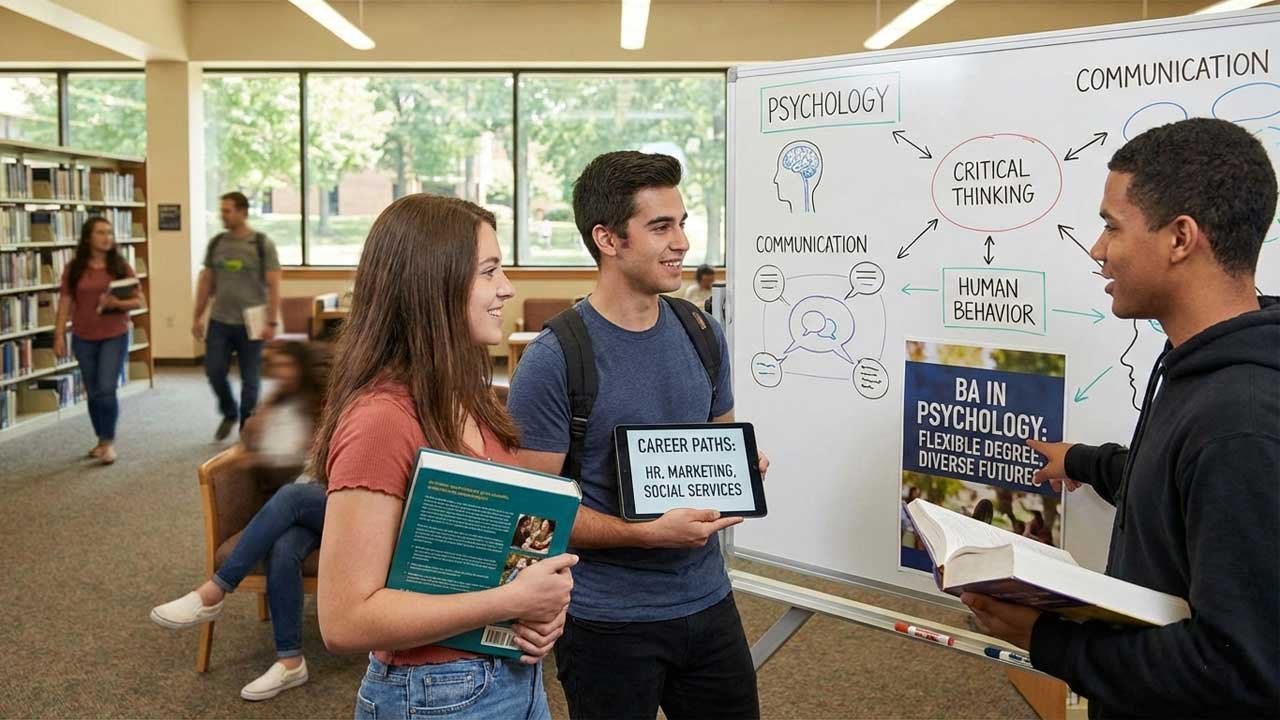
A Bachelor of Arts (BA) in Psychology is a versatile undergraduate degree designed for students interested in understanding human behavior, cognition, and mental processes. Unlike its counterpart, the Bachelor of Science (BS), a BA in Psychology emphasizes liberal arts foundations, communications skills, and social sciences alongside psychological theory.
This comprehensive guide explores whether a BA in Psychology is the right choice for your career, what salaries you can expect globally, and how to maximize your educational investment.
In this article, you’ll discover:
- Real salary data from the US, India, and international markets
- Complete career pathways with and without further education
- Practical differences between BA and BS programs
- Scholarship opportunities worth $2,500-$20,000+
- Cost-benefit analysis to determine ROI
- Top-ranked online programs
- Step-by-step guide to becoming a licensed therapist
Section 1: What is a Bachelor of Arts in Psychology?
Definition and Program Structure
A Bachelor of Arts in Psychology is a four-year undergraduate degree (120 credit hours in the US, 3 years in India) that provides foundational knowledge of psychological principles, human behavior, research methodology, and mental health. The BA differs from a BS by offering greater flexibility through elective courses in humanities, social sciences, foreign languages, and communications.
Typical BA Psychology Curriculum:
- Core courses: Introduction to Psychology, Research Methods, Statistics
- Specialized courses: Cognitive Psychology, Developmental Psychology, Social Psychology, Clinical Psychology, Neuropsychology
- Electives: Cultural Psychology, Forensic Psychology, Industrial-Organizational Psychology, Health Psychology
- Humanities/Arts: Foreign language, History, Philosophy, Literature, Social Sciences
- Capstone project or research experience
BA vs. BS in Psychology: Which Should You Choose?
The distinction between BA and BS affects your career trajectory primarily for advanced studies, not entry-level employment. Here’s the comprehensive comparison:
| Factor | BA in Psychology | BS in Psychology |
|---|---|---|
| Curriculum Focus | Broader liberal arts; humanities emphasis | Science-heavy; research & statistics focus |
| Math Requirements | Typically 1-2 courses | 3-4 advanced math/statistics courses |
| Lab/Science Courses | Fewer lab requirements | Extensive lab work; neuropsychology labs |
| Communication Focus | Strong emphasis on writing & speaking | Technical writing & data presentation |
| Research Methods | Introductory & survey-based | Advanced statistics, experimental design |
| Foreign Language | Often required (2+ semesters) | Rarely required |
| Electives | History, Philosophy, Arts, Languages | Neuroscience, Advanced Statistics, Biology |
| Best For Career Paths | HR, Counseling, Social Work, Education, Marketing | Research, Clinical roles, Academia, Neuroscience |
| Graduate School Prep | Counseling, Social Work, HR, Education masters | Clinical Psychology PhD, Research positions |
| Difficulty Level | Moderate | Challenging (more quantitative) |
Critical Finding: Both BA and BS graduates qualify for identical entry-level positions. Career differentiation emerges only when pursuing advanced degrees or specialized research roles. A BA Psychology graduate earns the same starting salary as a BS graduate in HR, case management, or market research roles.
Section 2: Career Paths with a BA in Psychology
Entry-Level Careers (No Additional Education Required)
With a BA in Psychology, you can immediately enter several professional fields. The following data represents 2024-2026 salary ranges across the US market:
1. Human Resources (HR) Specialist – Highest Entry-Level Pay
- Median Annual Salary: $72,910
- Entry Level (10th percentile): $45,000
- Experienced (90th percentile): $115,000+
- Job Growth: +5% through 2034
- Responsibilities: Recruiting, employee relations, conflict resolution, benefits administration, workplace culture development
- Why Psychology Helps: Understanding employee behavior, motivation, group dynamics, and stress management
- Typical Employers: Fortune 500 companies, tech startups, healthcare systems, government agencies
2. Market Research Analyst – Strong Analytical Career
- Median Annual Salary: $68,230 to $76,950
- Entry Level: $42,070
- Experienced: $144,610+
- Job Growth: +7% through 2034
- Responsibilities: Consumer behavior analysis, survey design, data interpretation, trend forecasting, focus group facilitation
- Why Psychology Helps: Consumer psychology, cognitive biases, behavioral economics, research methodology
- Typical Employers: Marketing firms, tech companies, consumer goods manufacturers, research institutes
3. Social and Human Service Assistant / Case Manager
- Median Annual Salary: $37,180 to $45,120
- Entry Level: $33,280
- Experienced: $63,850+
- Job Growth: +6% through 2034
- Responsibilities: Client assessment, resource coordination, advocacy, progress monitoring, crisis intervention support
- Why Psychology Helps: Empathy, communication, understanding mental health, motivational interviewing techniques
- Typical Employers: Non-profits, government agencies, community mental health centers, child protective services
4. Psychiatric Technician / Mental Health Technician
- Median Annual Salary: $37,090 to $45,000+
- Entry Level: $32,000
- Experienced: $60,000+
- Job Growth: +12% through 2034 (fastest-growing role)
- Responsibilities: Patient care support, behavioral observation, therapeutic activity assistance, vital signs monitoring
- Why Psychology Helps: Patient communication, understanding mental health conditions, behavioral management techniques
- Typical Employers: Hospitals, psychiatric facilities, rehabilitation centers, correctional facilities
5. Police Officer / Law Enforcement
- Median Annual Salary: $77,270
- Entry Level: $48,230
- Experienced: $120,460+
- Job Growth: +3% through 2034
- Responsibilities: Criminal investigation, community policing, suspect interviews, crisis negotiation
- Why Psychology Helps: Interview techniques, criminal psychology, understanding suspect motivation, threat assessment
- Typical Employers: Police departments, FBI (with additional training), criminal justice agencies
6. Education Coordinator / Corporate Trainer
- Median Annual Salary: $60,000-$75,000
- Entry Level: $40,000-$50,000
- Experienced: $85,000-$110,000
- Job Growth: Moderate (varies by sector)
- Responsibilities: Curriculum development, training delivery, learning assessment, employee development programs
- Why Psychology Helps: Learning theory, developmental psychology, instructional design principles
- Typical Employers: Corporate training departments, education technology companies, universities
7. Sales Manager
- Median Annual Salary: $138,060
- Entry Level: $66,910
- Experienced: $239,200+
- Job Growth: +5% through 2034
- Responsibilities: Team leadership, sales strategy, performance management, client relationship management
- Why Psychology Helps: Motivating teams, understanding customer psychology, influence principles, conflict management
- Typical Employers: Tech companies, pharmaceutical sales, software companies, financial services
Advanced Careers (Requiring Master’s Degree or Further Education)
If you invest 2-3 additional years in a master’s degree after your BA, significantly higher earnings become possible:
Mental Health Counselor / Licensed Professional Counselor (LPC)
- Additional Education Required: Master’s degree in Counseling/Psychology (2-3 years) + state licensure (300-1,000+ supervised hours)
- Median Annual Salary: $59,190
- Entry Level: $39,090
- Experienced: $98,210+
- Job Growth: +18% through 2032 (fastest-growing psychology field)
- Typical Path: BA in Psychology → Master’s in Counseling or Clinical Mental Health Counseling → LPC licensure exam → practice
- Typical Employers: Private practice, community mental health centers, hospitals, schools
Licensed Clinical Social Worker (LCSW)
- Additional Education Required: Master of Social Work (MSW) (2 years) + 2,000+ supervised clinical hours + state licensure exam
- Median Annual Salary: $68,090
- Entry Level: $45,030
- Experienced: $100,870+
- Specializations: Clinical social work, healthcare social work, substance abuse treatment
- Typical Path: BA in Psychology → MSW → Clinical experience → LCSW licensure
- Typical Employers: Hospitals, private practice, mental health clinics, schools
Marriage and Family Therapist (LMFT)
- Additional Education Required: Master’s in Marriage and Family Therapy (2-3 years) + 1,000+ supervised clinical hours + state licensure
- Median Annual Salary: $63,780
- Entry Level: $42,610
- Experienced: $111,610+
- Typical Path: BA in Psychology → Master’s in MFT → Supervised clinical practice → LMFT licensure
- Note: Some states accept BA Psychology + specific counseling-focused employment as part of licensing requirements
- Typical Employers: Private practice, couples therapy centers, family service agencies
School Psychologist
- Additional Education Required: Specialist degree (EdS) or Master’s (2-3 years) + state certification
- Median Annual Salary: $84,940
- Entry Level: $51,020
- Experienced: $130,460+
- Responsibilities: Student assessment, behavioral consultation, intervention planning, parent-teacher collaboration
- Typical Path: BA in Psychology → Master’s in School Psychology or Counseling → State certification
- Typical Employers: School districts, education agencies
Clinical Psychologist (PhD or PsyD)
- Additional Education Required: Doctoral degree (PhD or PsyD) (5-7 years) + state licensure + supervised practice
- Median Annual Salary: $96,100
- Entry Level: $52,110 to $75,000
- Experienced: $143,620-$200,000+
- Specializations: Clinical, Counseling, Neuropsychology, Forensic, Health Psychology
- Typical Path: BA Psychology → Graduate psychology coursework → Clinical internship → Doctoral degree → Licensure
- Note: PhD programs often fully funded with stipends ($20K-$30K/year); PsyD programs rarely funded
- Typical Employers: Private practice, hospitals, research institutions, universities
Industrial-Organizational Psychologist (I-O Psychologist)
- Additional Education Required: Master’s or PhD in I-O Psychology (2-7 years)
- Median Annual Salary: $139,280 (one of the highest-paying psychology careers)
- Entry Level: $61,380
- Experienced: $206,180+
- Responsibilities: Organizational development, employee training, performance evaluation, workplace culture
- Typical Employers: Fortune 500 companies, consulting firms, tech companies, government agencies
Section 3: Bachelor of Arts Psychology Salary by Country
United States Salary Overview
The US offers the highest entry-level salaries globally for psychology degree holders:
Entry-Level Salary Range (BA Psychology): $45,000-$55,000
Median Career Salary: $59,190-$96,100 (depending on role and experience)
Top 10% Earners: $140,000-$250,000+ (clinical psychologists, I-O psychologists in senior roles)
Salary Growth Timeline:
- Years 1-3: $45,000-$60,000
- Years 3-7: $60,000-$85,000
- Years 7-10: $85,000-$120,000+
- 10+ years: $120,000-$200,000+ (with specialization or advanced degree)
India Salary Overview
India offers a rapidly growing market for psychology graduates with lower entry-level costs but competitive career growth:
Entry-Level Salary Range (BA Psychology): ₹15,000-₹30,000/month (~$180-$360/year equivalent, but lower cost of living)
Average Annual Salary (BA Psychology): ₹3.1 LPA (~$3,700)
Salary Range: ₹3-7 LPA (~$3,600-$8,400/year)
Monthly Salary Average: ₹47,359 (~$570/month)
Career-Level Salaries in India:
- Entry-level HR Coordinator: ₹4-6 LPA (~$4,800-$7,200)
- Research Analyst: ₹4-7 LPA (~$4,800-$8,400)
- Social Worker: ₹3-6 LPA (~$3,600-$7,200)
- Counselor (with certification): ₹3-5 LPA (~$3,600-$6,000)
- Highest-paying psychology roles (Neuropsychologist, I-O Psychologist): 15-21 LPA (~$18,000-$25,000)
Why Study Psychology in India?
- Ultra-low tuition costs (₹1-5 lakhs for 3-year degree = $1,200-$6,000 total)
- Rapid job market growth in mental health and corporate sectors
- High ROI compared to US/UK markets
- Growing acceptance of psychology careers in traditionally counseling-resistant markets
United Kingdom Salary Overview
Entry-Level Salary Range: £25,000-£32,000 (~$31,000-$40,000 USD)
Median Career Salary: £35,000-£55,000 (~$44,000-$69,000 USD)
NHS Psychological Practitioner: £26,000-£43,000 starting (~$32,000-$54,000 USD)
Australia Salary Overview
Entry-Level Salary Range: AUD $55,000-$65,000 (~$37,000-$44,000 USD)
Median Career Salary: AUD $70,000-$95,000 (~$47,000-$64,000 USD)
Registered Psychologist (with further education): AUD $80,000-$120,000+ (~$54,000-$81,000+ USD)
Section 4: Is a BA in Psychology Worth It? Cost-Benefit Analysis
Total Cost of BA Psychology (United States)
| Cost Component | Public In-State Universities | Public Out-of-State | Private Universities |
|---|---|---|---|
| Average Annual Tuition & Fees | $9,750 | $27,000 | $35,000-$45,000 |
| Room & Board (per year) | $12,000-$15,000 | $12,000-$15,000 | $12,000-$15,000 |
| Books & Supplies (per year) | $1,200-$1,700 | $1,200-$1,700 | $1,200-$1,700 |
| Total Annual Cost | $22,950-$26,450 | $40,200-$43,700 | $48,200-$58,200 |
| 4-Year Total (before financial aid) | $91,800-$105,800 | $160,800-$174,800 | $192,800-$232,800 |
| Average with Financial Aid | $60,000-$75,000 | $100,000-$120,000 | $120,000-$150,000 |
Online Psychology Degree Cost (Much Lower):
- Arizona State University Online BA Psychology: ~$40,000 total
- Southern New Hampshire University Online BA Psychology: ~$35,000-$50,000 total
- University of Florida Online BA Psychology: ~$30,000-$50,000 total (in-state tuition benefit for all students)
Return on Investment Analysis
Scenario 1: BA Psychology → Immediate Entry-Level Job (HR Specialist)
- Total Cost: $75,000 (average with aid)
- Starting Salary: $45,000
- Years 1-5 Earnings: $250,000
- Years 5-10 Earnings: $400,000 (with 3-4% annual raises)
- 10-Year Career Earnings: $650,000
- Net ROI (after cost): $575,000 gained
- Break-Even Point: ~2 years
- Verdict: Strong ROI for immediate employment
Scenario 2: BA Psychology → Master’s Degree → Licensed Counselor
- Total Cost BA: $75,000
- Total Cost Master’s: $40,000-$100,000
- Combined Investment: $115,000-$175,000
- Starting Salary (post-master’s): $39,090 (entry LMFT/LPC)
- Mid-Career Salary (5-10 years): $70,000-$85,000
- Years 1-5 Earnings (post-master’s): $220,000
- Years 5-10 Earnings: $400,000
- 10-Year Career Earnings: $620,000
- Net ROI (after total cost): $445,000-$505,000 gained
- Break-Even Point: ~3-4 years
- Verdict: Good long-term ROI with meaningful work
Scenario 3: BA Psychology → PhD Clinical Psychology → Licensed Psychologist
- Total Cost BA: $75,000
- Total Cost PhD: $0-$50,000 (if fully funded program; $120,000+ if unfunded)
- Years in School: 10-12 years
- Starting Salary (as licensed psychologist): $75,000-$90,000
- Years 1-10 Earnings: $850,000
- Years 10-20 Earnings: $1,200,000+
- Lifetime Earnings Potential: $3.8 million+ (40-year career at median $96,100)
- Net ROI (if funded PhD): Exceptional after 5-7 years
- Verdict: Excellent long-term ROI, but requires 10+ years investment and student debt considerations
Section 5: How to Become a Therapist with a BA in Psychology
Step-by-Step Pathway
Becoming a licensed therapist is one of the most popular career paths for BA Psychology graduates. Here’s the exact roadmap:
Step 1: Earn BA in Psychology (Years 1-4)
- Focus Areas: Child development, cognitive therapy, counseling techniques, abnormal psychology
- What Helps: Volunteer experience at mental health clinics or crisis hotlines
- Target GPA: 3.0+ (required for most master’s programs)
- Average Cost: $60,000-$100,000
Step 2: Choose Your Licensure Path (Choose One)
Option A: Licensed Professional Counselor (LPC) Path
- Master’s degree: MS/MA in Counseling or Clinical Mental Health Counseling (2-3 years)
- Typical cost: $30,000-$80,000
- Supervised hours required: 1,000-2,000 (depends on state)
- Licensure exam: Typically $200-$400
- Time to licensure: 4-6 years post-BA
- Best for: General counseling, school counseling, community mental health
Option B: Licensed Marriage and Family Therapist (LMFT) Path
- Master’s degree: MA/MS in Marriage and Family Therapy (2-3 years)
- Typical cost: $30,000-$70,000
- Supervised hours: 1,000-4,000 (varies by state)
- Licensure exam: $300-$500
- Time to licensure: 4-7 years post-BA
- Best for: Couples therapy, family dynamics, relationship issues
Option C: Licensed Clinical Social Worker (LCSW) Path
- Master’s degree: MSW (Master of Social Work) (2 years)
- Typical cost: $30,000-$90,000
- Supervised clinical hours: 2,000+
- Licensure exam: $200-$400
- Time to licensure: 4-5 years post-BA
- Best for: Broader social services, healthcare settings, flexibility
- Advantage: MSW opens doors to non-clinical positions if therapy isn’t right
Step 3: Gain Supervised Clinical Experience (While in/After Master’s Program)
- Most master’s programs include internship/practicum components (600-1,000 hours typically)
- Additional supervised hours required post-graduation (depends on license type and state)
- Examples: 1,000 hours minimum for LPC, 2,000 hours for LCSW
- Supervised hours typically paid ($15-$30/hour, or unpaid internships)
Step 4: Pass State Licensure Exam
- LPC National Counselor Examination (NCE): 200 questions, pass score ~125+
- LMFT National Examination (LMFT): Similar format
- LCSW Exam (ASWB): Advanced level exam
- Typical pass rate: 70-80% on first attempt
- Cost: $200-$500 per exam
Step 5: Complete Post-Licensure Supervision (If Required)
- Some states require 1,000-2,000 additional supervised hours post-degree
- Must work under licensed supervisor ($50-$150/hour cost or shared revenue)
- Timeline: 1-2 years typically
Step 6: Apply for State Licensure
- Submit application to state licensing board
- Provide proof of: degree, supervised hours, exam passing score, background check
- Cost: $100-$300
- Result: Licensed to practice independently as therapist
Total Investment to Become Therapist
| Component | Time | Cost |
|---|---|---|
| BA Psychology | 4 years | $60,000-$100,000 |
| Master’s Degree | 2-3 years | $30,000-$90,000 |
| Supervised Clinical Hours | 1-2 years (often concurrent with master’s) | $0-$50,000 |
| Licensing Exams & Applications | 1 year | $500-$1,500 |
| Total | 7-9 years | $90,500-$241,500 |
Starting Salary After Licensure: $39,090-$45,000
Break-Even Point: 2-3 years post-licensure
Career Earning Potential: $600,000-$1,000,000 over 25-year career
Section 6: Top-Ranked Online BA Psychology Programs
Best Online Programs for International Students
1. Arizona State University (ASU) Online – BA Psychology
- Format: 100% online
- Duration: 4 years (120 credit hours)
- Cost: ~$40,000-$50,000 total
- Accreditation: Higher Learning Commission
- Specializations: Forensic Psychology, Child Psychology, Clinical Psychology
- International Students: Accepted worldwide
- Strengths: Affordable, well-ranked, flexible scheduling
- Admission Requirements: High school diploma, 2.5+ GPA
- Website: asuonline.asu.edu
2. University of Florida (UF) Online – BA Psychology
- Format: 100% online with multiple track options
- Duration: 4 years (120 credit hours)
- Cost: ~$30,000-$50,000 (all students get in-state tuition)
- Accreditation: Southern Association of Colleges and Schools Commission on Colleges (SACSCOC)
- Specializations: Clinical, Experimental, General, Neuroscience, Industrial-Organizational, Human Factors
- Strengths: In-state tuition for all students, top-ranked
- Admission Requirements: High school diploma, 3.0+ GPA preferred
- Ranking: Frequently appears in US News & World Report top 10 online psychology programs
- Website: ufonline.ufl.edu
3. Southern New Hampshire University (SNHU) – BA/BS Psychology
- Format: Online with flexible start dates
- Duration: 4 years (120 credit hours)
- Cost: ~$35,000-$50,000 total
- Accreditation: New England Commission of Higher Education (NECHE)
- Specializations: Child & Adolescent Psychology, Forensic Psychology, Mental Health, Organizational Psychology
- Strengths: Highly flexible, affordable, large online community
- Admission Requirements: High school diploma, rolling admissions
- Website: snhu.edu
4. University of Massachusetts Online – BA Psychology
- Format: Online/Blended options
- Duration: 4 years
- Cost: ~$40,000-$60,000
- Accreditation: NECHE
- Strengths: Prestigious university brand, strong psychology program
- International Appeal: Good for students wanting US-quality education at moderate cost
- Website: umass.edu
5. Purdue University Global – BS Psychology (or BA available)
- Format: 100% online
- Duration: 4 years (120 credit hours)
- Cost: ~$40,000-$55,000
- Accreditation: Higher Learning Commission
- Specializations: Business psychology, counseling focus
- Strengths: Purdue prestige, uniform tuition for in/out-of-state
- Website: purdueglobal.edu
Top Programs in India
1. Chandigarh University – BA Psychology (Honours)
- Format: Campus-based with online option
- Duration: 4 years (if Honours track; 3 years standard)
- Cost: ₹3-5 lakhs (~$3,600-$6,000)
- Strengths: NAAC A++ accreditation, strong placement, psychology labs
- Specializations: Clinical, Counseling, Neuropsychology, Forensic
- Courses: Cognitive Psychology, Developmental Psychology, Criminal Psychology, Disability Studies
- Website: chandigarh.edu.in
2. Parul University – BA Psychology
- Format: Campus-based
- Duration: 4 years (with Honours option)
- Cost: ₹2-4 lakhs (~$2,400-$4,800)
- Strengths: Psychology labs, clinical exposure, internship opportunities
- Career Support: High placement rates in HR, counseling, social work
- Website: paruluniversity.ac.in
3. GITAM University – BA Psychology (Visakhapatnam)
- Format: Campus-based
- Duration: 3-4 years
- Cost: ₹2-4 lakhs (~$2,400-$4,800)
- Strengths: ICSSR collaboration, government job preparation
- Specializations: Clinical, Health, Organizational, Indian Psychology
- Website: gitam.edu
4. Chitkara University – BA Psychology (Honours)
- Format: Campus-based (can extend with honours year)
- Duration: 3 years (plus 1-year honours option)
- Cost: ₹3-5 lakhs (~$3,600-$6,000)
- Strengths: Industry-focused curriculum, counseling practice orientation
- Website: chitkara.edu.in
Section 7: Available Scholarships for BA Psychology Students
US Scholarships
1. Sharon Stephens Brehm Undergraduate Psychology Scholarships
- Award: $5,000 per scholarship (8 scholarships available)
- Eligibility: Undergraduate psychology majors, 3.5+ GPA, financial need, accredited institution
- Deadline: July 10, 2026
- Provider: American Psychological Foundation (APF)
- Website: ampsychfdn.org
2. NIH Undergraduate Scholarship (Biomedical/Behavioral Sciences)
- Award: Up to $20,000
- Eligibility: US citizen, full-time student, 3.3+ GPA, financial need, psychology/social science student
- Deadline: March annually
- Provider: National Institutes of Health
- Website: nih.gov
3. APA Student Scholarships
- Award: $2,500-$5,000
- Eligibility: APA student member, psychology major, 3.0+ GPA, demonstrated interest in psychology
- Provider: American Psychological Association
- Annual Deadline: Usually fall/winter
4. The Melanie Foundation Scholarship
- Award: $2,500
- Eligibility: Psychology masters/doctoral students (some undergraduate opportunities), commitment to mental health field
- Deadline: March
- Website: melanfoundation.org
5. Bold.org Psychology Scholarships
- Award: $2,000-$4,600+ (multiple scholarships available)
- Eligibility: Various criteria including: mental illness background, low-income status, specific states, 3.5+ GPA
- Deadline: Multiple deadlines throughout year (rolling)
- Website: bold.org
India Scholarships
National Scholarship Scheme (NSS)
- Award: Full tuition + living stipend
- Eligibility: Economically weaker sections (EWS), specific income criteria, merit-based
- Provider: Ministry of Education, Government of India
- Website: scholarships.gov.in
Merit-Based Scholarships (University-Specific)
- Most Indian universities offer 25-50% tuition waivers for students with 90%+ 12th board scores
- Chandigarh University: Full scholarships available for top 5% of admitted students
- Parul University: Partial scholarships for 85%+ scores
International Scholarships
Chevening Scholarships (For UK Master’s, some UG)
- Award: Full tuition + living costs
- For international students pursuing studies in UK
Fulbright Scholarships (US)
- Award: Full program sponsorship
- Highly competitive, limited slots for developing countries
Section 8: Career Growth and Specialization Paths
After Your BA: Specialization Options
Psychology graduates often pursue specialized master’s degrees that dramatically increase earning potential:
Forensic Psychology Specialization
- Additional Education: Master’s in Forensic Psychology (2 years)
- Salary: $70,000-$120,000+
- Roles: Criminal profiler, expert witness, correctional psychologist
- Where: FBI, police departments, courts, correctional facilities
- Unique Value: High-profile cases, investigative work
Sports Psychology Specialization
- Additional Education: Master’s in Sports Psychology (2 years)
- Salary: $60,000-$100,000+
- Roles: Athletic team psychologist, sports performance consultant
- Where: Professional sports teams, Olympic committees, sports franchises
- Unique Value: Work with elite athletes, performance enhancement
Health Psychology Specialization
- Additional Education: Master’s or PhD in Health Psychology (2-7 years)
- Salary: $65,000-$130,000+
- Roles: Hospital psychologist, wellness coordinator, health behavior researcher
- Where: Hospitals, health centers, pharmaceutical companies, research institutions
- Unique Value: Medical psychology, chronic disease management, preventive health
Organizational/Industrial-Organizational (I-O) Psychology
- Additional Education: Master’s in I-O Psychology (2 years)
- Salary: $100,000-$200,000+ (highest-paying specialization)
- Roles: Organizational consultant, talent management, executive coach
- Where: Fortune 500 companies, consulting firms, tech companies
- Unique Value: Corporate work, high compensation, organizational impact
Section 9: Applying for BA Psychology Programs
Application Timeline (For 2026-2027 Intake)
| Timeline | Action |
|---|---|
| 12 months before | Research universities, attend virtual info sessions, explore specializations |
| 9-10 months before | Prepare for standardized tests (SAT if required), strengthen grades |
| 6-8 months before | Complete applications, prepare personal statements, request recommendation letters |
| 4-6 months before | Submit applications with transcripts, test scores, essays |
| 3-4 months before | Application review period; universities send decisions |
| 2-3 months before | Accept offer, arrange housing, finalize visa (international students) |
| 1 month before | Orientation, course registration, arrange transportation |
Application Requirements (Typical)
For US Online Programs:
- High school diploma or GED
- Minimum GPA (2.5-3.5 depending on institution)
- SAT/ACT scores (some waived for online programs)
- Personal statement/essay (500-1,000 words)
- 2-3 letters of recommendation
- Application fee ($30-$75)
- FAFSA submission (for US financial aid)
For UK/Australian Universities:
- High school diploma equivalent
- IELTS or TOEFL (if English not native language)
- Personal statement
- References
- Application through national portals (UCAS for UK, etc.)
For Indian Universities:
- 10+2 (12th board) certificate
- Merit-based entrance (some universities), or direct admission based on board scores
- For some private universities: entrance test scores
Section 10: Career Outcomes and Employment Data
Employment Statistics for BA Psychology Graduates
Overall Job Market Health:
- Psychology field job growth: 7% through 2034 (in line with national average)
- Related psychology roles (psychiatric tech, social workers): 12-18% growth (faster than average)
- Total psychology professionals in US: 180,000+
- Total projected growth: 12,500+ new positions by 2034
Placement Rates by Institution:
- Top-ranked universities: 85-95% employment within 6 months of graduation
- Average universities: 70-80% employment within 6-12 months
- Online program graduates: 65-85% employment rate (varies by program quality)
Common Employers of BA Psychology Graduates:
- Google, Microsoft, Amazon (HR, market research)
- Apple, Meta, TikTok (user research, organizational psychology)
- JPMorgan Chase, Bank of America (HR, compliance)
- Johnson & Johnson, Pfizer, Moderna (clinical research, medical device user research)
- McKinsey, Deloitte, Accenture (organizational consulting)
- US Government (FBI, NSA, NIH, state agencies)
- Major hospitals and healthcare systems
- Non-profit organizations (80,000+ HR jobs in non-profit sector)
- Educational institutions
Frequently Asked Questions (FAQ)
Q: Can I become a therapist with just a BA in Psychology?
A: No. To become a licensed therapist, you need a master’s degree (2-3 additional years) plus supervised clinical hours (1,000-2,000+) and state licensure. A BA Psychology is the first step, not the destination. However, you can work as a “psychological assistant” or “counselor” (unlicensed) with only a BA.
Q: Is a BA in Psychology worth it if I’m not pursuing therapy?
A: Yes. The BA develops highly transferable skills (communication, critical thinking, data analysis, research) valued in HR, marketing, business, and social services. Starting salary of $45,000+ with strong upside potential makes it financially sound.
Q: Should I choose online or in-campus BA Psychology?
A: Choose based on: lifestyle (online = flexible), social needs (campus = community), cost (online = often cheaper), and career goals. For entry-level jobs, employers don’t differentiate; for research/academic careers, campus programs offer better networking.
Q: What’s the difference between psychology and psychiatric nursing?
A: Psychology is the study of behavior; psychiatric nursing is clinical medical care for mental health patients. Psychology degree opens broader career paths (HR, business, research); nursing focuses on patient care and requires different certification.
Q: How difficult is the BA Psychology coursework?
A: Moderate difficulty. Unlike BS, BA programs have less quantitative rigor (fewer stats/math courses). You’ll memorize concepts, write research papers, and participate in discussions. Not as hard as engineering/pre-med but requires consistent effort.
Q: Can I study BA Psychology internationally and work in the US?
A: For entry-level jobs (HR, market research), yes—employers accept international degrees. For licensed therapy roles, you’ll need: US master’s degree (most international degrees not directly recognized), or equivalency evaluation + additional coursework + state licensing. US master’s is typical path.
Q: What GPA do I need to get into a good BA Psychology program?
A: Minimum 2.5-3.0 GPA for admission; 3.5+ GPA required for competitive scholarships and top universities.
Q: Is there job growth in psychology?
A: Yes. Psychology job growth is 7-18% depending on specialization through 2034. Mental health counselors (18% growth) lead, followed by social workers (12-13% growth). Much faster than shrinking fields like journalism.
Q: How much does a BA Psychology degree cost in different countries?
A: US ($60K-$100K online, $90K-$150K on-campus), UK (£25,000-£45,000), India (₹2-5 lakhs = $2,400-$6,000), Australia (AUD $55,000-$85,000).
Q: Can I switch from BA to BS after starting?
A: Most universities allow switching between BA and BS within first year. Talk to academic advisors as requirements differ (mostly in math/science vs. humanities distribution).
Conclusion: Making Your Decision
A Bachelor of Arts in Psychology is a financially sound, personally rewarding degree that opens doors to immediate employment and graduate study pathways. With entry-level salaries of $45,000-$75,000 and potential to reach $100,000-$200,000+ with specialization, the degree offers strong long-term ROI despite initial 4-year investment.
Choose BA Psychology if you:
- Want broader career flexibility (HR, marketing, social services)
- Prefer humanities and communication focus over quantitative analysis
- Plan to pursue counseling, social work, or HR master’s programs
- Value direct entry to workforce over extended academic training
- Prefer to keep career options open
The decision to pursue a BA in Psychology ultimately depends on your career aspirations, financial situation, and learning preferences. With 50,000+ psychology professionals in the US alone and job growth across specializations, this degree remains one of the most versatile undergraduate investments available.


Leave a Reply
You must be logged in to post a comment.