

A Bachelor of Mathematics (B.Math) is a prestigious, research-oriented undergraduate degree that emphasizes rigorous theoretical training, proofs, and advanced problem-solving, offering stronger academic depth than a typical B.Sc in Mathematics and preparing students for high-impact careers in data science, actuarial science, quantitative finance, software engineering, machine learning, research, and academia.
Typically completed in three years, the program includes core areas such as analysis, algebra, probability, topology, and algorithms, with specializations ranging from financial mathematics to cryptography and data science, and is offered by elite institutions worldwide including MIT, Cambridge, ETH Zurich, ISI, and CMI. Admission often requires strong mathematics backgrounds and competitive entrance exams, while global study options, scholarships, and research exposure significantly enhance prospects.
Graduates enjoy excellent global recognition, strong salary potential—especially in the US and Switzerland—and exceptional career flexibility across technology, finance, government, and academia, making B.Math an ideal choice for students with strong analytical aptitude and long-term ambitions in mathematically intensive fields.
| Aspect | Information |
|---|---|
| Degree Name | Bachelor of Mathematics (B.Math / BMath) |
| Duration | 3 years (some universities offer 4-year programs) |
| Focus | Pure & applied mathematics, proofs, advanced theory |
| Skill Development | Analytical thinking, problem-solving, programming, modeling |
| Major Specializations | Data Science, Actuarial Science, Financial Math, Machine Learning, Cryptography |
| Top Institutions | MIT, Cambridge, Oxford, ETH Zurich, ISI Bangalore, CMI |
| Admission Mode | Entrance exams + academic merit |
| Career Fields | Data Science, Finance, Software, Research, Academia, Risk Analysis |
| Average Starting Salary | India: ₹3.5–5.5 LPA |
| Global Recognition | Highly recognized by universities, employers, and research institutes |
What Is a Bachelor of Mathematics?
A Bachelor of Mathematics (B.Math or BMath) is an undergraduate academic degree awarded after successfully completing a specialized program in pure mathematics, applied mathematics, or related mathematical disciplines. The degree is designed for students with exceptional aptitude in mathematical reasoning and analytical problem-solving.
Unlike a general Bachelor of Science (B.Sc) degree with a mathematics specialization, a B.Math offers a more concentrated, honors-level curriculum that emphasizes theoretical foundations, mathematical proofs, and advanced problem-solving techniques. This degree equips graduates with the analytical, computational, and logical reasoning skills needed for careers in technology, finance, research, and academia.
The Bachelor of Mathematics is internationally recognized and accepted across universities, corporations, and research institutions worldwide. Relatively few institutions award the B.Math degree distinction—most universities offer mathematics through B.Sc or B.A programs—making it a prestigious qualification that signals a deep mathematical foundation.
Key Features of a B.Math Degree:
- Duration: Typically 3 years (some universities offer 4-year programs)
- Academic Focus: Pure and applied mathematics, with emphasis on mathematical rigor
- Global Recognition: Highly valued by international employers and graduate programs
- Career Flexibility: Opens doors to diverse sectors including finance, technology, research, and education
- Specialization Options: Data science, actuarial science, financial mathematics, operations research, and computational mathematics
B.Math vs BSc Mathematics: Key Differences
Students pursuing mathematics often face the question: “Should I choose B.Math or BSc Mathematics?” While both degrees provide solid mathematical training, they have distinct differences in curriculum structure, depth, and career outcomes.
Curriculum Differences
| Aspect | B.Math | BSc Mathematics |
|---|---|---|
| Focus | Pure, theoretical mathematics with proofs and rigorous analysis | Balanced between theory, applications, and practical sciences |
| Course Difficulty | Higher-level courses (13x series) with emphasis on abstract concepts | Foundational to intermediate level (12x series) courses |
| Additional Requirements | Computer Science, Statistics, Advanced Real Analysis, Topology | Physics, Chemistry, or Electronics as complementary subjects |
| Elective Flexibility | More advanced, research-oriented electives | More applied, industry-focused electives |
| Assessment | Emphasis on written proofs and theoretical problem-solving | Mix of theory, practical exams, and laboratory work |
Why Choose B.Math?
- Research-Oriented: Better preparation for PhD programs and academic careers
- Theoretical Depth: Stronger foundation in abstract mathematics and advanced topics
- Graduate Program Access: More attractive to top-tier graduate schools globally
- Academic Excellence: Preferred by universities with world-class mathematics departments
Why Choose BSc Mathematics?
- Versatility: Easier transition to applied fields and industry roles
- Practical Applications: Better grounding in real-world mathematical applications
- Career Variety: More options for non-academic careers immediately after graduation
- Accessibility: Generally less demanding, suitable for students with strong math skills but diverse interests
Degree Structure and Course Curriculum
A typical Bachelor of Mathematics program spans 6 semesters (3 years) and includes core courses, advanced coursework, and elective subjects. The curriculum is designed to build mathematical maturity progressively.
First Year Curriculum
Semester I:
- Real Analysis I (Calculus of One Variable)
- Linear Algebra I
- Probability Theory I
- Elementary Number Theory
- Fundamentals of Computing and Programming
Semester II:
- Real Analysis II (Metric Spaces and Multivariable Calculus)
- Linear Algebra II
- Probability Theory II
- Introduction to Statistics
- Numerical Computing
Second Year Curriculum
Semester III:
- Analysis of Several Variables (Vector Calculus)
- Group Theory
- Statistical Inference
- Classical Mechanics
- Discrete Mathematics I
Semester IV:
- Topology
- Rings and Modules
- Ordinary Differential Equations
- Electrodynamics
- Introduction to Linear Models
Third Year Curriculum
Semester V:
- Complex Analysis
- Differential Geometry
- Design and Analysis of Algorithms
- Geometry
- Elective I
- Elective II
Semester VI:
- Optimization
- Elective III
- Elective IV
- Seminar/Project/Thesis
Popular Elective Subjects
Students typically choose from these advanced topics in their final year:
- Financial Mathematics: Mathematical models for finance and derivatives pricing
- Cryptography: Number theory applications in cybersecurity
- Operations Research: Optimization and decision-making under constraints
- Mathematical Biology: Modeling biological systems using mathematics
- Machine Learning: Statistical learning theory and algorithms
- Functional Analysis: Advanced analysis for theoretical mathematics
- Differential Geometry: Mathematical study of curves and surfaces
- Number Theory: Advanced properties of integers and algebraic numbers
- Graph Theory: Combinatorial structures and network analysis
- Data Science Specialization: Statistics, computation, and data analytics
Top Universities Worldwide for Bachelor of Mathematics
Attending a prestigious mathematics program significantly enhances career prospects and provides access to cutting-edge research and world-class faculty. Here are the globally ranked institutions offering excellent Bachelor of Mathematics or equivalent programs:
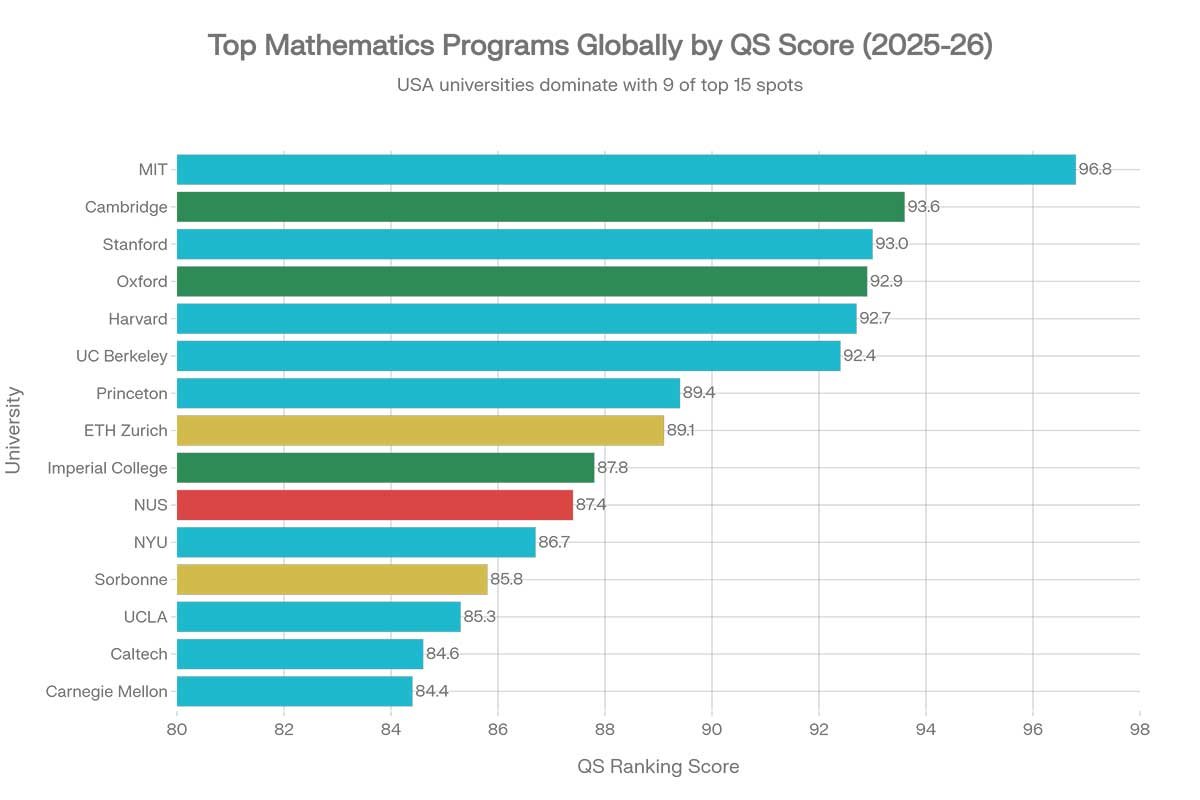
Global Top 10 Universities for Mathematics (2026-27)
| Rank | University | Country | Specialty |
|---|---|---|---|
| 1 | Massachusetts Institute of Technology (MIT) | USA | Pure & Applied Mathematics, Theoretical Physics |
| 2 | University of Cambridge | UK | Classical Mathematics, Research Excellence |
| 3 | Stanford University | USA | Applied Mathematics, Computer Science |
| 4 | University of Oxford | UK | Pure Mathematics, Mathematical Institute |
| 5 | Harvard University | USA | Theoretical Mathematics, Interdisciplinary |
| 6 | UC Berkeley | USA | Applied Mathematics, Research Focus |
| 7 | Princeton University | USA | Pure Mathematics, Graduate Programs |
| 8 | ETH Zurich | Switzerland | Applied Mathematics, Engineering Focus |
| 9 | Imperial College London | UK | Applied Mathematics, Technology |
| 10 | National University of Singapore | Singapore | Asian Excellence, Tech Applications |
Top Indian Institutions for B.Math
- Indian Statistical Institute (ISI), Bangalore: Prestigious B.Math program with international recognition
- Chennai Mathematical Institute (CMI): Offers BSc (Hons) Mathematics and Computer Science
- IIT Bombay: Strong mathematics program with research focus
- Ramakrishna Mission Vivekananda Educational and Research Institute: Quality B.Math instruction
Top Universities for Study Abroad
United States
MIT, Stanford, Princeton, Harvard, Yale, UC Berkeley, Caltech, University of Chicago, Carnegie Mellon
United Kingdom
Cambridge, Oxford, Imperial College London, University of Warwick, University of Edinburgh, LSE
Canada
University of Toronto, University of Waterloo, University of British Columbia, McGill University
Continental Europe
ETH Zurich (Switzerland), Technical University of Munich (Germany), University of Göttingen (Germany), Sorbonne University (France)
Admission Requirements and Application Process
Basic Eligibility Criteria
Educational Qualifications:
- Completion of 10+2 or equivalent secondary education
- Mathematics as a compulsory subject with minimum 50% marks
- Some premium institutions require 70-90% aggregate scores
Age Requirement:
- No strict age limit (varies by institution)
Nationality:
- Both Indian and international students can apply
- Foreign applicants may need to meet additional criteria
Entrance Examinations in India
For Central Universities (2026):
- CUET UG 2026: Conducted by National Test Agency
- Exam Dates: May 2026
- Eligibility: 10+2 passed or appearing
For Prestigious Institutes:
- ISI Entrance Exam (Indian Statistical Institute):
- Exam Date: May 10, 2026
- Application Deadline: March 25, 2026
- Programs: B.Math (3-year at Bangalore), B.Stat, B.S.in Data Science
- Pattern: Part 1 (Objective), Part 2 (Descriptive)
- CMI Entrance Exam (Chennai Mathematical Institute):
- Exam Date: May 2, 2026 (Saturday, 2 PM)
- Programs: BSc (Hons) Mathematics, BSc Mathematics & Computer Science, BSc Mathematics & Physics
- Syllabus: Higher secondary mathematics topics
- Direct admission available for Olympiad performers
Application Process Step-by-Step
- Register on Official Website: Create account with email and phone number
- Fill Application Form: Provide personal, educational, and contact details
- Select Program: Choose B.Math, B.Stat, or other preferred program
- Upload Documents: Scans of 10+2 marksheet, admit card, and photo
- Pay Application Fee: Usually ₹500-1,500 (varies by institution)
- Receive Admit Card: Check email for downloadable admit card
- Appear for Entrance Exam: On scheduled date at designated center
- Wait for Results: Typically declared within 2-3 months
- Interview Round: Shortlisted candidates may be called for interview
- Counseling & Admission: Seat allotment and document verification
Career Paths After B.Math: High-Paying Jobs
A Bachelor of Mathematics degree opens doors to numerous high-demand, well-compensated career opportunities across diverse sectors. Graduates can work in finance, technology, government, research, and academia.
Top 10 Career Options for B.Math Graduates
1. Data Scientist/Data Analyst
- Role: Extract insights from large datasets using statistical methods and machine learning
- Industries: Tech companies, finance, e-commerce, healthcare
- Salary Range (USA): Entry-level $70,000-$90,000; Median $103,500; Top 10% $174,790+
- Skills Required: Python, R, SQL, machine learning, statistical analysis
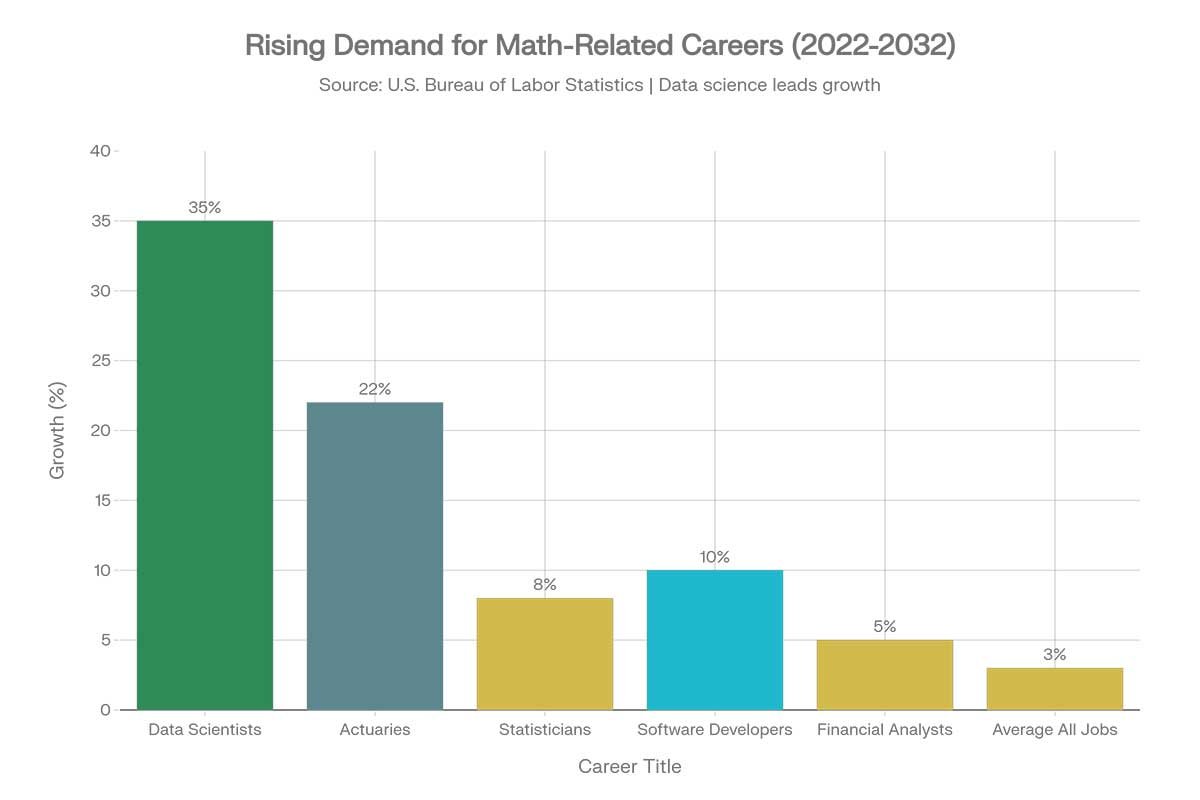
- Growth Outlook: 35% job growth projected (2022-2032)
2. Actuarial Analyst/Actuary
- Role: Assess and manage financial risk for insurance, pensions, and investments
- Industries: Insurance, pension funds, consulting, investment banks
- Salary Range (USA): Entry-level $70,000-$85,000; Median $114,000; Top 10% $200,000+
- Certifications Required: Society of Actuaries (SOA) exams
- Growth Outlook: 22% job growth projected (2022-2032)
3. Financial Analyst
- Role: Analyze financial data, create models, and make investment recommendations
- Industries: Banking, investment firms, corporate finance departments
- Salary Range (USA): Entry-level $55,000-$70,000; Median $128,420; Top 10% $213,800+
- Skills Required: Excel, financial modeling, data analysis, market knowledge
- Career Path: Progress to Senior Analyst → Portfolio Manager → Chief Investment Officer
4. Quantitative Analyst (Quant)
- Role: Develop mathematical models for trading and risk management
- Industries: Investment banks, hedge funds, trading firms
- Salary Range: Entry-level $100,000-$150,000; Senior $200,000-$500,000+ (with bonuses)
- Education: Master’s degree often preferred
- Skills Required: Advanced mathematics, programming, financial theory
5. Software Developer/Engineer
- Role: Design and develop software applications using mathematical algorithms
- Industries: Tech companies, startups, software firms
- Salary Range (USA): Entry-level $80,000-$100,000; Median $110,000-$130,000; Senior $150,000-$250,000+
- Skills Required: Programming languages (Python, Java, C++), algorithms, problem-solving
- Growth Outlook: Consistent demand, especially for specialized roles
6. Research Scientist/Mathematician
- Role: Conduct original mathematical research and publish findings
- Industries: Research institutes, universities, government labs, tech R&D departments
- Salary Range: Varies by location; Academic positions: ₹5-8 LPA (entry) to ₹15+ LPA (senior)
- Education: PhD usually required for advanced positions
- Locations: IIT, ISI, NIT, CSIR Labs, Tech company research divisions
7. Machine Learning Engineer
- Role: Build and optimize machine learning models and systems
- Industries: AI/ML companies, tech giants (Google, Facebook, Amazon), startups
- Salary Range (USA): Entry-level $90,000-$120,000; Median $120,000-$150,000; Senior $150,000-$300,000+
- Skills Required: Mathematics, Python, TensorFlow, deep learning theory
- Growth Outlook: Rapidly growing field with high demand
8. Investment Banker
- Role: Structure deals, perform valuations, and provide financial advice
- Industries: Investment banks, private equity, venture capital
- Salary Range: Entry-level (Analyst) $100,000-$150,000+; Vice President $200,000-$500,000+
- Path: Analyst → Associate → Vice President → Director
- Certifications: CFA, MBA
9. Academic/Professor
- Role: Teach mathematics, conduct research, mentor students
- Industries: Universities, colleges, research institutions
- Salary Range (India): Entry-level ₹5-8 LPA; Senior Professor ₹15-25+ LPA
- Education: MSc, PhD required; research record important
- Job Security: Excellent; tenure-track positions available
10. Risk Analyst
- Role: Identify, assess, and mitigate financial and operational risks
- Industries: Banking, insurance, investment firms, government agencies
- Salary Range: Entry-level $60,000-$80,000; Mid-level $90,000-$150,000; Senior $150,000-$250,000+
- Skills Required: Statistics, data analysis, business acumen, risk modeling
- Certifications: FRM (Financial Risk Manager), CRM (Certified Risk Manager)
Salary Expectations Globally: B.Math Graduate Earnings
Salary prospects for Bachelor of Mathematics graduates vary significantly based on geography, specialization, experience, and employer type. Here’s a comprehensive breakdown:
Salary by Region
India
- Entry-Level (0-2 years): ₹3.5-5.5 LPA (₹420,000-₹660,000 annually)
- Government sector: ₹3.5-5.5 LPA
- Private sector: ₹4-8 LPA
- Startups: ₹2.5-6 LPA
- Mid-Level (2-5 years): ₹8-15 LPA
- With specializations (Data Science, Finance): ₹10-20 LPA
- Senior-Level (5+ years): ₹15-50+ LPA
- Senior roles (Lead, Manager, Principal): ₹20-50 LPA+
- Executive positions (Director, VP): ₹50+ LPA
United States
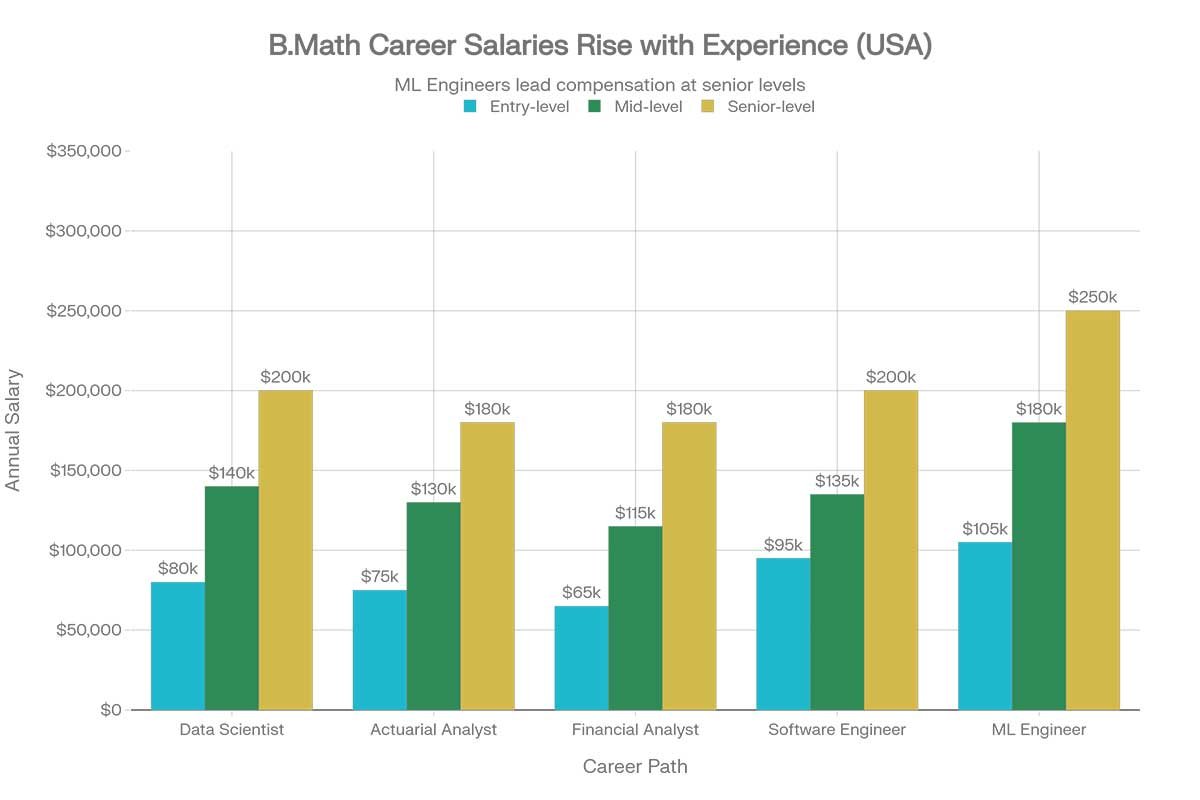
- Entry-Level: $70,000-$100,000
- Median Salary: $103,500-$130,000 (varies by role)
- Top 10% Earnings: $170,000-$220,000+
- C-Suite (Chief Data Officer, VP): $200,000-$500,000+
United Kingdom
- Entry-Level: £28,000-£40,000
- Mid-Level: £45,000-£75,000
- Senior: £80,000-£150,000+
Canada
- Entry-Level: CAD $50,000-$70,000
- Mid-Level: CAD $70,000-$110,000
- Senior: CAD $110,000-$180,000+
Australia
- Entry-Level: AUD $50,000-$70,000
- Mid-Level: AUD $75,000-$120,000
- Senior: AUD $130,000-$200,000+
Salary by Specialization
| Specialization | Entry-Level | Mid-Level | Senior-Level |
|---|---|---|---|
| Data Science | $70K-$90K | $100K-$180K | $150K-$300K+ |
| Actuarial Science | $70K-$85K | $100K-$160K | $150K-$250K+ |
| Quantitative Finance | $100K-$150K | $150K-$300K | $300K-$1M+ |
| Software Engineering | $80K-$110K | $110K-$160K | $160K-$300K+ |
| Machine Learning | $85K-$120K | $120K-$200K | $200K-$350K+ |
| Financial Analysis | $55K-$75K | $90K-$140K | $140K-$250K+ |
| Academia/Research | $40K-$60K | $60K-$100K | $100K-$200K+ |
Factors Affecting Salary
- Education Level: Master’s degree and PhD significantly increase earning potential
- Certifications: CFA, FRM, SOA, CSP increase marketability and salary
- Experience: 5+ years can double or triple entry-level salary
- Location: Metro cities and tech hubs offer 20-40% higher salaries
- Employer Size: Tech giants, investment banks, and consulting firms pay premium
- Specialization: Quantitative finance, actuarial science, and data science command highest salaries
- Gender & Diversity: Competitive markets increasingly value diversity; some gaps still exist
Studying Bachelor of Mathematics Abroad
International education offers B.Math graduates exposure to world-class curricula, global networking, and enhanced career prospects. Here’s a comprehensive guide to studying mathematics abroad.
Top Countries for Bachelor of Mathematics
1. United States
- Advantages: World’s largest economy, highest salaries, cutting-edge research, abundant scholarships
- Top Universities: MIT, Stanford, Princeton, Harvard, Yale, UC Berkeley, Caltech, Carnegie Mellon
- Duration: Typically 4 years
- Cost: $30,000-$70,000 per year (tuition); total $120,000-$280,000
- Financial Aid: Scholarships, grants, work-study, loans available
- Career Outcome: H-1B visa pathways, diverse job market, high starting salaries
2. United Kingdom
- Advantages: World’s oldest universities, shorter duration, rich academic tradition, global reputation
- Top Universities: Cambridge, Oxford, Imperial College London, Warwick, Edinburgh
- Duration: 3 years (undergraduate honors degree)
- Cost: £15,000-£35,000 per year; total £45,000-£105,000
- International Students: Tuition fees higher than UK students; post-study work visa available
- Specialties: Pure mathematics, mathematical physics, cryptography
3. Canada
- Advantages: Affordable tuition, friendly immigration policies, high quality of life, strong academics
- Top Universities: University of Toronto, Waterloo, UBC, McGill, McMaster
- Duration: 4 years
- Cost: CAD 15,000-$35,000 per year; total CAD 60,000-$140,000
- Co-op Programs: Waterloo famous for work-integrated learning (paid internships)
- Post-Study Work Permit: Up to 3 years available
- Career: High employability; easy transition to permanent residency
4. Germany
- Advantages: Tuition-free or low-cost, world-class education, affordable living, strong research
- Top Universities: Technical University of Munich, University of Göttingen, University of Bonn, Humboldt University Berlin
- Cost: Free-€500/year tuition; living expenses €800-1,200/month
- Language: Many programs in English; some require German proficiency
- Specialties: Abstract algebra, number theory, differential geometry
- Career: EU work permit upon graduation
5. Switzerland
- Advantages: Highest salaries post-graduation, excellent research, strong industry ties
- Top Universities: ETH Zurich, University of Zurich
- Cost: CHF 3,000-8,000/year tuition; living expenses CHF 2,000-3,000/month
- Salary After Graduation: CHF 80,000-120,000+ (highest globally)
- Internship Opportunities: Strong links with tech and finance industries
- Visa: Highly restrictive for non-EU students
6. France
- Advantages: Strong mathematics tradition, affordable tuition, cultural experience
- Top Universities: École Polytechnique, École Normale Supérieure (ENS), Sorbonne University, Université Paris-Saclay
- Duration: 3 years (Licence) + 2 years (Master)
- Cost: €200-600/year for French programs; €4,000-8,000 for English-taught programs
- Research: Excellent for PhD prospects
- Language: French proficiency required for most programs
Scholarship Opportunities for International Students
- Erasmus Mundus: EU scholarships for international students studying in Europe
- DAAD Scholarships (Germany): Prestigious fellowship program
- Chevening Scholarships (UK): British government scholarships
- Fullbright Program (USA): Educational exchange programs
- Commonwealth Scholarships: For students from Commonwealth nations
- University-Specific Scholarships: Most universities offer merit-based aid
- Barry Goldwater Scholarship: Up to $7,500/year for STEM research
- NSF Graduate Fellowships: $37,000 annual stipend for graduate studies
Scholarships and Financial Aid
Merit-Based Scholarships in India
| Institution | Scholarship | Amount | Eligibility |
|---|---|---|---|
| ISI Bangalore | Full Scholarship | 100% tuition fees | Entrance exam merit |
| CMI | Merit Scholarship | Variable | Top performers |
| IIT Bombay | Incentive Scholarship | Up to 50% | Academic excellence |
| Ramakrishna Mission | Fellowship | Partial/Full | Financial need + merit |
Financial Aid Strategies for B.Math Students
- Merit-Based Scholarships: Available at most universities for high achievers
- Government Scholarships: Post-Matric Scholarships (for SC/ST/OBC), State-specific schemes
- Educational Loans: HDFC, ICICI, Axis Bank, Central Bank offer education loans at 7-9% interest
- Teaching Assistantships: Part-time work as teaching assistant (if applicable)
- Research Grants: Universities often provide research funding for projects
- Fee Waivers: Top performers may get 25-50% fee concessions
- Installment Plans: Many colleges allow fee payment in installments
Scholarship Timeline in India (2026-27)
- January-March 2026: Application period for entrance exams
- April-June 2026: Entrance exams and result declaration
- June-July 2026: Admission counseling and scholarship announcement
- July-August 2026: Admission and fee payment
FAQs About Bachelor of Mathematics
Q1: Is a Bachelor of Mathematics better than a Bachelor of Science in Mathematics?
A: B.Math is more theoretical and research-focused, ideal for PhD programs and academia. B.Sc is more applied and flexible for industry careers. Choice depends on your career goals.
Q2: What is the minimum eligibility to apply for B.Math in India?
A: 10+2 completion with Mathematics as a subject, minimum 50% aggregate score (higher for premium institutions like ISI/CMI).
Q3: Which entrance exams should I prepare for B.Math admission in India?
A: Top choices are ISI Entrance Exam, CMI Entrance Exam, CUET UG, IISER Aptitude Test. Each has different syllabi and selection criteria.
Q4: Can I work part-time while pursuing B.Math?
A: Depends on the institution. Most colleges allow research assistantships or teaching assistantships. Work should not compromise academics.
Q5: What is the average salary for a B.Math graduate in India?
A: Entry-level ₹3.5-5.5 LPA in private sector, ₹3-5 LPA in government. Mid-level rises to ₹10-20 LPA with specializations.
Q6: Is B.Math recognized globally?
A: Yes, B.Math from reputed Indian institutions (ISI, CMI, IITs) is highly recognized internationally. Facilitates admission to top master’s programs worldwide.
Q7: What are the best specialization options after B.Math?
A: Data Science, Actuarial Science, Financial Mathematics, Machine Learning, Cryptography, Operations Research, Pure Mathematics (for academic careers).
Q8: Can I pursue B.Math if I don’t want to become a teacher?
A: Absolutely. B.Math graduates work in diverse fields: finance, technology, consulting, research, government. Teaching is just one option.
Q9: Which country offers the best salary for B.Math graduates?
A: USA and Switzerland offer highest salaries ($100K-$300K+ for entry to mid-level roles). UK and Canada also offer competitive packages.
Q10: Is there scope for B.Math graduates in India?
A: Yes, significant demand in IT, finance, government research institutions, teaching, and startups. Growing opportunities in data science and AI.
Q11: What skills do I need to develop during B.Math?
A: Programming (Python, R, MATLAB), data analysis, problem-solving, communication, research skills, specialization knowledge (finance/data science/actuarial), adaptability.
Q12: How long does it take to complete B.Math?
A: Typically 3 years (6 semesters). Some universities offer 4-year integrated programs combining B.Math + M.Sc.
Q13: What is the difference between B.Math at ISI and CMI?
A: Both are prestigious. ISI emphasizes statistics and applied mathematics; CMI focuses on pure mathematics and CS. Curriculum and philosophy differ slightly.
Q14: Can international students apply for B.Math in India?
A: Yes, foreign nationals can apply to ISI and other institutions. Additional documentation and possible separate entrance exams required.
Q15: Is a master’s degree necessary after B.Math?
A: Not mandatory, but MSc/MBA significantly enhances career prospects and earning potential, especially for academic or specialized roles.
Final Thoughts: Is Bachelor of Mathematics Right for You?
A Bachelor of Mathematics is an excellent choice if you:
- Have a passion for mathematical problem-solving and logical thinking
- Want to pursue careers in data science, finance, technology, or research
- Aim for PhD programs or academic careers
- Seek globally recognized, prestigious qualification
- Enjoy theoretical challenges and want to understand the “why” behind concepts
- Are willing to invest time in developing analytical and programming skills
The degree offers remarkable flexibility, allowing graduates to pivot into diverse, high-paying careers across sectors. With the global demand for data scientists, actuaries, and quantitative professionals at an all-time high, a B.Math degree positions you for long-term career success and growth.
Start your journey today. Prepare thoroughly, excel in entrance exams, and position yourself for a rewarding career in mathematics.


Leave a Reply
You must be logged in to post a comment.