
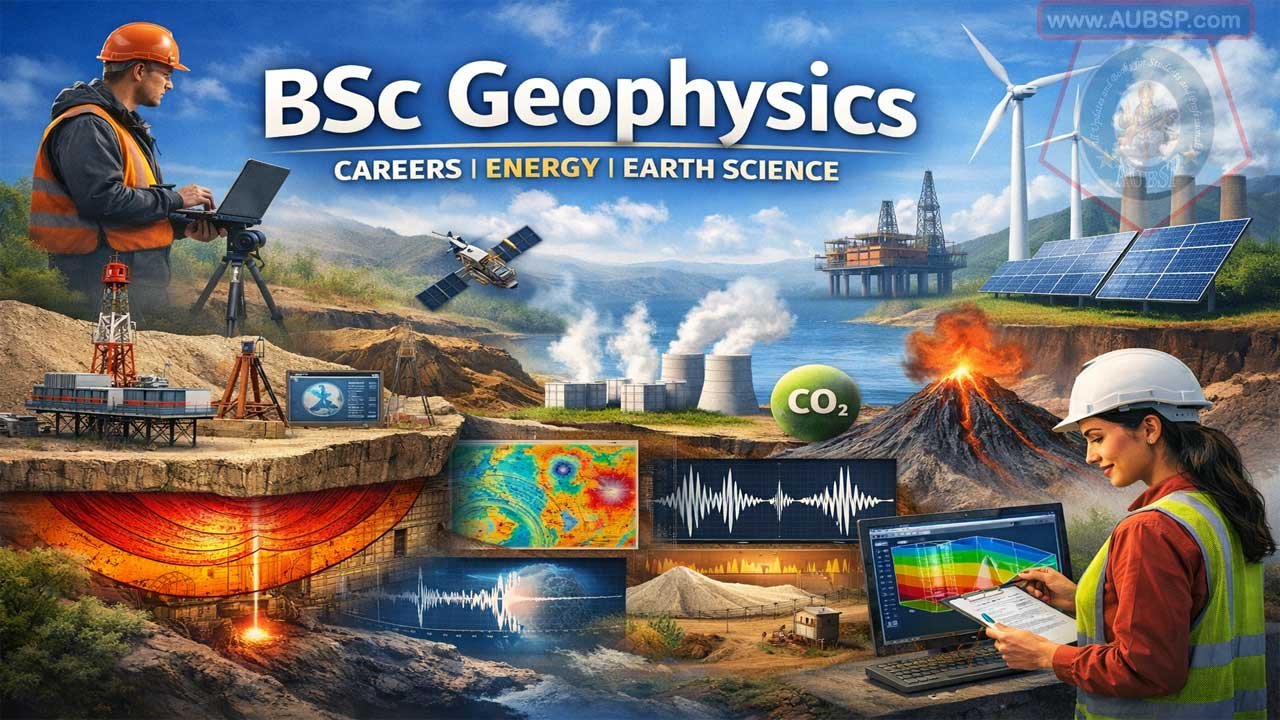
The Bachelor of Science in Geophysics (BScGeophys) is a rigorous interdisciplinary STEM degree that blends physics, mathematics, and geology to study Earth’s physical processes and subsurface structures, preparing graduates for diverse careers in energy, environment, natural hazard monitoring, and data science.
Typically completed in 3–4 years, the program emphasizes strong foundations in physics and math alongside hands-on fieldwork, computational modeling, and specialized geophysical techniques such as seismology, gravity, magnetics, and electromagnetics.
Graduates are employed across traditional sectors like oil and gas as well as fast-growing fields including renewable energy, geothermal exploration, environmental and geotechnical consulting, carbon storage, and AI-driven data analysis, with competitive global salaries that increase significantly with experience and advanced degrees.
While the profession faces challenges such as industry cyclicality and geographic concentration, the ongoing energy transition and demand for hazard assessment and sustainability solutions position geophysics as a future-relevant, adaptable, and intellectually rewarding career path for students with strong analytical and problem-solving skills.
| Aspect | Information |
|---|---|
| Degree | Bachelor of Science in Geophysics (BSc Geophysics) |
| Duration | 3–4 years (full-time) |
| Core Subjects | Physics, Mathematics, Geology, Seismology, Geophysical Methods |
| Skills Gained | Data analysis, programming (Python/MATLAB), field surveys, modeling |
| Admission Requirements | Strong background in Physics & Mathematics |
| Learning Style | Theory + fieldwork + labs + computational projects |
| Top Career Sectors | Energy, Renewables, Environment, Natural Hazards, Data Science |
| Entry-Level Salary | $60k–75k (US), £28k–30k (UK), ₹3–5 LPA (India) |
| Top Employers | Energy companies, consultancies, government agencies, research institutes |
| Higher Study Options | MSc Geophysics, Applied Geophysics, Data Science, PhD |
| Job Outlook | Stable with growing demand in renewables and climate-related fields |
Bachelor of Science in Geophysics (BScGeophys): Complete Career and Education Guide
The Bachelor of Science in Geophysics (BScGeophys) is a specialized STEM degree that combines physics, mathematics, and geology to understand Earth’s physical processes and subsurface structures. Geophysics has emerged as a critical discipline in the 21st century—driving innovation in renewable energy, natural disaster prevention, environmental remediation, and resource exploration.
This comprehensive AUBSP guide explores everything prospective students and career changers need to know about pursuing a geophysics degree, from admission requirements to salary expectations and emerging career paths.
What is Geophysics? Understanding the Discipline
Geophysics applies physical principles and mathematical methods to investigate Earth’s structure, composition, and dynamic processes. Geophysicists use specialized instruments and data analysis techniques to “see” beneath the surface without drilling or excavating.
Core applications include:
- Seismic exploration: Mapping subsurface geological formations using seismic waves
- Gravity and magnetic surveys: Detecting mineral deposits, oil reserves, and structural features
- Electromagnetic methods: Identifying groundwater, mineral deposits, and subsurface contamination
- Geodesy and GPS analysis: Measuring ground deformation and earthquake hazards
- Environmental geophysics: Assessing contaminated sites, landfill integrity, and groundwater aquifers
- Seismic hazard assessment: Predicting earthquake risk and designing resilient infrastructure
Unlike geology (which focuses on rocks and minerals) or physics (which studies universal laws), geophysics bridges both disciplines to solve real-world Earth science problems.
Bachelor of Science in Geophysics: Program Overview
Program Duration and Structure
A typical BScGeophys program runs 3–4 years full-time. The curriculum integrates fundamental physics, mathematics, and chemistry with specialized geophysics modules. Most programs include 18–22 core modules spanning 144–150 credit hours.
Typical course structure:
- First Year: Foundational mathematics (linear algebra, calculus, differential equations), classical physics (mechanics, thermodynamics, electromagnetism), introductory geology
- Second Year: Advanced physics, introduction to geophysics, data processing, field methods
- Third Year: Specialized geophysics (seismology, potential fields, electromagnetic methods), computational techniques, field camps
- Fourth Year (if applicable): Research project, capstone, specialized electives, or industry internship
Hands-On Learning Components
Modern geophysics programs emphasize practical experience alongside theory. Students typically engage in:
- Field camps: Multi-week expeditions acquiring real seismic, gravity, or magnetic data
- Laboratory experiments: Measuring physical properties of rock samples, analyzing seismic waves
- Computer modeling: Using industry-standard software (Matlab, Python, seismic interpretation packages) for data visualization and modeling
- Research projects: Original investigations with faculty mentors or industry partners
- Industry internships: Placements with energy companies, consulting firms, or government agencies
Admission Requirements for BScGeophys Programs
Academic Prerequisites
Admission standards vary by institution and country. Typical requirements include:
Qualifications (by region):
- UK universities: A-level grades AAB minimum, with mathematics and physics required; geology, chemistry, or further mathematics preferred. Some universities accept International Baccalaureate (36 points minimum, including Math and Physics at higher level).
- US universities: High school diploma with strong performance in calculus, physics, and chemistry. SAT/ACT scores typically required (average SAT 1360–1545 for top institutions).
- Australia: Senior secondary certificate or equivalent, with mathematics (advanced preferred) and physics essential.
- India: 12th-pass with physics, chemistry, and mathematics; entrance exams like JEE Main for IIT programs.
Language Requirements
For non-native English speakers, universities typically require:
- TOEFL score: 80–100+ (internet-based)
- IELTS score: 6.5–7.0+
- Duolingo English Test: 110+
Core Prerequisites
Strong foundational knowledge in physics and mathematics is non-negotiable. Programs expect students to understand:
- Classical mechanics, wave motion, and electromagnetism
- Differential and integral calculus
- Linear algebra and complex numbers
- Basic chemistry and chemistry principles
Top Universities Offering Geophysics Degrees
Global Rankings 2026
According to QS World University Rankings by Subject (2026), the leading institutions for geophysics research and education are:
| Rank | University | Location |
|---|---|---|
| 1 | ETH Zurich | Switzerland |
| 2 | University of Oxford | UK |
| 3 | University of Cambridge | UK |
| 4 | Stanford University | USA |
| 5 | MIT | USA |
| 6 | Caltech | USA |
| 7 | UC Berkeley | USA |
| 8 | University of Washington | USA |
| 9 | University of Tokyo | Japan |
| 10 | University of Texas at Austin | USA |
Regional Standouts
Asia-Pacific: Australian National University, University of Tokyo, Tsinghua University (China), China University of Geosciences
Europe: University of Oxford, Cambridge, Swiss Federal Institute of Technology, University of Copenhagen, Catholic University of Leuven
North America: Stanford, MIT, Caltech, University of Washington, University of Texas at Austin, Texas A&M University
India: IIT Bombay, IIT Kharagpur, Banaras Hindu University
BScGeophys Program Cost and Financial Considerations
Tuition Fees by Region
Program costs vary dramatically by country, funding model, and institution type:
United States:
- Public universities: $8,000–$15,000/year in-state; $25,000–$40,000/year out-of-state
- Private universities: $40,000–$60,000/year
- Total 4-year cost (with living expenses): $60,000–$240,000
United Kingdom:
- Home (UK/EU) students: £9,000–£9,250/year
- International students: £20,000–£35,000/year
- Total 3-year program cost: £60,000–£105,000+ for international students
Canada:
- Domestic: $6,000–$12,000 CAD/year
- International: $20,000–$40,000 CAD/year
Australia:
- Domestic (HECS): Varies by funding band; typically $9,000–$14,500 AUD/year
- International: $25,000–$45,000 AUD/year
India:
- Government universities (IIT, university colleges): ₹30,000–₹10,00,000 for entire program
- Private institutions: ₹5,00,000–₹15,00,000 for degree
Scholarships and Financial Aid
Major funding opportunities include:
- Government scholarships: Fulbright (USA), CHEVENING (UK), Australia Awards
- University-specific: Merit scholarships at MIT, Stanford, Cambridge
- Industry-sponsored: Oil and gas companies, energy firms, and consulting firms often sponsor talented students
- Research grants: Many universities offer financial support linked to research assistantships
- International scholarships: QS Scholarships, Erasmus Mundus (Europe), Commonwealth Scholarships
Geophysicist Salary: Global Earning Potential
Geophysics is among the better-paying STEM careers, with significant variation by experience, location, and specialization.
Annual Salaries by Country and Experience
United States:
| Experience Level | Average Annual Salary | Salary Range |
|---|---|---|
| Entry-level (0–2 years) | $65,000 | $48,500–$85,000 |
| Mid-career (5–10 years) | $95,411 | $70,000–$112,000 |
| Experienced (15+ years) | $125,000+ | $112,000–$136,500+ |
India:
| Education Level | Average Annual Salary (INR) |
|---|---|
| Bachelor’s degree | ₹4,87,600 |
| Master’s degree | ₹6,02,700 |
| PhD | ₹9,65,000 |
| Entry-level (0–2 years) | ₹3,77,200 |
| 5–10 years experience | ₹6,59,400 |
| 10–15 years experience | ₹7,95,700 |
United Kingdom:
- Entry-level (new graduates): £28,000–£30,000/year
- Mid-career (5–10 years): £50,000–£70,000/year
- Senior positions (15+ years): £80,000–£120,000/year
Australia:
- Entry-level: AUD $60,000–$75,000
- Experienced: AUD $100,000–$140,000+
Salary Influencers
Several factors significantly impact earning potential:
- Specialization: Computational geophysics and data science roles command 15–30% premium over traditional positions
- Industry sector: Oil and gas extraction pays 20–40% more than academic or government positions
- Geographic location: Offshore roles, international assignments, and remote areas typically offer higher compensation
- Advanced degree: Master’s graduates earn 20–25% more; PhD holders earn 40–60% premium
- Gender: Global data reveals a persistent 10–15% wage gap (male advantage), though this is narrowing
- Employer size: Multinational corporations typically pay 25–50% more than small consulting firms
Career Paths and Job Opportunities for Geophysics Graduates
Traditional Sectors (Oil and Gas Exploration)
Historically, the petroleum industry has been the primary employer of geophysicists. Roles include:
- Seismic interpreter: Analyzes 2D and 3D seismic data to map hydrocarbon-bearing formations
- Petrophysicist: Evaluates rock properties and reservoir potential using well log data
- Reservoir geophysicist: Models subsurface geometry and fluid properties for production optimization
- Acquisition specialist: Designs and supervises seismic survey operations
- Processing geophysicist: Develops algorithms and workflows for seismic data enhancement
Current situation: The oil and gas sector is experiencing structural decline due to energy transition. However, employment remains stable for skilled professionals. The global oil and gas workforce employed approximately 10.4 million people in 2024, with specialized geophysicists maintaining premium positions.
Emerging Growth Sectors
1. Renewable Energy
Geophysicists are increasingly critical in transitioning to clean energy:
- Geothermal energy: Locating high-temperature geothermal reservoirs; Germany has created 22,000+ jobs in geothermal since 2000
- Offshore wind: Assessing seabed conditions, cable routes, and turbine foundation stability
- Carbon capture and storage (CCS): Monitoring CO2 injection and subsurface integrity
- Hydrogen storage: Evaluating underground cavern suitability for hydrogen reserves
2. Environmental and Geotechnical Consulting
Environmental remediation is a growth sector with strong demand:
- Groundwater assessment: Mapping aquifers, contamination plumes, and water resources
- Landfill monitoring: Ensuring compliance with regulatory requirements and environmental protection
- Site characterization: Evaluating subsurface conditions before construction
- Natural hazard assessment: Seismic risk analysis, landslide potential, flood risk modeling
- Soil remediation: Identifying and monitoring contaminated sites
3. Natural Hazard Monitoring
Climate change and urbanization have increased demand for hazard prediction professionals:
- Earthquake seismology: Operating monitoring networks, assessing seismic hazards, designing early warning systems
- Volcanic monitoring: Predicting volcanic eruptions through geophysical signals
- Tsunami early warning: Rapid earthquake detection and characterization
- Flood and landslide risk: Geophysical monitoring of slope stability and hydrological conditions
4. Data Science and Machine Learning
The convergence of geophysics and artificial intelligence is creating high-demand roles:
- Machine learning engineer (geophysics): Developing AI models for seismic signal detection, image classification, and anomaly identification
- Data scientist (earth science): Analyzing large geophysical datasets using cloud computing and advanced analytics
- Software engineer (geophysics): Building production-grade geophysical modeling software
Global Job Market Statistics
- US employment: 337,167 geoscientists working (January 2026); projected 3.7% increase by 2034
- UK supply shortage: Employers advertise approximately 245 geophysicist positions annually, but only 70–100 graduates enter the job market yearly
- Industry outlook: US Bureau of Labor Statistics projects 3% growth for geoscientists 2024–2034 (approximately 2,000 openings/year)
Essential Skills for BScGeophys Success
Technical Skills
Programming languages:
- Python: Industry standard for data analysis, visualization, and scientific computing; most accessible for beginners
- MATLAB: Widely used in geophysics for modeling and data processing
- C++/Fortran: Required for production-grade, computationally intensive software
- Bash/Unix: Essential for working on high-performance computing clusters
Geophysical software proficiency:
- Seismic interpretation software (Petrel, Geoview, SMT Kingdom)
- Gravity and magnetic interpretation packages
- 3D modeling and visualization tools (Surfer, Golden Software)
- GIS software (ArcGIS, QGIS)
- Coordinate systems and geodetic tools
Data analysis:
- Statistical methods and multivariate analysis
- Signal processing (filtering, Fourier analysis, wavelets)
- Time-series analysis
- Machine learning algorithms (classification, regression, clustering)
- Data visualization and presentation
Core Scientific Knowledge
- Solid mechanics and continuum mechanics
- Wave propagation and seismic theory
- Potential field theory (gravity and magnetics)
- Electromagnetic theory and electromagnetic methods
- Thermodynamics and heat transfer
- Fluid mechanics for subsurface flow
Professional Competencies
- Project management: Planning surveys, managing timelines and budgets
- Communication: Writing technical reports, presenting to non-technical audiences, collaborating across disciplines
- Problem-solving: Analytical thinking, creative solution development, working with incomplete or ambiguous data
- Teamwork: Collaborating with geologists, engineers, physicists, and business professionals
- Continuous learning: Staying current with rapidly evolving technologies (AI, cloud computing, advanced visualization)
Specialized Geophysics Subfields
Seismology and Earthquake Science
Seismologists study Earth’s interior through seismic waves. Career paths include:
- Earthquake detection and monitoring
- Seismic hazard assessment
- Earthquake early warning systems
- Volcano monitoring
- Deep Earth structure imaging
Potential Fields (Gravity and Magnetics)
Specialists in potential fields apply gravity and magnetic methods to:
- Mineral and hydrocarbon exploration
- Geothermal resource assessment
- Near-surface characterization
- Archaeological surveys
- Geoid and reference field modeling
Electromagnetic Geophysics
Electromagnetic methods detect subsurface features through electromagnetic field variations:
- Groundwater exploration
- Environmental contamination mapping
- Mineral deposit identification
- Geothermal exploration
- Submarine cable routing
Computational and Applied Geophysics
High-demand interdisciplinary area combining geophysics with computational science:
- Seismic inversion and imaging
- Reservoir simulation
- Machine learning for geophysical data
- High-performance computing applications
- 4D time-lapse monitoring
Challenges and Realistic Career Expectations
Industry Cyclicality
Geophysics employment is closely tied to commodity prices, energy markets, and economic cycles. The oil and gas industry—historically the largest employer—is volatile, leading to periodic layoffs and rehiring waves. Entry-level graduates may face extended job searches during industry downturns.
Mitigation strategies:
- Develop portable, interdisciplinary skills
- Consider further education (master’s degree) to increase career flexibility
- Network actively in expanding sectors (renewables, data science, environmental)
- Build strong programming and software engineering capabilities
Geographic Limitations
High-quality jobs concentrate in specific regions: the United States (Texas, Oklahoma, Houston), North Sea (UK, Norway), Middle East, Australia, and Canada. International relocation or willingness to work remotely is often necessary.
Supply-Demand Imbalance
In some regions (particularly the UK), employer demand significantly exceeds graduate supply, but salaries have not proportionally increased. This paradox reflects industry consolidation, automation, and the shift from exploration to production roles.
Overqualification Risk
Pursuing a PhD is increasingly risky without a clear research career plan. Many PhD graduates find themselves competing with master’s graduates for the same industrial positions, facing overqualification challenges.
Recommendation: Carefully evaluate whether advanced degrees align with specific career goals (academic research, senior technical roles, specialized consulting).
Master’s Degree and Advanced Education
Why Pursue a Master’s After BScGeophys?
A master’s degree significantly enhances career prospects and earning potential:
Advantages:
- 20–25% salary increase over bachelor’s degree holders
- Access to senior technical and managerial roles
- Enhanced research and problem-solving capabilities
- Opportunities for specialization (computational geophysics, environmental geophysics, geothermal exploration)
- International study and networking
Disadvantages:
- 1–2 year time investment and financial cost
- Risk of overqualification for some industrial roles
- PhD completion rates are lower; not all master’s programs lead to PhD pathways
- Market preference for practical experience over credentials in some sectors
Popular Master’s Specializations
- Computational geophysics and seismic imaging
- Environmental geophysics
- Geothermal energy and heat transport
- Petroleum geoscience
- Near-surface geophysics
- Data science for earth sciences
- Applied geophysics with industry focus
Alternative Career Paths for Geophysics Graduates
Geophysics graduates possess valuable, transferable skills that open doors outside traditional geophysics roles:
- Engineering consulting: Civil, geotechnical, and offshore engineering firms value geophysicists’ subsurface expertise
- Data science and analytics: Finance, tech companies, and government agencies recruit physics/math-strong graduates
- Insurance and risk assessment: Geophysics skills directly apply to natural hazard risk evaluation for insurance pricing
- Policy and government: Environmental agencies, geological surveys, and climate research organizations employ geophysicists
- Tech and software: Materials science, physics-based simulation, machine learning roles
- Environmental compliance: Regulatory agencies and NGOs managing environmental projects
Geophysics and the Energy Transition
From Oil and Gas to Renewables
The geophysics profession faces a historic pivot. While traditional oil and gas roles remain, demand growth is concentrated in renewable energy, sustainability, and climate-related applications:
Expanding opportunities:
- Geothermal energy development: Locating and characterizing high-temperature reservoirs; Germany’s experience suggests massive job creation potential
- Offshore wind foundation design: Seismic and geotechnical surveys for turbine installation
- CCS and hydrogen storage: Managing underground storage of carbon and hydrogen for energy transition
- Groundwater and aquifer monitoring: Critical for agriculture and freshwater security
- Climate hazard monitoring: Assessing coastal subsidence, glacial melt, and permafrost degradation
Skills translation: Core geophysical competencies (data interpretation, modeling, risk assessment) transfer directly to renewable energy and climate applications, positioning graduates well for the energy transition.
Getting Started: Steps Toward a Geophysics Career
For High School Students
- Excel in sciences: Prioritize physics, mathematics, and chemistry with distinction-level grades
- Develop programming skills: Learn Python or similar language; high school competitions encourage early expertise
- Research universities: Identify programs aligned with interests (traditional exploration, renewables, research)
- Seek internships: Summer field camps or research internships differentiate competitive applicants
- Network: Attend geology and geophysics conferences, join student clubs
- Take relevant AP/IB courses: Advanced Placement Physics C, IB Physics Higher Level strengthen applications
For Career Changers
- Assess foundational knowledge: Ensure strong background in physics, mathematics, calculus
- Explore master’s programs: Specialized master’s degrees in geophysics accept graduates from physics, engineering, and mathematics backgrounds
- Build programming expertise: Online courses in Python and MATLAB accelerate career transition
- Consider field-based internships: Short-term geophysical field courses or industry placements validate commitment
- Network with professionals: LinkedIn, professional societies, and industry conferences facilitate connections
Frequently Asked Questions (FAQs)
Q: How competitive is admissions to top geophysics programs?
A: Top universities (Stanford, MIT, Caltech, Oxford) have 3–22% acceptance rates. Strong high school grades (A-levels AAB or equivalent), SAT/ACT scores, and demonstrated interest in physics/earth science are essential. International competitiveness is high; building research experience or exceptional extracurriculars strengthens applications.
Q: Is a geophysics degree valuable if oil and gas employment declines?
A: Yes. The energy transition is creating substantial demand for geophysicists in renewable energy, environmental consulting, geotechnical engineering, and data science. However, early-career professionals should actively develop interdisciplinary skills and stay informed about industry shifts.
Q: What’s the job market like after graduation?
A: Highly variable by timing, location, and specialization. During industry upturns, multiple offers are common. During downturns, graduates may require 6–12 months to secure positions. UK graduates face moderate competition despite favorable supply-demand ratios; US graduates typically face stronger job markets. International mobility increases opportunities.
Q: Should I pursue a PhD in geophysics?
A: PhDs are valuable for academic research and specialized technical roles but are not necessary for industrial careers. Many PhD graduates compete with master’s graduates for the same positions. Consider PhD only if committed to research, academic, or leadership roles.
Q: What programming languages should I learn?
A: Python is essential and most accessible for beginners. MATLAB complements Python for numerical work. C++ or Fortran becomes necessary for high-performance computing. GIS software and specialized geophysical packages complete the toolkit.
Q: Are there geophysics jobs outside traditional sectors?
A: Absolutely. Environmental consulting, geotechnical engineering, renewable energy, insurance, climate science, policy, and data science all actively recruit geophysics graduates. Transferable skills are significant.
Q: What’s the gender representation in geophysics?
A: Geophysics remains male-dominated (approximately 70% male globally), though representation is improving. Women in the field earn, on average, 10–15% less than male counterparts—a gap persistent across experience levels. Professional organizations actively work to improve diversity and inclusion.
Q: How important are internships during a bachelor’s degree?
A: Highly important. Internships provide practical field experience, professional network development, and competitive advantage in job searches. Many top graduates have 2–3 internships before graduation.
Conclusion
The Bachelor of Science in Geophysics is a rigorous, rewarding degree that opens diverse career pathways in a rapidly evolving world. Whether pursuing traditional subsurface exploration, renewable energy innovation, environmental protection, or cutting-edge data science, geophysics graduates possess critical skills for addressing 21st-century challenges.
The global transition to sustainable energy, increasing demand for natural hazard monitoring, and integration of artificial intelligence are reshaping the profession in favor of adaptable, interdisciplinary professionals. Prospective students should approach the degree with awareness of industry dynamics, commitment to continuous learning, and openness to career evolution.
For students passionate about understanding Earth’s physics, solving complex technical challenges, and contributing to global sustainability, geophysics offers a intellectually stimulating and professionally rewarding career path.
Additional Resources
Professional Organizations: European Association of Geoscientists and Engineers (EAGE), Society of Exploration Geophysicists (SEG), American Geophysical Union (AGU)
Online Learning: Coursera, Udacity, edX offer geophysics and related courses from leading universities
Conferences: Annual meetings of SEG, EAGE, and AGU provide networking and professional development
Salary Research: Glassdoor, LinkedIn Salary, Payscale, Indeed provide updated compensation data by role, location, and experience
Job Boards: LinkedIn, Indeed, Dice, specialized job sites (Society of Exploration Geophysicists job board, company career pages)


Leave a Reply
You must be logged in to post a comment.