
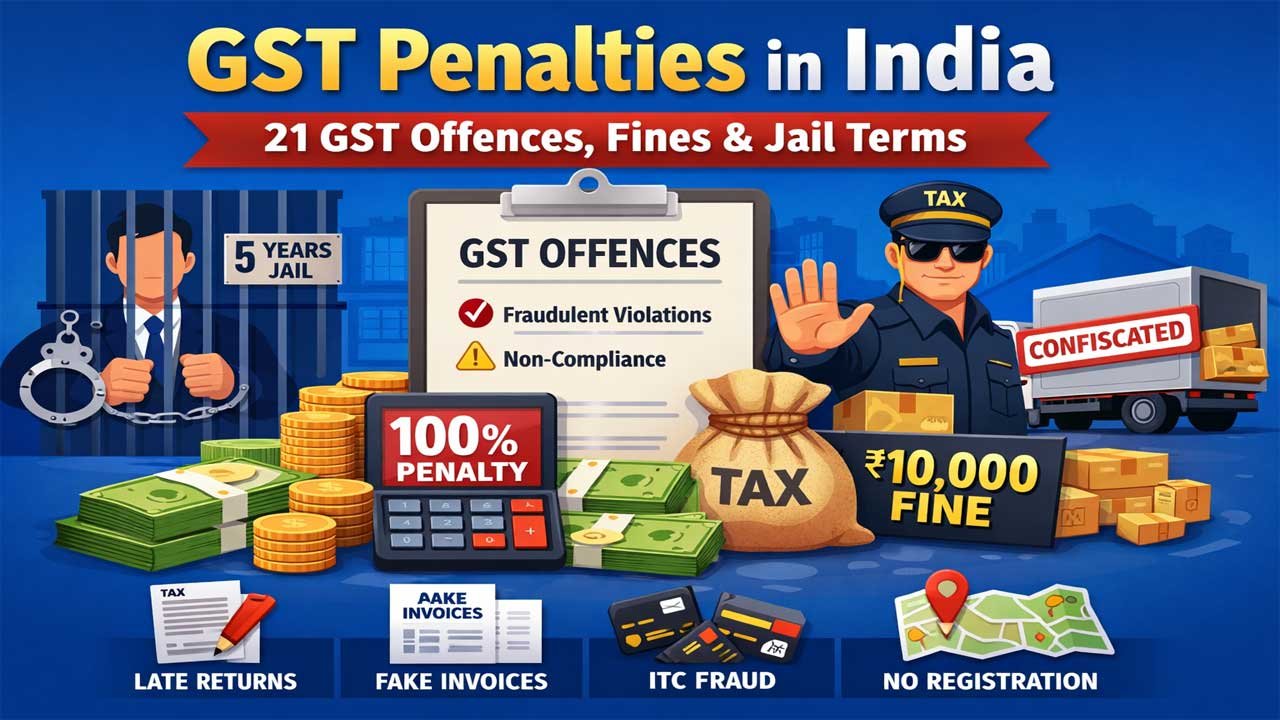
India’s GST law imposes strict penalties to ensure compliance, defining 21 offences under the CGST Act that range from minor procedural lapses to serious fraud.
Offences are broadly classified as non-fraudulent (arising from negligence or errors) and fraudulent (involving deliberate tax evasion), with penalties of 10% of tax due (minimum ₹10,000) for non-fraud cases and 100% of tax evaded (minimum ₹10,000) for fraud, along with possible confiscation of goods and conveyances. Serious fraud can lead to criminal prosecution with non-bailable jail terms of up to five years depending on the amount evaded.
Penalties also extend to those who aid or abet violations, such as consultants or transporters. Common causes include late return filing, incorrect invoicing, ITC misuse, and registration failures, though relief and appeal mechanisms exist for genuine errors. Overall, maintaining accurate records, timely filings, correct tax payments, and professional oversight is far more cost-effective than facing GST penalties, confiscation, and prosecution.
GST Penalties in India: 21 GST Offences, Fines, Jail Terms & Compliance Guide
India’s Goods and Services Tax (GST) system maintains strict penalties for non-compliance. The government enforces 21 defined offences under the CGST Act to prevent tax evasion and ensure business compliance. Understanding these penalties is essential for every registered business.
The penalty structure in India ranges from ₹10,000 to complete confiscation of goods. Serious fraud cases attract jail terms up to 5 years. Learning these rules protects your business and prevents costly penalties.
What Are GST Offences?
GST offences are illegal activities that violate tax compliance rules. The CGST Act defines 21 specific offences that attract penalties. These offences fall into two categories: fraudulent and non-fraudulent breaches.
Fraudulent offences involve deliberate intent to evade taxes. These attract harsher penalties. Non-fraudulent offences occur due to negligence or administrative errors. These attract lower penalties.
Understanding the difference matters. Fraudulent cases face 100% penalty plus potential jail time. Non-fraudulent cases face 10% penalty with a minimum of ₹10,000.
The 21 GST Offences Under Indian Law
The CGST Act specifies 21 distinct offences. Here are the major categories:
Registration and Payment Violations
- Not registering under GST despite legal requirement
- Not collecting GST on supplies
- Not depositing collected GST to government
- Failing to deduct tax at source
Invoice and Documentation Fraud
- Issuing fake or fraudulent invoices
- Issuing incorrect invoices
- Not issuing invoices for supplies
- Charging wrong GST rates
- Falsifying records or documents
Tax Evasion and Credit Misuse
- Evading tax through false claims
- Availing fake input tax credit (ITC)
- Wrongly utilizing or distributing ITC
- Fraudulently claiming refunds
Non-Compliance Issues
- Failing to file GST returns
- Providing false statistics
- Operating without proper accounting records
- Non-cooperation with tax authorities
Other Violations
- Using banned conveyances for goods transport
- Supplying goods in breach of GST rules
- Aiding or abetting any offence
- Receiving or storing goods illegally
GST Penalty Structure: Non-Fraudulent Cases
Non-fraudulent offences involve mistakes rather than intentional evasion. These attract lower penalties under GST law.
Penalty Amount
- 10% of tax due or ₹10,000, whichever is higher
- Maximum penalty capped at practical levels
- Relief provisions available for genuine errors
Common Non-Fraudulent Cases
- Late filing of returns
- Minor documentation errors
- Unintentional ITC avoidance issues
- Administrative oversights
For example, if your business has ₹1 lakh tax due and fails to file returns, the penalty is 10% of ₹1 lakh (₹10,000) or minimum ₹10,000—whichever is higher. In this case, the penalty is ₹10,000.
GST Penalty Structure: Fraudulent Cases
Fraudulent offences involve deliberate intent to evade taxes. These attract severe penalties under GST law.
Penalty Amount
- 100% of tax evaded or ₹10,000, whichever is higher
- Applied to fake invoicing, tax evasion, and wrongful GST collection
- No relief provisions for fraud cases
Specific Fraudulent Penalties
| Offence | Penalty |
|---|---|
| Fake invoicing | 100% of tax evaded or ₹10,000 (higher) |
| Tax evasion | 100% of tax evaded or ₹10,000 (higher) |
| Wrongful GST collection | 100% of tax collected or ₹10,000 (higher) |
| Non-registration (fraud) | 100% of tax amount or ₹10,000 (higher) |
| Not issuing invoices | 100% of tax evaded or ₹10,000 (higher) |
| Incorrect invoicing | ₹25,000 fixed penalty |
Example: If a business fraudulently evades ₹5 lakh in taxes, the penalty is 100% of ₹5 lakh (₹5,00,000). This can be combined with jail time.
GST Prosecution and Jail Terms
Serious fraud cases attract criminal prosecution under GST law. The government imposes jail terms based on tax evasion amount.
Jail Terms for Tax Evasion
| Tax Evaded | Jail Term | Fine |
|---|---|---|
| ₹100 lakh to ₹200 lakh | Up to 1 year | Applicable in all cases |
| ₹200 lakh to ₹500 lakh | Up to 3 years | Applicable in all cases |
| Above ₹500 lakh | Up to 5 years | Applicable in all cases |
| Repeat offenders | Extended terms | Additional penalties |
These jail terms are non-bailable. They apply alongside monetary penalties.
For example, if a business evades ₹3 crore (₹300 lakh) in GST, the owner faces up to 3 years imprisonment plus 100% penalty (₹3 crore).
Specific Penalty Provisions
Different GST offences attract different penalties. Understanding each provision helps businesses stay compliant.
Penalty for Not Registering
- Penalty: Higher of ₹10,000 or 100% of tax amount
- Applies to unregistered suppliers
- Severe penalties for deliberate non-registration
Penalty for Not Filing Returns
- Penalty: 10% of tax due or ₹10,000 (whichever is higher)
- Applies monthly for continued non-compliance
- Can exceed ₹25,000 for extended non-filing
Penalty for Fake Invoices
- Penalty: 100% of tax evaded or ₹10,000 (whichever is higher)
- Applies to fraudulent billing
- Criminal prosecution possible
Penalty for Wrong GST Rates
- Penalty: 100% of extra GST collected or ₹10,000 (whichever is higher)
- If higher rate charged and not submitted to government
- Refund required plus penalty
Penalty for Incorrect Invoicing
- Penalty: Fixed ₹25,000 regardless of amount
- Applies to invoice errors and omissions
- Separate from other penalty provisions
Penalty for Not Issuing Invoices
- Penalty: 100% of tax evaded or ₹10,000 (whichever is higher)
- Severe consequences for invoice omission
- Criminal case possible for large amounts
Penalty for Fake Input Tax Credit
- Penalty: Higher of ₹10,000 or amount of wrongly availed ITC
- Applies to false credit claims
- Recovery plus penalty imposed
Aiding and Abetting Penalties
GST law extends penalties to persons who help others commit offences. These provisions catch consultants, accountants, and facilitators.
Who Can Be Penalized?
- People aiding in fraud commission
- Those dealing with smuggled goods
- Persons transporting illegally supplied goods
- Anyone receiving stolen or smuggled goods
Penalty Amount
- Extending to ₹25,000
- Applied regardless of GST registration status
- Criminal prosecution possible
For example, if an accountant helps a client claim fake ITC, the accountant can be penalized up to ₹25,000 plus criminal charges.
Confiscation of Goods and Conveyances
GST law permits confiscation of goods and vehicles used in illegal supply. This creates substantial financial losses beyond penalties.
When Confiscation Applies
- Goods supplied without proper invoicing
- Goods transported in breach of GST rules
- Goods supplied by unregistered persons
- Conveyances used to transport taxable goods illegally
Penalty Structure for Confiscation
- 50% to 200% of goods value as penalty
- Complete confiscation of conveyances
- Additional monetary penalties imposed
Example: If a truck carries ₹10 lakh worth of goods in breach of GST rules, the truck can be confiscated plus ₹5-20 lakh penalty imposed.
High-Value Fraud Cases
GST laws provide enhanced penalties for high-value fraud. These cases receive special attention from tax authorities.
Defining High-Value Fraud
- Tax evasion exceeding ₹1 crore
- Multiple offences by same person
- Repeat violations within short periods
- Organized schemes involving multiple parties
Consequences
- Mandatory prosecution (no negotiation)
- Jail terms up to 5 years
- 100% penalty on tax evaded
- Complete confiscation of goods and vehicles
- Professional liability and reputation damage
Common Reasons for GST Penalties
Most businesses face penalties due to preventable errors. Understanding common violations helps maintain compliance.
Documentation Errors
- Incorrect GST-IN on invoices
- Wrong invoice dates or numbers
- Missing mandatory invoice details
- Incomplete billing information
Return Filing Issues
- Late GSTR-1 submission
- Incorrect return data
- Missing supporting documents
- Incomplete disclosures
Payment Delays
- Late tax deposits to government
- Partial tax payments
- Bounce checks or failed payments
- Missing payment reconciliation
ITC Misuse
- Claiming credit on personal expenses
- Availing credit on ineligible goods
- Wrong credit attribution
- Fraudulent invoice basis claims
Registration Problems
- Operating without GST registration
- Wrong registration category
- Ineligible composition scheme use
- Multi-state compliance failures
Defenses Against GST Penalties
Businesses can challenge penalty orders under GST law. Understanding defenses helps protect your rights.
Valid Defenses
- Genuine errors with documentary proof
- Procedural violations by tax officer
- Absence of fraudulent intent
- Good faith compliance efforts
- Previous history of perfect compliance
Relief Provisions
- Penalty waiver for first-time minor violations
- Partial penalty reduction for cooperation
- Extended payment timelines available
- Appeal rights through proper channels
For example, if you filed a wrong invoice due to system error and rectified it immediately, you can defend against penalty with technical proof.
Appeals and Remedies
GST law provides multiple appeal levels for penalty orders. Businesses can challenge unfair penalties.
Appeal Process
- First Appeal: File with Deputy/Joint Commissioner
- Second Appeal: File with GST Appellate Tribunal
- Higher Appeal: File in High Court if legal principle violated
- Supreme Court: Final remedy for landmark cases
Appeal Requirements
- File within 30 days of penalty order
- Provide documentary evidence
- Pay 50% penalty amount (in some cases)
- Hire qualified tax professional
How to Avoid GST Penalties
Maintaining GST compliance is easier than fighting penalties. Follow these best practices:
Documentation Best Practices
- Maintain accurate invoicing system
- Regular document verification
- Proper record retention (6 years)
- Monthly reconciliation procedures
Return Filing Discipline
- File returns on scheduled dates
- Verify data before submission
- Keep supporting documents ready
- Track return status regularly
Payment Management
- Pay taxes on due dates
- Maintain bank transaction records
- Set payment reminders
- Reconcile payment reports monthly
ITC Management
- Claim only eligible credits
- Cross-verify with supplier records
- Maintain invoice copies
- Regular ITC reconciliation
Registration Compliance
- Verify registration status quarterly
- Update business details promptly
- Maintain threshold compliance
- Track state-wise sales regularly
GST Compliance Tools and Resources
Modern tools simplify GST compliance and reduce penalty risks.
Government Platforms
- GST Portal (gst.gov.in) for filing returns
- GSTN e-invoicing system for invoice generation
- Common Portal for registration updates
Accounting Software
- ERPNext for complete business management
- Tally ERP for automated GST calculations
- Zoho Books for simplified invoicing
Professional Services
- Chartered Accountants (CAs) for complex compliance
- GST consultants for registration and planning
- Audit firms for comprehensive reviews
Recent GST Penalty Updates (2026)
GST penalty provisions remain strict in 2026. Recent updates include:
- Enhanced penalties for e-invoicing violations
- Strict ITC audit procedures
- Increased prosecution for organized fraud
- Simplified penalty waiver procedures for MSMEs
- Technology-based compliance monitoring
Conclusion
GST penalties in India range from ₹10,000 to ₹5 crore plus jail time. Understanding the 21 offences helps businesses maintain compliance and avoid costly penalties. The penalty structure differentiates between fraudulent and non-fraudulent breaches. Small errors attract 10% penalties while fraud attracts 100% penalties.
Businesses must maintain accurate invoicing, timely returns, and proper ITC management. Penalties apply not only to registered persons but also to those aiding violations. Professional guidance and modern accounting tools significantly reduce penalty risks.
Staying compliant with GST law is cost-effective compared to fighting penalty orders and prosecution. Implement strong documentation practices, regular audits, and professional oversight today.
Frequently Asked Questions
Q1: What is the maximum GST penalty amount?
A: The maximum monetary penalty is 100% of tax evaded (minimum ₹10,000) plus confiscation and jail time up to 5 years for serious fraud.
Q2: Can I reduce GST penalties?
A: Yes, through proper appeals, demonstrating good faith, or with professional help. Some penalties may be partially waived.
Q3: How long can I face jail for GST fraud?
A: Jail terms range from 1 year (₹100-200 lakh evasion) to 5 years (above ₹500 lakh evasion).
Q4: What should I do if I receive a penalty notice?
A: Seek professional help immediately. Review the order, gather documents, and file an appeal within 30 days.
Q5: Are GST penalties negotiable?
A: Fraud penalties are not negotiable. Non-fraudulent penalties may have partial relief options through proper channels.


Leave a Reply
You must be logged in to post a comment.