
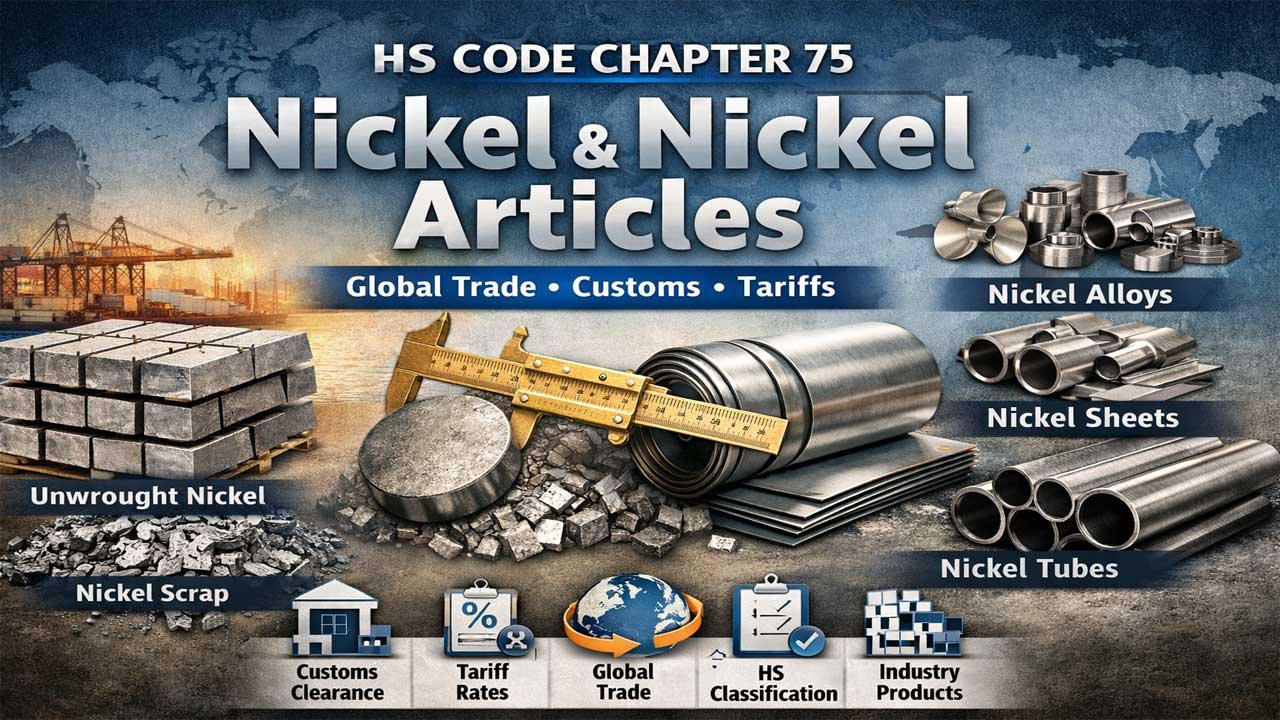
HS Code Chapter 75 covers nickel and nickel articles. This chapter is vital for import and export operations. The code helps classify nickel products accurately. Correct classification ensures smooth customs clearance. It also determines the right tariff duties and taxes.
The HS system uses a six-digit classification. Chapter 75 is part of Section XV. This section covers base metals and their articles. Nickel falls under this important trade category.
Complete HS Code Structure for Nickel (Chapter 75)
Understanding the HS code headings is essential. Each heading covers a specific type of nickel product. Let’s break down each category:
| HS Code Heading | Product Category | Description |
|---|---|---|
| 7501 | Nickel Intermediate Products | Nickel mattes, oxide sinters, metallurgy products |
| 7502 | Unwrought Nickel | Non-alloyed nickel and nickel alloys |
| 7503 | Nickel Waste & Scrap | Recycled nickel materials |
| 7504 | Nickel Powders & Flakes | Fine nickel particles |
| 7505 | Nickel Bars, Rods, Profiles & Wire | Structural nickel forms |
| 7506 | Nickel Plates, Sheets, Strip & Foil | Flat nickel products |
| 7507 | Nickel Tubes, Pipes & Fittings | Hollow nickel products |
| 7508 | Other Nickel Articles | Specialized nickel products |
Detailed Breakdown: HS Code 7501 – Nickel Intermediate Products
7501 Heading Classification
Nickel intermediate products are crucial for the industry. These materials result from nickel metallurgy. They serve as raw materials for further processing.
Main Sub-codes:
- 75011000 – Nickel Mattes: Used in nickel smelting. These are partially refined nickel products.
- 75012000 – Nickel Oxide Sinters: Intermediate products from nickel metallurgy. Essential for refining processes.
Importing these products requires proper customs documentation. You need commercial invoices and packing lists. Certificates of analysis are often required by customs authorities.
HS Code 7502: Unwrought Nickel – A Major Trade Category
Non-Alloyed Nickel (75021000)
This is the most commonly traded nickel product. Pure nickel meets strict composition standards. It must contain at least 99% nickel plus cobalt. The cobalt content cannot exceed 1.5% by weight.
Key Specifications:
- Iron content: Maximum 0.50%
- Oxygen content: Maximum 0.40%
- Other elements: Maximum 0.30% each
Applications:
- Battery manufacturing
- Chemical processing
- Electronic components
- Stainless steel production
Nickel Alloys (750220 Sub-heading)
75022010 – Cupro-Nickel (40%+ Nickel):
- Copper and nickel blends
- Maritime applications
- Desalination equipment
- High corrosion resistance
75022020 – Monel Metal:
- Contains nickel and copper
- Extreme temperature resistance
- Chemical processing equipment
- Deep-sea applications
75022030 – Nickel Alloys (40%+ Nickel):
- Superior strength alloys
- Aerospace components
- Heat-resistant applications
- Industrial machinery
75022040 – Medium Nickel Content (10-40%):
- Cost-effective alternatives
- Common industrial use
- Construction materials
- General manufacturing
75022090 – Other Alloys:
- Specialized nickel blends
- Custom compositions
- Niche applications
India Import Duty on Unwrought Nickel
The basic customs duty on HS code 7502 is 0% in India. This zero tariff encourages nickel imports. However, other taxes may apply. GST rates vary by product specification.
HS Code 7503: Nickel Waste and Scrap
Recycling Opportunity in Trade
Nickel waste has significant commercial value. Recycling supports sustainability goals. It reduces manufacturing costs for consumers.
75030010 – Classified Nickel Scrap:
- New nickel clippings
- Monel solids and clippings
- Mixed nickel materials
- Specific ISRI code categories
75030090 – Other Nickel Scrap:
- Unspecified nickel waste
- Industrial trim materials
- Processing byproducts
Importing scrap nickel offers cost advantages. Tariff rates are favorable. Customs classification requires proper documentation. Grade and composition certifications are necessary.
HS Code 7504: Nickel Powders and Flakes
Specialized Nickel Forms
Nickel powders serve advanced applications. Flakes are used in specific industries. These forms command premium prices in trade.
75040000 – Nickel Powders and Flakes:
- Powder metallurgy applications
- Chemical catalysts
- Battery technology
- Specialized coatings
Uses in Industry:
- Additive manufacturing
- Metal injection molding
- Electroplating solutions
- Thermal spray applications
The commercial value of nickel powders is high. Import costs depend on particle size and purity. Quality certifications affect pricing significantly.
HS Code 7505: Nickel Bars, Rods, Profiles and Wire
Structural Nickel Products
Bars and rods form the backbone of industrial applications. These products provide specific geometric forms. They’re ready for further processing.
75051100 – Non-Alloyed Nickel:
- 75051110 – Hollow Bars: Lightweight applications
- 75051120 – Solid Bars and Rods: Load-bearing use
75051200 – Nickel Alloy Forms:
- 75051210 – Hollow Bars: Aerospace components
- 75051220 – Solid Bars and Rods: Heavy industry
75052100 & 75052200 – Wire Products:
- Non-alloyed nickel wire
- Alloy wire for specialized use
- Heating elements
- Electrical components
Import Export Data for Wire Products
Wire represents a growing import category. Importers target European and North American markets. Prices vary by diameter and composition. Quality standards require specific testing.
HS Code 7506: Nickel Plates, Sheets, Strip and Foil
Flat Nickel Products Market
Plates and sheets dominate nickel trade. These forms serve manufacturing directly. Industries rely on consistent supplies.
75061000 – Non-Alloyed Nickel Sheets:
- Uniform thickness products
- Wide variety of dimensions
- Industrial manufacturing
- Commercial applications
75062000 – Nickel Alloy Sheets:
- Enhanced properties
- Specialized applications
- Premium market segment
- Higher price points
Industry Applications:
- Chemical processing tanks
- Heat exchangers
- Electroplating anodes
- Industrial filters
- Decorative uses
The import-export business in nickel sheets is substantial. Global trade volumes exceed millions of tons. India is a significant importer and processor. Customs procedures are streamlined for regular traders.
HS Code 7507: Nickel Tubes, Pipes and Fittings
Hollow Nickel Products
Tubes and pipes serve critical industrial functions. These products provide specialized solutions. Quality and durability are essential requirements.
75071100 – Non-Alloyed Nickel Tubes:
- Seamless construction
- Precision dimensions
- High-temperature applications
- Chemical resistance
75071200 – Alloy Nickel Tubes:
- Enhanced performance
- Extreme conditions
- Specialized applications
- Premium pricing
75072000 – Tube and Pipe Fittings:
- Couplings: Connection components
- Elbows: Directional fittings
- Sleeves: Protective components
- Tees and Adapters: Custom configurations
Commercial Trading Considerations
Tube and pipe products show strong demand. Industries include petrochemicals and pharmaceuticals. Export markets are primarily developed nations. Quality certifications are mandatory for exports.
HS Code 7508: Other Articles of Nickel
Specialized Nickel Products
Category 7508 covers diverse applications. This heading captures remaining nickel articles. It’s an important catch-all classification.
75081000 – Nickel Wire Cloth, Grill, and Netting:
- Filtration screens
- Protective meshes
- Architectural elements
- Industrial sieves
75089010 – Electroplating Anodes:
- Essential for metal coating
- High purity requirements
- Consistent demand
- Premium value products
75089020 – Tube and Pipe Blanks:
- Manufacturing inputs
- Specialized components
- Custom configurations
75089030 – Nickel Screens:
- Industrial filtration
- Separation applications
- High-value products
75089090 – Other Nickel Articles:
- Fasteners
- Brackets
- Custom components
- Specialized applications
Global Nickel Market Overview
Market Size and Growth
Global nickel imports reached 52.3 million tons in 2024. This represents 4.9% growth from 2023. The market continues expanding steadily. Growth drivers include EV battery demand and industrial expansion.
Top Nickel Importing Countries:
- China: Dominant importer (40,018,200 tons in 2022)
- Indonesia: Growing processor
- Canada: Significant importer
- Finland: Major refiner
- Namibia: Emerging supplier
Price Trends (2024-2025):
- Average price: $15,349 per ton (2025)
- Down from $17,049 per ton (2024)
- Supply increases affect prices
- Long-term demand remains strong
India’s Role in Global Nickel Trade
India exports approximately $15 million of raw nickel. The country imports refined nickel products. Domestic stainless steel industry drives demand. Indian manufacturers are competitive globally.
Export opportunities:
- Nickel alloys
- Processed products
- Specialized forms
- Value-added goods
Customs Duty and Tariff Information for India
Basic Customs Duty Rates
Understanding duty rates is critical for traders. Different products attract different rates.
| HS Code | Product | Basic Customs Duty | Additional Notes |
|---|---|---|---|
| 7501 | Nickel Intermediate Products | Varies | Dependent on composition |
| 7502 | Unwrought Nickel | 0% | Most Favoured Nation (MFN) |
| 7503 | Nickel Scrap | 0% | Recycling incentive |
| 7504 | Nickel Powders | Varies | Based on purity |
| 7505 | Bars, Rods, Wire | Varies | By form and composition |
| 7506 | Plates, Sheets, Foil | Varies | Thickness dependent |
| 7507 | Tubes and Pipes | Varies | Diameter specific |
| 7508 | Other Articles | 5-10% | Product dependent |
Additional Taxes in India
GST (Goods and Services Tax):
- Applied on top of customs duty
- Rate depends on HS code classification
- Standard rate for most nickel: 5% or higher
- Input tax credit available to registered businesses
AIDC (Agriculture Infrastructure Development Cess):
- Applies to specific products
- Check product-specific regulations
- Affects landed cost calculations
Free Trade Agreements (FTAs):
- India has multiple FTA arrangements
- Most Favoured Nation (MFN) treatment
- Preferential rates for specific countries
- Thailand, ASEAN, and others qualify
Processing Customs Documentation
Proper documentation ensures smooth clearance. Errors cause delays and additional costs.
Required Documents:
- Commercial invoice (original)
- Packing list (detailed)
- Bill of lading or airway bill
- Certificate of origin
- Quality/test certificates
- HS code classification certificate (advisable)
- Import license (if applicable)
Compliance Requirements:
- Accurate HS code declaration
- Correct tariff classification
- Honest commercial value declaration
- Complete product descriptions
- Supplier information details
Nickel Trade: Import-Export Procedures
Step-by-Step Import Process
1. Identify Product Category:
Determine the correct HS code. Review product specifications. Consult classification guidelines if uncertain. Use professional services if needed.
2. Obtain Import License:
Check if your product requires special permits. Some nickel forms need environmental clearance. Verify regulatory compliance. Register with relevant authorities.
3. Arrange Shipment:
Contact suppliers for quotations. Negotiate payment terms. Arrange transportation and insurance. Confirm delivery schedules.
4. Prepare Customs Documents:
Gather all required paperwork. Prepare detailed packing lists. Calculate tariff implications. File advance declarations if needed.
5. Customs Clearance:
Submit documents to customs authority. Pay applicable duties and taxes. Complete inspection if required. Receive bill of entry.
6. Final Delivery:
Arrange final transportation. Verify goods condition. Complete quality checks. Update inventory records.
Export Process for Nickel Products
1. Product Selection:
Choose appropriate HS code. Prepare quality certifications. Arrange third-party testing. Document product specifications.
2. Find Buyers:
Identify target markets. Connect with importers. Negotiate commercial terms. Confirm order quantities.
3. Prepare Export Documents:
Draft commercial invoices. Create packing lists. Prepare certificates of origin. Arrange shipping documents.
4. Quality Compliance:
Conduct product testing. Maintain quality standards. Obtain required certifications. Document quality assurance.
5. Port Procedures:
Submit export documents. Register with customs authority. Receive shipping bill. Complete port formalities.
6. Logistics Management:
Arrange shipping or airfreight. Obtain insurance coverage. Track shipment progress. Provide buyer tracking information.
HS Code Classification Tips and Best Practices
Correct Classification Methodology
Step 1: Product Identification
- Determine product composition
- Identify primary material (nickel percentage)
- Note alloying elements
- Document exact form and shape
Step 2: Review HS Notes
- Read chapter notes carefully
- Check subheading notes
- Understand definitions
- Note percentage requirements
Step 3: Apply Classification Rules
- Most specific code wins
- General to specific progression
- Function and material matter
- Consider end-use applications
Step 4: Cross-Check Classification
- Review similar products
- Compare with import data
- Consult tariff reference books
- Consider precedent rulings
Common Classification Mistakes
Error 1: Ignoring Alloying Elements
- Check cobalt content (1.5% threshold)
- Verify iron limits (0.50% max)
- Confirm oxygen levels (0.40% max)
- Analyze other element percentages
Error 2: Confusing Product Forms
- Bars differ from rods
- Sheets differ from foil
- Wire differs from rod
- Tubes differ from pipes
Error 3: Misidentifying Scrap
- New scrap differs from old scrap
- Mixed materials require specific codes
- Waste differs from finished products
- Grade affects classification
Error 4: Overlooking Specifications
- Thickness matters for sheets
- Diameter matters for wire
- Diameter matters for tubes
- Purity affects alloy classification
Professional Assistance
Consider consulting experts for:
- Complex product classifications
- High-value shipments
- Specialized nickel forms
- Multi-component products
- Regulatory uncertainty
Professional customs brokers save time and money. They ensure compliance with regulations. They handle documentation efficiently. They protect your business interests.
Market Opportunities in Nickel Trading
Import Opportunities
Primary Nickel:
- Growing demand for refined nickel
- EV battery revolution drives consumption
- Stainless steel industry expansion
- Investment opportunities exist
Recycled Nickel:
- Environmental benefits
- Cost advantages
- Growing market segment
- Sustainable sourcing
Nickel Alloys:
- High-value products
- Specialized applications
- Premium pricing
- Growing industrial demand
Export Opportunities
India-Based Opportunities:
- Process imported nickel
- Manufacture specialized forms
- Export value-added products
- Target global markets
Target Markets:
- European Union countries
- United States importers
- Southeast Asian buyers
- Middle Eastern traders
Growth Sectors:
- Electric vehicle batteries
- Renewable energy storage
- Aerospace components
- Medical equipment
Current Market Dynamics
Recent Market Developments
Nickel prices experienced volatility. Average price was $15,349/ton in 2025. Supply constraints have eased. Industrial demand remains stable. Battery technology drives long-term growth.
US Tariff Implications:
- Trump administration imposed 10% tariff on China nickel
- Canadian nickel imports face potential tariffs
- Market uncertainty affects pricing
- Importers monitor policy changes closely
Asian Market Trends:
- Philippines exports show variability
- Indonesia processes significant volumes
- Vietnam emerges as processor
- China maintains dominant position
Industry Outlook
The nickel industry shows positive growth trajectory. Demand fundamentals remain strong. Supply dynamics are stabilizing. Prices may increase mid-term. Long-term outlook is bullish for nickel.
FAQs: HS Code for Nickel and Articles
Q: What is the most commonly traded nickel HS code?
A: HS code 7502 (unwrought nickel) is the primary trading category. It dominates global nickel commerce. Most importers and exporters handle this product.
Q: Is there customs duty on nickel imports in India?
A: Basic customs duty is 0% for unwrought nickel (7502). However, GST applies on top. Other nickel products may have varying duties. Always verify current tariff schedules.
Q: How do I know the correct HS code for my nickel product?
A: Review product specifications and composition. Check the detailed HS notes. Use reference materials or consult customs brokers. Test laboratories can provide analysis certificates.
Q: What documents do I need for nickel imports?
A: You need commercial invoice, packing list, bill of lading, certificate of origin, and quality certificates. Additional documents depend on regulatory requirements. Your customs broker can provide complete checklists.
Q: Can nickel waste be imported profitably?
A: Yes, nickel scrap (7503) offers cost advantages. Import duty is 0%. Quality and grade determine profitability. Market prices affect trading margins significantly.
Q: What are the safety requirements for nickel imports?
A: Nickel doesn’t have dangerous goods restrictions. However, packaging standards apply. Documentation must be accurate and complete. Check for regulatory changes periodically.
Q: Is there demand for nickel products in India?
A: Strong domestic demand exists. Stainless steel industry drives consumption. Battery manufacturers are expanding. Export opportunities are growing significantly.
Q: How long does nickel customs clearance take?
A: Typical clearance takes 2-7 days. Complete documentation expedites processing. Incomplete paperwork causes delays. Holidays and port congestion affect timeline.
Conclusion: Maximize Your Nickel Trading Success
Understanding HS codes for nickel is essential for traders. Chapter 75 offers diverse product categories. Correct classification ensures smooth operations. Proper documentation prevents delays and penalties.
The global nickel market offers substantial opportunities. Demand continues growing steadily. Quality products command premium prices. Professional approach ensures profitability.
Start by identifying your specific product category. Review corresponding HS codes carefully. Gather all required documentation. Consider professional customs assistance.
The nickel industry rewards informed traders. Market knowledge provides competitive advantages. Regulatory compliance protects your business. Strategic timing maximizes profits.
Take action today. Explore nickel trading opportunities. Build sustainable business relationships. Position yourself for long-term success in this dynamic global market.


