
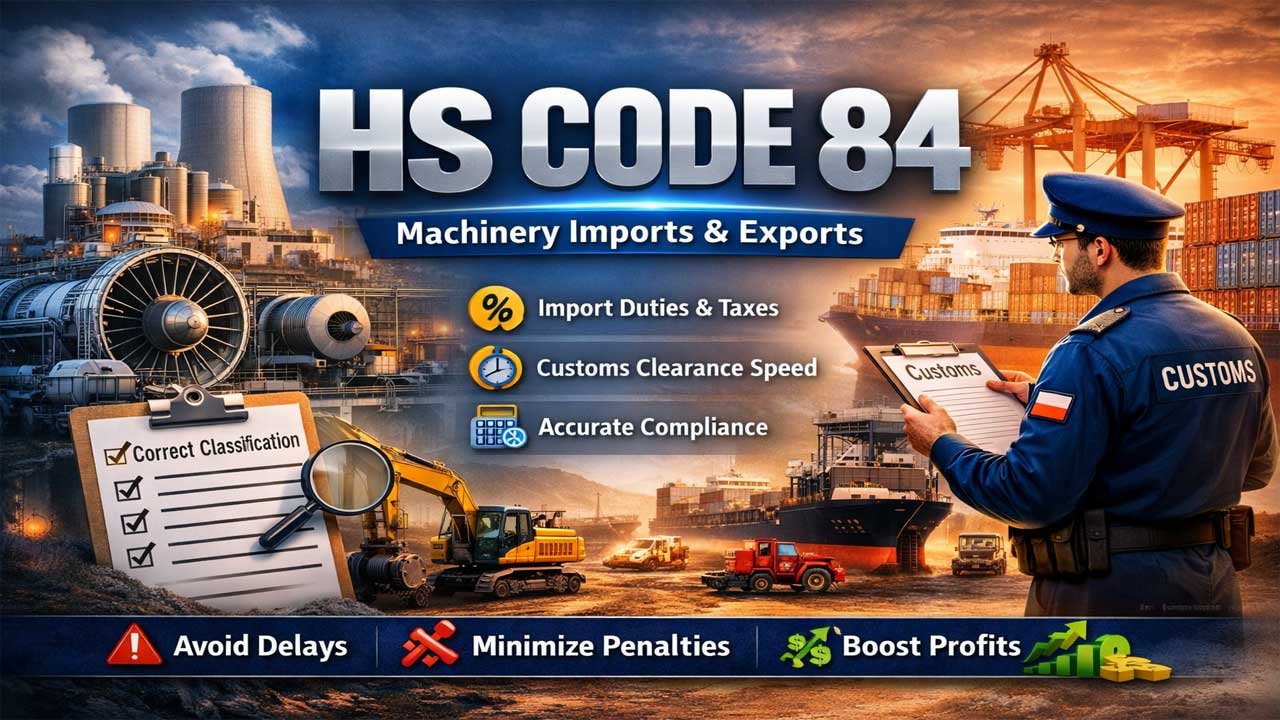
HS Code Chapter 84 covers all nuclear reactors, boilers, machinery, and mechanical appliances. This is the most important classification for industrial equipment import and export. The World Customs Organization maintains these codes globally. Understanding HS Code 84 is essential for traders, manufacturers, and importers.
This chapter contains 86 main headings. Each heading has specific subheadings. The codes range from 8401 to 8490. These codes determine your import duties and taxes. Correct classification is crucial for business success.
Why HS Code 84 Matters for Your Business
Accurate HS Code 84 classification affects several aspects of your business. It determines your exact import duty rates. It affects customs clearance speed. It impacts tax calculations. Wrong classification leads to delays and penalties.
Machinery equipment import-export trade is a major business sector. Thousands of companies trade these products globally. India alone exports significant machinery value annually. Many businesses struggle with correct classification. This guide eliminates that confusion.
HS Code 84 products are high-value items. Commercial buyers search actively for suppliers. Buyers look for accurate information about classification and pricing. Your business needs this visibility.
Complete List of HS Code 84 Headings
Understanding the subcategories helps you find the exact code for your product.
| HS Code | Product Category | Key Details |
|---|---|---|
| 8401 | Nuclear Reactors | Fuel elements, isotopic separation machinery |
| 8402 | Steam or Vapor Boilers | Excluding central heating boilers |
| 8403 | Central Heating Boilers | Hot water boilers for heating systems |
| 8404 | Auxiliary Boiler Plant | Economizers, super-heaters, soot removers |
| 8405 | Gas Generators | Producer gas, acetylene gas generators |
| 8406 | Steam Turbines | Vapor turbines, rotary engines |
| 8407 | Spark-Ignition Engines | Petrol engines, gasoline engines |
| 8408 | Diesel Engines | Compression-ignition engines, semi-diesel |
| 8409 | Engine Parts | Components for engines 8407-8408 |
| 8410 | Hydraulic Turbines | Water wheels, hydraulic power systems |
| 8411 | Gas Turbines | Turbo-jets, turbo-propellers |
| 8412 | Other Motors | Electric motors, hydraulic motors |
| 8413 | Liquid Pumps | Centrifugal pumps, submersible pumps |
| 8414 | Air Pumps & Compressors | Vacuum pumps, air compressors, fans |
| 8415 | Air Conditioning | Cooling and heating systems |
| 8416 | Furnace Burners | Industrial burners, combustion equipment |
| 8417 | Industrial Furnaces | Roasting furnaces, laboratory furnaces |
| 8418 | Refrigeration Equipment | Freezers, refrigerators, heat pumps |
| 8419 | Heat Exchange Equipment | Drying machines, heat treatment apparatus |
| 8420 | Calendering Machines | Rolling machines for materials |
| 8421 | Centrifuges | Separating and filtering equipment |
| 8422 | Packaging Machinery | Filling, sealing, labeling machines |
| 8423 | Weighing Machinery | Scales, balances, continuous weighers |
| 8424 | Spraying Equipment | Spray guns, spreaders, fire extinguishers |
| 8425-8428 | Material Handling | Pulleys, lifting machines, conveyors |
| 8430-8435 | Mining & Agricultural | Excavators, combine harvesters |
| 8436-8444 | Food & Textile | Food processing, textile machinery |
| 8445-8452 | Textile Operations | Spinning, weaving, garment machinery |
| 8453-8465 | Machine Tools | Lathes, drilling, milling machines |
| 8466 | Tool Holders & Parts | Machine tool accessories |
| 8467-8480 | Specialized Equipment | Hand tools, cutting equipment, valves |
| 8481-8487 | Mechanical Components | Bearings, gears, seals, gaskets |
Key HS Code 84 Classifications Explained
HS Code 8401 – 8404: Nuclear Reactors and Boilers
HS Code 8401 covers nuclear reactors and related equipment. This includes fuel elements and machinery for isotopic separation. These are highly regulated items. Import licenses are required. Environmental clearances are mandatory.
HS Code 8402 classifies steam and vapor-generating boilers. These exclude central heating boilers. This code covers industrial steam boilers. It includes thermic fluid heaters. Power generation boilers fall here too.
HS Code 8403 is for central heating boilers only. These are hot water boilers for building heating systems. They have lower power outputs than industrial boilers. They fall under different duty rates.
HS Code 8404 covers auxiliary boiler equipment. This includes economizers and super-heaters. It covers soot removers and gas recoverers. Condensers for steam systems classify here. These components improve boiler efficiency.
Importing Tip: Boiler parts must match the parent boiler classification. Wrong classification of parts causes customs delays.
HS Code 8406-8412: Engines and Turbines
HS Code 8406 covers steam turbines and vapor turbines. These generate electricity from steam. They power industrial processes. Power plants use these extensively.
HS Code 8407 classifies spark-ignition engines. These are petrol-powered engines. They include rotary engines and reciprocating engines. Small engines under 1000 kW fit here. Aircraft engines have special classifications.
HS Code 8408 covers diesel engines and compression-ignition engines. These are more powerful than spark-ignition engines. They deliver higher torque and efficiency. Heavy machinery uses diesel engines predominantly.
HS Code 8410 is for hydraulic turbines and water wheels. Hydroelectric power plants use these. Small-scale hydro systems use this classification. Capacity matters for sub-classification.
HS Code 8411 covers turbo-jets and gas turbines. Aviation turbines classify here. Industrial gas turbines for power generation fit this code. Thrust rating determines the exact sub-code.
Exporting Tip: Engine classification depends on power output and fuel type. Always verify specifications before export documentation.
HS Code 8413-8415: Pumps and Compressors
HS Code 8413 covers all pumps for liquids. This includes centrifugal pumps and submersible pumps. Deep well pumps fit this category. Hand pumps and power pumps both classify here. Pump capacity determines sub-classification.
HS Code 8414 is for air and vacuum pumps. Gas compressors classify here too. Industrial fans fall under this heading. Air conditioning compressors have specific sub-codes. Hand pumps and portable air pumps fit different classifications.
HS Code 8415 covers air conditioning and refrigeration machinery. This includes cooling systems and heat pumps. Industrial climate control equipment classifies here. Capacity and type determine exact codes.
Importing Tip: Pump power rating must be accurately stated. Higher power ratings may trigger additional import licenses.
HS Code 8416-8424: Industrial Processing Equipment
HS Code 8416 covers furnace burners and combustion equipment. Oil burners and gas burners fit here. These are high-demand industrial components.
HS Code 8417 classifies industrial and laboratory furnaces. These include roasting furnaces and melting furnaces. Heating capacity and temperature range matter. Laboratory furnaces have specific classifications.
HS Code 8418 covers refrigeration and freezing equipment. Industrial refrigerators fit here. Walk-in coolers and cold storage units classify as machinery. Heat pumps also fall under this heading.
HS Code 8422 is for packaging machinery. Filling machines and sealing equipment fit here. Labeling machines and wrapping machinery classify this way. High-value commercial keywords target this code.
Commercial Keywords: “Boiler supplier India,” “machinery manufacturer,” “industrial equipment distributor,” “compressor supplier,” “packaging machine quotation.”
Accurate Classification Rules for HS Code 84
Classification accuracy prevents costly delays and penalties. Follow these essential rules carefully.
Rule 1: Priority of Headings
Headings 8401–8424 and 8486 have priority. Use these before 8425–8480. Principal function determines classification.
Rule 2: Multi-Function Machines
When a machine does multiple functions, classify by principal function. The main purpose determines the code. Secondary functions don’t affect classification.
Rule 3: Component Classification
Components fit the same code as the machine they belong to. Engine parts go under engine codes. Boiler parts follow boiler classification. Exception: Parts with independent function classify separately.
Rule 4: Exclusions Matter
Some items exclude from Chapter 84 entirely. Millstones go under Chapter 68. Ceramic parts fit Chapter 69. Hand tools under Chapter 82. Vacuum cleaners under 8508. Domestic appliances under 8509.
Rule 5: Tech Equipment
Computer-integrated machinery still classifies as machinery. If principal function is mechanical, it stays in Chapter 84. Data processing is secondary.
Import Duty Rates for HS Code 84 Products
Import duty rates vary significantly by country and specific product.
| Region | Typical Duty Rate | High-Value Surcharge | Notes |
|---|---|---|---|
| India (Most Items) | 7.5% – 12.5% | Basic + applicable | GST 18% applies |
| India (Power Equipment) | 10% – 15% | Additional excise possible | State-level GST varies |
| EU | 0% – 15% | Free for certain tech | Green machinery: 2-4% |
| USA | 0% – 5% | Trade agreement rates | USMCA reduces rates |
| China | 3% – 20% | Varies by product | Sustainability rates apply |
Note: Exact rates depend on HS sub-codes (8-10 digits). Preferential trade agreements reduce rates. Environmental equipment gets lower rates in many countries.
Export Regulations for HS Code 84 Machinery
Exporting machinery requires strict compliance. Proper documentation is mandatory for legal export.
Essential Export Requirements:
- Obtain Correct HS Code Certification – Verify 8-digit Indian ITC code before shipment. Wrong codes trigger export license refusal.
- Environmental Clearance – Ministry of Environment approval needed for certain items. Equipment meeting emissions standards require certification. Hazardous materials need special documentation.
- Certificate of Origin – Required by most importing countries. Proves product manufactured in your country. Enables duty benefits under trade agreements.
- Quality Certifications – ISO 9001 certification recommended for machinery exports. IBR (Indian Boiler Regulation) for boiler equipment. Technical specifications verified by lab testing.
- Export License – Check Foreign Trade Policy requirements. Some machinery requires advance government approval. Technology items may have export restrictions.
- Inspection and Testing – Test reports from accredited laboratories required. Emissions testing for combustion equipment mandatory. Performance verification before shipment essential.
- Proper Packaging – Use crating or palletization as required. Include technical documentation and spare parts lists. Safety certificates must accompany machinery.
Exporting Tip: Non-compliance costs 10-15% extra in delays and penalties. Get all documents certified and ready 30 days before shipment.
Import Regulations and Compliance
Importing machinery under HS Code 84 demands adherence to several regulations.
Import Documentation Checklist:
- Commercial invoice with exact HS codes
- Certificate of Origin from exporting country
- Packing list with detailed specifications
- Test reports from authorized laboratories
- Environmental clearance (if applicable)
- Bill of Lading or Airway Bill
- Import license (for restricted items)
Testing and Certification Requirements:
Environmental compliance testing is mandatory in most countries. Boilers require pressure vessel certifications. Engines need emission compliance documentation. Electrical machinery requires safety certifications.
Special Cases for India Imports:
Ministry of Environment and Forest (MOEF) regulates hazardous materials. Three sample sets drawn for lab analysis. Test reports retained for 2+ years. Bilateral and multilateral trade agreements reduce documentation burden.
How to Find Exact HS Code for Your Product
Accurate classification prevents customs clearance delays. Use this systematic approach.
Step 1: Identify Principal Function
What is the machine’s main purpose? Is it for heating, cooling, pumping, or processing? Principal function determines the heading.
Step 2: Check Exclusions First
Does your product fall in exclusions? Hand tools go to Chapter 82. Electrical items might fit Chapter 85. Ceramic parts go to Chapter 69.
Step 3: Use the Headings Table
Match your product to specific headings 8401-8487. Most products fit clearly into one category. Note the 4-digit heading code.
Step 4: Verify Sub-Classifications
Sub-codes (6-8 digits) add specificity. Power rating determines many sub-codes. Material composition matters for some products. Capacity thresholds affect classification.
Step 5: Consult Official Resources
Use WCO Harmonized System explanatory notes. Check your country’s Tariff Board website. Import-export trade databases provide examples. Customs brokers can verify classifications.
Step 6: Get Official Verification
Request classification ruling from customs authorities. Many countries provide advance classification decisions. This prevents costly reclassification later.
Professional Tip: Use classification firms for high-value imports. Duty savings often exceed consulting fees.
Step-by-Step Process for Machinery Import and Export
Following proper procedures ensures legal compliance and smooth transactions.
For Importing Machinery:
Phase 1: Pre-Purchase (Days 1-15)
Research supplier reputation thoroughly. Verify credentials and certifications. Request technical specifications and compliance documents. Get HS code classification confirmed.
Phase 2: Purchase Agreement (Days 15-30)
Finalize purchase order with exact specifications. Specify HS codes in the PO. Include delivery terms (FOB/CIF). Define quality standards and inspection points.
Phase 3: Pre-Shipment (Days 30-45)
Arrange quality inspection at supplier location. Obtain test certificates and compliance documents. Arrange insurance coverage for machinery. Arrange customs broker to handle documentation.
Phase 4: Shipment Documentation (Days 45-60)
Prepare commercial invoice with HS codes. Get Certificate of Origin from exporting country. Arrange Bill of Lading or Airway Bill. File import documentation with customs at arrival port.
Phase 5: Customs Clearance (Days 60-75)
Present all documents to customs authorities. Pay import duties based on HS classification. Clear goods from warehouse after duty payment. Inspect goods upon receipt for damage.
Phase 6: Post-Import (Days 75+)
Install machinery with vendor support. Commission and test before production use. Keep all import documents for 5+ years. Register for warranty and maintenance support.
For Exporting Machinery:
Phase 1: Order Confirmation (Days 1-10)
Get purchase order with exact specifications. Confirm HS code classification with buyer. Clarify export destination and regulations. Verify any export licenses required.
Phase 2: Manufacturing/Procurement (Days 10-40)
Source components per specifications. Test and quality-check all components. Arrange third-party testing if needed. Prepare technical documentation package.
Phase 3: Pre-Shipment Preparation (Days 40-50)
Get environmental clearances if required. Prepare Certificate of Origin application. Package machinery with protective materials. Create packing list and detailed specifications.
Phase 4: Documentation (Days 50-60)
Prepare commercial invoice with HS codes. Apply for Certificate of Origin from industry body. Prepare export declaration forms. File with Export-Import Code (IEC) holder.
Phase 5: Shipment (Days 60-70)
Arrange freight forwarder and logistics. Get Bill of Lading/Airway Bill. Arrange insurance coverage. Track shipment until delivery.
Phase 6: Post-Export (Days 70+)
File export reports with customs authorities. Maintain export documentation for records. Track payments and handle any disputes. Collect feedback for warranty support.
Common Classification Mistakes to Avoid
Many traders make costly errors in HS code classification. Learning from these mistakes saves money and time.
Mistake 1: Ignoring Capacity Thresholds
Many HS codes change based on power rating or capacity. A 5 kW motor classifies differently than 50 kW. Always verify exact capacity specifications. This mistake costs 2-5% in tariff differences.
Mistake 2: Misclassifying Components as Finished Goods
Engine parts go under engine codes, not as separate products. Boiler components follow boiler classification. This error triggers re-examination and delays.
Mistake 3: Forgetting Exclusions
Some machinery falls outside Chapter 84 entirely. Ceramic boilers go to Chapter 69. Stainless steel components may be Chapter 73. Check exclusions before finalizing codes.
Mistake 4: Wrong Sub-Code for Material
Stainless steel and mild steel versions have different sub-codes sometimes. Material composition affects some classifications. Get material specifications in writing.
Mistake 5: Ignoring Trade Agreement Rates
Many countries reduce rates under bilateral agreements. India-ASEAN rates differ from MFN rates. Check applicable trade agreements before calculating duty.
Mistake 6: Not Verifying Equipment Standards
International standards affect classification of advanced equipment. IoT-enabled machinery may have special codes. Energy-efficient equipment gets preferential rates. Ensure compliance certifications are current.
Prevention Tip: Always use a customs broker for first-time imports/exports. Their expertise prevents costly reclassification and fines.
Latest Updates in HS Code 84 Classifications
The World Customs Organization updates HS codes regularly. These 2025 changes affect modern machinery traders.
New Subcategories for Industry 4.0 Technology:
- 3D printing machinery added under specific headings
- Collaborative robots (cobots) get dedicated classifications
- Autonomous guided vehicles (AGVs) fit new sub-codes
Sustainability and Green Equipment:
Energy-efficient motors get preferential rates (2-4% in EU). Renewable energy equipment classified separately. Environmental compliance affects duty calculations.
Digital Integration Considerations:
Edge computing devices for industrial IoT get special treatment. Industrial internet of things (IIoT) gateways have specific codes. AI-enhanced process control systems follow machinery classification rules.
Impact on Your Business:
Check if your equipment qualifies for new preferential rates. Update supplier catalogs with latest codes. Verify compliance certifications for 2025 standards.
Tools and Resources for HS Code Research
Finding accurate information is critical for compliance and cost optimization.
Official Resources:
- World Customs Organization (WCO) Database – Most authoritative source. Provides explanatory notes and classification decisions. Free access to Harmonized System codes.
- National Tariff Boards – India: DGFT (Directorate General of Foreign Trade). USA: USITC (US International Trade Commission). EU: European Commission Tariff Database.
- Import-Export Data Platforms – Seair, Trademo, Import Globals, and similar platforms provide real transaction data. Show actual classification used by traders. Reveal market trends and pricing.
- Customs Authority Websites – Most countries maintain searchable databases. Provide advance classification decisions. Allow tracking of tariff changes.
Professional Tools:
- Trade Compliance Software – Specialized software for classification management. Maintains updated tariff schedules. Calculates duties automatically.
- Customs Brokers – Professional brokers with current knowledge. Provide advance classification rulings. Manage import-export documentation.
- Industry Associations – Manufacturing bodies maintain classification guides. Provide sector-specific expertise. Offer training on compliance.
Frequently Asked Questions About HS Code 84
Q: What’s the difference between HS Code 8402 and 8403?
A: Code 8402 is for industrial steam boilers (high pressure, high capacity). Code 8403 is for central heating boilers (lower capacity, for building heating).
Q: Do I need an export license for machinery under HS Code 84?
A: Not always. Most items export freely if they have an IEC code. Certain restricted items like nuclear-related equipment need special licenses. Check with DGFT (India) or your country’s trade ministry.
Q: How do I know if my equipment has preferential rates under trade agreements?
A: Check bilateral and multilateral agreements your country has signed. India-ASEAN, India-Japan, India-South Korea agreements offer reduced rates. Your customs broker can determine applicability.
Q: What happens if I classify my machinery wrongly?
A: You pay incorrect duties initially. Customs may reclassify upon examination. You’ll owe additional duty plus interest and possible penalties. Always get advance classification rulings for valuable imports.
Q: Are there any sub-codes for environmentally friendly machinery?
A: Yes, as of 2025, energy-efficient equipment qualifies for lower rates in many countries. EU offers 2-4% rates for green machinery. Verify your equipment meets standards.
Q: How long should I keep import-export documentation?
A: Maintain records for minimum 5 years from date of import/export. GST regulations in India require 6 years. Keep all original documents including certificates.
Q: Can I import machinery without a customs broker?
A: Legally yes, but not recommended. Brokers prevent costly classification errors. They manage complex documentation. Cost (typically 1-2% of duty) is worth avoiding mistakes.
Conclusion: Mastering HS Code 84 for Business Success
HS Code Chapter 84 is essential knowledge for machinery traders, manufacturers, and importers. Proper classification directly impacts your bottom line through duty calculations, compliance costs, and customs delays.
Key Takeaways:
- HS Code 84 covers 86 main headings from nuclear reactors to mechanical components
- Accurate classification prevents duty overpayment and customs delays
- Sub-codes (8-10 digits) determine exact duty rates and compliance requirements
- Principal function determines classification for multi-purpose machinery
- Export regulations vary by country and equipment type
- Latest 2025 updates favor sustainable and high-tech equipment
- Professional assistance often pays for itself through duty optimization
Next Steps for Your Business:
- Get current classification rulings for your products
- Check applicable trade agreement rates
- Update supplier and buyer documentation with correct codes
- Train your team on classification procedures
- Use professional customs brokers for high-value imports
Remember: Classification is not permanent. When equipment specifications change, HS codes change. Verify codes for each new import or export transaction.


