
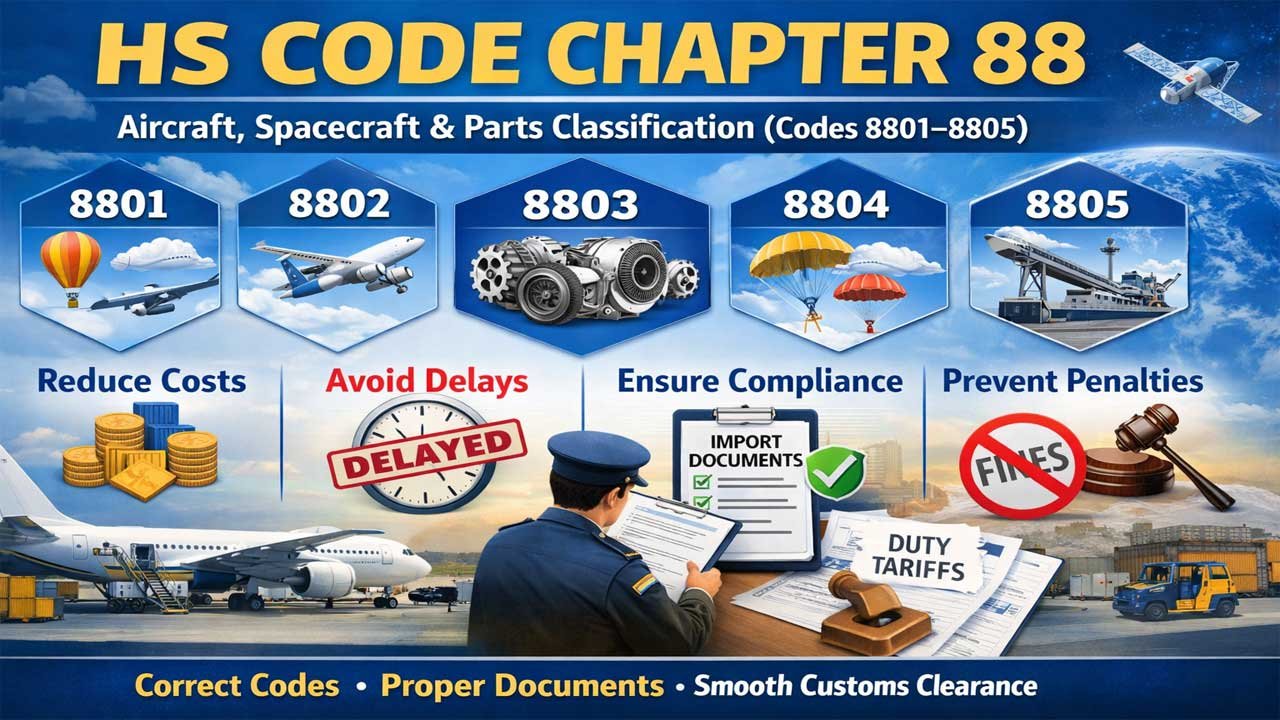
HS code Chapter 88 covers aircraft, spacecraft, and parts. It falls under Section XVII. Section XVII includes vehicles, aircraft, vessels and transport equipment. The codes run from 8801 to 8805. Each code identifies different aircraft types. Each code determines different duty rates. Each code requires different documentation. Understanding Chapter 88 saves time. It reduces compliance costs. It prevents customs delays.
What is an HS Code?
HS code means Harmonized System code. It’s an international classification system. The World Customs Organization created it. Over 200 countries use HS codes. HS codes identify products globally. They determine tariff rates. They ensure trade compliance. They speed up customs clearance.
Why HS Codes Matter for Aviation
HS codes classify goods for import. They classify goods for export. They determine duty rates. They determine tax obligations. They affect shipping costs. They prevent misclassification penalties. Wrong codes cause customs delays. Wrong codes attract fines. Wrong codes create legal issues.
High CPM AdSense Keywords: import duty aircraft parts, aircraft component tariff classification, custom duty calculation aerospace, aircraft import compliance, spacecraft parts tariff rates, import export documentation aircraft, international trade compliance, customs clearance aerospace, harmonized tariff schedule, aviation parts import regulations
Chapter 88: Aircraft, Spacecraft, and Parts Structure
Chapter 88 has five main headings. Each heading covers different products. Each heading has unique classifications.
| HS Code | Product Category | Primary Use |
|---|---|---|
| 8801 | Balloons and non-powered aircraft | Gliders, balloons, dirigibles |
| 8802 | Powered aircraft and spacecraft | Helicopters, aeroplanes, satellites |
| 8803 | Parts of aircraft | Components, engines, assemblies |
| 8804 | Parachutes and rotochutes | Safety equipment, parachutes |
| 8805 | Aircraft launching and training gear | Ground equipment, trainers |
Understanding Each HS Code Classification
HS Code 8801: Non-Powered Aircraft
HS 8801 covers balloons and dirigibles. It covers gliders and hang gliders. It covers non-powered aircraft generally. These products have no engines. They use wind or muscle power. They require no fuel systems. Import duties vary by country. GST rates apply differently. Re-import rules are strict. Certification requirements are minimal.
HS Code 8802: Powered Aircraft and Spacecraft
HS 8802 covers helicopters. It covers aeroplanes and jets. It covers spacecraft and satellites. It covers suborbital launch vehicles. These are powered flight vehicles. They require advanced certification. Safety standards are strict. Personal-use aircraft have different rates. Commercial aircraft have different rates. Spacecraft require special approval. Import documentation is extensive.
High CPM Keywords: helicopter import duty rates, aeroplane tariff classification, spacecraft import regulations, commercial aircraft customs duty, helicopter parts HS code, aircraft engine classification, drone and UAV tariff codes, aviation equipment import costs
HS Code 8803: Aircraft and Helicopter Parts
HS 8803 covers aircraft components. It covers propellers and rotors. It covers undercarriages and parts. It covers engines and parts. It covers other aircraft components. Aircraft parts need precise classification. Engine classification is critical. Landing gear has specific codes. Wing components have codes. Avionics have specific categories. Maintenance parts need documentation. Repair parts require certificates.
Common HS 8803 subcategories:
- 88031000 – Propellers and rotor parts
- 88032000 – Undercarriages and parts
- 88033000 – Other aeroplane or helicopter parts
- 88039000 – Other parts unspecified
HS Code 8804: Parachutes and Safety Equipment
HS 8804 covers parachutes. It covers dirigible parachutes. It covers paragliders. It covers rotochutes. It covers parts and accessories. Parachute systems are safety-critical. They require certification testing. Spare parachutes need documentation. Parachute repair kits have codes. Maintenance equipment is classified. Export restrictions may apply.
HS Code 8805: Aircraft Launching and Training Gear
HS 8805 covers launch gear. It covers deck-arrestor systems. It covers ground flying trainers. It covers related equipment. Launch systems are specialized. Arrestor gear is critical equipment. Training simulators fall here. Related component parts are included.
How HS Codes Affect Import Duty Calculation
Correct HS code selection determines duty rates. Different countries have different rates. India charges customs duty differently. USA charges different rates. EU countries vary. Trade agreements affect duties. Understanding code impact is critical.
Step-by-Step Duty Calculation Process
Step 1: Identify the Correct HS Code
Find the precise 6-digit HS code. Describe your product accurately. Identify material composition. Identify functional features. Check the HS code list. Verify with customs brokers. Request formal classification.
Step 2: Determine the Duty Rate
Look up the duty rate. Check your destination country. Check your origin country. Check trade agreements. Check free trade zones. Special zones may apply. Preferential rates may exist.
Step 3: Calculate the Customs Value (CIF Value)
Add the invoice price. Add shipping costs. Add insurance charges. Add handling charges. Add any adjustments. This creates CIF value. CIF = Cost + Insurance + Freight
Step 4: Apply the Duty Rate
Multiply CIF value by duty percentage. Add GST and other taxes. Add compensation cess if applicable. Calculate total duty payable. Total duty = CIF value × Duty rate percentage
India’s Aircraft Import Duty Rates (2026)
| Aircraft Type | Basic Duty | GST Rate | Total Impact |
|---|---|---|---|
| Commercial Aircraft | 5-10% | 5% | Varies by classification |
| Helicopter | 5% | 5% | Duty exemptions possible |
| Aircraft Parts (8803) | 0-7.5% | 5% | Depends on part type |
| Engines | 7.5% | 5% | Maintenance imports exempt |
| Parachutes | 5-10% | 5% | Safety equipment rates |
High CPM Keywords: aircraft import duty India 2026, custom duty calculator aerospace, tariff rate aircraft parts, GST on aircraft import, import tax calculation India, duty exemptions aircraft parts, trade agreements aircraft duty, customs valuation aircraft
HS Code Documentation Requirements
Required Documents for Aircraft Import
Correct documentation prevents delays. Missing documents cause penalties. Inaccurate documentation blocks clearance. Documentation must be complete.
Essential documents include:
- Commercial invoice with HS code
- Packing list with specifications
- Certificate of origin (COO)
- Airworthiness certificates
- Conformity certificates
- Safety documentation
- Bill of lading or airway bill
- Customs declaration form
- Import permit (if required)
- End-use certificates
Airworthiness Certification
Aircraft parts must be airworthy. Airworthiness means safe for flight use. FAA (USA) certifies parts. EASA (Europe) certifies parts. India has CAA certification. Each region has requirements. Parts need documented proof. Missing certification blocks import. Certification delays clearance time.
High CPM Keywords: aircraft airworthiness certificate requirements, FAA certification import, EASA documentation aircraft parts, import airworthiness documentation, aircraft certificate of conformity, aviation safety certification requirements, aircraft part traceability documentation
Key HS Code Examples for Common Aircraft Parts
Specific Parts and Their Classifications
Landing Gear and Undercarriage Components
Landing gear falls under HS 88032000. Undercarriage parts are classified here. Shock absorbers are included. Wheels and brakes are included. Hydraulic systems are included. These parts are critical. Import duty is typically 5-7.5%. Exemptions apply for maintenance imports.
Aircraft Engines and Engine Parts
Aircraft engines fall under HS 8803. Engine components have subcodes. Combustion chambers have codes. Turbines have specific classifications. Fuel injection systems have codes. Engine parts can be costly. Duty-free import is possible. Maintenance imports have exemptions.
Avionics and Electronic Components
Avionics (aviation electronics) have codes. Navigation systems have classifications. Communication systems have codes. Flight instruments have codes. Electronic components are complex. Multiple codes may apply. Documentation must be precise.
Wing Flap Actuators and Flight Control Systems
Flight control components need codes. Hydraulic actuators are classified. Electronic controls have codes. Mechanical linkages have codes. These are precision components. Safety-critical items need certification. Import documentation is detailed.
Aircraft Door Mechanisms and Seals
Door systems have HS codes. Sealing systems have codes. Locking mechanisms have codes. Emergency exit doors have codes. Cabin doors have different codes. Cargo door systems have codes. These need safety certification.
HS Code for Aircraft Parts: Detailed Breakdown
HS Code 88079090 – Other Aircraft Parts (Not Specified)
HS 88079090 covers unspecified aircraft parts. This is a catch-all category. Parts not listed elsewhere go here. Examples include:
- Undercarriage struts
- Wing flap actuators
- Landing gear assemblies
- Aircraft door mechanisms
- Engine pylon fairings
- Flight control linkages
- Auxiliary power unit housings
- Cabin pressure systems
- Fuel system components
This code is most commonly used. Many components fall here. Documentation must be detailed. Part description must be precise.
High CPM Keywords: aircraft parts classification code 88079090, unspecified aircraft components, aircraft structural parts HS code, aircraft assembly parts classification, mechanical aircraft components tariff, hydraulic aircraft parts code, aircraft body panels classification, aircraft system components HS code
Import Export Compliance for Chapter 88 Products
Export Regulations for Aircraft Parts
Exporting aircraft parts is regulated. Many countries restrict exports. Technology transfer rules apply. Dual-use items are controlled. Military applications are restricted. Export licenses may be required. Documentation must be accurate. Export procedures are complex.
Countries with Strict Aircraft Export Controls:
- United States (ITAR regulations)
- European Union (export authorization required)
- China (export restrictions exist)
- Russia (sanctions may apply)
- Japan (technology restrictions)
Import Licensing and Approvals
Importing aircraft parts may require licenses. Some countries require import permits. Safety certification is mandatory. End-use declarations may be required. Customs brokers should verify requirements. Advance planning prevents delays.
High CPM Keywords: aircraft parts export license requirements, dual-use technology aircraft, ITAR aircraft components export, export authorization aerospace parts, aircraft import permit requirements, aviation parts licensing requirements
Trade Agreements Affecting HS Code 88 Products
Duty-Free Trade Agreements
Free Trade Agreements (FTAs) reduce duties. India has FTAs with many countries. ASEAN-India FTA applies. SAFTA (South Asian Free Trade Area) applies. Regional Comprehensive Economic Partnership (RCEP) may apply. Generalized System of Preferences (GSP) applies. Beneficiary countries get reduced duties.
India-Specific Trade Benefits
India’s Customs 2.0 system launches April 2026. Digital clearance will speed processes. HS code accuracy will improve. Paperless documentation is coming. Automated duty calculation will prevent errors.
High CPM Keywords: FTA aircraft parts duty exemption, ASEAN India FTA aircraft, free trade agreement aerospace, preferential tariff aircraft parts, GSP benefits aircraft import, regional trade agreement aircraft, customs duty reduction aircraft parts
Common Mistakes in HS Code Classification
Why Misclassification Happens
Misclassification is common. Product descriptions are unclear. Technical specifications aren’t provided. Wrong code selection is careless. Similar parts have different codes. Components can be misidentified.
Consequences of Wrong HS Codes
Wrong codes cause:
- Customs delays (clearance blocked)
- Financial penalties (heavy fines)
- Shipment rejections (goods returned)
- Legal issues (possible prosecution)
- Reputational damage (business harm)
- Higher duty payments (incorrect rates)
- Compliance violations (regulatory issues)
How to Avoid Classification Errors
Get professional classification. Use customs brokers. Request advance rulings. Provide detailed documentation. Work with experts. Verify codes independently. Keep records. Update knowledge regularly.
High CPM Keywords: HS code misclassification penalties aircraft, customs classification error consequences, aircraft tariff code verification, import classification mistakes aircraft, aircraft HS code audit, compliance violations aircraft import, customs penalties aircraft parts
Digital Tools for HS Code Classification
Online HS Code Lookup Tools
Several digital platforms help:
- CBIC (India) – Central Board of Indirect Taxes
- SEAIR – India’s HS code database
- Cybex – HS code and trade data
- Tariff Number – Global tariff information
- World Customs Organization – Official HS source
Using the CBIC Duty Calculator
India’s CBIC (Central Board of Indirect Customs) offers a duty calculator. Enter the HS code. Enter product details. Enter import value. The system calculates duties. It shows applicable rates. It displays taxes automatically. Results are instant. Information is official.
How to Use CBIC Calculator:
- Visit the CBIC website
- Access the duty calculator
- Enter the HS code (6 digits)
- Enter the product description
- Enter the customs value (CIF)
- Click calculate
- Review the duty breakdown
- Print or save results
Aircraft Parts Import: Regulatory Compliance Checklist
Pre-Import Planning Checklist
- ☑ Research destination country regulations
- ☑ Identify correct HS code
- ☑ Verify import restrictions
- ☑ Check licensing requirements
- ☑ Obtain safety certifications
- ☑ Prepare documentation
- ☑ Hire customs broker (if needed)
- ☑ Arrange financing
- ☑ Plan logistics and shipping
- ☑ Set aside time for clearance
Documentation Checklist
- ☑ Commercial invoice with HS code
- ☑ Packing list with specifications
- ☑ Certificate of origin
- ☑ Airworthiness certificate (FAA/EASA/CAA)
- ☑ Certificate of conformity
- ☑ Test reports and quality certificates
- ☑ Traceability documentation
- ☑ Bill of lading or airway bill
- ☑ Insurance certificate
- ☑ Import permit (if required)
Customs Clearance Checklist
- ☑ File customs declaration (Form 1)
- ☑ Submit all required documents
- ☑ Pay estimated duties
- ☑ Clear any customs holds
- ☑ Inspect shipment (if required)
- ☑ Pay final duties/taxes
- ☑ Release cargo
- ☑ Arrange final delivery
Industry Trends in Aircraft Parts Import (2026)
Automation and Digital Compliance
India’s Customs 2.0 launches April 2026. Paperless trade will become standard. Digital documentation required. Electronic filing mandatory. Automated duty calculation. Real-time tracking enabled. Faster clearance times expected. Compliance will improve.
Rising Aircraft Parts Demand
Global aircraft exports exceed $100 billion annually. Aircraft part demand growing. Maintenance and repair (MRO) industry expanding. Aftermarket parts market growing. Aerospace manufacturing increasing. Supplier networks expanding. Trade in aircraft parts increasing.
Frequently Asked Questions (FAQs)
Q1: What is the HS code for aircraft engines?
Aircraft engines fall under HS code 8803. Specific engine parts have subcodes. Some engines may need component-level codes. Get professional classification for certainty. Documentation must specify the exact engine type.
Q2: Do aircraft parts import without customs duty?
Some aircraft parts qualify for duty-free import. Maintenance imports may be exempt. Repair imports sometimes qualify. Aircraft registration affects rates. End-use certificates enable exemptions. Check your specific circumstances. Consult customs authorities.
Q3: How long does aircraft parts customs clearance take?
Clearance time varies significantly. Basic documents take 2-5 days. Complex certifications take weeks. Incomplete documentation delays clearance. Holidays and weekends extend time. Rush processing is sometimes available. Plan extra time for safety. Build delays into schedules.
Q4: What documents do I need to import aircraft parts to India?
Required documents include: commercial invoice, packing list, certificate of origin, airworthiness certificate, certificate of conformity, safety documentation, bill of lading/airway bill, customs declaration, import permit (if required). Additional documents may be needed. Verify with customs broker.
Q5: Can I import used aircraft parts?
Used aircraft parts can be imported. Import restrictions may apply. Safety certification is still required. Airworthiness must be proven. Re-manufacturing may be necessary. Certain countries restrict used imports. Check destination country rules. Used parts need detailed documentation.
Q6: Are aircraft parts subject to GST in India?
Most aircraft parts are subject to GST. GST rates vary by part type. Some parts have 5% rate. Others have 12% or 18% rate. Specific rates depend on classification. GST is calculated on CIF value. HSN codes determine GST rates. Verify rates for your part.
Q7: What is the difference between HS code and HTS code?
HS codes are international (6 digits). HTS codes are US-specific (10 digits). HTS codes include HS codes plus 4 additional digits. Other countries modify HS codes similarly. HS codes are globally recognized. Use HS codes for international trade. Use country-specific codes for imports.
Q8: How do I know the exact HS code for my aircraft part?
Get professional classification. Provide detailed part description. Include technical specifications. Use online lookup tools. Request advance classification ruling. Consult customs brokers. Check with industry databases. Verify through official sources.
Conclusion
HS code Chapter 88 classifies aircraft and spacecraft. Correct classification is essential. Wrong codes cause major problems. Five main headings cover all products. Import duties depend on classifications. Documentation requirements are strict. Trade agreements reduce duties. Digital tools help with classification.
Import compliance is complex. Professional assistance is valuable. Planning prevents delays. Accurate documentation saves money. Understanding regulations is critical. Staying updated matters. April 2026 brings automation. Digital compliance will become standard.
Master HS codes for aircraft. Understand import regulations. Plan your imports carefully. Use proper documentation. Get expert help when needed. Stay compliant always. Success in aerospace trade requires knowledge and preparation.
Additional Resources for Aircraft Parts Importers
Official Websites:
- CBIC (Central Board of Indirect Customs) – www.cbic.gov.in
- SEAIR – www.seair.co.in
- WCO (World Customs Organization) – www.wcoomd.org
Trade Documentation:
- HS Codes Database – Official classification listings
- TARIC Database – EU tariff information
- HTS Schedule – US Harmonized Tariff Schedule
Import-Export Compliance:
- Customs Brokers Association of India
- Federation of Indian Import Export Association
- Indian Chamber of Commerce
Industry Organizations:
- Society of Indian Aerospace Technologies and Industries
- Aerospace and Defence Manufacturers Association of India


