
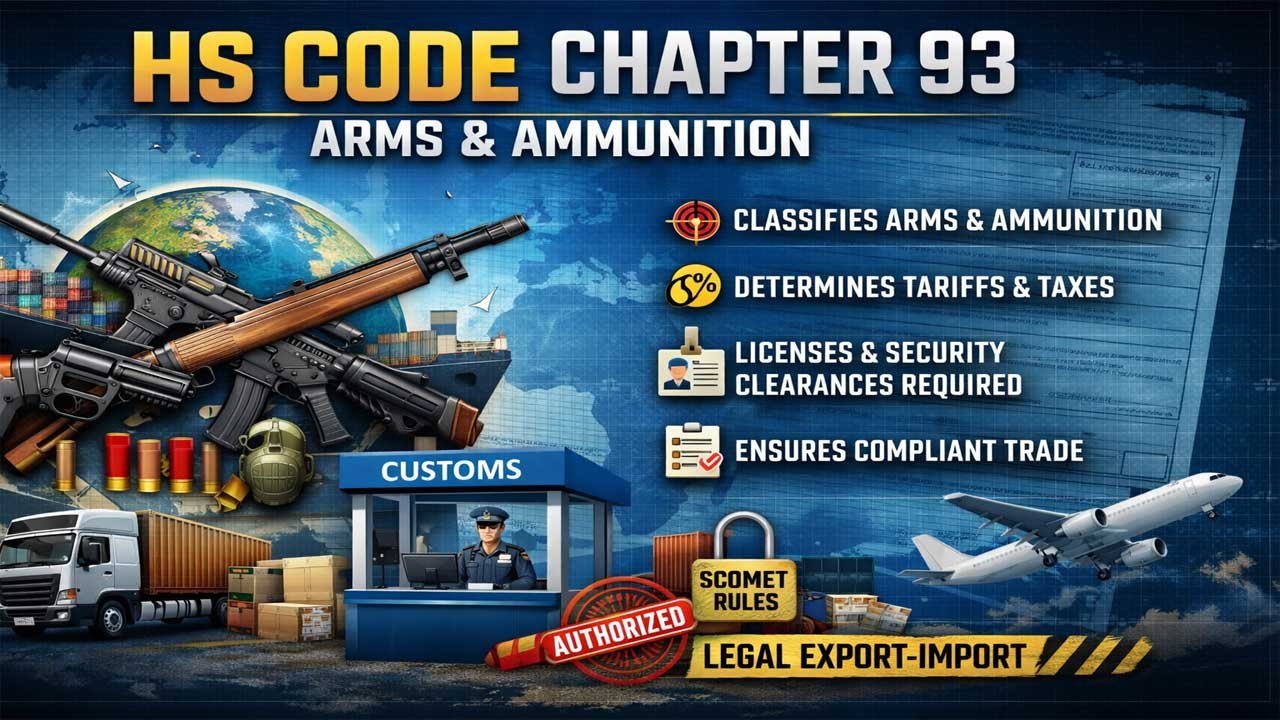
The HS Code system classifies products globally. Chapter 93 covers arms and ammunition. This chapter includes firearms, parts, and accessories. Every product has a specific code. These codes determine tariff rates. They also ensure regulatory compliance. Understanding these codes is critical. It helps with import and export operations. It also prevents legal issues.
What Is HS Code Chapter 93?
HS Code Chapter 93 is a classification system. It covers all arms and ammunition products. It also includes parts and accessories. This chapter belongs to Section XIX. Section XIX is for arms and ammunition items. The HS system is used worldwide. It is harmonized across countries. Each code has six base digits. Countries add extra digits for specificity.
HS Code is short for Harmonized System Code. It is used for customs classification. It determines tariff duties. It also calculates import and export taxes. Every country uses this system. The World Customs Organization (WCO) maintains it. The system is updated annually. New codes are added regularly. Some codes change classification rules.
Main HS Codes for Arms and Ammunition
HS Code 9301: Military Weapons
HS Code 9301 covers military weapons. These are not revolvers or pistols. The code includes artillery weapons. Guns are covered under this code. Howitzers are included. Mortars are also classified here. This code has two main subcategories.
HS Code 9301.10: Covers self-propelled artillery weapons. These are guns on vehicles. They can move on their own.
HS Code 9301.20: Covers rocket launchers. It also includes flame throwers. Grenade launchers are listed here. Torpedo tubes are covered. Similar projectors are included.
HS Code 9301.90: Covers other military weapons. Any weapon not listed above falls here.
Military weapons are heavily restricted. Most countries require special licenses. Import-export of these items needs approval. Compliance is strictly enforced.
HS Code 9302: Revolvers and Pistols
HS Code 9302 classifies all revolvers and pistols. These are handguns used worldwide. Revolvers have a rotating cylinder. Pistols have a magazine. Both are covered under this code. This code does not include blank ammunition pistols. It excludes signal flares. Other specialized pistols need different codes.
Handgun classification is important for compliance. Many countries regulate handguns strictly. Import licenses are mandatory. Export requires special permissions. Documentation must be complete. Background checks are required. Proper licensing ensures legal trade.
HS Code 9303: Other Firearms
HS Code 9303 covers all other firearms. Sporting shotguns are included. Hunting rifles are covered. Target-shooting firearms fall under this code. Muzzle-loading firearms are listed. Very pistols and flare guns are included. Line-throwing guns are covered. Captive-bolt humane killers are classified here.
HS Code 9303.10: Muzzle-loading firearms. These are older-style guns. They are loaded from the muzzle. Collectors often own these. Some hunters use them. Historical firearms are included.
HS Code 9303.20: Sporting shotguns for hunting. These are common civilian firearms. Target-shooting shotguns are listed. Combination shotgun-rifles are included. These are popular in many countries.
HS Code 9303.30: Sporting hunting rifles. Target-shooting rifles are covered. These are standard civilian firearms. Bolt-action rifles are included. Semi-automatic rifles fall under this code.
HS Code 9303.90: Other firearms. Any explosive-charge devices not listed above. Signal flare devices. Blank ammunition firearms. Other specialized devices.
HS Code 9304: Other Arms
HS Code 9304 covers non-firearm weapons. Spring guns and air guns. Gas-powered pistols. Truncheons and batons. Any non-explosive arms. This code excludes swords and bayonets. Those have a separate code.
Airgun classification is distinct. Air rifles and air pistols are common. These are lower-powered weapons. They are regulated differently. Some countries have fewer restrictions. Others require the same licenses as firearms.
HS Code 9305: Parts and Accessories
HS Code 9305 covers all parts and accessories. These are components for weapons listed above. Gun barrels are included. Triggers and firing mechanisms. Springs and bolts. Stocks and handles. Sights and scopes (when sold separately). Any replacement part is covered.
HS Code 9305.10: Parts for revolvers and pistols. Trigger mechanisms. Hammer parts. Barrel components. Cylinder parts.
HS Code 9305.20: Parts for shotguns and rifles. Gun barrels. Breech mechanisms. Firing pins. Bolt assemblies. Stocks and furniture.
HS Code 9305.91: Parts for military weapons. Components for weapons in code 9301.
HS Code 9305.99: Other parts. Any component not listed above.
Parts and accessories trade is growing. Spare parts are always needed. Replacement components generate revenue. This segment is less restricted. However, licensing is still required.
HS Code 9306: Ammunition and Cartridges
HS Code 9306 covers all ammunition types. Bombs and grenades. Torpedoes and mines. Missiles and munitions. Cartridges and ammunition. Projectiles and bullets. Shot and cartridge wads.
HS Code 9306.21: Shotgun cartridges. These contain ammunition. Shells loaded with pellets. Used for hunting. Used for sport shooting.
HS Code 9306.29: Air gun pellets. BB pellets. Ammunition for air rifles. Other shotgun ammunition components.
HS Code 9306.30: Cartridges and empty shells. Brass casings. Polymer cartridges. Empty ammunition boxes. Reloadable cartridges. Used casings.
HS Code 9306.90: Other ammunition. Projectiles and projectile components. Explosive devices. Military munitions. Other ammunition types.
Ammunition trade requires careful classification. Tariff rates vary by type. Some items face restrictions. Export controls are strict. Compliance documentation is essential.
HS Code 9307: Swords and Bayonets
HS Code 9307 covers edged weapons. Swords and cutlasses. Bayonets and lances. Similar bladed weapons. Scabbards and sheaths.
This category is less regulated. Decorative swords are included. Historical weapons are covered. Bayonets have limited civilian use.
GST and Tariff Rates in India
GST Rate for Chapter 93
The GST rate for arms and ammunition is 18%. This applies to all subcategories. GST is calculated on the product value. It is added at each supply stage. Proper documentation is required. GST compliance is mandatory.
Customs Duty Rates
Customs duty rates vary by product. Specific rates apply to each subcategory. Duty is calculated based on the HS code. The six-digit code determines the base rate. Individual countries add additional digits. This creates country-specific rates.
India has revised tariff rates recently. The Union Budget 2025-26 simplified tariff structure. Seven tariff rates were removed. Only eight tariff slabs remain. This includes the zero rate. These changes aim to simplify compliance. They also reduce administrative burden.
Tariff rates impact import costs. Higher duties increase product prices. Lower duties encourage trade. Rates are negotiated in trade agreements. Different countries have different rates. Checking current rates is essential.
Import and Export Requirements
Licensing Requirements in India
Arms and ammunition import requires special licensing. The Arms Act of 1959 governs this. The Arms Rules of 2016 provide detailed procedures. Licenses are mandatory for import. Licenses are mandatory for export.
Key Licensing Authorities:
- Ministry of Home Affairs (MHA)
- Directorate General of Foreign Trade (DGFT)
- Department for Promotion of Industry and Internal Trade (DPIIT)
Required Documentation:
- Import-Export Code (IEC)
- Arms license
- End-user certificates
- Security clearances
- Background verification
- Commercial documentation
SCOMET Regulations
SCOMET stands for Special Chemicals, Organisms, Materials, Equipment, and Technologies. Some arms and ammunition are on the SCOMET list. These items face additional restrictions. Special licenses are required. Export is carefully controlled. Government approval is needed.
Compliance and Registration
The National Database of Arms Licenses (NDAL) tracks all licenses. All licensees must register. Unique identification numbers are assigned. Records must be maintained. Regular inspections occur. Non-compliance results in penalties.
Detailed records are essential. Transaction documentation is mandatory. Every purchase and sale must be recorded. Inspection results must be filed. Violations can result in license cancellation.
Market Opportunities and Industry Overview
Global Market Size
The global ammunition market was valued at $15.5 billion in 2023. The market is expected to reach $16.0 billion in 2024. Growth is projected to continue. By 2032, the market could reach $22.0 billion. This represents a CAGR of 3.95%. Growth is driven by geopolitical tensions. Modernization of armed forces. Increased military spending.
India’s Ammunition Sector
India’s ammunition market is growing rapidly. It was valued at $844 million in 2023. Government initiatives support growth. The “Raksha Aatmanirbharta” program encourages self-reliance. Defence modernization programs are increasing. The government allocated higher budgets. India aims to become a major exporter.
Business Opportunities
Several opportunities exist in this sector. Manufacturing is growing. Export opportunities are expanding. Parts and accessories have steady demand. Ammunition consumption is always required. Military modernization drives demand. Government contracts are available.
Compliance knowledge is valuable. Consulting services are needed. Trading firms can leverage opportunities. Logistics and distribution are critical. Technology upgrading creates demand.
Practical Guide to HS Code Selection
Step 1: Identify Product Type
First, determine what product you have. Is it a complete firearm? Is it just ammunition? Is it parts or accessories? Different categories have different codes. Accurate identification is crucial. Misclassification leads to penalties.
Step 2: Find the Base Six-Digit Code
The base code uses six digits. First two digits identify the chapter. Chapter 93 for arms and ammunition. Next two digits identify the heading. Last two digits identify the subheading.
Example: For a hunting rifle:
- Chapter 93 (arms and ammunition)
- Heading 03 (other firearms)
- Subheading 30 (sporting hunting rifles)
- Full six-digit code: 930330
Step 3: Determine Country-Specific Codes
Most countries add additional digits. The US uses 10 digits total. India uses 8 digits total. These extra digits provide specificity. They determine exact tariff rates. They also control quotas and restrictions.
Step 4: Verify with Authorities
Always verify with customs authorities. Different countries have different rules. Online databases are available. The WCO maintains the global database. DGFT maintains Indian databases. US Customs maintains US databases.
Step 5: Maintain Documentation
Keep all classification documents. Import-export documentation must match codes. Invoices should list HS codes. Bills of lading must show codes. Customs declarations require codes. Incorrect documentation causes delays.
Compliance Best Practices
Documentation Management
Maintain organized records. All transactions should be documented. Import licenses must be filed. Export permits must be kept. Invoices should be detailed. Shipping documents must match HS codes.
Digital systems help track records. Cloud storage ensures accessibility. Regular backups prevent data loss. Audit trails show compliance history.
Regular Compliance Audits
Schedule regular audits. Verify all codes are correct. Check that licenses are current. Ensure documentation is complete. Review compliance procedures. Update policies as rules change.
Third-party auditors provide objective assessment. They identify compliance gaps. They suggest improvements. Regular audits prevent penalties.
Staying Updated on Regulations
Regulations change frequently. Subscribe to government updates. Follow DGFT announcements. Join industry associations. Attend trade seminars. Network with compliance professionals.
Online resources provide current information. Cybex and other databases update regularly. WCO releases annual updates. Tax authorities issue guidelines. Professional associations publish alerts.
Common Mistakes to Avoid
Incorrect Code Classification
Using wrong HS codes causes penalties. Fines are imposed for misclassification. Shipments can be delayed. Products may be seized. Customs can demand payment of correct duties. Always verify codes carefully.
Missing or Incomplete Documentation
All required documents must be complete. Missing licenses cause delays. Incomplete invoices create problems. Customs declarations must be accurate. Bills of lading must match shipments.
Ignoring SCOMET Restrictions
Some items face special restrictions. SCOMET list items need special licenses. Military items require extra approvals. End-user certificates are mandatory. Government approval cannot be skipped.
Not Updating Knowledge
Rules change frequently. Tariff rates are updated annually. Classifications can change. New codes are added. Old rules are sometimes removed. Regular training is essential. Professional development is important.
Conclusion
HS Code Chapter 93 provides comprehensive classification. Arms and ammunition have specific codes. Each product category has its own code. Proper classification ensures compliance. It also optimizes tariff rates. Understanding these codes is essential. It ensures successful import-export operations. It prevents legal issues. It protects business interests.
The arms and ammunition sector is regulated. Licenses are mandatory in most countries. Compliance is strictly enforced. Proper documentation is essential. Professional guidance is recommended. Staying updated is critical. Success requires careful attention to detail. Compliance creates sustainable business growth.


