
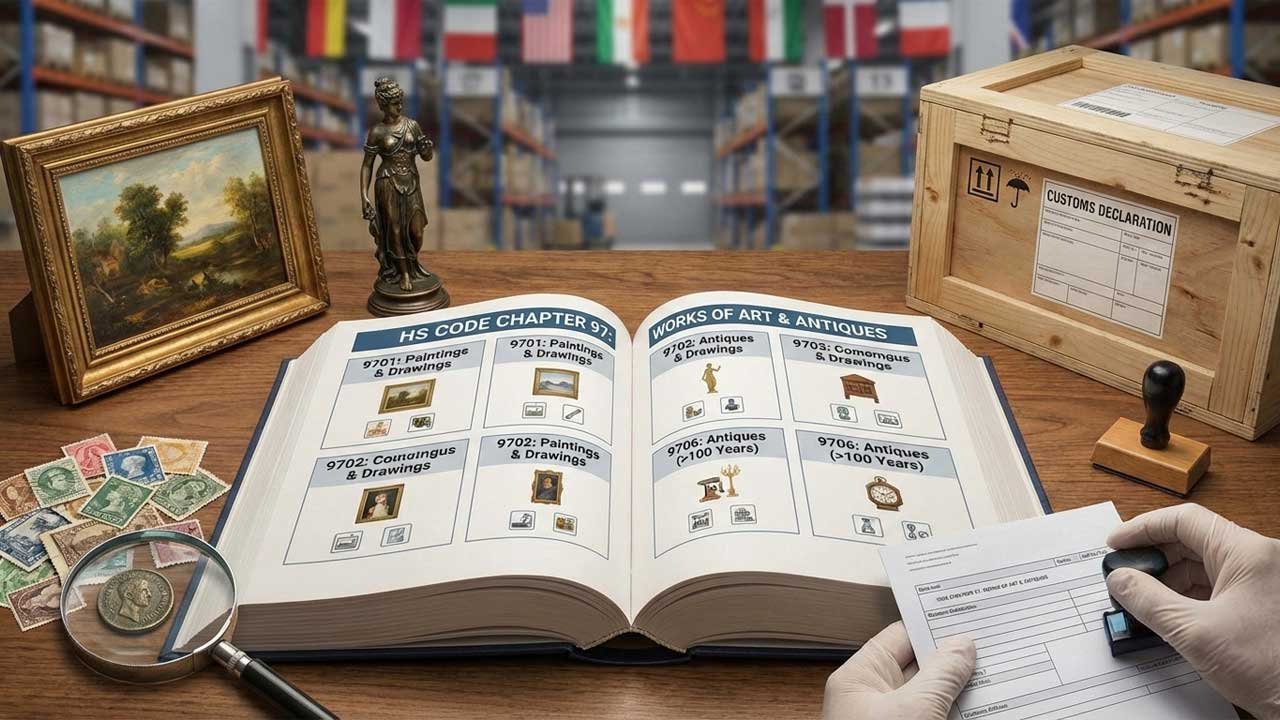
The HS Code 97 is important. It covers works of art. It covers collectors’ pieces. It covers antiques. HS stands for Harmonized System. It’s a global classification method. Every country uses it. It determines customs duties. It affects import taxes. It impacts export regulations.
Do you trade art? Do you deal with antiques? Do you buy or sell collectors’ items? You need to know HS Code 97. It’s essential for compliance. It ensures smooth customs clearance. It prevents shipping delays.
Why Accurate HS Code Classification Matters
Wrong classification costs money. It leads to penalties. It causes customs delays. Goods can be seized. Your shipment might get rejected. You lose time and profits.
Correct classification has benefits. You pay the right duty. You avoid legal issues. You speed up customs processing. You maintain good customs relations. You reduce shipping costs.
The difference matters for businesses. Large companies spend heavily on customs compliance. Customs consultancy is profitable.
What is Chapter 97? The Complete Overview
Chapter 97 is Section XXI of the tariff system. It’s one of 98 chapters. It classifies art and collectibles. It includes six main HS codes. These are codes 9701 through 9706.
The chapter covers:
- Hand-painted and hand-drawn items
- Original sculptures and statues
- Engravings and prints
- Stamps and postal stationery
- Collectors’ pieces of special interest
- Antiques over 100 years old
Important rules apply. Mass-produced items don’t qualify. Commercial reproductions are excluded. Items must be original. They must meet specific criteria. Each code has strict definitions.
HS Code 9701: Paintings, Drawings and Pastels
This code covers hand-created artwork. The work must be entirely by hand. It includes paintings. It includes pastels. It includes drawings. It covers collages. It covers decorative plaques.
What Qualifies Under 9701
Original creations qualify. The artist must create them by hand. No mechanical processes allowed. No mass production. Each piece must be unique.
Examples include:
- Oil paintings
- Watercolor paintings
- Pastel drawings
- Charcoal sketches
- Hand-painted collages
- Mosaic artworks
What Does NOT Qualify
Mass-produced items are excluded. Commercially manufactured art is out. Reproductions don’t count. Posters don’t qualify. Commercial prints are not included.
Hand-decorated manufactured articles are different. They fall into another category. Theatrical scenery goes here only if it’s 100+ years old. Otherwise, it’s classified elsewhere.
Import Duties and GST
India’s GST rate is 12%. Duties vary by country. U.S. duties depend on origin. EU rates are different. Check your specific country’s rates.
HS Code 9702: Original Engravings, Prints and Lithographs
This code covers printed art. The art must be original. It must be in limited numbers. Mechanical reproduction is excluded. Photomechanical processes don’t qualify.
What Qualifies Under 9702
Engravings are included. They must be hand-engraved. They must be original. Limited editions qualify.
Prints are covered. They must be created in limited numbers. Mass production disqualifies them. Hand-printed items work. Screen prints by artists work.
Lithographs are eligible. Traditional lithography qualifies. Limited runs are important. Commercial printing doesn’t count.
Key Requirements
Limited edition matters. High production numbers disqualify items. Signed and numbered works are better. Numbered prints help prove authenticity. Artist signatures are important.
Import Duties and GST
India’s GST is 12%. This matches paintings and drawings. Different countries have different rates. Check before importing.
HS Code 9703: Original Sculptures and Statuary
This code covers three-dimensional art. Sculptures must be original. Statuary must be hand-created. Any material qualifies. Metal, stone, wood, ceramic—all work.
What Qualifies as 9703
Original sculptures count. The artist must create them. Hand-carving is included. Hand-molding is included. Casting is allowed. The first 12 castings from an original qualify. Later castings don’t.
Examples include:
- Stone statues
- Metal sculptures
- Wooden carvings
- Ceramic pieces
- Bronze sculptures
- Marble statues
Important Rule: The 12-Casting Rule
U.S. law allows 12 castings. These are castings from the artist’s original or model. The sculptor or another artist can make them. Scale changes are allowed. The sculptor need not be alive.
After 12 castings, classification changes. Items become ordinary goods. Different duty rates apply. This rule is strict. It’s enforced by customs.
Import Duties and GST
India’s GST is 12%. Equal to paintings. Standard rates apply. Check preferential area rates if applicable.
HS Code 9704: Postage and Revenue Stamps
This code is specialized. It covers stamps. It covers first-day covers. It covers postal stationery. Items can be used or unused.
What Qualifies
Postage stamps qualify. Used stamps work. Unused stamps work. Rare stamps are included. Collector stamps qualify.
Revenue stamps are covered. Used revenue stamps work. Unused work too.
First-day covers qualify. These are envelopes with new stamps. They have first-day cancellation marks. Philatelists collect them. They have special value.
Postal stationery is included. Stamped paper and pre-printed envelopes work. These have official stamps. Collector versions qualify.
What Does NOT Qualify
Unused modern postage stamps don’t. These go under heading 4907. That’s a different category. Only special or collectible stamps qualify.
Import Duties and GST
India’s GST is only 5%. This is lower than other art codes. Numismatic coins also get 5%. Stamp collectors benefit from this rate.
HS Code 9705: Collections and Collectors’ Pieces
This is the broadest category. It covers many types of items. These items have special interest. They have cultural significance. They have collector value.
What Qualifies
Six types qualify:
- Zoological pieces – Stuffed animals, preserved specimens, taxidermy
- Botanical pieces – Preserved plants, special specimens, pressed flowers
- Mineralogical pieces – Rare minerals, crystal collections, geological specimens
- Anatomical pieces – Medical specimens, anatomical models
- Historical pieces – Items from important historical events
- Archaeological pieces – Objects at least 250 years old, found through excavation
Seven is the seventh type:
- Ethnographic pieces – Objects from tribal or non-industrial societies, culturally important
Eighth type is included:
- Numismatic pieces – Coins and medals with special collector value
Archaeological Pieces Definition
They must be 250+ years old. Older requirement than antiques. They have cultural significance. They’re usually excavated. These items are regulated strictly.
Numismatic Coins
Coins get special treatment. They have a separate rate. GST is 5% for numismatic coins. Other collectors’ pieces get 12%. The difference is important.
Import Duties and GST
Non-numismatic pieces: 12% GST. Most collectors’ pieces fall here.
Numismatic coins: 5% GST. Coins get preferential treatment.
HS Code 9706: Antiques Over 100 Years Old
This is the simplest code. Age is the only requirement. Items must be 100+ years old. No other conditions apply. Origin doesn’t matter. Material doesn’t matter. Purpose doesn’t matter.
The 100-Year Rule
100 years is the legal standard. This rule is international. It’s used worldwide. The U.S. adopted it in 1930. Most countries follow it now.
Calculation is straightforward. Take today’s date. Go back 100 years. Older items are antiques. Items 1926 or older are antiques in 2026.
What Qualifies as 9706
Any item 100+ years old qualifies. Furniture qualifies. Art qualifies. Tools qualify. Decorative items qualify. Functional items qualify. Almost anything works if it’s old enough.
Examples include:
- Antique furniture
- Old paintings (not covered by 9701 if over 100 years)
- Antique tools
- Vintage clothing
- Old books
- Historic machinery
- Ancient pottery
- Aged textiles
Important Exception
Items classified as 9701-9705 are excluded. If an item qualifies as paintings (9701), it stays there. If it qualifies as sculptures (9703), it stays there. Only items that don’t fit other categories use 9706.
Authentication Requirements
Age must be proven. Documentation helps. Certificates are valuable. Expert appraisals support claims. Provenance records are important.
Age verification matters. Without proof, items might be reclassified. Reclassification triggers different duties. Penalties apply to false claims. Customs can seize items.
Import Duties and GST
India’s GST is 12%. Equal to most art codes. This applies to all antiques over 100 years.
Note: If an antique is later determined to be under 100 years old, additional duty applies. The U.S. charges 6.6% additional duty. Penalties may be added.
How to Correctly Classify Your Items
Step 1: Determine the item type. Is it a painting? Is it a sculpture? Is it a print? Is it a stamp? Is it a special collection? Is it just old?
Step 2: Check the specific requirements. Was it hand-created? Is it original? Is it mass-produced? Are there limited editions? Does age matter?
Step 3: Verify the age if needed. For antiques, confirm it’s 100+ years old. Archaeological items need 250+ years. Get documentation.
Step 4: Confirm materials and method. Hand-made or mechanically produced? Original or reproduction? Limited edition or mass-produced? Material composition?
Step 5: Select the correct code. Match your item to the definition. Start with 9701. Check each code sequentially. Find the best fit.
Step 6: Verify with local customs. Check your country’s specific rules. Different countries apply rules differently. Some have additional requirements. Pre-clearance is helpful.
Import and Export Procedures for Art and Antiques
Documentation Required
For all art and antiques, you need:
- Commercial invoice
- Packing list
- Certificate of origin
- Photographs of items
- Detailed descriptions
- HS code classification
- GST information (if applicable)
For antiques specifically:
- Proof of age
- Authentication certificate
- Export permit (from origin country)
- Cultural heritage clearance (if required)
For valuable items:
- Professional appraisal
- Insurance documents
- Detailed photographs
- Condition reports
Export Restrictions
Some countries restrict art exports. Cultural heritage items may need permits. Archaeological items are strictly controlled. Some items are prohibited entirely.
UNESCO conventions apply. Many countries are signatories. Cultural property is protected. Smuggling is illegal. Penalties are severe.
Check before exporting. Contact your customs authority. Ask about restrictions. Get export licenses early. Delays are common.
Import Procedures
Step 1: Submit HS Code. Declare the correct code. Provide supporting documents.
Step 2: Await customs inspection. Items are examined. Authenticity may be verified. Age may be confirmed.
Step 3: Pay applicable duties. GST is calculated. Other duties may apply. Some items get duty exemption.
Step 4: Receive clearance. Items can be released. Certificates are provided if needed.
Duty Exemption in India
Central Board of Indirect Taxes (CBIC) offers exemptions. Basic customs duty (BCD) can be zero. Items under 9701, 9702, and 9706 may qualify. Conditions apply. Check current notifications.
Exemption requirements:
- Must meet HS code definitions
- Must provide proof of authenticity
- For antiques, age must be verified
- Documentation must be complete
Understanding GST Rates for Chapter 97 Items
Rate Summary for India:
| HS Code | Category | GST Rate |
|---|---|---|
| 9701 | Paintings, Drawings, Pastels | 12% |
| 9702 | Engravings, Prints, Lithographs | 12% |
| 9703 | Sculptures and Statuary | 12% |
| 9704 | Stamps and Postal Stationery | 5% |
| 9705 | Collectors’ Pieces (non-numismatic) | 12% |
| 9705 | Numismatic Coins | 5% |
| 9706 | Antiques (100+ years) | 12% |
Lower rates apply to stamps and coins. These special items get 5% GST. Everything else gets 12%. Rates became effective July 1, 2017.
Note: GST rates apply in India. International rates vary. Check your destination country. Different rates apply to different nations.
Key Differences Between Similar Categories
Paintings (9701) vs. Antique Paintings
Under 100 years old? Use code 9701 if hand-created. Original paintings qualify. Unique items qualify.
Over 100 years old? You can use 9706 instead. Older items may fit antiques code. Sometimes 9701 is better. Sometimes 9706 is better. Context matters.
What’s the difference? 9701 requires hand-creation. 9706 only requires age. 9701 includes reproductions if hand-decorated. 9706 includes mass-produced items if old enough.
Prints (9702) vs. Old Prints
Modern prints? Limited edition qualifies. Hand-printed matters. Original lithography qualifies.
Old prints? Over 100 years? Use 9706 instead. Sometimes 9702 is appropriate. Age alone doesn’t make it 9706. Quality and originality matter too.
Collectors’ Pieces (9705) vs. Antiques (9706)
Special items? Zoological, botanical, archaeological items go under 9705. These have cultural significance. Age isn’t the determining factor.
Old items? Any item 100+ years old goes under 9706. Origin doesn’t matter. Material doesn’t matter. Only age matters for 9706.
Archaeological Items (9705) vs. Antiques (9706)
Archaeological items are special. They must be 250+ years old. They have cultural significance. They’re excavated or discovered. These go under 9705.
Regular antiques are simpler. Just 100+ years old. Archaeological or not doesn’t matter. 9706 is the default code for old items.
Frequently Asked Questions About HS Code 97
Q1: Does my painting qualify as 9701?
Answer: It depends on several factors. Was it created entirely by hand? Is it original or a reproduction? Was it hand-painted or hand-decorated? If yes to all three, it likely qualifies.
But: Mass-produced items don’t qualify. Prints don’t qualify (they use 9702). Commercial art doesn’t qualify. Manufacturing date matters. Modern mass-production excludes items.
Q2: How old must an antique be?
Answer: It must be 100 years or older. This is the international standard. The year 1926 or earlier means antique in 2026.
But: Some collectors use 80 years as a threshold. Some use different definitions. For customs purposes, 100 years is the legal standard. This is consistent globally.
Q3: Can I import archaeological artifacts?
Answer: Archaeological pieces are allowed. They must be 250+ years old. They must be documented. Cultural property laws may apply.
But: Some countries prohibit artifact export. UNESCO conventions restrict some items. Check export country restrictions first. Import restrictions may also apply.
Q4: What’s the difference between vintage and antique?
Answer: Vintage is 20-100 years old. Antique is 100+ years old. This is the standard distinction.
But: Museums and experts use different definitions. Some consider 50+ years as antique. For customs purposes, 100 years is the legal threshold.
Q5: Do I need certificates for antiques?
Answer: Yes, documentation helps. Age proof is important for 100+ year items. Authenticity certificates are valuable. Professional appraisals support claims.
But: Some items are difficult to authenticate. Customs may delay clearance. Getting appraisals before shipping is smart. Keep copies of all documents.
Q6: Are mass-produced items excluded?
Answer: Yes, they’re mostly excluded. Mass production disqualifies items from most codes.
Exception: Items made by hand can be mass-produced if hand-made. But true mass-production with machines is excluded. The process matters more than quantity.
Q7: What happens if I use the wrong HS code?
Answer: Penalties apply. Additional duties are charged. Customs can seize items. Shipping delays occur. Your credibility suffers.
Prevention: Get pre-clearance from customs. Use customs brokers for guidance. Double-check your classification. Documentation is your protection.
Q8: Do frames affect HS code classification?
Answer: Frames are included with the art. If the frame is normal for the item, it’s classified together.
But: Valuable or unusual frames may be classified separately. High-value frames get their own code. The rule is about proportional value.
How to Navigate Customs Like a Professional
Tip 1: Use a Customs Broker. Brokers understand the system. They know current regulations. They handle documentation. They expedite clearance.
Tip 2: Get Pre-Shipment Classification. Ask customs to classify items before shipping. This prevents surprises. It ensures smooth clearance. It saves money and time.
Tip 3: Document Everything. Keep detailed records. Take high-quality photographs. Get professional appraisals. Preserve all certificates.
Tip 4: Understand Your Market. Different countries have different restrictions. Cultural heritage laws vary. Export restrictions differ. Research your specific market.
Tip 5: Stay Current on Regulations. HS codes change sometimes. Tariff rates update. Trade policies shift. Subscribe to customs alerts.
Tip 6: Consider Insurance. High-value items need protection. Insurance covers losses. It’s relatively inexpensive. It provides peace of mind.
Customs Duty Exemption in India
Major exemption announced (2025). Basic Customs Duty (BCD) exemption exists. Specified works of art qualify. Collectors’ pieces may qualify. Antiques can be exempt.
Who qualifies?
- Items under HS codes 9701, 9702, and 9706
- Authentic works verified by customs
- Properly documented items
- Items meeting specific criteria
Benefits of exemption:
- Zero basic customs duty
- Faster clearance process
- Reduced import costs
- Preferential treatment
How to get exemption:
- Apply with proper documentation
- Get authenticity verification
- Submit HS code classification
- Wait for customs approval
Important Notes for Business Owners
High-Value Transaction Alert. Customs watches high-value shipments. Large amounts trigger scrutiny. Multiple shipments are monitored. Be transparent. Keep records complete.
Professional Certification Helps. Use recognized appraisers. Get museum-quality documentation. Use established auction houses. Credibility matters. Documentation supports claims.
Timing Considerations. Customs delays happen. Plan for extra time. Seasonal busy periods add delays. Peak seasons are harder. Allow extra weeks for processing.
Insurance is Essential. Art and antiques are fragile. Breakage happens. Damage occurs. Insurance is affordable. It’s professional practice. It protects your investment.
Conclusion
HS Code Chapter 97 is essential knowledge. It covers works of art. It covers collectors’ pieces. It covers antiques. Understanding the codes saves money. It prevents penalties. It ensures smooth customs clearance.
Key takeaways are simple:
- Use code 9701 for hand-painted art
- Use code 9702 for original prints
- Use code 9703 for sculptures
- Use code 9704 for stamps
- Use code 9705 for special collections
- Use code 9706 for items 100+ years old
Document everything properly. Proof of authenticity matters. Age documentation is crucial. Keep all records. Get professional help if needed.
Get professional guidance. Customs brokers are helpful. Professional appraisers add credibility. Tax consultants advise on duties. Their expertise saves money and time.
The art and antiques market is growing. International trade in art is increasing. Customs regulations are evolving. Staying informed is important. This knowledge is valuable. Use it wisely.


