
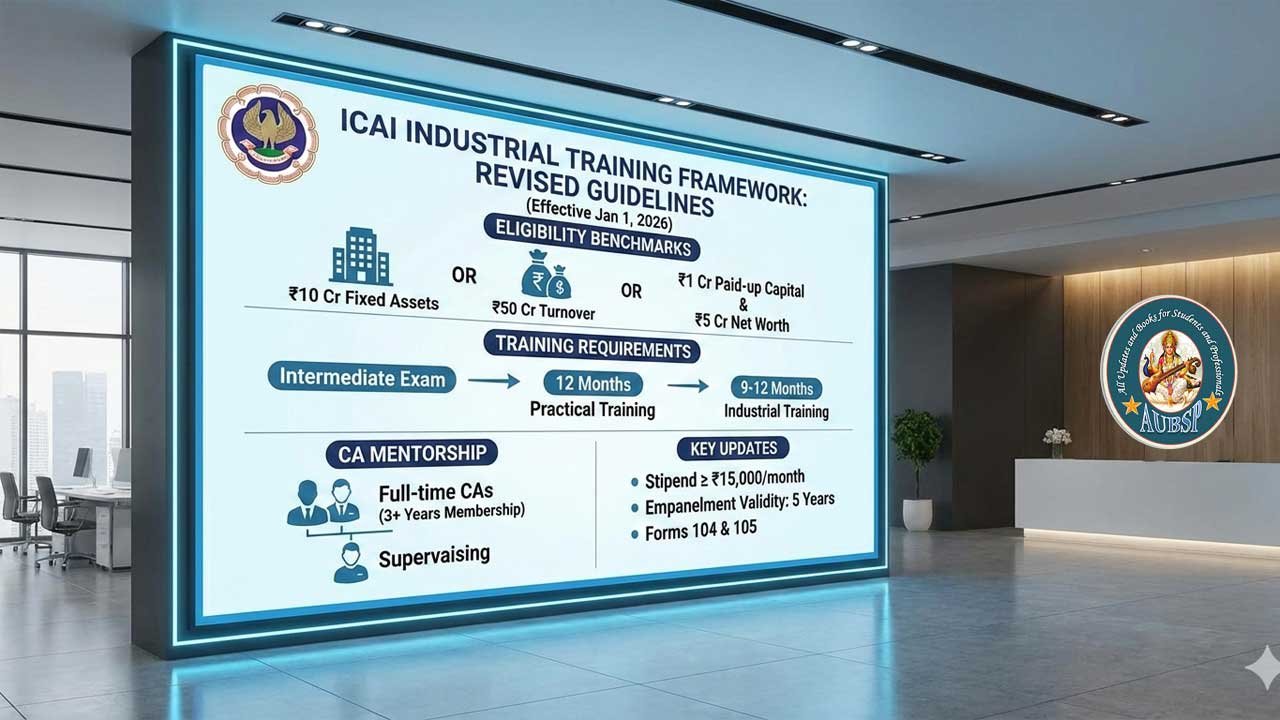
ICAI has revised the eligibility and regulatory framework for Industrial Training empanelment effective 1 January 2026, introducing stricter financial benchmarks for organizations—eligibility through any one of ₹10 crore fixed assets, ₹50 crore turnover, or jointly ₹1 crore paid-up capital and ₹5 crore net worth—along with a requirement of at least two full-time Chartered Accountants with three years’ continuous membership.
Articled assistants can pursue industrial training after passing the Intermediate examination and completing 12 months of practical training, with Associates eligible to train one industrial trainee and Fellows up to two at a time. Industrial training will span 9–12 months, requires three months’ prior intimation to the Principal, and will be governed by prescribed forms (Form 104 and 105), with the period counted as service under articles.
Empanelment will be valid for five years subject to renewal, stipends must be at least ₹15,000 per month, and ICAI retains powers to de-empanel non-compliant organizations, while transitional provisions protect trainees who began training before the effective date.
| Aspect | Information |
|---|---|
| Effective Date | 1 January 2026 |
| Empanelment Validity | 5 years (renewal mandatory thereafter) |
| Financial Eligibility (Any One) | ₹10 Cr Fixed Assets OR ₹50 Cr Turnover OR ₹1 Cr Paid-up Capital + ₹5 Cr Net Worth |
| Minimum CAs Required | 2 full-time CAs with 3 years continuous ICAI membership |
| Student Eligibility | Intermediate exam passed + 12 months practical training |
| Training Duration | 9–12 months |
| Advance Intimation | 3 months prior notice to Principal |
| Trainee Capacity | Associate: 1 trainee; Fellow: 2 trainees |
| Minimum Stipend | ₹15,000 per month |
| Forms Prescribed | Form 104 (Agreement), Form 105 (Completion Certificate) |
| Foreign Training | 6–12 months abroad; deputation up to 3 months |
| Status of Training | Counted as service under articles |
| Compliance Action | De-empanelment / suspension for violations |
| Transitional Provision | Pre-1 Jan 2026 trainees continue under old rules |
ICAI Introduces Revised Eligibility Criteria for Industrial Training Empanelment: What Members and Students Need to Know
The Institute of Chartered Accountants of India (ICAI) has announced significant revisions to the eligibility criteria for organizations seeking empanelment to impart Industrial Training.
Effective from January 1, 2026, these changes represent ICAI’s commitment to maintaining quality standards in professional training while ensuring better opportunities for articled assistants. Here’s everything members and students need to know about the new framework.
Understanding the New Financial Thresholds for Organization Empanelment
| Criteria Category | Minimum Requirement |
|---|---|
| Fixed Assets | ₹10 Crore |
| Total Turnover | ₹50 Crore |
| Paid-up Share Capital & Net Worth | ₹1 Crore Paid-up Capital AND ₹5 Crore Net Worth (Jointly) |
The revised regulations establish clear financial benchmarks that organizations must meet to qualify for empanelment. Rather than maintaining a single criterion, ICAI now offers flexibility by allowing organizations to demonstrate eligibility through any one of three financial pathways:
The first pathway requires a minimum of ₹10 crore in fixed assets. This criterion is designed to accommodate organizations with substantial physical infrastructure and capital investments, making it particularly relevant for manufacturing units and established commercial enterprises.
The second option sets the minimum total turnover requirement at ₹50 crore. Organizations with significant revenue streams can leverage this criterion, which is especially suited for large service providers, consultancies, and commercial establishments that generate high annual revenue.
The third criterion combines two requirements that must be fulfilled jointly: a minimum paid-up share capital of ₹1 crore and a net worth of ₹5 crore. This option recognizes the equity and financial stability of well-capitalized organizations, making it accessible for companies with strong balance sheets but potentially lower fixed assets or turnover.
Beyond these financial criteria, organizations must demonstrate professional expertise by maintaining at least two full-time working Chartered Accountants, each with a continuous ICAI membership of at least three years. This requirement ensures that industrial training is guided and supervised by experienced, qualified professionals who understand both the accounting profession and the specific needs of articled assistants.
Who Can Pursue Industrial Training? Eligibility Requirements Explained
The eligibility pathway for industrial training is clearly defined to ensure only qualified candidates participate. An articled assistant becomes eligible for industrial training after:
- Successfully passing the Intermediate (Professional Competence) Examination or Professional Education (Examination-II), or the Intermediate examination
- Completing a minimum of 12 months of practical training as per regulatory requirements
This dual requirement ensures that candidates have both theoretical knowledge and foundational practical experience before entering the industrial training phase, which serves as an advanced professional development opportunity.
Determining How Many Trainees Your Firm Can Engage
The regulations establish distinct entitlements based on membership category:
Associate Members who have maintained continuous membership for at least three years are entitled to train one industrial trainee at a time. This measured approach allows emerging firms and practitioners to provide focused mentorship while managing their professional responsibilities.
Fellow Members have greater capacity and are entitled to train up to two industrial trainees simultaneously. This reflects the seniority, experience, and professional standing of Fellows within the ICAI hierarchy.
These entitlements ensure that trainees receive adequate attention and mentorship while preventing over-burdening of supervising professionals with excessive training responsibilities.
Timeline and Structure: Planning Industrial Training Programs
Industrial training must be structured with proper planning and coordination. An articled assistant must notify their Principal at least three months in advance of the intended commencement date. This lead time allows for proper coordination between the training member, the principal employer, and the trainee.
The training period spans between 9 to 12 months, offering flexibility to accommodate different organizational needs while ensuring sufficient duration for meaningful professional development and skill acquisition. This extended period allows trainees to experience various professional scenarios and develop competency across multiple domains within the accounting and finance sector.
The Five-Year Empanelment Cycle: Renewal and Continued Eligibility
Organizations should note that empanelment is not a permanent designation. Empanelment remains valid for five years, after which mandatory renewal is required. This periodic review mechanism ensures that organizations continue to meet established standards and adapt to evolving regulatory requirements.
Organizations that have completed their five-year empanelment cycle must proactively apply for renewal to maintain their authorization to engage industrial trainees. The renewal process is subject to the eligibility criteria prevailing at the time of application, which may include updated requirements. To avoid disruptions in engaging trainees, organizations are strongly advised to initiate renewal proceedings well in advance of their empanelment expiry date.
Procedural Framework: Documentation and Formalities
ICAI has established standardized procedures to ensure consistency and professionalism across all industrial training programs:
Agreement of Training: Every industrial training arrangement must be formalized through an Agreement of Training using Form 104, which is approved and prescribed by the ICAI Council. This document outlines the responsibilities, expectations, and terms of the training relationship.
Completion Certificate: Upon satisfactory completion of industrial training, the supervising member must issue a Completion Certificate to the trainee using Form 105. A copy of this certificate must be promptly forwarded to the ICAI Secretary, creating an official record of completion.
Recognition as Service: Importantly, the period spent in industrial training is recognized and counted as service under articles for all regulatory purposes, provided the trainee submits the prescribed completion certificate. This ensures that industrial training contributes to meeting the total professional development requirements under ICAI regulations.
International Opportunities: Training Across Borders
The regulations acknowledge the increasingly globalized nature of professional practice:
Foreign Industrial Training: Articled assistants may undertake industrial training in any foreign country under a member of a recognized accountancy body (recognized by the International Federation of Accountants) for a period of six to twelve months. This opens pathways for international exposure and learning.
International Deputation: Members may also depute industrial trainees to work in foreign countries for up to three months, facilitating cross-border professional development and exposure to international accounting practices and standards.
These provisions reflect the modern professional landscape and ICAI’s commitment to developing globally competent accounting professionals.
Compensation and Rights: Understanding Trainee Stipends
Industrial trainees are entitled to monetary compensation for their work and development. Monthly stipends shall be mutually agreed between the trainee and the member, subject to a minimum of ₹15,000 per month. This minimum ensures fair compensation while allowing flexibility for organizations to offer higher remuneration based on their circumstances and the trainee’s qualifications.
The stipend structure recognizes that industrial training is a specialized, focused professional engagement that differs from regular articled assistantship and merits appropriate compensation.
Compliance and Consequences: Maintaining Standards
ICAI reserves significant enforcement powers to maintain the integrity of industrial training programs. Any violation of the Chartered Accountants Regulations, 1988—including infractions relating to excess leave during industrial training—may result in serious consequences for empaneled organizations.
Specifically, ICAI may:
- Discontinue registrations of further industrial trainees
- De-empanel organizations from imparting industrial training
These enforcement mechanisms underscore the seriousness of regulatory compliance and the importance of members and organizations adhering strictly to prescribed regulations.
Transitional Provisions: Protecting Existing Trainees
To ensure fairness and minimize disruption, ICAI has included transitional protections. Articled assistants who commenced industrial training before January 1, 2026, and are covered under the earlier regulations, may continue and complete their remaining training period according to their existing training agreement.
This grandfather clause acknowledges the legitimate expectations of trainees operating under previous rules and prevents arbitrary disruption of ongoing professional development.
Key Takeaways for Stakeholders
For Organizations: Ensure you meet the revised financial criteria and maintain the required number of qualified Chartered Accountants. If you’re approaching the five-year renewal mark, begin the renewal process immediately to maintain continuity.
For Members: Understand your trainee capacity based on your membership category (Associates: 1 trainee; Fellows: 2 trainees) and ensure proper documentation using prescribed forms. Monitor compliance with regulations strictly.
For Articled Assistants and Students: If eligible for industrial training, initiate discussions with your Principal three months before your intended start date. Ensure your supervising member maintains proper documentation and issues your completion certificate promptly.
Getting Additional Assistance
For detailed guidance, clarifications, or specific queries regarding industrial training, the Members & Students Services Directorate of ICAI is available to assist. Members and students may direct their inquiries to: sroart[at]icai[dot]in
About These Changes
These revised eligibility criteria, effective from January 1, 2026, represent ICAI’s forward-thinking approach to professional education and training. By establishing clear benchmarks, ensuring adequate professional supervision, and maintaining flexibility in implementation, ICAI continues to uphold the highest standards of chartered accountancy education while creating meaningful development opportunities for emerging professionals.
As the accounting profession evolves, industrial training remains a critical component of professional development, and these revised criteria are designed to ensure that only organizations meeting rigorous standards participate in shaping the next generation of chartered accountants.
FAQs on Revised ICAI Industrial Training Rules
What are the revised ICAI Industrial Training rules effective from 2026?
ICAI has revised the eligibility, financial criteria, supervision norms, stipend requirements, and compliance framework for industrial training, effective from 1 January 2026.
From when are the new industrial training eligibility criteria applicable?
The revised criteria apply to empanelment and training commencing on or after 1 January 2026.
Who can apply for empanelment to impart industrial training?
Organizations meeting the prescribed financial criteria and employing at least two full-time Chartered Accountants with the required experience can apply.
What are the financial eligibility criteria for empanelment?
An organization must satisfy any one of the following: ₹10 crore fixed assets, ₹50 crore total turnover, or ₹1 crore paid-up share capital along with ₹5 crore net worth.
Is it mandatory to fulfill all financial criteria for empanelment?
No, fulfilling any one of the prescribed financial criteria is sufficient.
Why has ICAI introduced multiple financial pathways for eligibility?
To provide flexibility for organizations with different business models while maintaining quality training standards.
How many Chartered Accountants must be employed by an empaneled organization?
At least two full-time Chartered Accountants with a minimum of three years’ continuous ICAI membership.
Can part-time Chartered Accountants be considered for eligibility?
No, only full-time working Chartered Accountants are considered.
Who is eligible to undergo industrial training?
Articled assistants who have passed the Intermediate examination and completed at least 12 months of practical training.
Can a student pursue industrial training before completing 12 months of articleship?
No, completion of 12 months of practical training is mandatory.
What examinations qualify a student for industrial training eligibility?
Intermediate (Professional Competence) Examination, Professional Education (Examination-II), or Intermediate Examination.
What is the minimum and maximum duration of industrial training?
Industrial training must be for a period of 9 to 12 months.
Is it compulsory to inform the Principal before joining industrial training?
Yes, a minimum three-month prior intimation to the Principal is mandatory.
Can industrial training be extended beyond 12 months?
No, the maximum permissible duration is 12 months.
How many industrial trainees can an Associate Member train?
An Associate Member with at least three years’ continuous membership can train one industrial trainee at a time.
How many industrial trainees can a Fellow Member train?
A Fellow Member is entitled to train up to two industrial trainees simultaneously.
Does continuous membership matter for trainee entitlement?
Yes, continuous membership of at least three years is required.
Is industrial training considered part of articleship?
Yes, the period of industrial training is counted as service under articles.
What form is used for the industrial training agreement?
Form 104, prescribed and approved by ICAI.
Which form is issued after completion of industrial training?
Form 105, the Completion Certificate.
Is submission of the completion certificate mandatory?
Yes, submission of Form 105 is required for the training period to be recognized.
What is the minimum stipend payable to industrial trainees?
₹15,000 per month.
Can organizations pay more than the minimum stipend?
Yes, stipend may be higher based on mutual agreement.
Is the stipend fixed by ICAI for all trainees?
Only the minimum stipend is prescribed; higher amounts are permitted.
How long is empanelment valid for industrial training?
Empanelment is valid for five years.
Is renewal of empanelment mandatory?
Yes, renewal is mandatory after completion of the five-year period.
Will renewal be based on old or new criteria?
Renewal will be subject to the eligibility criteria prevailing at the time of renewal.
What happens if an organization fails to renew empanelment on time?
It may lose authorization to engage industrial trainees.
Can ICAI de-empanel organizations for non-compliance?
Yes, ICAI has the power to de-empanel organizations for regulatory violations.
What kind of violations can lead to de-empanelment?
Non-compliance with Chartered Accountants Regulations, excess leave, or breach of training norms.
Can ICAI stop future trainee registrations for violations?
Yes, ICAI may discontinue registration of further industrial trainees.
Are international industrial training opportunities allowed?
Yes, industrial training can be undertaken in foreign countries.
What is the duration of foreign industrial training?
Between 6 and 12 months.
Under whom can foreign industrial training be undertaken?
Under a member of a recognized accountancy body recognized by IFAC.
Is international deputation different from foreign industrial training?
Yes, international deputation is limited to a maximum of three months.
Can all trainees opt for foreign industrial training?
Yes, subject to compliance with ICAI regulations and approvals.
Are trainees who started industrial training before 1 January 2026 affected by the new rules?
No, they may continue under the old regulations.
What is the purpose of the transitional provision?
To protect trainees already undergoing industrial training from disruption.
Does industrial training replace the entire articleship period?
No, it forms part of the articleship and is counted accordingly.
Can industrial training be undertaken in any organization?
Only in ICAI-empaneled organizations.
Is documentation mandatory for every industrial training arrangement?
Yes, proper documentation using prescribed forms is mandatory.
Who can be contacted for clarification on industrial training rules?
The Members & Students Services Directorate of ICAI.
Why has ICAI revised the industrial training framework?
To enhance training quality, ensure professional supervision, and align with evolving industry standards.
How do the revised rules benefit students?
They ensure structured training, fair stipend, better supervision, and global exposure opportunities.
How do the revised rules impact organizations?
Organizations must meet higher standards, ensure compliance, and maintain professional mentorship quality.
Is industrial training compulsory for all CA students?
No, it is optional but provides advanced professional exposure.
Does excess leave during industrial training have consequences?
Yes, excess leave may attract regulatory action under ICAI rules.
Can industrial training be terminated midway?
Only as per ICAI regulations and with proper documentation and approvals.
Is industrial training applicable to both Associate and Fellow Members?
Yes, with different trainee capacity limits.
Do these changes reflect ICAI’s long-term vision?
Yes, they align with ICAI’s objective of producing globally competent Chartered Accountants.


Leave a Reply
You must be logged in to post a comment.