
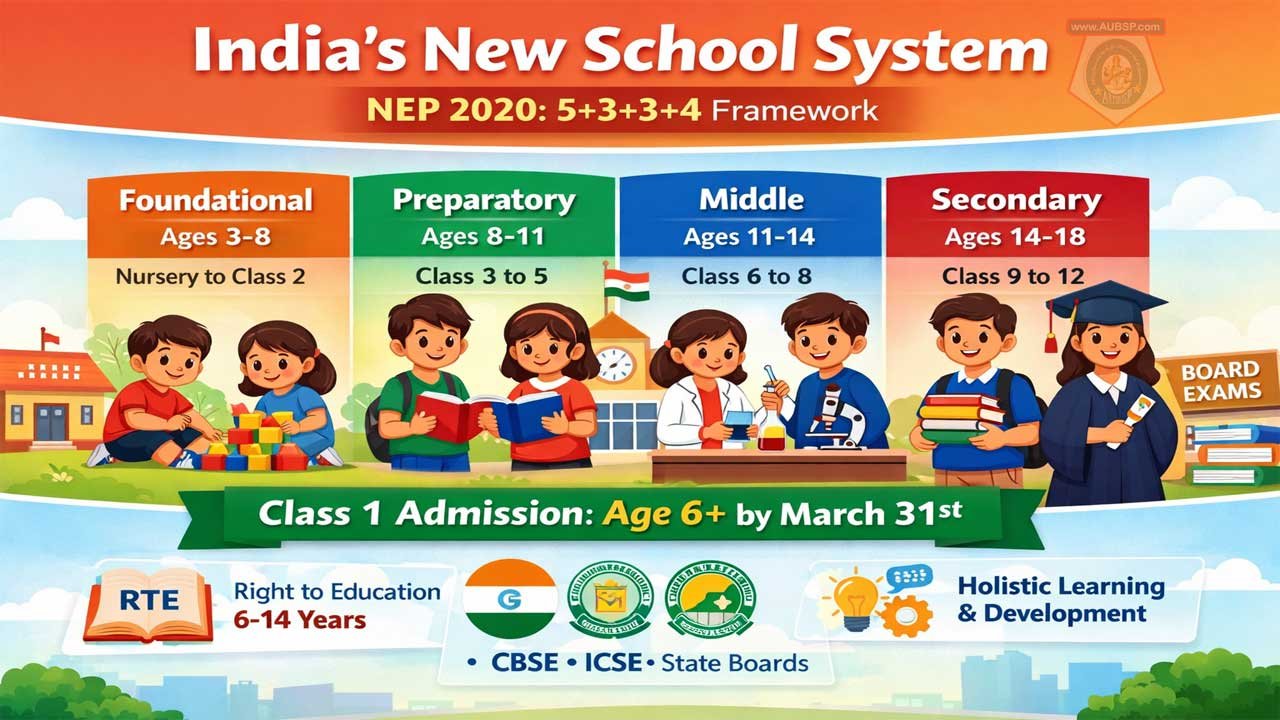
India’s school education system, restructured under the National Education Policy (NEP) 2020, replaces the old 10+2 format with a developmentally aligned 5+3+3+4 framework covering ages 3–18, emphasizing age-appropriate, holistic learning from early childhood through secondary education.
Class 1 admission at age 6 (by March 31 cut-off) is mandatory nationwide under the Right to Education (RTE) Act, which guarantees free and compulsory schooling for ages 6–14, while pre-primary education (ages 3–6) is strongly encouraged for better long-term outcomes. The system progresses from play-based foundational learning to structured academics, critical thinking, subject specialization, and board examinations, with variations across CBSE, ICSE, and state boards but a common legal and developmental rationale.
Age-appropriate admission is crucial for cognitive, social, and emotional readiness, as early or delayed entry can cause learning and psychological challenges; exceptions are rare and typically require judicial approval for exceptionally gifted children. Overall, NEP 2020 aims to create an inclusive, equitable, and developmentally sound education system that supports every child’s academic and personal growth.
Schooling by Age in India: Complete Guide to School System & Age Criteria 2026
India’s education system has undergone significant transformation with the implementation of the National Education Policy (NEP) 2020, replacing the traditional 10+2 structure with a more developmentally aligned 5+3+3+4 framework.
Understanding the correct age for school admission is crucial for parents planning their children’s academic journey. This comprehensive guide explains the school system by age, admission criteria, and important guidelines every parent should know.
What Is the Indian School System Structure?
The National Education Policy 2020 divides school education into four distinct stages based on age groups and cognitive development:
| Stage | Age Group | Classes | Duration | Focus |
|---|---|---|---|---|
| Foundational | 3–8 years | Nursery, LKG, UKG, Grades 1–2 | 5 years | Play-based, foundational literacy & numeracy |
| Preparatory | 8–11 years | Grades 3–5 | 3 years | Structured learning, subject introduction |
| Middle | 11–14 years | Grades 6–8 | 3 years | Analytical thinking, deeper subject study |
| Secondary | 14–18 years | Grades 9–12 | 4 years | Specialization, board exams, higher education prep |
This 5+3+3+4 structure replaced the older 10+2 system to better align schooling with children’s developmental stages and cognitive readiness. The design emphasizes holistic development, critical thinking, and age-appropriate learning experiences rather than purely academic pressure.
Age-Wise School Admission Guide 2025-26
Pre-Primary Education (Ages 3–6 Years)
Nursery (Age 3+)
- Eligibility: Child must be 3 years old by March 31, 2026
- Curriculum: Play-based learning, basic alphabet and number recognition, storytelling, rhymes, drawing, coloring
- Why This Age: The brain development during ages 3–5 is critical for language, social skills, and foundational thinking
- Duration: 1 year
Lower Kindergarten (LKG) – Age 4+
- Eligibility: Child must be 4 years old by March 31, 2026
- Curriculum: Continued play-based activities, enhanced alphabet/number skills, basic writing preparation
- Benefits: Better academic performance later in school and improved socialization skills
- Duration: 1 year
Upper Kindergarten (UKG) – Age 5+
- Eligibility: Child must be 5 years old by March 31, 2026
- Curriculum: Pre-reading, pre-writing, pre-math skills; social and emotional development emphasized
- Transition Phase: Bridges between play-based preschool and formal primary education
- Duration: 1 year
Key Insight: Children who attend quality early childhood education (ages 3–5) show significantly better grades in the long-term compared to those who skip preschool.
Primary Education (Ages 6–11 Years)
Class 1 (Age 6+) – MANDATORY ADMISSION AGE
- Eligibility: Minimum age 6 years by March 31 – This is non-negotiable across CBSE, ICSE, and most state boards
- Exception: Very rare state relaxations (e.g., Karnataka allowed 5.5 years in 2025-26)
- Curriculum: English, Hindi/Regional Language, Mathematics, Science, Social Studies, Art, PE
- Why 6 Years: Brain readiness for formal classroom learning, attention span, and social maturity
- Legal Framework: Right to Education (RTE) Act 2009 mandates free and compulsory education from age 6
Class 2 (Age 7+)
- Eligibility: 7 years old by March 31
- Focus: Consolidation of foundational skills, introduction to structured subjects
Class 3 (Age 8+) to Class 5 (Age 10+)
- Ages: 8+, 9+, 10+ years respectively
- Curriculum: Enhanced literacy, numeracy, science concepts, historical understanding
- Phase: Preparatory Stage under NEP 2020 – builds upon foundational skills
Important Note: The RTE Act mandates free, compulsory education for children aged 6–14 years in government or government-approved schools. Parents have a legal duty to ensure their child’s enrollment.
Upper Primary/Middle School (Ages 11–14 Years)
Class 6 (Age 11+) to Class 8 (Age 13+)
- Ages: 11+, 12+, 13+ years
- Curriculum: Science (Physics, Chemistry, Biology), Social Studies, English, Regional Language, Mathematics
- Significance: Middle Stage emphasizes experiential learning and critical thinking
- Key Development: Students identify interests and aptitudes; foundation for future specialization
Board Exams: Class 8 is where some students transition between different school systems
Secondary Education (Ages 14–18 Years)
Class 9 (Age 14+) & Class 10 (Age 15+)
- Curriculum: Deeper subject specialization, addition of optional subjects
- Board Exams: Class 10 final exams determine school leaving certificate
- Career Significance: Students begin thinking about post-secondary paths (vocational or academic)
Class 11 (Age 16+) & Class 12 (Age 17+)
- Stream Selection: Students choose Science, Commerce, or Arts based on interests
- Board Exams: Class 12 board exams are crucial for higher education admission
- Specialization: Students focus on competitive exams, entrance tests
School Age Criteria by Educational Board
CBSE (Central Board of Secondary Education)
| Class | Minimum Age | Cut-off Date | Notes |
|---|---|---|---|
| Class 1 | 6 years | March 31 | No relaxation permitted |
| Class 5 | 10 years | March 31 | Standard progression |
| Class 10 (Board Exam) | 14 years | December 31 of exam year | Minimum age for exam eligibility |
| Class 12 (Board Exam) | 16 years | May 30 of exam year | For Higher Secondary Certificate |
CBSE Policy: Age limits are strictly enforced. No relaxation except for children with special needs (up to 2 years).
ICSE (Indian Certificate of Secondary Education)
- Nursery/KG: 3.5–4.5 years minimum by start of academic year
- Primary (Class 1–5): Age 6–11 years
- Secondary (Class 6–10): Age 11–16 years
- Flexibility: ICSE schools may exercise mild flexibility for students with birthdays close to cut-off dates
- No Exam Age Limit: ICSE has no strict age limit for appearing in exams, unlike CBSE
State Boards
- Variation: Each state education department sets its own age criteria
- RTE Compliance: All must comply with RTE Act’s 6–14-year mandatory education period
- Regional Language: Regional language is medium of instruction in many state schools from primary level
Right to Education (RTE) Act 2009: What Parents Need to Know
The RTE Act is the legal framework ensuring every child’s right to free and compulsory education in India.
Key Provisions:
- Age Coverage: Free education for all children aged 6–14 years
- Responsibility: Every parent/guardian must admit their child to a neighborhood school
- Private School Quota: 25% reservation for economically weaker sections (EWS) in private schools
- Pre-Primary (Anganwadi): States may provide free pre-school education for children aged 3–6 years
- No Punishment: No corporal punishment, harsh treatment, or exploitative fees allowed
- Vocational Education: States must provide skill-based education alongside academics
Who Benefits:
- All children regardless of socioeconomic status, caste, religion, or gender
- Children with disabilities (special needs) – eligible for relaxation up to 2 years in age criteria
- Children who haven’t been admitted earlier can be placed in age-appropriate class
Admission Age Criteria: Complete Reference Table
Here’s the standard age criteria for 2025-26 and 2026-27 academic years:
| Class | Birth Period (2025-26) | Age Requirement | Birth Period (2026-27) |
|---|---|---|---|
| Nursery | April 1, 2021 – March 31, 2022 | 3+ years | April 1, 2022 – March 31, 2023 |
| LKG | April 1, 2020 – March 31, 2021 | 4+ years | April 1, 2021 – March 31, 2022 |
| UKG | April 1, 2019 – March 31, 2020 | 5+ years | April 1, 2020 – March 31, 2021 |
| Class 1 | April 1, 2018 – March 31, 2019 | 6+ years | April 1, 2019 – March 31, 2020 |
| Class 2 | April 1, 2017 – March 31, 2018 | 7+ years | April 1, 2018 – March 31, 2019 |
| Class 3 | April 1, 2016 – March 31, 2017 | 8+ years | April 1, 2017 – March 31, 2018 |
| Class 4 | April 1, 2015 – March 31, 2016 | 9+ years | April 1, 2016 – March 31, 2017 |
| Class 5 | April 1, 2014 – March 31, 2015 | 10+ years | April 1, 2015 – March 31, 2016 |
| Class 6 | April 1, 2013 – March 31, 2014 | 11+ years | April 1, 2014 – March 31, 2015 |
| Class 7 | April 1, 2012 – March 31, 2013 | 12+ years | April 1, 2013 – March 31, 2014 |
| Class 8 | April 1, 2011 – March 31, 2012 | 13+ years | April 1, 2012 – March 31, 2013 |
| Class 9 | April 1, 2010 – March 31, 2011 | 14+ years | April 1, 2011 – March 31, 2012 |
| Class 10 | April 1, 2009 – March 31, 2010 | 15+ years | April 1, 2010 – March 31, 2011 |
| Class 11 | April 1, 2008 – March 31, 2009 | 16+ years | April 1, 2009 – March 31, 2010 |
| Class 12 | April 1, 2007 – March 31, 2008 | 17+ years | April 1, 2008 – March 31, 2009 |
Note: The cut-off date is always March 31st of the admission year. A child’s age is calculated on this date to determine eligibility.
Why Age Matters: Cognitive Development & School Readiness
The Science Behind Age-Based Schooling
Research clearly demonstrates that age-appropriate admission improves learning outcomes.
Ages 3–5: Critical Brain Development
- The brain undergoes its most significant development during early childhood
- 90% of brain development happens before age 5
- Early schooling enhances:
- Language and communication skills
- Social and emotional development
- Problem-solving and logical reasoning
- Basic literacy and numeracy foundations
Ages 6–8: Foundational Stage (NEP 2020)
- Brain achieves approximately 80–90% of adult size
- Improved attention span and ability to follow instructions
- Capacity for structured classroom learning
- Better classroom behavior and peer relationships
Ages 8–11: Preparatory Stage
- Logical reasoning becomes stronger
- Abstract thinking starts developing
- Subject specialization begins
- Academic performance stabilizes
Ages 11–14: Middle Stage
- Advanced critical and analytical thinking
- Subject-specific interest development
- Emotional maturity increases
- Peer relationships become more complex
Ages 14–18: Secondary Stage
- Full logical reasoning abilities
- Career interests emerge
- Abstract concepts become easier to grasp
- Capacity for independent research and learning
What Happens When Age Criteria Are Not Met?
Admitting children below the prescribed age can result in:
- Learning difficulties: Inability to concentrate, shorter attention span
- Behavioral issues: Acting out, frustration, social withdrawal
- Psychological stress: Anxiety, low confidence, feeling overwhelmed
- Academic underperformance: Struggle to keep up with curriculum and peers
- Social challenges: Difficulty forming peer relationships due to developmental mismatch
Age Exceptions & Special Cases: Gifted Children
Are There Any Exceptions to Age Criteria?
Generally, age criteria are strictly enforced across India for several reasons: maintaining developmental readiness, curriculum appropriateness, and physical maturity.
However, recent High Court judgments have recognized exceptions for exceptionally gifted children.
Judicial Precedents:
- Madhya Pradesh High Court (2025): Allowed an 11-year-old prodigy to pursue Class 9 admission despite age restrictions
- Patna High Court (2024): Directed CBSE to consider a 10-year-old’s request for Class 10 exams based on exceptional academic merit
- Himachal Pradesh High Court (2022): Permitted an 8-year-old with IQ of 128 to study Class 8 provisionally
- Madras High Court (2021): Allowed a 16-year-old with high IQ to sit for NEET exam (medical entrance)
Key Takeaway: While CBSE and boards state “no relaxation permitted,” Indian courts have emphasized that age norms are guidelines for ordinary cases and can be waived for exceptional merit. However, approval requires:
- Documented evidence of gifted talent (IQ tests, academic records)
- High Court petition or school appeal
- Case-by-case evaluation
- Monitoring of psychological and social well-being
Challenges in Indian School System Implementation
While India has made significant progress in school enrollment and access, several challenges persist.
1. High Dropout Rates
- Upper Primary Crisis: Enrollment decreases significantly from Class 6 onwards
- Gender Disparity: Girls drop out at higher rates, especially post-primary
- Root Causes: Economic pressure on families, child labor, safety concerns, poor school infrastructure
2. Infrastructure & Teacher Shortage
- Many schools lack basic facilities: clean drinking water, toilets, proper classrooms
- Teacher Shortage: Acute shortfall in qualified, trained teachers, especially in rural areas
- Training Deficiency: Inconsistent implementation of mandated teacher professional development
3. Rural vs. Urban Disparity
- Rural schools have fewer resources, larger class sizes, unmotivated teachers
- Limited access to technology and digital learning tools
- Geographic isolation reduces enrollment, particularly for girls
4. Special Needs Children
- While RTE provides for age relaxation (up to 2 years), mainstream schools often lack:
- Trained special educators
- Accessible infrastructure
- Specialized curriculum
- Inclusive education remains underfunded
5. Socioeconomic Barriers
- Hidden Costs: While education is “free,” families still pay for uniforms, books, transportation
- Opportunity Cost: Older children may be removed from school to work and support family
Age-Wise School Structure: Quick Reference
Preschool Phase (Ages 3–6):
- Focus on play-based learning, social skills, early literacy
- Nursery → LKG → UKG progression
Primary Phase (Ages 6–11):
- Foundational academic skills: reading, writing, arithmetic
- Introduction to science and social studies
- Classes 1–5
Middle Phase (Ages 11–14):
- Deeper subject exploration
- Introduction of separate science subjects (Physics, Chemistry, Biology)
- Classes 6–8
- Identification of student interests
Secondary Phase (Ages 14–18):
- Stream selection (Science, Commerce, Arts)
- Board examinations
- Preparation for higher education
- Classes 9–12
FAQs About Schooling by Age in India
Q1: What if my child is born in January 2020 – can they join Class 1 in 2026-27?
A: Yes, if they have turned 6 years old by March 31, 2026. A child born on January 15, 2020, would be eligible since they would be 6 years old by the cut-off date.
Q2: Is pre-school (Nursery) compulsory in India?
A: No, pre-school (ages 3–6) is not legally mandatory. However, NEP 2020 emphasizes pre-schooling, and research shows children who attend pre-school perform better academically.
Q3: Can my child join Class 1 at age 5 if they are academically advanced?
A: Generally, no. CBSE strictly enforces the 6-year minimum. However, very gifted children may appeal to high courts, though this requires extensive documentation and judicial intervention.
Q4: What happens if a child doesn’t go to school until age 8?
A: Under RTE Act, the child must be placed in an age-appropriate class based on assessment. The government should provide support (remedial education) to help them catch up.
Q5: Are age criteria the same in all Indian states?
A: While the national framework (RTE Act, NEP 2020) is uniform, state governments can modify implementation. Most states follow March 31 cut-off, but some variations exist. Check with your state education board or school.
Q6: Does my child need to attend Nursery to join Class 1?
A: Not legally. If your child is 6+ years old, they can directly join Class 1. However, children without prior schooling may face initial academic challenges.
Q7: What is the age difference between Grade 9 in India vs. Grade 9 in the US?
A: In India, Grade 9 (Class 9) typically starts at age 14. In the US, Grade 9 (Freshman) typically starts around age 14–15. The systems are roughly comparable.
Q8: Can a child repeat a class to be older before moving to higher classes?
A: While not common, retention policies exist. However, repeatedly holding a child back is not recommended due to psychological and social effects. Remedial support and appropriate curriculum differentiation are better approaches.
Q9: What does NEP 2020 mean for my child’s school age?
A: NEP 2020’s 5+3+3+4 system emphasizes that children should start Class 1 at 6 years and that early childhood (ages 3–6) requires quality education. It represents a shift toward developmental readiness over purely chronological age.
Q10: What if my child has a birthday right after the cut-off date?
A: If a child’s birthday is after March 31, they will be admitted to the next academic year. For example, a child born April 2, 2019, would join Class 1 in 2026-27 (not 2025-26).
Conclusion: Understanding School Age Criteria for Better Planning
The Indian school system’s age-based structure, guided by the National Education Policy 2020 and Right to Education Act 2009, ensures that children receive education appropriate to their developmental stage. The minimum age of 6 years for Class 1 is non-negotiable across CBSE, ICSE, and most state boards because research consistently shows this is when most children are cognitively, emotionally, and socially ready for formal schooling.
Key Takeaways for Parents:
- Age matters: Children enrolled at developmentally appropriate ages show better academic and social outcomes
- March 31 is the cut-off: Your child’s age on this date determines their class eligibility
- RTE ensures access: Free, compulsory education from age 6–14 is your child’s right
- Pre-school matters: While not mandatory, ages 3–6 education significantly impacts future success
- Exceptions are rare: Only exceptionally gifted children might seek age relaxation through legal channels
- Board differences exist: CBSE is stricter than ICSE; state boards vary
As India continues to reform its education system under NEP 2020, the focus remains on creating an inclusive, developmentally sound system where every child—regardless of background—can learn at their own pace and reach their full potential.


Leave a Reply
You must be logged in to post a comment.