
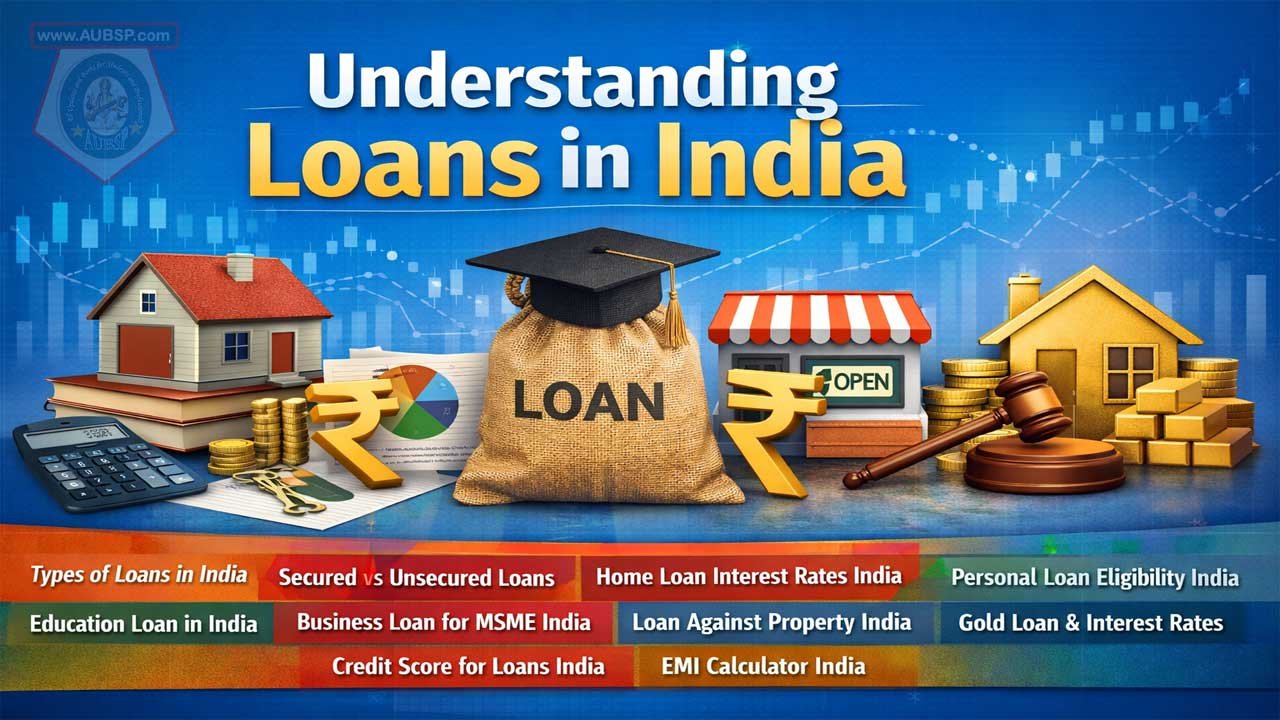
Are you planning to buy your dream home, fund a wedding, or expand your business? In India’s rapidly evolving financial market, there is a loan product for almost every need. However, choosing the right type of loan can save you lakhs in interest payments and protect your credit score.
Loans have become a core part of financial planning in India. Whether you want to buy a home, fund education, start a business, or handle emergencies, choosing the right type of loan can save you lakhs in interest and protect your credit score.
This detailed AUBSP guide explains all major types of loans in India, their features, eligibility, interest rates, and how to choose the best option for your needs.
Types of Loan in India: Complete Guide for Indian Borrowers (2026)
In India, loans are broadly classified based on their purpose and security. The main types include secured loans, such as home loans, car loans, and loan against property, where borrowers pledge an asset as collateral; and unsecured loans, like personal loans, education loans, and credit card loans, which are given without collateral but usually carry higher interest rates.
There are also short-term loans (like payday or consumer durable loans) and long-term loans (such as housing loans that can run for decades). Additionally, businesses can access working capital loans, term loans, and MSME financing through banks regulated by the Reserve Bank of India.
Each type differs in eligibility, interest rates, repayment period, and risk level depending on the borrower’s needs and financial profile.
What is a Loan?
A loan is money borrowed from a bank, NBFC, or lender that must be repaid with interest over a fixed period through EMIs (Equated Monthly Installments). In India, loans are regulated by the Reserve Bank of India, which sets lending guidelines and consumer protection norms.
At its core, a loan is a financial agreement where one party (the lender) provides money, property, or other assets to another party (the borrower) with the expectation that the value will be repaid, usually with interest, over a set period.
Think of a loan as a product you buy. The “product” is the money you receive now, and the “price” you pay for it is the interest and fees you pay over time.
Main Categories of Loans in India
All loans in India fall into two major categories:
1. Secured Loans
Secured Loans 101: Unlocking Lower Rates and Higher Limits with Collateral
Discover how secured loans work, the types of collateral accepted, and the pros and cons for borrowers. Learn how to leverage your assets for better loan terms, even with bad credit.
For many loan seekers, finding a lending option with manageable interest rates and flexible terms can feel like an uphill battle—especially if your credit score isn’t perfect. This is where secured loans come into play. By leveraging assets you already own, you can unlock borrowing power that might otherwise be out of reach.
Whether you are looking to buy a home, consolidate debt, or cover a major expense, understanding the mechanics of a secured loan is the first step toward making a financially sound decision. This guide covers everything from the types of collateral you can use to the specific risks involved.
What is a Secured Loan?
A secured loan is a type of borrowing where you pledge a valuable asset—known as collateral—to the lender to “secure” the debt. This collateral acts as a safety net for the lender. If you default on your payments, the lender has the legal right to seize the asset to recover their money.
Because the lender takes on less risk, they are often willing to offer lower interest rates and higher loan amounts compared to unsecured loans.
Common Types of Collateral
Lenders accept various forms of assets, depending on the loan type:
- Real Estate: Your home or land (used for mortgages and home equity loans).
- Vehicles: Cars, motorcycles, or boats (used for auto loans).
- Savings: Certificates of Deposit (CDs) or savings accounts.
- Investments: Stocks, bonds, or mutual funds.
- Valuables: High-end jewelry or gold (often used for pawn or specific gold loans).
Types of Secured Loans
Secured loans come in many forms, tailored to different financial needs.
1. Mortgages and Home Loans
The most common type of secured loan. The home you are buying serves as the collateral. If you stop paying, the bank can foreclose on the property.
2. Auto Loans
Similar to a mortgage, the vehicle you purchase secures the loan. Failure to pay results in repossession of the car.
3. Secured Personal Loans
These can be used for almost any purpose (debt consolidation, medical bills, vacations). You secure the loan with a personal asset, such as a car you already own or a savings account.
4. Home Equity Loans & HELOCs
If you have equity in your home (the difference between your home’s value and what you owe), you can borrow against it.
- Home Equity Loan: A lump sum with a fixed interest rate.
- HELOC (Home Equity Line of Credit): A revolving credit line similar to a credit card.
5. Secured Credit Cards
Designed for building credit. You put down a cash deposit (e.g., $500) which serves as your credit limit.
Pros and Cons of Secured Loans
Before signing on the dotted line, weigh the benefits against the potential risks.
✅ The Pros
- Easier Qualification: Lenders are more lenient with credit scores because the loan is backed by an asset. This makes secured loans a top choice for borrowers with bad credit.
- Lower Interest Rates: Since the lender’s risk is reduced, they pass the savings on to you in the form of lower Annual Percentage Rates (APRs).
- Larger Loan Amounts: You can typically borrow a significant percentage of your collateral’s value.
- Credit Building: Consistent, on-time payments can significantly boost your credit score over time.
❌ The Cons
- Risk of Asset Loss: The biggest drawback. If you can’t pay, you lose your home, car, or savings.
- Upfront Costs: Some secured loans, like mortgages, involve appraisal fees to determine the value of your collateral.
- Spending Restrictions: While secured personal loans are flexible, auto and home loans must be used for their specific purchase.
How to Apply for a Secured Loan
- Check Your Credit: Even though these loans are easier to get, your credit score still influences the interest rate.
- Assess Your Collateral: Determine the value of the asset you want to pledge. For a car or home, you may need a professional appraisal.
- Compare Lenders: Look at banks, credit unions, and online lenders. Compare APRs, origination fees, and loan-to-value (LTV) ratios.
- Gather Documentation: Be ready to provide proof of income (pay stubs), proof of identity, and proof of ownership for your collateral.
- Read the Fine Print: Understand the repossession terms. Know exactly how many missed payments trigger a default.
Is a Secured Loan Right for You?
A secured loan is often the best strategy if:
- You need to borrow a large amount of money.
- You have a low credit score and cannot qualify for unsecured options.
- You want the lowest possible interest rate to save money over time.
Warning: Never pledge an asset you cannot afford to lose. If your income is unstable, risking your primary residence or vehicle may not be worth the lower interest rate.
2. Unsecured Loans
Unsecured Loans: The Complete Guide to Borrowing Without Collateral
If you need funds for a wedding, medical emergency, or debt consolidation but don’t want to risk your home or car, an unsecured loan is often the best solution. Unlike secured loans that require valuable assets as security, unsecured loans rely entirely on your creditworthiness.
This AUBSP guide covers everything you need to know about unsecured loans—how they work, the different types available, eligibility requirements, and how to get approved even with imperfect credit.
What Is an Unsecured Loan?
An unsecured loan is a type of debt that does not require you to pledge collateral (like a house, vehicle, or savings account) to the lender. Because there is no asset for the lender to seize if you default, approval is based heavily on your credit score, income, and financial history.
Key Characteristics:
- No Collateral: Your assets are safe from immediate seizure (though lenders can still sue for repayment).
- Higher Risk for Lenders: This often translates to slightly higher interest rates compared to secured loans (like mortgages).
- Faster Approval: Without the need to appraise property, funding is often quicker—sometimes within 24 hours.
Common Types of Unsecured Loans
“Unsecured loan” is an umbrella term. Here are the most common specific forms you might encounter:
1. Personal Loans
The most versatile type of unsecured loan. You receive a lump sum of cash which is repaid in fixed monthly installments over a set term (usually 2 to 7 years).
- Best for: Debt consolidation, home improvements, weddings, or medical bills.
2. Student Loans
Federal and many private student loans are unsecured. Lenders lend money based on the student’s future ability to repay (often requiring a co-signer for private loans).
- Best for: Tuition, books, and living expenses during college.
3. Credit Cards
Credit cards are a form of revolving unsecured credit. You can borrow up to a limit, repay it, and borrow again.
- Best for: Everyday purchases and smaller, short-term expenses.
4. Unsecured Business Loans
For entrepreneurs who don’t have (or don’t want to risk) business assets. These often require a personal guarantee and a strong credit profile.
- Best for: Working capital, inventory, or expansion.
Pros and Cons of Unsecured Loans
✅ The Benefits
- Asset Protection: You don’t have to worry about losing your home or car if you face financial trouble.
- Speed: Digital lenders and banks can process these applications very quickly.
- Flexibility: unlike an auto loan (which must buy a car), a personal loan can be used for almost anything.
⚠️ The Risks
- Higher Costs: Interest rates can range from 6% to 36% depending on your credit.
- Strict Eligibility: If you have a poor credit history, you may be rejected or offered very high rates.
- Credit Impact: Missing payments can severely damage your credit score, making future borrowing difficult.
Eligibility Criteria: Do You Qualify?
Lenders use the “5 Cs of Credit” to evaluate your application, but they focus primarily on these three factors for unsecured loans:
- Credit Score:
- Excellent (750+): Access to the lowest rates.
- Good (700-749): Competitive rates.
- Fair/Poor (<650): May require “bad credit loans” with higher rates.
- Debt-to-Income (DTI) Ratio: Lenders want to see that your debts (including the new loan) don’t eat up too much of your monthly income. A DTI below 36-43% is ideal.
- Stable Income: You must provide proof of steady employment or income (pay stubs, tax returns, or bank statements).
How to Apply for an Unsecured Loan (Step-by-Step)
Follow this process to maximize your chances of approval and secure the best rate.
Step 1: Check Your Credit
Pull your credit report beforehand. Fix any errors and know your score so you have realistic expectations about interest rates.
Step 2: Shop Around & Pre-Qualify
Do not apply to the first lender you see.
- Use online marketplaces to compare rates from banks, credit unions, and online lenders.
- Look for a “Pre-qualification” option. This performs a soft credit check (which doesn’t hurt your score) to show you estimated rates.
Step 3: Compare APRs, Not Just Interest Rates
The Annual Percentage Rate (APR) includes the interest rate plus any fees (like origination fees). It is the true cost of the loan.
Step 4: Gather Documents
Have the following ready to speed up the process:
- Government-issued ID (Driver’s license, Passport).
- Proof of address (Utility bill).
- Proof of income (W-2s, pay stubs, or bank statements).
Step 5: Submit & Get Funded
Once you submit the formal application, a hard credit check will be performed. If approved, funds are typically deposited directly into your bank account within 1-3 business days.
Unsecured vs. Secured Loans: What’s the Difference?
The main difference lies in the collateral. Unsecured loans (like student loans or standard personal loans) rely entirely on your creditworthiness.
| Feature | Unsecured Loan | Secured Loan |
|---|---|---|
| Collateral | Not Required | Required (Home, Car, Gold, Savings etc.) |
| Interest Rates | Generally Higher | Generally Lower |
| Approval Speed | Fast (Days or Hours) | Slower (Weeks) |
| Approval Odds | Lower (Strict credit checks) | Higher (Even with bad credit) |
| Risk to Borrower | Damage to Credit Score & Legal Action | Loss of Asset + Credit Score Damage |
| Borrowing Limit | Lower (Based on Income) | Higher (Based on Asset Value) |
Major Types of Loans in India
Let’s explore the most popular loan types in detail.
1. Home Loan
A home loan is a type of loan provided by a bank or financial institution to help people buy, build, or renovate a house. Instead of paying the full property price at once, the borrower receives the required amount from the lender and repays it over a fixed period through monthly installments called EMIs (Equated Monthly Installments).
These installments usually include both the principal amount and interest charged by the lender. Home loans typically have long repayment tenures, often ranging from 10 to 30 years, and the property itself usually acts as collateral, meaning the lender can take legal possession if the borrower fails to repay. They make home ownership more affordable by spreading the cost over time.
2. Personal Loan
A personal loan is a type of unsecured loan offered by banks or financial institutions that individuals can use for various personal needs, such as medical expenses, travel, education, weddings, or emergencies.
Unlike a home or car loan, it does not require any collateral, meaning borrowers do not have to pledge assets. The loan is approved based on factors like income, credit score, and repayment capacity. It is usually repaid in fixed monthly installments (EMIs) over a short to medium period, typically ranging from 1 to 5 years, and often carries a higher interest rate compared to secured loans because of the higher risk to the lender.
3. Education Loan
An education loan is a type of financial assistance provided by banks or financial institutions to help students pay for their studies, including tuition fees, books, accommodation, and other related expenses. It is usually offered for higher education in India or abroad and can be taken by students with a parent or guardian as a co-applicant.
The repayment of the loan generally starts after the completion of the course, along with a grace period known as a moratorium. The loan is repaid in monthly installments over a fixed tenure, and interest is charged on the borrowed amount. Education loans make it easier for students to pursue their academic goals without facing immediate financial burden.
4. Vehicle Loan
A vehicle loan is a type of loan provided by banks or financial institutions to help individuals purchase a vehicle such as a car, bike, or commercial vehicle. Instead of paying the full cost upfront, the borrower receives the required amount from the lender and repays it in fixed monthly installments (EMIs) over a set period.
The vehicle itself usually serves as collateral, meaning the lender has the right to repossess it if the borrower fails to repay the loan. Vehicle loans typically have shorter repayment tenures compared to home loans, and the interest rate depends on factors like income, credit score, and the type of vehicle being purchased.
5. Gold Loan
A gold loan is a type of secured loan in which a borrower pledges their gold ornaments or coins as collateral to a bank or financial institution in exchange for money. The loan amount is usually based on the value and purity of the gold pledged. It is popular because it is easy to obtain, requires minimal documentation, and is processed quickly.
Borrowers repay the loan through regular installments or in a lump sum within a short tenure, along with interest charged by the lender. If the borrower fails to repay the loan, the lender has the right to sell the pledged gold to recover the amount.
6. Loan Against Property (LAP)
A loan against property (LAP) is a type of secured loan where a borrower pledges a residential, commercial, or industrial property as collateral to obtain funds from a bank or financial institution. The loan amount is usually a percentage of the property’s market value.
Borrowers can use this loan for various purposes such as business expansion, education, medical expenses, or personal needs. It is repaid through fixed monthly installments over a long tenure, and the interest rates are generally lower than unsecured loans because the property provides security to the lender. If the borrower fails to repay the loan, the lender has the legal right to take possession of the pledged property.
7. Business Loans
A business loan is a type of financial assistance provided by banks or financial institutions to help individuals or companies start, manage, or expand their business activities. It can be used for purposes such as purchasing equipment, managing working capital, hiring staff, or expanding operations. Business loans may be secured (requiring collateral like property or assets) or unsecured (based on creditworthiness and business performance).
The borrower repays the loan in fixed monthly installments over an agreed period, along with interest charged by the lender. These loans help businesses maintain cash flow and support growth without needing to use their own capital immediately.
8. Credit Card Loans
A credit card loan is a type of short-term loan offered by credit card issuers to their cardholders, allowing them to borrow money either by converting their available credit limit into a loan or by taking a cash advance. It does not require any collateral and is usually approved quickly because it is based on the customer’s credit card history and limit.
The borrowed amount is repaid in fixed monthly installments (EMIs) over a chosen tenure, along with interest and possible processing fees. Credit card loans are convenient for urgent financial needs, but they often carry higher interest rates compared to many other types of loans.
9. Government-Backed Loans
Government-backed loans are loans supported or guaranteed by the Government of India to help specific groups such as students, farmers, small business owners, and low-income individuals access affordable financing. These loans are usually offered through banks and financial institutions but come with benefits like lower interest rates, flexible repayment terms, subsidies, or partial government guarantees that reduce the lender’s risk.
Common purposes include education, agriculture, housing, and small business development. Government-backed loans aim to promote economic growth, financial inclusion, and social welfare by making credit more accessible to people who might otherwise struggle to obtain loans.
Interest Rates of Loans in India (2026)
| Loan Type | Interest Rate |
|---|---|
| Home Loan | 8% – 9.5% |
| Personal Loan | 10% – 24% |
| Gold Loan | 8% – 17% |
| Education Loan | 9% – 15% |
| Business Loan | 11% – 22% |
| LAP | 9% – 12% |
Rates depend on lender and credit profile.
Loan Eligibility Criteria in India
In India’s financial ecosystem, eligibility criteria act as the gatekeepers between you and your desired funds. Whether you are eyeing a new home, a car, or emergency cash, lenders use a specific set of parameters to gauge your “creditworthiness”—essentially, your ability and intention to repay borrowed money.
Here is details the eligibility standards across major loan categories in India, the role of your credit score, and the documentation you will need.
The “Big Three” General Factors
Regardless of the loan type, almost every bank or Non-Banking Financial Company (NBFC) in India looks at these three core pillars first:
A. CIBIL Score (Credit Score)
- The Golden Number: A score of 750 or above is considered excellent and often unlocks the lowest interest rates.
- The Minimum: Most lenders require a score of at least 650-700 to process an application.
- Impact: A low score might not result in immediate rejection, but it will likely lead to a higher interest rate or a lower sanctioned amount.
B. Age & Employment Stability
- Age: You must be at least 18 or 21 years old (depending on the lender) and no older than 60-65 years by the time the loan tenure ends.
- Stability:
- Salaried: Minimum 1–2 years of total work experience, with at least 6 months in the current organization.
- Self-Employed: Business continuity of at least 2–3 years with profitable returns.
C. Income (Net Monthly Income)
- Minimum Threshold: Varies by city.
- Metros (Mumbai, Delhi, Bangalore): Minimum ₹20,000 – ₹25,000/month.
- Non-Metros: Minimum ₹15,000/month.
- FOIR (Fixed Obligation to Income Ratio): Lenders prefer that your total EMIs (including the new one) do not exceed 40%–50% of your net monthly income.
Loan-Specific Eligibility Criteria
Different loans have unique requirements based on the collateral (security) and the purpose of the funds.
A. Personal Loan (Unsecured)
Since there is no collateral, criteria are stricter regarding income and credit history.
- Age: 21 to 60 years.
- Minimum Income: ₹15,000 to ₹25,000 per month.
- Credit Score: Highly critical (750+ preferred).
- Employer Status: Employees of “listed” companies or government bodies often get faster approvals and better rates than those in smaller, unlisted private firms.
B. Home Loan (Secured)
The property acts as security, making lenders slightly more flexible, but the tenure is long (up to 30 years).
- Age: 21 to 65 years (can go up to 70 for self-employed).
- LTV Ratio (Loan-to-Value): Lenders finance only 75%–90% of the property’s value. You must arrange the remaining 10%–25% as a down payment.
- Co-applicants: Adding a co-applicant (spouse/parent) with a separate income can significantly increase your eligible loan amount.
C. Car Loan (Secured)
- Age: 21 to 65 years.
- Income: Minimum ₹18,000/month (Salaried) or ₹2.5 Lakhs annual profit (Self-Employed).
- Car Age (Used Cars): For pre-owned car loans, the age of the car + loan tenure usually should not exceed 8–10 years.
- Income Proof Waiver: Some banks offer car loans without income proof to existing customers with a strong banking relationship (Pre-approved offers).
D. Education Loan
- Applicant: The student is the main applicant, but a parent/guardian is required as a co-borrower.
- Academic Record: Strong academic history (10th, 12th, and graduation marks).
- Admission Status: Confirmed admission letter from a recognized university/institution.
- Collateral:
- Up to ₹4 Lakhs: No collateral or third-party guarantee required.
- ₹4 Lakhs – ₹7.5 Lakhs: Third-party guarantor required.
- Above ₹7.5 Lakhs: Tangible collateral (Property, FD, etc.) is mandatory.
Document Checklist
Having these ready can speed up your application by days.
| Document Type | Salaried Individuals | Self-Employed Individuals |
|---|---|---|
| Identity Proof | PAN Card, Aadhaar, Passport, Voter ID | PAN Card, Aadhaar, Passport, Voter ID |
| Address Proof | Aadhaar, Utility Bill, Rent Agreement | Aadhaar, Utility Bill, Shop Act License |
| Income Proof | Salary slips (last 3 months), Form 16 | ITR (last 2 years), P&L Statement, Balance Sheet |
| Bank Proof | Bank Statements (last 3-6 months) | Current Account Statements (last 6 months) |
| Business Proof | Offer Letter / Employee ID Card | GST Registration, Business License |
| Photos | Passport-sized photographs | Passport-sized photographs |
Why Was My Loan Rejected? (Common Reasons)
Even if you meet the income criteria, rejection can happen due to:
- Too Many Inquiries: Applying to 4-5 banks simultaneously makes you look “credit hungry.”
- Job Hopping: Frequent job changes (e.g., 3 jobs in 1 year) signal instability.
- Low Credit Score: Defaulting on a previous credit card bill or loan EMI.
- Property Issues (Home Loan): If the property has legal disputes or unclear titles.
- Address Verification Failure: If the verification agent visits your home/office and cannot confirm your residency or employment.
How to Improve Your Eligibility
- Clear Existing Debts: Close small loans or credit cards to lower your FOIR (Fixed Obligation to Income Ratio).
- Add a Co-applicant: If your income is low, merge it with a working spouse or parent to boost eligibility.
- Declare Additional Income: Rental income or annual bonuses can be added to your total income to increase the sanctioned amount.
- Choose a Longer Tenure: This reduces your monthly EMI, making it easier to fit within your current income (though you pay more interest in the long run).
The Borrower’s Playbook: How to Choose the Right Loan
Taking out a loan is not just about getting cash; it is about buying time or assets with your future income. When chosen correctly, a loan is a powerful lever for growth—buying a home, funding education, or expanding a business. When chosen poorly, it becomes an anchor that drags down your financial freedom.
Here is the details the strategic approach to selecting the right loan, moving beyond the “monthly payment” mindset to understand the true cost of borrowing.
Phase 1: The Diagnosis (Before You Apply)
Before you ever look at a lender, you must look at your own financial dashboard. Jumping straight to applications triggers “hard inquiries” on your credit report, which can hurt your score.
Define the Purpose
Different loans are engineered for specific assets. Matching the loan type to the purpose is step one.
- Mortgages/Auto Loans: These are “Secured” loans. The asset (house/car) backs the loan, leading to lower interest rates.
- Personal Loans: “Unsecured” loans used for debt consolidation, weddings, or medical bills. Rates are higher because the lender takes more risk.
- Student Loans: specialized loans with unique repayment terms (deferment, income-driven repayment) that you generally cannot get with private personal loans.
Check Your Vitals
Lenders evaluate you based on the “Three C’s”: Credit, Capacity, and Collateral.
- Credit Score: Check your score 3–6 months in advance. A score above 760 usually unlocks the “prime” rates. A score below 600 may relegate you to subprime lenders.
- Debt-to-Income Ratio (DTI): This is the percentage of your gross monthly income that goes to paying debt.
- Formula:
- DTI = (Total Monthly Debt Payments ÷ Gross Monthly Income) × 100
- Ideal: < 36%
- Warning Zone: > 43% (Approvals become difficult)
- Formula:
Phase 2: Structural Decisions
Once you know what you need, you must decide how you want to structure the debt. This involves trade-offs between stability, risk, and cost.
Secured vs. Unsecured
- Secured Loans: You pledge an asset (collateral). If you default, the lender seizes the asset.
- Pros: Lower interest rates, higher borrowing limits, easier approval.
- Cons: Risk of losing your home or car.
- Unsecured Loans: No collateral required.
- Pros: Your assets are safe from immediate seizure.
- Cons: Higher rates, stricter credit requirements.
Fixed vs. Variable Rates
- Fixed Rate: The interest rate never changes. Your monthly payment is identical for the life of the loan.
- Best for: Budgeters who need predictability and long-term loans (e.g., 30-year mortgages) in a rising-rate environment.
- Variable (Floating) Rate: The rate fluctuates with a market index (like the Prime Rate or SOFR).
- Best for: Borrowers who plan to pay off the loan quickly (before rates rise) or when starting rates are significantly lower than fixed options.
Phase 3: The Metrics That Matter
This is where most borrowers get tricked. Never choose a loan based solely on the “Monthly Payment.” Lenders can manipulate the loan term to make a payment look low while charging you massive amounts of interest.
APR vs. Interest Rate
This is the single most important distinction in lending.
- Interest Rate: The cost of borrowing the principal amount.
- APR (Annual Percentage Rate): The Interest Rate + All Fees (origination fees, closing costs, broker fees).
The Golden Rule: Always compare the APR, not the interest rate. The APR represents the true cost of the loan. If Lender A offers a 5% rate with high fees, their APR might be 7%. If Lender B offers a 6% rate with zero fees, their APR is 6%. Lender B is cheaper, even though their “rate” looks higher.
The Term Length Trap
Extending the loan term lowers your monthly payment but drastically increases the total interest paid.
Example: ₹20,000 Auto Loan at 6%
| Term | Monthly Payment | Total Interest Paid |
|---|---|---|
| 36 Months (3 Years) | ₹608 | ₹1,898 |
| 72 Months (6 Years) | ₹331 | ₹3,864 |
- Insight: By choosing the lower monthly payment (72 months), you pay double the interest. Always choose the shortest term you can comfortably afford.
Phase 4: Scouting the Lenders
Don’t just walk into your primary bank. Loyalty rarely pays in lending; competition does.
- Banks: Good for existing customers who want relationship discounts. Process can be slow and rigid.
- Credit Unions: Non-profits. often offer lower rates and fewer fees than big banks, but technology might be outdated.
- Online Lenders / Fintech: Fast, algorithm-based approvals. Excellent for personal loans and tech-savvy borrowers.
- Peer-to-Peer (P2P): Platforms connecting individual investors to borrowers. Can be good for those with “thin” credit files.
Phase 5: Red Flags & “Gotchas”
Read the fine print for these wealth-eroding clauses:
- Prepayment Penalties: A fee charged for paying off your loan early. Avoid this at all costs. You should always have the freedom to get out of debt faster.
- Origination Fees: An upfront fee (1%–8% of the loan amount) deducted from the cash you receive. Ensure you calculate this into your total need.
- “Guaranteed Approval”: A major red flag. legitimate lenders always check credit risk. If they don’t, it is likely a predatory “payday” or “title” loan with APRs exceeding 300%.
- Credit Insurance: Optional add-ons often slipped into paperwork that pay the loan if you die or lose your job. These are usually overpriced and unnecessary.
Summary Checklist
- [ ] Purpose: Is this loan for an asset (investment) or consumption (expense)?
- [ ] Affordability: Is the monthly payment < 10% of my monthly income?
- [ ] Cost: Have I compared the APR (not just the rate) of at least 3 lenders?
- [ ] Flexibility: Can I pay this off early without a penalty?
- [ ] Total Cost: Have I calculated the total interest paid over the full life of the loan?
The Strategic Advantage: Why Taking a Loan Can Be a Smart Financial Move
In popular culture and casual conversation, “debt” is often a four-letter word. We are frequently taught that financial freedom means being entirely debt-free. While avoiding high-interest consumer debt is sound advice, painting all loans with the same brush overlooks a fundamental truth of modern finance: Loans are tools of leverage.
When used strategically, loans are not just about “owing money”—they are about accelerating growth, preserving liquidity, and building a foundation for future wealth. Whether for personal milestones or business expansion, borrowing capital can open doors that saving alone cannot unlock.
Below is a detailed look at the benefits of taking loans and how they function as instruments of financial progression.
1. The Power of Leverage: Acquiring Assets Sooner
The most significant benefit of a loan is the ability to use Leverage. This is the concept of using borrowed capital to increase the potential return of an investment.
- Beating the Savings Clock: Saving enough cash to buy a home or start a business can take decades. By the time you save the full amount, inflation may have driven the price up significantly. A loan allows you to lock in the asset price today and pay for it over time with money that, due to inflation, effectively becomes “cheaper” in the future.
- Asset Appreciation: When you take a mortgage to buy a home, you control an appreciating asset with a relatively small down payment. If the home’s value rises, it rises on the total value of the property, not just the cash you put down. This creates a return on investment (ROI) that is difficult to match through saving alone.
2. Building Creditworthiness
It seems like a paradox, but to prove you don’t need money, you often have to prove you can borrow it. Taking a loan and repaying it consistently is the single most effective way to build a high credit score.
- Trust Building: Lenders want to see a history of reliability. A mix of credit types (revolving credit like credit cards vs. installment loans like auto or personal loans) improves your credit profile.
- Future Access: A strong credit history built on a modest loan today ensures you get the lowest interest rates on massive loans (like a mortgage) tomorrow. This can save you tens of thousands of dollars over a lifetime.
3. Preserving Liquidity (Cash Flow Management)
One of the hidden dangers of paying “all cash” for large purchases is that it drains your liquid reserves.
- The “Rainy Day” Buffer: If you spend all your savings to buy a car or renovate a house, you are left vulnerable to emergencies (medical bills, job loss). Taking a low-interest loan allows you to keep your cash in the bank as a safety net.
- Opportunity Cost: If your cash is invested in the stock market earning an average of 7-8%, and you can get a car loan at 4%, it makes mathematical sense to take the loan. By leaving your cash invested, you earn the “spread” (the difference) between the investment return and the loan interest.
4. Investing in Human Capital (Education)
Student loans are often viewed negatively due to rising costs, but they remain a primary vehicle for increasing lifetime earning potential.
- ROI on Education: Statistics consistently show that individuals with higher education degrees earn significantly more over their lifetimes than those without. A student loan is an investment in your own “human capital”—purchasing the skills and credentials that will generate higher income for decades.
5. Business Expansion and Operations
For entrepreneurs, loans are often the fuel for the engine. Bootstrapping (funding yourself) is noble, but it is often slow.
- Speed to Market: A business loan allows a company to buy inventory, hire staff, or launch marketing campaigns now, capturing market share before competitors do.
- Equipment Financing: Loans allow businesses to purchase essential machinery or technology immediately. The revenue generated by this new equipment often exceeds the monthly loan payment, meaning the debt essentially pays for itself.
6. Tax Advantages
Not all debt costs the same. The government often incentivizes certain types of borrowing by making the interest tax-deductible, which lowers the effective interest rate you pay.
| Loan Type | Tax Benefit |
|---|---|
| Mortgages | In many jurisdictions, interest paid on home loans is tax-deductible up to a limit. |
| Student Loans | Interest paid on qualified student loans is often deductible, reducing taxable income. |
| Business Loans | Interest on business loans is generally treated as a business expense, lowering the company’s tax burden. |
7. Debt Consolidation and Simplicity
If you are juggling multiple high-interest debts (like credit cards), taking out a single personal loan to pay them off can be highly beneficial.
- Lower Interest: Personal loans typically have much lower interest rates than credit cards.
- Fixed End Date: Unlike credit cards, which can drag on forever with minimum payments, a consolidation loan has a fixed term (e.g., 3 years). You know exactly when you will be debt-free.
- Psychological Ease: Managing one monthly payment is far less stressful than managing five or six.
The Crucial Distinction: Good Debt vs. Bad Debt
To maximize the benefits of loans, one must distinguish between two types of debt:
- Good Debt: Money borrowed to purchase assets that appreciate in value or generate income (Homes, Education, Business). This debt usually has lower interest rates and tax benefits.
- Bad Debt: Money borrowed to purchase rapidly depreciating assets or consumables (Luxury vacations, clothes, excessive gadgets). This debt usually carries high interest and no financial return.
Taking a loan is not an admission of financial defeat; rather, it is often a sign of financial strategy. When used responsibly to acquire assets, build credit, or preserve cash reserves, loans act as a lever that lifts your financial potential higher than it could reach on its own. The key lies not in avoiding debt, but in managing it wisely—ensuring that the cost of borrowing is always outweighed by the value gained.
The Double-Edged Sword: A Comprehensive Guide to the Risks of Loans
Loans are often marketed as financial lifelines—tools to buy a home, start a business, or bridge a cash-flow gap. While debt can be a powerful lever for growth (“good debt”), it introduces significant vulnerabilities to your financial foundation. Understanding the multifaceted risks of borrowing—from the mathematical to the psychological—is critical before signing any promissory note.
1. Financial Risks
The most immediate risks of a loan are financial. These factors directly affect your bank account and long-term wealth accumulation.
The Compound Interest Trap
Interest is the cost of renting money. Over time, even a seemingly small interest rate can inflate the total amount repaid significantly.
- Amortization mechanics: In the early years of a long-term loan (like a mortgage), the majority of your payment goes toward interest, not the principal balance. You build equity very slowly at first.
- Variable Rate Risk: If you take out a variable-rate loan (Adjustable-Rate Mortgage or floating-rate business loan), your interest rate is tied to a market index (like the Prime Rate). If the economy shifts and rates rise, your monthly payment can skyrocket, potentially becoming unaffordable.
Fees and Hidden Costs
The “headline” interest rate (APR) is rarely the only cost.
- Origination Fees: Upfront charges (often 1%–8% of the loan amount) just for processing the loan.
- Prepayment Penalties: Some lenders charge a fee if you pay off the loan early, effectively punishing you for trying to save on interest.
- Late Fees: Missing a payment deadline often incurs steep penalties, adding to the debt pile.
Credit Score Damage
Your credit score is your financial reputation. Loans impact it in two ways:
- The Hard Inquiry: Simply applying for a loan triggers a “hard pull” on your credit report, which typically drops your score by a few points temporarily.
- Payment History: A single payment missed by 30 days or more can devastate your score (dropping it by 50–100 points), making future borrowing for cars, homes, or businesses much more expensive or impossible.
2. Asset and Legal Risks
When you cannot repay a loan, the consequences escalate from financial penalties to the loss of physical property and legal autonomy.
Collateral Loss (Secured Loans)
In a secured loan (mortgages, auto loans, pawn shops), the lender owns a claim on a specific asset.
- Repossession: If you default on a car loan, the lender can tow your car—often without warning—leaving you without transportation to get to work.
- Foreclosure: Defaulting on a mortgage results in the loss of your home and all the equity you have built up in it.
Personal Guarantees & The “Corporate Veil”
For business owners, a major risk is the Personal Guarantee. Even if you have an LLC or Corporation, lenders often require you to personally guarantee the loan.
- Risk: If your business fails, the lender can bypass the business’s bankruptcy protection and come after your personal assets, including your house, personal savings, and retirement accounts.
Legal Judgments and Garnishment
For unsecured loans (credit cards, personal loans, medical debt), the lender cannot automatically take your property, but they can sue you.
- Wage Garnishment: If a lender wins a court judgment against you, they can obtain a court order to take a portion of your paycheck directly from your employer before you even see it.
- Bank Levies: Creditors with a judgment can sometimes freeze and seize funds directly from your bank account.
3. The Psychological & Lifestyle Risks
Debt is not just a math problem; it is a behavioral and emotional burden.
The “Debt Cycle” (The Trap)
This is common with high-interest, short-term lending like Payday Loans or credit cards.
- The Mechanism: You borrow to cover expenses, but the interest consumes so much of your next paycheck that you must borrow again just to survive the month.
- The Result: You end up paying 300%+ APR effectively, trapping you in a cycle of poverty where you work solely to service debt.
Reduced Financial Agility (Opportunity Cost)
Debt commits your future income to pay for past decisions. This reduces your flexibility.
- If a great job opportunity comes up in another city, a massive mortgage might prevent you from moving.
- If you want to start a business or retire early, high monthly debt service ratios (payments relative to income) will make those goals mathematically impossible.
Mental Health and Relationship Strain
Studies consistently link high debt loads to:
- Chronic Stress & Anxiety: The constant worry about making payments can lead to sleep deprivation and health issues.
- Relationship Conflict: Money arguments are a leading predictor of divorce. High debt loads can create resentment or secrecy between partners.
4. Specific Risk Profiles by Loan Type
| Loan Type | Primary Risk Factor | “Watch Out” Scenario |
|---|---|---|
| Credit Cards | Compounding Interest | Making only “minimum payments” can turn a $1,000 purchase into a $3,000 debt over years. |
| Student Loans | Non-Dischargeability | In many countries (like the US), student loans are rarely forgivable in bankruptcy. You carry them for life until paid. |
| Payday Loans | Predatory Rates | APRs can exceed 400%. These are widely considered the most dangerous form of consumer debt. |
| Home Equity (HELOC) | Loss of Shelter | You are putting your home on the line to buy something else (e.g., renovations). If you can’t pay, you lose the house. |
| Variable Rate Mortgage | Market Volatility | If interest rates jump from 4% to 8%, your monthly payment could double, leading to payment shock. |
Conclusion: How to Mitigate the Risks
Debt is a tool, like a power saw. Used correctly with safety guards, it builds; used carelessly, it injures. To minimize risk:
- Read the “Truth in Lending” Disclosure: Always look at the Total Cost of Borrowing (Principal + Interest + Fees), not just the monthly payment.
- Avoid Variable Rates: Unless you plan to pay the loan off very quickly, opt for fixed rates to lock in predictability.
- Keep a Liquidity Buffer: Never borrow to the point where you have ₹0 in savings. You need an emergency fund to pay the loan if you lose your income temporarily.
- The 30% Rule: Try to keep your total debt payments (including housing) under 30–36% of your gross income. Lenders may let you go up to 43% or 50%, but that puts you in the “danger zone” for financial stress.
Final Thoughts
Loans can be powerful tools for achieving major life and business goals in India, but they must be chosen and used wisely. Understand the difference between secured and unsecured options, compare true costs (APR, fees, tenure), ensure EMIs fit your budget, and borrow only for clear, value-adding purposes.
With informed choices and disciplined repayment—under the regulatory framework of the Reserve Bank of India—you can leverage credit to build assets, protect cash flow, and strengthen your financial future without falling into avoidable debt traps.
Understanding the types of loans in India helps you make smarter borrowing decisions. From home loans for long-term stability to personal loans for emergencies, each option serves a different purpose.
Before applying, always compare lenders, calculate EMIs, and borrow responsibly.
FAQs on types of Loans in India
What is a loan?
A loan is money borrowed from a bank or lender that you repay over time with interest through EMIs.
What are the main types of loans in India?
Loans are mainly secured (home, car, gold, LAP) and unsecured (personal, education, credit card).
What is the difference between secured and unsecured loans?
Secured loans need collateral and usually have lower interest rates; unsecured loans don’t need collateral but cost more.
Which loan has the lowest interest rate in India?
Home loans and loans against property generally have the lowest rates because they are secured.
Which loan is easiest to get?
Personal loans and gold loans are typically easier and faster to get if you meet basic income and credit criteria.
What is EMI?
EMI is the fixed monthly payment that includes both principal and interest.
What credit score is needed for a loan?
A score of 750+ gets the best rates; many lenders consider 650–700 as the minimum.
Can I get a loan with a low credit score?
Yes, but rates will be higher or you may need collateral or a co-applicant.
What is APR and why is it important?
APR shows the true cost of a loan including interest and fees; always compare APRs, not just rates.
How much loan can I get on my income?
Lenders usually limit total EMIs to about 40–50% of your monthly income.
What documents are required for loans?
ID, address proof, income proof, and bank statements are commonly required.
Can self-employed individuals get loans?
Yes, with business proof and income documents like ITRs and financial statements.
What is a moratorium in education loans?
It’s a grace period after studies during which repayment doesn’t start.
Is prepayment of loans allowed?
Yes, but check for prepayment or foreclosure charges before signing.
Are fixed or floating rates better?
Fixed rates give predictability; floating rates may start lower but can rise later.
What is loan against property (LAP)?
It’s a secured loan using residential or commercial property as collateral for various needs.
Is a gold loan safe?
Yes if repaid on time, but default can lead to loss of pledged gold.
Can I use a personal loan for any purpose?
Generally yes, personal loans are flexible with no end-use restrictions.
How long does loan approval take?
Digital personal loans can be approved in hours; home loans may take weeks.
Does applying to many lenders hurt my credit?
Yes, multiple hard inquiries can temporarily reduce your credit score.
Can adding a co-applicant help?
Yes, it can improve eligibility and sometimes reduce interest rates.
What happens if I miss EMIs?
You may face penalties, credit score damage, and possible legal action.
Are government-backed loans available in India?
Yes, for students, farmers, MSMEs, and housing through schemes supported by the Government of India.
Is debt always bad?
No, loans for assets like homes, education, or business can be “good debt” if managed well.
Should I take a longer tenure to reduce EMI?
Lower EMI helps cash flow but increases total interest paid over time.
Can loans help build credit history?
Yes, timely repayments improve your credit profile.
What is FOIR/DTI?
It’s the ratio of your total monthly debt obligations to your income used to judge affordability.
Can I switch lenders to reduce interest?
Yes, balance transfer or refinancing can lower rates if your credit has improved.
Are processing fees refundable?
Usually no; processing and documentation fees are non-refundable.
How do I choose the right loan?
Match the loan type to your goal, compare APRs, check flexibility, and ensure EMIs fit your budget.


