
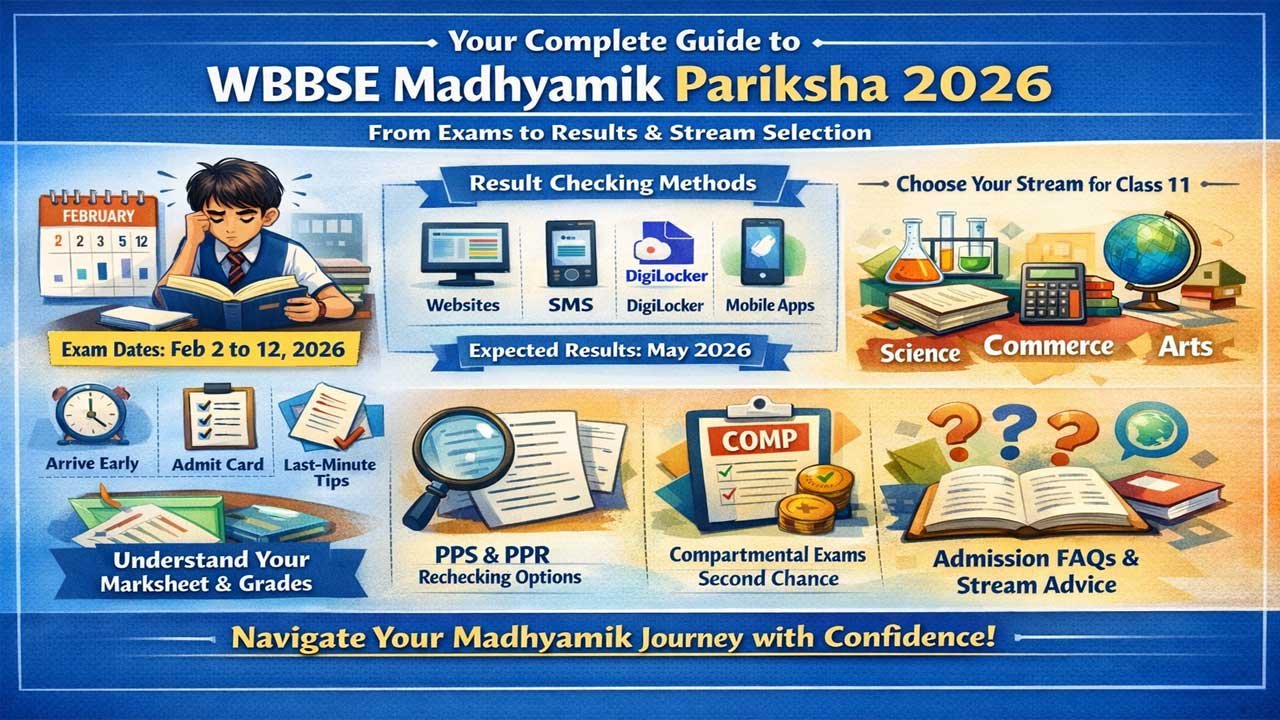
The West Bengal Board of Secondary Education (WBBSE) Madhyamik Pariksha stands as one of West Bengal’s most significant educational milestones for Class 10 students. As the February 2026 exams approach, students across the state experience a blend of anticipation and anxiety.
This comprehensive guide walks you through every critical phase of your Madhyamik journey—from exam schedules and result declarations to understanding your marksheet and selecting your future stream. By the time you finish reading, you’ll have a clear roadmap for navigating this important transition.
The Final Countdown: WBBSE Madhyamik 2026 Exam Schedule
The West Bengal Board has officially announced that Madhyamik exams will run from February 2 to February 12, 2026. Understanding the exact schedule is crucial for effective preparation and logistics planning.
Subject-Wise Exam Dates and Timings
| Date | Day | Subject | Time |
|---|---|---|---|
| Feb 2, 2026 | Monday | First Language (Bengali, English, Hindi, etc.) | 10:45 AM – 2:00 PM |
| Feb 3, 2026 | Tuesday | Second Language (English, Bengali, etc.) | 10:45 AM – 2:00 PM |
| Feb 6, 2026 | Friday | History | 10:45 AM – 2:00 PM |
| Feb 7, 2026 | Saturday | Geography | 10:45 AM – 2:00 PM |
| Feb 9, 2026 | Monday | Mathematics | 10:45 AM – 2:00 PM |
| Feb 10, 2026 | Tuesday | Physical Science | 10:45 AM – 2:00 PM |
| Feb 11, 2026 | Wednesday | Life Science | 10:45 AM – 2:00 PM |
| Feb 12, 2026 | Thursday | Optional Elective Subjects | 10:45 AM – 2:00 PM |
Important Note on Exam Duration: Each paper runs for 3 hours and 15 minutes total. The first 15 minutes are allocated exclusively for reading the question paper—you cannot write during this time. The actual writing period is 3 hours.
Pro Tip for Success: Arrive at your exam center at least 60 minutes early on the first day to locate your seating arrangement without last-minute stress. On subsequent days, arriving 45 minutes early is sufficient. Bring your admit card (admission card) without fail—entry to the exam hall is strictly prohibited without it.
Madhyamik Result 2026: Declaration Date and Historical Trends
The WBBSE typically declares Madhyamik results approximately 75 to 90 days after the conclusion of exams. Based on historical patterns and official indications, here’s what you need to know:
Expected Result Declaration Timeline
| Aspect | Details |
|---|---|
| Expected Declaration Date | First or Second week of May 2026 |
| Historical Pattern (2025) | May 2, 2025 (declared at 9:00 AM via press conference) |
| Historical Pattern (2024) | May 2, 2024 |
| Typical Announcement Time | 9:00 AM press conference; links activate at 10:00 AM |
| Result Availability | Online portals, SMS service, DigiLocker, mobile apps |
Understanding this timeline helps you plan ahead. Schools typically receive marks sheets and certificates at their designated distribution centers, after which students can collect their documents.
Four Proven Methods to Check Your Madhyamik Results
When lakhs of students access the result portals simultaneously, website crashes are common. That’s why having multiple backup methods is essential. Here are the most reliable ways to access your scores:
Method 1: Official Websites (Fastest & Most Direct)
Bookmark these links immediately:
- www.wbresults.nic.in (Primary portal)
- www.wbbse.wb.gov.in (WBBSE official site)
- www.exametc.com (Alternative official link)
Step-by-Step Process:
- Open any of the three links above
- Locate and click the active link “WBBSE Class 10th Results 2026”
- Enter your Roll Number in the first box and Registration Number in the second box (note: these are two separate fields)
- Input your Date of Birth in DD/MM/YYYY format (example: 15/08/2011)
- Click “Submit”
- Your result will display on screen—immediately save or screenshot it
- Download and save the PDF for future reference (admission, scholarship applications, etc.)
Why This Works: Official portals are managed directly by WBBSE, so your data is verified and authentic. Even if the site loads slowly during peak hours, results from official portals are legally recognized.
Method 2: SMS Service (Offline, No Internet Required)
This method is invaluable if you lack a smartphone or reliable data connection.
Format: WB10 [space] ROLL NUMBER
Send To: 56070 or 56263
Example: If your roll number is 123456, send “WB10 123456” to either number
Timeline: You’ll receive your subject-wise marks via SMS within minutes of sending the request
Advantage: Works with basic SMS-enabled phones from any network and location
Method 3: DigiLocker (Legal & Permanent Digital Document)
DigiLocker provides an officially verified digital copy recognized across all Indian educational and government institutions.
How to Access:
- Download the official DigiLocker app from Google Play Store or visit www.digilocker.gov.in
- Sign up using your mobile number and Aadhaar card
- Navigate to “Education” section → “West Bengal Board of Secondary Education”
- Select “Class X Marksheet”
- Enter your credentials to fetch and download your certificate
Critical Advantage: DigiLocker documents hold the same legal status as original physical marksheets under the Information Technology Act 2000, Section 9A. You can submit the DigiLocker copy for college admissions, scholarship applications, and government job applications without needing the original hard copy.
Method 4: Mobile Apps for Faster Loading
Popular apps like “Madhyamik Results,” “FastResult,” and “Exametc” on Google Play Store often load faster than browsers during peak traffic periods because they cache data locally.
Why It Works: These apps pre-load and store data, reducing the load on live servers. Download one before result day so you’re ready immediately.
Decoding Your Madhyamik Marksheet: Grades, Divisions & What They Mean
Your marksheet is far more than a scorecard—it’s a detailed record used for college admissions, stream selection, and scholarship eligibility. Understanding every abbreviation and grade is essential.
WBBSE Grading System: The Seven-Point Scale
| Grade | Marks Range | Percentage | Remarks | Meaning |
|---|---|---|---|---|
| AA | 90-100 | 90-100% | Outstanding | Exceptional performance |
| A+ | 80-89 | 80-89% | Excellent | Very strong grasp of subject |
| A | 60-79 | 60-79% | Very Good | Solid understanding |
| B+ | 45-59 | 45-59% | Good | Satisfactory understanding |
| B | 35-44 | 35-44% | Satisfactory | Meets requirements |
| C | 25-34 | 25-34% | Marginal | Minimum passing grade |
| D | <25 | <25% | Disqualified | Failed—eligible for compartment exam |
Key Point: You must achieve at least a Grade C (25-34%) in all subjects to pass. Scoring below 25% in any subject results in failure for that subject, though you may still qualify overall if your aggregate score is sufficient.
Division Classification & What It Means for Your Future
The WBBSE uses a division system based on aggregate marks (total across all 7 subjects):
| Division | Marks Out of 800 | Percentage | Significance |
|---|---|---|---|
| First Division | 480 or above | 60% or above | Opens doors for premium colleges; essential for Science stream admission |
| Second Division | 360-479 | 45-59% | Good standing; suitable for most colleges and streams |
| Third Division | 272-359 | 34-44% | Passing division; limited college options |
| Fail | Below 272 | Below 34% | Ineligible for regular admission; must appear for compartmental exams |
Common Marksheet Abbreviations Explained
| Abbreviation | Full Form | What It Means |
|---|---|---|
| P | Passed | You’ve successfully passed this subject |
| COMP | Compartment | You failed this subject but are eligible to retake it in supplementary exams (typically July/August) |
| X | Unsuccessful/Failed | You failed; check if you’re eligible for compartment exams |
| AB | Absent | You were absent during the exam; marked as fail |
Understanding Your Aggregate vs. Subject Scores
Your marksheet shows both individual subject scores and an aggregate (total). A single failing subject doesn’t mean you’ve failed overall—what matters is your aggregate. For example, if you score 250 out of 800 (below 272), you fail despite potentially having passing grades in some subjects.
Post-Result Options: PPS vs. PPR (Know Your Rights)
If your marks disappoint you, WBBSE provides two official channels to challenge the evaluation. The difference between them is critical:
PPS: Post Publication Scrutiny (For Passed Students Only)
What It Is: A re-totalling of your marks to check for computational errors or unmarked answers
Eligibility: Only students who passed all subjects can apply
Process:
- Your answer scripts are checked for:
- Any answers left unmarked by examiners
- Incorrect total calculations
- Transcription errors
- The board does NOT re-evaluate or change the grading
Application Fee: ₹40 per paper
Success Rate: Moderate—changes are typically small corrections (1-5 marks)
Timeline: Application within 15 days of result declaration; PPR results published in June-July
PPR: Post Publication Review (For Failed Students)
What It Is: A complete re-evaluation of your answer script by a fresh examiner
Eligibility: Students who failed one or more subjects (regardless of overall aggregate)
Process:
- A new examiner re-reads your entire answer script
- Questions are re-evaluated independently
- Marks can increase or decrease significantly
- More thorough but also more unpredictable
Application Fee: ₹50 per paper
Success Rate: Higher chance of significant mark fluctuation (up to 20+ marks difference)
Timeline: Application within 15 days of result declaration; results in June-July
How to Apply for PPS or PPR
- Contact your school principal immediately after receiving results
- Your school submits the application on your behalf to WBBSE
- Pay the applicable fee (₹40 for PPS or ₹50 for PPR)
- You’ll receive acknowledgment; track the application status on the official portal
- Results published in June-July 2026
Strategic Advice: If you’ve failed by just 1-2 marks, PPS (scrutiny) might suffice. If you’re significantly below passing (10+ marks), go for PPR (review), as the full re-evaluation offers better chances of improvement.
Compartmental Exams: A Second Chance When You Need It
Failing an exam doesn’t define your academic journey. WBBSE conducts supplementary or “compartmental” exams specifically for students who didn’t pass initially.
Who Is Eligible?
- Students who failed in one or two subjects (maximum two subjects)
- Students who failed overall but wish to retake failed subjects
- Any student marked as “COMP” on their marksheet
Key Compartmental Exam Details
| Detail | Information |
|---|---|
| Expected Schedule | June or July 2026 (tentative) |
| Result Declaration | August 2026 (typically) |
| Subjects | Only the failed subjects—you don’t retake passed subjects |
| Exam Pattern | Same syllabus and exam format as the original exam |
| Advantage | You can join Class 11 in the same academic year without repeating a year |
| Application | Done through your school after result declaration |
Registration & Admit Card
- Your school will notify you about compartmental exam registration
- You’ll need to fill out an online form specifying which subject(s) you’re retaking
- Admit cards are issued approximately 1-2 weeks before exams
- Carry your admit card to the exam center
Important: Compartmental exams allow you to catch up within the same academic year. Many successful professionals took compartmental exams and went on to excel in higher studies—this is not a permanent mark against your record.
Admission to Class 11: Stream Selection After Madhyamik Results
Your Madhyamik result directly determines which stream you’re eligible for in Class 11. Understanding cut-offs and selection criteria is crucial for planning your future.
Science Stream (Physics, Chemistry, Mathematics, Biology/Statistics/Computer Science)
Typical Requirements:
- Aggregate: 75%-80%+ (varies by school)
- Mathematics: Minimum 80-85% in this subject specifically
- Physical Science (Physics + Chemistry combined): Minimum 80-85%
- Life Science (Biology): Minimum 80-85%
What This Means: Science stream is competitive. You’re expected to demonstrate strong fundamentals in all three core subjects, not just overall performance.
Career Paths: Engineering, Medicine, Architecture, Biotechnology, Computer Science, Research
Commerce Stream (Accountancy, Business Studies, Economics, Computer Applications)
Typical Requirements:
- Aggregate: 60%-70%+ (varies by school)
- Mathematics: Minimum 50-60%
- English/Hindi proficiency is important
What This Means: Commerce is accessible to students with good overall performance. Strong numerical ability in mathematics is preferred but not always mandatory for all subject combinations.
Career Paths: Chartered Accountancy (CA), Company Secretary (CS), Cost Accountancy, Finance, Banking, Entrepreneurship
Arts/Humanities (History, Political Science, Geography, Education, etc.)
Typical Requirements:
- Aggregate: 45%-60%+ (varies by school; most flexible)
- Language proficiency (English, Hindi, Bengali) is valued
What This Means: Arts has the most flexible cut-offs. Passion for social sciences, literature, and humanities matters more than percentages. However, competitive colleges still have their own criteria.
Career Paths: Civil Services (UPSC), Journalism, Teaching, Law, Sociology, Public Administration, Content Creation
Important Notes on Stream Selection
- School-Specific Cut-offs: Every school sets its own criteria. Your dream school’s cut-off may differ from the general West Bengal standard. Check with your school immediately after results.
- Subject-Level Performance Matters: WBBSE often publishes eligibility criteria tied to individual subject scores, not just aggregate. For example, taking Biology in Class 11 might require 35-40% in Life Science specifically.
- Optional Subject Consideration: If you took an optional elective (like Computer Applications), this sometimes counts in merit calculations for certain streams.
- Merit Lists: Most schools prepare merit lists within 2-3 weeks of result declaration. Admission happens on a first-come, first-served basis after merit qualifications are met.
Frequently Asked Questions (FAQ): Everything You Need to Know
General Questions
Q: Can I check my result using my name instead of roll number?
A: The official WBBSE website requires your roll number. However, some third-party education portals like IndiaResults.com allow name-wise searches, though these are less reliable than official portals.
Q: Is the online marksheet printout valid for college admission?
A: Yes, most schools and colleges accept online printouts provisionally for Class 11 admission until the original hard copy is issued by WBBSE. DigiLocker copies are particularly reliable because they’re government-verified.
Q: What exactly is the passing mark for Madhyamik 2026?
A: You need a minimum of 34 marks out of 100 per subject (approximately 30 marks in written exam + 3-4 marks in internal assessment). Overall, you need 272 marks out of 800 (34% aggregate) to pass.
Q: If I fail one subject but pass overall, what happens?
A: If your aggregate is 272+, you’ve technically “passed” but with a compartmental status in the failed subject. You can retake that subject in the July supplementary exam and improve your grade without repeating Class 10.
Q: Are DigiLocker marksheets legally valid for job applications?
A: Absolutely. DigiLocker documents are legally recognized as equivalent to original physical documents under the IT Act 2000. Government bodies and private employers accept them.
Q: How is internal assessment calculated?
A: Internal assessment (10 marks per subject) is typically based on:
- Continuous evaluation during the year
- 50% of your Class 9 annual exam score in that subject
- 50% of Class 10 formative evaluation marks
Each school calculates this slightly differently—ask your school for specifics.
Result-Related Questions
Q: What time exactly will results be announced on May 2, 2026?
A: Results are typically announced via press conference at 9:00 AM. Online links activate at 10:00 AM. However, official announcements are rare before 9:45 AM.
Q: Will my school receive results before they’re publicly announced?
A: Schools typically receive marked data before public announcement, but they cannot declare results publicly before the board’s official announcement time.
Q: Can I apply for PPR if I fail just one subject but pass overall?
A: Technically, no—PPR is only for students who fail overall (below 272/800) OR who fail in one or more individual subjects. But if you pass overall with a compartment, you’d typically apply for a re-evaluation (scrutiny) through your school rather than formal PPR.
Stream Selection Questions
Q: Can I take Science if my marks are exactly at the minimum cut-off?
A: Yes, but space is limited. Your admission depends on merit list rankings. Schools use a merit calculation formula (often: Aggregate + Subject Scores) to rank students. If 50 Science seats are available and 200 students qualify, only the top 50 will be admitted.
Q: Can I switch streams after joining Class 11?
A: Most schools allow stream switching within the first 2-4 weeks of Class 11. After that, it’s rarely permitted. Choose wisely during admission.
Q: What if I want to take a subject outside my “eligible” stream?
A: Some schools allow subject-level exceptions. Speak with your school principal. For example, taking additional Science subjects alongside Commerce is sometimes permitted.
Q: If I fail a subject, am I automatically rejected for Science stream?
A: Not necessarily. If you fail in a subject unrelated to Science (e.g., History), you can still qualify. But if you fail Mathematics or Physical Science, most schools will reject your Science application.
Pro Tips for Success During & After Results
- Back Up Your Result: Save your online result, take a screenshot, download from DigiLocker, and request a copy from your school. Multiple copies prevent issues later.
- Understand Your Merit Calculation: Ask your school for the exact formula used to rank students for admission. It’s rarely just the aggregate—usually includes subject-specific scores.
- Don’t Panic Over Marks: A grade that seems low to you today might open unexpected doors. Many successful professionals have second and third division results.
- Apply for PPR If Justified: If you scored just below passing or just below stream eligibility, filing for review is worth the ₹50. Many students gain 5-15 marks on review.
- Collect Your Certificate Early: Don’t delay collecting your original marksheet. Many students face admission issues if they postpone collection.
Conclusion: Your Journey Continues
The Madhyamik Pariksha 2026 is not an ending—it’s a gateway. Whether you secure a first division or barely pass, your next choices matter far more. Choose a stream aligned with your genuine interests, not societal pressure. Many industry leaders excelled despite average Madhyamik scores because they pursued their passion from Class 11 onwards.
By February 2026, you’ll have completed your exams. By May, you’ll have your results. By June, you’ll be settling into Class 11. The path is clear—all you need now is clarity on each step. Use this guide to navigate your Madhyamik journey with confidence, and remember: this exam defines your next two years, not your entire future.
Final Checklist Before Results Day:
- ✓ Bookmark all three official result portals
- ✓ Prepare your roll number, registration number, and DOB
- ✓ Download DigiLocker app
- ✓ Charge your phone and ensure stable internet
- ✓ Have a backup plan (SMS service, mobile app)
- ✓ Note down your school’s Class 11 admission timeline
- ✓ Plan your stream choice based on realistic self-assessment
Best of luck with your results and your exciting journey ahead!


Leave a Reply
You must be logged in to post a comment.