
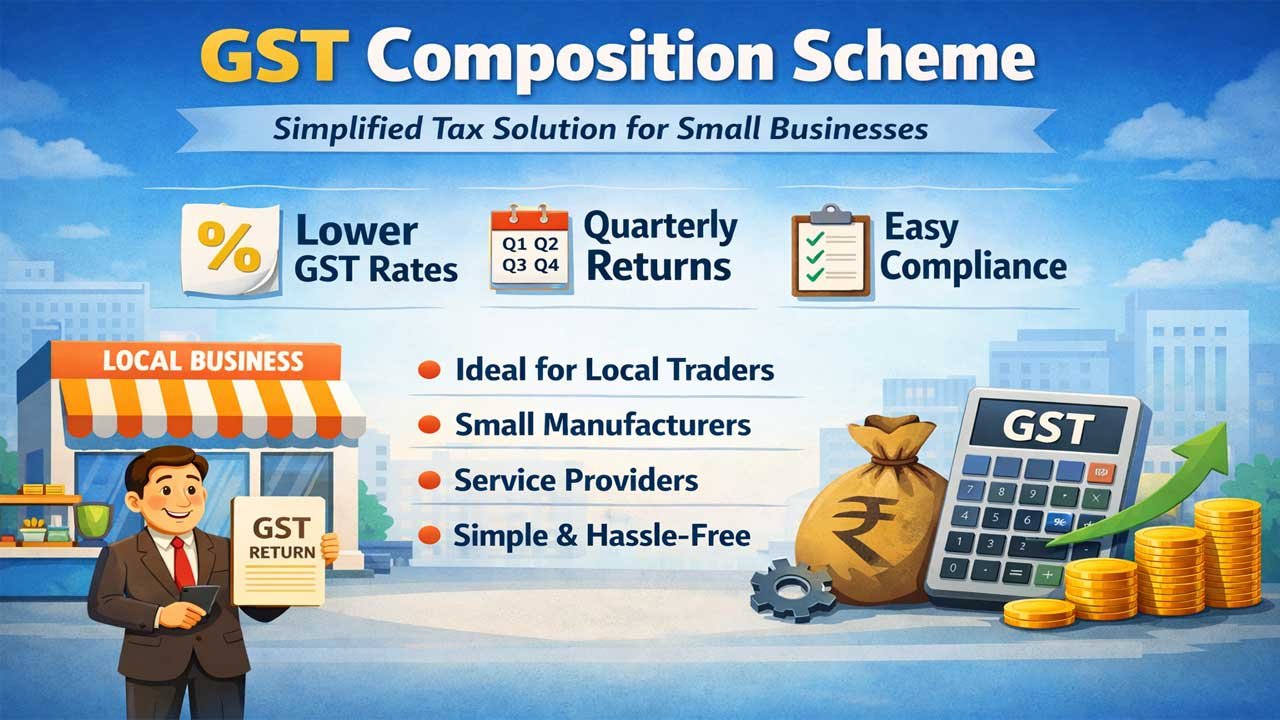
The GST Composition Scheme is a simplified tax regime for small businesses. It reduces your tax filing burden. You pay lower GST rates on your turnover. Monthly paperwork becomes quarterly returns. This scheme is perfect for small traders, manufacturers, and service providers.
The scheme was designed by the Government of India. It aims to encourage small business growth. Registration is optional. You can choose to opt in or out. The scheme makes tax compliance easier. It reduces administrative costs. Small businesses can focus on operations instead of taxes.
Who is Eligible for GST Composition Scheme?
Your business can opt for this scheme if it meets specific criteria. Here are the key eligibility requirements:
Annual Turnover Limits for GST Composition Scheme:
| Category | Turnover Limit | Special States Limit |
|---|---|---|
| Traders and Manufacturers | ₹1.5 crore | ₹75 lakh |
| Service Providers | ₹50 lakh | ₹50 lakh |
| Restaurants (Non-Alcoholic) | ₹1.5 crore | ₹75 lakh |
Special category states include Arunachal Pradesh, Meghalaya, Mizoram, Sikkim, Himachal Pradesh, and Uttarakhand.
Your business must meet these conditions:
- You must be registered under GST already
- You cannot supply exempt goods like alcohol or tobacco
- You cannot engage in inter-state sales
- You cannot sell through e-commerce platforms
- All businesses under your single PAN must opt together
GST Composition Scheme Tax Rates
The composition scheme offers significantly lower tax rates. You pay tax on your total turnover. Not on individual transactions. This simplifies calculations.
Current GST Composition Tax Rates (2026):
| Business Type | Tax Rate | CGST | SGST |
|---|---|---|---|
| Manufacturers | 1% | 0.5% | 0.5% |
| Traders | 1% | 0.5% | 0.5% |
| Restaurants (Non-Alcoholic) | 5% | 2.5% | 2.5% |
| Service Providers | 6% | 3% | 3% |
These rates are fixed by law. They don’t change based on product type. This provides tax certainty for business planning.
Major Advantages of GST Composition Scheme
Lower Tax Liability
Your tax burden reduces dramatically under this scheme. A trader pays just 1% instead of 18%. A service provider pays 6% instead of up to 18%. This saves thousands of rupees annually. Money stays in your business. You can invest in growth.
Simplified Tax Compliance
Filing taxes becomes much easier. You file returns only once per quarter. Not monthly. Annual returns reduce paperwork. The quarterly filing schedule is fixed. You have predictable compliance deadlines. Less time on tax administration. More time on business operations.
Reduced Administrative Burden
You don’t need complex accounting systems. Monthly reconciliation is unnecessary. You maintain simpler records. This reduces accounting costs. Professional consultants charge less for quarterly returns. Software costs decrease. Your administrative overhead drops significantly.
Better Cash Flow Management
Lower tax rates mean lower cash outflow. Your business maintains better liquidity. Capital stays available for operations. You can invest in inventory. You can pay employees on time. You can purchase equipment.
Focused Business Growth
With less compliance work, you focus on actual business. Marketing gets attention. Customer service improves. Innovation becomes possible. Growth accelerates faster.
Key Disadvantages of GST Composition Scheme
No Input Tax Credit (ITC)
This is the biggest drawback. You cannot claim ITC on purchases. Tax paid on inputs becomes a cost. Your product costs increase. Customers buying from you also cannot claim ITC. This affects your competitiveness. B2B sales become difficult.
Cannot Collect GST from Customers
You cannot charge GST separately. Your tax becomes a cost burden. Prices must include tax. This affects profit margins. It reduces your business flexibility.
No Inter-State Sales
You can only sell within your state. Multi-state expansion is blocked. Growth is geographically limited. National markets are inaccessible. This severely restricts scaling opportunities.
Restricted E-Commerce Sales
You cannot sell on Amazon, Flipkart, or other platforms. Online expansion is impossible. You miss digital revenue streams. E-commerce is now essential for businesses.
All Businesses Must Opt Together
If you have multiple businesses under one PAN, all must choose the same scheme. You cannot opt one business in and another out. This limits flexibility.
GST Composition Scheme Filing Requirements
Forms You Need to File
| Form | Frequency | Deadline | Purpose |
|---|---|---|---|
| CMP-01 | Once | Within 30 days of registration | Application to opt for scheme |
| CMP-02 | Once | Before financial year starts | Stock and inward supplies details |
| CMP-08 | Quarterly | 18th of next month | Quarterly returns and tax payment |
| GSTR-4 | Annually | 30th April | Annual return filing |
You must maintain proper records. Keep sales invoices. Maintain purchase bills. Store bank statements. Track GST payments. Documentation helps during audits.
How to Apply for GST Composition Scheme
Step-by-Step Application Process
Step 1: Access GST Portal
Login to the official GST portal. Use your GSTIN and password. New registrations get login credentials automatically.
Step 2: Navigate to Application Section
Go to “Services” > “Registration” > “Application to Opt for Composition Levy.”
Step 3: Fill Form CMP-01
Select your business category. Review eligibility conditions. Declare that you meet all requirements. Check verification boxes. Submit the form.
Step 4: Fill Form CMP-02
Provide stock details of opening inventory. List inward supplies from unregistered dealers. Enter this information before the financial year begins.
Step 5: Get Approval
The GST officer reviews your application. Approval typically comes within 30 days. You get a confirmation notice. Your status changes to “Composition Taxable Person.”
Step 6: Display Status
Print your registration certificate. Display it at your business premises. Mention on all bills and invoices: “Composition Taxable Person – not eligible to collect tax on supplies.”
Composition Scheme vs Regular GST Scheme
Understanding the differences helps you choose correctly.
| Feature | Composition Scheme | Regular GST Scheme |
|---|---|---|
| Tax Rates | 1%-6% on turnover | 5%-28% on goods/services |
| Monthly Returns | Not required | Required (GSTR-1, GSTR-3B) |
| Quarterly Returns | Required (CMP-08) | Not required |
| Input Tax Credit | Cannot claim | Can claim |
| GST Collection | Cannot collect GST | Can collect GST |
| Inter-State Sales | Not allowed | Allowed |
| E-Commerce Sales | Not allowed | Allowed |
| Invoice Type | Bill of Supply | Tax Invoice |
| Best For | Local small businesses | Medium to large businesses |
Choose the scheme that fits your business model. If you plan interstate expansion, regular GST is better. For local operations, composition scheme saves more taxes.
Important Documents for GST Composition Scheme
Essential Documents You Must Keep
- Sales invoices/bills of supply
- Purchase bills from suppliers
- Bank statements and payment records
- GST payment challans
- Stock registers and inventory records
- Correspondence with GST authorities
- CMP-01 and CMP-02 forms (approved copies)
- Quarterly return filing receipts
- Annual GSTR-4 return copies
Good documentation prevents penalties. Audits become easier. Tax officers accept your records quickly.
GST Composition Scheme: Transition Rules
Can You Switch Schemes?
Yes, you can switch from composition to regular scheme. The process is simple. You cannot switch mid-year. Changes apply from April 1st (new financial year). Filing an application is required.
Switching Back Is Difficult
If you switch to regular GST, you cannot return to composition scheme immediately. Rules require waiting one financial year before reapplying. Plan scheme changes carefully.
Penalties and Compliance Issues
Late Filing Penalties
Filing CMP-08 late attracts penalties. Each day costs ₹100. Accumulated delay becomes expensive. Missing the deadline blocks further returns.
Non-Compliance Consequences
- GST registration suspension
- Blocked e-way bills
- Inability to file new returns
- Interest on delayed tax payments
- Legal notices from tax authorities
- Business disruption
Always file on time. Calendar your deadlines. Use reminders.
Who Should NOT Opt for Composition Scheme?
This scheme is NOT suitable for:
- Businesses selling through e-commerce platforms
- Traders doing multi-state sales
- Service providers with large B2B client base
- Manufacturers requiring high input credit
- Exporters and import-export businesses
- Casual taxable persons
- Non-resident foreign taxpayers
- Businesses supplying exempt goods
- Ice cream, pan masala, tobacco manufacturers
GST Composition Scheme Benefits for Specific Business Types
For Kirana Stores
Lower tax rates mean better margins. Quarterly compliance reduces paperwork. Cash remains within the business.
For Small Medical Shops
Reduced tax burden helps smaller pharmacies compete. Simplified returns save accounting costs. Local customer base fits the scheme perfectly.
For Small Restaurants
5% rate is significantly lower than regular rates. Quarterly returns are manageable. Local service delivery matches the scheme.
For Small Traders
1% tax rate dramatically reduces costs. Local operations fit perfectly. Growth stays within state boundaries.
Latest 2026 GST Updates Affecting Composition Scheme
New Compliance Requirements: As of January 2026, GST filing has become more stringent. Invoice matching is now mandatory. Mismatches block input tax credit immediately. Auto-generated returns reduce manual work.
Bank Account Verification: Bank details must be furnished within 30 days of registration. Failure leads to automatic GST registration suspension. You cannot file returns or generate e-way bills if bank details are missing.
Enhanced Real-Time Monitoring: The GST system now tracks sales invoices in real-time. E-invoices are monitored continuously. E-way bills are automatically verified. Bank payment information is cross-checked automatically. Any discrepancy triggers immediate scrutiny.
Frequently Asked Questions About GST Composition Scheme
Q: Can I claim Input Tax Credit under the composition scheme?
A: No. You cannot claim ITC. This is a major drawback. Tax on purchases becomes a business cost.
Q: Can I supply goods inter-state?
A: No. Inter-state supplies are not allowed. You must operate within your state only.
Q: What documents prove my composition scheme status?
A: Your GSTIN registration certificate. The approval notice. These confirm your status officially.
Q: How often must I file returns?
A: Quarterly returns (CMP-08) are mandatory. Annual return (GSTR-4) is required.
Q: Can I sell online under this scheme?
A: No. E-commerce sales are prohibited.
Q: What is a bill of supply?
A: It’s the invoice type for composition dealers. Unlike tax invoices, it doesn’t show GST amount. The buyer cannot claim ITC.
Q: What happens if my turnover exceeds the limit?
A: You are automatically removed from the scheme. You must register under regular GST immediately.
Q: Can I opt out of the composition scheme?
A: Yes. You can switch to regular GST. You cannot switch back immediately.
How to Track Your GST Composition Scheme Status
Monitor Your Turnover: Keep accurate records of monthly turnover. Track cumulative sales throughout the year. If you exceed the limit, prepare for auto opt-out. Calculate projected annual turnover quarterly.
Plan Your Growth Strategy: As your business grows, evaluate scheme suitability. If turnover approaches the limit, assess regular GST benefits. Make informed decisions about expansion.
Stay Compliant: File returns on time consistently. Maintain proper documentation. Respond to GST notices promptly. Keep your registration active.
Tax Planning Tips for Composition Scheme Businesses
Maximize Lower Tax Rates: Use the 1% or 6% rates to your advantage. Build better margins. Reinvest savings into business growth.
Plan for Growth: If expansion exceeds turnover limits, prepare transition to regular GST. Understand ITC benefits before crossing the threshold.
Maintain Clean Records: Documentation prevents audit issues. Digital record-keeping reduces errors. Organized files speed up tax filing.
Budget for Quarterly Returns: Allocate time for quarterly compliance. Set reminder alerts for deadlines. Budget for professional help if needed.
Conclusion
The GST Composition Scheme simplifies taxes for small businesses. Lower rates reduce your tax burden. Quarterly returns cut compliance work. This scheme is ideal for local traders, small retailers, and service providers.
However, significant limitations exist. No input tax credit. No interstate sales. No e-commerce operations. No GST collection from customers.
Evaluate your business model carefully. Calculate your projected turnover. Review growth plans. Determine which scheme fits best.
If you’re a local small business staying within your state, the composition scheme saves significant money and time. If you plan multi-state expansion or e-commerce sales, regular GST suits you better.
Consult with a GST professional. Analyze your specific situation. Make an informed decision. Choose the scheme that maximizes your business potential and minimizes your tax burden.


Leave a Reply
You must be logged in to post a comment.