
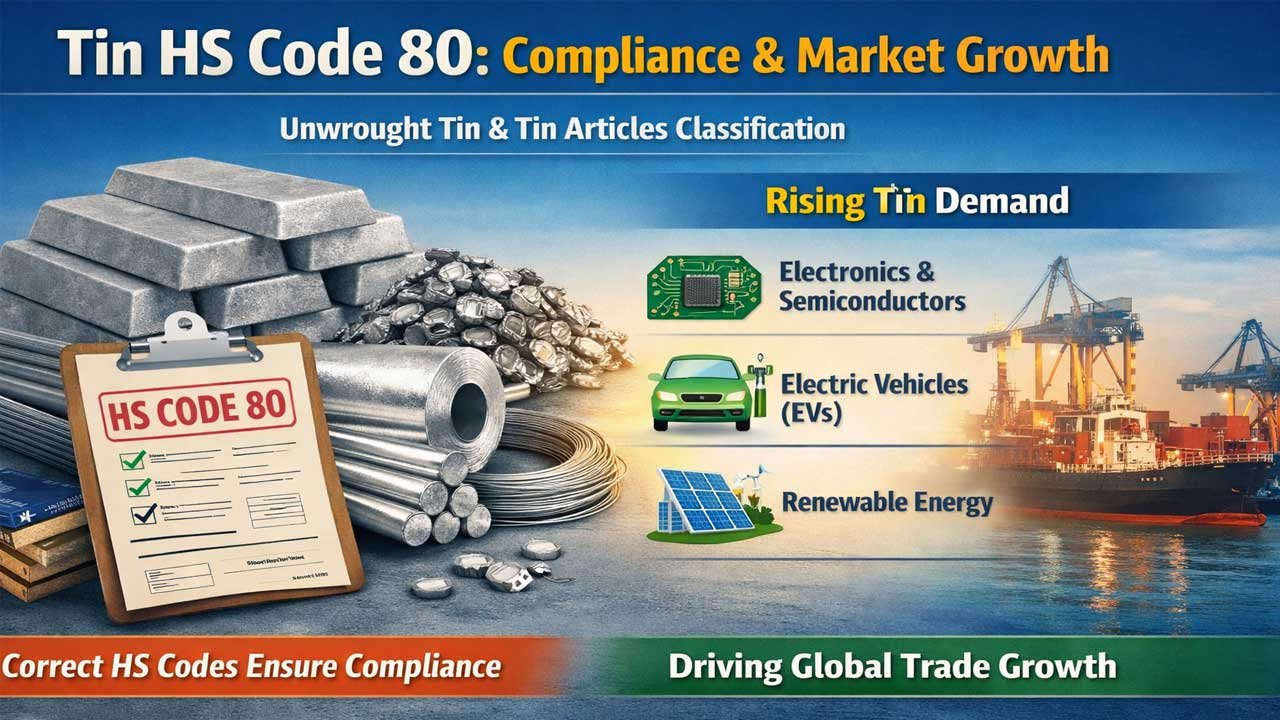
Tin is a valuable base metal. It has many industrial uses. The HS code for tin is Chapter 80. This chapter covers unwrought tin and tin articles. Understanding HS codes is critical for import and export businesses. Proper classification ensures regulatory compliance. It also reduces customs delays and penalties.
Tin demand is growing rapidly. The global tin market reached 417.2 kilotons in 2025. The market is expected to reach 461.6 kilotons by 2034. This growth reflects strong demand from electronics, semiconductors, and renewable energy sectors. Businesses involved in tin trading need accurate HS code knowledge. It impacts GST rates, import duties, and customs clearance procedures.
What Is HS Code 80 for Tin?
HS code 80 is the Harmonized System code for tin and tin articles. The Harmonized System is an international classification standard. It is used by customs authorities worldwide. Every product has a unique HS code. The code determines import duties and GST rates.
HS code 80 consists of seven main sub-headings:
| HS Code | Description | GST Rate | Notes |
|---|---|---|---|
| 8001 | Unwrought tin | 18% | Includes blocks, ingots, pigs, slabs |
| 8002 | Tin waste and scrap | 18% | Recycled tin material |
| 8003 | Tin bars, rods, profiles, wire | 18% | Hollow bars, solid bars, rods |
| 8004 | Tin plates, sheets, strip | 0% | Thickness exceeding 0.2mm |
| 8005 | Tin foil, powders, flakes | 0% | Thickness not exceeding 0.2mm |
| 8006 | Tin tubes, pipes, fittings | 0% | Couplings, elbows, sleeves |
| 8007 | Other tin articles | 18% | Blanks and miscellaneous items |
Each sub-heading has specific product classifications. Importers must correctly classify their products. Using the wrong code can result in penalties. It can also delay customs clearance significantly.
Understanding HS Code 8001: Unwrought Tin
HS code 8001 classifies raw tin. Unwrought tin is tin that has not been processed into finished products. It exists in primary forms. These forms include blocks, ingots, pigs, and slabs. The GST rate for unwrought tin is 18% in India.
Unwrought tin has two sub-categories:
- 8001 10: Tin, not alloyed
- 8001 20: Tin alloys
Businesses importing pure tin metal use code 8001 10. Tin alloy imports use code 8001 20. This distinction is important. Tin alloys contain other metals mixed with tin. The composition affects pricing and application. Pure tin has higher value in electronics and semiconductor manufacturing.
HS Code 8002: Tin Waste and Scrap
HS code 8002 covers tin waste and scrap materials. This is a critical category for recycling businesses. Tin scrap includes used and discarded tin products. It also includes high-tin base babbit and pewter scrap. The GST rate for tin waste is 18% in India.
Types of tin waste classified under 8002:
- Block tin covered by ISRI code word RANCH
- High-tin base babbit covered by ISRI code word RAVES
- Pewter covered by ISRI code word RANKS
- Other tin scrap
Tin recycling is becoming increasingly important. Recycled tin reduces environmental impact. It also lowers production costs compared to mining. Major electronics manufacturers are focusing on recycled tin sources. This trend is driving business opportunities in tin scrap trading.
The import custom duty on tin waste and scrap is 5% in India. This relatively low duty encourages tin recycling and scrap imports. The social welfare surcharge is an additional 10%.
HS Code 8003: Tin Bars, Rods, Profiles, and Wire
HS code 8003 classifies tin bars, rods, profiles, and wire. These are semi-finished tin products. They have specialized applications. The GST rate is 18%.
HS 8003 sub-categories include:
- 8003 10: Hollow bars
- 8003 20: Bars (other than hollow bars) and rods
- 8003 30: Profiles
- 8003 40: Wire
Tin wire is widely used in electronics. It is essential for soldering circuit boards. The semiconductor industry relies heavily on tin wire. Lead-free solder regulations in many countries have increased tin wire demand. Manufacturers of electronic components import tin wire under this code.
HS Codes 8004-8006: Finished Tin Products with Zero GST
HS codes 8004, 8005, and 8006 have zero GST rate in India. This makes them attractive for importers. Zero GST reduces overall import costs significantly.
HS Code 8004: Tin Plates, Sheets, and Strip
HS code 8004 covers tin plates, sheets, and strip. The thickness must exceed 0.2 millimeters. These products have zero GST rate. They are used extensively in packaging. The food and beverage industry is the largest consumer. Tin plates provide corrosion resistance. They also offer excellent food preservation qualities.
HS Code 8005: Tin Foil, Powders, and Flakes
HS code 8005 covers tin foil and powders. The foil thickness must not exceed 0.2 millimeters. Tin foil is used in packaging and insulation. Tin powders and flakes have specialized industrial applications. Electronics manufacturers use tin powders for coating and plating. Pharmaceutical companies use tin foil for medication packaging.
HS Code 8006: Tin Tubes, Pipes, and Fittings
HS code 8006 includes tin tubes, pipes, and fittings. Examples are couplings, elbows, and sleeves. These products have zero GST. They are used in industrial applications. Plumbing systems, HVAC installations, and chemical processing facilities use tin tubes and pipes.
HS Code 8007: Other Articles of Tin
HS code 8007 covers other tin articles not classified elsewhere. It includes tin blanks and miscellaneous items. The GST rate is 18%. This code is used for specialized tin products. Tin cookware falls under this category. Decorative tin items and tin containers are also classified here.
Import Duties and GST Rates for Tin Products
Understanding import duties is crucial for cost calculations. India applies custom duty on tin imports based on HS code classification.
| HS Code | Custom Duty | GST Rate | Social Welfare Surcharge | Total Effective Rate |
|---|---|---|---|---|
| 8001 | 10% | 18% | 10% | ~38% |
| 8002 | 5% | 18% | 10% | ~33% |
| 8003 | 10% | 18% | 10% | ~38% |
| 8004 | 10% | 0% | 0% | ~10% |
| 8005 | 10% | 0% | 0% | ~10% |
| 8006 | 10% | 0% | 0% | ~10% |
| 8007 | 10% | 18% | 10% | ~38% |
These rates affect the landed cost of tin products significantly. Higher GST rates increase overall expenses. This is why codes 8004-8006 are attractive for importers. Proper classification is essential for cost optimization.
Market Demand and Pricing for Tin (2026-2027)
The global tin market is experiencing strong growth. Market demand is driven by multiple industries. Tin prices are influenced by supply disruptions and demand fluctuations.
Current Market Size and Growth
The global tin market was valued at 417.2 kilotons in 2025. The market is projected to reach 461.6 kilotons by 2034. This represents a compound annual growth rate (CAGR) of 1.13%. Some analysts project higher growth rates of 2.48% CAGR.
Tin Price Trends for 2026
Tin prices are forecasted to remain elevated in 2026. Industry experts predict prices between $32,000 to $35,000 per tonne. Supply constraints from major producers support higher prices. Myanmar’s mining suspension and Indonesia’s smelter changes have tightened global supplies.
Key Demand Drivers
Electronics and Semiconductor Industry: The electronics sector accounts for approximately 50% of global tin consumption. Semiconductors require high-purity tin for soldering. AI computing expansion is driving unprecedented semiconductor demand. This trend is expected to continue through 2026 and beyond.
Renewable Energy and Solar: Solar panel manufacturing uses tin for coating and connections. The renewable energy sector is one of the fastest-growing tin consumers. Photovoltaic installations are expanding globally. This creates sustained demand for tin products.
Electric Vehicle Manufacturing: EV battery production requires tin solder for electrical connections. As EV adoption accelerates worldwide, tin demand increases proportionally. Major automakers are securing long-term tin supply contracts.
Lead-Free Solder Requirements: Environmental regulations mandate lead-free solders in electronics. Lead-free solder formulations require higher tin content than traditional lead-based solders. This regulatory shift has permanently increased tin demand.
Regional Market Distribution
Asia-Pacific dominates the global tin market, holding over 45% market share. China is the largest tin consumer and processor. Indonesia and Myanmar are major tin producers. Supply disruptions in these regions directly impact global prices and availability.
Import and Export Procedures for Tin and Articles
Importing or exporting tin requires following strict regulatory procedures. Non-compliance can result in significant penalties and delays.
Requirements for Importing Tin
Step 1: Obtain IEC Number
An Import Export Code (IEC) number is mandatory for all imports and exports from India. Apply online at www.dgft.gov.in. The IEC registration is a one-time process. It links with customs and banking systems automatically.
Step 2: Identify Correct HS Code
Determine the correct HS code for your specific tin product. Misclassification leads to customs penalties. Classification is based on product form, purity, and end-use.
Step 3: Obtain Certificate of Origin
A certificate of origin from the exporting country is required. It proves the country of origin. This certificate helps determine import duty exemptions. It also facilitates bilateral and multilateral trade agreements.
Step 4: Environmental Clearance
If importing tin waste and scrap, obtain permission from Ministry of Environment and Forest (MOEF). Hazardous waste items require special clearance. Submit Form 9 as per hazardous waste management rules.
Step 5: Laboratory Test Reports
Obtain test reports from accredited laboratories. These reports verify product specifications and purity levels. Reports must comply with importing country standards.
Step 6: File Import Documentation
Submit import entry documents along with:
- Bill of Lading or Airway Bill (carrier document)
- Commercial invoice
- Packing list
- Certificate of origin
- Laboratory test report
- Customs declaration forms
Step 7: Customs Clearance and Payment
Clear goods through customs at the designated port. Pay applicable import duties and GST. Collect goods upon payment clearance.
Export Procedures for Tin
Export Registration: Maintain updated IEC registration with Foreign Trade Policy compliance.
Quality Certification: Obtain BIS certification if products meet Indian standards. ISO 14001 environmental certification enhances market value.
Export Documentation: Maintain detailed records of:
- Manufacturing or sourcing details
- Product specifications
- Test certificates
- Quantity and packaging information
- Invoice and shipping documents
Market Compliance: Ensure compliance with importing country regulations. Different countries have varying purity and quality requirements. US and European markets have strict environmental standards.
Business Opportunities in Tin Trading
The tin market offers multiple business opportunities for importers, exporters, and traders.
Refined Tin Metal Market Growth
The refined tin metal market was valued at USD 4.5 billion in 2024. It is growing at a CAGR of 4% annually. Refined tin has higher margins than raw tin. Premium pricing attracts specialized manufacturers and exporters.
Supply Chain Diversification Opportunities
Western countries are actively diversifying tin supply chains away from Asia. This creates opportunities for:
- Tin ore suppliers from Africa and South America
- Recycling businesses processing tin scrap
- Specialty alloy manufacturers
- Trading companies connecting producers and consumers
Sustainable Tin and ESG Compliance
Manufacturers increasingly demand ESG-compliant tin. Responsible sourcing commands 10-15% price premiums. Companies have built multimetal recycling streams with ISO certifications. This trend creates opportunities for ethical suppliers.
Tin Waste Recycling Business
Tin waste recycling is expanding rapidly. Recycled tin reduces environmental impact significantly. Manufacturing recycled tin costs less than mining. Business opportunities exist in:
- Scrap collection and sorting
- Tin waste processing
- Secondary tin refining
- Export of recycled tin products
Compliance and Regulatory Considerations
GST Compliance for Tin Importers
Maintain proper GST documentation. File GST returns based on HS code classification. Incorrect classification results in GST penalties. Input GST credit depends on proper invoice classification.
Customs Documentation Standards
Keep detailed customs records for minimum seven years. Documentation must include:
- Original invoices and bills of lading
- GST paid receipts
- Certificate of origin
- Laboratory test reports
- Correspondence with customs authorities
Quality and Standards Compliance
Different markets have varying quality standards:
- India: BIS standards for tin packaging (IS 916:2000 for tins)
- US/Canada: ASTM standards for tin purity
- EU: ISO and RoHS compliance requirements
Environmental Regulations
Tin waste management follows Basel Convention rules. Hazardous waste handling requires special permits. Environmental compliance is mandatory before importing tin waste and scrap.
Conclusion
Understanding HS codes for tin is essential for import-export businesses. Correct classification ensures compliance and cost optimization. The global tin market offers significant opportunities. Supply growth is constrained while demand increases steadily.
Tin prices are expected to remain elevated through 2026 due to supply disruptions. Electronics, semiconductors, renewable energy, and EV manufacturing drive sustained demand. Businesses should focus on:
- Accurate HS code classification
- Regulatory compliance procedures
- Market opportunity identification
- Sustainable sourcing practices
- Quality assurance and certifications
The tin industry is transitioning toward sustainability and traceability. ESG-compliant products command premium pricing. Supply chain diversification creates opportunities for new market entrants. Recycled tin represents a growing market segment.
For importers and exporters, success depends on staying updated with regulations and market trends. Maintain proper documentation and compliance standards. Build relationships with certified suppliers. Monitor market prices and demand forecasts. The tin business offers profitable opportunities for well-informed traders and importers.


