
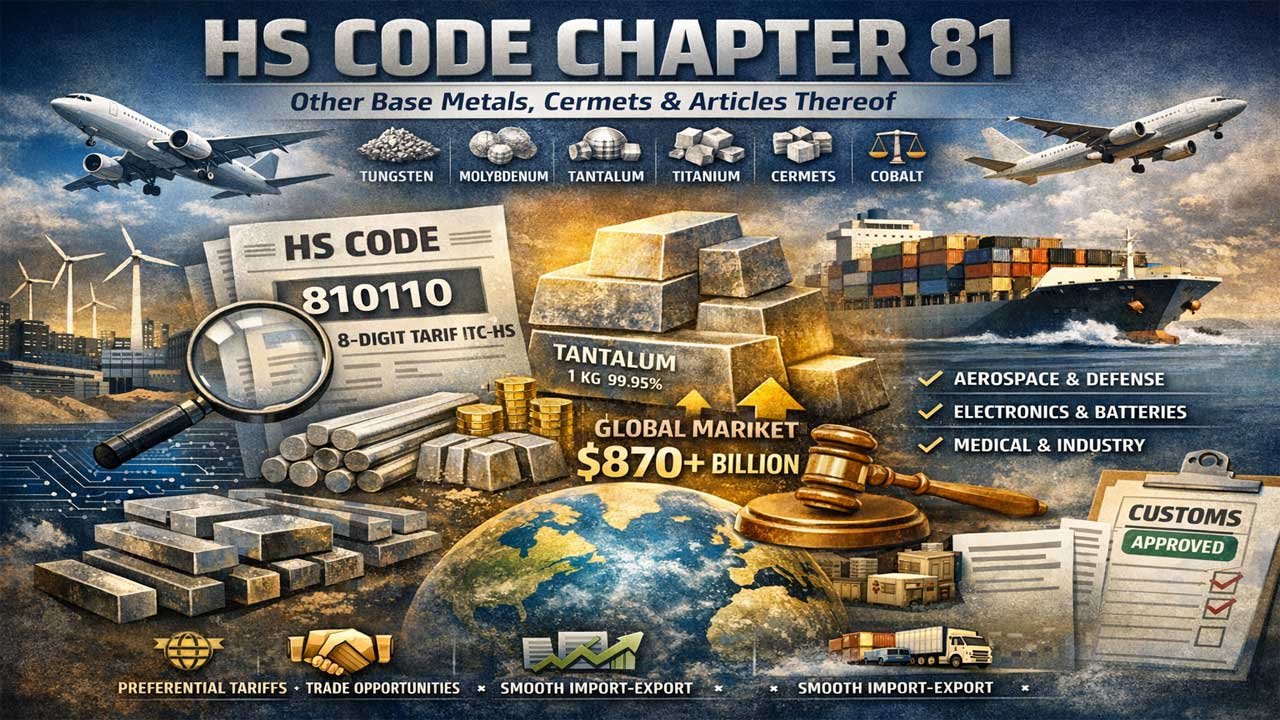
HS Code Chapter 81, part of Section XV of the Harmonized System, covers “other base metals, cermets, and articles thereof,” excluding iron and precious metals, and focuses on specialty metals like tungsten, molybdenum, tantalum, magnesium, cobalt, titanium, zirconium, antimony, manganese, and composite materials such as cermets.
Using the global six-digit HS structure (extended to eight digits in India under ITC-HS), accurate classification under Chapter 81 is critical because these high-value materials attract significant duties, are subject to strict compliance checks, and are widely used in fast-growing sectors like aerospace, defense, electronics, batteries, medical devices, and advanced manufacturing.
With the global base metals market exceeding $870 billion and growing steadily, correct HS coding helps businesses avoid customs delays, duty miscalculations, and legal issues while enabling them to capitalize on expanding trade opportunities, benefit from preferential tariffs, and ensure smooth import-export operations through proper documentation, up-to-date tariff knowledge, and alignment with DGFT and WCO guidelines.
What is HS Code Chapter 81?
HS Code Chapter 81 covers “Other base metals, cermets, articles thereof.” It is part of Section XV of the Harmonized System. This chapter excludes precious metals and iron. It focuses on specialty metals and composite materials.
The HS code format uses six digits internationally. India extends this to eight digits. The first two digits identify the chapter. The next two digits show the heading. The last two digits indicate the subheading.
Why Does Chapter 81 Matter?
Base metals in Chapter 81 have high market value. Businesses trading these materials need accurate classifications. Wrong classifications cause customs delays. They result in duty miscalculations. They create legal compliance issues. Accurate HS codes protect your shipments.
The global base metals market was valued at $872.14 billion in 2026. It is growing at 7% annually. By 2032, it will reach $1,320 billion. This growth creates opportunities for traders.
HS Code Structure Explained: How Chapter 81 Works
Breaking Down the Six-Digit Code
Every HS code has a standard structure. Understanding this structure helps you classify products correctly.
- First 2 Digits (Chapter): Identifies the broad product category. For Chapter 81, the digits are “81.”
- Next 2 Digits (Heading): Specifies the metal type within the chapter. Example: “01” for tungsten, “02” for molybdenum.
- Last 2 Digits (Subheading): Provides the most specific product classification. Example: “10” for unwrought material, “90” for waste and scrap.
India’s Extended Eight-Digit Format
India uses the ITC-HS code system. It extends the international six-digit code to eight digits. The additional two digits serve specific tariff and statistical purposes in India.
Example: A tungsten product might be classified as:
- International HS Code: 810110
- Indian ITC-HS Code: 81011010 (with additional specifications)
This extended format helps customs authorities track imports and exports accurately.
Major HS Code Classifications Under Chapter 81
8101: Tungsten (Wolfram) and Articles Thereof
Tungsten is a rare, hard metal. It has the highest melting point of all metals. It is used in high-temperature applications.
Tungsten products under 8101 include:
- Unwrought tungsten (powder, bars, rods)
- Tungsten articles and semi-finished products
- Tungsten waste and scrap materials
- Tungsten alloys
The tungsten market showed high volatility in 2025. Prices increased 19-21% in the first half of the year. Demand from military applications drove this growth.
8102: Molybdenum and Articles Thereof
Molybdenum is a transition metal. It is used as a catalyst and in alloys. It improves hardness and corrosion resistance.
Products under 8102 classification include:
- Unwrought molybdenum (including bars and rods)
- Molybdenum powders and flakes
- Molybdenum alloys
- Molybdenum waste and scrap
Molybdenum-tantalum alloys represent a fast-growing market. This market was valued at $6.93 billion in 2025. It is expected to grow at 15.68% CAGR through 2033.
8103: Tantalum and Articles Thereof
Tantalum is a corrosion-resistant metal. It is essential for electronics and aerospace industries. It is used in capacitors, semiconductors, and thermal systems.
Tantalum classification includes:
- Unwrought tantalum materials
- Tantalum bars, rods, and profiles
- Tantalum powder and waste
- Tantalum alloy articles
The tantalum market was valued at $5.64 billion in 2026. It is projected to reach $8.21 billion by 2032. This represents a 6.4% compound annual growth rate.
8104: Magnesium and Articles Thereof
Magnesium is a lightweight metal. It is used in automotive and aerospace applications. It improves fuel efficiency and performance.
Magnesium products include:
- Unwrought magnesium
- Magnesium bars, rods, and profiles
- Magnesium powders and flakes
- Magnesium waste and scrap
8105: Cobalt Mattes and Articles
Cobalt is critical for battery technology. It is used in rechargeable batteries and aviation alloys. It is also used in pigments and catalysts.
Cobalt classification includes:
- Cobalt mattes and intermediate products
- Unwrought cobalt materials
- Cobalt articles and alloys
- Cobalt waste and scrap
8108: Titanium and Articles Thereof
Titanium is valued for its strength-to-weight ratio. It is used in aerospace, medical implants, and military equipment. It resists corrosion and high temperatures.
Products include:
- Unwrought titanium
- Titanium bars, rods, and profiles
- Titanium powders and flakes
- Titanium articles and waste
8109: Zirconium and Articles Thereof
Zirconium is used in nuclear reactors and industrial heating. It has excellent corrosion resistance. It is used in refractory materials.
8110: Antimony and Articles Thereof
Antimony is used in flame retardants. It is used in semiconductors and pewter alloys. It has applications in electronics and chemicals.
8111: Manganese and Articles Thereof
Manganese is essential for stainless steel production. It improves hardness and corrosion resistance. It is used in batteries and welding rods.
8112: Beryllium, Chromium, Germanium, Vanadium & Similar Metals
This heading covers specialty metals with specific industrial applications:
- Beryllium: Used in aerospace and electronics
- Chromium: Essential for stainless steel production
- Germanium: Used in semiconductors and optics
- Vanadium: Improves steel strength and corrosion resistance
- Gallium, Hafnium, Indium, Niobium, Rhenium, Thallium: Specialty applications in electronics, aerospace, and nuclear industries
8113: Cermets and Articles Thereof
Cermets are composite materials. They combine ceramic and metallic components. They offer unique properties not found in pure metals.
What Are Cermets? Definition & Industrial Applications
Understanding Cermet Composition
The term “cermet” comes from “ceramic” + “metal.” It describes a composite material made of two distinct phases.
The ceramic component provides:
- High-temperature resistance
- Hardness and wear resistance
- Chemical stability
- Brittle strength
The metallic component provides:
- Ductility (ability to deform without breaking)
- Toughness and resilience
- Thermal conductivity
- Easier handling and processing
Common Cermet Types
The most widely used cermet is tungsten carbide with cobalt binder (WC-Co). This combination accounts for approximately 98% of commercial cemented carbides.
Other important cermet types include:
- TiN (Titanium Nitride): Excellent hardness and thermal stability
- TiCN (Titanium Carbonitride): Better wear resistance and oxidation resistance than TiN
- TiC (Titanium Carbide): Superior at high temperatures
- WCN (Tungsten Carbonitride): Improved corrosion resistance
- MAX Phase Composites: Emerging materials for aerospace and automotive use
Cermet Applications Across Industries
Cutting Tools and Machining:
- Cermets replace pure tungsten carbide in many applications
- Better wear resistance and longer cutting life
- Superior corrosion properties
- Ideal for continuous cutting operations
Resistors and Electronic Components:
- Potentiometers for precision applications
- Capacitors for high-temperature environments
- Circuit components for specialized electronics
- Thermal management applications
Aerospace and Defense:
- Engine components and turbine blades
- Heat-resistant coatings
- Missile and weapon components
- Aircraft structural elements
Automotive Applications:
- Engine components and pistons
- Valve seats and guides
- Transmission components
- Lightweight structural parts
Industrial Tools:
- Saw blades and cutting edges
- Brazed tool applications
- Punches and dies
- High-stress work tools
Medical and Healthcare:
- Surgical implants (cobalt-based cermets)
- Orthopedic devices
- Diagnostic equipment
- Biocompatible applications
Emerging Aerospace Applications:
- Spacecraft shielding materials
- Protection against micrometeoroids and orbital debris
- High-velocity impact resistance
- Deep-space mission equipment
Import Duty and Tariff Rates for Chapter 81 Products in India
Understanding Tariff Structure
India applies a three-tier duty system on base metal imports:
- Basic Customs Duty: The primary import tariff rate
- IGST (Integrated Goods and Services Tax): Standard 10% on most imports
- Additional Levies: Social welfare surcharge (typically 3%) where applicable
Typical Duty Rates for Chapter 81 Products
Tungsten (8101):
- Basic Duty: 10%
- IGST: 10%
- Social Welfare Surcharge: 3%
- Effective Total: ~23%
Molybdenum (8102):
- Basic Duty: 10%
- IGST: 10%
- Social Welfare Surcharge: 3%
- Effective Total: ~23%
Tantalum (8103):
- Basic Duty: 10%
- IGST: 10%
- Social Welfare Surcharge: 3%
- Effective Total: ~23%
Cermets (8113):
- Basic Duty: 10%
- IGST: 10%
- Social Welfare Surcharge: 3%
- Effective Total: ~23%
Important Note: Duty rates may vary based on specific product composition, country of origin, and trade agreements. Always verify current rates with DGFT (Directorate General of Foreign Trade) or your customs broker.
How to Classify Your Products Under Chapter 81
Step 1: Identify the Metal Type
First, determine which specific metal your product contains. Chapter 81 covers 13 different metal categories.
Ask yourself:
- What is the primary metal in this product?
- Is it a pure metal or an alloy?
- What percentage is the primary metal?
- Are there secondary metals present?
Step 2: Check the Product Form
The product form affects its classification. The same metal can have different codes based on its physical state.
Product forms include:
- Unwrought: Raw material without processing (powder, ingots)
- Bars and Rods: Formed but not finished
- Profiles: Special cross-sectional shapes
- Plates and Sheets: Thin, flat forms
- Foil: Very thin sheets
- Wire: Thin, drawn material
- Powder: Ultra-fine particles
- Waste and Scrap: Recycled or rejected material
- Finished Articles: Ready-to-use products
Step 3: Determine the Grade and Purity
Purity levels affect classification. Higher purity materials have different codes than alloys.
Classifications include:
- High Purity (99%+): Primary metal designation
- Standard Grade (85-99%): Standard designation
- Alloy (varies): Alloy heading
- Powder Form: Special powder classification
Step 4: Use Official Classification Tools
DGFT ITC-HS Lookup:
Access at: www.dgft.gov.in
Provides official Indian HS code classifications
Updated regularly with latest tariff information
WCO HS Database:
World Customs Organization database
International reference for product classification
ICEGATE:
Indian customs electronic gate portal
Real-time verification for imports
Private Databases:
- Export Genius
- ImportYeti
- Customs Info Database
Step 5: Verify with Documentation
Gather supporting documents for classification:
- Product specifications and technical data sheets
- Chemical composition certificates
- Manufacturer’s declaration
- Previous import documentation
- Trade invoices and packing lists
Common Mistakes in HS Code Classification for Chapter 81
Mistake 1: Confusing Alloy Classification
Many traders misclassify alloys as pure metals. An alloy under 99% may belong to a different heading.
Solution: Verify exact metal content percentages. Check if the alloy has its own dedicated classification.
Mistake 2: Ignoring Product Form
The same metal in different forms has different codes. Powder is classified differently than bars.
Solution: Identify the exact physical form of your product. Refer to product form definitions in tariff notes.
Mistake 3: Wrong Waste and Scrap Classification
Waste and scrap materials have specific subheadings. They are not classified as primary products.
Solution: If importing waste or scrap, use the specific waste subheading (usually ending in “90”).
Mistake 4: Missing Composition Details
Products with multiple metal components need careful analysis. The dominant metal determines classification.
Solution: Determine the metal composition percentage. The primary metal (highest percentage) typically drives classification.
Mistake 5: Failing to Update Classification
Tariff codes and regulations change annually. Using outdated codes causes compliance issues.
Solution: Verify current codes with official sources. Update your records quarterly.
Market Trends and Demand Analysis for Chapter 81 Metals
Global Base Metals Market Growth
The global base metals market shows strong growth trajectory. The market was valued at $872.14 billion in 2026. It is projected to reach $1,320 billion by 2032.
Key growth drivers include:
- Rising demand for electric vehicles
- Renewable energy infrastructure expansion
- Aerospace and defense modernization
- Electronics and semiconductor growth
- Medical device manufacturing
Recycling and Circular Economy Impact
Recycled metals are growing faster than primary mining. Recycling is expected to grow at 4.67% CAGR. This exceeds primary mining growth rates.
Benefits of recycling:
- Reduced environmental impact
- Lower production costs
- Reliable supply security
- Support for sustainability initiatives
- Compliance with ESG requirements
Asia-Pacific Market Expansion
The Asia-Pacific region shows fastest growth potential. China, India, and Southeast Asia drive demand.
Growth factors:
- Rapid industrialization
- Expanding manufacturing bases
- Urbanization and infrastructure development
- Adoption of cost-effective technologies
- Rising middle-class consumption
Specialty Metal Demand
High-tech applications drive specialty metal demand:
Tungsten: Growing military demand and advanced manufacturing applications.
Molybdenum-Tantalum: Expected to grow 15.68% CAGR through 2033, driven by advanced alloys and aerospace applications.
Tantalum: Reaching $8.21 billion market by 2032, supported by electronics, aerospace, and emerging energy storage technologies.
Cobalt: Battery technology drives growth as electric vehicle adoption accelerates.
Titanium: Aerospace demand remains strong. Medical implant applications expand.
How to Calculate Import Duty for Chapter 81 Products
Basic Calculation Formula
Duty calculation follows this structure:
Total Payable Duty = (CIF Value × Basic Duty %) + (CIF Value × IGST %) + (Social Welfare Surcharge)
Where CIF = Cost, Insurance, and Freight value
Step-by-Step Calculation Example
Scenario: Importing tungsten bars under HS Code 8101.94.10
Given Information:
- CIF Value: $10,000
- Basic Duty Rate: 10%
- IGST Rate: 10%
- Social Welfare Surcharge: 3%
Calculation:
- Basic Duty = $10,000 × 10% = $1,000
- IGST on CIF Value = $10,000 × 10% = $1,000
- Social Welfare Surcharge = ($1,000 + $1,000) × 3% = $60
- Total Payable Duty = $1,000 + $1,000 + $60 = $2,060
Final Import Cost = $10,000 + $2,060 = $12,060
Important Considerations
Preferential Trade Agreements:
Products from partner countries may qualify for reduced duties under FTA or RTA.
Exemptions and Concessions:
Specific items may qualify for duty exemptions based on end-use or policy.
Country of Origin:
Tariff treatment varies by country. Verify with commercial invoices and certificates of origin.
Timing Considerations:
Duty rates change with Union Budget announcements. Plan imports strategically around rate changes.
Export Requirements for Chapter 81 Products from India
Export Classification Process
Exporting Chapter 81 products requires accurate HS code classification for destination countries.
Step 1: Verify Product Compliance
Ensure your product meets India’s export standards:
- Quality certifications
- Environmental compliance
- Safety standards
- Purity certificates
- Technical documentation
Step 2: Obtain Export Documentation
Required documents include:
- Commercial Invoice
- Packing List (detailed)
- Certificate of Origin
- Composition Certificates (for alloys)
- Technical Specifications
Step 3: Register with DGFT
Export businesses need DGFT registration:
- Obtain Importer-Exporter Code (IEC)
- Register with customs authority
- Maintain compliance records
Step 4: File Export Declaration
Submit electronic export declaration:
- Use ICEGATE system
- File Bill of Export
- Attach required documents
- Specify destination country
- Indicate exact HS code
Export Incentives and Benefits
India offers export incentives for specialty metals:
- Remission of duties and taxes (RoSCTL)
- Export Credit Guarantee Corporation (ECGC) insurance
- Special Economic Zone (SEZ) benefits
- Technology Upgradation Fund Scheme (TUFS)
- Focus Market Scheme (FMS)
Regional Export Preferences
Different countries apply preferential tariff rates:
- SAARC Countries: Reduced rates under SAFTA
- ASEAN Nations: Benefits under APTA
- African Nations: Duty-free access under COMESA/SAPTA
- European Union: Preferences under GSP scheme
- United States: Standard tariff rates
Legal Compliance and Documentation Requirements
GST Compliance for Chapter 81 Imports
Businesses must register under GST. Registration is required if:
- Annual turnover exceeds ₹40 lakhs
- Interstate supplies are involved
- Goods are supplied to other registered businesses
GST Invoicing Requirements:
- Valid GST invoices for all transactions
- IGST rate must be accurately mentioned
- Input tax credit documentation
- Regular GST returns filing
Customs Compliance
Key Requirements:
- Accurate product description matching invoice
- Correct HS code on shipping documents
- Verified composition certificates
- Proper marking and labeling
- Pre-import notification where required
Documentation Checklist:
- Commercial Invoice
- Packing List
- Bill of Lading (ocean) or Airway Bill (air)
- Certificate of Origin
- Product Certificates
- Insurance documents
- Import License (if required)
Quality and Safety Standards
Many Chapter 81 products must meet quality standards:
- ISO Certification
- BIS (Bureau of Indian Standards) approval
- Industry-specific standards
- End-use application certifications
Frequently Asked Questions About HS Code Chapter 81
Q1: What is the difference between base metals and precious metals?
Base metals tarnish, oxidize, or corrode when exposed to air or moisture. They are more abundant and affordable. Precious metals (gold, silver, platinum) retain their value and resist corrosion. HS Code Chapter 81 covers base metals only.
Q2: How often are HS codes updated?
The World Customs Organization updates the HS Nomenclature every two years. India typically implements changes with the Union Budget. Monitor official DGFT announcements for updates.
Q3: Can I use the same HS code for exports and imports?
The first six digits of the international HS code are standard globally. However, destination countries may use different extended codes. Always verify the specific code required by the importing country.
Q4: What happens if I use the wrong HS code?
Consequences include:
- Customs delays and inspections
- Duty miscalculations and penalties
- Legal compliance issues
- Potential shipment seizure
- Reputational damage
Q5: How do I find the correct HS code for my product?
Use official resources:
- DGFT ITC-HS database
- WCO HS browser
- Customs classification rulings
- Professional customs brokers
- Product technical specifications
Q6: Are there trade agreements that reduce Chapter 81 duties?
Yes. India has preferential trade agreements with several countries. Check your destination country’s FTA status. Consult with customs brokers for specific rates.
Q7: What is the current duty rate for tungsten imports?
Standard basic duty is 10% on most Chapter 81 products. Add 10% IGST and 3% social welfare surcharge. Total effective rate is approximately 23%. Verify current rates with official sources.
Q8: Do waste and scrap metals have different classifications?
Yes. Waste and scrap materials (HS Code subheading ending in “90”) are classified separately. They have different duty treatments. Special waste classification helps track recycling.
Q9: How long does customs clearance take for Chapter 81 products?
Standard clearance: 2-3 days with complete documentation.
With inspections: 5-7 days or more.
Early filing and document accuracy speed up the process.
Q10: What are cermets used for?
Cermets are used in cutting tools, electronics, aerospace, automotive, industrial machinery, and medical devices. They combine ceramic hardness with metallic toughness. Tungsten carbide cermets are most common in industrial applications.
Conclusion: Mastering Chapter 81 Classification
Accurate HS Code classification is essential for smooth import-export operations. Chapter 81 covers specialty metals and cermets with growing global demand.
Key Takeaways:
- Structure Matters: Understand the six-digit structure for proper classification.
- Metal Type is Primary: Identify the exact metal type first. This drives your classification.
- Product Form Counts: The same metal in different forms has different codes.
- Documentation is Critical: Accurate supporting documents prevent costly errors.
- Stay Updated: Duty rates and regulations change. Verify current information regularly.
- Use Official Resources: Rely on DGFT, WCO, and ICEGATE for authoritative guidance.
- Professional Help: Customs brokers provide valuable expertise for complex classifications.
The base metals market continues to grow. Opportunities exist for importers and exporters. Success requires accurate classification and full compliance.
Next Steps:
- Verify your current product classifications
- Update your tariff records
- Register with DGFT if not already done
- Consult official databases for specific products
- Consider working with experienced customs brokers
By mastering Chapter 81 classification, you ensure smooth customs clearance, accurate duty calculations, and full regulatory compliance. This protects your business and maximizes profitability.
Resources and References
Official Government Resources:
- DGFT (www.dgft.gov.in) – Import-Export Policy and HS Code database
- ICEGATE (www.icegate.gov.in) – Customs electronic filing
- Ministry of Commerce (commerce.gov.in) – Trade policy information
- BIS (Bureau of Indian Standards) – Quality certifications
International Resources:
- World Customs Organization (www.wcoomd.org) – HS Nomenclature
- World Trade Organization (www.wto.org) – Trade agreements
- UN COMTRADE – Global trade statistics
Industry References:
- FIEO (Federation of Indian Export Organisations) – Export guidance
- CII (Confederation of Indian Industry) – Industry standards
- CEIC (Commodity Experts Import-Export Consortium) – Trade data
Market Information:
- Base Metals Market valued at $872.14B in 2026
- Tantalum Market projected to reach $8.21B by 2032
- Molybdenum-Tantalum Alloy Market growing at 15.68% CAGR
- Recycled metals growing at 4.67% CAGR (faster than primary mining)


