
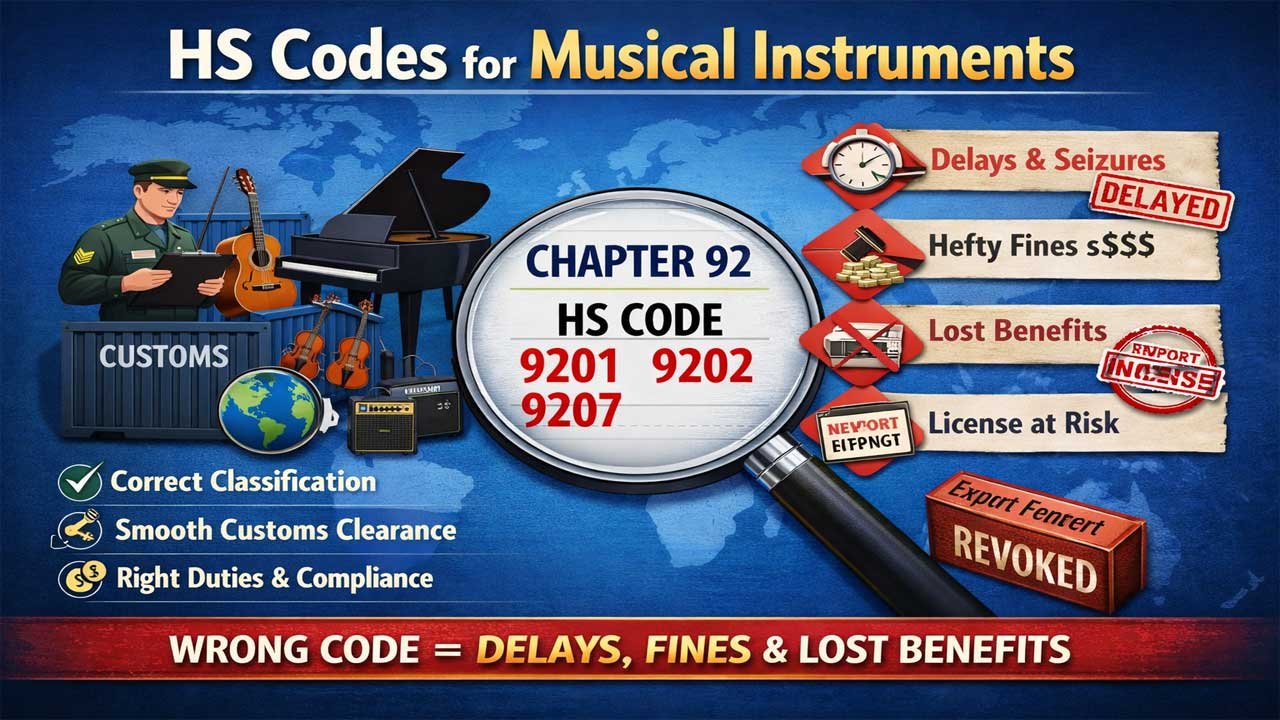
The HS Code is important for your business. It is a special number system. This system classifies musical instruments globally. Every musical instrument has its own code. The code helps customs officials identify your products.
HS stands for Harmonized System. It was created by the World Customs Organization. Over 200 countries use this system. The system makes international trade smooth. It reduces delays at customs. It helps calculate the correct duties on your goods.
Why Does Your Business Need the Correct HS Code?
Using the wrong HS code is very costly. A single mistake can cost you thousands of dollars. Penalties can reach twice the amount of lost duties. Some cases result in fines of $10,000 or more per violation.
Your business needs the correct code. It avoids customs delays. It prevents unexpected charges. It protects your import-export license. It helps you claim export benefits. It keeps your business compliant with regulations.
Chapter 92: Musical Instruments Classification
Chapter 92 is where all musical instruments live. This chapter covers instruments from pianos to guitars. It includes parts and accessories too.
The chapter has nine main headings. Each heading covers different types of instruments. Let me explain each one for you.
HS Code 9201: Pianos and Keyboard Stringed Instruments
Pianos fall under heading 9201. This includes automatic pianos. It includes harpsichords too. Other keyboard stringed instruments go here as well.
The code breaks down further:
- 92011000: Upright pianos
- 92012000: Grand pianos
- 92019000: Other types of pianos
HS Code 9202: String Instruments
Guitars and violins go under heading 9202. This includes all string instruments. Harps also fall in this category.
The subheadings are:
- 92021000: Instruments played with a bow
- 92029000: Other string instruments
HS Code 9203: Keyboard Organs
This heading covers keyboard pipe organs. Harmoniums fall here too. Similar keyboard instruments with free metal reeds go under this code.
HS Code 9204: Accordions and Mouth Organs
Accordions and similar instruments have their own code. Mouth organs are classified here. These instruments have unique construction. They deserve their own classification.
HS Code 9205: Wind Instruments
Wind instruments like clarinets go under 9205. Trumpets and bagpipes are classified here. Brass-wind instruments have a subheading: 92051000. Other wind instruments have: 92059000.
Some popular sub-codes are:
- 92059010: Flutes
- 92059020: Clarinets
- 92059090: Other wind instruments
HS Code 9206: Percussion Instruments
Drums and xylophones fall under heading 9206. Cymbals and castanets are classified here. Maracas and other percussion instruments go here too.
The code is: 92060000. This single code covers all percussion instruments.
HS Code 9207: Electric Musical Instruments
Electric guitars and electric organs get special treatment. Heading 9207 covers all electrically amplified instruments. Any instrument with electric sound production goes here.
The subheadings are:
- 92071000: Keyboard instruments (not accordions)
- 92079000: Other electric instruments
HS Code 9208: Musical Boxes and Mechanical Instruments
Musical boxes have their own heading. Fairground organs fall here too. Mechanical singing birds are classified under 9208.
The codes are:
- 92081000: Musical boxes
- 92089000: Other mechanical instruments
HS Code 9209: Parts and Accessories
Parts of instruments get classified under 9209. Accessories like strings go here. Metronomes and tuning forks are classified under this heading too.
Popular sub-codes include:
- 92093000: Musical instrument strings
- 92099100: Parts for pianos
- 92099200: Parts for string instruments
- 92099400: Parts for electric instruments
- 92099900: Other parts and accessories
How To Find The Correct HS Code For Your Product
Finding the right code is a critical business decision. A wrong code can lead to serious consequences. Let me show you the proper steps.
Step 1: Identify Your Product Category
First, you must identify your product. Is it a piano or a guitar? Is it a drum or a flute? Write down the exact product name. Include all details about construction.
Step 2: Check For Electrical Amplification
Does your instrument need electricity? Electric guitars go under 9207. Acoustic guitars go under 9202. This detail is very important.
Step 3: Use Official Classification Tools
India provides free tools for HS code search. The Indian Trade Portal helps you find codes. ICEGATE is another official resource.
The World Customs Organization database is reliable too. The CBIC official HSN classification helps as well.
Step 4: Verify With Your Customs Broker
Never rely on guesses for HS codes. Your customs clearance agent knows the rules well. Your freight forwarder has proper expertise. They can prevent costly mistakes. Professional verification takes time but saves money.
Common Mistakes In HS Code Classification
Mistake 1: Misclassifying Electric Instruments
Many traders make this error. They classify electric guitars as 9202. But the correct code is 9207. The difference matters for duties. The difference affects export benefits too.
Mistake 2: Wrong Classification of Parts
Instrument parts often get misclassified. A guitar neck should not go with pianos. Drum heads should not go with strings. Each part has its specific code under 9209.
Mistake 3: Treating Accessories as Instrument Codes
Amplifiers do not go under Chapter 92. Microphones belong to Chapter 85. Instrument stands go to Chapter 94. This distinction is legally binding.
Mistake 4: Ignoring Country-Specific Codes
India uses 8-digit codes. The USA uses 10-digit codes. China has its own system too. Always verify your importing country’s system.
What Are The Penalties For Wrong Classification?
Financial Penalties
Wrong classification results in monetary fines. Penalties can be 0.5 to 8 times the lost duties.
If your business imports \$10,000 worth of instruments with 10% duty loss, the penalty starts at \$500. But it can reach \$4,000 or more depending on negligence.
Shipment Delays
Customs will hold your shipment. This creates serious business disruptions. You lose sales opportunities. You damage customer relationships.
Loss of Import Benefits
Correct HS codes unlock export incentives. Wrong codes block these benefits. You lose potential tax refunds. You lose preferential trading benefits.
Revoked Import Privileges
Serious repeat violations have severe consequences. Your company’s import-export license may be suspended. In worst cases, it can be permanently revoked.
GST Rates For Musical Instruments In India
In India, GST applies to musical instruments. Different instruments have different rates. Let me explain the current structure.
Most musical instruments attract 5% GST in India.
Some instruments in Chapter 92 have specific rates:
- Pianos: Check with your tax advisor
- String instruments: Standard rates apply
- Wind instruments: Standard rates apply
- Percussion: Standard rates apply
- Electric instruments: Standard rates apply
GST varies based on final product classification. Always check with your GST compliance expert. This ensures your business stays compliant with tax law.
Import-Export License Requirements
What Is An IEC License?
An IEC is the Import-Export Code. This is a 10-digit code given by DGFT. DGFT stands for Directorate General of Foreign Trade.
You cannot legally import or export without an IEC. It is mandatory for all commercial traders. It takes just 1-2 days to get it.
How Much Does IEC Cost?
The government fee is very simple: ₹500 only.
But you may need professional help. Professional fees range from ₹2,000 to ₹5,000. Total cost: ₹2,500 to ₹5,500 approximately.
What Documents Do You Need?
You need very simple documents:
- PAN Card
- Aadhaar Card
- Bank account details
- Business address
- Email and phone number
That is all! No office visit is needed. The entire process is done online.
Customs Clearance Charges For Musical Instruments
When you import musical instruments, you pay customs charges. Let me break down the costs for you.
India Customs Clearance Costs
India charges a 1% customs handling fee on import value. This applies to all imports. No exceptions exist.
For example: You import instruments worth ₹1,00,000.
- Customs handling fee: ₹1,000 (1%)
- Plus import duties (varies by product)
- Plus GST on the total
- Plus broker fees: ₹2,000-₹5,000
Total charges can be significant. Plan accordingly in your business budget.
USA Customs Clearance Costs
The USA charges a Merchandise Processing Fee (MPF). The rate is 0.3464% of the entered value.
Minimum fee: $31.67
Maximum fee: $651.50
For a $100,000 shipment: $346.40 MPF
Plus additional fees:
- Documentation fees: $50-$200
- Inspection fees: varies
- Broker fees: $15-$50
Additional Charges You Will Encounter
- Port handling charges: Cover cargo handling
- Inspection fees: If customs examines your goods
- Storage fees: If goods stay in warehouse
- Documentation fees: For certificate, forms, permits
- Broker brokerage fees: For professional clearance service
How To Classify Musical Instrument Accessories
Accessories need special care. Many accessories do not go under Chapter 92. This confuses many traders.
What Goes Under Chapter 92?
Only specific items stay under Chapter 92:
- Musical instrument strings: Code 92093000
- Parts of pianos: Code 92099100
- Parts of string instruments: Code 92099200
- Parts of electric instruments: Code 92099400
- Mechanisms for musical boxes: Goes under 9209
What Does NOT Go Under Chapter 92?
Many items are NOT classified in Chapter 92:
- Amplifiers: Chapter 85 (electrical machinery)
- Microphones: Chapter 85
- Instrument stands: Chapter 94 (furniture)
- Headphones: Chapter 85
- Cables and connectors: Chapter 85
- Cases and gig bags: Chapter 42 (leather goods)
Wrong classification of these items is very common. This leads to penalties. Ensure your customs broker classifies correctly.
HS Code Classification Rules You Must Know
General Interpretative Rule 1 (GIR 1)
Classify goods directly under the heading text. Most products fit here perfectly. Simple classification is always best.
General Interpretative Rule 2 (GIR 2)
Use this rule only if GIR 1 fails. It applies to incomplete, unfinished, or unassembled goods. It covers mixture of materials too.
General Interpretative Rule 3 (GIR 3)
Use the most specific description available. If multiple descriptions fit, choose the most detailed one. This rule has three parts (a, b, c).
General Interpretative Rule 5
Packing materials stay with the goods. But reusable containers are excluded. For example: shipping foam stays with instruments.
A Real Example: Electric Guitar Classification
Let me show you a practical example. This helps you understand the classification process.
Your product: Electric guitar with amplifier
Step 1: Identify the main product
The main product is the electric guitar itself.
Step 2: Check for electrical feature
Yes. It needs electricity to produce sound.
Step 3: Find the heading
Heading 9207 covers electrically amplified instruments.
Step 4: Choose the subheading
Since it is not a keyboard instrument, it goes under 92079000.
Step 5: Add country-specific digits
In India: 92079000 (8 digits total)
In USA: 9207.90.00 (10 digits total)
Step 6: Handle the amplifier separately
The amplifier goes under Chapter 85 (electrical machinery).
Final codes:
- Electric guitar: 92079000
- Amplifier: 8518 (sound amplifying apparatus)
Trade Compliance: Avoiding Violations
What Is A Classification Violation?
A violation occurs when you use the wrong HS code. CBP (U.S. Customs and Border Protection) enforces the rules. This leads to official penalties.
Culpability Levels
The penalty depends on your fault level:
- Negligence: Unintentional mistake. Penalty: 0.5x to 2x lost duties.
- Gross Negligence: Major oversight. Penalty: 4x to 8x lost duties.
- Fraud: Intentional deception. Penalty: Full domestic value of goods.
How To Stay Compliant
- Use official tools: Indian Trade Portal, ICEGATE
- Hire professionals: Use customs brokers with experience
- Keep records: Document your classification research
- Update regularly: Laws change frequently
- Double-check everything: Verification prevents problems
Chapter 92 GST Rates In India
The Government of India sets GST rates for Chapter 92 products. These rates apply uniformly across the country.
Most instruments fall under 5% GST rate. But rates can vary based on:
- Product specification
- Material composition
- Manufacturing process
- Final end-use classification
Always verify with your tax accountant. GST compliance is critical for your business. Wrong GST rates trigger penalties too.
Key Takeaways For Your Business
Point 1: Chapter 92 covers all musical instruments. Heading 9201 to 9209 classify different types.
Point 2: Use official classification tools. Never guess. Wrong codes are expensive.
Point 3: Electric instruments need different codes than acoustic instruments.
Point 4: Accessories often belong to different chapters. Verify each item.
Point 5: Hire a customs broker to verify your classification. Prevention is cheaper than penalties.
Point 6: IEC license costs just ₹500 government fee plus professional fees.
Point 7: Customs clearance costs add 1-3% to your import value in India.
Point 8: Single classification error can cost thousands in fines.
Point 9: Keep your IEC current and valid. It is your most important business document.
Point 10: Always work with experienced professionals. The import-export business demands expertise and precision.
How This Affects Your Bottom Line
Using the correct HS code saves money. It prevents delays that hurt sales. It protects your import-export license. It helps you claim rightful export benefits.
A wrong HS code costs thousands. Penalties eat profits quickly. Delays damage customer relationships. Lost benefits reduce competitiveness.
Your business depends on getting this right. Invest in proper classification. Hire experienced customs brokers. Verify everything with official tools.
The cost of getting it right is minimal. The cost of getting it wrong is devastating.


