
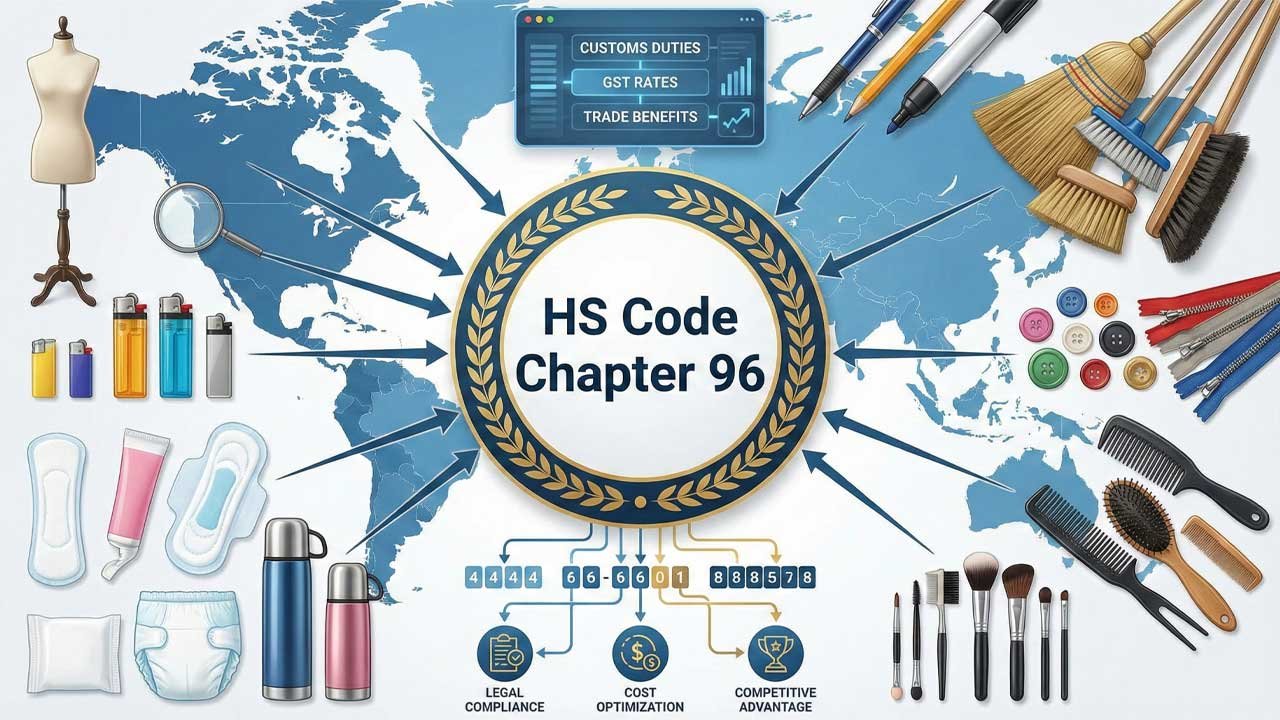
What is HS Code Chapter 96?
HS Code Chapter 96 is the classification system for miscellaneous manufactured articles. It is the final chapter in the Harmonized System of tariff codes. This chapter covers products that do not fit into chapters 1 through 95.
The HS Code 96 is used for international trade classification. It helps determine customs duties on import and export. It also impacts GST rates in India. Understanding HS Code 96 is essential for importers and exporters.
Why Does HS Code 96 Matter?
Proper classification under HS Code 96 ensures correct duty payment. Wrong classification can lead to penalties. It affects your import-export compliance. It impacts your overall cost structure. Business insurance for trade often depends on product classification.
HS Code 96 Structure and Organization
HS Code Chapter 96 contains 19 main headings. Each heading covers a specific product category. The codes range from 9601 to 9619.
The structure follows this pattern:
- 4-digit code = Heading (primary classification)
- 6-digit code = Sub-heading (sub-classification)
- 8-digit code = Tariff Item (final tariff rate applied)
Understanding the Coding System
The coding system uses dashes for clarity. A single dash shows primary classification. Double dashes indicate sub-classification. This system helps with accurate product identification.
The tariff structure includes five columns. These columns show tariff item, goods description, unit, standard duty rate, and preferential area rates. This format makes tariff classification easier for traders.
Major Categories Under HS Code 96
9601: Worked Animal Carving Materials
This heading covers articles made from animal materials. Examples include worked ivory and bone. Tortoise-shell articles fall under this code. Horn, antlers, and coral items are included.
Mother-of-pearl articles are classified here. These items must be worked or carved. Raw animal materials are excluded from this classification.
Import and Export Implications
Many countries restrict animal material imports due to conservation laws. CITES regulations apply to ivory and tortoise-shell. Custom tariff rates vary by country. Compliance is mandatory for legal import-export operations.
9602: Worked Vegetable and Mineral Carving Materials
This code covers vegetable carving materials. Mineral carving materials are included. Wax articles fall under this classification.
Products made from natural gums and resins are included. Modeling paste articles are covered. Worked amber and unhardened gelatin articles are classified here.
Gelatin capsules for pharmaceuticals fall under 9602.00.10. Artificial honeycombs are also in this category. These products have different tariff rates and duties.
9603: Brooms, Brushes, and Cleaning Equipment
This is one of the most commercially important headings. Brooms made from twigs and vegetable materials are included. Traditional broom bristles fall under this code.
Paint brushes are classified here. Mops and feather dusters are covered. Hand-operated floor sweepers are included. Paint pads and rollers are classified under 9603.
Prepared knots and tufts for brush making are in this category. Paint roller frames and handles are covered. Squeegees fall under this heading.
Market Opportunities
The broom and brush market is significant. Manufacturers supply cleaning companies continuously. Painters need replacement brushes regularly. This creates recurring demand.
Tariff classifications affect pricing. Lower tariff rates increase competitiveness. Understanding applicable duties helps with pricing strategy. Import-export cost calculation is essential for profitability.
9604: Hand Sieves and Hand Riddles
Hand sieves are mechanical separation tools. Hand riddles are similar devices. These tools have industrial applications. Food processing uses these products.
Mining and agriculture rely on hand sieves. Flour milling industry uses hand riddles. Laboratory applications require these items. These are niche products with specific markets.
9605: Travel Sets for Personal Use
Travel sets for personal toilet are included. Sewing travel sets fall under this code. Shoe cleaning sets are classified here. Clothes cleaning travel sets are included.
These are convenience products for travelers. Hotels and tourism industries purchase these items. Airlines include these in amenity kits. These products have consistent demand from hospitality sectors.
9606: Buttons and Fasteners
Buttons made from various materials are covered. Press-fasteners and snap-fasteners are included. Button molds and component parts are classified here. Button blanks are in this category.
The garment industry uses these products extensively. Fashion designers source quality buttons. Cost of buttons affects garment pricing. Import-export of fasteners is a competitive market.
9607: Slide Fasteners (Zippers)
Zippers are essential textile components. Slide fasteners include zipper teeth and sliders. Component parts of zippers are classified here. Zipper repair parts are covered.
The textile and apparel industry relies on zippers. High-quality zippers improve product value. Zipper classification affects tariff costs. Understanding applicable duties is crucial for manufacturers.
9608: Writing Instruments
Ball point pens fall under this heading. Felt-tipped and porous-tipped pens are included. Fountain pens are classified here. Stylograph pens and marker pens are covered.
Pen holders and pencil holders are classified in 9608. Propelling and sliding pencils are included. Parts like caps and clips are covered. This is a high-volume commercial category.
Stationary Industry Importance
The stationery industry is substantial globally. Schools and offices buy pens continuously. Corporate gifting includes branded pens. Pen manufacturing is an established industry.
Tariff rates affect pricing competitiveness. Pen parts sourcing from different countries requires knowledge of tariff codes. GST rates in India vary by pen type. Compliance ensures smooth operations.
9609: Pencils, Crayons, and Drawing Materials
Pencils are basic writing instruments. Colored pencils and crayons are included. Pencil leads and pastels fall under this code. Drawing charcoals are classified here.
Chalks for writing and tailoring are included. Pastels for art are covered. Sketch materials fall under 9609. These products have educational and commercial applications.
9610: Writing and Drawing Surfaces
Slates and boards with writing surfaces are included. Framed and unframed boards are covered. Whiteboards fall under this classification. Chalkboards are included.
Educational institutions use these products. Offices rely on writing surfaces. Retail stores use display boards. These products have diverse applications.
9611: Stamps and Printing Devices
Date stamps and sealing stamps are covered. Numbering stamps are classified here. Hand-operated printing devices are included. Embossing label devices fall under this code.
Composing sticks and hand printing sets are covered. Office operations depend on stamps. Legal documents require proper sealing. Customs and compliance use official stamps.
9612: Typewriter Ribbons and Ink Pads
Typewriter ribbons are classified here. Ink-pads are included in this heading. Spools and cartridges for ribbons are covered. Ribbon inked preparations are included.
Though typewriters are less common, ribbon demand persists. Old machines still operate in some offices. Refurbished typewriter markets exist. Ink-pad demand remains stable.
9613: Cigarette Lighters
This heading covers gas-fueled lighters. Mechanical and electrical lighters are included. Lighter parts (excluding flints and wicks) are covered. Refillable pocket lighters are classified here.
Lighter manufacturing is a global industry. Lighter design varies significantly. Safety regulations affect lighter classification. Import duties impact retail pricing.
9614: Smoking Pipes and Cigar Holders
Smoking pipes including pipe bowls are covered. Cigar and cigarette holders are classified here. Replacement parts are included. Decorative smoking accessories fall under 9614.
The smoking accessories market has niche demand. Premium pipes attract higher tariff rates. Customized holders command premium pricing. Artisan-made pipes have specific classifications.
9615: Combs and Hair Accessories
Combs made from various materials are included. Hair-slides and hairpins fall under 9614. Curling pins and curling grips are covered. Hair-curlers and parts are classified here.
The beauty and personal care industry relies on these products. Hair salons purchase these items regularly. Retail demand is continuous. Fashion trends affect product styles.
9616: Toilet Sprays and Cosmetic Application Tools
Scent sprays and toilet sprays are covered. Spray mounts and heads are included. Powder-puffs are classified here. Cosmetic application pads are covered.
The beauty and personal care industry heavily uses these items. Cosmetic companies include these in product lines. Retail beauty stores stock these items. Consumer demand is consistent year-round.
9617: Vacuum Flasks and Thermal Vessels
Vacuum flasks with protective cases are included. Vacuum vessels for thermal insulation are covered. Parts of vacuum vessels are classified here. Glass inner components have separate codes.
The home and office market for vacuum flasks is substantial. Travel and outdoor activities drive demand. Hotels and restaurants purchase thermal vessels. Quality variants command premium tariff rates.
9618: Tailors’ Dummies and Display Automata
Tailors’ dummies for clothing fitting are covered. Lay figures for art and design are included. Automata for shop window displays are classified here. Animated display figures fall under this code.
Fashion industry uses tailors’ dummies extensively. Retail stores display products on dummies. Art studios use lay figures. Window displays enhance retail appeal. These products have specialized markets.
9619: Sanitary Products and Baby Articles
Sanitary towels and pads are classified here. Tampons fall under 9619. Baby napkins and diaper liners are covered. Clinical diapers are included.
This is a high-volume consumer product category. Recurring purchase patterns ensure stable demand. Feminine hygiene products require consistent supply. Baby care is an essential market segment.
Market Size and Growth
The sanitary products market grows annually. Developing countries increase consumption rates. Premium product variants command higher prices. Health consciousness drives market expansion. Feminine hygiene is a necessity product with stable demand.
Understanding HS Code 96 Tariff Rates and Duties
Basic Customs Duty
Basic customs duty varies by specific item. Some items have 5% duty. Others are charged at 10% or 12%. Writing instruments may have higher rates.
The duty is calculated on the assessed value of goods. Correct valuation is essential for compliance. Undervaluation can trigger penalties. Professional valuation ensures legal compliance.
IGST and Additional Duties
IGST (Integrated Goods and Services Tax) applies on top of customs duty. IGST rates range from 5% to 28%. The rate depends on the specific item classification.
Additional duties may apply to specific goods. SWS (Special Additional Duty) is calculated on basic duty. Compensation Cess applies to certain products. Total duty calculation includes all components.
Preferential Area Rates
Imports from specific countries enjoy preferential rates. Myanmar, Bangladesh, Mauritius, and Nepal have preferential rates. These rates are lower than standard rates. Trade agreements determine preferential status.
Understanding preferential rates is important for import cost optimization. Sourcing from preferential countries reduces tariff burden. Documentation proving country of origin is mandatory. Preferential rates significantly impact profitability.
Duty Calculation Example
Assume goods assessed value is Rs. 100:
- Basic Duty at 7.5% = Rs. 7.50
- SWS at 10% of basic duty = Rs. 0.75
- IGST at 18% of (basic + SWS) = Rs. 1.485
- Total Duty = Rs. 9.735
This calculation method applies to Chapter 96 items. Accurate calculation ensures compliance. Errors can result in penalties. Professional assistance is recommended.
GST Rates for HS Code 96 Items in India
GST rates vary by specific product classification. Writing instruments typically attract 18% GST. Some items have 12% GST rate. Essential items like sanitary products may have 5% or 0% GST.
Correct GST classification is mandatory in India. Wrong classification triggers compliance issues. Input tax credit depends on accurate classification. Proper documentation prevents disputes with tax authorities.
GST Rate Categories
0% GST Items:
- Certain essential products
- Some basic stationery items
- Specific health-related items
5% GST Items:
- Sanitary napkins and pads
- Baby diapers
- Tampons
- Travel sets
12% GST Items:
- Certain writing instruments
- Specific cosmetic application tools
- Some travel-related items
18% GST Items:
- High-end writing instruments
- Premium combs and hair accessories
- Quality smoking pipes
- Designer stationery items
How to Classify Your Products Under HS Code 96
Step 1: Identify the Primary Function
First, determine the main purpose of your product. Is it a writing instrument or cleaning tool? Is it a personal care item or office equipment?
The primary function guides initial classification. Section Notes and Chapter Notes provide context. General Interpretative Rules (GIR) help with ambiguous cases.
Step 2: Check Section and Chapter Notes
Read Section 20 notes covering chapters 94-96. Chapter 96 notes explain specific exclusions. These notes prevent misclassification.
Notes specify what products are NOT included in certain headings. These clarifications are legally binding. Ignoring notes can result in incorrect classification.
Step 3: Examine Tariff Headings
Compare your product with each heading description. Select the heading that best matches your product. Sub-headings provide further specificity.
The 6-digit sub-heading code refines classification. The 8-digit tariff item code determines the final duty rate. Each level adds specificity.
Step 4: Consider Material Composition
Material composition affects classification in many cases. A pen made from plastic differs from one made from gold. Material impacts the tariff rate.
Natural materials may have different classification than synthetic ones. Examination of material samples may be necessary. Material testing ensures accurate classification.
Step 5: Review General Interpretative Rules
GIR provides specific rules for classification when Section and Chapter notes don’t clarify. GIR Rule 1 emphasizes titles are for reference only. Rules are applied sequentially for classification.
GIR Rule 3 provides guidance for partly finished products. The most advanced stage of manufacture determines classification. Understanding these rules prevents costly errors.
Step 6: Consult Professional Assistance
Customs brokers and classification experts provide professional guidance. Their expertise ensures accurate classification. Professional assistance saves money in the long run.
Misclassification penalties can be substantial. Legal compliance is essential for business operations. Professional advice is a worthwhile investment.
Common Mistakes in HS Code 96 Classification
Mistake 1: Ignoring Material Composition
Many importers overlook material differences. Plastic combs differ from wooden combs. The material significantly affects classification.
Material composition must be verified before classification. Sample examination prevents misclassification. Physical inspection is sometimes necessary.
Mistake 2: Confusing Similar Products
Some products seem identical but have different purposes. Classification depends on intended use. A sharpened pencil differs from a pencil lead.
Intended use determines classification in ambiguous cases. Written intent documentation strengthens your position. Manufacturer specifications clarify product purpose.
Mistake 3: Missing Updated Tariff Codes
Tariff codes change periodically with amendments. Outdated information leads to wrong classification. Regular tariff updates are necessary.
Government notifications update tariff rates regularly. Online databases provide current information. Customs authorities maintain official code lists. Staying updated prevents classification errors.
Mistake 4: Incorrect Value Assessment
Product value affects duty calculation significantly. Undervaluation is a serious compliance violation. Penalties for undervaluation are severe.
Professional appraisers ensure correct valuation. International valuation standards apply. Fair market value determination is essential. Documentation supports proper valuation.
Mistake 5: Ignoring Origin Country Requirements
Origin of goods affects preferential rates. Documentation proving origin is mandatory. Customs authorities verify origin details.
Certificate of Origin is required for preferential rates. Falsifying origin is a serious offense. Proper documentation ensures compliance.
Benefits of Correct HS Code Classification
Cost Savings
Accurate classification determines duty rates. Lower applicable rates reduce import costs. Cost savings improve profit margins significantly.
Preferential area sourcing reduces tariff burden. Correct classification helps identify cheaper sourcing options. Strategic sourcing decisions depend on tariff knowledge.
Compliance and Risk Management
Correct classification ensures legal compliance. Avoiding penalties protects your business reputation. Regulatory compliance builds customer trust.
Proper documentation prevents customs delays. Smooth customs clearance accelerates delivery. Business operations run smoothly with compliance.
Competitive Advantage
Knowledge of tariff rates provides competitive advantage. Duty optimization reduces product cost. Lower costs enable competitive pricing.
Correct classification demonstrates professionalism. Customers trust compliant businesses. Reputation for compliance attracts quality customers.
Supply Chain Optimization
Understanding tariff structures optimizes supply chain decisions. Strategic sourcing reduces overall costs. Supplier selection considers tariff implications.
Inventory management benefits from tariff knowledge. Procurement timing can optimize duty benefits. Seasonal tariff variations affect purchasing decisions.
Recent Changes and Updates to HS Code 96
Tariff schedules are updated regularly. New products require new classifications. Technological advancement drives classification changes.
Government notifications announce tariff amendments. Online resources provide real-time updates. Customs authorities maintain official information. Regular monitoring ensures compliance with current rules.
2024-2025 Notable Updates:
Several items have seen tariff modifications. Writing instrument classifications were refined. Sanitary product categories underwent review. Electronic components in lighters required reclassification.
Premium products sometimes face higher rates. Basic items enjoy lower tariff protection. Economic policies influence tariff decisions. Trade agreements affect preferential rates.
Practical Examples of HS Code 96 Classification
Example 1: Ballpoint Pens
You manufacture plastic ballpoint pens with refillable cartridges.
Classification Process:
- Primary function: Writing instrument (indicates heading 9608)
- Material: Plastic body, metal tip assembly
- Sub-classification: Ball point pens of plastic
- 8-digit code: 96089099 (other ball point pens)
- Applicable duty: 18% GST in India
Example 2: Natural Hair Brushes
You import natural bristle brushes from China.
Classification Process:
- Primary function: Hair grooming tool (indicates heading 9615)
- Material: Natural bristles, wooden handle
- Sub-classification: Combs and brushes of natural material
- 8-digit code: 96159000 (other combs and brushes)
- Applicable duty: 12% GST + basic customs duty
Example 3: Sanitary Pads
You manufacture sanitary pads for the Indian market.
Classification Process:
- Primary function: Personal hygiene product (indicates heading 9619)
- Material: Cotton absorbent layer, plastic backing
- Sub-classification: Sanitary napkins
- 8-digit code: 96190010 (sanitary towels and napkins)
- Applicable duty: 0% or 5% GST in India (essential product)
Example 4: Cigarette Lighter
You import refillable gas lighters from Taiwan.
Classification Process:
- Primary function: Ignition device (indicates heading 9613)
- Type: Gas-fueled, refillable
- Sub-classification: Pocket lighters, gas-fueled
- 8-digit code: 9613.20.00 (pocket lighters, gas-fueled, refillable)
- Applicable duty: Varies by country, approximately 20-25% in many countries
Conclusion
HS Code Chapter 96 covers diverse miscellaneous manufactured articles. Correct classification is essential for import-export operations. Understanding tariff structures ensures compliance and cost optimization.
The 19 headings under Chapter 96 cover everything from writing instruments to sanitary products. Each heading has specific sub-classifications. Proper documentation prevents costly compliance issues.
Professional guidance ensures accurate classification. Regular updates keep your knowledge current. Investment in proper classification pays dividends. Business success depends on regulatory compliance.
Importers and exporters should maintain updated tariff information. Professional classification experts provide valuable assistance. Correct classification optimizes costs and ensures compliance. Regular audits of classification practices ensure ongoing accuracy.
For businesses involved in manufacturing, importing, or exporting goods falling under HS Code 96, accuracy in classification is not just a regulatory requirement—it is a fundamental business practice. Taking time to properly classify products, understand applicable tariff rates, and maintain complete documentation ensures smooth operations, reduces risks, and optimizes profitability.


